



Blockchain — What it Is and What it Could Be
for Financial Services
...the global economy moves, on average,
$5.1 trillion every day.
The gears of the financial system behind
this jaw-dropping number are too often
reliant upon aging infrastructure and
third-party intermediaries that:
require manual reconciliation
add cost
provide opportunities for fraud
According to the International Monetary Fund (IMF)...
$5.1
trillion
Could blockchain technology be the answer to
improving the efficiency of clearing and settlement?
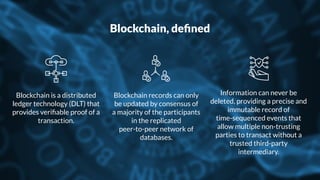
Blockchain is a distributed
ledger technology (DLT) that
provides verifiable proof of a
transaction.
Blockchain records can only
be updated by consensus of
a majority of the participants
in the replicated
peer-to-peer network of
databases.
Information can never be
deleted, providing a precise and
immutable record of
time-sequenced events that
allow multiple non-trusting
parties to transact without a
trusted third-party
intermediary.
Blockchain, defined
Bitcoin’s volatility and its reputation as a
vehicle for unregulated transactions are
precisely the reasons why it is so important
to differentiate the technology on which
bitcoin is built from the cryptocurrency.
For the financial services industry to
carefully consider investments in blockchain
technology, it must be decoupled from the
singular use of bitcoin.
Blockchain is a lot more than bitcoin.
Public or Private Blockchain?
Sets its rules at the very beginning
and has few opportunities for later
changes to be made.
The public blockchain
Permissionless and open to everybody, to both
participate and to read / write new transactions.
Some can be publicly readable, yet limit the trusted
parties allowed to write data to the network.
Can help communities worldwide
share data securely and openly.
Offers high availability,
transparency, trust and decreased
hardware costs.
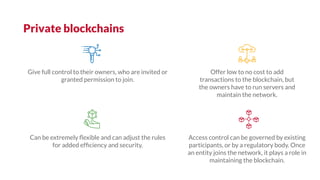
Private blockchains
Access control can be governed by existing
participants, or by a regulatory body. Once
an entity joins the network, it plays a role in
maintaining the blockchain.
Give full control to their owners, who are invited or
granted permission to join.
Offer low to no cost to add
transactions to the blockchain, but
the owners have to run servers and
maintain the network.
Can be extremely flexible and can adjust the rules
for added efficiency and security.
There is a special kind of private
blockchain called a “Consortium”.
Consortia have become a popular
means for enterprises to work
together on blockchain technology.
Blockchain Consortia
Business-focused consortia build
and operate blockchain-based
platforms to solve specific
business problems.
Technology-focused consortia
come together to create
technical standards and reusable
blockchain platforms.
Blockchain consortia can be either business-focused
or technology-focused.
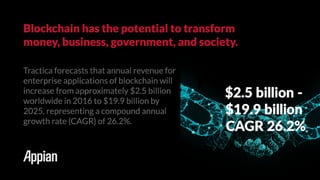
Tractica forecasts that annual revenue for
enterprise applications of blockchain will
increase from approximately $2.5 billion
worldwide in 2016 to $19.9 billion by
2025, representing a compound annual
growth rate (CAGR) of 26.2%.
Blockchain has the potential to transform
money, business, government, and society.
$2.5 billion -
$19.9 billion
CAGR 26.2%
Learn More
www.appian.com/finserv
facebook.com/AppianCorporation
linkedin.com/company/appian-corporation
youtube.com/user/appian
twitter.com/appian
instagram.com/appiancorp

Blockchain 101 for Financial Services

  • 1.
    Blockchain — Whatit Is and What it Could Be for Financial Services
  • 2.
    ...the global economymoves, on average, $5.1 trillion every day. The gears of the financial system behind this jaw-dropping number are too often reliant upon aging infrastructure and third-party intermediaries that: require manual reconciliation add cost provide opportunities for fraud According to the International Monetary Fund (IMF)... $5.1 trillion
  • 3.
    Could blockchain technologybe the answer to improving the efficiency of clearing and settlement?
  • 4.
    Blockchain is adistributed ledger technology (DLT) that provides verifiable proof of a transaction. Blockchain records can only be updated by consensus of a majority of the participants in the replicated peer-to-peer network of databases. Information can never be deleted, providing a precise and immutable record of time-sequenced events that allow multiple non-trusting parties to transact without a trusted third-party intermediary. Blockchain, defined
  • 5.
    Bitcoin’s volatility andits reputation as a vehicle for unregulated transactions are precisely the reasons why it is so important to differentiate the technology on which bitcoin is built from the cryptocurrency. For the financial services industry to carefully consider investments in blockchain technology, it must be decoupled from the singular use of bitcoin. Blockchain is a lot more than bitcoin.
  • 6.
    Public or PrivateBlockchain?
  • 7.
    Sets its rulesat the very beginning and has few opportunities for later changes to be made. The public blockchain Permissionless and open to everybody, to both participate and to read / write new transactions. Some can be publicly readable, yet limit the trusted parties allowed to write data to the network. Can help communities worldwide share data securely and openly. Offers high availability, transparency, trust and decreased hardware costs.
  • 8.
    Private blockchains Access controlcan be governed by existing participants, or by a regulatory body. Once an entity joins the network, it plays a role in maintaining the blockchain. Give full control to their owners, who are invited or granted permission to join. Offer low to no cost to add transactions to the blockchain, but the owners have to run servers and maintain the network. Can be extremely flexible and can adjust the rules for added efficiency and security.
  • 9.
    There is aspecial kind of private blockchain called a “Consortium”. Consortia have become a popular means for enterprises to work together on blockchain technology. Blockchain Consortia
  • 10.
    Business-focused consortia build andoperate blockchain-based platforms to solve specific business problems. Technology-focused consortia come together to create technical standards and reusable blockchain platforms. Blockchain consortia can be either business-focused or technology-focused.
  • 11.
    Tractica forecasts thatannual revenue for enterprise applications of blockchain will increase from approximately $2.5 billion worldwide in 2016 to $19.9 billion by 2025, representing a compound annual growth rate (CAGR) of 26.2%. Blockchain has the potential to transform money, business, government, and society. $2.5 billion - $19.9 billion CAGR 26.2%
  • 12.