Blockchain Explained
An Introduction to Blockchain for Business
V5.20, 24 September 2019
Blockchain Explained Series
Blockchain Explained
IBM Blockchain Platform Explained
Solutions Explained
Labs Explained
What’s New
IBM Blockchain Usage Patterns
What is Blockchain?
How can IBM help?
Example networks
3
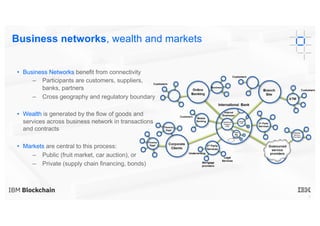
Business networks, wealth and markets
• Business Networks benefit from connectivity
– Participants are customers, suppliers,
banks, partners
– Cross geography and regulatory boundary
• Wealth is generated by the flow of goods and
services across business network in transactions
and contracts
• Markets are central to this process:
– Public (fruit market, car auction), or
– Private (supply chain financing, bonds)
4
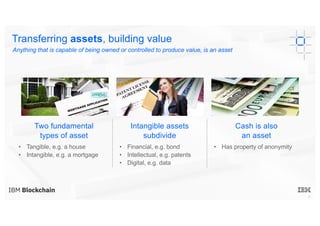
Transferring assets, building value
Anything that is capable of being owned or controlled to produce value, is an asset
Two fundamental
types of asset
Intangible assets
subdivide
Cash is also
an asset
• Tangible, e.g. a house
• Intangible, e.g. a mortgage
• Financial, e.g. bond
• Intellectual, e.g. patents
• Digital, e.g. data
• Has property of anonymity
5
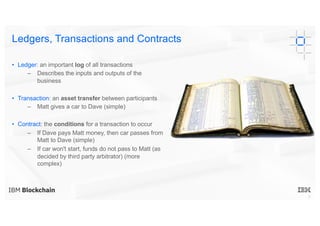
Ledgers, Transactions and Contracts
• Ledger: an important log of all transactions
– Describes the inputs and outputs of the
business
• Transaction: an asset transfer between participants
– Matt gives a car to Dave (simple)
• Contract: the conditions for a transaction to occur
– If Dave pays Matt money, then car passes from
Matt to Dave (simple)
– If car won't start, funds do not pass to Matt (as
decided by third party arbitrator) (more
complex)
6
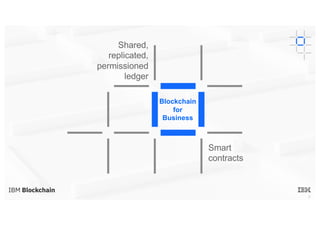
Blockchain
for
Business
Shared,
replicated,
permissioned
ledger
Smart
contracts
7
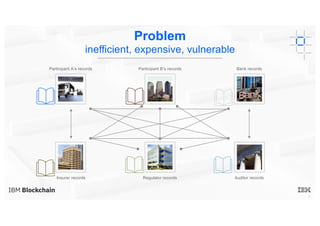
Problem
inefficient, expensive, vulnerable
Participant A’s records Participant B’s records Bank records
Insurer records Regulator records Auditor records
8
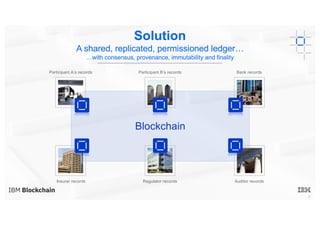
Blockchain
Participant A’s records Participant B’s records Bank records
Insurer records Regulator records Auditor records
Solution
A shared, replicated, permissioned ledger…
…with consensus, provenance, immutability and finality
9
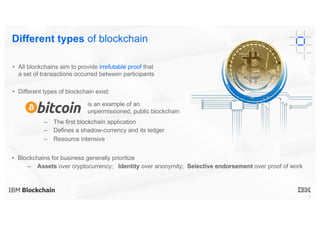
Different types of blockchain
– The first blockchain application
– Defines a shadow-currency and its ledger
– Resource intensive
is an example of an
unpermissioned, public blockchain
• All blockchains aim to provide irrefutable proof that
a set of transactions occurred between participants
• Different types of blockchain exist:
• Blockchains for business generally prioritize
– Assets over cryptocurrency; Identity over anonymity; Selective endorsement over proof of work
10
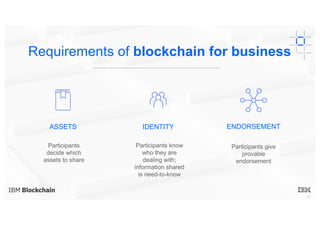
Requirements of blockchain for business
Participants
decide which
assets to share
ASSETS
Participants know
who they are
dealing with;
information shared
is need-to-know
IDENTITY
Participants give
provable
endorsement
ENDORSEMENT
11
Assets
The business network decides what to share on the ledger
• Assets are anything of value
– On the blockchain, these are represented
digitally using a pre-agreed format
• Transactions change the state of an asset and
are provably recorded on the blockchain
– e.g. transfer ownership, change color
• Transactions are underpinned by smart contracts
– Verifiable business rules that cause the
asset to change state
12
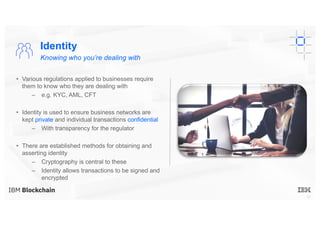
Identity
Knowing who you’re dealing with
• Various regulations applied to businesses require
them to know who they are dealing with
– e.g. KYC, AML, CFT
• Identity is used to ensure business networks are
kept private and individual transactions confidential
– With transparency for the regulator
• There are established methods for obtaining and
asserting identity
– Cryptography is central to these
– Identity allows transactions to be signed and
encrypted
13
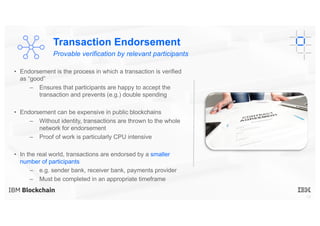
Transaction Endorsement
Provable verification by relevant participants
• Endorsement is the process in which a transaction is verified
as “good”
– Ensures that participants are happy to accept the
transaction and prevents (e.g.) double spending
• Endorsement can be expensive in public blockchains
– Without identity, transactions are thrown to the whole
network for endorsement
– Proof of work is particularly CPU intensive
• In the real world, transactions are endorsed by a smaller
number of participants
– e.g. sender bank, receiver bank, payments provider
– Must be completed in an appropriate timeframe
What is Blockchain?
How can IBM help?
Example networks
15
Trade
Finance
Universal
Payments
Global
Trade
Identity
Healthcare
Bank
Guarantees
Food
Government Distributed
Energy
Clearing &
Settlement
Provenance
Unlisted
Securities
Insurance
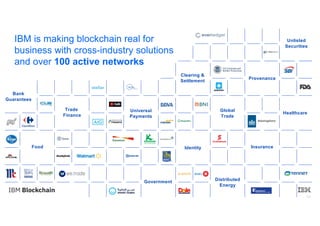
IBM is making blockchain real for
business with cross-industry solutions
and over 100 active networks
16
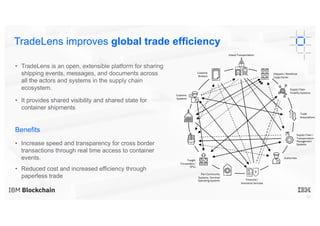
• TradeLens is an open, extensible platform for sharing
shipping events, messages, and documents across
all the actors and systems in the supply chain
ecosystem.
• It provides shared visibility and shared state for
container shipments
Benefits
• Increase speed and transparency for cross border
transactions through real time access to container
events.
• Reduced cost and increased efficiency through
paperless trade
TradeLens improves global trade efficiency
Inland Transportation
Shippers / Beneficial
Cargo Owner
Supply Chain
Visibility Systems
Trade
Associations
Supply Chain /
Transportation
Management
Systems
Authorities
Financial /
Insurance Services
Port Community
Systems; Terminal
Operating Systems
Freight
Forwarders /
3PLs
Customs
Systems
Customs
Brokers
17
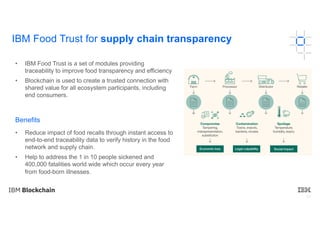
• IBM Food Trust is a set of modules providing
traceability to improve food transparency and efficiency
• Blockchain is used to create a trusted connection with
shared value for all ecosystem participants, including
end consumers.
Benefits
• Reduce impact of food recalls through instant access to
end-to-end traceability data to verify history in the food
network and supply chain.
• Help to address the 1 in 10 people sickened and
400,000 fatalities world wide which occur every year
from food-born illnesses.
IBM Food Trust for supply chain transparency
18
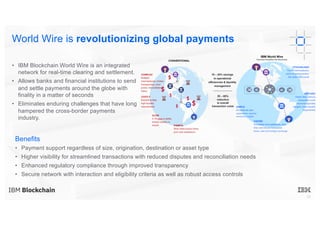
• IBM Blockchain World Wire is an integrated
network for real-time clearing and settlement.
• Allows banks and financial institutions to send
and settle payments around the globe with
finality in a matter of seconds
• Eliminates enduring challenges that have long
hampered the cross-border payments
industry.
World Wire is revolutionizing global payments
Benefits
• Payment support regardless of size, origination, destination or asset type
• Higher visibility for streamlined transactions with reduced disputes and reconciliation needs
• Enhanced regulatory compliance through improved transparency
• Secure network with interaction and eligibility criteria as well as robust access controls
19
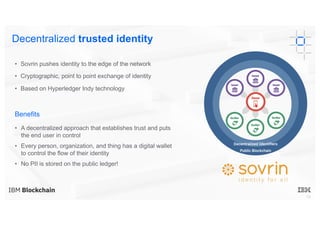
• Sovrin pushes identity to the edge of the network
• Cryptographic, point to point exchange of identity
• Based on Hyperledger Indy technology
Benefits
• A decentralized approach that establishes trust and puts
the end user in control
• Every person, organization, and thing has a digital wallet
to control the flow of their identity
• No PII is stored on the public ledger!
Decentralized trusted identity
Decentralized Identifiers
Public Blockchain
20
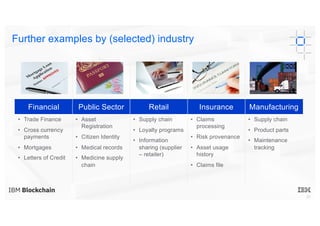
Financial Public Sector Retail Insurance Manufacturing
• Trade Finance
• Cross currency
payments
• Mortgages
• Letters of Credit
• Asset
Registration
• Citizen Identity
• Medical records
• Medicine supply
chain
• Supply chain
• Loyalty programs
• Information
sharing (supplier
– retailer)
• Claims
processing
• Risk provenance
• Asset usage
history
• Claims file
• Supply chain
• Product parts
• Maintenance
tracking
Further examples by (selected) industry
21
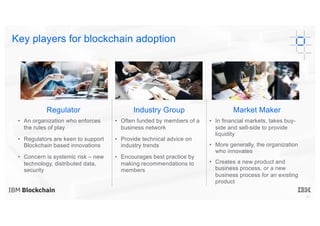
Key players for blockchain adoption
Regulator Industry Group Market Maker
• An organization who enforces
the rules of play
• Regulators are keen to support
Blockchain based innovations
• Concern is systemic risk – new
technology, distributed data,
security
• Often funded by members of a
business network
• Provide technical advice on
industry trends
• Encourages best practice by
making recommendations to
members
• In financial markets, takes buy-
side and sell-side to provide
liquidity
• More generally, the organization
who innovates
• Creates a new product and
business process, or a new
business process for an existing
product
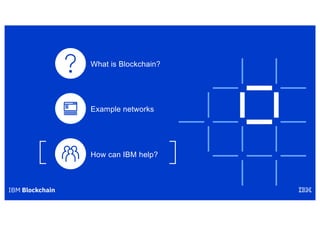
What is Blockchain?
How can IBM help?
Example networks
23
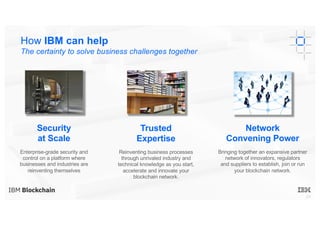
How IBM can help
The certainty to solve business challenges together
Security
at Scale
Enterprise-grade security and
control on a platform where
businesses and industries are
reinventing themselves
Trusted
Expertise
Reinventing business processes
through unrivaled industry and
technical knowledge as you start,
accelerate and innovate your
blockchain network.
Network
Convening Power
Bringing together an expansive partner
network of innovators, regulators
and suppliers to establish, join or run
your blockchain network.
24
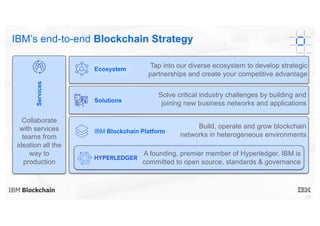
IBM’s end-to-end Blockchain Strategy
Solutions
Services
Ecosystem
IBM Blockchain Platform
Collaborate
with services
teams from
ideation all the
way to
production
Tap into our diverse ecosystem to develop strategic
partnerships and create your competitive advantage
Solve critical industry challenges by building and
joining new business networks and applications
Build, operate and grow blockchain
networks in heterogeneous environments
A founding, premier member of Hyperledger, IBM is
committed to open source, standards & governance
25
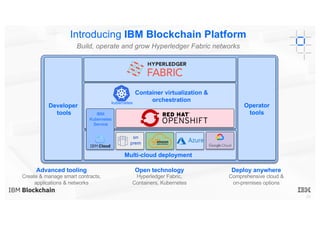
Advanced tooling
Create & manage smart contracts,
applications & networks
Open technology
Hyperledger Fabric,
Containers, Kubernetes
Deploy anywhere
Comprehensive cloud &
on-premises options
Introducing IBM Blockchain Platform
Build, operate and grow Hyperledger Fabric networks
Developer
tools
Operator
tools
kubernetes
Kubernetes
on
prem
IBM
Kubernetes
Service
Container virtualization &
orchestration
Multi-cloud deployment
kubernetes
26
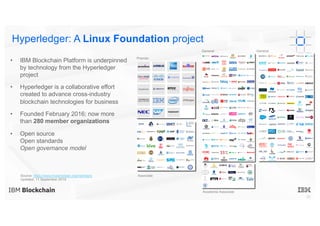
Hyperledger: A Linux Foundation project
• IBM Blockchain Platform is underpinned
by technology from the Hyperledger
project
• Hyperledger is a collaborative effort
created to advance cross-industry
blockchain technologies for business
• Founded February 2016; now more
than 280 member organizations
• Open source
Open standards
Open governance model
Source: https://www.hyperledger.org/members
Updated: 11 September 2019
Premier
Associate
Academia Associate
General General
27
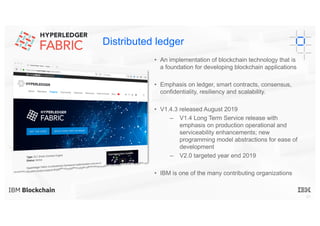
Distributed ledger
• An implementation of blockchain technology that is
a foundation for developing blockchain applications
• Emphasis on ledger, smart contracts, consensus,
confidentiality, resiliency and scalability.
• V1.4.3 released August 2019
– V1.4 Long Term Service release with
emphasis on production operational and
serviceability enhancements; new
programming model abstractions for ease of
development
– V2.0 targeted year end 2019
• IBM is one of the many contributing organizations
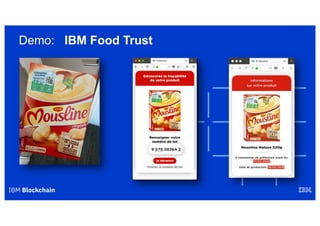
Demo: IBM Food Trust
29
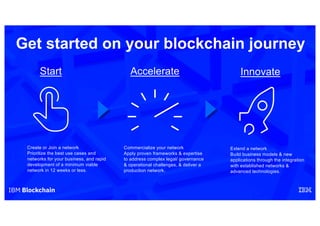
Get started on your blockchain journey
Extend a network
Build business models & new
applications through the integration
with established networks &
advanced technologies.
Commercialize your network
Apply proven frameworks & expertise
to address complex legal/ governance
& operational challenges, & deliver a
production network.
Create or Join a network
Prioritize the best use cases and
networks for your business, and rapid
development of a minimum viable
network in 12 weeks or less.
Start Accelerate Innovate
Questions? Tweet us or
go to ibm.com/blockchain
@IBMBlockchain
IBM Blockchain
IBM Blockchain
Thank you
© Copyright IBM Corporation 2019. All rights reserved. The information contained in these
materials is provided for informational purposes only, and is provided AS IS without warranty
of any kind, express or implied. Any statement of direction represents IBM's current intent, is
subject to change or withdrawal, and represents only goals and objectives. IBM, the IBM
logo, and other IBM products and services are trademarks of the International Business
Machines Corporation, in the United States, other countries or both. Other company, product,
or service names may be trademarks or service marks of others.

Blockchain Explained v5.20

  • 1.
    Blockchain Explained An Introductionto Blockchain for Business V5.20, 24 September 2019 Blockchain Explained Series Blockchain Explained IBM Blockchain Platform Explained Solutions Explained Labs Explained What’s New IBM Blockchain Usage Patterns
  • 2.
    What is Blockchain? Howcan IBM help? Example networks
  • 3.
    3 Business networks, wealthand markets • Business Networks benefit from connectivity – Participants are customers, suppliers, banks, partners – Cross geography and regulatory boundary • Wealth is generated by the flow of goods and services across business network in transactions and contracts • Markets are central to this process: – Public (fruit market, car auction), or – Private (supply chain financing, bonds)
  • 4.
    4 Transferring assets, buildingvalue Anything that is capable of being owned or controlled to produce value, is an asset Two fundamental types of asset Intangible assets subdivide Cash is also an asset • Tangible, e.g. a house • Intangible, e.g. a mortgage • Financial, e.g. bond • Intellectual, e.g. patents • Digital, e.g. data • Has property of anonymity
  • 5.
    5 Ledgers, Transactions andContracts • Ledger: an important log of all transactions – Describes the inputs and outputs of the business • Transaction: an asset transfer between participants – Matt gives a car to Dave (simple) • Contract: the conditions for a transaction to occur – If Dave pays Matt money, then car passes from Matt to Dave (simple) – If car won't start, funds do not pass to Matt (as decided by third party arbitrator) (more complex)
  • 6.
  • 7.
    7 Problem inefficient, expensive, vulnerable ParticipantA’s records Participant B’s records Bank records Insurer records Regulator records Auditor records
  • 8.
    8 Blockchain Participant A’s recordsParticipant B’s records Bank records Insurer records Regulator records Auditor records Solution A shared, replicated, permissioned ledger… …with consensus, provenance, immutability and finality
  • 9.
    9 Different types ofblockchain – The first blockchain application – Defines a shadow-currency and its ledger – Resource intensive is an example of an unpermissioned, public blockchain • All blockchains aim to provide irrefutable proof that a set of transactions occurred between participants • Different types of blockchain exist: • Blockchains for business generally prioritize – Assets over cryptocurrency; Identity over anonymity; Selective endorsement over proof of work
  • 10.
    10 Requirements of blockchainfor business Participants decide which assets to share ASSETS Participants know who they are dealing with; information shared is need-to-know IDENTITY Participants give provable endorsement ENDORSEMENT
  • 11.
    11 Assets The business networkdecides what to share on the ledger • Assets are anything of value – On the blockchain, these are represented digitally using a pre-agreed format • Transactions change the state of an asset and are provably recorded on the blockchain – e.g. transfer ownership, change color • Transactions are underpinned by smart contracts – Verifiable business rules that cause the asset to change state
  • 12.
    12 Identity Knowing who you’redealing with • Various regulations applied to businesses require them to know who they are dealing with – e.g. KYC, AML, CFT • Identity is used to ensure business networks are kept private and individual transactions confidential – With transparency for the regulator • There are established methods for obtaining and asserting identity – Cryptography is central to these – Identity allows transactions to be signed and encrypted
  • 13.
    13 Transaction Endorsement Provable verificationby relevant participants • Endorsement is the process in which a transaction is verified as “good” – Ensures that participants are happy to accept the transaction and prevents (e.g.) double spending • Endorsement can be expensive in public blockchains – Without identity, transactions are thrown to the whole network for endorsement – Proof of work is particularly CPU intensive • In the real world, transactions are endorsed by a smaller number of participants – e.g. sender bank, receiver bank, payments provider – Must be completed in an appropriate timeframe
  • 14.
    What is Blockchain? Howcan IBM help? Example networks
  • 15.
  • 16.
    16 • TradeLens isan open, extensible platform for sharing shipping events, messages, and documents across all the actors and systems in the supply chain ecosystem. • It provides shared visibility and shared state for container shipments Benefits • Increase speed and transparency for cross border transactions through real time access to container events. • Reduced cost and increased efficiency through paperless trade TradeLens improves global trade efficiency Inland Transportation Shippers / Beneficial Cargo Owner Supply Chain Visibility Systems Trade Associations Supply Chain / Transportation Management Systems Authorities Financial / Insurance Services Port Community Systems; Terminal Operating Systems Freight Forwarders / 3PLs Customs Systems Customs Brokers
  • 17.
    17 • IBM FoodTrust is a set of modules providing traceability to improve food transparency and efficiency • Blockchain is used to create a trusted connection with shared value for all ecosystem participants, including end consumers. Benefits • Reduce impact of food recalls through instant access to end-to-end traceability data to verify history in the food network and supply chain. • Help to address the 1 in 10 people sickened and 400,000 fatalities world wide which occur every year from food-born illnesses. IBM Food Trust for supply chain transparency
  • 18.
    18 • IBM BlockchainWorld Wire is an integrated network for real-time clearing and settlement. • Allows banks and financial institutions to send and settle payments around the globe with finality in a matter of seconds • Eliminates enduring challenges that have long hampered the cross-border payments industry. World Wire is revolutionizing global payments Benefits • Payment support regardless of size, origination, destination or asset type • Higher visibility for streamlined transactions with reduced disputes and reconciliation needs • Enhanced regulatory compliance through improved transparency • Secure network with interaction and eligibility criteria as well as robust access controls
  • 19.
    19 • Sovrin pushesidentity to the edge of the network • Cryptographic, point to point exchange of identity • Based on Hyperledger Indy technology Benefits • A decentralized approach that establishes trust and puts the end user in control • Every person, organization, and thing has a digital wallet to control the flow of their identity • No PII is stored on the public ledger! Decentralized trusted identity Decentralized Identifiers Public Blockchain
  • 20.
    20 Financial Public SectorRetail Insurance Manufacturing • Trade Finance • Cross currency payments • Mortgages • Letters of Credit • Asset Registration • Citizen Identity • Medical records • Medicine supply chain • Supply chain • Loyalty programs • Information sharing (supplier – retailer) • Claims processing • Risk provenance • Asset usage history • Claims file • Supply chain • Product parts • Maintenance tracking Further examples by (selected) industry
  • 21.
    21 Key players forblockchain adoption Regulator Industry Group Market Maker • An organization who enforces the rules of play • Regulators are keen to support Blockchain based innovations • Concern is systemic risk – new technology, distributed data, security • Often funded by members of a business network • Provide technical advice on industry trends • Encourages best practice by making recommendations to members • In financial markets, takes buy- side and sell-side to provide liquidity • More generally, the organization who innovates • Creates a new product and business process, or a new business process for an existing product
  • 22.
    What is Blockchain? Howcan IBM help? Example networks
  • 23.
    23 How IBM canhelp The certainty to solve business challenges together Security at Scale Enterprise-grade security and control on a platform where businesses and industries are reinventing themselves Trusted Expertise Reinventing business processes through unrivaled industry and technical knowledge as you start, accelerate and innovate your blockchain network. Network Convening Power Bringing together an expansive partner network of innovators, regulators and suppliers to establish, join or run your blockchain network.
  • 24.
    24 IBM’s end-to-end BlockchainStrategy Solutions Services Ecosystem IBM Blockchain Platform Collaborate with services teams from ideation all the way to production Tap into our diverse ecosystem to develop strategic partnerships and create your competitive advantage Solve critical industry challenges by building and joining new business networks and applications Build, operate and grow blockchain networks in heterogeneous environments A founding, premier member of Hyperledger, IBM is committed to open source, standards & governance
  • 25.
    25 Advanced tooling Create &manage smart contracts, applications & networks Open technology Hyperledger Fabric, Containers, Kubernetes Deploy anywhere Comprehensive cloud & on-premises options Introducing IBM Blockchain Platform Build, operate and grow Hyperledger Fabric networks Developer tools Operator tools kubernetes Kubernetes on prem IBM Kubernetes Service Container virtualization & orchestration Multi-cloud deployment kubernetes
  • 26.
    26 Hyperledger: A LinuxFoundation project • IBM Blockchain Platform is underpinned by technology from the Hyperledger project • Hyperledger is a collaborative effort created to advance cross-industry blockchain technologies for business • Founded February 2016; now more than 280 member organizations • Open source Open standards Open governance model Source: https://www.hyperledger.org/members Updated: 11 September 2019 Premier Associate Academia Associate General General
  • 27.
    27 Distributed ledger • Animplementation of blockchain technology that is a foundation for developing blockchain applications • Emphasis on ledger, smart contracts, consensus, confidentiality, resiliency and scalability. • V1.4.3 released August 2019 – V1.4 Long Term Service release with emphasis on production operational and serviceability enhancements; new programming model abstractions for ease of development – V2.0 targeted year end 2019 • IBM is one of the many contributing organizations
  • 28.
  • 29.
    29 Get started onyour blockchain journey Extend a network Build business models & new applications through the integration with established networks & advanced technologies. Commercialize your network Apply proven frameworks & expertise to address complex legal/ governance & operational challenges, & deliver a production network. Create or Join a network Prioritize the best use cases and networks for your business, and rapid development of a minimum viable network in 12 weeks or less. Start Accelerate Innovate
  • 30.
    Questions? Tweet usor go to ibm.com/blockchain @IBMBlockchain IBM Blockchain IBM Blockchain Thank you
  • 31.
    © Copyright IBMCorporation 2019. All rights reserved. The information contained in these materials is provided for informational purposes only, and is provided AS IS without warranty of any kind, express or implied. Any statement of direction represents IBM's current intent, is subject to change or withdrawal, and represents only goals and objectives. IBM, the IBM logo, and other IBM products and services are trademarks of the International Business Machines Corporation, in the United States, other countries or both. Other company, product, or service names may be trademarks or service marks of others.