CRYPTOCURRENCY
&
What is Blockchain?
A DISTRIBUTED DATABASE
 Ingenious invention of a person known as Satoshi
Nakamoto.
 A spreadsheet that is duplicated thousands of times across a
network of computers which is regularly updated.
 Originally devised for the digital currency, Bitcoin.
 Information held on a blockchain exists as a shared — and
continually reconciled — database
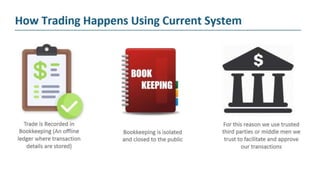
Current Monetary System
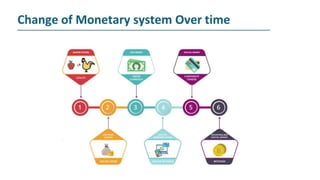
EVOLUTION OF MONETARY SYSTEM
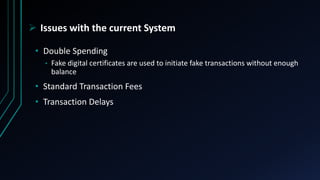
 Issues with the current System
• Double Spending
• Fake digital certificates are used to initiate fake transactions without enough
balance
• Standard Transaction Fees
• Transaction Delays
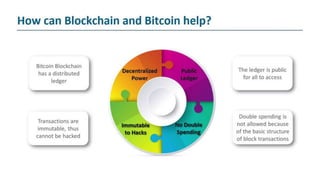
How Blockchain and Bitcoin help
NEW MODE OF TRANSACTION
How Blockchain works
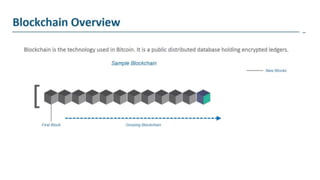
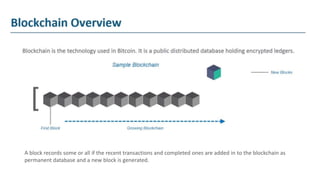
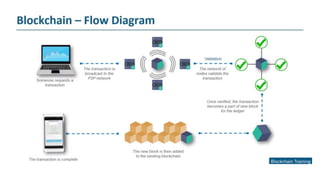
A block records some or all if the recent transactions and completed ones are added in to the blockchain as
permanent database and a new block is generated.
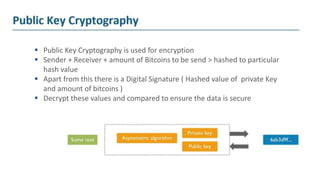
 Public Key Cryptography is used for encryption
 Sender + Receiver + amount of Bitcoins to be send > hashed to particular
hash value
 Apart from this there is a Digital Signature ( Hashed value of private Key
and amount of bitcoins )
 Decrypt these values and compared to ensure the data is secure
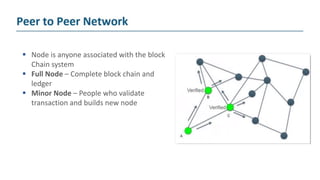
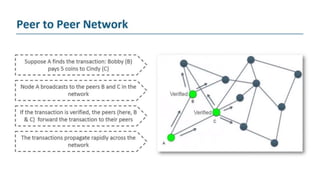
Peer to Peer Network
 Node is anyone associated with the block
Chain system
 Full Node – Complete block chain and
ledger
 Minor Node – People who validate
transaction and builds new node
What is BITCOIN
NEW MODE OF TRANSACTION
 First Decentralized Cryptocurrency
 Uses cryptography to control its creation and management
 Various cryptography technologies and mathematical
algorithms for creating Bitcoins are very complicated
 Total Bitcoins are limited to 21 Million
 Last bitcoin will be mined only by 2040
Block Chain Bitcoin and Crypto Currency

Block Chain Bitcoin and Crypto Currency

  • 1.
  • 2.
    What is Blockchain? ADISTRIBUTED DATABASE
  • 3.
     Ingenious inventionof a person known as Satoshi Nakamoto.  A spreadsheet that is duplicated thousands of times across a network of computers which is regularly updated.  Originally devised for the digital currency, Bitcoin.  Information held on a blockchain exists as a shared — and continually reconciled — database
  • 4.
  • 7.
     Issues withthe current System • Double Spending • Fake digital certificates are used to initiate fake transactions without enough balance • Standard Transaction Fees • Transaction Delays
  • 8.
    How Blockchain andBitcoin help NEW MODE OF TRANSACTION
  • 10.
  • 12.
    A block recordssome or all if the recent transactions and completed ones are added in to the blockchain as permanent database and a new block is generated.
  • 14.
     Public KeyCryptography is used for encryption  Sender + Receiver + amount of Bitcoins to be send > hashed to particular hash value  Apart from this there is a Digital Signature ( Hashed value of private Key and amount of bitcoins )  Decrypt these values and compared to ensure the data is secure
  • 15.
    Peer to PeerNetwork  Node is anyone associated with the block Chain system  Full Node – Complete block chain and ledger  Minor Node – People who validate transaction and builds new node
  • 18.
    What is BITCOIN NEWMODE OF TRANSACTION
  • 19.
     First DecentralizedCryptocurrency  Uses cryptography to control its creation and management  Various cryptography technologies and mathematical algorithms for creating Bitcoins are very complicated  Total Bitcoins are limited to 21 Million  Last bitcoin will be mined only by 2040