ROHIT GAUTAM
IT/626/14
CRYPTOCURRENCY
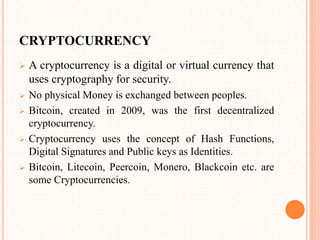
 A cryptocurrency is a digital or virtual currency that
uses cryptography for security.
 No physical Money is exchanged between peoples.
 Bitcoin, created in 2009, was the first decentralized
cryptocurrency.
 Cryptocurrency uses the concept of Hash Functions,
Digital Signatures and Public keys as Identities.
 Bitcoin, Litecoin, Peercoin, Monero, Blackcoin etc. are
some Cryptocurrencies.
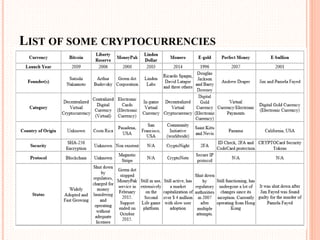
LIST OF SOME CRYPTOCURRENCIES
BITCOIN – FIRST DECENTRALIZED CRYPTOCURRENCY
 Bitcoin is a worldwide cryptocurrency and
digital payment system.
 First decentralized cryptocurrency.
 It works without a central repository or single
administrator.
 It was invented by an unknown person or group of
programmers under the name Satoshi Nakamoto and
released as open-source software in 2009.
 Peer to Peer transactions.
BITCOIN – FIRST DECENTRALIZED CRYPTOCURRENCY
 Transactions are verified by network nodes and recorded
in public ledger (digital file contains names and
balances) called the blockchain.
 BTC = ₹ 465922.34 .
 Maximum supply limit is 21 million according to
coinmarketcap (on Nov 09, 2017).
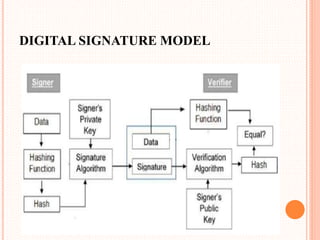
DIGITAL SIGNATURE MODEL
HOW DOES IT WORK?
HOW DOES IT WORK?
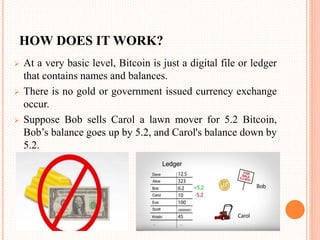
 At a very basic level, Bitcoin is just a digital file or ledger
that contains names and balances.
 There is no gold or government issued currency exchange
occur.
 Suppose Bob sells Carol a lawn mover for 5.2 Bitcoin,
Bob’s balance goes up by 5.2, and Carol's balance down by
5.2.
HOW DOES IT WORK?
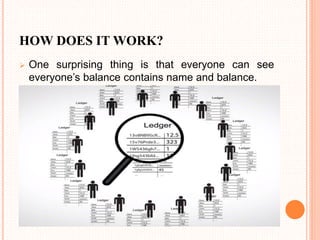
 One surprising thing is that everyone can see
everyone’s balance contains name and balance.
HOW DOES IT WORKS?
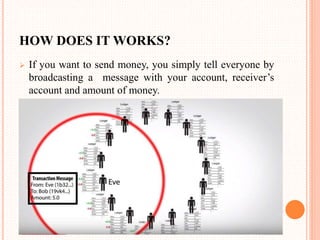
 If you want to send money, you simply tell everyone by
broadcasting a message with your account, receiver’s
account and amount of money.
HOW DOES IT WORKS?
 It avoids the concept of any centralized control.
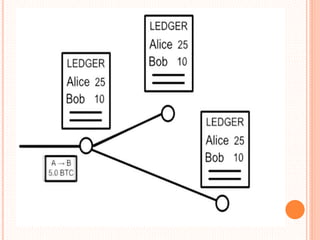
 Every participant maintains their own copy of ledger.
 One surprising fact of this is that everyone can see
everyone else’s balances.
 Like a pen & paper check, Bitcoin requires a kind of
signature to prove that sender is the real owner of
account.
 Signature is based on math rather than handwriting.
 Bitcoin Addresses are 160 bit long hash output of the
private key.
HOW DOES IT WORK?
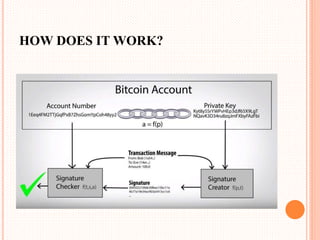
 When a new account number is created, It comes along
with a private key.
 private key is mathematically linked to that account
number.
 Before transaction a signature is created using a
cryptographic function.
 To create a signature, a private key and the text from a
transaction (or say message) are fed into a special
cryptographic function.
 Another function allows other people to check the
signature, making sure it was created by the account
owner, and that it applies to that specific transaction.
HOW DOES IT WORK?
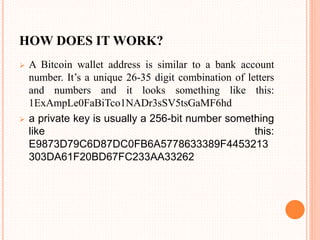
 A Bitcoin wallet address is similar to a bank account
number. It’s a unique 26-35 digit combination of letters
and numbers and it looks something like this:
1ExAmpLe0FaBiTco1NADr3sSV5tsGaMF6hd
 a private key is usually a 256-bit number something
like this:
E9873D79C6D87DC0FB6A5778633389F4453213
303DA61F20BD67FC233AA33262
HOW DOES IT WORK?
BITCOIN TRANSACTION
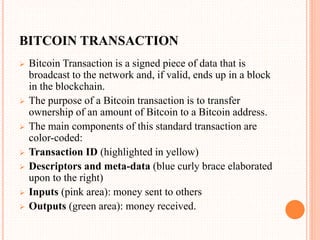
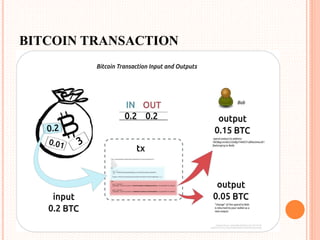
 Bitcoin Transaction is a signed piece of data that is
broadcast to the network and, if valid, ends up in a block
in the blockchain.
 The purpose of a Bitcoin transaction is to transfer
ownership of an amount of Bitcoin to a Bitcoin address.
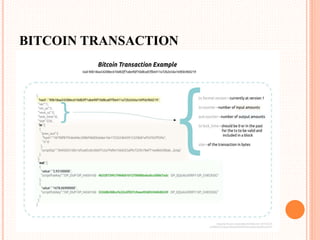
 The main components of this standard transaction are
color-coded:
 Transaction ID (highlighted in yellow)
 Descriptors and meta-data (blue curly brace elaborated
upon to the right)
 Inputs (pink area): money sent to others
 Outputs (green area): money received.
BITCOIN TRANSACTION
BITCOIN TRANSACTION
TRANSACTION ORDER
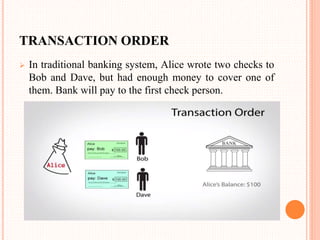
 In traditional banking system, Alice wrote two checks to
Bob and Dave, but had enough money to cover one of
them. Bank will pay to the first check person.
IS THE TRANSACTION AUTHENTIC?
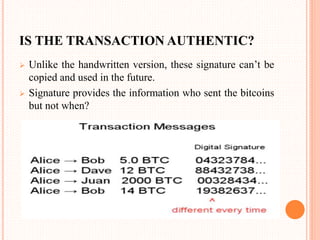
 Unlike the handwritten version, these signature can’t be
copied and used in the future.
 Signature provides the information who sent the bitcoins
but not when?
TRANSACTION ORDER
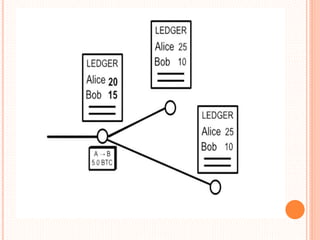
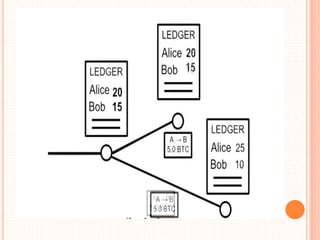
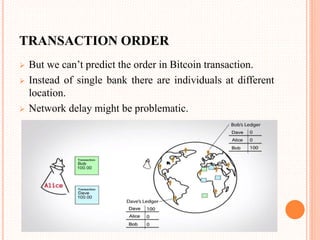
 But we can’t predict the order in Bitcoin transaction.
 Instead of single bank there are individuals at different
location.
 Network delay might be problematic.
TRANSACTION ORDER
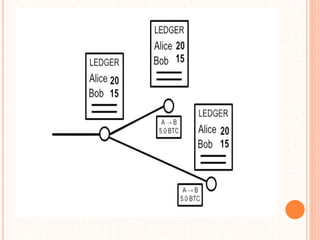
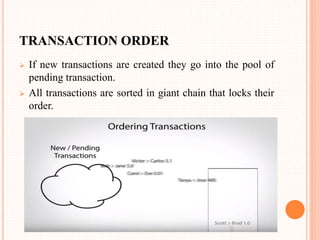
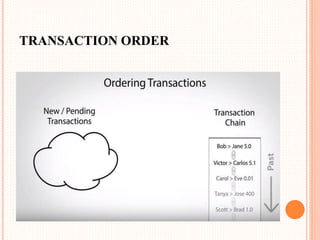
 If new transactions are created they go into the pool of
pending transaction.
 All transactions are sorted in giant chain that locks their
order.
TRANSACTION ORDER
BITCOIN MINING
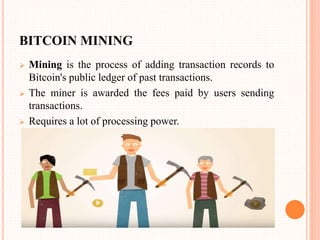
 Mining is the process of adding transaction records to
Bitcoin's public ledger of past transactions.
 The miner is awarded the fees paid by users sending
transactions.
 Requires a lot of processing power.
BITCOIN MINING
 More miners means more secure network.
 Miners are required to approve transactions.
 Graphic card (GPU) are faster than ordinary CPUs,
 Card uses more electricity and produces more heat.
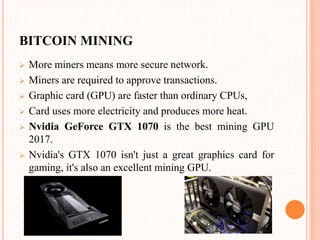
 Nvidia GeForce GTX 1070 is the best mining GPU
2017.
 Nvidia's GTX 1070 isn't just a great graphics card for
gaming, it's also an excellent mining GPU.
DO YOU WANT BITCOINS ?
 You need a bitcoin wallet to get started.
 You can create your bitcoin accounts on
blockchain.info or any other browser.
 Bitcoin wallets are available for desktops, mobile
devices, paper wallets and even hardware wallets.
 Bitcoin Block Explorer is an online block chain
browser which displays the contents of
individual Bitcoin blocks and transactions and the
transaction histories and balances of addresses.
Blockexplorer.com
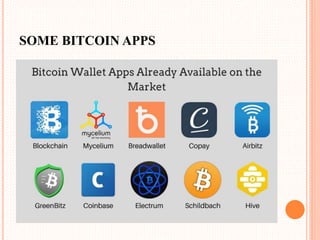
SOME BITCOIN APPS
ADVANTAGES
 No Third Party Seizure
 No Taxes
 No Tracking
 Low Transaction costs
 No charge backs
 Information is Transparent.
 Fewer Risks for Merchants
DISADVANTAGES
 Used for illegal Activity.
 Lack of Awareness & Understanding.
 Mining causes large energy consumption.
 Banned in some countries like China, Thailand.
 Still quite unstable and currency value can go up and
down rapidly.
 Still Developing still at its infancy stage with
incomplete features.
 A Bitcoin transaction wastes as much electricity as it
takes to power an American home for a week.
CONCLUSION
 Bitcoins can be helpful to a lot of people.
 On a positive note, the minimal fees and lack of
regulations makes it much easier and cheaper to send
money internationally.
 All of these will definitely help Bitcoin get more users,
and if everyone uses Bitcoin it could replace official
currencies.
 Sure, it has some disadvantages, but some of those are
because Bitcoin is a new thing, so as time goes on they
will be less of a problem. The others can easily be
avoided.
THANK YOU
Bitcoin ppt

Bitcoin ppt

  • 1.
  • 2.
    CRYPTOCURRENCY  A cryptocurrencyis a digital or virtual currency that uses cryptography for security.  No physical Money is exchanged between peoples.  Bitcoin, created in 2009, was the first decentralized cryptocurrency.  Cryptocurrency uses the concept of Hash Functions, Digital Signatures and Public keys as Identities.  Bitcoin, Litecoin, Peercoin, Monero, Blackcoin etc. are some Cryptocurrencies.
  • 3.
    LIST OF SOMECRYPTOCURRENCIES
  • 4.
    BITCOIN – FIRSTDECENTRALIZED CRYPTOCURRENCY  Bitcoin is a worldwide cryptocurrency and digital payment system.  First decentralized cryptocurrency.  It works without a central repository or single administrator.  It was invented by an unknown person or group of programmers under the name Satoshi Nakamoto and released as open-source software in 2009.  Peer to Peer transactions.
  • 5.
    BITCOIN – FIRSTDECENTRALIZED CRYPTOCURRENCY  Transactions are verified by network nodes and recorded in public ledger (digital file contains names and balances) called the blockchain.  BTC = ₹ 465922.34 .  Maximum supply limit is 21 million according to coinmarketcap (on Nov 09, 2017).
  • 6.
  • 7.
  • 8.
    HOW DOES ITWORK?  At a very basic level, Bitcoin is just a digital file or ledger that contains names and balances.  There is no gold or government issued currency exchange occur.  Suppose Bob sells Carol a lawn mover for 5.2 Bitcoin, Bob’s balance goes up by 5.2, and Carol's balance down by 5.2.
  • 9.
    HOW DOES ITWORK?  One surprising thing is that everyone can see everyone’s balance contains name and balance.
  • 10.
    HOW DOES ITWORKS?  If you want to send money, you simply tell everyone by broadcasting a message with your account, receiver’s account and amount of money.
  • 11.
    HOW DOES ITWORKS?  It avoids the concept of any centralized control.  Every participant maintains their own copy of ledger.  One surprising fact of this is that everyone can see everyone else’s balances.  Like a pen & paper check, Bitcoin requires a kind of signature to prove that sender is the real owner of account.  Signature is based on math rather than handwriting.  Bitcoin Addresses are 160 bit long hash output of the private key.
  • 16.
    HOW DOES ITWORK?  When a new account number is created, It comes along with a private key.  private key is mathematically linked to that account number.  Before transaction a signature is created using a cryptographic function.  To create a signature, a private key and the text from a transaction (or say message) are fed into a special cryptographic function.  Another function allows other people to check the signature, making sure it was created by the account owner, and that it applies to that specific transaction.
  • 17.
    HOW DOES ITWORK?  A Bitcoin wallet address is similar to a bank account number. It’s a unique 26-35 digit combination of letters and numbers and it looks something like this: 1ExAmpLe0FaBiTco1NADr3sSV5tsGaMF6hd  a private key is usually a 256-bit number something like this: E9873D79C6D87DC0FB6A5778633389F4453213 303DA61F20BD67FC233AA33262
  • 18.
  • 19.
    BITCOIN TRANSACTION  BitcoinTransaction is a signed piece of data that is broadcast to the network and, if valid, ends up in a block in the blockchain.  The purpose of a Bitcoin transaction is to transfer ownership of an amount of Bitcoin to a Bitcoin address.  The main components of this standard transaction are color-coded:  Transaction ID (highlighted in yellow)  Descriptors and meta-data (blue curly brace elaborated upon to the right)  Inputs (pink area): money sent to others  Outputs (green area): money received.
  • 20.
  • 21.
  • 22.
    TRANSACTION ORDER  Intraditional banking system, Alice wrote two checks to Bob and Dave, but had enough money to cover one of them. Bank will pay to the first check person.
  • 23.
    IS THE TRANSACTIONAUTHENTIC?  Unlike the handwritten version, these signature can’t be copied and used in the future.  Signature provides the information who sent the bitcoins but not when?
  • 24.
    TRANSACTION ORDER  Butwe can’t predict the order in Bitcoin transaction.  Instead of single bank there are individuals at different location.  Network delay might be problematic.
  • 25.
    TRANSACTION ORDER  Ifnew transactions are created they go into the pool of pending transaction.  All transactions are sorted in giant chain that locks their order.
  • 26.
  • 27.
    BITCOIN MINING  Miningis the process of adding transaction records to Bitcoin's public ledger of past transactions.  The miner is awarded the fees paid by users sending transactions.  Requires a lot of processing power.
  • 28.
    BITCOIN MINING  Moreminers means more secure network.  Miners are required to approve transactions.  Graphic card (GPU) are faster than ordinary CPUs,  Card uses more electricity and produces more heat.  Nvidia GeForce GTX 1070 is the best mining GPU 2017.  Nvidia's GTX 1070 isn't just a great graphics card for gaming, it's also an excellent mining GPU.
  • 29.
    DO YOU WANTBITCOINS ?  You need a bitcoin wallet to get started.  You can create your bitcoin accounts on blockchain.info or any other browser.  Bitcoin wallets are available for desktops, mobile devices, paper wallets and even hardware wallets.  Bitcoin Block Explorer is an online block chain browser which displays the contents of individual Bitcoin blocks and transactions and the transaction histories and balances of addresses. Blockexplorer.com
  • 30.
  • 31.
    ADVANTAGES  No ThirdParty Seizure  No Taxes  No Tracking  Low Transaction costs  No charge backs  Information is Transparent.  Fewer Risks for Merchants
  • 32.
    DISADVANTAGES  Used forillegal Activity.  Lack of Awareness & Understanding.  Mining causes large energy consumption.  Banned in some countries like China, Thailand.  Still quite unstable and currency value can go up and down rapidly.  Still Developing still at its infancy stage with incomplete features.  A Bitcoin transaction wastes as much electricity as it takes to power an American home for a week.
  • 33.
    CONCLUSION  Bitcoins canbe helpful to a lot of people.  On a positive note, the minimal fees and lack of regulations makes it much easier and cheaper to send money internationally.  All of these will definitely help Bitcoin get more users, and if everyone uses Bitcoin it could replace official currencies.  Sure, it has some disadvantages, but some of those are because Bitcoin is a new thing, so as time goes on they will be less of a problem. The others can easily be avoided.
  • 34.