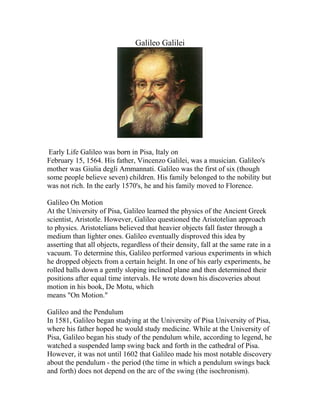
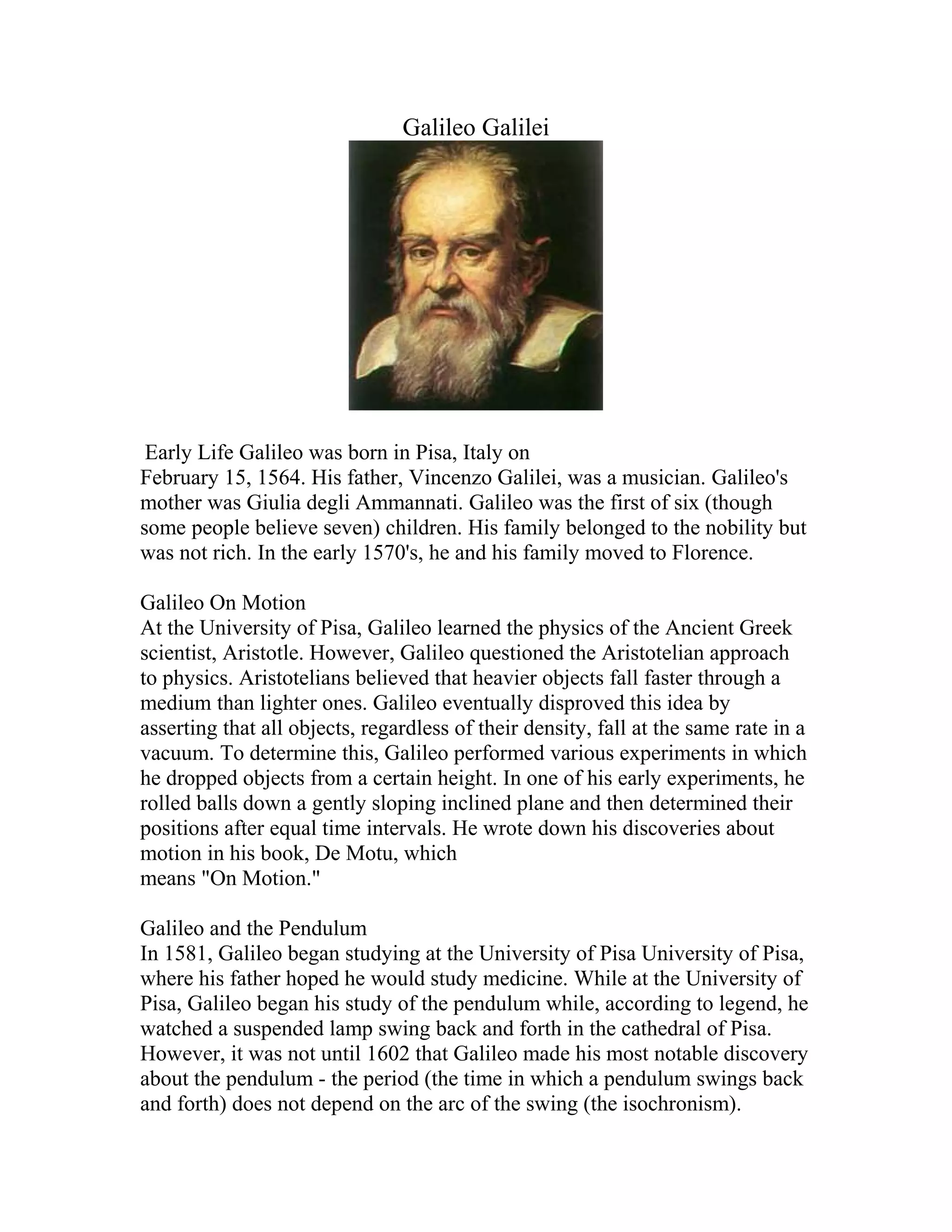
Galileo Galilei
Early Life Galileo was born in Pisa, Italy on
February 15, 1564. His father, Vincenzo Galilei, was a musician. Galileo's
mother was Giulia degli Ammannati. Galileo was the first of six (though
some people believe seven) children. His family belonged to the nobility but
was not rich. In the early 1570's, he and his family moved to Florence.
Galileo On Motion
At the University of Pisa, Galileo learned the physics of the Ancient Greek
scientist, Aristotle. However, Galileo questioned the Aristotelian approach
to physics. Aristotelians believed that heavier objects fall faster through a
medium than lighter ones. Galileo eventually disproved this idea by
asserting that all objects, regardless of their density, fall at the same rate in a
vacuum. To determine this, Galileo performed various experiments in which
he dropped objects from a certain height. In one of his early experiments, he
rolled balls down a gently sloping inclined plane and then determined their
positions after equal time intervals. He wrote down his discoveries about
motion in his book, De Motu, which
means "On Motion."
Galileo and the Pendulum
In 1581, Galileo began studying at the University of Pisa University of Pisa,
where his father hoped he would study medicine. While at the University of
Pisa, Galileo began his study of the pendulum while, according to legend, he
watched a suspended lamp swing back and forth in the cathedral of Pisa.
However, it was not until 1602 that Galileo made his most notable discovery
about the pendulum - the period (the time in which a pendulum swings back
and forth) does not depend on the arc of the swing (the isochronism).
Eventually, this discovery would lead to Galileo's further study of time
intervals and the development of his idea for a
pendulum clock

Galileo Galilei

  • 1.
    Galileo Galilei Early LifeGalileo was born in Pisa, Italy on February 15, 1564. His father, Vincenzo Galilei, was a musician. Galileo's mother was Giulia degli Ammannati. Galileo was the first of six (though some people believe seven) children. His family belonged to the nobility but was not rich. In the early 1570's, he and his family moved to Florence. Galileo On Motion At the University of Pisa, Galileo learned the physics of the Ancient Greek scientist, Aristotle. However, Galileo questioned the Aristotelian approach to physics. Aristotelians believed that heavier objects fall faster through a medium than lighter ones. Galileo eventually disproved this idea by asserting that all objects, regardless of their density, fall at the same rate in a vacuum. To determine this, Galileo performed various experiments in which he dropped objects from a certain height. In one of his early experiments, he rolled balls down a gently sloping inclined plane and then determined their positions after equal time intervals. He wrote down his discoveries about motion in his book, De Motu, which means "On Motion." Galileo and the Pendulum In 1581, Galileo began studying at the University of Pisa University of Pisa, where his father hoped he would study medicine. While at the University of Pisa, Galileo began his study of the pendulum while, according to legend, he watched a suspended lamp swing back and forth in the cathedral of Pisa. However, it was not until 1602 that Galileo made his most notable discovery about the pendulum - the period (the time in which a pendulum swings back and forth) does not depend on the arc of the swing (the isochronism).
  • 2.
    Eventually, this discoverywould lead to Galileo's further study of time intervals and the development of his idea for a pendulum clock