1
Presentation Agenda


➔
    Brief History
➔
    Technology Overview
➔
    Positioning towards other Projects
➔
    Roadmap
➔
    The Team
➔
    Wrap-Up


2
Brief BlackRay History
What is BlackRay?
●
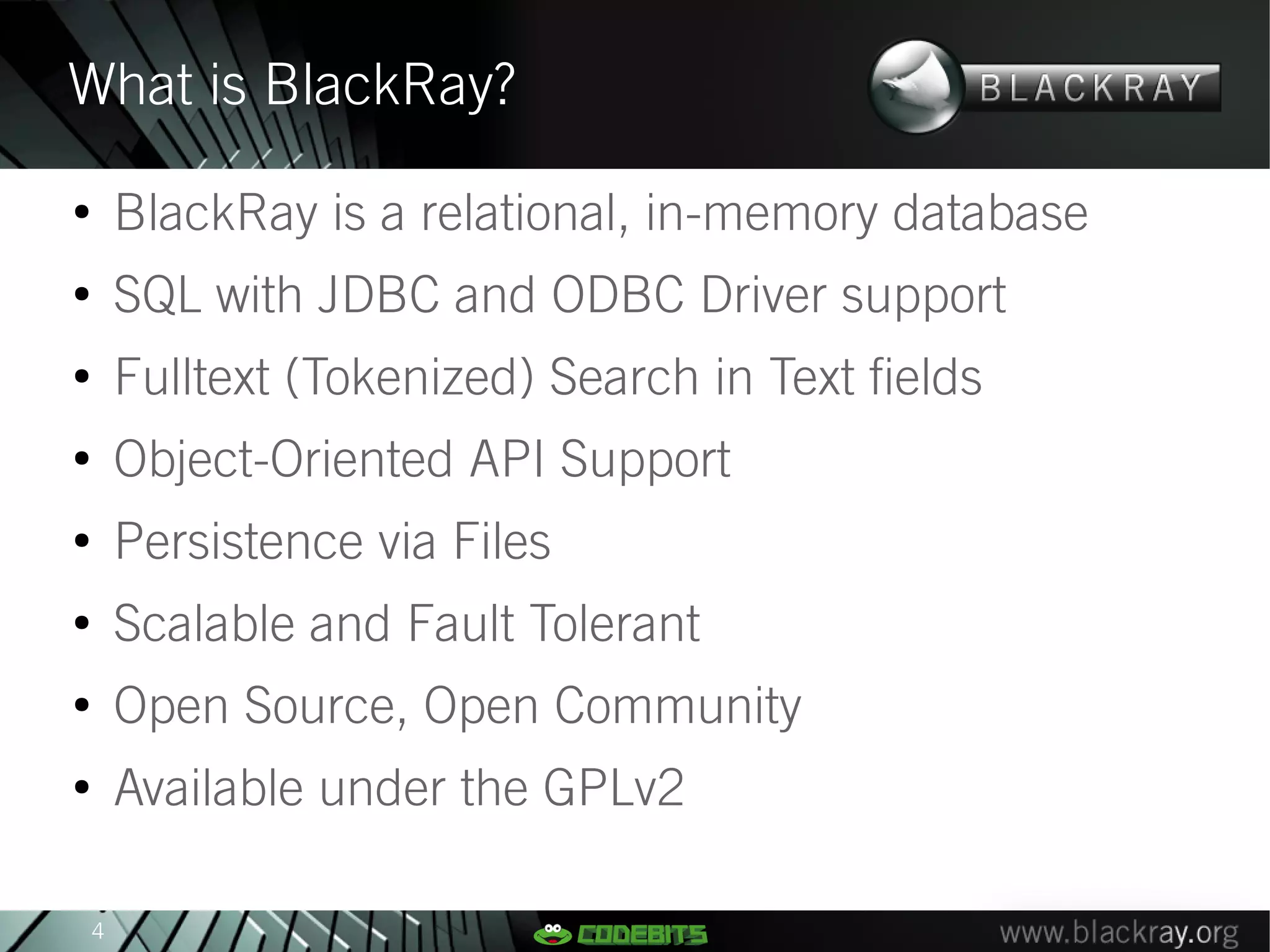
        BlackRay is a relational, in-memory database
●
        SQL with JDBC and ODBC Driver support
●
        Fulltext (Tokenized) Search in Text fields
●
        Object-Oriented API Support
●
        Persistence via Files
●
        Scalable and Fault Tolerant
●
        Open Source, Open Community
●
        Available under the GPLv2

    4
BlackRay History
●
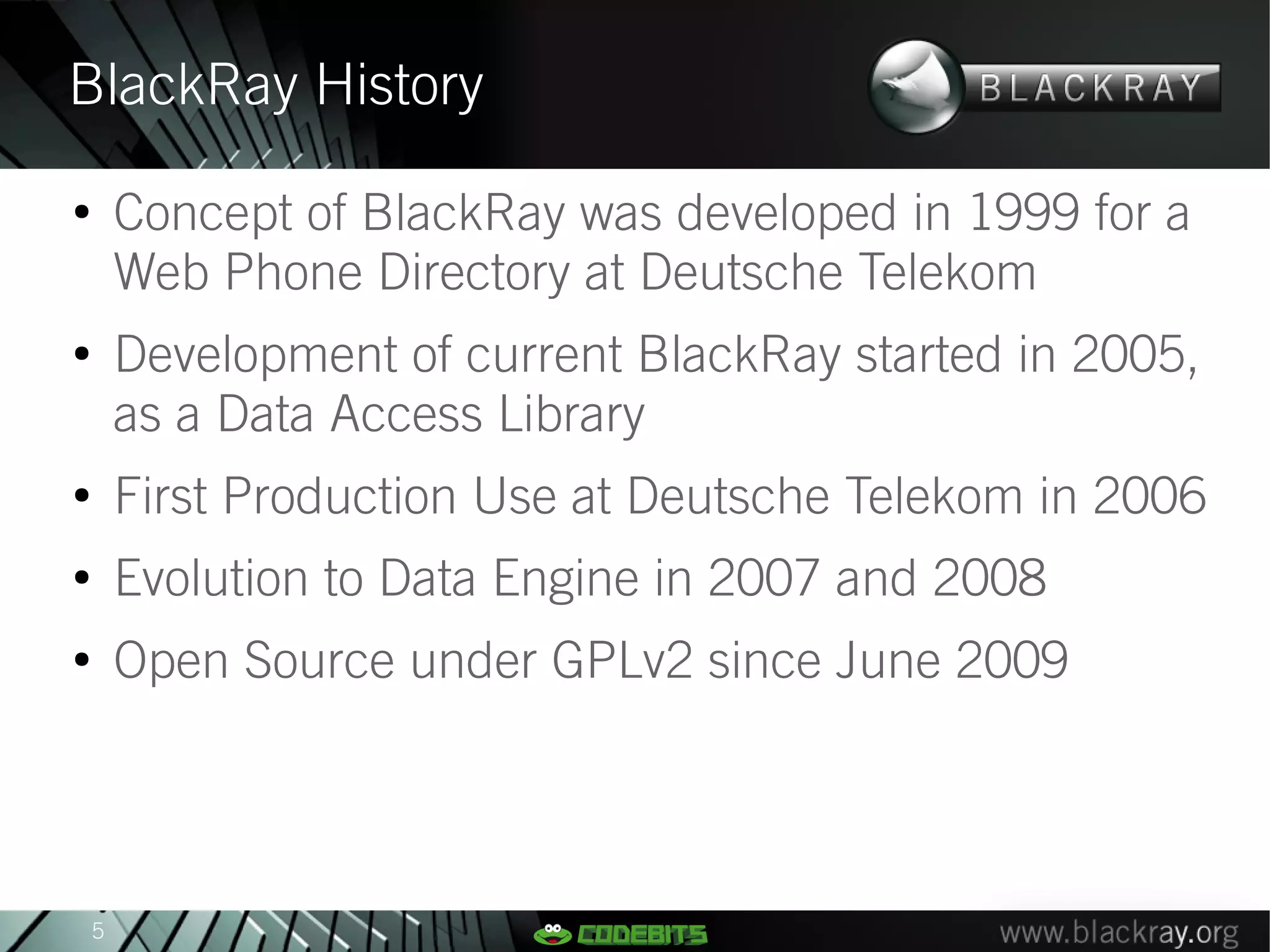
        Concept of BlackRay was developed in 1999 for a
        Web Phone Directory at Deutsche Telekom
●
        Development of current BlackRay started in 2005,
        as a Data Access Library
●
        First Production Use at Deutsche Telekom in 2006
●
        Evolution to Data Engine in 2007 and 2008
●
        Open Source under GPLv2 since June 2009


    5
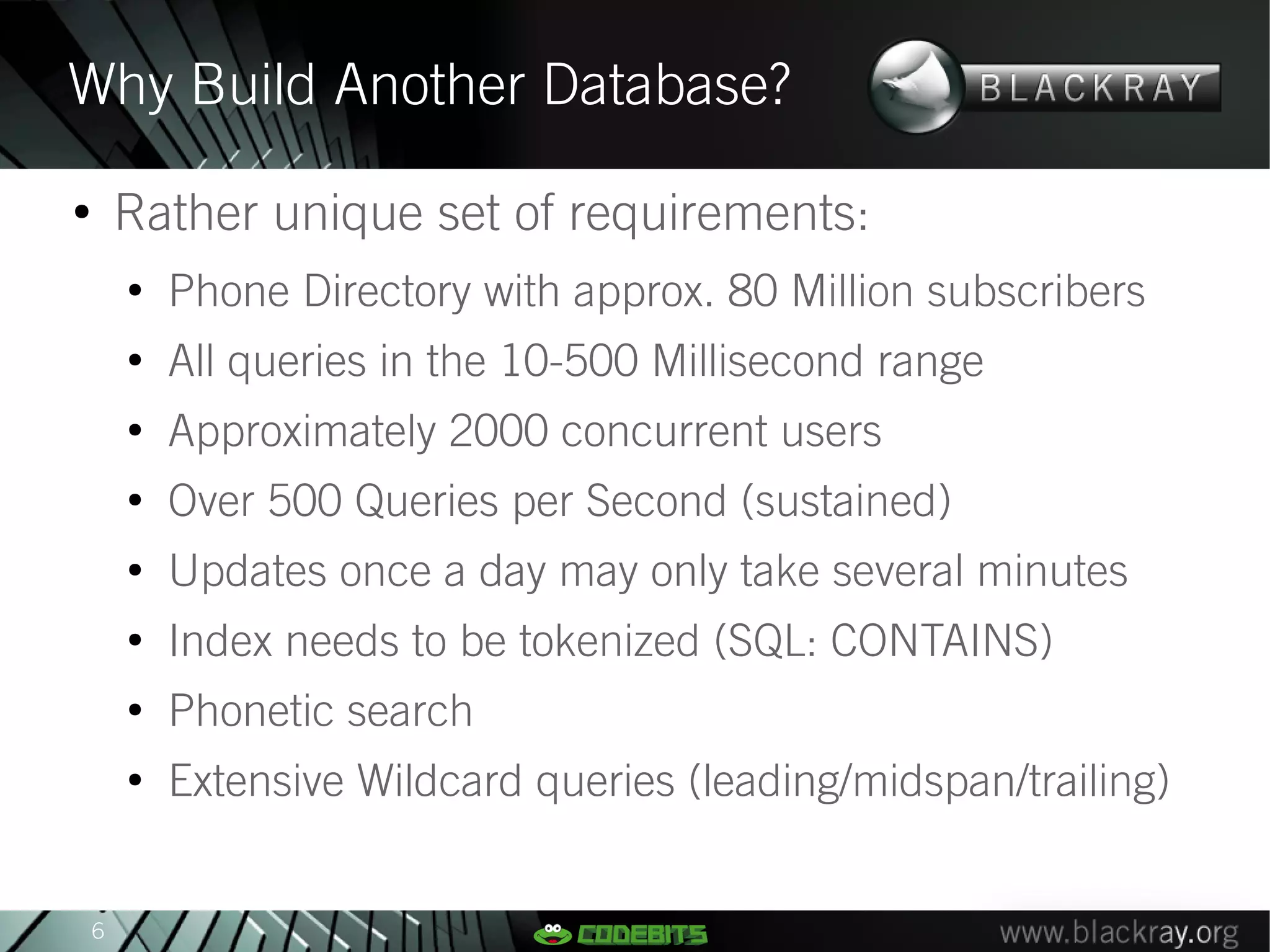
Why Build Another Database?
●
        Rather unique set of requirements:
        ●
            Phone Directory with approx. 80 Million subscribers
        ●
            All queries in the 10-500 Millisecond range
        ●
            Approximately 2000 concurrent users
        ●
            Over 500 Queries per Second (sustained)
        ●
            Updates once a day may only take several minutes
        ●
            Index needs to be tokenized (SQL: CONTAINS)
        ●
            Phonetic search
        ●
            Extensive Wildcard queries (leading/midspan/trailing)


    6
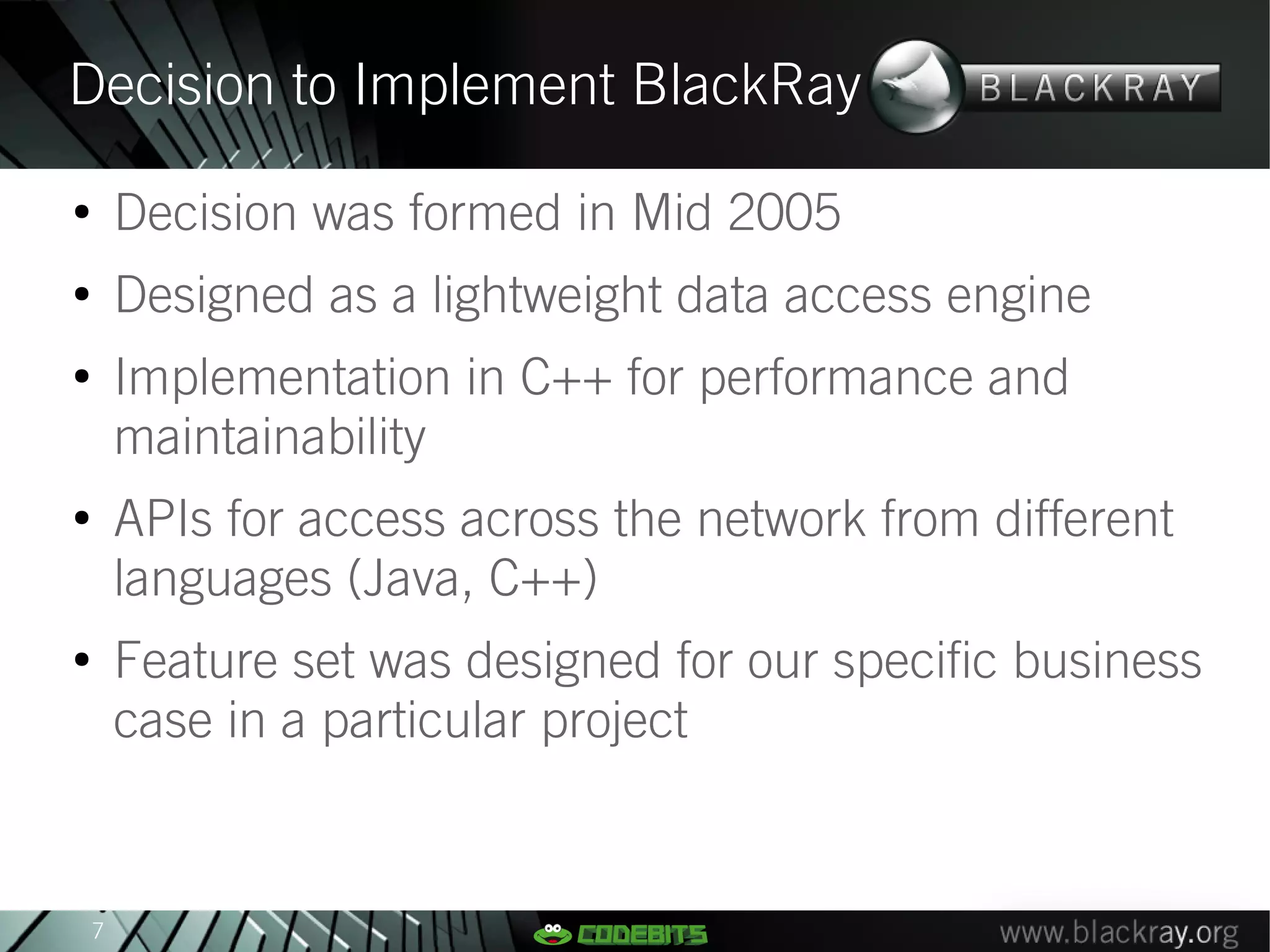
Decision to Implement BlackRay
●
        Decision was formed in Mid 2005
●
        Designed as a lightweight data access engine
●
        Implementation in C++ for performance and
        maintainability
●
        APIs for access across the network from different
        languages (Java, C++)
●
        Feature set was designed for our specific business
        case in a particular project


    7
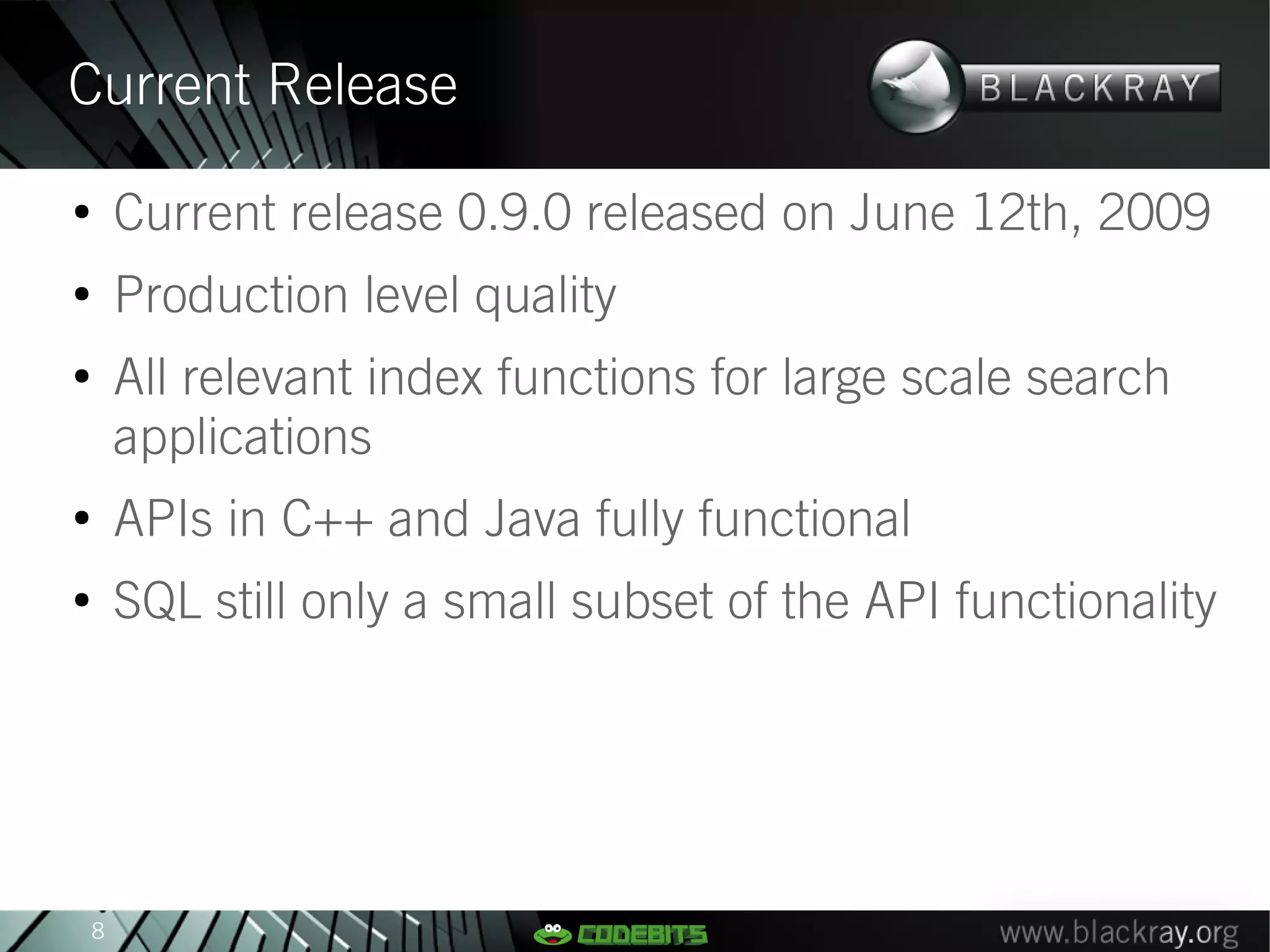
Current Release
●
        Current release 0.9.0 released on June 12th, 2009
●
        Production level quality
●
        All relevant index functions for large scale search
        applications
●
        APIs in C++ and Java fully functional
●
        SQL still only a small subset of the API functionality


    8
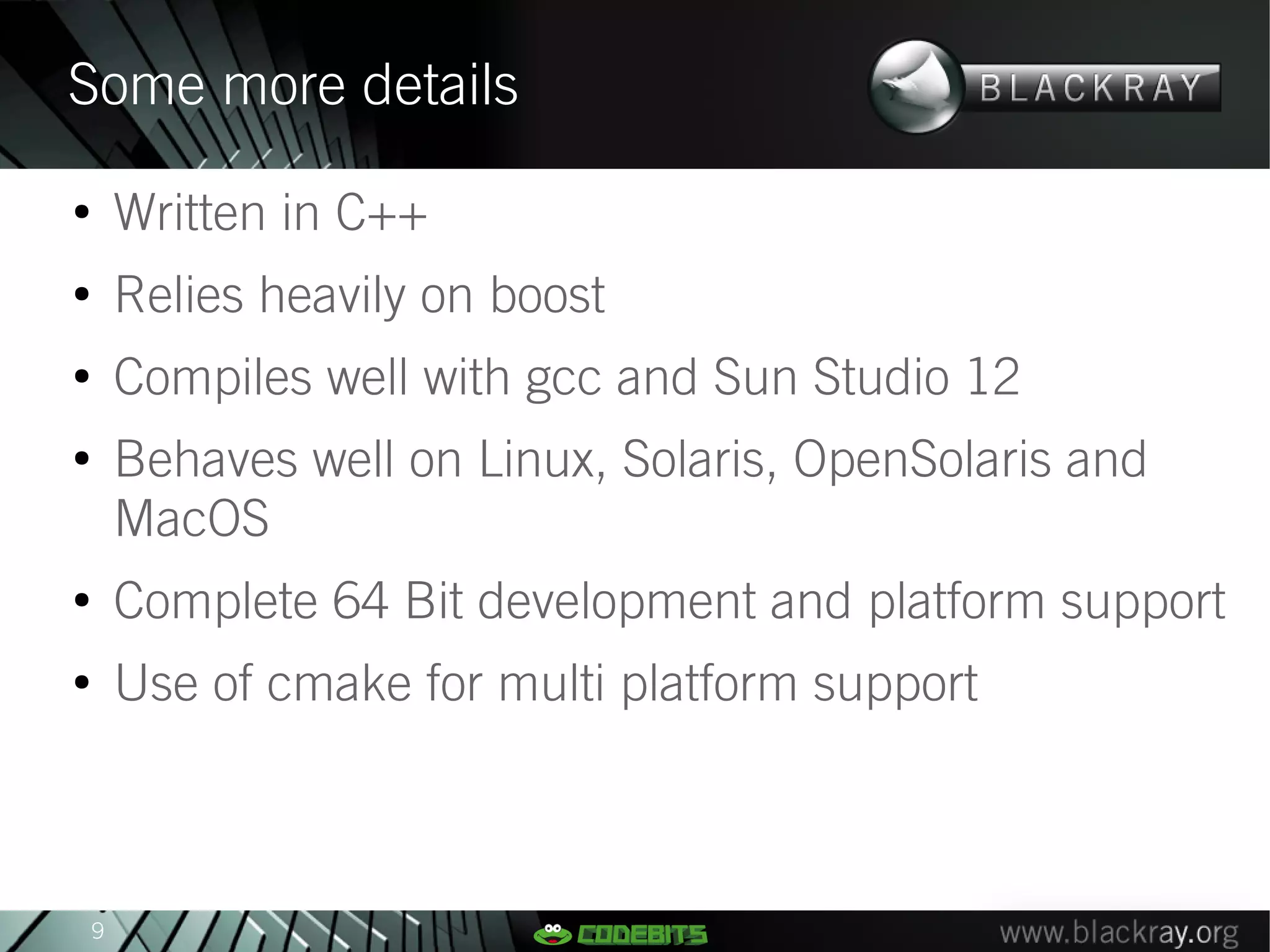
Some more details
●
        Written in C++
●
        Relies heavily on boost
●
        Compiles well with gcc and Sun Studio 12
●
        Behaves well on Linux, Solaris, OpenSolaris and
        MacOS
●
        Complete 64 Bit development and platform support
●
        Use of cmake for multi platform support


    9
Technology Overview
Why call it Data Engine?
●
     BlackRay is a hybrid between a relational database
     and a search engine → thus we call it „data engine“
●
     Database features:
     ●
         Relational structure, with Join between tables
     ●
         Wildcards and index functions
     ●
         SQL and JDBC/ODBC
●
     Search Engine Features
     ●
         Fulltext retrieval (token index)
     ●
         Phonetic and similar approximation search
     ●
         Extremely low latency
11
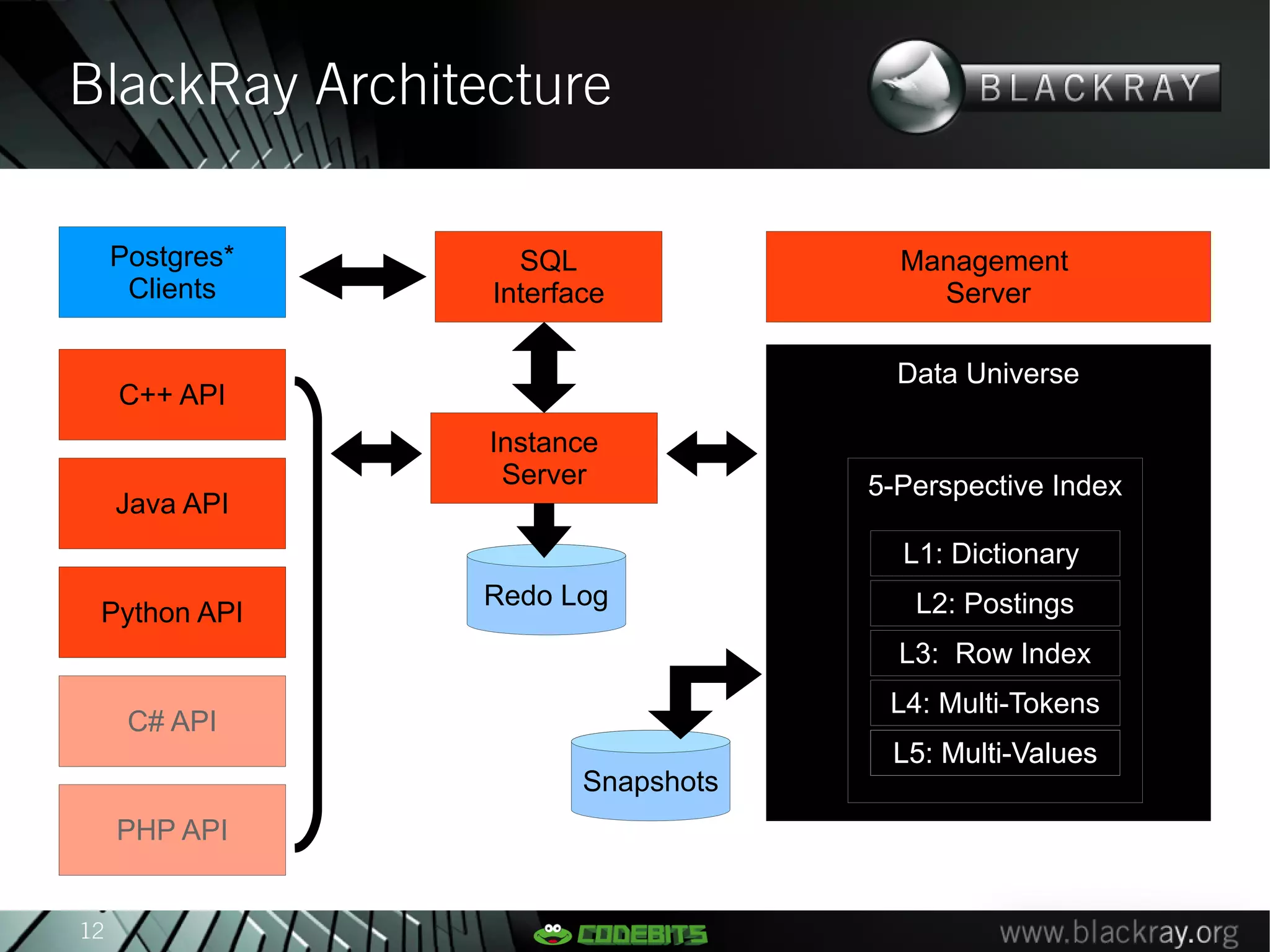
BlackRay Architecture

     Postgres*     SQL                Management
      Clients    Interface              Server

                                      Data Universe
     C++ API
                 Instance
                  Server            5-Perspective Index
     Java API
                                      L1: Dictionary
                 Redo Log              L2: Postings
 Python API
                                      L3: Row Index
                                     L4: Multi-Tokens
      C# API
                                     L5: Multi-Values
                        Snapshots          <
     PHP API


12
Hierarchical Model
●
     Each BlackRay node can hold many Instances
●
     One Management process per node
●
     Each Instance runs in a separate Process
●
     Instances are completely separated from each other
●
     Snapshots (for persistence) are taken on an
     Instance level
●
     In an Instance, Schemas and Tables can be created
●
     Within one Instance, Queries can span across
     Tables and Schemas
13
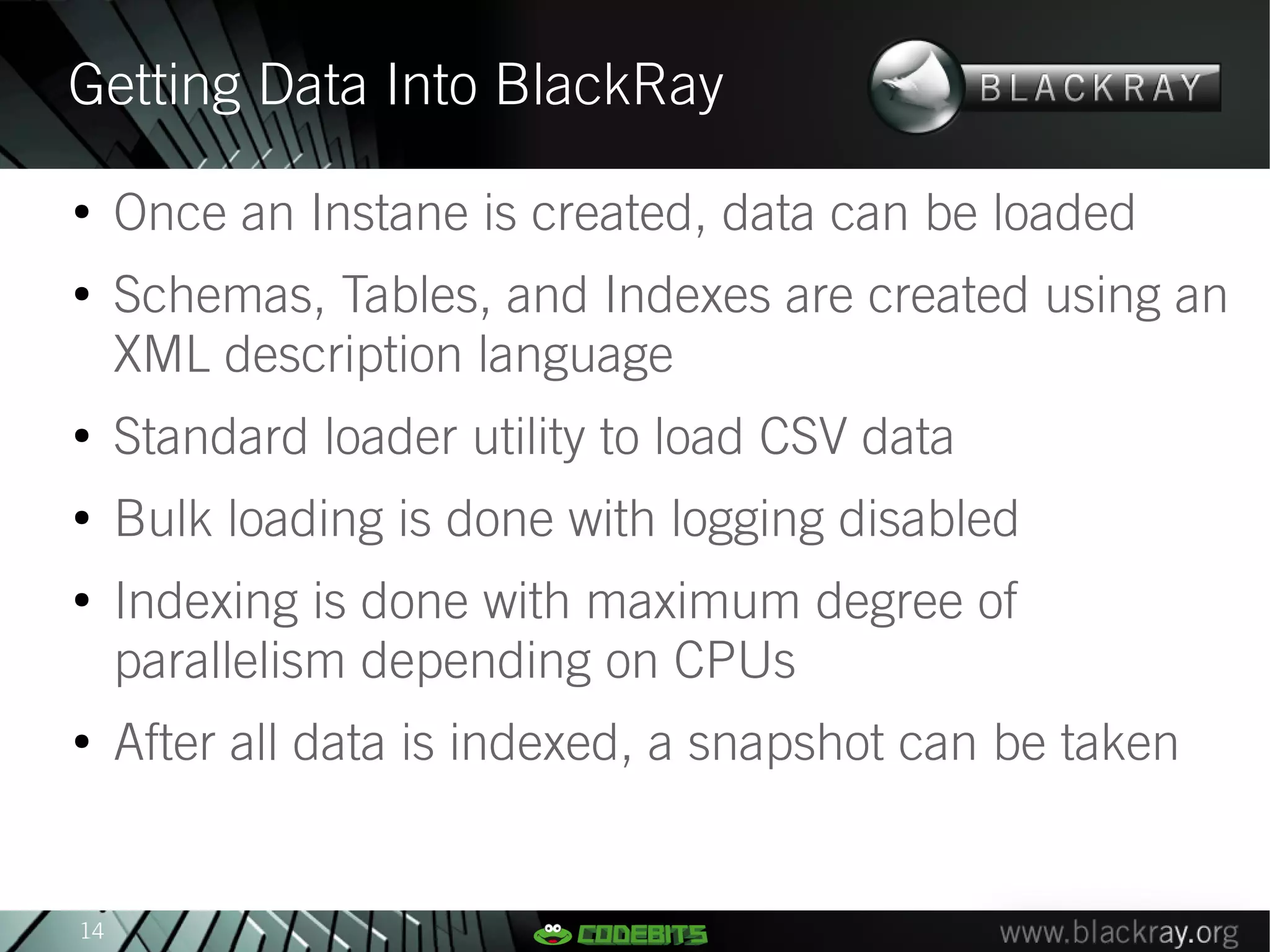
Getting Data Into BlackRay
●
     Once an Instane is created, data can be loaded
●
     Schemas, Tables, and Indexes are created using an
     XML description language
●
     Standard loader utility to load CSV data
●
     Bulk loading is done with logging disabled
●
     Indexing is done with maximum degree of
     parallelism depending on CPUs
●
     After all data is indexed, a snapshot can be taken


14
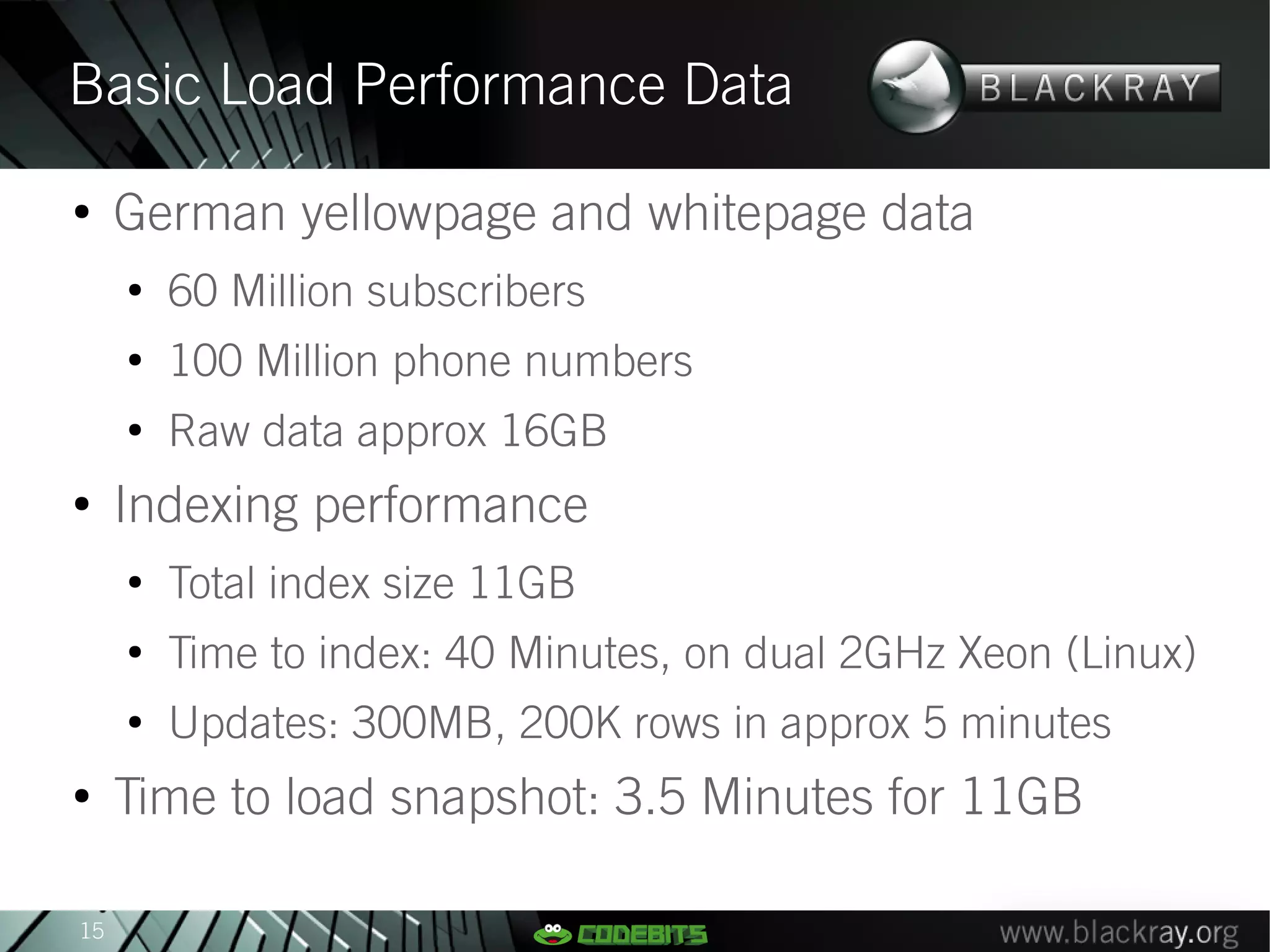
Basic Load Performance Data
●
     German yellowpage and whitepage data
     ●
         60 Million subscribers
     ●
         100 Million phone numbers
     ●
         Raw data approx 16GB
●
     Indexing performance
     ●
         Total index size 11GB
     ●
         Time to index: 40 Minutes, on dual 2GHz Xeon (Linux)
     ●
         Updates: 300MB, 200K rows in approx 5 minutes
●
     Time to load snapshot: 3.5 Minutes for 11GB

15
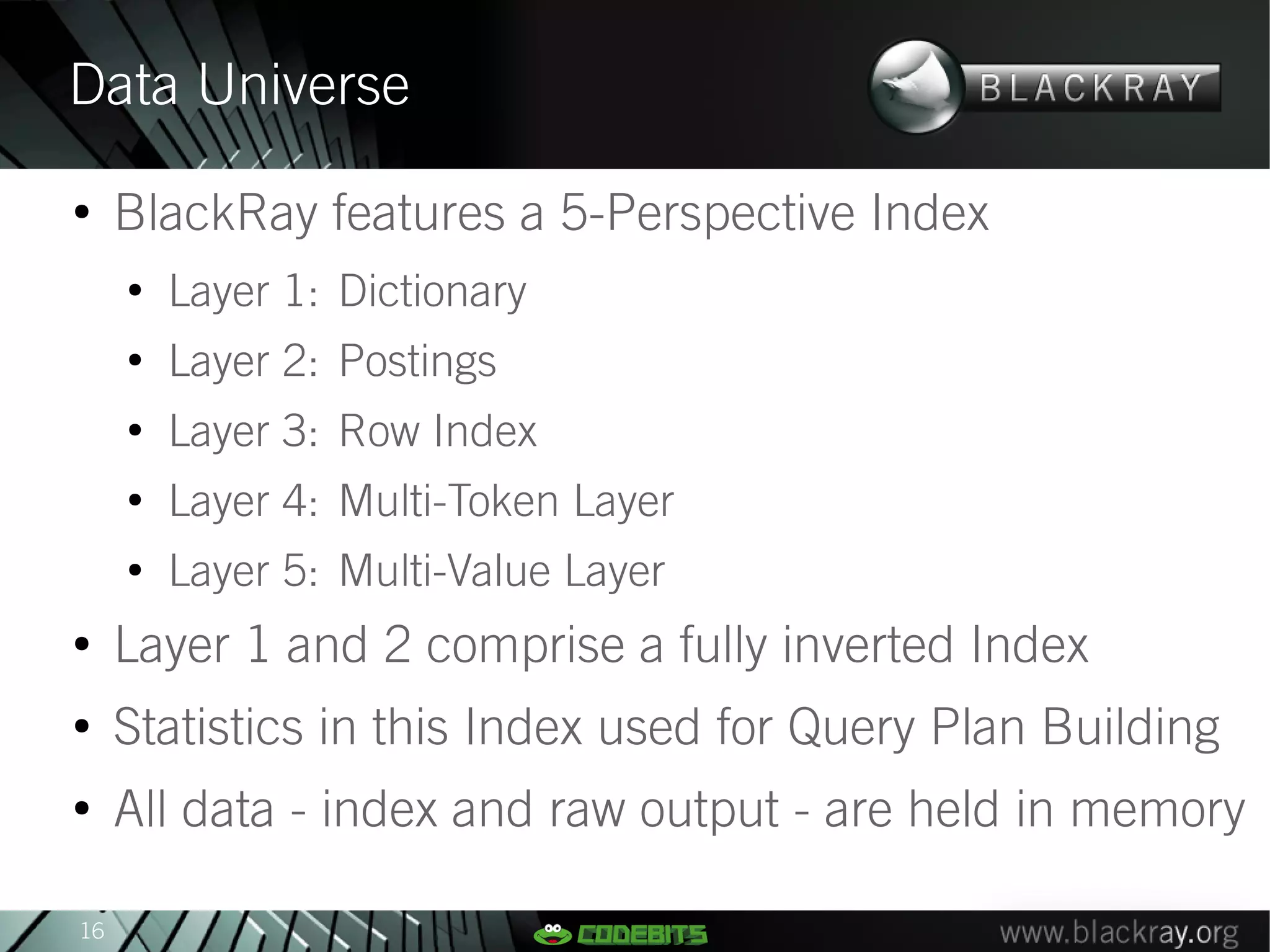
Data Universe
●
     BlackRay features a 5-Perspective Index
     ●
         Layer 1: Dictionary
     ●
         Layer 2: Postings
     ●
         Layer 3: Row Index
     ●
         Layer 4: Multi-Token Layer
     ●
         Layer 5: Multi-Value Layer
●
     Layer 1 and 2 comprise a fully inverted Index
●
     Statistics in this Index used for Query Plan Building
●
     All data - index and raw output - are held in memory

16
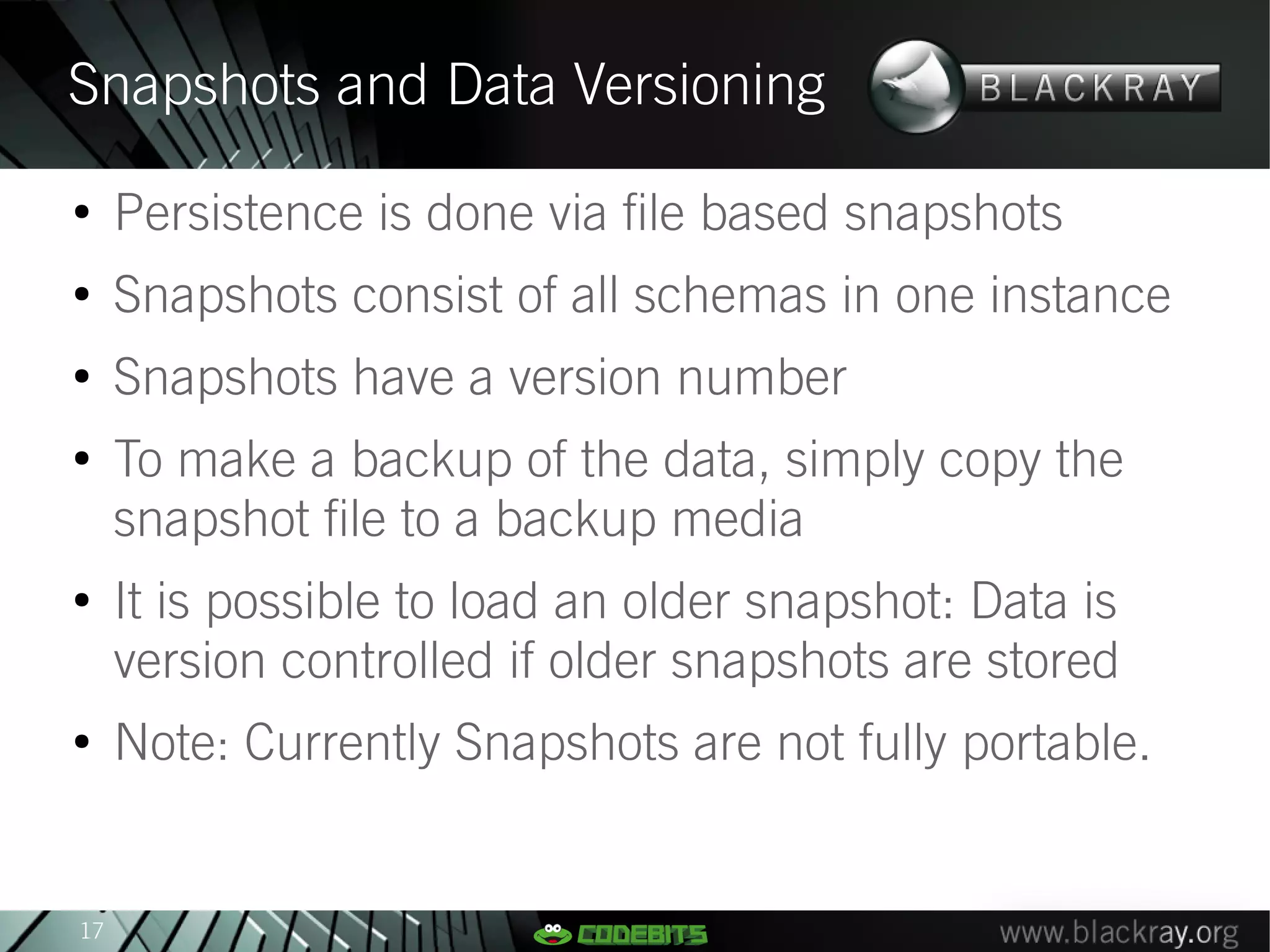
Snapshots and Data Versioning
●
     Persistence is done via file based snapshots
●
     Snapshots consist of all schemas in one instance
●
     Snapshots have a version number
●
     To make a backup of the data, simply copy the
     snapshot file to a backup media
●
     It is possible to load an older snapshot: Data is
     version controlled if older snapshots are stored
●
     Note: Currently Snapshots are not fully portable.


17
Transactions in BlackRay
●
     BlackRay supports transactions via a Redo Log
●
     All commands that modify data are logged if
     requested
●
     In case of a crash, the latest snapshot will be loaded
●
     Replay of the transaction log will then bring the
     database back to a consistent state
●
     Redo Log is eliminated when a snapshot is persisted
●
     For better performance snapshots should be taken
     periodically, ideally after each bulk update

18
Native Query APIs
●
     C++, Java and Python Object Oriented APIs are
     available
●
     Built with ICE (ZeroC) as the Network and Object
     Brokerage Protocol
●
     Query Objects are constructed using an Object
     Builder
●
     Execution via the network, Results as Objects
●
     Load balacing and failover built into the protocol
●
     Native support for Ruby, PHP and C# upcoming

19
Native Query APIs
●
     Queries can use any combination of OR, AND
●
     Index functions (phonetic, sysnonyms, stopwords)
     can be stacked
●
     Token search (fulltext) and wildcard are also
     supported
●
     Advantage of the APIs:
     ●
         Minimized overhead
     ●
         Very low latency
     ●
         High availability

20
Standard Query Interface
●
     BlackRay implements the PostgreSQL server socket
     interface
●
     All PostgreSQL compatible frontends can be utilized
     against BlackRay
●
     JDBC, ODBC, native drivers using socket interface
     are all supported
●
     Limitations: SQL is only a reasonable subset of
     SQL92, Metadata is not yet fully implemented...
●
     Currently not all index functions can be accessed
     via SQL statements
21
Management Features
●
     Management Server acts as central broker for all
     Instances
●
     Command line tools for administration
●
     SNMP management:
     ●
         Health check of Instances
     ●
         Statistics , including access counters and performance
         measurements


22
Clustering and Replication
●
     BlackRay supports a multi-node setup for fault
     tolerance
●
     Cluster have N query nodes and single update node
●
     All query nodes are equal and require the full index
     data available
●
     Index creation is done offline on the update node
●
     Query nodes can reload snapshots to receive
     updated data, via shared storage or local copy
●
     Load-balancing handled by native APIs

23
Administration Requirements
●
     In-Memory Databases require very little
     administrative tasks
●
     Configuration via one file per Instance
●
     Disk layout etc all are of no importance
●
     Backups are performed by copying snapshots
●
     Recovery is done by restoring a snapshot
●
     No daily administration required
●
     SNMP allows remote supervision with common tools


24
Positioning BlackRay
BlackRay and other Projects
●
     BlackRay is being positioned as a Query intensive
     database addition
●
     Ideally suited where updates are done in Bulk and
     searches outweigh updates by many orders of
     magnitude
●
     Wildcards come with little overhead: No overhead
     for trailing wildcard, some overhead for leading and
     midspan wildcard
●
     Good match when index functions such as phonetic
     or word rotation/position search combined with
     relational data are required
26
FOSS Projects with similar Goals
●
     Relational Databases (the usual suspects):
     ●
         MySQL, MariaDB, Drizzle....
     ●
         PostgreSQL...
     ●
         Many more alternatives, including embedded etc....
●
     Fulltext Search:
     ●
         Sphinx
     ●
         Lucene
●
     In-Memory Databases:
     ●
         FastDB
     ●
         HSQLDB/H2 (Java → Garbage collection issues....)
27
Commercial Alternatives
●
     Commercial In-Memory Databases
     ●
         ORACLE/TimesTen (Acquired by ORACLE in 2005)
     ●
         IBM/SolidDB (Acquired by IBM in 2007)
     ●
         VoltDB (No real data available as of yet)
     ●
         eXtremeDB (embedded use only)

●
     Dual-Licensed Alternatives
     ●
         CSQL (Open Source Version is severely crippled)
     ●
         MySQL with memcached

28
Is it the right thing for me?
●
     BlackRay is not designed as a 100% RDBMS
     replacement
●
     Questions to ask:
     ●
         Do I need ad-hoc data updates, or are updates done in
         bulk?
     ●
         How important are fulltext search and extensive
         wildcards?
     ●
         How large is my data? Gigabytes: OK. Terrabytes: Not yet
     ●
         Do I need a relational data model?
     ●
         Is SQL an important feature?

29
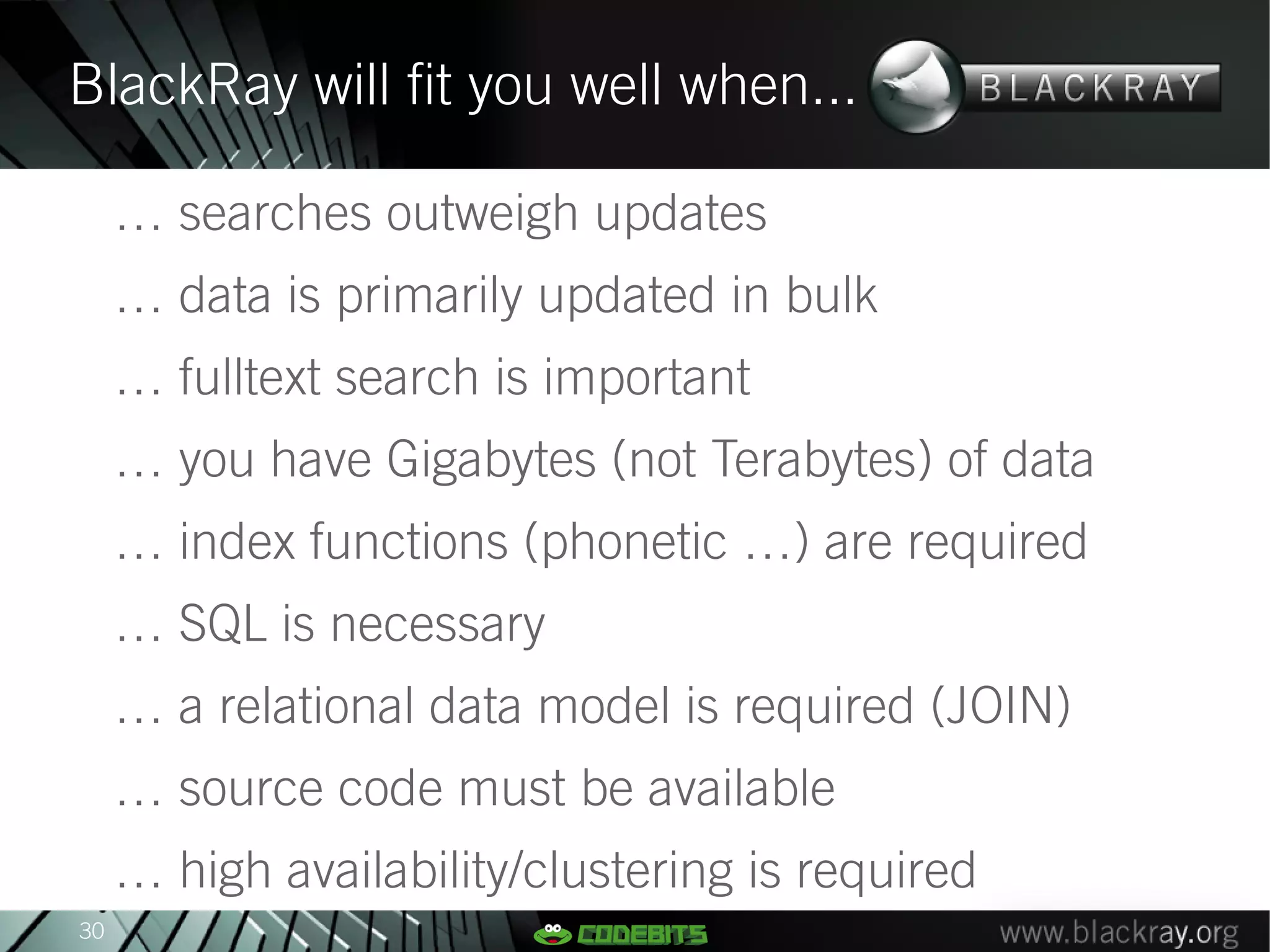
BlackRay will fit you well when...

     … searches outweigh updates
     … data is primarily updated in bulk
     … fulltext search is important
     … you have Gigabytes (not Terabytes) of data
     … index functions (phonetic …) are required
     … SQL is necessary
     … a relational data model is required (JOIN)
     … source code must be available
     … high availability/clustering is required
30
Project Roadmap
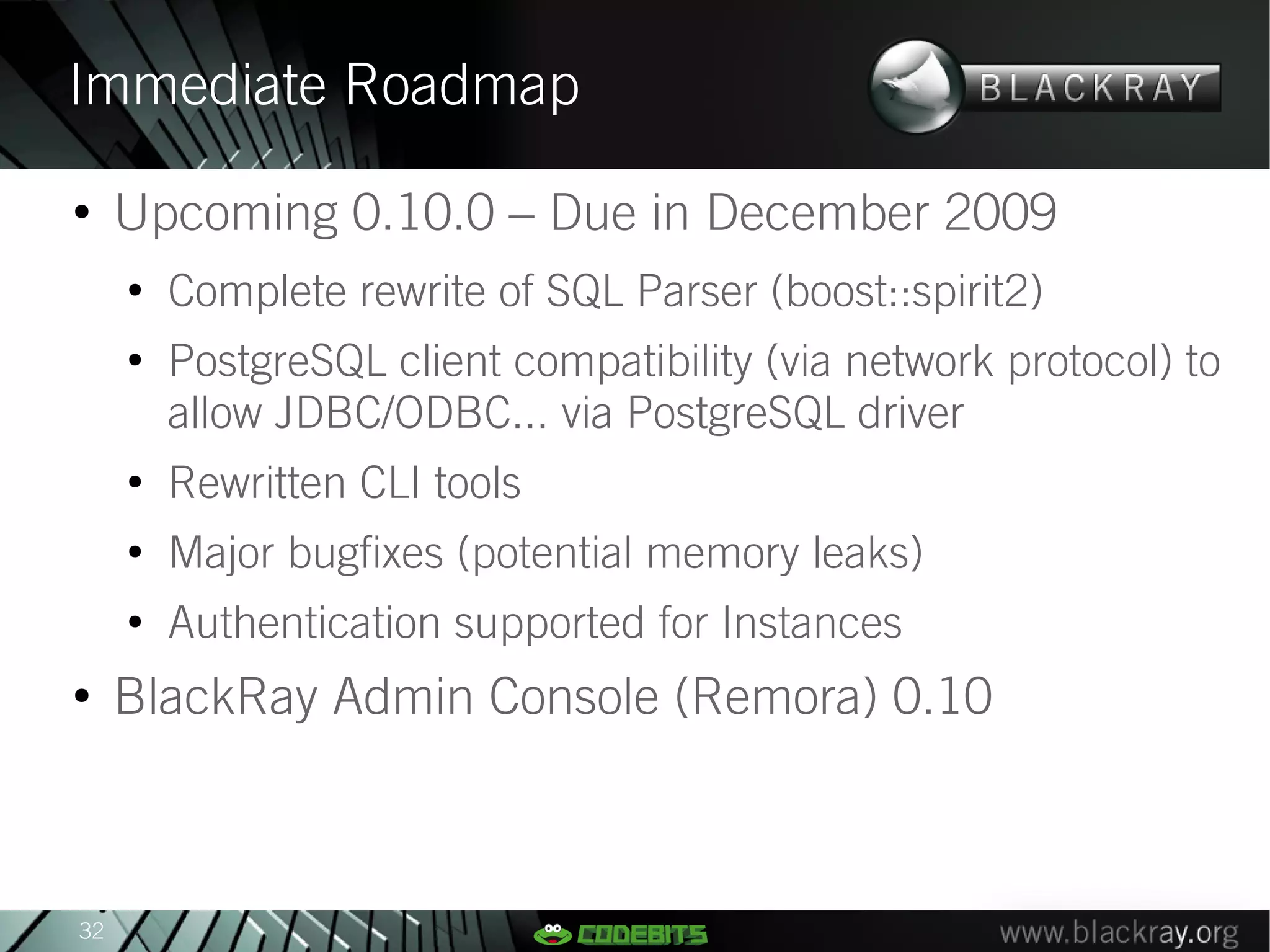
Immediate Roadmap
●
     Upcoming 0.10.0 – Due in December 2009
     ●
         Complete rewrite of SQL Parser (boost::spirit2)
     ●
         PostgreSQL client compatibility (via network protocol) to
         allow JDBC/ODBC... via PostgreSQL driver
     ●
         Rewritten CLI tools
     ●
         Major bugfixes (potential memory leaks)
     ●
         Authentication supported for Instances
●
     BlackRay Admin Console (Remora) 0.10


32
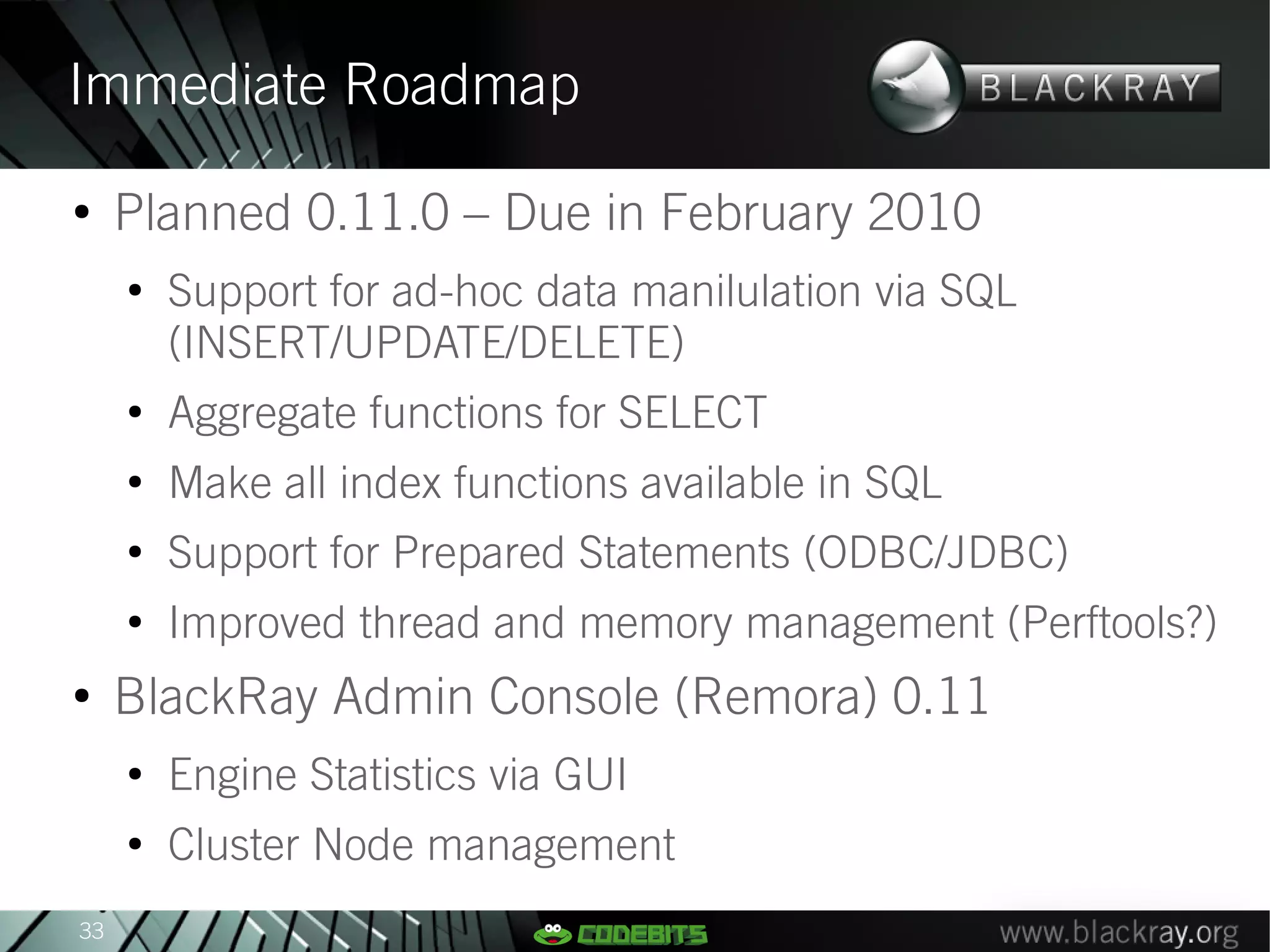
Immediate Roadmap
●
     Planned 0.11.0 – Due in February 2010
     ●
         Support for ad-hoc data manilulation via SQL
         (INSERT/UPDATE/DELETE)
     ●
         Aggregate functions for SELECT
     ●
         Make all index functions available in SQL
     ●
         Support for Prepared Statements (ODBC/JDBC)
     ●
         Improved thread and memory management (Perftools?)
●
     BlackRay Admin Console (Remora) 0.11
     ●
         Engine Statistics via GUI
     ●
         Cluster Node management
33
Midterm Roadmap
●
     Scalability Features
     ●
         Sharding & Partitioning Options
     ●
         Federated Search
●
     Fully portable snapshot format (across platforms)
●
     Query Performance Analyzer
●
     Improved Statistics Module with GUI
●
     Removal of ICE as a core component
●
     BlackRay as a Storage Backend for SUN OpenDS
     LDAP Engine
34
Midterm Roadmap
●
     Security Features
     ●
         Improved User and Access Control concepts
     ●
         SSL for all connections
     ●
         External User Store (LDAP/OpenSSO/PAM...)
●
     Increased Platform support
     ●
         Windows 7 and Windows Server platforms
     ●
         Embedded platforms
●
     Other, random features by popular request.


35
Longterm Roadmap
●
     Integration with other DBMSs
     ●
         Storage Engine for other DBMSs
         MariaDB/MySQL: → Depends on potential modification
         needs of the storage engine interfaces
     ●
         Trigger-based updates to support BlackRay as a Query
         cache instance over a regular DBMS
●
     Update: The Storage Engine Interface Issue was
     discussed at the OpenSQL Camp 2009 in Portland,
     Tokutek suggested a portable and more efficient
     Universal Storage Engine Interface

36
Longterm Roadmap
●
     Standalone Engine Improvements
     ●
         SQL92 compliance: SUBSELECT/UNION support
     ●
         Triggers in BlackRay
     ●
         Full ACID Transaction support


37
The Team behind BlackRay
SoftMethod GmbH
●
     SoftMethod GmbH initiated the project in 2005 and
●
     Company was founded in 2004 and currently has
     10 employees
●
     Focus of SoftMethod is high performance software
     engineering
●
     Product portfolio includes directory assistance and
     LDAP enabled applications
●
     SoftMethod also offers load testing and technical
     software quality assurance support.

39
Development Team
●
     SoftMethod Core Team
     ●
         Thomas Wunschel – Lead Developer
     ●
         Felix Schupp – Project Sponsor
     ●
         Andreas Meyer – Documentation, Porting
     ●
         Frank Fiedler – PhD Student in Database Systems
●
     Key Contributors
     ●
         Mike Alexeev – Senior Developer
     ●
         Souvik Roy, Intern at SoftMethod GmbH
     ●
         Andreas Strafner – Developer, Porting to AIX

40
Thomas Wunschel
●
     Director of Development, SoftMethod GmbH
●
     Almost 10 years of development experience
●
     Involved with BlackRay and its applications since
     2005
●
     Currently involved in the Network Protocol Stack
●
     Lead Designer and Decision Lead for new Features


41
Felix Schupp
●
     Managing Director, SoftMethod GmbH
●
     Over 10 years of commercial software development
●
     Designer of first BlackRay predecessor in 1999
●
     Project sponsor and spokesperson
●
     Responsible for funding and applications
●
     Guide and coach in the development process


42
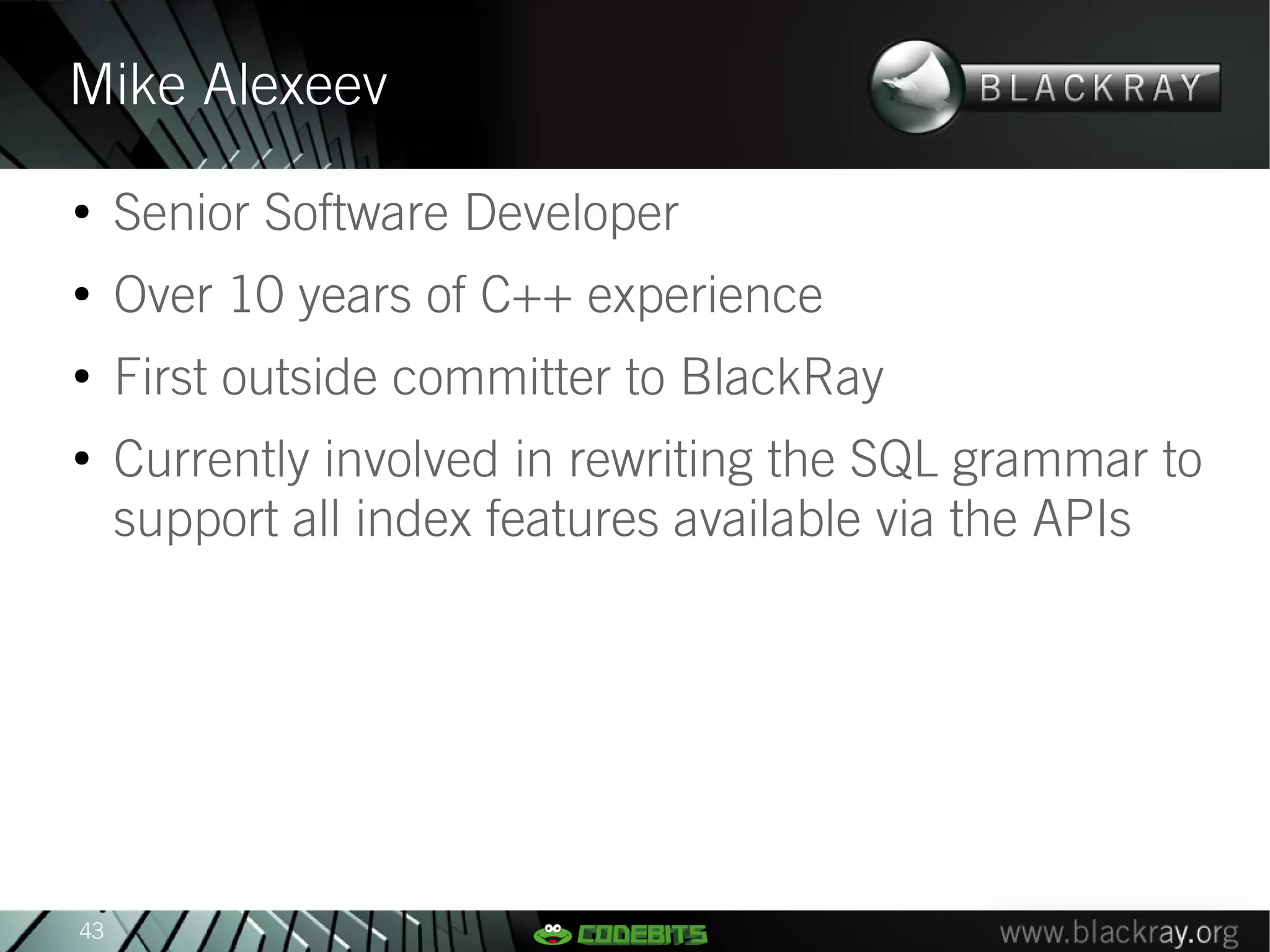
Mike Alexeev
●
     Senior Software Developer
●
     Over 10 years of C++ experience
●
     First outside committer to BlackRay
●
     Currently involved in rewriting the SQL grammar to
     support all index features available via the APIs


43
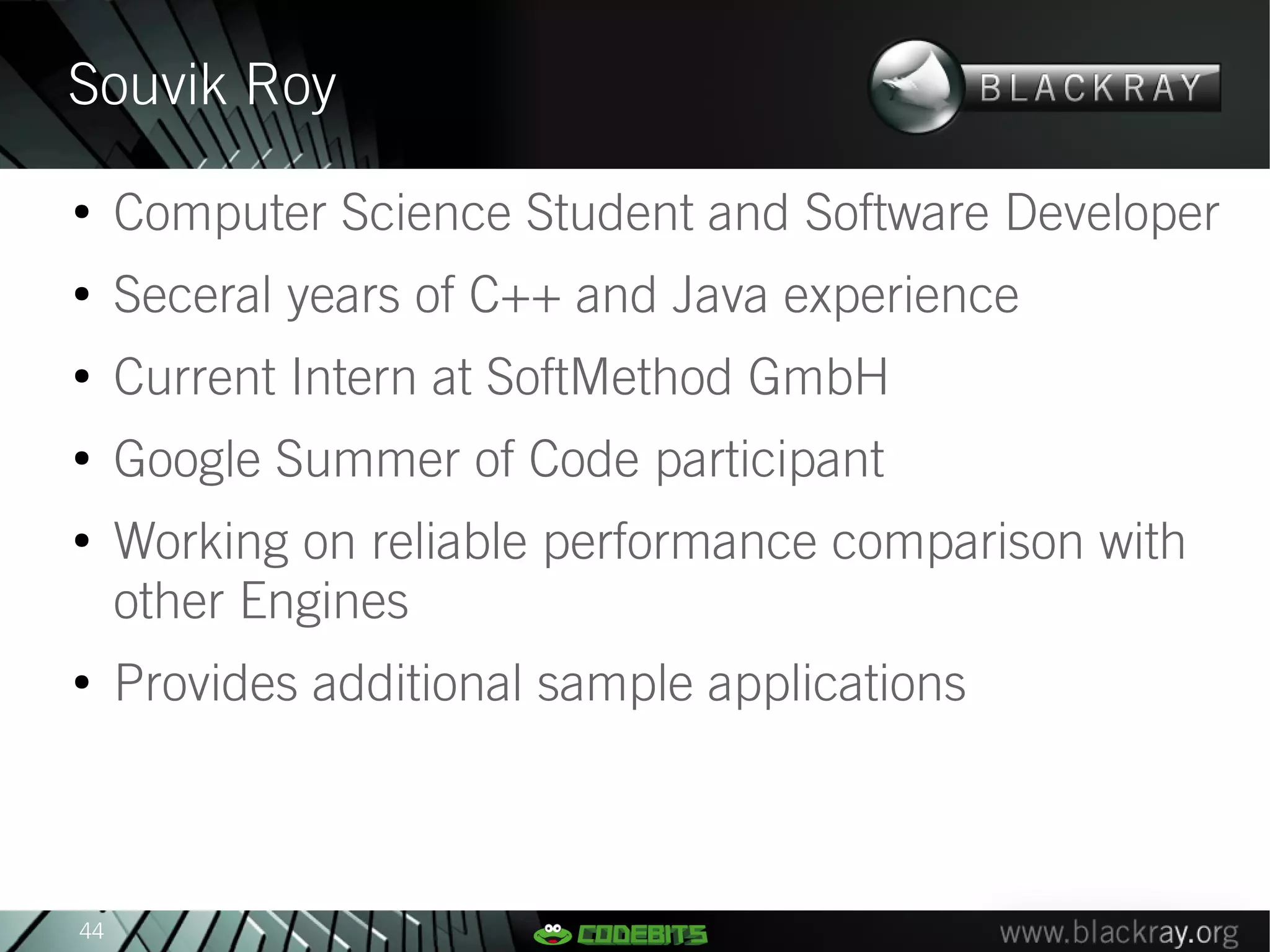
Souvik Roy
●
     Computer Science Student and Software Developer
●
     Seceral years of C++ and Java experience
●
     Current Intern at SoftMethod GmbH
●
     Google Summer of Code participant
●
     Working on reliable performance comparison with
     other Engines
●
     Provides additional sample applications


44
Wrap-Up
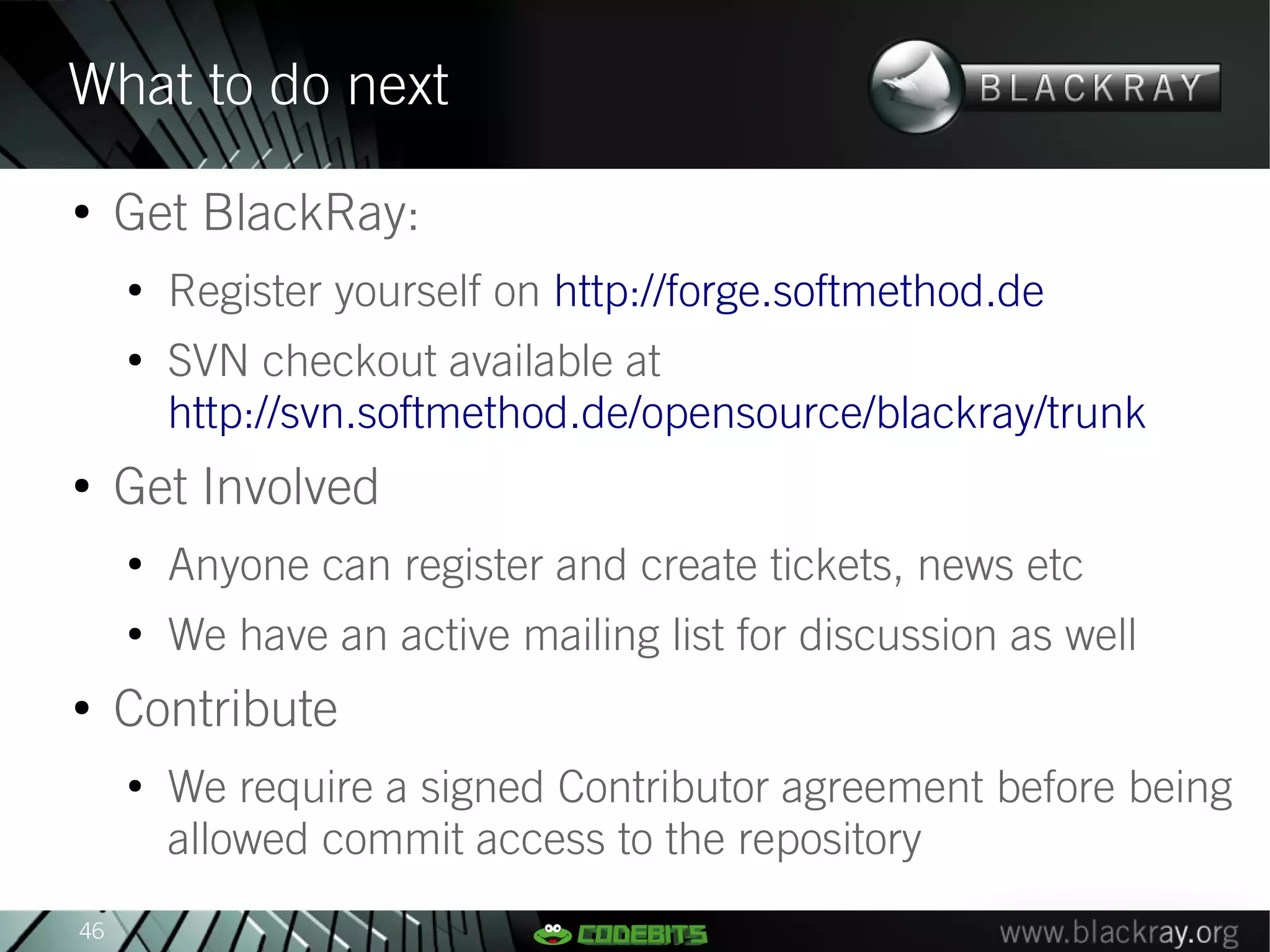
What to do next
●
     Get BlackRay:
     ●
         Register yourself on http://forge.softmethod.de
     ●
         SVN checkout available at
         http://svn.softmethod.de/opensource/blackray/trunk
●
     Get Involved
     ●
         Anyone can register and create tickets, news etc
     ●
         We have an active mailing list for discussion as well
●
     Contribute
     ●
         We require a signed Contributor agreement before being
         allowed commit access to the repository
46
Contact Us
●
     Website:     http://www.blackray.org
●
     Twitter:     http://twitter.com/dataengine
●
     Facebook     http://facebook.com/dataengine
●
     Mailing List: http://lists.softmethod.de
●
     Download:    http://sourceforge.net/projects/blackray

●
     Felix:       felix.schupp@softmethod.de
●
     Thomas:      thomas.wunschel@softmethod.de

47

Blackray @ SAPO CodeBits 2009

  • 1.
  • 2.
    Presentation Agenda ➔ Brief History ➔ Technology Overview ➔ Positioning towards other Projects ➔ Roadmap ➔ The Team ➔ Wrap-Up 2
  • 3.
  • 4.
    What is BlackRay? ● BlackRay is a relational, in-memory database ● SQL with JDBC and ODBC Driver support ● Fulltext (Tokenized) Search in Text fields ● Object-Oriented API Support ● Persistence via Files ● Scalable and Fault Tolerant ● Open Source, Open Community ● Available under the GPLv2 4
  • 5.
    BlackRay History ● Concept of BlackRay was developed in 1999 for a Web Phone Directory at Deutsche Telekom ● Development of current BlackRay started in 2005, as a Data Access Library ● First Production Use at Deutsche Telekom in 2006 ● Evolution to Data Engine in 2007 and 2008 ● Open Source under GPLv2 since June 2009 5
  • 6.
    Why Build AnotherDatabase? ● Rather unique set of requirements: ● Phone Directory with approx. 80 Million subscribers ● All queries in the 10-500 Millisecond range ● Approximately 2000 concurrent users ● Over 500 Queries per Second (sustained) ● Updates once a day may only take several minutes ● Index needs to be tokenized (SQL: CONTAINS) ● Phonetic search ● Extensive Wildcard queries (leading/midspan/trailing) 6
  • 7.
    Decision to ImplementBlackRay ● Decision was formed in Mid 2005 ● Designed as a lightweight data access engine ● Implementation in C++ for performance and maintainability ● APIs for access across the network from different languages (Java, C++) ● Feature set was designed for our specific business case in a particular project 7
  • 8.
    Current Release ● Current release 0.9.0 released on June 12th, 2009 ● Production level quality ● All relevant index functions for large scale search applications ● APIs in C++ and Java fully functional ● SQL still only a small subset of the API functionality 8
  • 9.
    Some more details ● Written in C++ ● Relies heavily on boost ● Compiles well with gcc and Sun Studio 12 ● Behaves well on Linux, Solaris, OpenSolaris and MacOS ● Complete 64 Bit development and platform support ● Use of cmake for multi platform support 9
  • 10.
  • 11.
    Why call itData Engine? ● BlackRay is a hybrid between a relational database and a search engine → thus we call it „data engine“ ● Database features: ● Relational structure, with Join between tables ● Wildcards and index functions ● SQL and JDBC/ODBC ● Search Engine Features ● Fulltext retrieval (token index) ● Phonetic and similar approximation search ● Extremely low latency 11
  • 12.
    BlackRay Architecture Postgres* SQL Management Clients Interface Server Data Universe C++ API Instance Server 5-Perspective Index Java API L1: Dictionary Redo Log L2: Postings Python API L3: Row Index L4: Multi-Tokens C# API L5: Multi-Values Snapshots < PHP API 12
  • 13.
    Hierarchical Model ● Each BlackRay node can hold many Instances ● One Management process per node ● Each Instance runs in a separate Process ● Instances are completely separated from each other ● Snapshots (for persistence) are taken on an Instance level ● In an Instance, Schemas and Tables can be created ● Within one Instance, Queries can span across Tables and Schemas 13
  • 14.
    Getting Data IntoBlackRay ● Once an Instane is created, data can be loaded ● Schemas, Tables, and Indexes are created using an XML description language ● Standard loader utility to load CSV data ● Bulk loading is done with logging disabled ● Indexing is done with maximum degree of parallelism depending on CPUs ● After all data is indexed, a snapshot can be taken 14
  • 15.
    Basic Load PerformanceData ● German yellowpage and whitepage data ● 60 Million subscribers ● 100 Million phone numbers ● Raw data approx 16GB ● Indexing performance ● Total index size 11GB ● Time to index: 40 Minutes, on dual 2GHz Xeon (Linux) ● Updates: 300MB, 200K rows in approx 5 minutes ● Time to load snapshot: 3.5 Minutes for 11GB 15
  • 16.
    Data Universe ● BlackRay features a 5-Perspective Index ● Layer 1: Dictionary ● Layer 2: Postings ● Layer 3: Row Index ● Layer 4: Multi-Token Layer ● Layer 5: Multi-Value Layer ● Layer 1 and 2 comprise a fully inverted Index ● Statistics in this Index used for Query Plan Building ● All data - index and raw output - are held in memory 16
  • 17.
    Snapshots and DataVersioning ● Persistence is done via file based snapshots ● Snapshots consist of all schemas in one instance ● Snapshots have a version number ● To make a backup of the data, simply copy the snapshot file to a backup media ● It is possible to load an older snapshot: Data is version controlled if older snapshots are stored ● Note: Currently Snapshots are not fully portable. 17
  • 18.
    Transactions in BlackRay ● BlackRay supports transactions via a Redo Log ● All commands that modify data are logged if requested ● In case of a crash, the latest snapshot will be loaded ● Replay of the transaction log will then bring the database back to a consistent state ● Redo Log is eliminated when a snapshot is persisted ● For better performance snapshots should be taken periodically, ideally after each bulk update 18
  • 19.
    Native Query APIs ● C++, Java and Python Object Oriented APIs are available ● Built with ICE (ZeroC) as the Network and Object Brokerage Protocol ● Query Objects are constructed using an Object Builder ● Execution via the network, Results as Objects ● Load balacing and failover built into the protocol ● Native support for Ruby, PHP and C# upcoming 19
  • 20.
    Native Query APIs ● Queries can use any combination of OR, AND ● Index functions (phonetic, sysnonyms, stopwords) can be stacked ● Token search (fulltext) and wildcard are also supported ● Advantage of the APIs: ● Minimized overhead ● Very low latency ● High availability 20
  • 21.
    Standard Query Interface ● BlackRay implements the PostgreSQL server socket interface ● All PostgreSQL compatible frontends can be utilized against BlackRay ● JDBC, ODBC, native drivers using socket interface are all supported ● Limitations: SQL is only a reasonable subset of SQL92, Metadata is not yet fully implemented... ● Currently not all index functions can be accessed via SQL statements 21
  • 22.
    Management Features ● Management Server acts as central broker for all Instances ● Command line tools for administration ● SNMP management: ● Health check of Instances ● Statistics , including access counters and performance measurements 22
  • 23.
    Clustering and Replication ● BlackRay supports a multi-node setup for fault tolerance ● Cluster have N query nodes and single update node ● All query nodes are equal and require the full index data available ● Index creation is done offline on the update node ● Query nodes can reload snapshots to receive updated data, via shared storage or local copy ● Load-balancing handled by native APIs 23
  • 24.
    Administration Requirements ● In-Memory Databases require very little administrative tasks ● Configuration via one file per Instance ● Disk layout etc all are of no importance ● Backups are performed by copying snapshots ● Recovery is done by restoring a snapshot ● No daily administration required ● SNMP allows remote supervision with common tools 24
  • 25.
  • 26.
    BlackRay and otherProjects ● BlackRay is being positioned as a Query intensive database addition ● Ideally suited where updates are done in Bulk and searches outweigh updates by many orders of magnitude ● Wildcards come with little overhead: No overhead for trailing wildcard, some overhead for leading and midspan wildcard ● Good match when index functions such as phonetic or word rotation/position search combined with relational data are required 26
  • 27.
    FOSS Projects withsimilar Goals ● Relational Databases (the usual suspects): ● MySQL, MariaDB, Drizzle.... ● PostgreSQL... ● Many more alternatives, including embedded etc.... ● Fulltext Search: ● Sphinx ● Lucene ● In-Memory Databases: ● FastDB ● HSQLDB/H2 (Java → Garbage collection issues....) 27
  • 28.
    Commercial Alternatives ● Commercial In-Memory Databases ● ORACLE/TimesTen (Acquired by ORACLE in 2005) ● IBM/SolidDB (Acquired by IBM in 2007) ● VoltDB (No real data available as of yet) ● eXtremeDB (embedded use only) ● Dual-Licensed Alternatives ● CSQL (Open Source Version is severely crippled) ● MySQL with memcached 28
  • 29.
    Is it theright thing for me? ● BlackRay is not designed as a 100% RDBMS replacement ● Questions to ask: ● Do I need ad-hoc data updates, or are updates done in bulk? ● How important are fulltext search and extensive wildcards? ● How large is my data? Gigabytes: OK. Terrabytes: Not yet ● Do I need a relational data model? ● Is SQL an important feature? 29
  • 30.
    BlackRay will fityou well when... … searches outweigh updates … data is primarily updated in bulk … fulltext search is important … you have Gigabytes (not Terabytes) of data … index functions (phonetic …) are required … SQL is necessary … a relational data model is required (JOIN) … source code must be available … high availability/clustering is required 30
  • 31.
  • 32.
    Immediate Roadmap ● Upcoming 0.10.0 – Due in December 2009 ● Complete rewrite of SQL Parser (boost::spirit2) ● PostgreSQL client compatibility (via network protocol) to allow JDBC/ODBC... via PostgreSQL driver ● Rewritten CLI tools ● Major bugfixes (potential memory leaks) ● Authentication supported for Instances ● BlackRay Admin Console (Remora) 0.10 32
  • 33.
    Immediate Roadmap ● Planned 0.11.0 – Due in February 2010 ● Support for ad-hoc data manilulation via SQL (INSERT/UPDATE/DELETE) ● Aggregate functions for SELECT ● Make all index functions available in SQL ● Support for Prepared Statements (ODBC/JDBC) ● Improved thread and memory management (Perftools?) ● BlackRay Admin Console (Remora) 0.11 ● Engine Statistics via GUI ● Cluster Node management 33
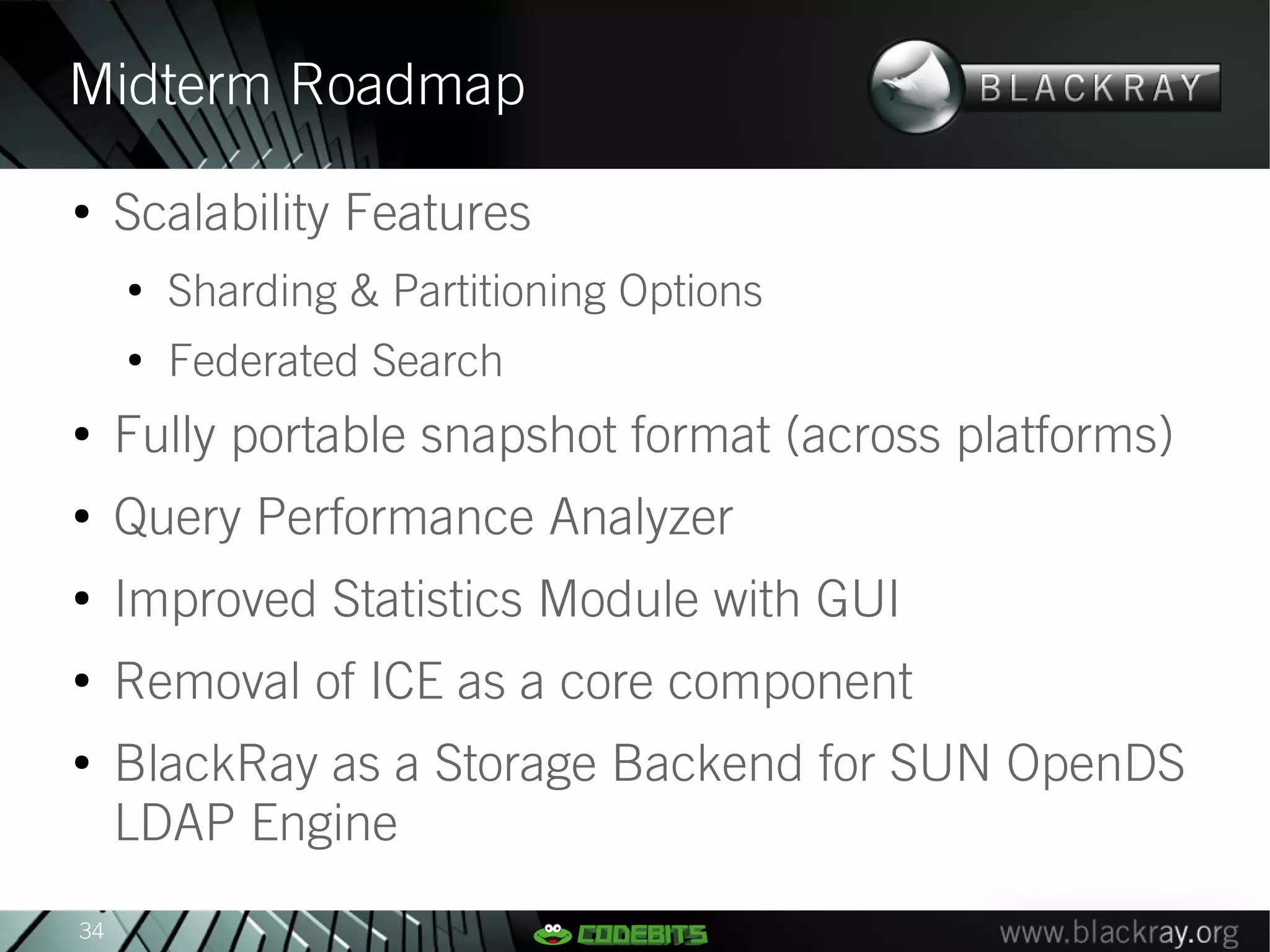
  • 34.
    Midterm Roadmap ● Scalability Features ● Sharding & Partitioning Options ● Federated Search ● Fully portable snapshot format (across platforms) ● Query Performance Analyzer ● Improved Statistics Module with GUI ● Removal of ICE as a core component ● BlackRay as a Storage Backend for SUN OpenDS LDAP Engine 34
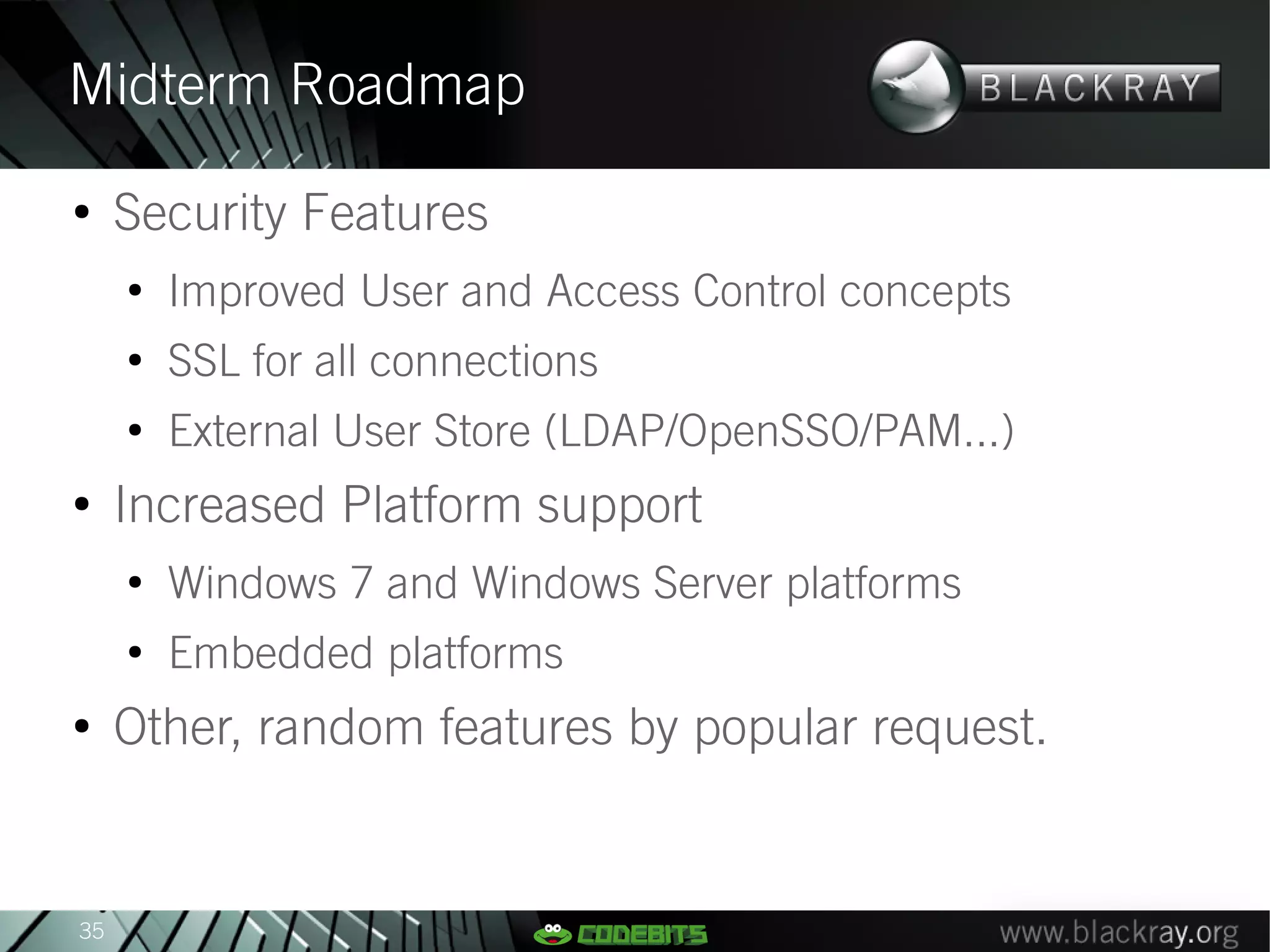
  • 35.
    Midterm Roadmap ● Security Features ● Improved User and Access Control concepts ● SSL for all connections ● External User Store (LDAP/OpenSSO/PAM...) ● Increased Platform support ● Windows 7 and Windows Server platforms ● Embedded platforms ● Other, random features by popular request. 35
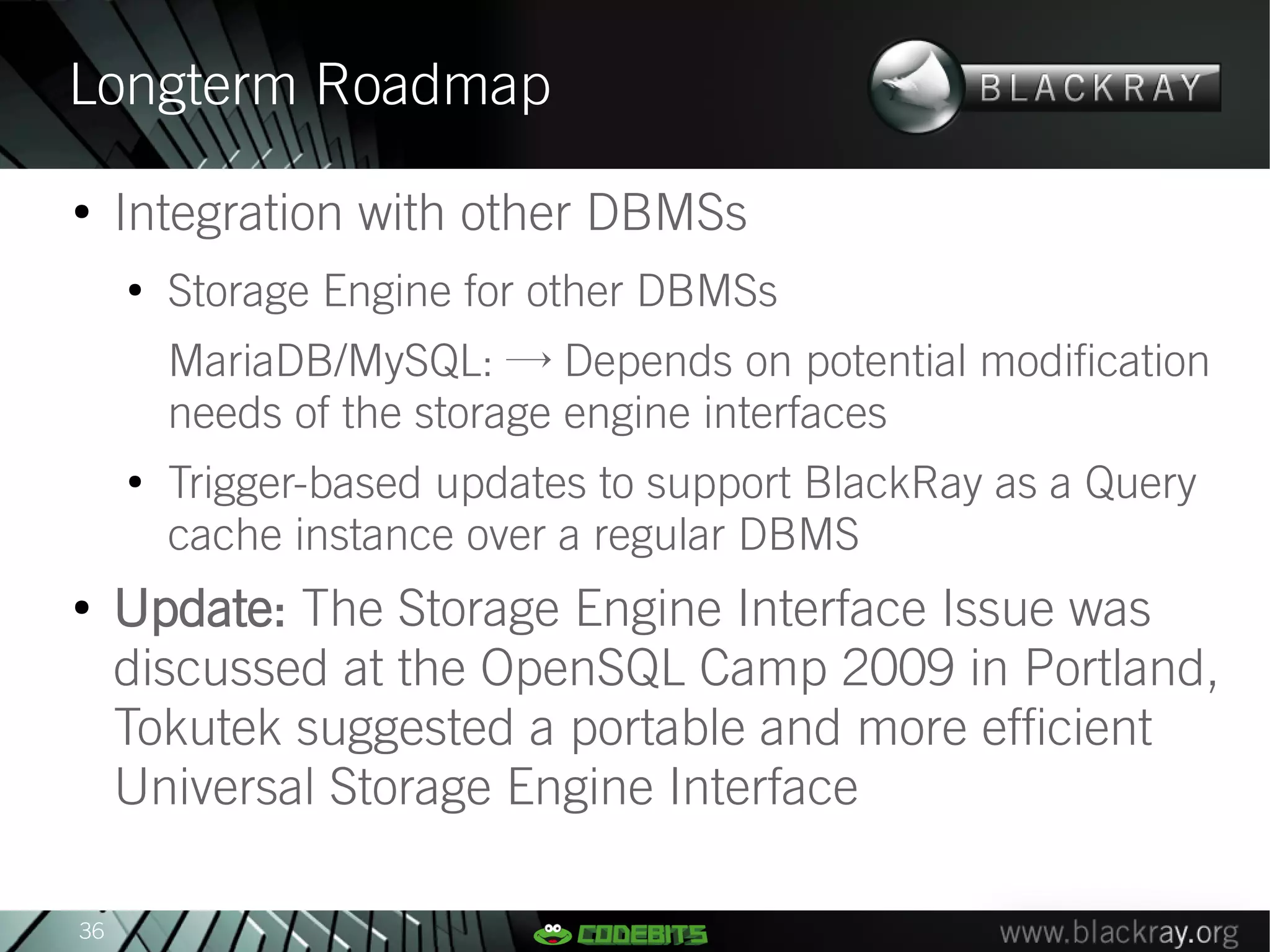
  • 36.
    Longterm Roadmap ● Integration with other DBMSs ● Storage Engine for other DBMSs MariaDB/MySQL: → Depends on potential modification needs of the storage engine interfaces ● Trigger-based updates to support BlackRay as a Query cache instance over a regular DBMS ● Update: The Storage Engine Interface Issue was discussed at the OpenSQL Camp 2009 in Portland, Tokutek suggested a portable and more efficient Universal Storage Engine Interface 36
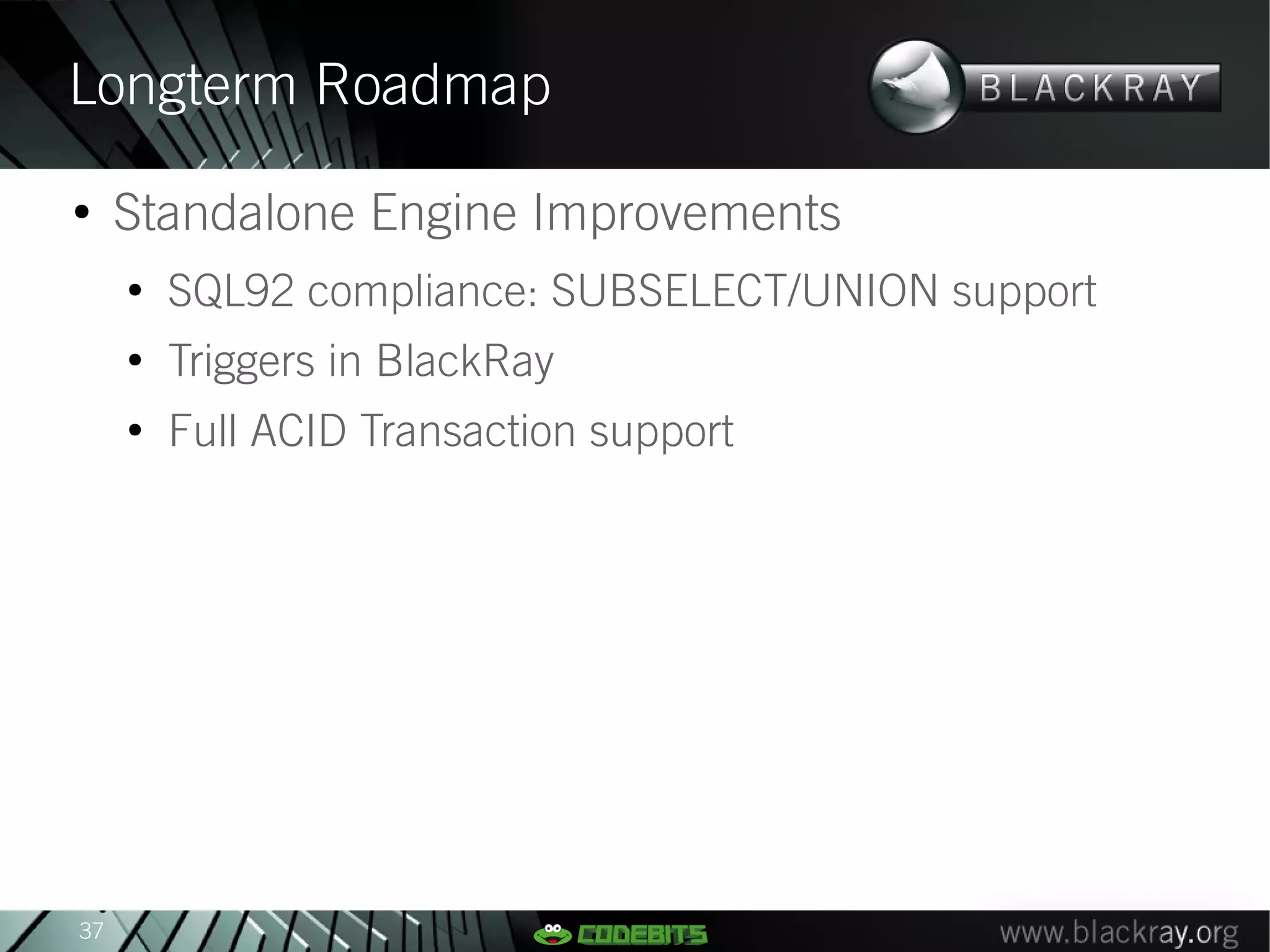
  • 37.
    Longterm Roadmap ● Standalone Engine Improvements ● SQL92 compliance: SUBSELECT/UNION support ● Triggers in BlackRay ● Full ACID Transaction support 37
  • 38.
  • 39.
    SoftMethod GmbH ● SoftMethod GmbH initiated the project in 2005 and ● Company was founded in 2004 and currently has 10 employees ● Focus of SoftMethod is high performance software engineering ● Product portfolio includes directory assistance and LDAP enabled applications ● SoftMethod also offers load testing and technical software quality assurance support. 39
  • 40.
    Development Team ● SoftMethod Core Team ● Thomas Wunschel – Lead Developer ● Felix Schupp – Project Sponsor ● Andreas Meyer – Documentation, Porting ● Frank Fiedler – PhD Student in Database Systems ● Key Contributors ● Mike Alexeev – Senior Developer ● Souvik Roy, Intern at SoftMethod GmbH ● Andreas Strafner – Developer, Porting to AIX 40
  • 41.
    Thomas Wunschel ● Director of Development, SoftMethod GmbH ● Almost 10 years of development experience ● Involved with BlackRay and its applications since 2005 ● Currently involved in the Network Protocol Stack ● Lead Designer and Decision Lead for new Features 41
  • 42.
    Felix Schupp ● Managing Director, SoftMethod GmbH ● Over 10 years of commercial software development ● Designer of first BlackRay predecessor in 1999 ● Project sponsor and spokesperson ● Responsible for funding and applications ● Guide and coach in the development process 42
  • 43.
    Mike Alexeev ● Senior Software Developer ● Over 10 years of C++ experience ● First outside committer to BlackRay ● Currently involved in rewriting the SQL grammar to support all index features available via the APIs 43
  • 44.
    Souvik Roy ● Computer Science Student and Software Developer ● Seceral years of C++ and Java experience ● Current Intern at SoftMethod GmbH ● Google Summer of Code participant ● Working on reliable performance comparison with other Engines ● Provides additional sample applications 44
  • 45.
  • 46.
    What to donext ● Get BlackRay: ● Register yourself on http://forge.softmethod.de ● SVN checkout available at http://svn.softmethod.de/opensource/blackray/trunk ● Get Involved ● Anyone can register and create tickets, news etc ● We have an active mailing list for discussion as well ● Contribute ● We require a signed Contributor agreement before being allowed commit access to the repository 46
  • 47.
    Contact Us ● Website: http://www.blackray.org ● Twitter: http://twitter.com/dataengine ● Facebook http://facebook.com/dataengine ● Mailing List: http://lists.softmethod.de ● Download: http://sourceforge.net/projects/blackray ● Felix: felix.schupp@softmethod.de ● Thomas: thomas.wunschel@softmethod.de 47