Dr. M. MARIAPPAN
M.Sc., M.Phil., M.Ed., Ph.D.
Assistant Professor,
Department of Zoology,
Government Arts College,
Melur – 625 106
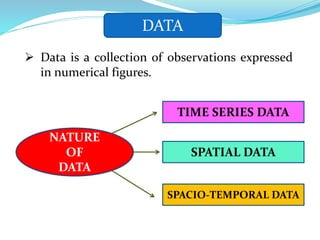
 Data is a collection of observations expressed
in numerical figures.
DATA
NATURE
OF
DATA
TIME SERIES DATA
SPATIAL DATA
SPACIO-TEMPORAL DATA
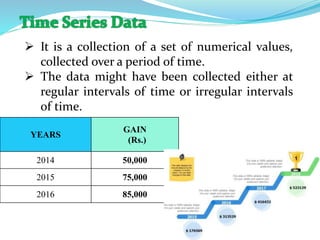
 It is a collection of a set of numerical values,
collected over a period of time.
 The data might have been collected either at
regular intervals of time or irregular intervals
of time.
YEARS
GAIN
(Rs.)
2014 50,000
2015 75,000
2016 85,000
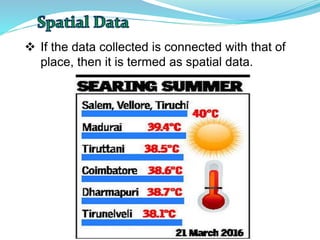
 If the data collected is connected with that of
place, then it is termed as spatial data.
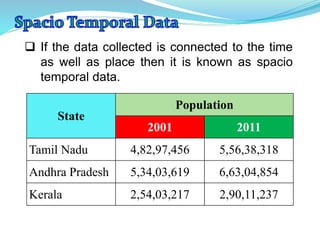
 If the data collected is connected to the time
as well as place then it is known as spacio
temporal data.
State
Population
2001 2011
Tamil Nadu 4,82,97,456 5,56,38,318
Andhra Pradesh 5,34,03,619 6,63,04,854
Kerala 2,54,03,217 2,90,11,237
CATEGORIES OF DATA
PRIMARY SECONDARY
PRIMARY DATA
 The data collected for the first time called
Primary Data.
 These data are collected directly from the
field of enquiry.
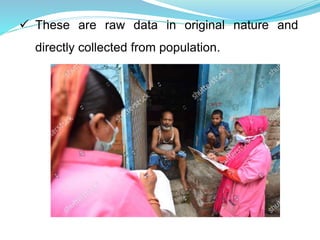
 These are raw data in original nature and
directly collected from population.
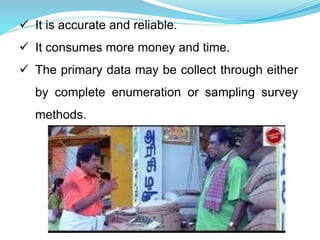
 It is accurate and reliable.
 It consumes more money and time.
 The primary data may be collect through either
by complete enumeration or sampling survey
methods.
SECONDARY DATA
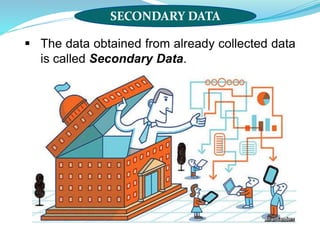
 The data obtained from already collected data
is called Secondary Data.
 These are numerical information which have
been already collected by some agency for a
specific purpose and are subsequently
compiled from that source for application in
different connection.
 It is not reliable.
COLLECTION OF
DATA
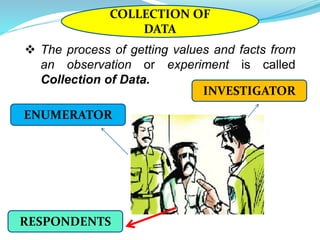
 The process of getting values and facts from
an observation or experiment is called
Collection of Data.
INVESTIGATOR
ENUMERATOR
RESPONDENTS
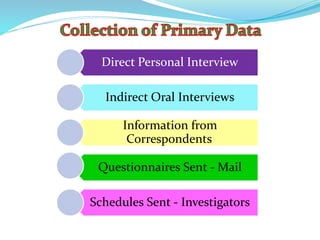
Direct Personal Interview
Indirect Oral Interviews
Information from
Correspondents
Questionnaires Sent - Mail
Schedules Sent - Investigators
 The investigator personally meets them and asks
questions to gather the necessary informations.
 It is the suitable method for intensive rather than
extensive field surveys.
 Original data is collected.
 Reliable information is obtained.
 There is uniformity in the collection of
information.
 This method is flexible because the investigator
can use his influence and different techniques as
the situation demands.
 The method yields more accurate results.
 It can be most useful when the area of
investigation is very small.
 This method is unsuitable when the area of
investigation is large.
 It is more expensive and time-consuming.
 The chances of personal bias are more.
 Under this method the investigator contacts
witnesses or neighbours or friends or some other
third parties who are capable of supplying the
necessary information.
 This method is preferred if the required information
is on cause of fire or theft or murder etc.,
 If a fire has broken out a certain place, the persons
living in neighbor hood and witnesses are likely to
give information on the cause of fire.
 It can be used when the area of investigation is large.
 It is a simple and convenient method of investigation.
 It is economical and saves time, money and labour.
 More complex data can also be analyzed.
 It is possible to obtain complete and adequate
information regarding the enquiry.
 The results may not always be true and accurate.
 The informants may not be serious in furnishing the
proper replies and hence degree of accuracy can be
affected.
 The investigator appoints local agents or
correspondents in different places and compiles the
information sent by them.
 Informations to Newspapers and some departments
of Government come by this method.
 It is cheap and appropriate for extensive
investigations.
 It is useful where the information is needed from
time to time.
 There is lack of originality in data.
 The information can be biased.
 Degree of accuracy is generally very low.
 Information made available may be out-of-date.
 There may not be uniformity in the collected data.
 Under this method a list of questions is prepared and
is sent to all the informants by post.
 The list of questions is technically called
questionnaire.
 A covering letter accompanying the questionnaire
explains the purpose of the investigation and the
importance of correct informations and request the
informants to fill in the blank spaces provided and to
return the form within a specified time.
 This method is appropriate in those cases where the
informants are literates and are spread over a wide
area.
 It is relatively cheap.
 It is preferable when the informants are spread over
the wide area.
 It is not possible to determine the degree of accuracy
of data.
 Information may be biased.
 Informants may not like to provide written
information.
 If the questionnaire is complex, it may not be
responded.
 Under this method enumerators or interviewers take
the schedules, meet the informants and filling their
replies.
 A schedule is filled by the interviewers in a face-to-
face situation with the informant. A questionnaire is
filled by the informant which he receives and returns
by post.
 It is suitable for extensive surveys.
 It can be adopted even if the informants are
illiterates.
 Answers for questions of personal and pecuniary
nature can be collected.
 Non-response is minimum as enumerators go
personally and contact the informants.
 The informations collected are reliable. The
enumerators can be properly trained for the same.
 It is most popular methods.
 It is the costliest method.
 Extensive training is to be given to the enumerators
for collecting correct and uniform informations.
 Interviewing requires experience. Unskilled
investigators are likely to fail in their work.
 Collection of primary data by framing a schedules or
distributing and collecting questionnaires by post is less
expensive and can be completed in shorter time.
 The information collected for primary data is mere
reliable than the secondary data.
 The collection of data by the method of personal survey
is possible only if the area covered by the investigator is
small.
 Collection of data by sending the enumerator is bound
to be expensive.
 Care should be taken twice that the enumerator record
correct information provided by the respondents.
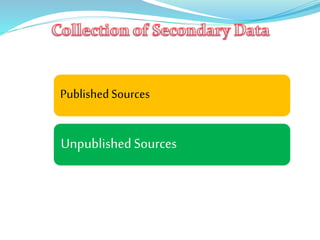
Published Sources
Unpublished Sources
 Reports and official publications of
 International bodies such as the International
Monetary Fund, International Finance
Corporation and United Nations Organisation.
 Central and State Governments such as the
Report of the Tandon Committee and Pay
Commission.
 Semi-official publication of various local bodies
such as Municipal Corporations and District Boards.
 Private publications-such as the publications of –
 Trade and professional bodies such as the
Federation of Indian Chambers of Commerce and
Institute of Chartered Accountants.
 Financial and economic journals such as
‘Commerce’ , ‘ Capital’ and ‘ Indian Finance’
 Annual reports of joint stock companies.
 Publications brought out by research agencies,
research scholars, etc.
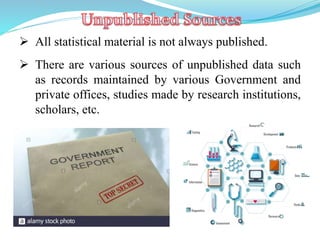
 All statistical material is not always published.
 There are various sources of unpublished data such
as records maintained by various Government and
private offices, studies made by research institutions,
scholars, etc.

Biostatistics Data

  • 1.
    Dr. M. MARIAPPAN M.Sc.,M.Phil., M.Ed., Ph.D. Assistant Professor, Department of Zoology, Government Arts College, Melur – 625 106
  • 2.
     Data isa collection of observations expressed in numerical figures. DATA NATURE OF DATA TIME SERIES DATA SPATIAL DATA SPACIO-TEMPORAL DATA
  • 3.
     It isa collection of a set of numerical values, collected over a period of time.  The data might have been collected either at regular intervals of time or irregular intervals of time. YEARS GAIN (Rs.) 2014 50,000 2015 75,000 2016 85,000
  • 4.
     If thedata collected is connected with that of place, then it is termed as spatial data.
  • 5.
     If thedata collected is connected to the time as well as place then it is known as spacio temporal data. State Population 2001 2011 Tamil Nadu 4,82,97,456 5,56,38,318 Andhra Pradesh 5,34,03,619 6,63,04,854 Kerala 2,54,03,217 2,90,11,237
  • 6.
    CATEGORIES OF DATA PRIMARYSECONDARY PRIMARY DATA  The data collected for the first time called Primary Data.  These data are collected directly from the field of enquiry.
  • 7.
     These areraw data in original nature and directly collected from population.
  • 8.
     It isaccurate and reliable.  It consumes more money and time.  The primary data may be collect through either by complete enumeration or sampling survey methods.
  • 9.
    SECONDARY DATA  Thedata obtained from already collected data is called Secondary Data.
  • 10.
     These arenumerical information which have been already collected by some agency for a specific purpose and are subsequently compiled from that source for application in different connection.  It is not reliable.
  • 11.
    COLLECTION OF DATA  Theprocess of getting values and facts from an observation or experiment is called Collection of Data. INVESTIGATOR ENUMERATOR RESPONDENTS
  • 12.
    Direct Personal Interview IndirectOral Interviews Information from Correspondents Questionnaires Sent - Mail Schedules Sent - Investigators
  • 13.
     The investigatorpersonally meets them and asks questions to gather the necessary informations.  It is the suitable method for intensive rather than extensive field surveys.
  • 14.
     Original datais collected.  Reliable information is obtained.  There is uniformity in the collection of information.  This method is flexible because the investigator can use his influence and different techniques as the situation demands.  The method yields more accurate results.  It can be most useful when the area of investigation is very small.
  • 15.
     This methodis unsuitable when the area of investigation is large.  It is more expensive and time-consuming.  The chances of personal bias are more.
  • 16.
     Under thismethod the investigator contacts witnesses or neighbours or friends or some other third parties who are capable of supplying the necessary information.  This method is preferred if the required information is on cause of fire or theft or murder etc.,  If a fire has broken out a certain place, the persons living in neighbor hood and witnesses are likely to give information on the cause of fire.
  • 17.
     It canbe used when the area of investigation is large.  It is a simple and convenient method of investigation.  It is economical and saves time, money and labour.  More complex data can also be analyzed.  It is possible to obtain complete and adequate information regarding the enquiry.  The results may not always be true and accurate.  The informants may not be serious in furnishing the proper replies and hence degree of accuracy can be affected.
  • 18.
     The investigatorappoints local agents or correspondents in different places and compiles the information sent by them.  Informations to Newspapers and some departments of Government come by this method.
  • 19.
     It ischeap and appropriate for extensive investigations.  It is useful where the information is needed from time to time.  There is lack of originality in data.  The information can be biased.  Degree of accuracy is generally very low.  Information made available may be out-of-date.  There may not be uniformity in the collected data.
  • 20.
     Under thismethod a list of questions is prepared and is sent to all the informants by post.  The list of questions is technically called questionnaire.  A covering letter accompanying the questionnaire explains the purpose of the investigation and the importance of correct informations and request the informants to fill in the blank spaces provided and to return the form within a specified time.  This method is appropriate in those cases where the informants are literates and are spread over a wide area.
  • 21.
     It isrelatively cheap.  It is preferable when the informants are spread over the wide area.  It is not possible to determine the degree of accuracy of data.  Information may be biased.  Informants may not like to provide written information.  If the questionnaire is complex, it may not be responded.
  • 22.
     Under thismethod enumerators or interviewers take the schedules, meet the informants and filling their replies.  A schedule is filled by the interviewers in a face-to- face situation with the informant. A questionnaire is filled by the informant which he receives and returns by post.  It is suitable for extensive surveys.
  • 23.
     It canbe adopted even if the informants are illiterates.  Answers for questions of personal and pecuniary nature can be collected.  Non-response is minimum as enumerators go personally and contact the informants.  The informations collected are reliable. The enumerators can be properly trained for the same.  It is most popular methods.
  • 24.
     It isthe costliest method.  Extensive training is to be given to the enumerators for collecting correct and uniform informations.  Interviewing requires experience. Unskilled investigators are likely to fail in their work.
  • 25.
     Collection ofprimary data by framing a schedules or distributing and collecting questionnaires by post is less expensive and can be completed in shorter time.  The information collected for primary data is mere reliable than the secondary data.  The collection of data by the method of personal survey is possible only if the area covered by the investigator is small.  Collection of data by sending the enumerator is bound to be expensive.  Care should be taken twice that the enumerator record correct information provided by the respondents.
  • 26.
  • 27.
     Reports andofficial publications of  International bodies such as the International Monetary Fund, International Finance Corporation and United Nations Organisation.  Central and State Governments such as the Report of the Tandon Committee and Pay Commission.  Semi-official publication of various local bodies such as Municipal Corporations and District Boards.
  • 28.
     Private publications-suchas the publications of –  Trade and professional bodies such as the Federation of Indian Chambers of Commerce and Institute of Chartered Accountants.  Financial and economic journals such as ‘Commerce’ , ‘ Capital’ and ‘ Indian Finance’  Annual reports of joint stock companies.  Publications brought out by research agencies, research scholars, etc.
  • 29.
     All statisticalmaterial is not always published.  There are various sources of unpublished data such as records maintained by various Government and private offices, studies made by research institutions, scholars, etc.