BIOMOLECULES
Molecules of Life
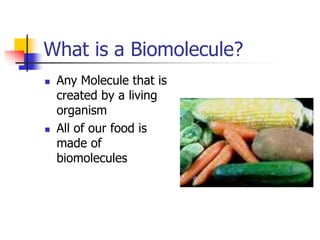
What is a Biomolecule?
 Any Molecule that is
created by a living
organism
 All of our food is
made of
biomolecules
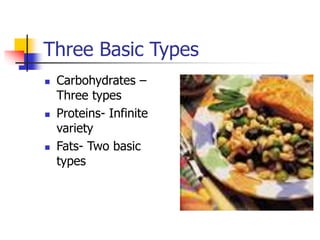
Three Basic Types
 Carbohydrates –
Three types
 Proteins- Infinite
variety
 Fats- Two basic
types
Carbohydrates
 Made of Carbon,
Hydrogen, and
Oxygen
 Identifiers
 Hydrogen:Oxygen
ratio is 2:1
 Basic Form is a ring
Three Basic Types of
Carbohydrates
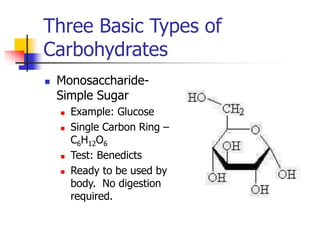
 Monosaccharide-
Simple Sugar
 Example: Glucose
 Single Carbon Ring –
C6H12O6
 Test: Benedicts
 Ready to be used by
body. No digestion
required.
Building a monosaccharide
 Look in the text book at a picture of a
glucose molecule.(page 37)
 Use your text to help you draw a picture
of your model
Three Basic Types of
Carbohydrates
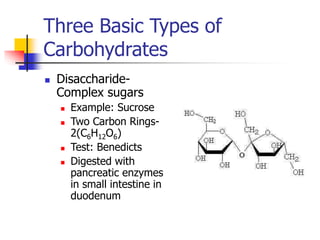
 Disaccharide-
Complex sugars
 Example: Sucrose
 Two Carbon Rings-
2(C6H12O6)
 Test: Benedicts
 Digested with
pancreatic enzymes
in small intestine in
duodenum
Building a disaccharide
 Look in the book. What type of
reaction occurs when two
monosaccharides are joined together?
(page 38)
 What type of molecule is released?
 Draw a picture of a disaccharide
Three Basic Types of
Carbohydrates
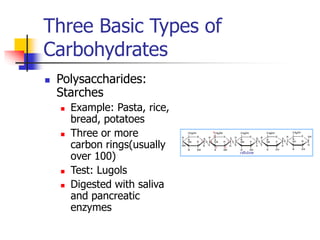
 Polysaccharides:
Starches
 Example: Pasta, rice,
bread, potatoes
 Three or more
carbon rings(usually
over 100)
 Test: Lugols
 Digested with saliva
and pancreatic
enzymes
Three Basic Types of
Carbohydrates
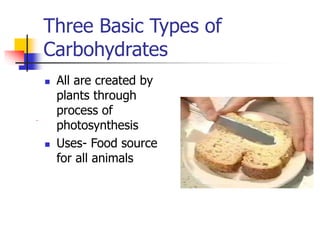
 All are created by
plants through
process of
photosynthesis
 Uses- Food source
for all animals
Proteins
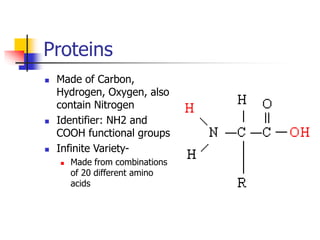
 Made of Carbon,
Hydrogen, Oxygen, also
contain Nitrogen
 Identifier: NH2 and
COOH functional groups
 Infinite Variety-
 Made from combinations
of 20 different amino
acids
Proteins
 Test- Ninhydrin, and
Buirets
 Origin – Protein
Synthesis
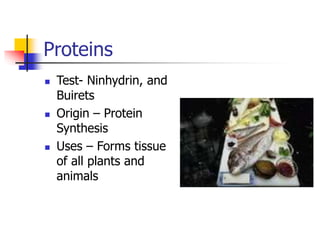
 Uses – Forms tissue
of all plants and
animals
Proteins
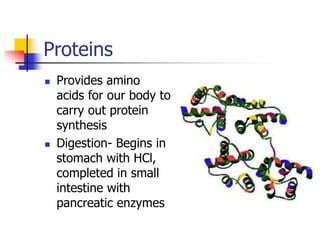
 Provides amino
acids for our body to
carry out protein
synthesis
 Digestion- Begins in
stomach with HCl,
completed in small
intestine with
pancreatic enzymes
From the textbook
 Look up amino acids and proteins (page
42-43)
 What type of reaction occurs when two
amino acids combine to form a di-
peptide (protein)?
 How is this similar to the formation of a
disaccharide?
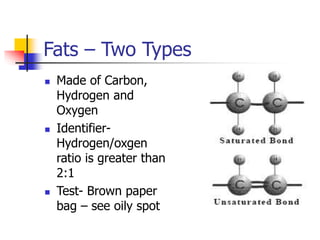
Fats – Two Types
 Made of Carbon,
Hydrogen and
Oxygen
 Identifier-
Hydrogen/oxgen
ratio is greater than
2:1
 Test- Brown paper
bag – see oily spot
Fats – Two Types
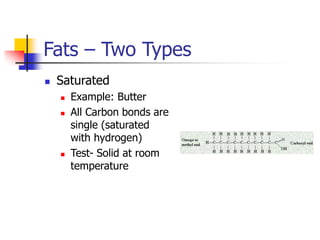
 Saturated
 Example: Butter
 All Carbon bonds are
single (saturated
with hydrogen)
 Test- Solid at room
temperature
Fats – Two Types
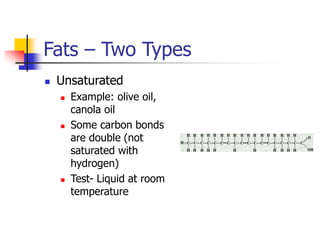
 Unsaturated
 Example: olive oil,
canola oil
 Some carbon bonds
are double (not
saturated with
hydrogen)
 Test- Liquid at room
temperature
Fats – Two Types
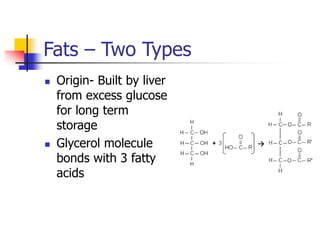
 Origin- Built by liver
from excess glucose
for long term
storage
 Glycerol molecule
bonds with 3 fatty
acids
Fats – Two Types
 Uses:
 Store energy
 Insulation
 Lubrication
 Cell membrane
 Broken down with bile in small
intestine, then digested by pancreatic
enzymes
STOP HERE
Look at the models of Fatty
acids?
 What do you notice about the stability of
the two molecules?
 From your observations, why are
unsaturated fats liquid at room
temperature?
Mystery Food
 You are a forensic scientist who has
discovered a mystery food product at
the scene of a crime.
 You take it back to the laboratory to
determine what it is made from.
 Use the information in your notes to
design an experiment to determine
which biomolecules are present
Mystery Food
 Note the directions with each
experiment.
 How will you determine how to
interpret the results?
 We will be writing a WASL style
application write-up
CSI: Mystery Powder to Trace
 Challenge: What biomolecules are in the
unknown?
 Rules: What are Biomolecules? What are the
chemical differences between them? Write
this information from your notes.
 Gather information: What tests can be used
to identify each type of biomolecule? Write
this from your notes.
 Safety: Eye protection when using hotplate
CSI: Mystery Powder to Trace
 Explore ideas: Try each indicator with each of
the various known biomolecules to see what
they look like. Follow Directions for each
indicator.
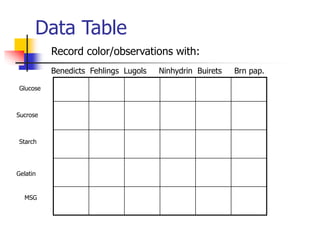
 Make a data table to record your data
Data Table
Record color/observations with:
Benedicts Fehlings Lugols Ninhydrin Buirets Brn pap.
Glucose
Sucrose
Starch
Gelatin
MSG
Now determine the Unknown
 Plan Summary: Describe how you will determine
the unknown?
 Provide step by step description of your
experiment
 List all materials you will need to solve the
problem
 Check off ___Have someone read your
application to be sure it is complete
CSI: Mystery Powder to Trace
 Test Solution: Carry out your tests. What will
you do for repetition?
 Test Results: Set up a data table to record all
reaction results with the unknown
 Description of Actual Results: Describe the
color reactions you got on the mystery
powder with each test. How do they
compare with the results with the known
biomolecules?
CSI: Mystery Powder to Trace
 Conclusion: What will you report to the
D.A. about the mystery powder? What
information will you use to be
persuasive?
CSI: Mysery Powder to Trace
 What is one feature of your test that
gives you confidence in your results?
 What is another feature of your test
that makes you unsure of your results?
Understanding Biomolecules
 Biomolecules contain energy we need to live!
 Make a diagram that shows the energy transfers
that occur in the life of a monosaccharide: Begin
with the sun.
 Show both where energy is transferred, and what types
of energy transfers are involved. Remember there are
light, thermal, chemical, and mechanical energy
transfers.

BIOMOLECULES G10 NOW.ppt

  • 1.
  • 2.
    What is aBiomolecule?  Any Molecule that is created by a living organism  All of our food is made of biomolecules
  • 4.
    Three Basic Types Carbohydrates – Three types  Proteins- Infinite variety  Fats- Two basic types
  • 5.
    Carbohydrates  Made ofCarbon, Hydrogen, and Oxygen  Identifiers  Hydrogen:Oxygen ratio is 2:1  Basic Form is a ring
  • 6.
    Three Basic Typesof Carbohydrates  Monosaccharide- Simple Sugar  Example: Glucose  Single Carbon Ring – C6H12O6  Test: Benedicts  Ready to be used by body. No digestion required.
  • 7.
    Building a monosaccharide Look in the text book at a picture of a glucose molecule.(page 37)  Use your text to help you draw a picture of your model
  • 8.
    Three Basic Typesof Carbohydrates  Disaccharide- Complex sugars  Example: Sucrose  Two Carbon Rings- 2(C6H12O6)  Test: Benedicts  Digested with pancreatic enzymes in small intestine in duodenum
  • 9.
    Building a disaccharide Look in the book. What type of reaction occurs when two monosaccharides are joined together? (page 38)  What type of molecule is released?  Draw a picture of a disaccharide
  • 10.
    Three Basic Typesof Carbohydrates  Polysaccharides: Starches  Example: Pasta, rice, bread, potatoes  Three or more carbon rings(usually over 100)  Test: Lugols  Digested with saliva and pancreatic enzymes
  • 11.
    Three Basic Typesof Carbohydrates  All are created by plants through process of photosynthesis  Uses- Food source for all animals
  • 12.
    Proteins  Made ofCarbon, Hydrogen, Oxygen, also contain Nitrogen  Identifier: NH2 and COOH functional groups  Infinite Variety-  Made from combinations of 20 different amino acids
  • 13.
    Proteins  Test- Ninhydrin,and Buirets  Origin – Protein Synthesis  Uses – Forms tissue of all plants and animals
  • 14.
    Proteins  Provides amino acidsfor our body to carry out protein synthesis  Digestion- Begins in stomach with HCl, completed in small intestine with pancreatic enzymes
  • 15.
    From the textbook Look up amino acids and proteins (page 42-43)  What type of reaction occurs when two amino acids combine to form a di- peptide (protein)?  How is this similar to the formation of a disaccharide?
  • 16.
    Fats – TwoTypes  Made of Carbon, Hydrogen and Oxygen  Identifier- Hydrogen/oxgen ratio is greater than 2:1  Test- Brown paper bag – see oily spot
  • 17.
    Fats – TwoTypes  Saturated  Example: Butter  All Carbon bonds are single (saturated with hydrogen)  Test- Solid at room temperature
  • 18.
    Fats – TwoTypes  Unsaturated  Example: olive oil, canola oil  Some carbon bonds are double (not saturated with hydrogen)  Test- Liquid at room temperature
  • 19.
    Fats – TwoTypes  Origin- Built by liver from excess glucose for long term storage  Glycerol molecule bonds with 3 fatty acids
  • 20.
    Fats – TwoTypes  Uses:  Store energy  Insulation  Lubrication  Cell membrane  Broken down with bile in small intestine, then digested by pancreatic enzymes
  • 21.
  • 22.
    Look at themodels of Fatty acids?  What do you notice about the stability of the two molecules?  From your observations, why are unsaturated fats liquid at room temperature?
  • 23.
    Mystery Food  Youare a forensic scientist who has discovered a mystery food product at the scene of a crime.  You take it back to the laboratory to determine what it is made from.  Use the information in your notes to design an experiment to determine which biomolecules are present
  • 24.
    Mystery Food  Notethe directions with each experiment.  How will you determine how to interpret the results?  We will be writing a WASL style application write-up
  • 25.
    CSI: Mystery Powderto Trace  Challenge: What biomolecules are in the unknown?  Rules: What are Biomolecules? What are the chemical differences between them? Write this information from your notes.  Gather information: What tests can be used to identify each type of biomolecule? Write this from your notes.  Safety: Eye protection when using hotplate
  • 26.
    CSI: Mystery Powderto Trace  Explore ideas: Try each indicator with each of the various known biomolecules to see what they look like. Follow Directions for each indicator.  Make a data table to record your data
  • 27.
    Data Table Record color/observationswith: Benedicts Fehlings Lugols Ninhydrin Buirets Brn pap. Glucose Sucrose Starch Gelatin MSG
  • 28.
    Now determine theUnknown  Plan Summary: Describe how you will determine the unknown?  Provide step by step description of your experiment  List all materials you will need to solve the problem  Check off ___Have someone read your application to be sure it is complete
  • 29.
    CSI: Mystery Powderto Trace  Test Solution: Carry out your tests. What will you do for repetition?  Test Results: Set up a data table to record all reaction results with the unknown  Description of Actual Results: Describe the color reactions you got on the mystery powder with each test. How do they compare with the results with the known biomolecules?
  • 30.
    CSI: Mystery Powderto Trace  Conclusion: What will you report to the D.A. about the mystery powder? What information will you use to be persuasive?
  • 31.
    CSI: Mysery Powderto Trace  What is one feature of your test that gives you confidence in your results?  What is another feature of your test that makes you unsure of your results?
  • 32.
    Understanding Biomolecules  Biomoleculescontain energy we need to live!  Make a diagram that shows the energy transfers that occur in the life of a monosaccharide: Begin with the sun.  Show both where energy is transferred, and what types of energy transfers are involved. Remember there are light, thermal, chemical, and mechanical energy transfers.