1


Biomolecular News
  By Daniel Gallego González
      Medicine Student
         III Semester
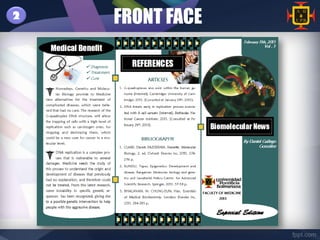
2   FRONT FACE
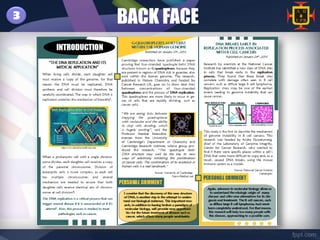
3   BACK FACE
4   INTRODUCTION

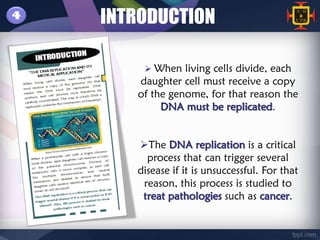
         When living cells divide, each
       daughter cell must receive a copy
       of the genome, for that reason the
            DNA must be replicated.


       The DNA replication is a critical
         process that can trigger several
       disease if it is unsuccessful. For that
        reason, this process is studied to
        treat pathologies such as cancer.
5                    FIRST NOTICE

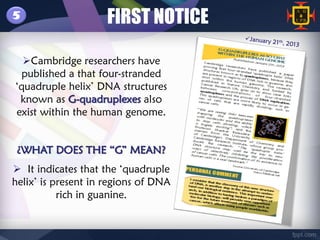
  Cambridge researchers have
 published a that four-stranded
‘quadruple helix’ DNA structures
 known as G-quadruplexes also
exist within the human genome.


 ¿WHAT DOES THE “G” MEAN?
 It indicates that the ‘quadruple
helix’ is present in regions of DNA
           rich in guanine.
6   FIRST NOTICE

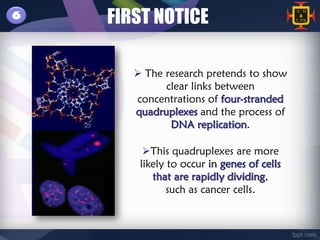
        The research pretends to show
             clear links between
       concentrations of four-stranded
       quadruplexes and the process of
              DNA replication.

         This quadruplexes are more
        likely to occur in genes of cells
           that are rapidly dividing,
               such as cancer cells.
7                       FIRST NOTICE
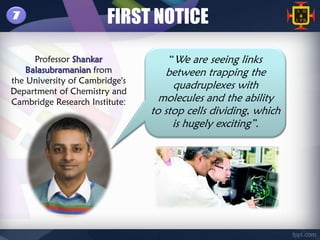
      Professor Shankar             “We are seeing links
    Balasubramanian from           between trapping the
the University of Cambridge's
Department of Chemistry and
                                     quadruplexes with
Cambridge Research Institute:     molecules and the ability
                                to stop cells dividing, which
                                     is hugely exciting”.
8                           FIRST NOTICE
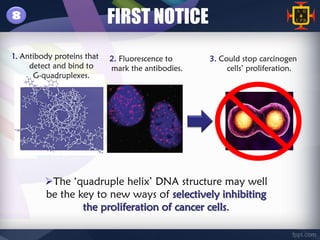
1. Antibody proteins that   2. Fluorescence to     3. Could stop carcinogen
     detect and bind to     mark the antibodies.        cells’ proliferation.
      G-quadruplexes.


         The ‘quadruple helix’ DNA structure may well
         be the key to new ways of selectively inhibiting
                 the proliferation of cancer cells.
9   PERSONAL COMMENT
10
     SECOND NOTICE

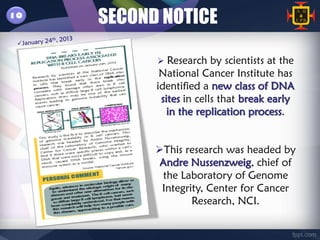
            Research by scientists at the
            National Cancer Institute has
           identified a new class of DNA
            sites in cells that break early
              in the replication process.


           This research was headed by
           Andre Nussenzweig, chief of
            the Laboratory of Genome
            Integrity, Center for Cancer
                   Research, NCI.
11
                         SECOND NOTICE
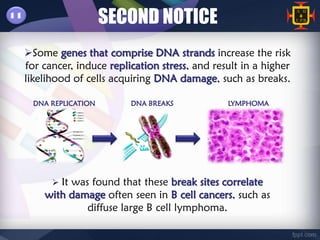
     Some genes that comprise DNA strands increase the risk
     for cancer, induce replication stress, and result in a higher
     likelihood of cells acquiring DNA damage, such as breaks.

       DNA REPLICATION       DNA BREAKS            LYMPHOMA


            It was found that these break sites correlate
         with damage often seen in B cell cancers, such as
                 diffuse large B cell lymphoma.
12
     SECOND NOTICE

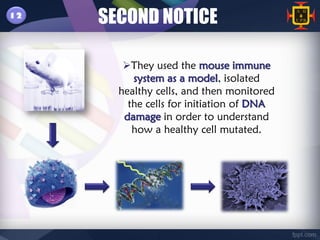
        They used the mouse immune
          system as a model, isolated
       healthy cells, and then monitored
         the cells for initiation of DNA
        damage in order to understand
          how a healthy cell mutated.
13
                 SECOND NOTICE

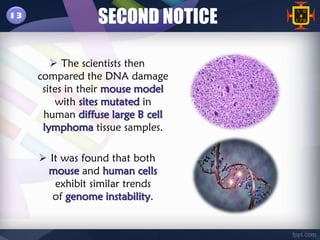
         The scientists then
     compared the DNA damage
      sites in their mouse model
         with sites mutated in
      human diffuse large B cell
      lymphoma tissue samples.

      It was found that both
      mouse and human cells
        exhibit similar trends
        of genome instability.
14
              PERSONAL COMMENT
        Again, advances in molecular biology allow
       us to understand the etiologic origin of many
          diseases and offer new alternatives for its
     diagnosis and treatment. The B cell cancers, such
     as diffuse large B cell lymphoma, had never been
        completely understood. For that reason, this
       research will help too many people with this
          diseases, approaching to a possible cure.
15
                   MEDICAL BENEFIT
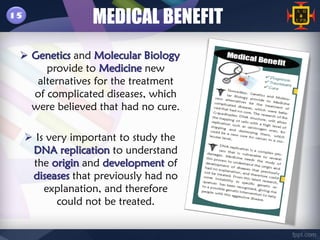
  Genetics and Molecular Biology
      provide to Medicine new
    alternatives for the treatment
   of complicated diseases, which
   were believed that had no cure.

      Is very important to study the
      DNA replication to understand
      the origin and development of
      diseases that previously had no
         explanation, and therefore
            could not be treated.
16
               MEDICAL BENEFIT

         The research of the
           G-quadruplex DNA
        structure, will allow the
     trapping of cells with a high
      level of replication such as
          carcinogen ones, for
       stopping and destroying
     them, which could be a new
           cure for cancer in a
             molecular level.
17
           MEDICAL BENEFIT

      From this latest research in B
      cell cancer, some instability in
      specific genetic sequences has
     been recognized, giving rise to a
       possible genetic intervention
         to help people with this
             aggressive disease.
18
                 MEDICAL BENEFIT
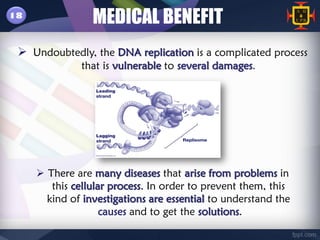
  Undoubtedly, the DNA replication is a complicated process
              that is vulnerable to several damages.


      There are many diseases that arise from problems in
        this cellular process. In order to prevent them, this
       kind of investigations are essential to understand the
                    causes and to get the solutions.
19
                        REFERENCES
     ARTICLES
       1. G-quadruplexes also exist within the human genome [Internet].
          Cambridge: University of Cambridge; 2013. [Consulted at January
          29th, 2013].
       2. DNA breaks early in replication process associated with B cell
          cancers [Internet]. Bethesda: National Cancer Institute; 2013.
          [Consulted at February 29th, 2013].


     BIBLIOGRAPHY
       1. CLARK, David; PAZDERNIK, Nanette. Molecular Biology. 2. ed.
          Oxford: Elsevier Inc, 2013. 274-276 p.
       2. KUNDU, Tapas. Epigenetics: Development and disease. Bangalore:
          Molecular biology and genetics unit Jawaharlal Nehru Centre for
          Advanced Scientific Research. Springer, 2013. 57-58 p.
       3. BHAGAVAN, N; CHUNG-EUN, Han. Essentials of Medical
          Biochemistry. London: Elsevier Inc, 2011. 294-295 p.
20


     By Daniel Gallego González,
         Cañón del Chicamocha,
                Santander, 2011.

Biomolecular news

  • 1.
    1 Biomolecular News By Daniel Gallego González Medicine Student III Semester
  • 2.
    2 FRONT FACE
  • 3.
    3 BACK FACE
  • 4.
    4 INTRODUCTION  When living cells divide, each daughter cell must receive a copy of the genome, for that reason the DNA must be replicated. The DNA replication is a critical process that can trigger several disease if it is unsuccessful. For that reason, this process is studied to treat pathologies such as cancer.
  • 5.
    5 FIRST NOTICE Cambridge researchers have published a that four-stranded ‘quadruple helix’ DNA structures known as G-quadruplexes also exist within the human genome. ¿WHAT DOES THE “G” MEAN?  It indicates that the ‘quadruple helix’ is present in regions of DNA rich in guanine.
  • 6.
    6 FIRST NOTICE  The research pretends to show clear links between concentrations of four-stranded quadruplexes and the process of DNA replication. This quadruplexes are more likely to occur in genes of cells that are rapidly dividing, such as cancer cells.
  • 7.
    7 FIRST NOTICE Professor Shankar “We are seeing links Balasubramanian from between trapping the the University of Cambridge's Department of Chemistry and quadruplexes with Cambridge Research Institute: molecules and the ability to stop cells dividing, which is hugely exciting”.
  • 8.
    8 FIRST NOTICE 1. Antibody proteins that 2. Fluorescence to 3. Could stop carcinogen detect and bind to mark the antibodies. cells’ proliferation. G-quadruplexes. The ‘quadruple helix’ DNA structure may well be the key to new ways of selectively inhibiting the proliferation of cancer cells.
  • 9.
    9 PERSONAL COMMENT
  • 10.
    10 SECOND NOTICE  Research by scientists at the National Cancer Institute has identified a new class of DNA sites in cells that break early in the replication process. This research was headed by Andre Nussenzweig, chief of the Laboratory of Genome Integrity, Center for Cancer Research, NCI.
  • 11.
    11 SECOND NOTICE Some genes that comprise DNA strands increase the risk for cancer, induce replication stress, and result in a higher likelihood of cells acquiring DNA damage, such as breaks. DNA REPLICATION DNA BREAKS LYMPHOMA  It was found that these break sites correlate with damage often seen in B cell cancers, such as diffuse large B cell lymphoma.
  • 12.
    12 SECOND NOTICE They used the mouse immune system as a model, isolated healthy cells, and then monitored the cells for initiation of DNA damage in order to understand how a healthy cell mutated.
  • 13.
    13 SECOND NOTICE  The scientists then compared the DNA damage sites in their mouse model with sites mutated in human diffuse large B cell lymphoma tissue samples.  It was found that both mouse and human cells exhibit similar trends of genome instability.
  • 14.
    14 PERSONAL COMMENT Again, advances in molecular biology allow us to understand the etiologic origin of many diseases and offer new alternatives for its diagnosis and treatment. The B cell cancers, such as diffuse large B cell lymphoma, had never been completely understood. For that reason, this research will help too many people with this diseases, approaching to a possible cure.
  • 15.
    15 MEDICAL BENEFIT  Genetics and Molecular Biology provide to Medicine new alternatives for the treatment of complicated diseases, which were believed that had no cure.  Is very important to study the DNA replication to understand the origin and development of diseases that previously had no explanation, and therefore could not be treated.
  • 16.
    16 MEDICAL BENEFIT  The research of the G-quadruplex DNA structure, will allow the trapping of cells with a high level of replication such as carcinogen ones, for stopping and destroying them, which could be a new cure for cancer in a molecular level.
  • 17.
    17 MEDICAL BENEFIT  From this latest research in B cell cancer, some instability in specific genetic sequences has been recognized, giving rise to a possible genetic intervention to help people with this aggressive disease.
  • 18.
    18 MEDICAL BENEFIT  Undoubtedly, the DNA replication is a complicated process that is vulnerable to several damages.  There are many diseases that arise from problems in this cellular process. In order to prevent them, this kind of investigations are essential to understand the causes and to get the solutions.
  • 19.
    19 REFERENCES ARTICLES 1. G-quadruplexes also exist within the human genome [Internet]. Cambridge: University of Cambridge; 2013. [Consulted at January 29th, 2013]. 2. DNA breaks early in replication process associated with B cell cancers [Internet]. Bethesda: National Cancer Institute; 2013. [Consulted at February 29th, 2013]. BIBLIOGRAPHY 1. CLARK, David; PAZDERNIK, Nanette. Molecular Biology. 2. ed. Oxford: Elsevier Inc, 2013. 274-276 p. 2. KUNDU, Tapas. Epigenetics: Development and disease. Bangalore: Molecular biology and genetics unit Jawaharlal Nehru Centre for Advanced Scientific Research. Springer, 2013. 57-58 p. 3. BHAGAVAN, N; CHUNG-EUN, Han. Essentials of Medical Biochemistry. London: Elsevier Inc, 2011. 294-295 p.
  • 20.
    20 By Daniel Gallego González, Cañón del Chicamocha, Santander, 2011.