BIOMIMICRY AND ITS APPLICATIONS IN
CIVIL ENGINEERING
PRESENTED BY:AJEENA BABY
STUDENT
CIVIL ENGINEERING DEPT
GUIDED BY: Mrs. NISAANN MATHEW
ASST. PROFESSOR
CIVIL ENGINEERING DEPT.
Dept. of Civil Engineering , VJCET, Vazhakulam
INTRODUCTION
BIOMIMICRY
• Interdisciplinary field where technology, science, art, design and architecture influence eac
h other & use biology for innovative solutions and products .
• Approach to innovation that seeks sustainable solutions to human challenges by emulating
nature’s time-tested patterns and strategies.
• Goal-create products, processes, and policies new ways of living well-adapted to life on ea
rth over long haul
• Organisms alive today are the successful models or products of evolution. We could learn
a lot from nature when it comes to solving our challenges in A sustainable way
• nature's adaptations result in the conservation of energy and reduction of waste, which are
of immeasurable interest to engineers and manufacturers
Biomimicry and its applications in Civil Engineering
2
Dept. of Civil Engineering , VJCET, Vazhakulam
LEVELS OF BIOMIMICRY
The natural form of organisms are used for inspiration
Natural process can be mimicked
Ecosystem level
1
2
3
For instance, mimicking the structure of a seashell co
uld lead to stronger buildings
For example chemical processes such as photosynthesis, can
be mimicked to create more sustainable materials.
In this level, entire ecosystems and their functional pr
inciples are mimicked. When a product is made with
the help of biomimicry, it is called a 'biomimetic' pro
duct. It can be biomimetic in terms of form, material,
construction, process or function.
Dept. of Civil Engineering , VJCET, Vazhakulam
3
Biomimicry and its applications in Civil Engineering
CONTENTS
Introduction Looping water slideLilypad floating
city
Cement having
composition of corals
Conclusion
Self cleaning paintPassive cooling More examples
Dept. of Civil Engineering , VJCET, Vazhakulam
4
Biomimicry and its applications in Civil Engineering
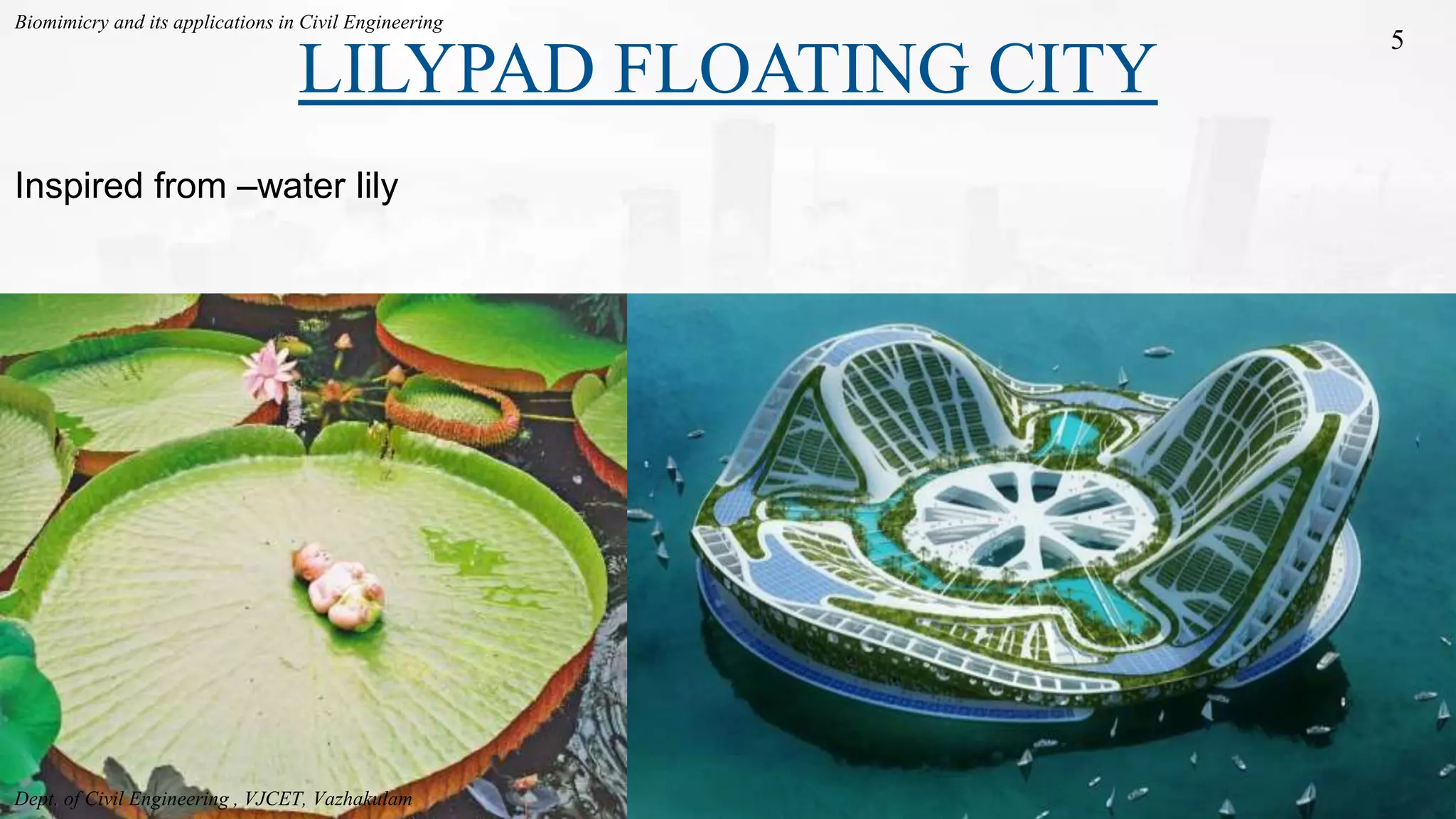
LILYPAD FLOATING CITY
Inspired from –water lily
Dept. of Civil Engineering , VJCET, Vazhakulam
5
Biomimicry and its applications in Civil Engineering
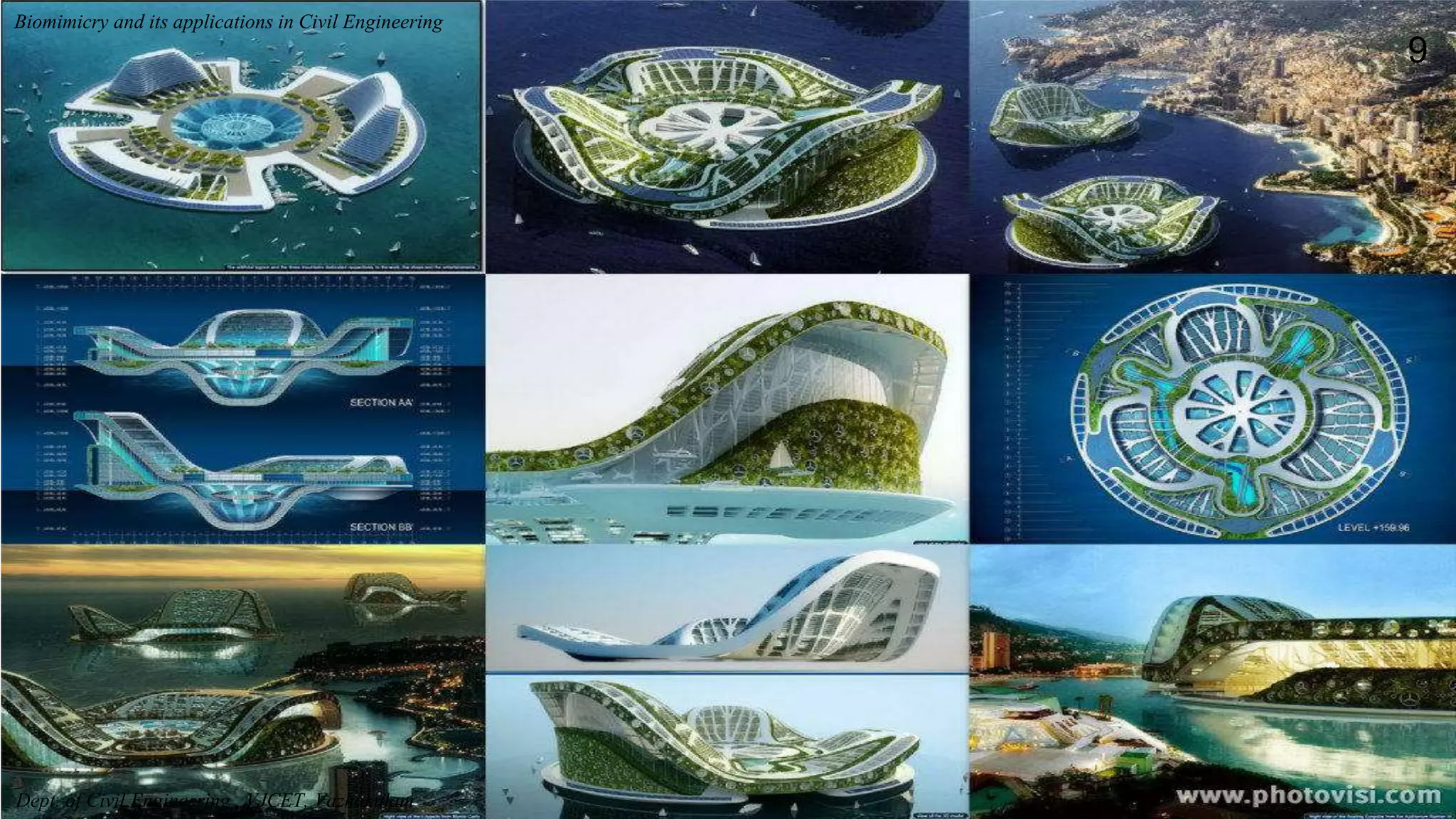
• With global sea levels predicted to rise significantly over the next ce
ntury due to climate change, a lot of people living in low lying areas
are expected to be displaced from their homes.
• Architect Vincent Callebaut- “Lilypad” concept ,reality by 2100.
• A completely self-sufficient floating city that would accommodate
upto 50,000.
• Three marinas and three mountains would surround a centrally locate
d artificial lagoon that is totally immersed below the water line to act
as ballast for the city.
6
Dept. of Civil Engineering , VJCET, Vazhakulam
Biomimicry and its applications in Civil Engineering
• Three mountains & marinas would be dedicated to work, shopping
and entertainment, respectively, while suspended gardens and aquacu
lture farms located below the water line would be used to grow food
and biomass.
• The floating city would also include full complement of renewable
energy technologies, including solar, thermal, wind,tidal,and biomass
to produce more energy than it consumes.
• The Lilypads could be located close to land or set free to follow the o
cean currents wherever they may lead.
Dept. of Civil Engineering , VJCET, Vazhakulam
7
Biomimicry and its applications in Civil Engineering
• Disadvantage –not affordable for all
8
Dept. of Civil Engineering , VJCET, Vazhakulam
Biomimicry and its applications in Civil Engineering
Dept. of Civil Engineering , VJCET, Vazhakulam
9
Biomimicry and its applications in Civil Engineering
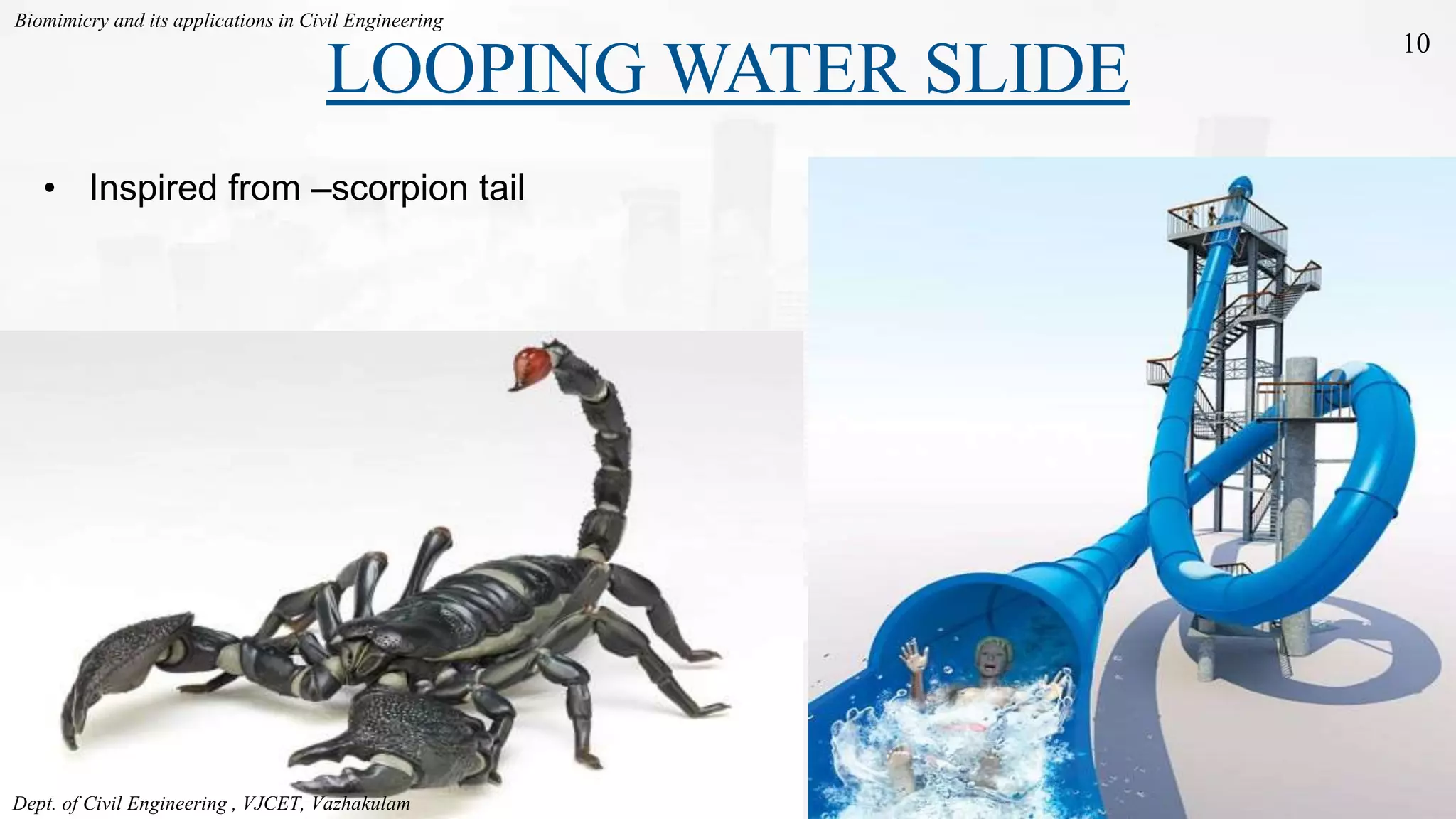
LOOPING WATER SLIDE
• Inspired from –scorpion tail
10
Dept. of Civil Engineering , VJCET, Vazhakulam
Biomimicry and its applications in Civil Engineering
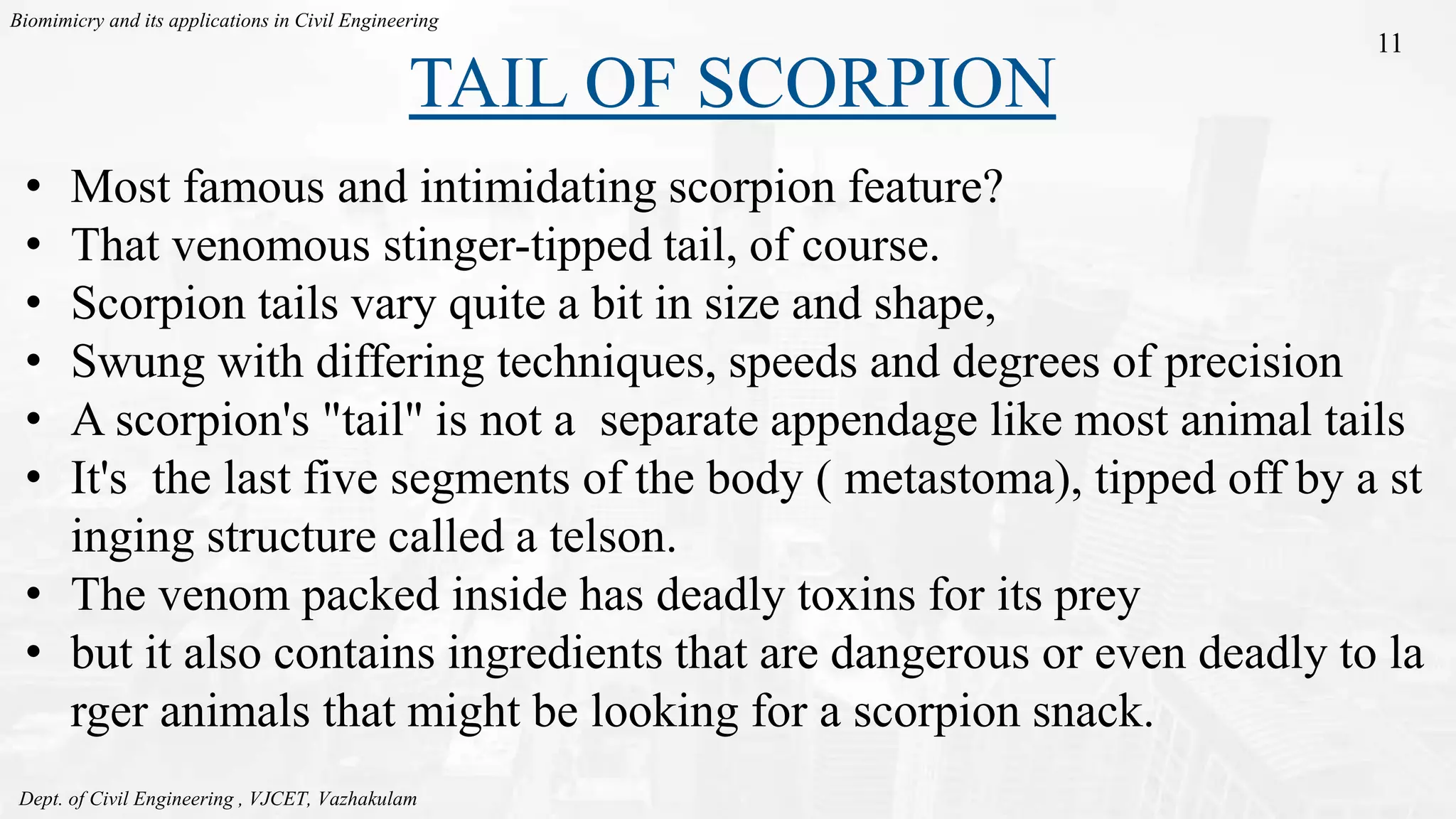
TAIL OF SCORPION
• Most famous and intimidating scorpion feature?
• That venomous stinger-tipped tail, of course.
• Scorpion tails vary quite a bit in size and shape,
• Swung with differing techniques, speeds and degrees of precision
• A scorpion's "tail" is not a separate appendage like most animal tails
• It's the last five segments of the body ( metastoma), tipped off by a st
inging structure called a telson.
• The venom packed inside has deadly toxins for its prey
• but it also contains ingredients that are dangerous or even deadly to la
rger animals that might be looking for a scorpion snack.
Dept. of Civil Engineering , VJCET, Vazhakulam
11
Biomimicry and its applications in Civil Engineering
WATER LOOP
• A trapdoor drops rider down.
• An operator open it when sensors report sufficient water flow and that the previous r
ider has finished.
• 55-foot chute descends 70-degree slope to help rider build up enough speed—about
30 mph to ascend the loop
• Optical sensors track a rider as he enters the slide
• 9-14 sec later rider splashes out into a slow-down lane of deeper water.
Dept. of Civil Engineering , VJCET, Vazhakulam
12
Biomimicry and its applications in Civil Engineering
• The 27-foot-high loop is angled 60 degrees,not a totally vertical 90, so you'll never
drop off the ceiling and crash into the floor.
• Fast riders travel high on the outside wall, nearly facing downward.
• Slower riders naturally drift down the wall to glide face-up on the tube's floor.
• Sprayers create a slicker, faster surface than is possible by pouring water down the
slide.
Dept. of Civil Engineering , VJCET, Vazhakulam
Biomimicry and its applications in Civil Engineering
13
14
Dept. of Civil Engineering , VJCET, Vazhakulam
Biomimicry and its applications in Civil Engineering
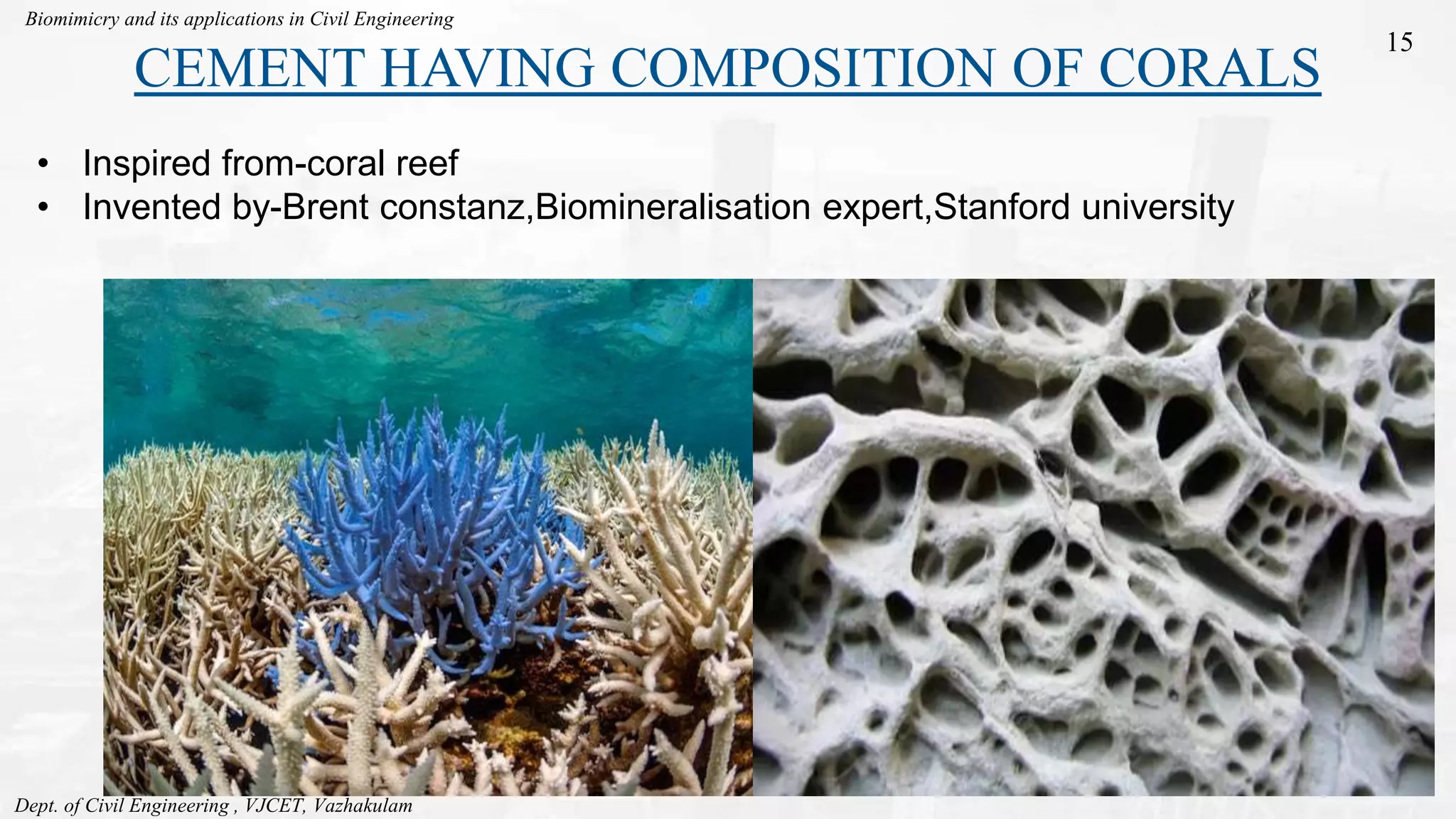
CEMENT HAVING COMPOSITION OF CORALS
• Inspired from-coral reef
• Invented by-Brent constanz,Biomineralisation expert,Stanford university
15
Dept. of Civil Engineering , VJCET, Vazhakulam
Biomimicry and its applications in Civil Engineering
CORAL FORMATION
• Sea water has calcium , CO2 gas dissolves into seawater
• Natural interaction between CO2 produces CO3 (limestone)
• Higher the concentration of CO2, the more carbonate is formed.
• That’s how corals form their shells..
Dept. of Civil Engineering , VJCET, Vazhakulam
16
Biomimicry and its applications in Civil Engineering
CONSTANTZ PROCESS
• Installation takes waste CO2 gas from local power plant.
• Dissolves it into seawater .
• Reaction of calcium with CO2 produces CO3.
• The solids that form fall to the bottom and are separated.
• They’re dried out using the waste heat from the hot flue gas.
• produces a powder in a spray dryer, which is akin to a machine making powdered m
ilk that’s cement.
Dept. of Civil Engineering , VJCET, Vazhakulam
17
Biomimicry and its applications in Civil Engineering
USES
• to make aggregate
• synthetic rock like synth
etic limestone
• it can be kept dry as a c
ement and used in a co
ncrete formulation
18
Dept. of Civil Engineering , VJCET, Vazhakulam
Biomimicry and its applications in Civil Engineering
PASSIVE COOLING-TERMITE INSPIRED
Inspired from –termite mount
Invented by-Engineers from firm Arup, led by Mick Pearce
Dept. of Civil Engineering , VJCET, Vazhakulam
19Biomimicry and its applications in Civil Engineering
TERMITE MOUND
• Termites build gigantic mounds inside they farm fungus.
• fungus must be kept at exactly 87 degrees F, while the temperatures ou
tside range from 35 degrees F at night to 104 degrees F.
• Achieved this by constantly opening and closing a series of heating an
d cooling vents throughout the mound over the course of the day.
• With a system of adjusted convection currents, air is sucked in at the lo
wer part of the mound, down into enclosures with muddy walls, and u
p through a channel to the peak of the termite mound.
• They constantly dig new vents and plug up old ones to regulate temper
ature.
Dept. of Civil Engineering , VJCET, Vazhakulam
20Biomimicry and its applications in Civil Engineering
EASTGATE CENTRE
• Eastgate Centre, largely made of concrete, has a ventilation system wh
ich operates in a similar way.
• Outside air that is drawn in is either warmed or cooled by the building
mass depending on which is hotter,the building concrete or the air.
• It is then vented into the building’s floors and offices.
• before exiting via chimneys at the top.
Dept. of Civil Engineering , VJCET, Vazhakulam
21Biomimicry and its applications in Civil Engineering
ADVANTAGE
• The Eastgate Centre uses less than
10% of the energy of a conventional
building its size.
• saved $3.5 million alone because of
an airconditioning system not have to
be implemented.
• trickle down rents 20 % lower than
in surrounding buildings.
• Sound climate control solution
• most cost effective
Dept. of Civil Engineering , VJCET, Vazhakulam
22Biomimicry and its applications in Civil Engineering
SELF CLEANING PAINTS
Inspired from-lotus leaf
Invented by-Professor Wilhem Barthlott, from the University of Bonn in Germany
Dept. of Civil Engineering , VJCET, Vazhakulam
23Biomimicry and its applications in Civil Engineering
LOTUS LEAF
• lotus leaves-distinctive surface built up in 2 levels
• tiny bumps seen in microscopic scale
• second level by thin nano-metric wires.
• waxy layer covering increases the hydrophobic effect.
• double structure underpin water dropplets maintain their spherical
shape
• waxy layer favours the rolling of droplets without wetting the leaf surf
ace
• combination of physical and chemical effects
• superhydrophobic
Dept. of Civil Engineering , VJCET, Vazhakulam
24
Biomimicry and its applications in Civil Engineering
SELF CLEANING PAINT
• paint creates microstructures on facade of buildings
• water form droplets with spherical shapes on building surfaces
• Water bead off
• taking dirt and bacteria along with it
Dept. of Civil Engineering , VJCET, Vazhakulam
25
Biomimicry and its applications in Civil Engineering
ADVANTAGES
• More cleaner
• reduces build-up of alg
ae and mold.
• low maintenance cost
• repainted less frequent
ly.
Dept. of Civil Engineering , VJCET, Vazhakulam
26
Biomimicry and its applications in Civil Engineering
Dept. of Civil Engineering , VJCET, Vazhakulam
27
Biomimicry and its applications in Civil Engineering
CONCLUSION
IMPORTANCE OF BIOMIMICRY
.
1. Nourish curiosity
Biomimicry provides the opportunity
to learn about life’s water, energy and
material-use strategies. This perspecti
ve broadens the design space to bring
new solutions to the table.
2. Go beyond form
Biomimicry looks beyond form and t
eases out life’s inherent sustainability
strategies, creating structures that fit f
orm to function, use materials efficie
ntly and adapt well to their environm
ent.
3. Give permission to play
Biomimicry Design as a framework,
looking to Life’s Principles and brin
ging ecologists and biomimics to th
e table, design teams can bring new
perspectives to their projects
4. Disrupt traditional thinking
Start by asking, “How would nature
solve this challenge?” . This framin
g gives project teams an opportunity
to explore new solutions and brainst
orm opportunities to solve challenge
s in new and innovative ways.
Dept. of Civil Engineering , VJCET, Vazhakulam
28Biomimicry and its applications in Civil Engineering
5 .Accomplish Multiple Needs with One Simple Gesture.
In nature, there are no single-purpose tools. Imagine building surfaces
and systems that could accomplish multiple functions with one simpl
e, multi-functional design
6 .Are Well-Adapted to their Context and Climate.
Rather than fighting against the climate using energy and resources to hold nature at
bay, our projects can leverage cyclic processes such as the change of seasons and buil
d with readily available materials and energy.
7.Emulating and Enhancing Ecosystem Services.
By constructing buildings, streets, and parks to perform the same services a natural ecosyste
m does: stormwater harvest, flooding mitigation, habitat creation, energy production, and ca
rbon sequestration, we can create a built environment that “fits in” again and contributes to t
he ecosystems we inhabit, truly emulating the genius of our place.
Dept. of Civil Engineering , VJCET, Vazhakulam
29
Biomimicry and its applications in Civil Engineering
8.Leveraging Collaborative Synergies.
Rethinking our buildings as nested systems, both made up of smaller systems and
a part of multiple larger ones, allows us to cultivate collaborative relationships th
at save resources, energy, and cost for the project and the community at large
9.Embodying Systemic Resilience.
Life on Earth is the epitome of resilience; adapting and changing itself to fit its context fo
r billions of years. By looking to how nature confers resilience on its systems, incorporati
ng diversity and embodying resilience through variation, redundancy, and decentralizatio
n, we can create human- built systems that are inherently resilient to disturbances, even
the unexpected.
Dept. of Civil Engineering , VJCET, Vazhakulam
30Biomimicry and its applications in Civil Engineering
You The more our world functions like the natural
world,the more likely we are to endure on this home that
is ours ,but not ours alone
-Janine M Benyus
“ “
Dept. of Civil Engineering , VJCET, Vazhakulam
31Biomimicry and its applications in Civil Engineering
THANK YOU
Dept. of Civil Engineering , VJCET, Vazhakulam
30

Biomimicry and its applications in civil engineering

  • 1.
    BIOMIMICRY AND ITSAPPLICATIONS IN CIVIL ENGINEERING PRESENTED BY:AJEENA BABY STUDENT CIVIL ENGINEERING DEPT GUIDED BY: Mrs. NISAANN MATHEW ASST. PROFESSOR CIVIL ENGINEERING DEPT. Dept. of Civil Engineering , VJCET, Vazhakulam
  • 2.
    INTRODUCTION BIOMIMICRY • Interdisciplinary fieldwhere technology, science, art, design and architecture influence eac h other & use biology for innovative solutions and products . • Approach to innovation that seeks sustainable solutions to human challenges by emulating nature’s time-tested patterns and strategies. • Goal-create products, processes, and policies new ways of living well-adapted to life on ea rth over long haul • Organisms alive today are the successful models or products of evolution. We could learn a lot from nature when it comes to solving our challenges in A sustainable way • nature's adaptations result in the conservation of energy and reduction of waste, which are of immeasurable interest to engineers and manufacturers Biomimicry and its applications in Civil Engineering 2 Dept. of Civil Engineering , VJCET, Vazhakulam
  • 3.
    LEVELS OF BIOMIMICRY Thenatural form of organisms are used for inspiration Natural process can be mimicked Ecosystem level 1 2 3 For instance, mimicking the structure of a seashell co uld lead to stronger buildings For example chemical processes such as photosynthesis, can be mimicked to create more sustainable materials. In this level, entire ecosystems and their functional pr inciples are mimicked. When a product is made with the help of biomimicry, it is called a 'biomimetic' pro duct. It can be biomimetic in terms of form, material, construction, process or function. Dept. of Civil Engineering , VJCET, Vazhakulam 3 Biomimicry and its applications in Civil Engineering
  • 4.
    CONTENTS Introduction Looping waterslideLilypad floating city Cement having composition of corals Conclusion Self cleaning paintPassive cooling More examples Dept. of Civil Engineering , VJCET, Vazhakulam 4 Biomimicry and its applications in Civil Engineering
  • 5.
    LILYPAD FLOATING CITY Inspiredfrom –water lily Dept. of Civil Engineering , VJCET, Vazhakulam 5 Biomimicry and its applications in Civil Engineering
  • 6.
    • With globalsea levels predicted to rise significantly over the next ce ntury due to climate change, a lot of people living in low lying areas are expected to be displaced from their homes. • Architect Vincent Callebaut- “Lilypad” concept ,reality by 2100. • A completely self-sufficient floating city that would accommodate upto 50,000. • Three marinas and three mountains would surround a centrally locate d artificial lagoon that is totally immersed below the water line to act as ballast for the city. 6 Dept. of Civil Engineering , VJCET, Vazhakulam Biomimicry and its applications in Civil Engineering
  • 7.
    • Three mountains& marinas would be dedicated to work, shopping and entertainment, respectively, while suspended gardens and aquacu lture farms located below the water line would be used to grow food and biomass. • The floating city would also include full complement of renewable energy technologies, including solar, thermal, wind,tidal,and biomass to produce more energy than it consumes. • The Lilypads could be located close to land or set free to follow the o cean currents wherever they may lead. Dept. of Civil Engineering , VJCET, Vazhakulam 7 Biomimicry and its applications in Civil Engineering
  • 8.
    • Disadvantage –notaffordable for all 8 Dept. of Civil Engineering , VJCET, Vazhakulam Biomimicry and its applications in Civil Engineering
  • 9.
    Dept. of CivilEngineering , VJCET, Vazhakulam 9 Biomimicry and its applications in Civil Engineering
  • 11.
    LOOPING WATER SLIDE •Inspired from –scorpion tail 10 Dept. of Civil Engineering , VJCET, Vazhakulam Biomimicry and its applications in Civil Engineering
  • 12.
    TAIL OF SCORPION •Most famous and intimidating scorpion feature? • That venomous stinger-tipped tail, of course. • Scorpion tails vary quite a bit in size and shape, • Swung with differing techniques, speeds and degrees of precision • A scorpion's "tail" is not a separate appendage like most animal tails • It's the last five segments of the body ( metastoma), tipped off by a st inging structure called a telson. • The venom packed inside has deadly toxins for its prey • but it also contains ingredients that are dangerous or even deadly to la rger animals that might be looking for a scorpion snack. Dept. of Civil Engineering , VJCET, Vazhakulam 11 Biomimicry and its applications in Civil Engineering
  • 13.
    WATER LOOP • Atrapdoor drops rider down. • An operator open it when sensors report sufficient water flow and that the previous r ider has finished. • 55-foot chute descends 70-degree slope to help rider build up enough speed—about 30 mph to ascend the loop • Optical sensors track a rider as he enters the slide • 9-14 sec later rider splashes out into a slow-down lane of deeper water. Dept. of Civil Engineering , VJCET, Vazhakulam 12 Biomimicry and its applications in Civil Engineering
  • 14.
    • The 27-foot-highloop is angled 60 degrees,not a totally vertical 90, so you'll never drop off the ceiling and crash into the floor. • Fast riders travel high on the outside wall, nearly facing downward. • Slower riders naturally drift down the wall to glide face-up on the tube's floor. • Sprayers create a slicker, faster surface than is possible by pouring water down the slide. Dept. of Civil Engineering , VJCET, Vazhakulam Biomimicry and its applications in Civil Engineering 13
  • 15.
    14 Dept. of CivilEngineering , VJCET, Vazhakulam Biomimicry and its applications in Civil Engineering
  • 17.
    CEMENT HAVING COMPOSITIONOF CORALS • Inspired from-coral reef • Invented by-Brent constanz,Biomineralisation expert,Stanford university 15 Dept. of Civil Engineering , VJCET, Vazhakulam Biomimicry and its applications in Civil Engineering
  • 18.
    CORAL FORMATION • Seawater has calcium , CO2 gas dissolves into seawater • Natural interaction between CO2 produces CO3 (limestone) • Higher the concentration of CO2, the more carbonate is formed. • That’s how corals form their shells.. Dept. of Civil Engineering , VJCET, Vazhakulam 16 Biomimicry and its applications in Civil Engineering
  • 19.
    CONSTANTZ PROCESS • Installationtakes waste CO2 gas from local power plant. • Dissolves it into seawater . • Reaction of calcium with CO2 produces CO3. • The solids that form fall to the bottom and are separated. • They’re dried out using the waste heat from the hot flue gas. • produces a powder in a spray dryer, which is akin to a machine making powdered m ilk that’s cement. Dept. of Civil Engineering , VJCET, Vazhakulam 17 Biomimicry and its applications in Civil Engineering
  • 20.
    USES • to makeaggregate • synthetic rock like synth etic limestone • it can be kept dry as a c ement and used in a co ncrete formulation 18 Dept. of Civil Engineering , VJCET, Vazhakulam Biomimicry and its applications in Civil Engineering
  • 21.
    PASSIVE COOLING-TERMITE INSPIRED Inspiredfrom –termite mount Invented by-Engineers from firm Arup, led by Mick Pearce Dept. of Civil Engineering , VJCET, Vazhakulam 19Biomimicry and its applications in Civil Engineering
  • 22.
    TERMITE MOUND • Termitesbuild gigantic mounds inside they farm fungus. • fungus must be kept at exactly 87 degrees F, while the temperatures ou tside range from 35 degrees F at night to 104 degrees F. • Achieved this by constantly opening and closing a series of heating an d cooling vents throughout the mound over the course of the day. • With a system of adjusted convection currents, air is sucked in at the lo wer part of the mound, down into enclosures with muddy walls, and u p through a channel to the peak of the termite mound. • They constantly dig new vents and plug up old ones to regulate temper ature. Dept. of Civil Engineering , VJCET, Vazhakulam 20Biomimicry and its applications in Civil Engineering
  • 23.
    EASTGATE CENTRE • EastgateCentre, largely made of concrete, has a ventilation system wh ich operates in a similar way. • Outside air that is drawn in is either warmed or cooled by the building mass depending on which is hotter,the building concrete or the air. • It is then vented into the building’s floors and offices. • before exiting via chimneys at the top. Dept. of Civil Engineering , VJCET, Vazhakulam 21Biomimicry and its applications in Civil Engineering
  • 24.
    ADVANTAGE • The EastgateCentre uses less than 10% of the energy of a conventional building its size. • saved $3.5 million alone because of an airconditioning system not have to be implemented. • trickle down rents 20 % lower than in surrounding buildings. • Sound climate control solution • most cost effective Dept. of Civil Engineering , VJCET, Vazhakulam 22Biomimicry and its applications in Civil Engineering
  • 25.
    SELF CLEANING PAINTS Inspiredfrom-lotus leaf Invented by-Professor Wilhem Barthlott, from the University of Bonn in Germany Dept. of Civil Engineering , VJCET, Vazhakulam 23Biomimicry and its applications in Civil Engineering
  • 26.
    LOTUS LEAF • lotusleaves-distinctive surface built up in 2 levels • tiny bumps seen in microscopic scale • second level by thin nano-metric wires. • waxy layer covering increases the hydrophobic effect. • double structure underpin water dropplets maintain their spherical shape • waxy layer favours the rolling of droplets without wetting the leaf surf ace • combination of physical and chemical effects • superhydrophobic Dept. of Civil Engineering , VJCET, Vazhakulam 24 Biomimicry and its applications in Civil Engineering
  • 27.
    SELF CLEANING PAINT •paint creates microstructures on facade of buildings • water form droplets with spherical shapes on building surfaces • Water bead off • taking dirt and bacteria along with it Dept. of Civil Engineering , VJCET, Vazhakulam 25 Biomimicry and its applications in Civil Engineering
  • 28.
    ADVANTAGES • More cleaner •reduces build-up of alg ae and mold. • low maintenance cost • repainted less frequent ly. Dept. of Civil Engineering , VJCET, Vazhakulam 26 Biomimicry and its applications in Civil Engineering
  • 29.
    Dept. of CivilEngineering , VJCET, Vazhakulam 27 Biomimicry and its applications in Civil Engineering
  • 30.
    CONCLUSION IMPORTANCE OF BIOMIMICRY . 1.Nourish curiosity Biomimicry provides the opportunity to learn about life’s water, energy and material-use strategies. This perspecti ve broadens the design space to bring new solutions to the table. 2. Go beyond form Biomimicry looks beyond form and t eases out life’s inherent sustainability strategies, creating structures that fit f orm to function, use materials efficie ntly and adapt well to their environm ent. 3. Give permission to play Biomimicry Design as a framework, looking to Life’s Principles and brin ging ecologists and biomimics to th e table, design teams can bring new perspectives to their projects 4. Disrupt traditional thinking Start by asking, “How would nature solve this challenge?” . This framin g gives project teams an opportunity to explore new solutions and brainst orm opportunities to solve challenge s in new and innovative ways. Dept. of Civil Engineering , VJCET, Vazhakulam 28Biomimicry and its applications in Civil Engineering
  • 31.
    5 .Accomplish MultipleNeeds with One Simple Gesture. In nature, there are no single-purpose tools. Imagine building surfaces and systems that could accomplish multiple functions with one simpl e, multi-functional design 6 .Are Well-Adapted to their Context and Climate. Rather than fighting against the climate using energy and resources to hold nature at bay, our projects can leverage cyclic processes such as the change of seasons and buil d with readily available materials and energy. 7.Emulating and Enhancing Ecosystem Services. By constructing buildings, streets, and parks to perform the same services a natural ecosyste m does: stormwater harvest, flooding mitigation, habitat creation, energy production, and ca rbon sequestration, we can create a built environment that “fits in” again and contributes to t he ecosystems we inhabit, truly emulating the genius of our place. Dept. of Civil Engineering , VJCET, Vazhakulam 29 Biomimicry and its applications in Civil Engineering
  • 32.
    8.Leveraging Collaborative Synergies. Rethinkingour buildings as nested systems, both made up of smaller systems and a part of multiple larger ones, allows us to cultivate collaborative relationships th at save resources, energy, and cost for the project and the community at large 9.Embodying Systemic Resilience. Life on Earth is the epitome of resilience; adapting and changing itself to fit its context fo r billions of years. By looking to how nature confers resilience on its systems, incorporati ng diversity and embodying resilience through variation, redundancy, and decentralizatio n, we can create human- built systems that are inherently resilient to disturbances, even the unexpected. Dept. of Civil Engineering , VJCET, Vazhakulam 30Biomimicry and its applications in Civil Engineering
  • 33.
    You The moreour world functions like the natural world,the more likely we are to endure on this home that is ours ,but not ours alone -Janine M Benyus “ “ Dept. of Civil Engineering , VJCET, Vazhakulam 31Biomimicry and its applications in Civil Engineering
  • 34.
    THANK YOU Dept. ofCivil Engineering , VJCET, Vazhakulam 30