BIO-MEDICAL WASTE
MANAGEMENT
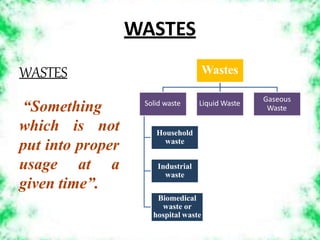
WASTES
Wastes
Solid waste
Household
waste
Industrial
waste
Biomedical
waste or
hospital waste
Liquid Waste
Gaseous
Waste
WASTES
“Something
which is not
put into proper
usage at a
given time”.
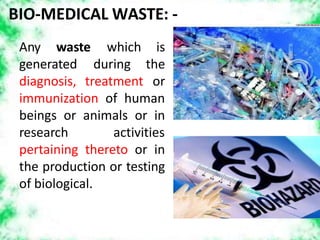
BIO-MEDICAL WASTE: -
Any waste
generated
diagnosis, treatment
which is
during the
or
immunization of human
beings or animals or in
research activities
pertaining thereto or in
the production or testing
of biological.
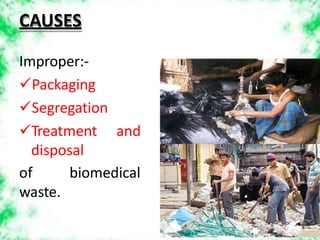
Improper:-
Packaging
Segregation
Treatment and
disposal
biomedical
of
waste.
CAUSES
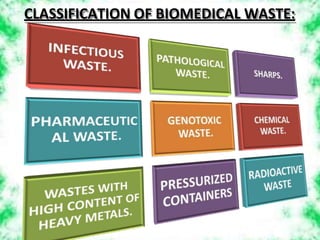
CLASSIFICATION OF BIOMEDICAL WASTE:
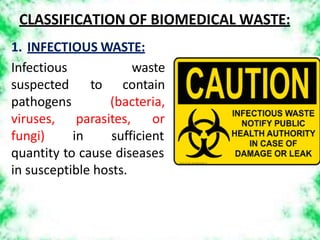
1. INFECTIOUS WASTE:
waste
to contain
(bacteria,
parasites, or
Infectious
suspected
pathogens
viruses,
fungi) in sufficient
quantity to cause diseases
in susceptible hosts.
continue…
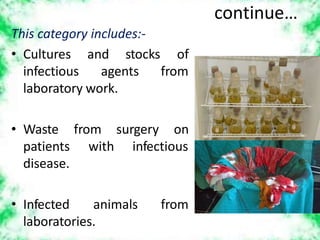
This category includes:-
• Cultures and stocks of
infectious agents from
laboratory work.
from surgery on
with infectious
• Waste
patients
disease.
• Infected animals from
laboratories.
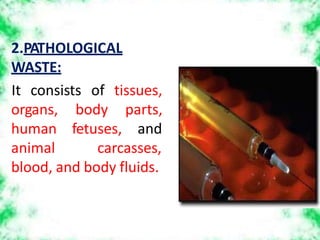
2.PATHOLOGICAL
WASTE:
body
It consists of tissues,
parts,
fetuses, and
organs,
human
animal carcasses,
blood, and body fluids.
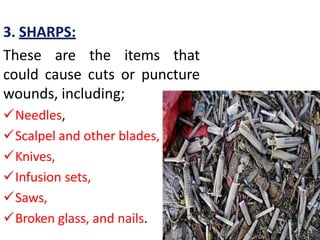
3. SHARPS:
These are the items that
could cause cuts or puncture
wounds, including;
Needles,
Scalpel and other blades,
Knives,
Infusion sets,
Saws,
Broken glass, and nails.
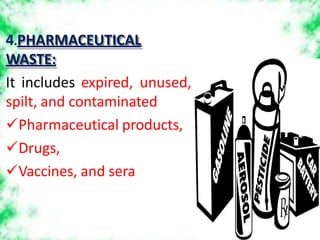
4.PHARMACEUTICAL
WASTE:
It includes expired, unused,
spilt, and contaminated
Pharmaceutical products,
Drugs,
Vaccines, and sera
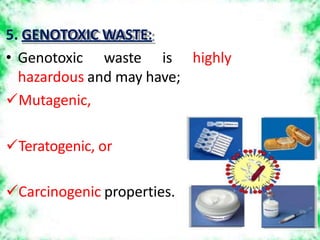
5. GENOTOXIC WASTE:
highly
• Genotoxic waste is
hazardous and may have;
Mutagenic,
Teratogenic, or
Carcinogenic properties.
• It raises serious safety problems,
both inside hospitals
disposal, and should
and after
be given
special attention.
• It includes certain cytostatic
drugs, vomit, urine, or feces from
patients treated with cytostatic
drugs, chemicals, and radioactive
material.
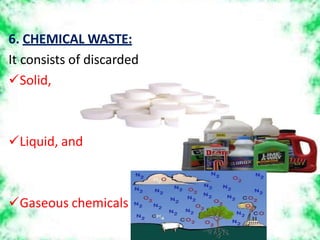
6. CHEMICAL WASTE:
It consists of discarded
Solid,
Liquid, and
Gaseous chemicals
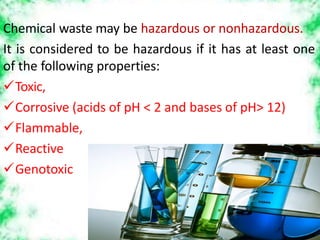
Chemical waste may be hazardous or nonhazardous.
It is considered to be hazardous if it has at least one
of the following properties:
Toxic,
Corrosive (acids of pH < 2 and bases of pH> 12)
Flammable,
Reactive
Genotoxic
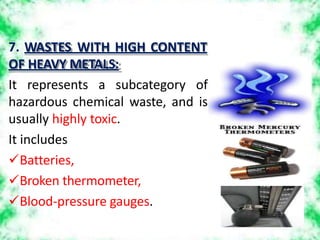
7. WASTES WITH HIGH CONTENT
OF HEAVY METALS:
It represents a subcategory of
hazardous chemical waste, and is
usually highly toxic.
It includes
Batteries,
Broken thermometer,
Blood-pressure gauges.
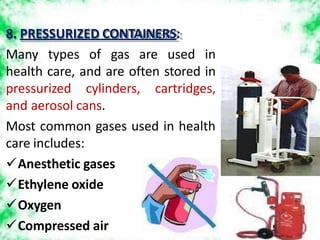
8. PRESSURIZED CONTAINERS:
Many types of gas are used in
health care, and are often stored in
pressurized cylinders, cartridges,
and aerosol cans.
Most common gases used in health
care includes:
Anesthetic gases
Ethylene oxide
Oxygen
Compressed air
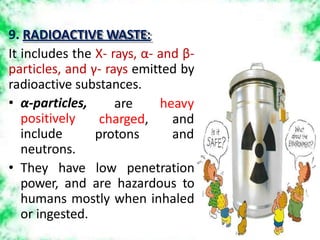
9. RADIOACTIVE WASTE:
It includes the X- rays, α- and β-
particles, and γ- rays emitted by
radioactive substances.
are heavy
charged, and
protons and
• α-particles,
positively
include
neutrons.
• They have low penetration
power, and are hazardous to
humans mostly when inhaled
or ingested.
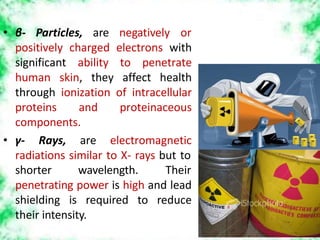
positively charged electrons with
significant ability to penetrate
human skin, they affect health
through ionization of intracellular
proteins and proteinaceous
components.
• γ- Rays, are electromagnetic
radiations similar to X- rays but to
• β- Particles, are negatively or
shorter wavelength. Their
penetrating power is high and lead
shielding is required to reduce
their intensity.
SOURCES OF BIOMEDICAL WASTE:
care
• It is generated primarily from health
establishments, including
• Hospitals,
• Nursing homes,
• Veterinary hospitals,
• Clinics and general practitioners,
• Dispensaries,
• Blood blanks,
• Animal houses and research institute.
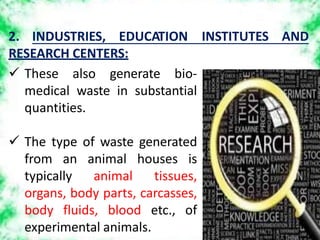
2. INDUSTRIES, EDUCATION INSTITUTES AND
RESEARCH CENTERS:
 These also generate bio-
medical waste in substantial
quantities.
 The type of waste generated
from an animal houses is
typically animal tissues,
organs, body parts, carcasses,
body fluids, blood etc., of
experimental animals.
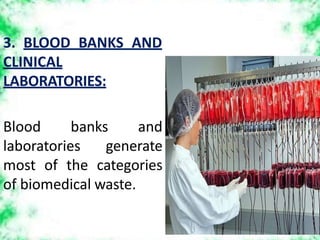
3. BLOOD BANKS AND
CLINICAL
LABORATORIES:
Blood banks and
laboratories generate
most of the categories
of biomedical waste.
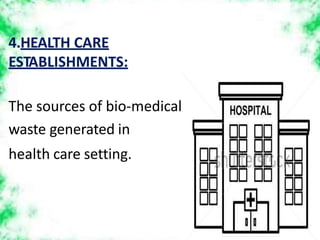
4.HEALTH CARE
ESTABLISHMENTS:
The sources of bio-medical
waste generated in
health care setting.
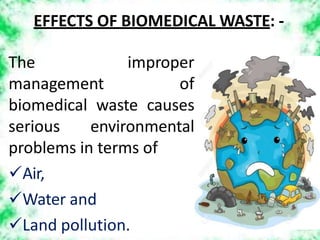
EFFECTS OF BIOMEDICAL WASTE: -
The
management
improper
of
biomedical waste causes
serious environmental
problems in terms of
Air,
Water and
Land pollution.
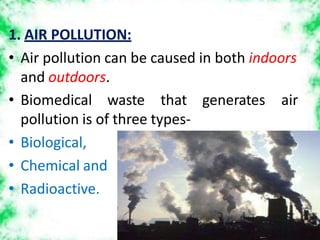
1. AIR POLLUTION:
• Air pollution can be caused in both indoors
and outdoors.
generates air
• Biomedical waste that
pollution is of three types-
• Biological,
• Chemical and
• Radioactive.
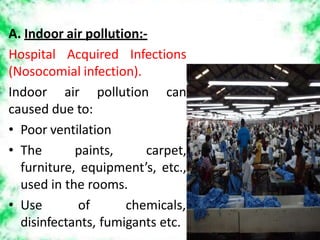
A. Indoor air pollution:-
Hospital Acquired Infections
(Nosocomial infection).
Indoor air pollution can
caused due to:
• Poor ventilation
• The paints, carpet,
furniture, equipment’s, etc.,
used in the rooms.
• Use of chemicals,
disinfectants, fumigants etc.
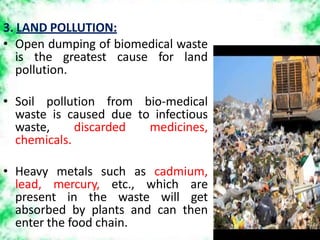
3. LAND POLLUTION:
• Open dumping of biomedical waste
is the greatest cause for land
pollution.
• Soil pollution from bio-medical
waste is caused due to infectious
waste, discarded medicines,
chemicals.
• Heavy metals such as cadmium,
lead, mercury, etc., which are
present in the waste will get
absorbed by plants and can then
enter the food chain.
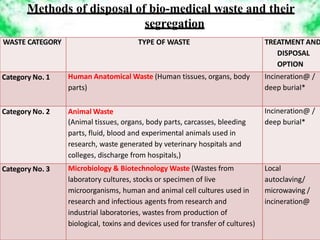
Methods of disposal of bio-medical waste and their
segregation
WASTE CATEGORY TYPE OF WASTE TREATMENT AND
DISPOSAL
OPTION
Category No. 1 Human Anatomical Waste (Human tissues, organs, body
parts)
Incineration@ /
deep burial*
Category No. 2 Animal Waste
(Animal tissues, organs, body parts, carcasses, bleeding
parts, fluid, blood and experimental animals used in
research, waste generated by veterinary hospitals and
colleges, discharge from hospitals,)
Incineration@ /
deep burial*
Category No. 3 Microbiology & Biotechnology Waste (Wastes from
laboratory cultures, stocks or specimen of live
microorganisms, human and animal cell cultures used in
research and infectious agents from research and
industrial laboratories, wastes from production of
biological, toxins and devices used for transfer of cultures)
Local
autoclaving/
microwaving /
incineration@
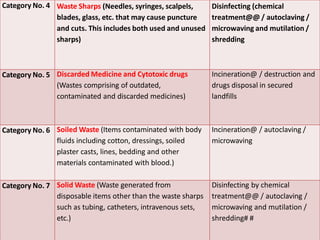
Category No. 4 Waste Sharps (Needles, syringes, scalpels,
blades, glass, etc. that may cause puncture
and cuts. This includes both used and unused
sharps)
Disinfecting (chemical
treatment@@ / autoclaving /
microwaving and mutilation /
shredding
Category No. 5 Discarded Medicine and Cytotoxic drugs
(Wastes comprising of outdated,
contaminated and discarded medicines)
Incineration@ / destruction and
drugs disposal in secured
landfills
Category No. 6 Soiled Waste (Items contaminated with body
fluids including cotton, dressings, soiled
plaster casts, lines, bedding and other
materials contaminated with blood.)
Incineration@ / autoclaving /
microwaving
Category No. 7 Solid Waste (Waste generated from
disposable items other than the waste sharps
such as tubing, catheters, intravenous sets,
etc.)
Disinfecting by chemical
treatment@@ / autoclaving /
microwaving and mutilation /
shredding# #
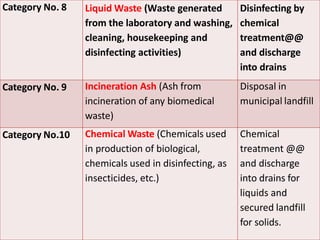
Category No. 8 Liquid Waste (Waste generated
from the laboratory and washing,
cleaning, housekeeping and
disinfecting activities)
Disinfecting by
chemical
treatment@@
and discharge
into drains
Category No. 9 Incineration Ash (Ash from
incineration of any biomedical
waste)
Disposal in
municipal landfill
Category No.10 Chemical Waste (Chemicals used
in production of biological,
chemicals used in disinfecting, as
insecticides, etc.)
Chemical
treatment @@
and discharge
into drains for
liquids and
secured landfill
for solids.
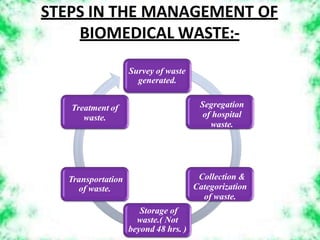
STEPS IN THE MANAGEMENT OF
BIOMEDICAL WASTE:-
Survey of waste
generated.
Segregation
of hospital
waste.
Collection &
Categorization
of waste.
Storage of
waste.( Not
beyond 48 hrs. )
Transportation
of waste.
Treatment of
waste.
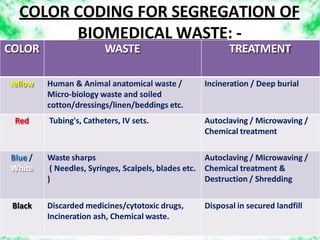
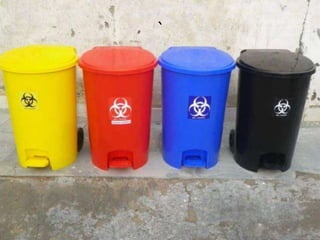
COLOR CODING FOR SEGREGATION OF
BIOMEDICAL WASTE: -
COLOR WASTE TREATMENT
Yellow Human & Animal anatomical waste /
Micro-biology waste and soiled
cotton/dressings/linen/beddings etc.
Incineration / Deep burial
Red Tubing's, Catheters, IV sets. Autoclaving / Microwaving /
Chemical treatment
Blue /
White
Waste sharps
( Needles, Syringes, Scalpels, blades etc.
)
Autoclaving / Microwaving /
Chemical treatment &
Destruction / Shredding
Black Discarded medicines/cytotoxic drugs,
Incineration ash, Chemical waste.
Disposal in secured landfill
`
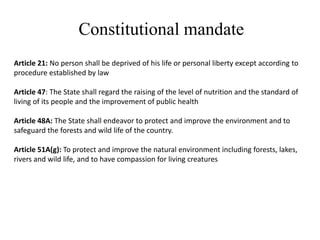
Constitutional mandate
Article 21: No person shall be deprived of his life or personal liberty except according to
procedure established by law
Article 47: The State shall regard the raising of the level of nutrition and the standard of
living of its people and the improvement of public health
Article 48A: The State shall endeavor to protect and improve the environment and to
safeguard the forests and wild life of the country.
Article 51A(g): To protect and improve the natural environment including forests, lakes,
rivers and wild life, and to have compassion for living creatures
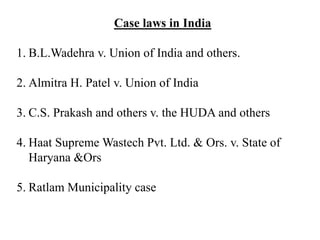
Case laws in India
1. B.L.Wadehra v. Union of India and others.
2. Almitra H. Patel v. Union of India
3. C.S. Prakash and others v. the HUDA and others
4. Haat Supreme Wastech Pvt. Ltd. & Ors. v. State of
Haryana &Ors
5. Ratlam Municipality case
• Doctors, nurses, and laboratory technicians have
better knowledge than sanitary staff regarding
biomedical waste management.
• Knowledge regarding the color coding and waste
segregation at source was found to be better
among nurses and laboratory staff as compared to
doctors.
• Regarding practices related to biomedical waste
management, sanitary staff were ignorant on all
the counts.
Conclusion

Bio-medical waste management.pptx

  • 1.
  • 2.
    WASTES Wastes Solid waste Household waste Industrial waste Biomedical waste or hospitalwaste Liquid Waste Gaseous Waste WASTES “Something which is not put into proper usage at a given time”.
  • 3.
    BIO-MEDICAL WASTE: - Anywaste generated diagnosis, treatment which is during the or immunization of human beings or animals or in research activities pertaining thereto or in the production or testing of biological.
  • 4.
  • 5.
  • 6.
    CLASSIFICATION OF BIOMEDICALWASTE: 1. INFECTIOUS WASTE: waste to contain (bacteria, parasites, or Infectious suspected pathogens viruses, fungi) in sufficient quantity to cause diseases in susceptible hosts.
  • 7.
    continue… This category includes:- •Cultures and stocks of infectious agents from laboratory work. from surgery on with infectious • Waste patients disease. • Infected animals from laboratories.
  • 8.
    2.PATHOLOGICAL WASTE: body It consists oftissues, parts, fetuses, and organs, human animal carcasses, blood, and body fluids.
  • 9.
    3. SHARPS: These arethe items that could cause cuts or puncture wounds, including; Needles, Scalpel and other blades, Knives, Infusion sets, Saws, Broken glass, and nails.
  • 10.
    4.PHARMACEUTICAL WASTE: It includes expired,unused, spilt, and contaminated Pharmaceutical products, Drugs, Vaccines, and sera
  • 11.
    5. GENOTOXIC WASTE: highly •Genotoxic waste is hazardous and may have; Mutagenic, Teratogenic, or Carcinogenic properties.
  • 12.
    • It raisesserious safety problems, both inside hospitals disposal, and should and after be given special attention. • It includes certain cytostatic drugs, vomit, urine, or feces from patients treated with cytostatic drugs, chemicals, and radioactive material.
  • 13.
    6. CHEMICAL WASTE: Itconsists of discarded Solid, Liquid, and Gaseous chemicals
  • 14.
    Chemical waste maybe hazardous or nonhazardous. It is considered to be hazardous if it has at least one of the following properties: Toxic, Corrosive (acids of pH < 2 and bases of pH> 12) Flammable, Reactive Genotoxic
  • 15.
    7. WASTES WITHHIGH CONTENT OF HEAVY METALS: It represents a subcategory of hazardous chemical waste, and is usually highly toxic. It includes Batteries, Broken thermometer, Blood-pressure gauges.
  • 16.
    8. PRESSURIZED CONTAINERS: Manytypes of gas are used in health care, and are often stored in pressurized cylinders, cartridges, and aerosol cans. Most common gases used in health care includes: Anesthetic gases Ethylene oxide Oxygen Compressed air
  • 17.
    9. RADIOACTIVE WASTE: Itincludes the X- rays, α- and β- particles, and γ- rays emitted by radioactive substances. are heavy charged, and protons and • α-particles, positively include neutrons. • They have low penetration power, and are hazardous to humans mostly when inhaled or ingested.
  • 18.
    positively charged electronswith significant ability to penetrate human skin, they affect health through ionization of intracellular proteins and proteinaceous components. • γ- Rays, are electromagnetic radiations similar to X- rays but to • β- Particles, are negatively or shorter wavelength. Their penetrating power is high and lead shielding is required to reduce their intensity.
  • 19.
    SOURCES OF BIOMEDICALWASTE: care • It is generated primarily from health establishments, including • Hospitals, • Nursing homes, • Veterinary hospitals, • Clinics and general practitioners, • Dispensaries, • Blood blanks, • Animal houses and research institute.
  • 20.
    2. INDUSTRIES, EDUCATIONINSTITUTES AND RESEARCH CENTERS:  These also generate bio- medical waste in substantial quantities.  The type of waste generated from an animal houses is typically animal tissues, organs, body parts, carcasses, body fluids, blood etc., of experimental animals.
  • 21.
    3. BLOOD BANKSAND CLINICAL LABORATORIES: Blood banks and laboratories generate most of the categories of biomedical waste.
  • 22.
    4.HEALTH CARE ESTABLISHMENTS: The sourcesof bio-medical waste generated in health care setting.
  • 23.
    EFFECTS OF BIOMEDICALWASTE: - The management improper of biomedical waste causes serious environmental problems in terms of Air, Water and Land pollution.
  • 24.
    1. AIR POLLUTION: •Air pollution can be caused in both indoors and outdoors. generates air • Biomedical waste that pollution is of three types- • Biological, • Chemical and • Radioactive.
  • 25.
    A. Indoor airpollution:- Hospital Acquired Infections (Nosocomial infection). Indoor air pollution can caused due to: • Poor ventilation • The paints, carpet, furniture, equipment’s, etc., used in the rooms. • Use of chemicals, disinfectants, fumigants etc.
  • 26.
    3. LAND POLLUTION: •Open dumping of biomedical waste is the greatest cause for land pollution. • Soil pollution from bio-medical waste is caused due to infectious waste, discarded medicines, chemicals. • Heavy metals such as cadmium, lead, mercury, etc., which are present in the waste will get absorbed by plants and can then enter the food chain.
  • 27.
    Methods of disposalof bio-medical waste and their segregation WASTE CATEGORY TYPE OF WASTE TREATMENT AND DISPOSAL OPTION Category No. 1 Human Anatomical Waste (Human tissues, organs, body parts) Incineration@ / deep burial* Category No. 2 Animal Waste (Animal tissues, organs, body parts, carcasses, bleeding parts, fluid, blood and experimental animals used in research, waste generated by veterinary hospitals and colleges, discharge from hospitals,) Incineration@ / deep burial* Category No. 3 Microbiology & Biotechnology Waste (Wastes from laboratory cultures, stocks or specimen of live microorganisms, human and animal cell cultures used in research and infectious agents from research and industrial laboratories, wastes from production of biological, toxins and devices used for transfer of cultures) Local autoclaving/ microwaving / incineration@
  • 28.
    Category No. 4Waste Sharps (Needles, syringes, scalpels, blades, glass, etc. that may cause puncture and cuts. This includes both used and unused sharps) Disinfecting (chemical treatment@@ / autoclaving / microwaving and mutilation / shredding Category No. 5 Discarded Medicine and Cytotoxic drugs (Wastes comprising of outdated, contaminated and discarded medicines) Incineration@ / destruction and drugs disposal in secured landfills Category No. 6 Soiled Waste (Items contaminated with body fluids including cotton, dressings, soiled plaster casts, lines, bedding and other materials contaminated with blood.) Incineration@ / autoclaving / microwaving Category No. 7 Solid Waste (Waste generated from disposable items other than the waste sharps such as tubing, catheters, intravenous sets, etc.) Disinfecting by chemical treatment@@ / autoclaving / microwaving and mutilation / shredding# #
  • 29.
    Category No. 8Liquid Waste (Waste generated from the laboratory and washing, cleaning, housekeeping and disinfecting activities) Disinfecting by chemical treatment@@ and discharge into drains Category No. 9 Incineration Ash (Ash from incineration of any biomedical waste) Disposal in municipal landfill Category No.10 Chemical Waste (Chemicals used in production of biological, chemicals used in disinfecting, as insecticides, etc.) Chemical treatment @@ and discharge into drains for liquids and secured landfill for solids.
  • 30.
    STEPS IN THEMANAGEMENT OF BIOMEDICAL WASTE:- Survey of waste generated. Segregation of hospital waste. Collection & Categorization of waste. Storage of waste.( Not beyond 48 hrs. ) Transportation of waste. Treatment of waste.
  • 31.
    COLOR CODING FORSEGREGATION OF BIOMEDICAL WASTE: - COLOR WASTE TREATMENT Yellow Human & Animal anatomical waste / Micro-biology waste and soiled cotton/dressings/linen/beddings etc. Incineration / Deep burial Red Tubing's, Catheters, IV sets. Autoclaving / Microwaving / Chemical treatment Blue / White Waste sharps ( Needles, Syringes, Scalpels, blades etc. ) Autoclaving / Microwaving / Chemical treatment & Destruction / Shredding Black Discarded medicines/cytotoxic drugs, Incineration ash, Chemical waste. Disposal in secured landfill
  • 32.
  • 33.
    Constitutional mandate Article 21:No person shall be deprived of his life or personal liberty except according to procedure established by law Article 47: The State shall regard the raising of the level of nutrition and the standard of living of its people and the improvement of public health Article 48A: The State shall endeavor to protect and improve the environment and to safeguard the forests and wild life of the country. Article 51A(g): To protect and improve the natural environment including forests, lakes, rivers and wild life, and to have compassion for living creatures
  • 34.
    Case laws inIndia 1. B.L.Wadehra v. Union of India and others. 2. Almitra H. Patel v. Union of India 3. C.S. Prakash and others v. the HUDA and others 4. Haat Supreme Wastech Pvt. Ltd. & Ors. v. State of Haryana &Ors 5. Ratlam Municipality case
  • 35.
    • Doctors, nurses,and laboratory technicians have better knowledge than sanitary staff regarding biomedical waste management. • Knowledge regarding the color coding and waste segregation at source was found to be better among nurses and laboratory staff as compared to doctors. • Regarding practices related to biomedical waste management, sanitary staff were ignorant on all the counts. Conclusion