Mrs. Sakshi Chaturvedi
Assistant professor
Banasthali vidyapith, Jaipur,Rajasthan
1
 In simple words it is waste generated by
medical and health care institutes/agencies .
2
 Biomedical waste is generated during
diagnosis, treatment and prevention of
disease ,in biomedical research and
production and testing of biochemicals.
3
 HOSPITAL
 NURSING HOMES
 HEALTH CARE CENTRE
 CLINICS
 MEDICAL RESEARCH CENTRE
 DIAGNOSTIC LABORATORIES
 VETERINARY INSTITUTES
 BLOOD BANK/DONATION CAMPS
 BIOTECHNOLOGY INSTITUTES
4
5
Cytotoxic
waste
6
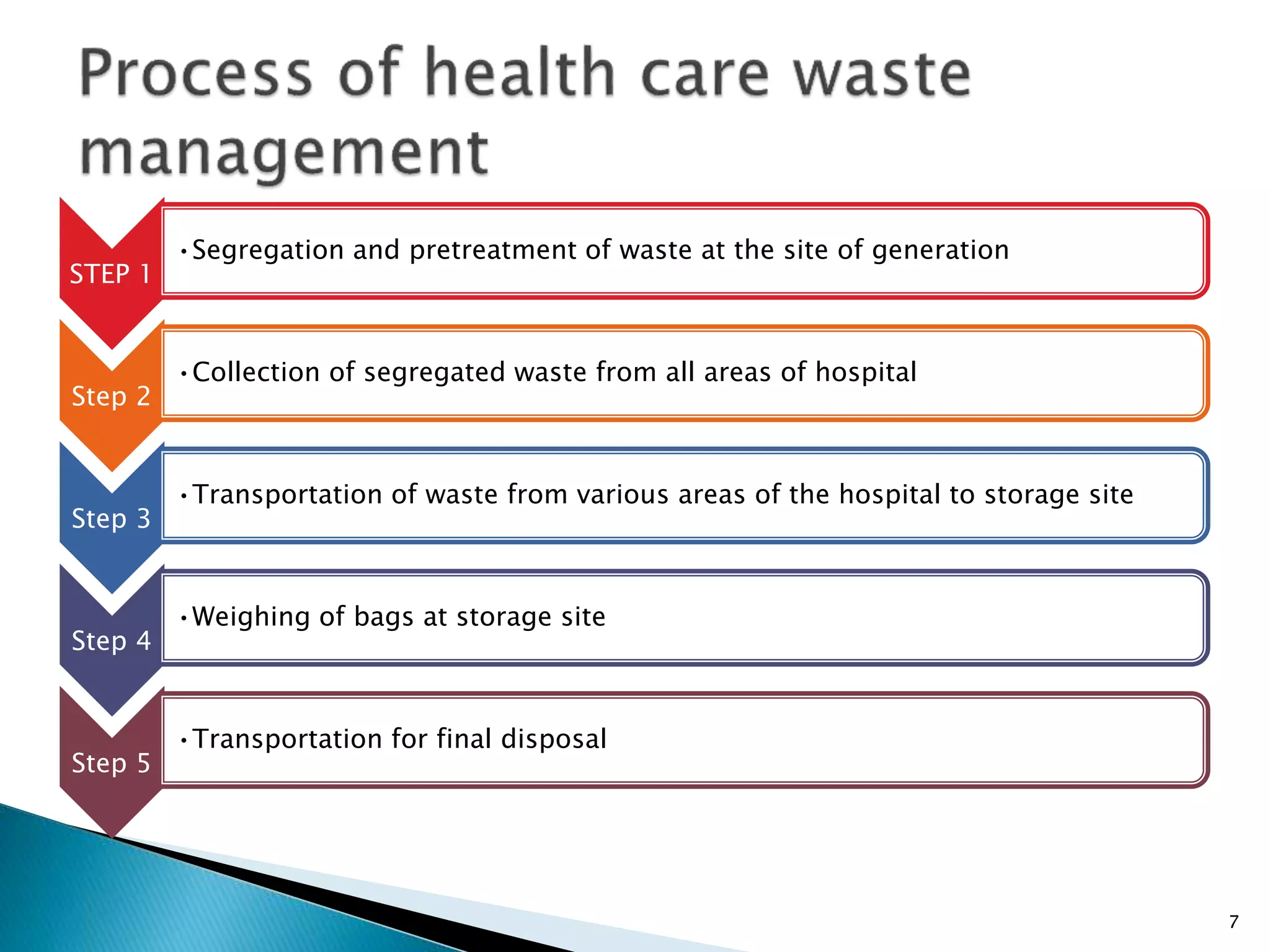
STEP 1
•Segregation and pretreatment of waste at the site of generation
Step 2
•Collection of segregated waste from all areas of hospital
Step 3
•Transportation of waste from various areas of the hospital to storage site
Step 4
•Weighing of bags at storage site
Step 5
•Transportation for final disposal
7
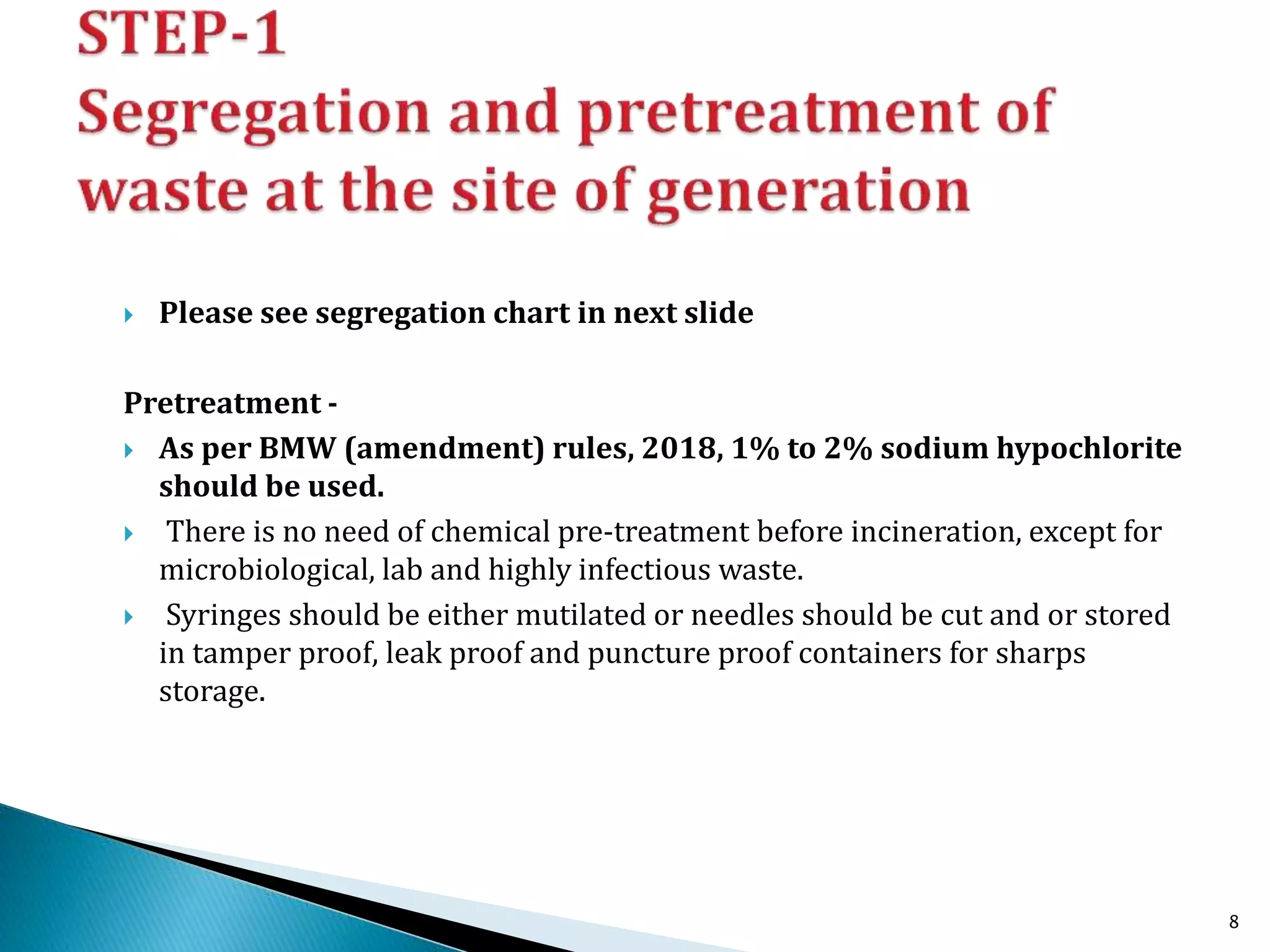
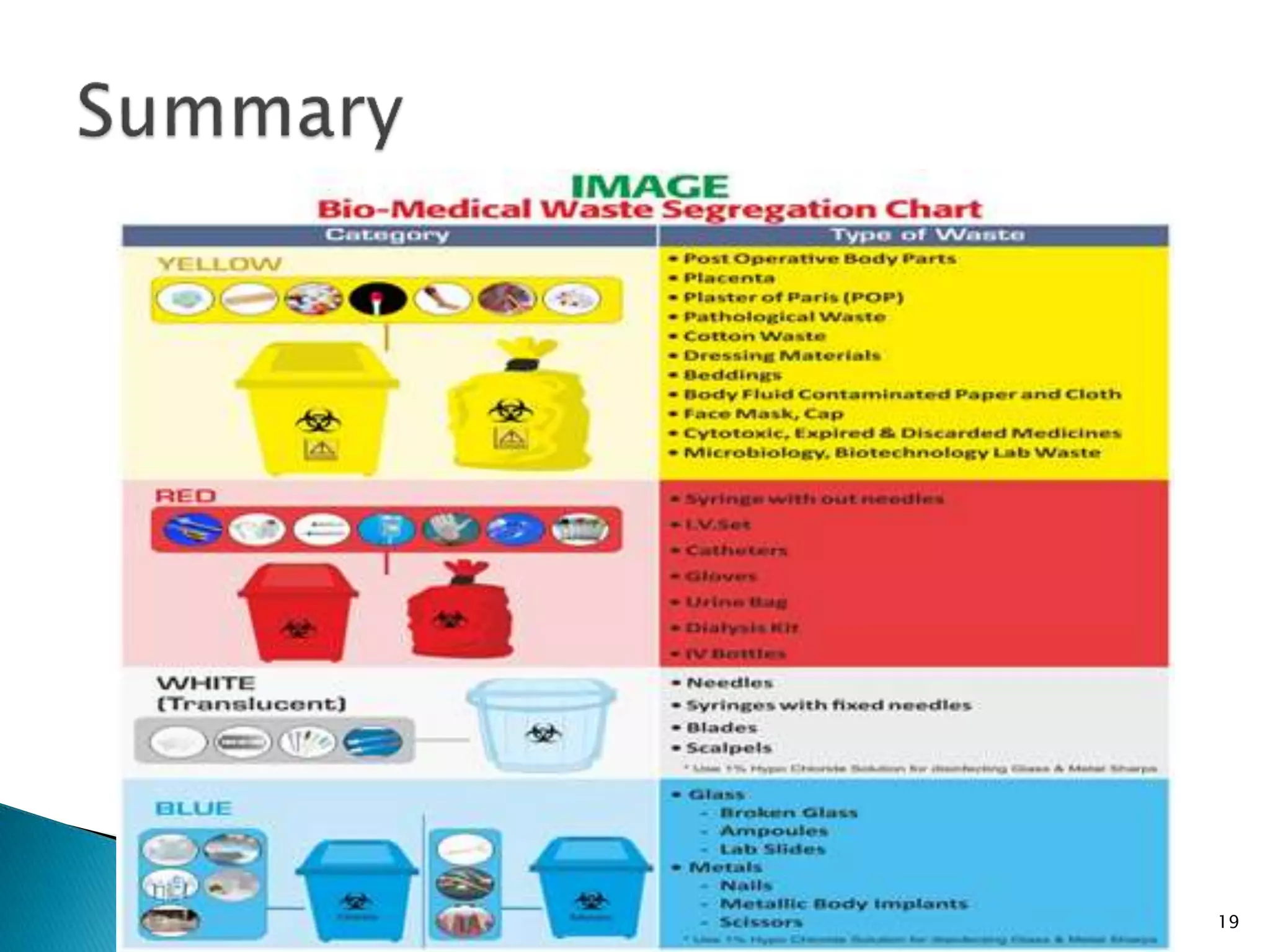
 Please see segregation chart in next slide
Pretreatment -
 As per BMW (amendment) rules, 2018, 1% to 2% sodium hypochlorite
should be used.
 There is no need of chemical pre-treatment before incineration, except for
microbiological, lab and highly infectious waste.
 Syringes should be either mutilated or needles should be cut and or stored
in tamper proof, leak proof and puncture proof containers for sharps
storage.
8
9
10
 The frequency of waste collection is:
 Emergencies- 3 times/day.
 OPDs and Laboratories- 2 times/day.
 Wards- Once or twice per day depending on waste
generated.
 Administrative area, Offices and Support services-
Once a day.
11
 Waste collected from all over the hospital is transported
to collection site in color coded waste trolleys.
 The workers transporting the waste use PPEs like boots,
gloves, masks and aprons.
 The collected waste is not stored for more than 48hrs. at
collection site.
12
 At the collection/ storage site, bags are weighed
before transportation for final disposal. Waste
collected per day from all over the hospital is
approximately:
 Yellow waste: 300-400 Kg
 Red waste: 80-110 Kg
 White waste: 7-8 Kg
 Blue waste: 2-3 Kg
 General waste: 1500-2000 Kg (3-4 municipal bins)
13
14
Waste item Treatment Final disposal
Yellow bag Incineration
or Plasma
pyrolysis or
deep burial*
Red bag Autoclaving/microwaving/
Hydroclaving and then
sent for recycling, not
sent to landfill
White Auto or Dry Heat
Sterilization followed by
shredding or mutilation or
encapsulation
Blue Disinfection or
autoclaving, microwaving,
Hydroclaving and then
sent for recycling
15
16
17
18
19
 Personal hygiene
 Immunization
 Personal protection
 Training and information
20
1. To provide a safe, ventilated and secured location for storage of segregated BMW
within premises.
2. As per the Bio-Medical Waste Management (Amendment) Rules, 2018, use of
chlorinated plastic bags (excluding blood bags) and gloves has to be phased out by the
27th March, 2019.
3. Provide training to all its health care workers and others involved in handling of bio
medical waste at the time of induction and once a year thereafter and maintain
records for the same.
4. Immunization against Hepatitis B and tetanus for workers.
21
5. Establish a Bar-Code System for bags or containers containing biomedical
waste to be sent out of the premises by 27th march, 2019 as per the Bio-Medical
Waste Management (Amendment) Rules, 2018.
6. Maintain and update the bio-medical waste management register daily and
display the monthly and annual record on website.
7. Report major accidents like needle stick injuries, broken mercury
thermometer, accidents caused by fire, blasts during handling of biomedical
waste and the remedial action taken and record it.
22
23

Biomedical waste management an update

  • 1.
    Mrs. Sakshi Chaturvedi Assistantprofessor Banasthali vidyapith, Jaipur,Rajasthan 1
  • 2.
     In simplewords it is waste generated by medical and health care institutes/agencies . 2
  • 3.
     Biomedical wasteis generated during diagnosis, treatment and prevention of disease ,in biomedical research and production and testing of biochemicals. 3
  • 4.
     HOSPITAL  NURSINGHOMES  HEALTH CARE CENTRE  CLINICS  MEDICAL RESEARCH CENTRE  DIAGNOSTIC LABORATORIES  VETERINARY INSTITUTES  BLOOD BANK/DONATION CAMPS  BIOTECHNOLOGY INSTITUTES 4
  • 5.
  • 6.
  • 7.
    STEP 1 •Segregation andpretreatment of waste at the site of generation Step 2 •Collection of segregated waste from all areas of hospital Step 3 •Transportation of waste from various areas of the hospital to storage site Step 4 •Weighing of bags at storage site Step 5 •Transportation for final disposal 7
  • 8.
     Please seesegregation chart in next slide Pretreatment -  As per BMW (amendment) rules, 2018, 1% to 2% sodium hypochlorite should be used.  There is no need of chemical pre-treatment before incineration, except for microbiological, lab and highly infectious waste.  Syringes should be either mutilated or needles should be cut and or stored in tamper proof, leak proof and puncture proof containers for sharps storage. 8
  • 9.
  • 10.
  • 11.
     The frequencyof waste collection is:  Emergencies- 3 times/day.  OPDs and Laboratories- 2 times/day.  Wards- Once or twice per day depending on waste generated.  Administrative area, Offices and Support services- Once a day. 11
  • 12.
     Waste collectedfrom all over the hospital is transported to collection site in color coded waste trolleys.  The workers transporting the waste use PPEs like boots, gloves, masks and aprons.  The collected waste is not stored for more than 48hrs. at collection site. 12
  • 13.
     At thecollection/ storage site, bags are weighed before transportation for final disposal. Waste collected per day from all over the hospital is approximately:  Yellow waste: 300-400 Kg  Red waste: 80-110 Kg  White waste: 7-8 Kg  Blue waste: 2-3 Kg  General waste: 1500-2000 Kg (3-4 municipal bins) 13
  • 14.
  • 15.
    Waste item TreatmentFinal disposal Yellow bag Incineration or Plasma pyrolysis or deep burial* Red bag Autoclaving/microwaving/ Hydroclaving and then sent for recycling, not sent to landfill White Auto or Dry Heat Sterilization followed by shredding or mutilation or encapsulation Blue Disinfection or autoclaving, microwaving, Hydroclaving and then sent for recycling 15
  • 16.
  • 17.
  • 18.
  • 19.
  • 20.
     Personal hygiene Immunization  Personal protection  Training and information 20
  • 21.
    1. To providea safe, ventilated and secured location for storage of segregated BMW within premises. 2. As per the Bio-Medical Waste Management (Amendment) Rules, 2018, use of chlorinated plastic bags (excluding blood bags) and gloves has to be phased out by the 27th March, 2019. 3. Provide training to all its health care workers and others involved in handling of bio medical waste at the time of induction and once a year thereafter and maintain records for the same. 4. Immunization against Hepatitis B and tetanus for workers. 21
  • 22.
    5. Establish aBar-Code System for bags or containers containing biomedical waste to be sent out of the premises by 27th march, 2019 as per the Bio-Medical Waste Management (Amendment) Rules, 2018. 6. Maintain and update the bio-medical waste management register daily and display the monthly and annual record on website. 7. Report major accidents like needle stick injuries, broken mercury thermometer, accidents caused by fire, blasts during handling of biomedical waste and the remedial action taken and record it. 22
  • 23.