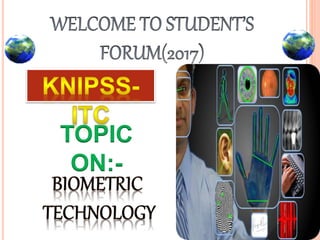
TOPIC
ON:-
CONTENTS
 INTRODUCTION
 WHAT IS BIOMETRICS?
 TYPE OF BIOMETRIC
 HOW BIOMETRICS SYSTEMS WORK
 RESEARCH METHODOLOGY
 BIOMETRICS AND ACCESS CONTROL
 BIOMETRICS AND PRIVACY
 ADVANTAGES OF BIOMETRIC
 DISADVANTAGES OF BIOMETRICS
 FINGERPRINTING BIOMETRIC
 HAND-SCAN
 VERIFICATION
INTRODUCTION
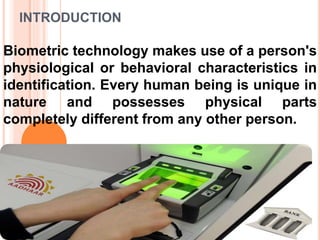
Biometric technology makes use of a person's
physiological or behavioral characteristics in
identification. Every human being is unique in
nature and possesses physical parts
completely different from any other person.
WHAT IS BIOMETRICS?
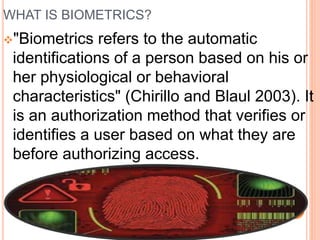
"Biometrics refers to the automatic
identifications of a person based on his or
her physiological or behavioral
characteristics" (Chirillo and Blaul 2003). It
is an authorization method that verifies or
identifies a user based on what they are
before authorizing access.
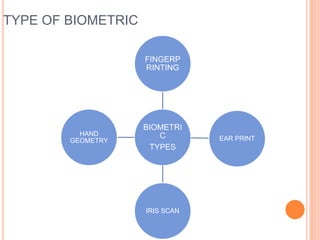
TYPE OF BIOMETRIC
BIOMETRI
C
TYPES
FINGERP
RINTING
EAR PRINT
IRIS SCAN
HAND
GEOMETRY
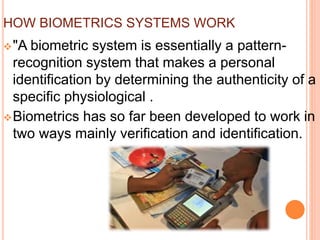
HOW BIOMETRICS SYSTEMS WORK
"A biometric system is essentially a pattern-
recognition system that makes a personal
identification by determining the authenticity of a
specific physiological .
Biometrics has so far been developed to work in
two ways mainly verification and identification.
RESEARCH METHODOLOGY
The research methodology designed for
this dissertation is mainly the qualitative
approach. A quantitative approach has
been overlooked due to limited time as
designing surveys.
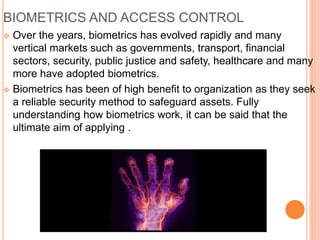
BIOMETRICS AND ACCESS CONTROL
 Over the years, biometrics has evolved rapidly and many
vertical markets such as governments, transport, financial
sectors, security, public justice and safety, healthcare and many
more have adopted biometrics.
 Biometrics has been of high benefit to organization as they seek
a reliable security method to safeguard assets. Fully
understanding how biometrics work, it can be said that the
ultimate aim of applying .
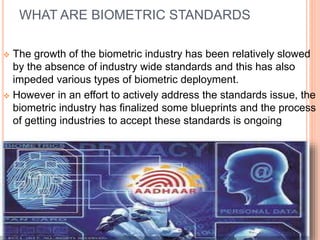
WHAT ARE BIOMETRIC STANDARDS
 The growth of the biometric industry has been relatively slowed
by the absence of industry wide standards and this has also
impeded various types of biometric deployment.
 However in an effort to actively address the standards issue, the
biometric industry has finalized some blueprints and the process
of getting industries to accept these standards is ongoing
BIOMETRICS AND PRIVACY
The fact that biometric technologies are
based on measuring physiological or
behavioral and archiving these data has
raised concerns on privacy risks, and also
raised discussion on the role biometrics
play when it comes to privacy.
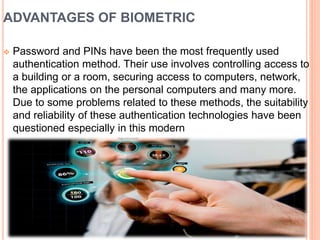
ADVANTAGES OF BIOMETRIC
 Password and PINs have been the most frequently used
authentication method. Their use involves controlling access to
a building or a room, securing access to computers, network,
the applications on the personal computers and many more.
Due to some problems related to these methods, the suitability
and reliability of these authentication technologies have been
questioned especially in this modern
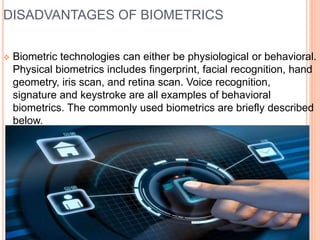
DISADVANTAGES OF BIOMETRICS
 Biometric technologies can either be physiological or behavioral.
Physical biometrics includes fingerprint, facial recognition, hand
geometry, iris scan, and retina scan. Voice recognition,
signature and keystroke are all examples of behavioral
biometrics. The commonly used biometrics are briefly described
below.
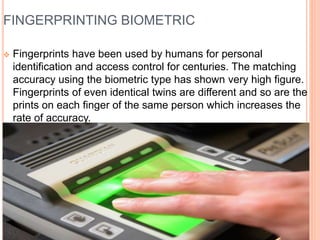
FINGERPRINTING BIOMETRIC
 Fingerprints have been used by humans for personal
identification and access control for centuries. The matching
accuracy using the biometric type has shown very high figure.
Fingerprints of even identical twins are different and so are the
prints on each finger of the same person which increases the
rate of accuracy.
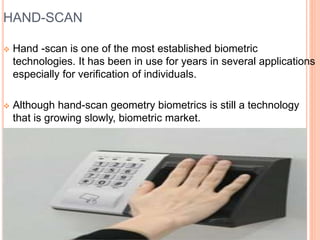
HAND-SCAN
 Hand -scan is one of the most established biometric
technologies. It has been in use for years in several applications
especially for verification of individuals.
 Although hand-scan geometry biometrics is still a technology
that is growing slowly, biometric market.
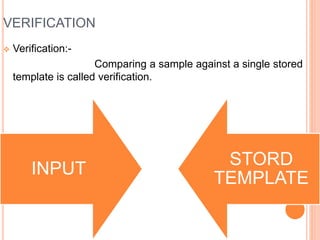
VERIFICATION
 Verification:-
Comparing a sample against a single stored
template is called verification.
INPUT
STORD
TEMPLATE
CONCLUSION
Technology is growing rapidly, but at
the same time security braches and
transactions frauds are also in the
increase world over.
All agencies including libraries who
are in need of security and safety
have to adopt biometric.
ANY QUERIES
PERSENTEDBY :-
SANTOSH KUMAR
REG NO.(34091)
MD. MUDASSIR KHAN
REG NO.(39122)

Biomatric technology

  • 1.
  • 2.
    CONTENTS  INTRODUCTION  WHATIS BIOMETRICS?  TYPE OF BIOMETRIC  HOW BIOMETRICS SYSTEMS WORK  RESEARCH METHODOLOGY  BIOMETRICS AND ACCESS CONTROL  BIOMETRICS AND PRIVACY  ADVANTAGES OF BIOMETRIC  DISADVANTAGES OF BIOMETRICS  FINGERPRINTING BIOMETRIC  HAND-SCAN  VERIFICATION
  • 3.
    INTRODUCTION Biometric technology makesuse of a person's physiological or behavioral characteristics in identification. Every human being is unique in nature and possesses physical parts completely different from any other person.
  • 4.
    WHAT IS BIOMETRICS? "Biometricsrefers to the automatic identifications of a person based on his or her physiological or behavioral characteristics" (Chirillo and Blaul 2003). It is an authorization method that verifies or identifies a user based on what they are before authorizing access.
  • 5.
  • 6.
    HOW BIOMETRICS SYSTEMSWORK "A biometric system is essentially a pattern- recognition system that makes a personal identification by determining the authenticity of a specific physiological . Biometrics has so far been developed to work in two ways mainly verification and identification.
  • 7.
    RESEARCH METHODOLOGY The researchmethodology designed for this dissertation is mainly the qualitative approach. A quantitative approach has been overlooked due to limited time as designing surveys.
  • 8.
    BIOMETRICS AND ACCESSCONTROL  Over the years, biometrics has evolved rapidly and many vertical markets such as governments, transport, financial sectors, security, public justice and safety, healthcare and many more have adopted biometrics.  Biometrics has been of high benefit to organization as they seek a reliable security method to safeguard assets. Fully understanding how biometrics work, it can be said that the ultimate aim of applying .
  • 9.
    WHAT ARE BIOMETRICSTANDARDS  The growth of the biometric industry has been relatively slowed by the absence of industry wide standards and this has also impeded various types of biometric deployment.  However in an effort to actively address the standards issue, the biometric industry has finalized some blueprints and the process of getting industries to accept these standards is ongoing
  • 10.
    BIOMETRICS AND PRIVACY Thefact that biometric technologies are based on measuring physiological or behavioral and archiving these data has raised concerns on privacy risks, and also raised discussion on the role biometrics play when it comes to privacy.
  • 11.
    ADVANTAGES OF BIOMETRIC Password and PINs have been the most frequently used authentication method. Their use involves controlling access to a building or a room, securing access to computers, network, the applications on the personal computers and many more. Due to some problems related to these methods, the suitability and reliability of these authentication technologies have been questioned especially in this modern
  • 12.
    DISADVANTAGES OF BIOMETRICS Biometric technologies can either be physiological or behavioral. Physical biometrics includes fingerprint, facial recognition, hand geometry, iris scan, and retina scan. Voice recognition, signature and keystroke are all examples of behavioral biometrics. The commonly used biometrics are briefly described below.
  • 13.
    FINGERPRINTING BIOMETRIC  Fingerprintshave been used by humans for personal identification and access control for centuries. The matching accuracy using the biometric type has shown very high figure. Fingerprints of even identical twins are different and so are the prints on each finger of the same person which increases the rate of accuracy.
  • 14.
    HAND-SCAN  Hand -scanis one of the most established biometric technologies. It has been in use for years in several applications especially for verification of individuals.  Although hand-scan geometry biometrics is still a technology that is growing slowly, biometric market.
  • 15.
    VERIFICATION  Verification:- Comparing asample against a single stored template is called verification. INPUT STORD TEMPLATE
  • 16.
    CONCLUSION Technology is growingrapidly, but at the same time security braches and transactions frauds are also in the increase world over. All agencies including libraries who are in need of security and safety have to adopt biometric.
  • 18.
  • 19.
    PERSENTEDBY :- SANTOSH KUMAR REGNO.(34091) MD. MUDASSIR KHAN REG NO.(39122)