www.maxpapers.com

UNIVERSITY OF CAMBRIDGE INTERNATIONAL EXAMINATIONS
International General Certificate of Secondary Education

0610/11

BIOLOGY
Paper 1 Multiple Choice

May/June 2013
45 minutes

Additional Materials:

*2526737671*

Multiple Choice Answer Sheet
Soft clean eraser
Soft pencil (type B or HB is recommended)

READ THESE INSTRUCTIONS FIRST
Write in soft pencil.
Do not use staples, paper clips, highlighters, glue or correction fluid.
Write your name, Centre number and candidate number on the Answer Sheet in the spaces provided
unless this has been done for you.
DO NOT WRITE IN ANY BARCODES
There are forty questions on this paper. Answer all questions. For each question there are four possible
answers A, B, C and D.
Choose the one you consider correct and record your choice in soft pencil on the separate Answer Sheet.
Read the instructions on the Answer Sheet very carefully.
Each correct answer will score one mark. A mark will not be deducted for a wrong answer.
Any rough working should be done in this booklet.
Electronic calculators may be used.

This document consists of 16 printed pages.
IB13 06_0610_11/5RP
© UCLES 2013

[Turn over
www.maxpapers.com
2
1

Worms come to the soil surface after heavy rain.
Which characteristic of living organisms does this show?
A
B

nutrition

C

reproduction

D
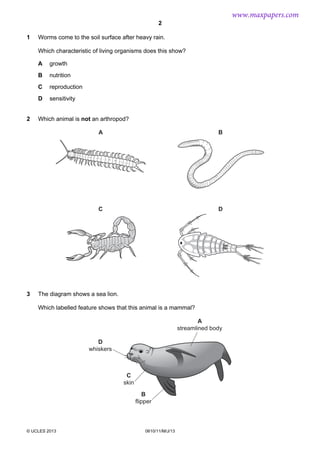
2

growth

sensitivity

Which animal is not an arthropod?
A

C

3

B

D

The diagram shows a sea lion.
Which labelled feature shows that this animal is a mammal?
A
streamlined body
D
whiskers

C
skin
B
flipper

© UCLES 2013

0610/11/M/J/13
www.maxpapers.com
3
4

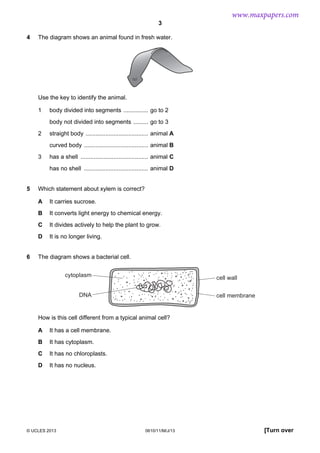
The diagram shows an animal found in fresh water.

Use the key to identify the animal.
1

body divided into segments ............... go to 2
body not divided into segments ......... go to 3

2

straight body ...................................... animal A
curved body ....................................... animal B

3

has a shell ......................................... animal C
has no shell ....................................... animal D

5

Which statement about xylem is correct?
A
B

It converts light energy to chemical energy.

C

It divides actively to help the plant to grow.

D
6

It carries sucrose.

It is no longer living.

The diagram shows a bacterial cell.
cytoplasm

cell wall

DNA

cell membrane

How is this cell different from a typical animal cell?
A

It has a cell membrane.

B

It has cytoplasm.

C

It has no chloroplasts.

D

It has no nucleus.

© UCLES 2013

0610/11/M/J/13

[Turn over
www.maxpapers.com
4
7

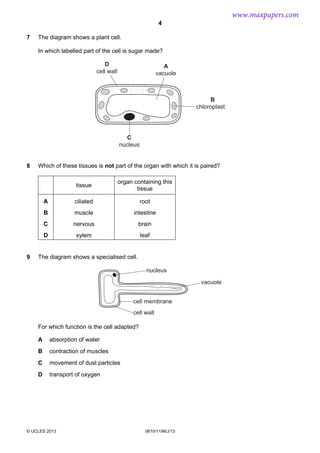
The diagram shows a plant cell.
In which labelled part of the cell is sugar made?
D
cell wall

A
vacuole

B
chloroplast

C
nucleus

8

Which of these tissues is not part of the organ with which it is paired?
tissue
A

ciliated

root

B

muscle

intestine

C

nervous

brain

D
9

organ containing this
tissue

xylem

leaf

The diagram shows a specialised cell.
nucleus
vacuole
cell membrane
cell wall

For which function is the cell adapted?
A

absorption of water

B

contraction of muscles

C

movement of dust particles

D

transport of oxygen

© UCLES 2013

0610/11/M/J/13
www.maxpapers.com
5
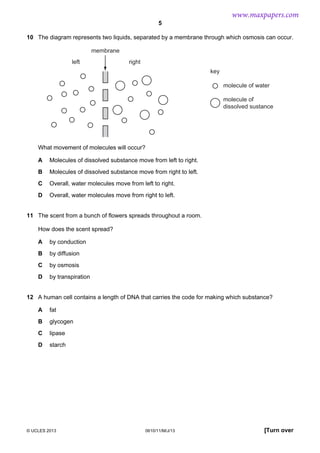
10 The diagram represents two liquids, separated by a membrane through which osmosis can occur.
membrane
left

right
key
molecule of water
molecule of
dissolved sustance

What movement of molecules will occur?
A

Molecules of dissolved substance move from left to right.

B

Molecules of dissolved substance move from right to left.

C

Overall, water molecules move from left to right.

D

Overall, water molecules move from right to left.

11 The scent from a bunch of flowers spreads throughout a room.
How does the scent spread?
A

by conduction

B

by diffusion

C

by osmosis

D

by transpiration

12 A human cell contains a length of DNA that carries the code for making which substance?
A

fat

B

glycogen

C

lipase

D

starch

© UCLES 2013

0610/11/M/J/13

[Turn over
www.maxpapers.com
6
13 A student set up a test-tube containing starch, water and amylase.
How could the student test whether the amylase had digested all the starch?
A

Add Biuret solution.

B

Add dilute hydrochloric acid.

C

Add iodine solution.

D

Weigh the test-tubes and contents before and after the experiment.

14 The diagram shows the apparatus used in an investigation to measure the rate of oxygen
production during photosynthesis.
measuring
cylinder

gas

bright
light

beaker

glass funnel
aquatic plant

water

The investigation was repeated several times and the average amount of gas collected was
calculated.
Which two factors must be kept constant during this investigation?
A

the amount of water in the beaker and the height of the measuring cylinder

B

the size of aquatic plant and the amount of gas in the measuring cylinder

C

the size of aquatic plant and the duration of exposure to light

D

the size of the beaker and the funnel

© UCLES 2013

0610/11/M/J/13
www.maxpapers.com
7
15 The diagram shows the four types of human tooth.
1

2

3

4

incisor

canine

premolar

molar

Which teeth are used for cutting rather than grinding food?
A

1 and 2

B

2 and 3

C

3 and 4

D

4 and 1

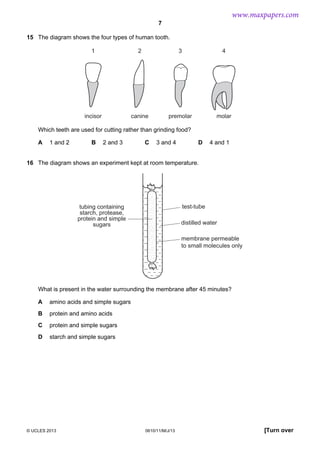
16 The diagram shows an experiment kept at room temperature.

test-tube

tubing containing
starch, protease,
protein and simple
sugars

distilled water
membrane permeable
to small molecules only

What is present in the water surrounding the membrane after 45 minutes?
A

amino acids and simple sugars

B

protein and amino acids

C

protein and simple sugars

D

starch and simple sugars

© UCLES 2013

0610/11/M/J/13

[Turn over
www.maxpapers.com
8
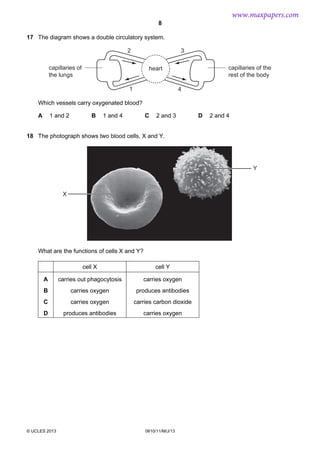
17 The diagram shows a double circulatory system.
2

3

capillaries of
the lungs

capillaries of the
rest of the body

heart

1

4

Which vessels carry oxygenated blood?
A

1 and 2

B

C

1 and 4

2 and 3

D

2 and 4

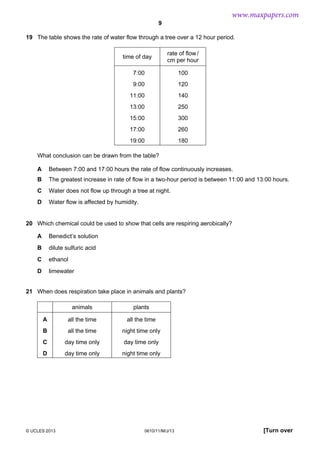
18 The photograph shows two blood cells, X and Y.

Y

X

What are the functions of cells X and Y?
cell X

cell Y

A

carries out phagocytosis

carries oxygen

B

carries oxygen

produces antibodies

C

carries oxygen

carries carbon dioxide

D

produces antibodies

carries oxygen

© UCLES 2013

0610/11/M/J/13
www.maxpapers.com
9
19 The table shows the rate of water flow through a tree over a 12 hour period.
time of day

rate of flow /
cm per hour

17:00

100

19:00

120

11:00

140

13:00

250

15:00

300

17:00

260

19:00

180

What conclusion can be drawn from the table?
A

Between 7:00 and 17:00 hours the rate of flow continuously increases.

B

The greatest increase in rate of flow in a two-hour period is between 11:00 and 13:00 hours.

C

Water does not flow up through a tree at night.

D

Water flow is affected by humidity.

20 Which chemical could be used to show that cells are respiring aerobically?
A

Benedict’s solution

B

dilute sulfuric acid

C

ethanol

D

limewater

21 When does respiration take place in animals and plants?
animals

plants

A

all the time

all the time

B

all the time

night time only

C

day time only

day time only

D

day time only

night time only

© UCLES 2013

0610/11/M/J/13

[Turn over
www.maxpapers.com
10
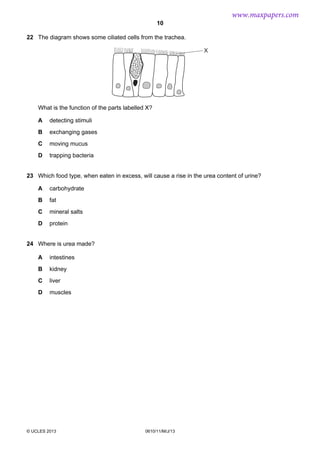
22 The diagram shows some ciliated cells from the trachea.
X

What is the function of the parts labelled X?
A

detecting stimuli

B

exchanging gases

C

moving mucus

D

trapping bacteria

23 Which food type, when eaten in excess, will cause a rise in the urea content of urine?
A

carbohydrate

B

fat

C

mineral salts

D

protein

24 Where is urea made?
A

intestines

B

kidney

C

liver

D

muscles

© UCLES 2013

0610/11/M/J/13
www.maxpapers.com
11
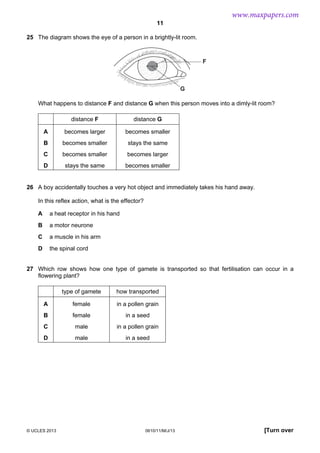
25 The diagram shows the eye of a person in a brightly-lit room.

F

G
What happens to distance F and distance G when this person moves into a dimly-lit room?
distance F

distance G

A

becomes larger

becomes smaller

B

becomes smaller

stays the same

C

becomes smaller

becomes larger

D

stays the same

becomes smaller

26 A boy accidentally touches a very hot object and immediately takes his hand away.
In this reflex action, what is the effector?
A

a heat receptor in his hand

B

a motor neurone

C

a muscle in his arm

D

the spinal cord

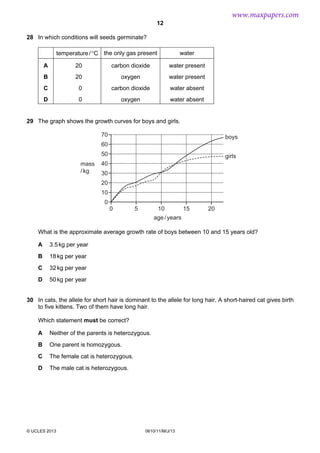
27 Which row shows how one type of gamete is transported so that fertilisation can occur in a
flowering plant?
type of gamete

how transported

A

female

in a pollen grain

B

female

in a seed

C

male

in a pollen grain

D

male

in a seed

© UCLES 2013

0610/11/M/J/13

[Turn over
www.maxpapers.com
12
28 In which conditions will seeds germinate?
temperature / °C the only gas present

water

A

20

carbon dioxide

water present

B

20

oxygen

water present

C

0

carbon dioxide

water absent

D

0

oxygen

water absent

29 The graph shows the growth curves for boys and girls.

70

boys

60
50
mass
/ kg

girls

40
30
20
10
0
0

5

10

15

20

age / years
What is the approximate average growth rate of boys between 10 and 15 years old?
A

3.5 kg per year

B

18 kg per year

C

32 kg per year

D

50 kg per year

30 In cats, the allele for short hair is dominant to the allele for long hair. A short-haired cat gives birth
to five kittens. Two of them have long hair.
Which statement must be correct?
A

Neither of the parents is heterozygous.

B

One parent is homozygous.

C

The female cat is heterozygous.

D

The male cat is heterozygous.

© UCLES 2013

0610/11/M/J/13
www.maxpapers.com
13
31 Cystic fibrosis is an inherited disease that occurs when an individual is homozygous for a
recessive allele.
If parents are both heterozygous for this characteristic, what is the probability that their first child
will have cystic fibrosis?
A

0%

B

25%

C

50%

D

100%

32 What determines the sex of a baby?
A

the father’s blood group

B

the father’s chromosomes

C

the mother’s blood group

D

the mother’s chromosomes

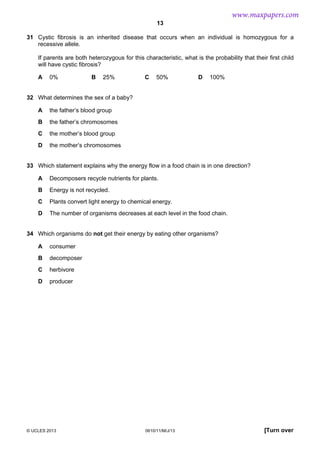
33 Which statement explains why the energy flow in a food chain is in one direction?
A

Decomposers recycle nutrients for plants.

B

Energy is not recycled.

C

Plants convert light energy to chemical energy.

D

The number of organisms decreases at each level in the food chain.

34 Which organisms do not get their energy by eating other organisms?
A

consumer

B

decomposer

C

herbivore

D

producer

© UCLES 2013

0610/11/M/J/13

[Turn over
www.maxpapers.com
14
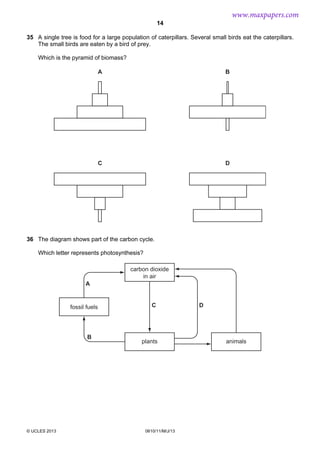
35 A single tree is food for a large population of caterpillars. Several small birds eat the caterpillars.
The small birds are eaten by a bird of prey.
Which is the pyramid of biomass?

A

B

C

D

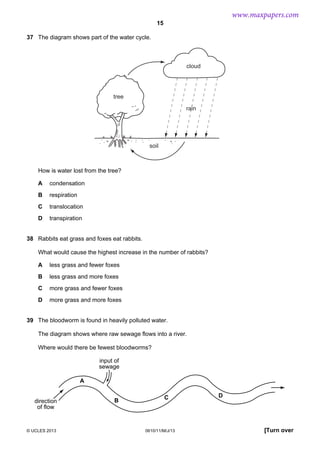
36 The diagram shows part of the carbon cycle.
Which letter represents photosynthesis?
carbon dioxide
in air
A

fossil fuels

B

© UCLES 2013

C

plants

0610/11/M/J/13

D

animals
www.maxpapers.com
15
37 The diagram shows part of the water cycle.

cloud

tree
rain

soil

How is water lost from the tree?
A

condensation

B

respiration

C

translocation

D

transpiration

38 Rabbits eat grass and foxes eat rabbits.
What would cause the highest increase in the number of rabbits?
A

less grass and fewer foxes

B

less grass and more foxes

C

more grass and fewer foxes

D

more grass and more foxes

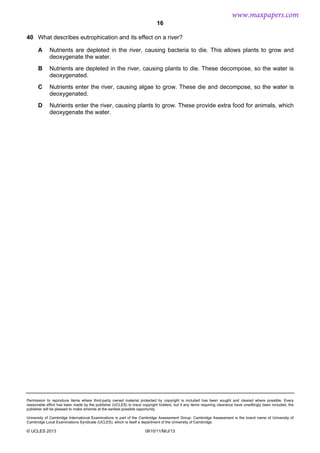
39 The bloodworm is found in heavily polluted water.
The diagram shows where raw sewage flows into a river.
Where would there be fewest bloodworms?
input of
sewage
A
direction
of flow

© UCLES 2013

B

C

0610/11/M/J/13

D

[Turn over
www.maxpapers.com
16
40 What describes eutrophication and its effect on a river?
A

Nutrients are depleted in the river, causing bacteria to die. This allows plants to grow and
deoxygenate the water.

B

Nutrients are depleted in the river, causing plants to die. These decompose, so the water is
deoxygenated.

C

Nutrients enter the river, causing algae to grow. These die and decompose, so the water is
deoxygenated.

D

Nutrients enter the river, causing plants to grow. These provide extra food for animals, which
deoxygenate the water.

Permission to reproduce items where third-party owned material protected by copyright is included has been sought and cleared where possible. Every
reasonable effort has been made by the publisher (UCLES) to trace copyright holders, but if any items requiring clearance have unwittingly been included, the
publisher will be pleased to make amends at the earliest possible opportunity.
University of Cambridge International Examinations is part of the Cambridge Assessment Group. Cambridge Assessment is the brand name of University of
Cambridge Local Examinations Syndicate (UCLES), which is itself a department of the University of Cambridge.

© UCLES 2013

0610/11/M/J/13

0610 s13 qp_11

  • 1.
    www.maxpapers.com UNIVERSITY OF CAMBRIDGEINTERNATIONAL EXAMINATIONS International General Certificate of Secondary Education 0610/11 BIOLOGY Paper 1 Multiple Choice May/June 2013 45 minutes Additional Materials: *2526737671* Multiple Choice Answer Sheet Soft clean eraser Soft pencil (type B or HB is recommended) READ THESE INSTRUCTIONS FIRST Write in soft pencil. Do not use staples, paper clips, highlighters, glue or correction fluid. Write your name, Centre number and candidate number on the Answer Sheet in the spaces provided unless this has been done for you. DO NOT WRITE IN ANY BARCODES There are forty questions on this paper. Answer all questions. For each question there are four possible answers A, B, C and D. Choose the one you consider correct and record your choice in soft pencil on the separate Answer Sheet. Read the instructions on the Answer Sheet very carefully. Each correct answer will score one mark. A mark will not be deducted for a wrong answer. Any rough working should be done in this booklet. Electronic calculators may be used. This document consists of 16 printed pages. IB13 06_0610_11/5RP © UCLES 2013 [Turn over
  • 2.
    www.maxpapers.com 2 1 Worms come tothe soil surface after heavy rain. Which characteristic of living organisms does this show? A B nutrition C reproduction D 2 growth sensitivity Which animal is not an arthropod? A C 3 B D The diagram shows a sea lion. Which labelled feature shows that this animal is a mammal? A streamlined body D whiskers C skin B flipper © UCLES 2013 0610/11/M/J/13
  • 3.
    www.maxpapers.com 3 4 The diagram showsan animal found in fresh water. Use the key to identify the animal. 1 body divided into segments ............... go to 2 body not divided into segments ......... go to 3 2 straight body ...................................... animal A curved body ....................................... animal B 3 has a shell ......................................... animal C has no shell ....................................... animal D 5 Which statement about xylem is correct? A B It converts light energy to chemical energy. C It divides actively to help the plant to grow. D 6 It carries sucrose. It is no longer living. The diagram shows a bacterial cell. cytoplasm cell wall DNA cell membrane How is this cell different from a typical animal cell? A It has a cell membrane. B It has cytoplasm. C It has no chloroplasts. D It has no nucleus. © UCLES 2013 0610/11/M/J/13 [Turn over
  • 4.
    www.maxpapers.com 4 7 The diagram showsa plant cell. In which labelled part of the cell is sugar made? D cell wall A vacuole B chloroplast C nucleus 8 Which of these tissues is not part of the organ with which it is paired? tissue A ciliated root B muscle intestine C nervous brain D 9 organ containing this tissue xylem leaf The diagram shows a specialised cell. nucleus vacuole cell membrane cell wall For which function is the cell adapted? A absorption of water B contraction of muscles C movement of dust particles D transport of oxygen © UCLES 2013 0610/11/M/J/13
  • 5.
    www.maxpapers.com 5 10 The diagramrepresents two liquids, separated by a membrane through which osmosis can occur. membrane left right key molecule of water molecule of dissolved sustance What movement of molecules will occur? A Molecules of dissolved substance move from left to right. B Molecules of dissolved substance move from right to left. C Overall, water molecules move from left to right. D Overall, water molecules move from right to left. 11 The scent from a bunch of flowers spreads throughout a room. How does the scent spread? A by conduction B by diffusion C by osmosis D by transpiration 12 A human cell contains a length of DNA that carries the code for making which substance? A fat B glycogen C lipase D starch © UCLES 2013 0610/11/M/J/13 [Turn over
  • 6.
    www.maxpapers.com 6 13 A studentset up a test-tube containing starch, water and amylase. How could the student test whether the amylase had digested all the starch? A Add Biuret solution. B Add dilute hydrochloric acid. C Add iodine solution. D Weigh the test-tubes and contents before and after the experiment. 14 The diagram shows the apparatus used in an investigation to measure the rate of oxygen production during photosynthesis. measuring cylinder gas bright light beaker glass funnel aquatic plant water The investigation was repeated several times and the average amount of gas collected was calculated. Which two factors must be kept constant during this investigation? A the amount of water in the beaker and the height of the measuring cylinder B the size of aquatic plant and the amount of gas in the measuring cylinder C the size of aquatic plant and the duration of exposure to light D the size of the beaker and the funnel © UCLES 2013 0610/11/M/J/13
  • 7.
    www.maxpapers.com 7 15 The diagramshows the four types of human tooth. 1 2 3 4 incisor canine premolar molar Which teeth are used for cutting rather than grinding food? A 1 and 2 B 2 and 3 C 3 and 4 D 4 and 1 16 The diagram shows an experiment kept at room temperature. test-tube tubing containing starch, protease, protein and simple sugars distilled water membrane permeable to small molecules only What is present in the water surrounding the membrane after 45 minutes? A amino acids and simple sugars B protein and amino acids C protein and simple sugars D starch and simple sugars © UCLES 2013 0610/11/M/J/13 [Turn over
  • 8.
    www.maxpapers.com 8 17 The diagramshows a double circulatory system. 2 3 capillaries of the lungs capillaries of the rest of the body heart 1 4 Which vessels carry oxygenated blood? A 1 and 2 B C 1 and 4 2 and 3 D 2 and 4 18 The photograph shows two blood cells, X and Y. Y X What are the functions of cells X and Y? cell X cell Y A carries out phagocytosis carries oxygen B carries oxygen produces antibodies C carries oxygen carries carbon dioxide D produces antibodies carries oxygen © UCLES 2013 0610/11/M/J/13
  • 9.
    www.maxpapers.com 9 19 The tableshows the rate of water flow through a tree over a 12 hour period. time of day rate of flow / cm per hour 17:00 100 19:00 120 11:00 140 13:00 250 15:00 300 17:00 260 19:00 180 What conclusion can be drawn from the table? A Between 7:00 and 17:00 hours the rate of flow continuously increases. B The greatest increase in rate of flow in a two-hour period is between 11:00 and 13:00 hours. C Water does not flow up through a tree at night. D Water flow is affected by humidity. 20 Which chemical could be used to show that cells are respiring aerobically? A Benedict’s solution B dilute sulfuric acid C ethanol D limewater 21 When does respiration take place in animals and plants? animals plants A all the time all the time B all the time night time only C day time only day time only D day time only night time only © UCLES 2013 0610/11/M/J/13 [Turn over
  • 10.
    www.maxpapers.com 10 22 The diagramshows some ciliated cells from the trachea. X What is the function of the parts labelled X? A detecting stimuli B exchanging gases C moving mucus D trapping bacteria 23 Which food type, when eaten in excess, will cause a rise in the urea content of urine? A carbohydrate B fat C mineral salts D protein 24 Where is urea made? A intestines B kidney C liver D muscles © UCLES 2013 0610/11/M/J/13
  • 11.
    www.maxpapers.com 11 25 The diagramshows the eye of a person in a brightly-lit room. F G What happens to distance F and distance G when this person moves into a dimly-lit room? distance F distance G A becomes larger becomes smaller B becomes smaller stays the same C becomes smaller becomes larger D stays the same becomes smaller 26 A boy accidentally touches a very hot object and immediately takes his hand away. In this reflex action, what is the effector? A a heat receptor in his hand B a motor neurone C a muscle in his arm D the spinal cord 27 Which row shows how one type of gamete is transported so that fertilisation can occur in a flowering plant? type of gamete how transported A female in a pollen grain B female in a seed C male in a pollen grain D male in a seed © UCLES 2013 0610/11/M/J/13 [Turn over
  • 12.
    www.maxpapers.com 12 28 In whichconditions will seeds germinate? temperature / °C the only gas present water A 20 carbon dioxide water present B 20 oxygen water present C 0 carbon dioxide water absent D 0 oxygen water absent 29 The graph shows the growth curves for boys and girls. 70 boys 60 50 mass / kg girls 40 30 20 10 0 0 5 10 15 20 age / years What is the approximate average growth rate of boys between 10 and 15 years old? A 3.5 kg per year B 18 kg per year C 32 kg per year D 50 kg per year 30 In cats, the allele for short hair is dominant to the allele for long hair. A short-haired cat gives birth to five kittens. Two of them have long hair. Which statement must be correct? A Neither of the parents is heterozygous. B One parent is homozygous. C The female cat is heterozygous. D The male cat is heterozygous. © UCLES 2013 0610/11/M/J/13
  • 13.
    www.maxpapers.com 13 31 Cystic fibrosisis an inherited disease that occurs when an individual is homozygous for a recessive allele. If parents are both heterozygous for this characteristic, what is the probability that their first child will have cystic fibrosis? A 0% B 25% C 50% D 100% 32 What determines the sex of a baby? A the father’s blood group B the father’s chromosomes C the mother’s blood group D the mother’s chromosomes 33 Which statement explains why the energy flow in a food chain is in one direction? A Decomposers recycle nutrients for plants. B Energy is not recycled. C Plants convert light energy to chemical energy. D The number of organisms decreases at each level in the food chain. 34 Which organisms do not get their energy by eating other organisms? A consumer B decomposer C herbivore D producer © UCLES 2013 0610/11/M/J/13 [Turn over
  • 14.
    www.maxpapers.com 14 35 A singletree is food for a large population of caterpillars. Several small birds eat the caterpillars. The small birds are eaten by a bird of prey. Which is the pyramid of biomass? A B C D 36 The diagram shows part of the carbon cycle. Which letter represents photosynthesis? carbon dioxide in air A fossil fuels B © UCLES 2013 C plants 0610/11/M/J/13 D animals
  • 15.
    www.maxpapers.com 15 37 The diagramshows part of the water cycle. cloud tree rain soil How is water lost from the tree? A condensation B respiration C translocation D transpiration 38 Rabbits eat grass and foxes eat rabbits. What would cause the highest increase in the number of rabbits? A less grass and fewer foxes B less grass and more foxes C more grass and fewer foxes D more grass and more foxes 39 The bloodworm is found in heavily polluted water. The diagram shows where raw sewage flows into a river. Where would there be fewest bloodworms? input of sewage A direction of flow © UCLES 2013 B C 0610/11/M/J/13 D [Turn over
  • 16.
    www.maxpapers.com 16 40 What describeseutrophication and its effect on a river? A Nutrients are depleted in the river, causing bacteria to die. This allows plants to grow and deoxygenate the water. B Nutrients are depleted in the river, causing plants to die. These decompose, so the water is deoxygenated. C Nutrients enter the river, causing algae to grow. These die and decompose, so the water is deoxygenated. D Nutrients enter the river, causing plants to grow. These provide extra food for animals, which deoxygenate the water. Permission to reproduce items where third-party owned material protected by copyright is included has been sought and cleared where possible. Every reasonable effort has been made by the publisher (UCLES) to trace copyright holders, but if any items requiring clearance have unwittingly been included, the publisher will be pleased to make amends at the earliest possible opportunity. University of Cambridge International Examinations is part of the Cambridge Assessment Group. Cambridge Assessment is the brand name of University of Cambridge Local Examinations Syndicate (UCLES), which is itself a department of the University of Cambridge. © UCLES 2013 0610/11/M/J/13