ClassGet out materials for class (sharpen pencils).
Hand in homework/due assignment.
Begin Bell Work.
     How to head paper :First Name   Last Name    Date: Month/Day/Year	     Class PeriodName of Assignment
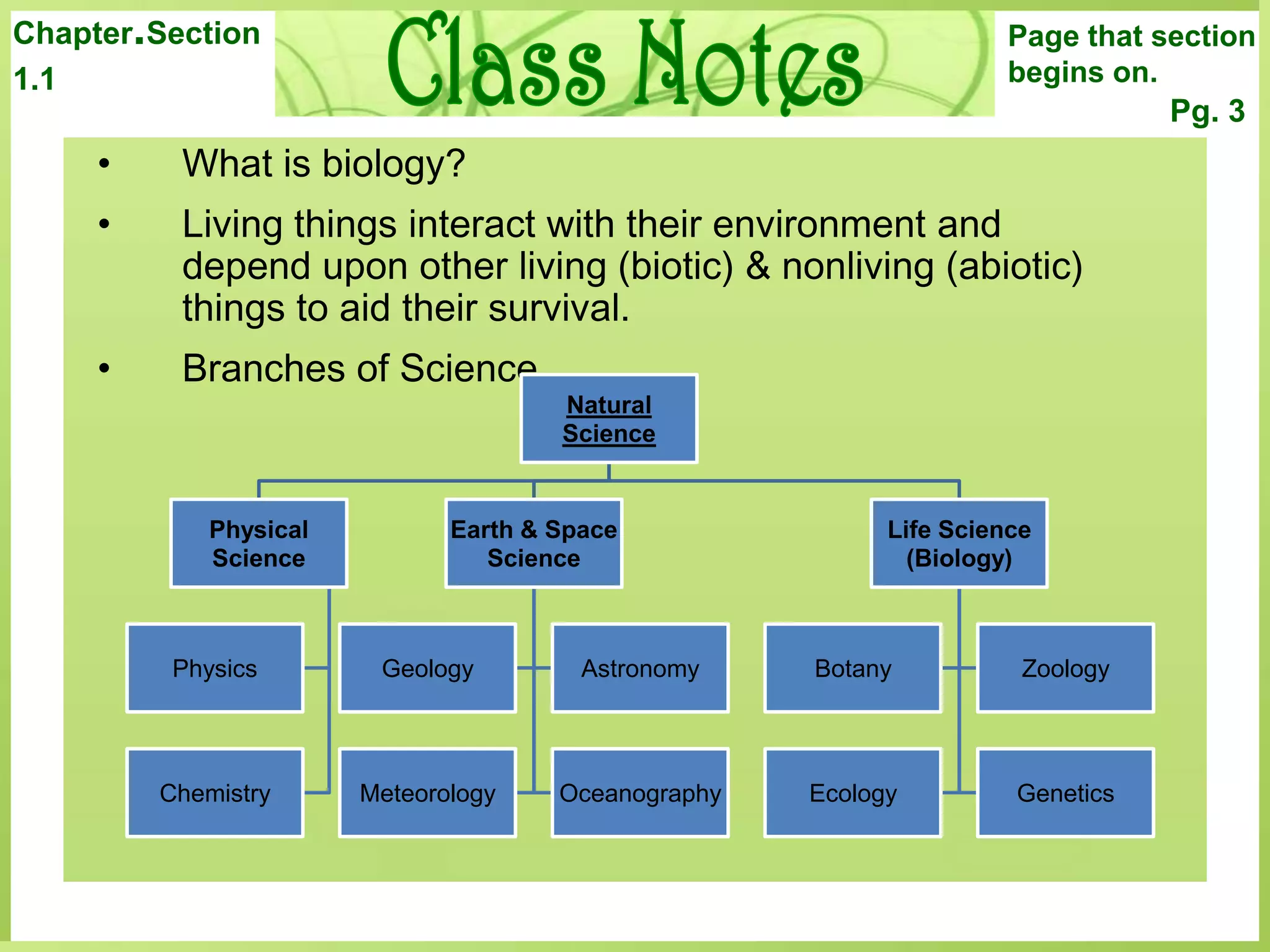
Chapter.Section1.1Page that section begins on.	    Pg. 3Class NotesWhat is biology?
Living things interact with their environment and depend upon other living (biotic) & nonliving (abiotic) things to aid their survival.
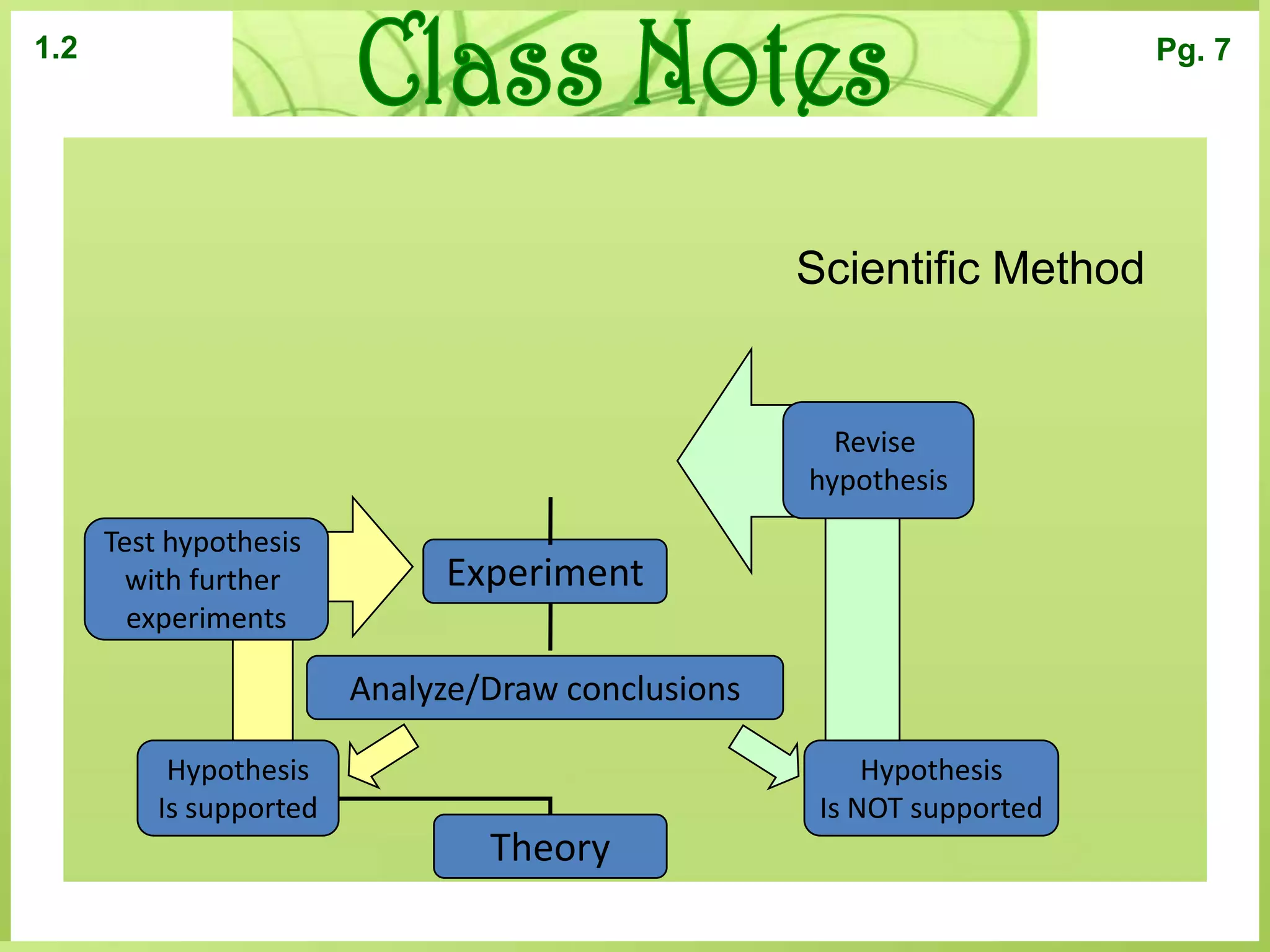
Branches of ScienceClass Notes1.2Pg. 7Scientific MethodRevise hypothesisTest hypothesis with further experimentsExperimentAnalyze/Draw conclusionsHypothesisIs supportedHypothesisIs NOT supportedTheory
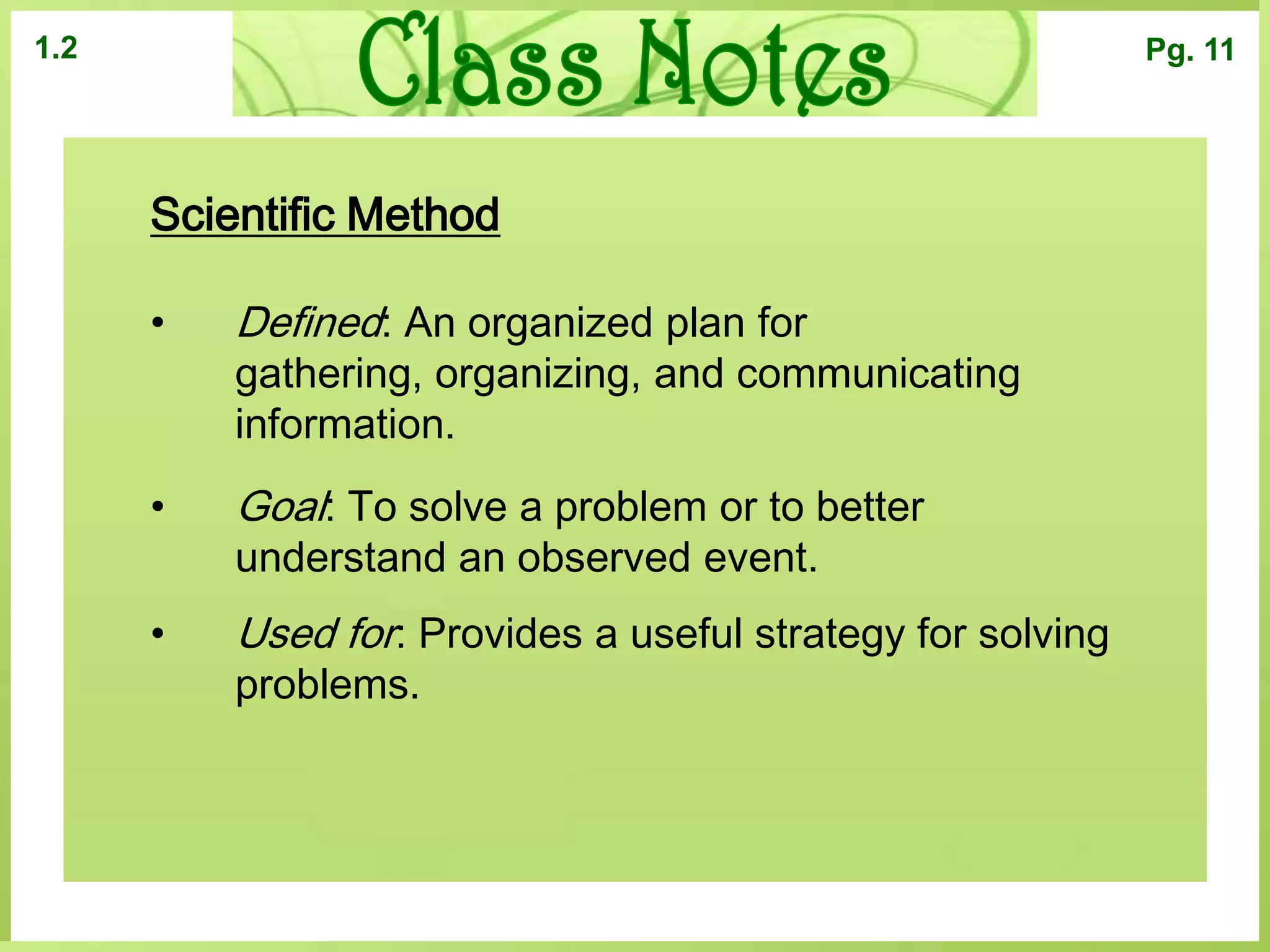
Class Notes1.2Pg. 11Scientific MethodDefined: An organized plan for gathering, organizing, and communicating information.
Goal: To solve a problem or to better understand an observed event.
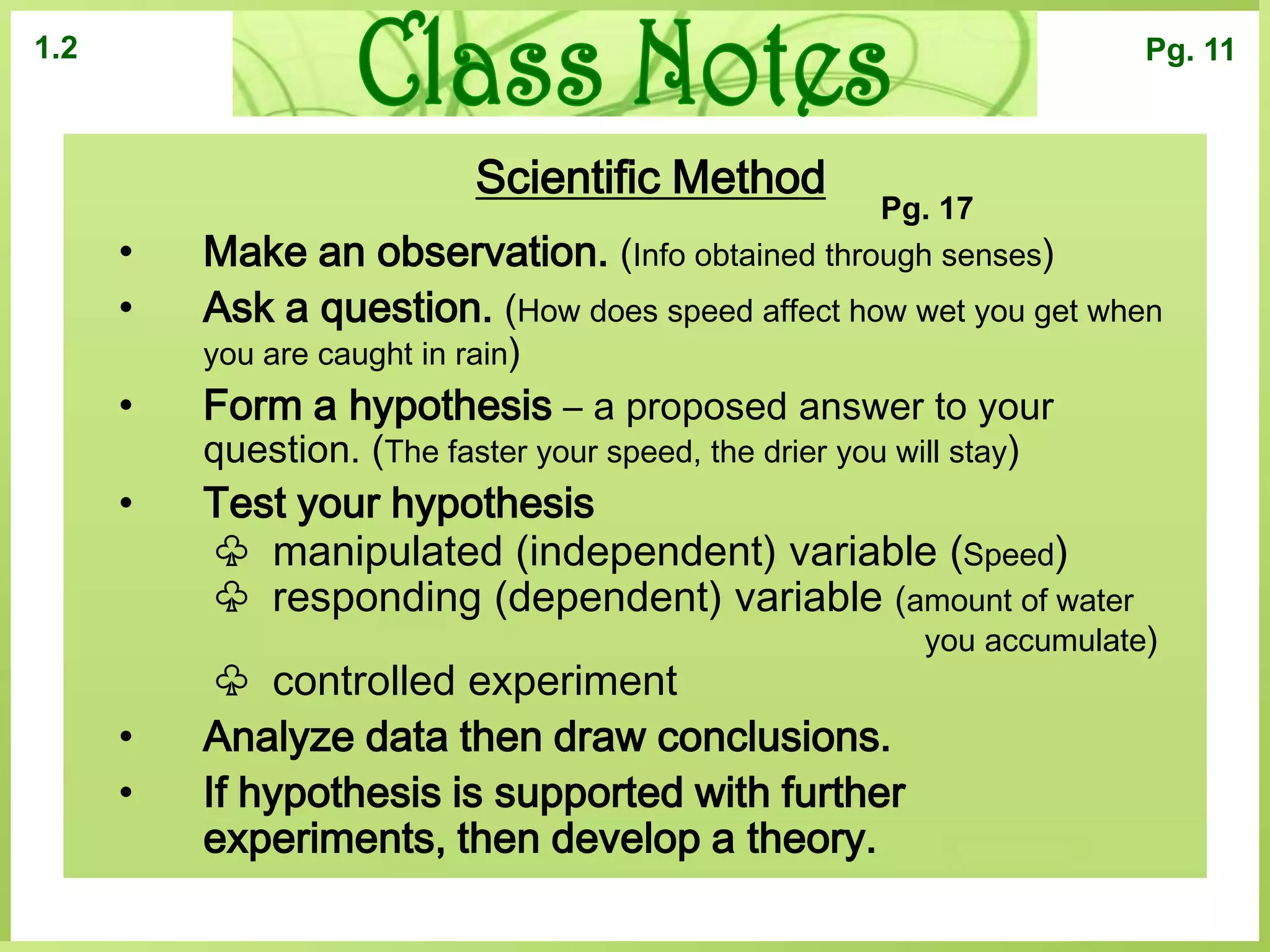
Used for: Provides a useful strategy for solving problems.Class Notes1.2Pg. 11Scientific MethodMake an observation. (Info obtained through senses)
Ask a question. (How does speed affect how wet you get when you are caught in rain)
Form a hypothesis – a proposed answer to your question. (The faster your speed, the drier you will stay)
Test your hypothesis♧  manipulated (independent) variable (Speed)♧ responding (dependent) variable (amount of water 						     you accumulate)♧  controlled experimentAnalyze data then draw conclusions.
If hypothesis is supported with further experiments, then develop a theory.Pg. 17
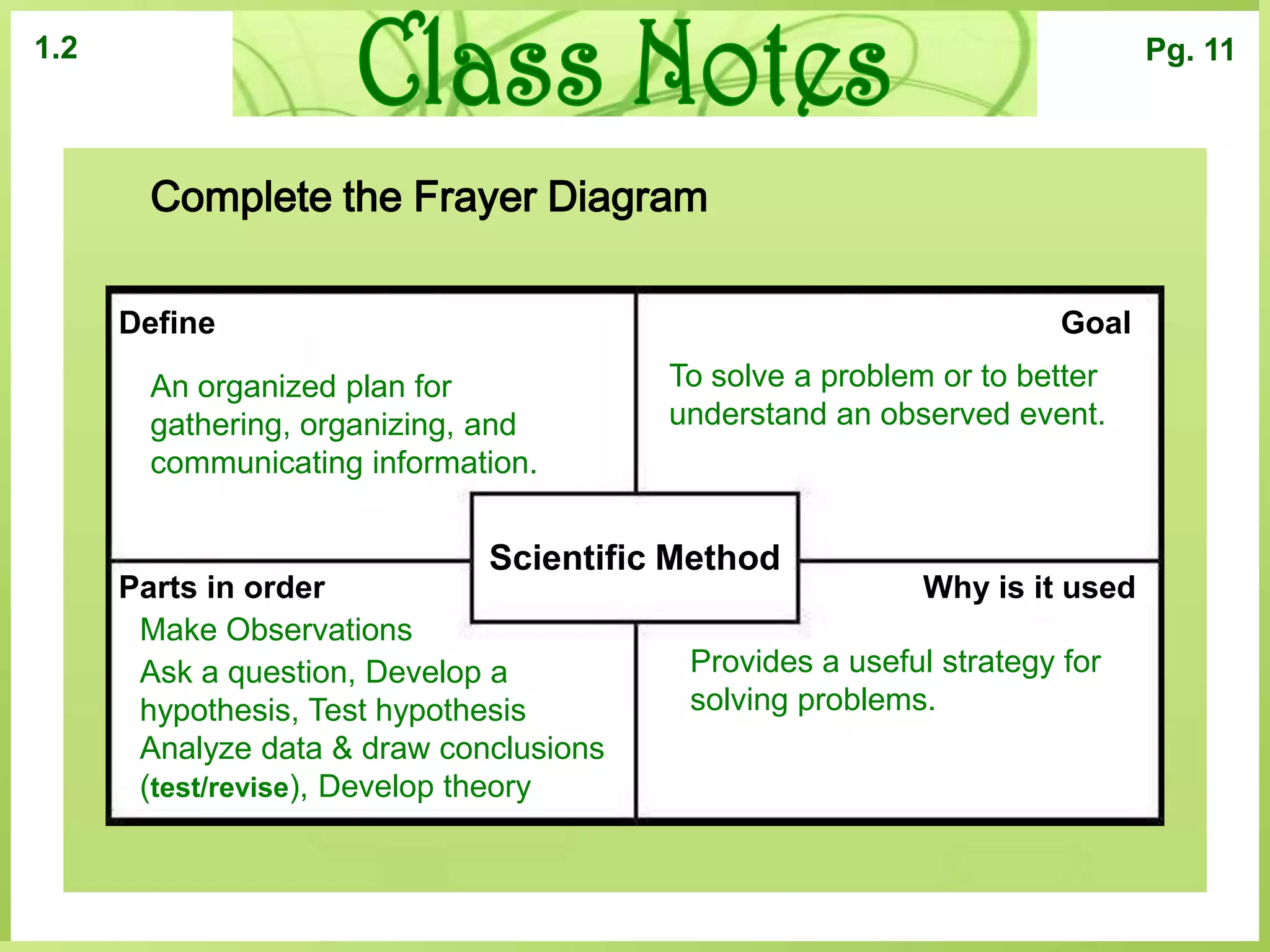
Class Notes1.2Pg. 11Complete the Frayer DiagramDefineGoalTo solve a problem or to better understand an observed event.An organized plan for gathering, organizing, and communicating information.Scientific MethodParts in orderWhy is it usedMake ObservationsProvides a useful strategy for solving problems.Ask a question, Develop a hypothesis, Test hypothesisAnalyze data & draw conclusions (test/revise), Develop theory
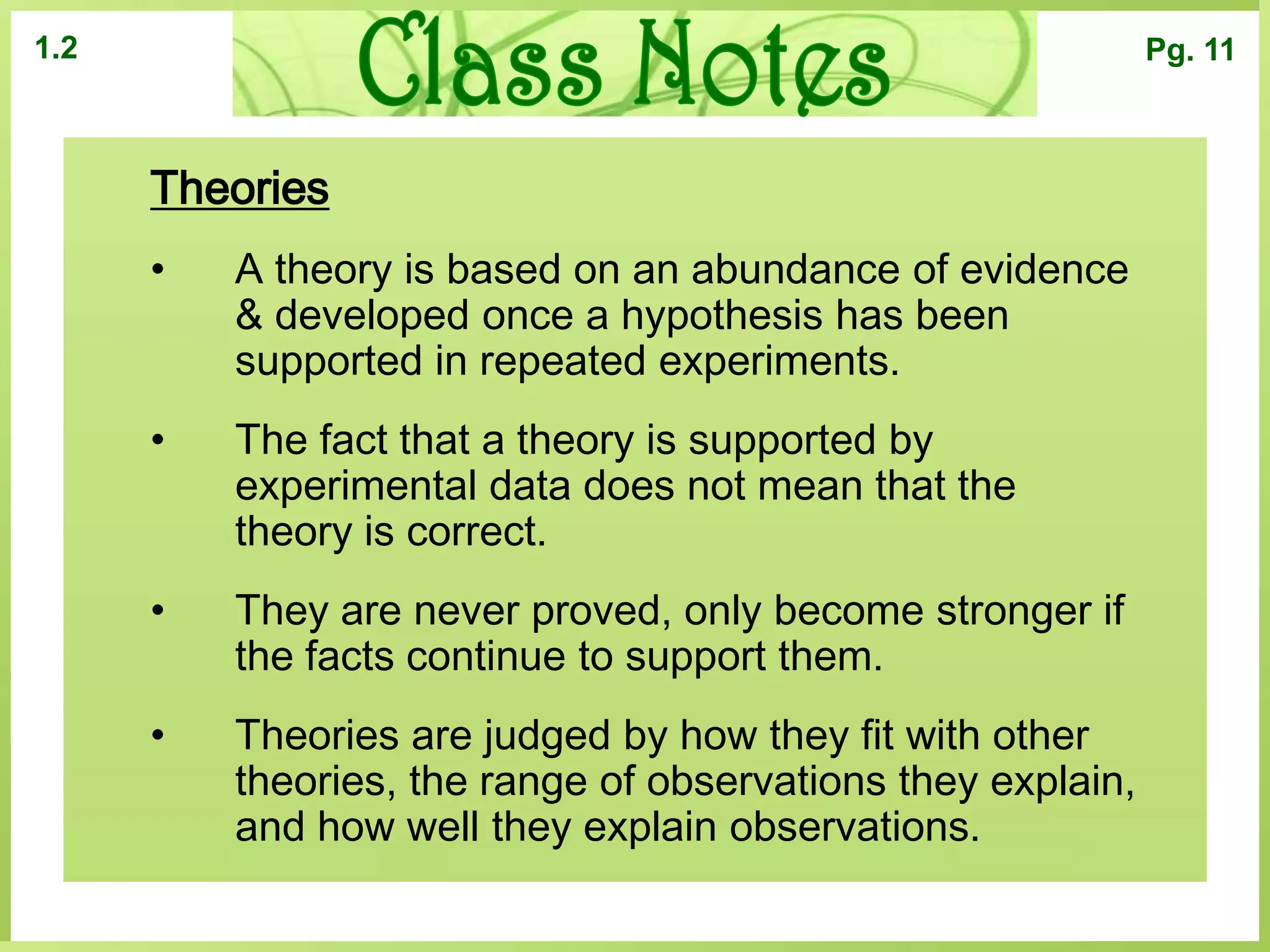
Class Notes1.2Pg. 11TheoriesA theory is based on an abundance of evidence & developed once a hypothesis has been supported in repeated experiments.
The fact that a theory is supported by experimental data does not mean that the theory is correct.
They are never proved, only become stronger if the facts continue to support them.
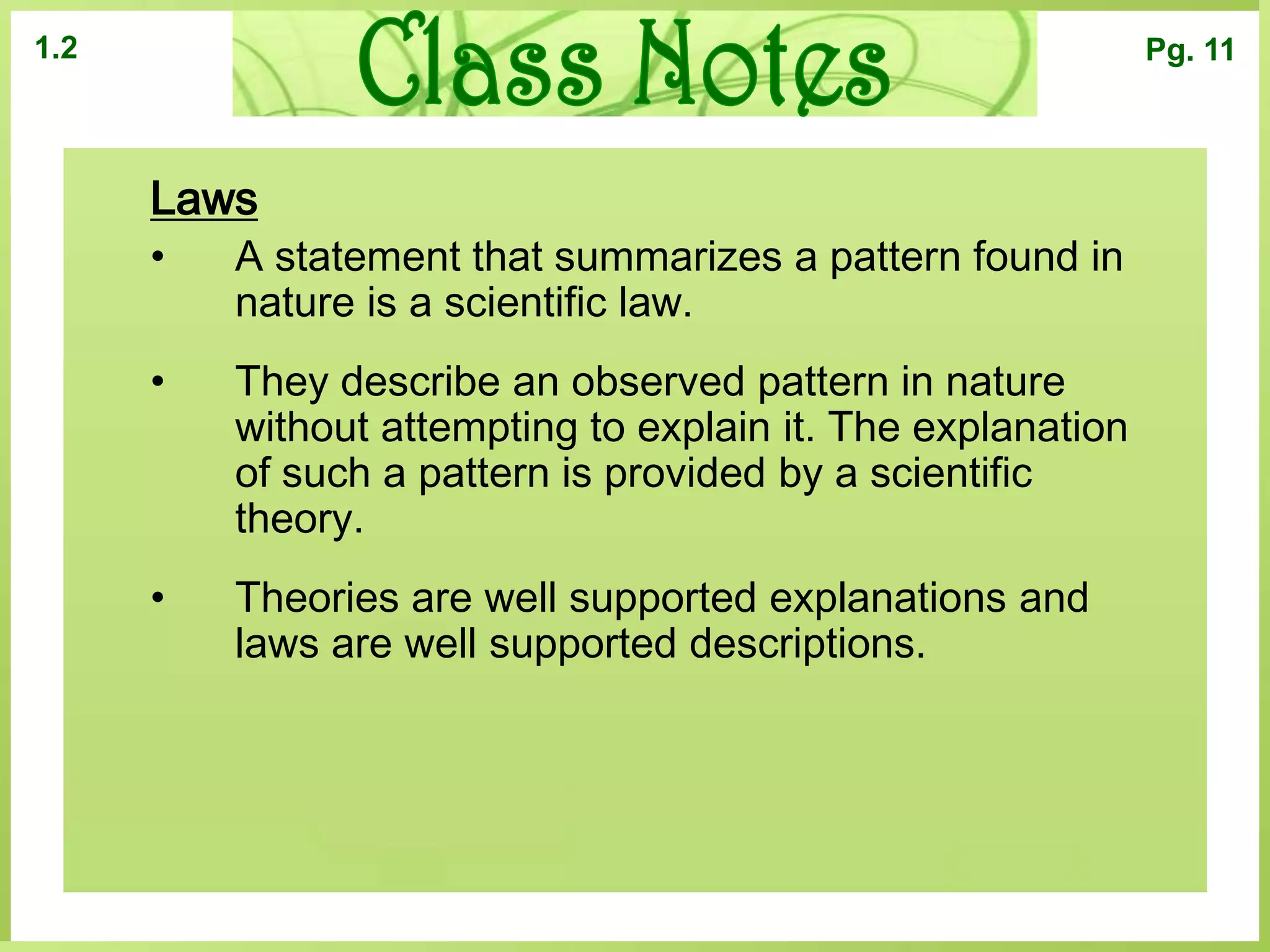
Theories are judged by how they fit with other theories, the range of observations they explain, and how well they explain observations.Class Notes1.2Pg. 11LawsA statement that summarizes a pattern found in nature is a scientific law.
They describe an observed pattern in nature without attempting to explain it. The explanation of such a pattern is provided by a scientific theory.
Theories are well supported explanations and laws are well supported descriptions. Class Notes1.2Pg. 11Empirical Evidence - A cumulative body of observations.  The word empirical denotes information gained by means of observation or experiments. Empirical data is data produced by an experiment or observation.
  A central concept in modern science and the scientific method is that all evidence must be empirical, or empirically based that is, dependent on evidence or consequences that are observable by the senses.
Competing interpretations of empirical evidence can lead to alternative explanations or support existing explanations.Class Notes1.2Pg. 11ModelsScientific models make it easier to understand things that might be too difficult to observe directly.
Models are a visual or mathematical representation of an object or process.

Biology class notes

  • 1.
    ClassGet out materialsfor class (sharpen pencils).
  • 2.
  • 3.
  • 4.
    How to head paper :First Name Last Name Date: Month/Day/Year Class PeriodName of Assignment
  • 6.
    Chapter.Section1.1Page that sectionbegins on. Pg. 3Class NotesWhat is biology?
  • 7.
    Living things interactwith their environment and depend upon other living (biotic) & nonliving (abiotic) things to aid their survival.
  • 8.
    Branches of ScienceClassNotes1.2Pg. 7Scientific MethodRevise hypothesisTest hypothesis with further experimentsExperimentAnalyze/Draw conclusionsHypothesisIs supportedHypothesisIs NOT supportedTheory
  • 9.
    Class Notes1.2Pg. 11ScientificMethodDefined: An organized plan for gathering, organizing, and communicating information.
  • 10.
    Goal: To solvea problem or to better understand an observed event.
  • 11.
    Used for: Providesa useful strategy for solving problems.Class Notes1.2Pg. 11Scientific MethodMake an observation. (Info obtained through senses)
  • 12.
    Ask a question.(How does speed affect how wet you get when you are caught in rain)
  • 13.
    Form a hypothesis– a proposed answer to your question. (The faster your speed, the drier you will stay)
  • 14.
    Test your hypothesis♧ manipulated (independent) variable (Speed)♧ responding (dependent) variable (amount of water you accumulate)♧ controlled experimentAnalyze data then draw conclusions.
  • 15.
    If hypothesis issupported with further experiments, then develop a theory.Pg. 17
  • 16.
    Class Notes1.2Pg. 11Completethe Frayer DiagramDefineGoalTo solve a problem or to better understand an observed event.An organized plan for gathering, organizing, and communicating information.Scientific MethodParts in orderWhy is it usedMake ObservationsProvides a useful strategy for solving problems.Ask a question, Develop a hypothesis, Test hypothesisAnalyze data & draw conclusions (test/revise), Develop theory
  • 17.
    Class Notes1.2Pg. 11TheoriesAtheory is based on an abundance of evidence & developed once a hypothesis has been supported in repeated experiments.
  • 18.
    The fact thata theory is supported by experimental data does not mean that the theory is correct.
  • 19.
    They are neverproved, only become stronger if the facts continue to support them.
  • 20.
    Theories are judgedby how they fit with other theories, the range of observations they explain, and how well they explain observations.Class Notes1.2Pg. 11LawsA statement that summarizes a pattern found in nature is a scientific law.
  • 21.
    They describe anobserved pattern in nature without attempting to explain it. The explanation of such a pattern is provided by a scientific theory.
  • 22.
    Theories are wellsupported explanations and laws are well supported descriptions. Class Notes1.2Pg. 11Empirical Evidence - A cumulative body of observations. The word empirical denotes information gained by means of observation or experiments. Empirical data is data produced by an experiment or observation.
  • 23.
    Acentral concept in modern science and the scientific method is that all evidence must be empirical, or empirically based that is, dependent on evidence or consequences that are observable by the senses.
  • 24.
    Competing interpretations ofempirical evidence can lead to alternative explanations or support existing explanations.Class Notes1.2Pg. 11ModelsScientific models make it easier to understand things that might be too difficult to observe directly.
  • 25.
    Models are avisual or mathematical representation of an object or process.
  • 26.
    Models are typicallyused when it is either impossible or impractical to create experimental conditions in which scientists can directly measure outcomes.
  • 27.
    Example: Street Map,GlobeClass Notes1.2Pg. 11 Answer these questions in pairs (each person writes on own paper)What is the difference between a hypothesis, scientific theory, and scientific law? What is an example of a scientific model?
  • 28.
    Class Notes Scientistsneed to be creative as they pose new questions, design investigations and develop explanations.
  • 29.
    Scientists around theworld have replicated similar investigations/experiments and obtained similar results. (checks & balances)
  • 30.
    Scientists use criticaland logical thinking, open-mindedness, objectivity and skepticism as they examine a scientific claim.
  • 31.
    Scientists accept thenotion that scientific knowledge is always open to improvement and can never be declared absolutely certain.Class NotesScientific knowledge is subject to modifications as new information challenges prevailing theories and as a new theory leads to looking at old observations in a new way.
  • 32.
    The varied backgrounds,talents, goals and interests of scientists influence the development of scientific knowledge.
  • 33.
    Science influences societythrough its knowledge and world view.
  • 34.
    New ideas inscience are limited by the context in which they are conceived; are often rejected by the scientific establishment; sometimes spring from unexpected findings; and usually grow slowly, through contributions from many investigators.Class Notes1.2Pg. 11ObservationsExample, "Upon magnification, the painted lady eggs appear bluish and barrel-shaped." Observations are direct enough that most would make the same observation in the same situation.InferencesWhen we bring our past experience into making a judgment based on an observation, it is an inference. For example, "The caterpillar appears as if it is about to form its chrysalis" is an inference, because you are interpreting observations according to knowledge from past experience. Class NotesInferenceInferring is the process of making an inference, an interpretation based on observations and prior knowledge
  • 35.
    An incorrect inferenceis known as a fallacy.
  • 36.
    Inference vs. Prediction:predicting is about the future, whereas inferring is about the presentClass Notesa
  • 37.
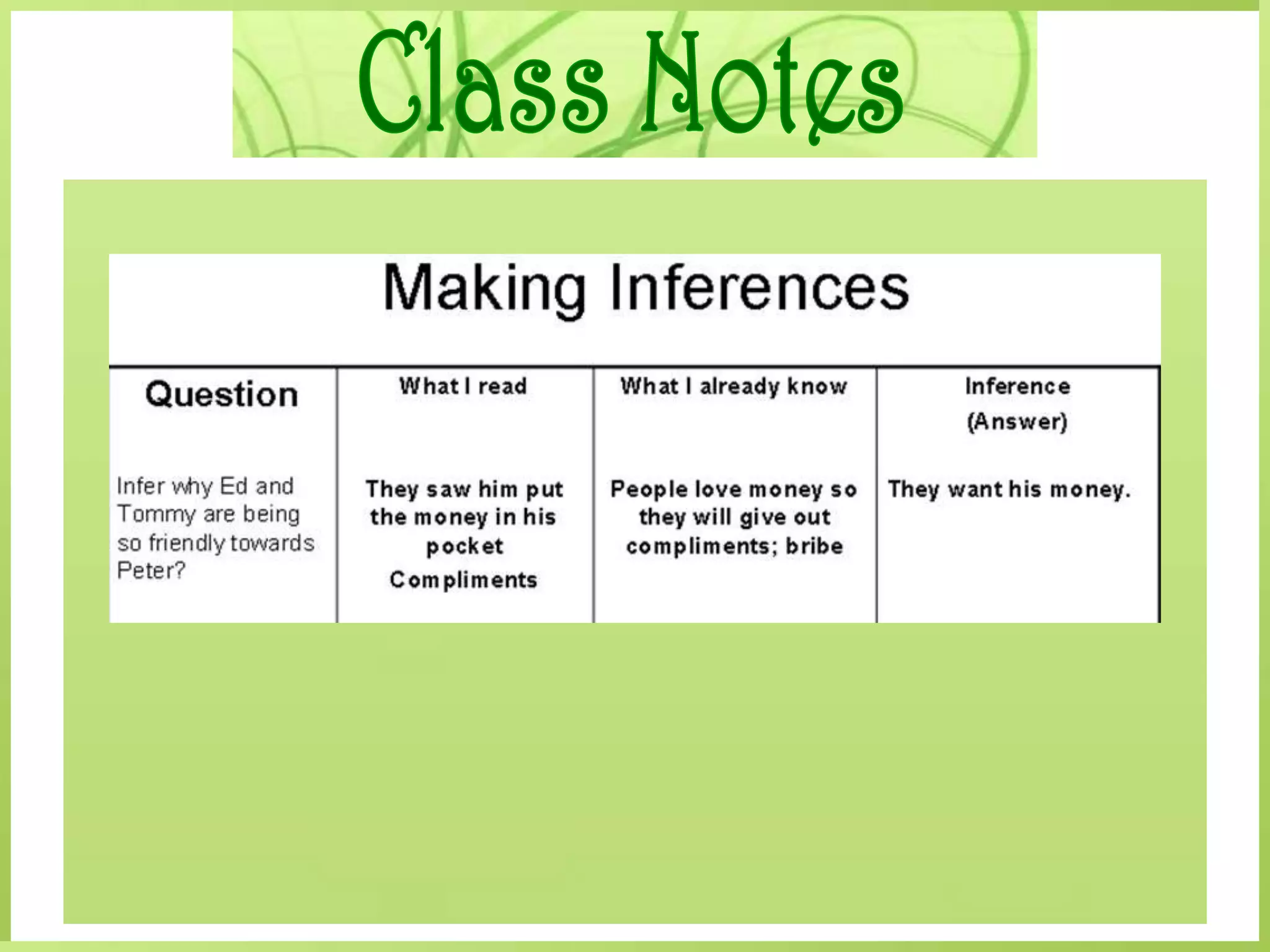
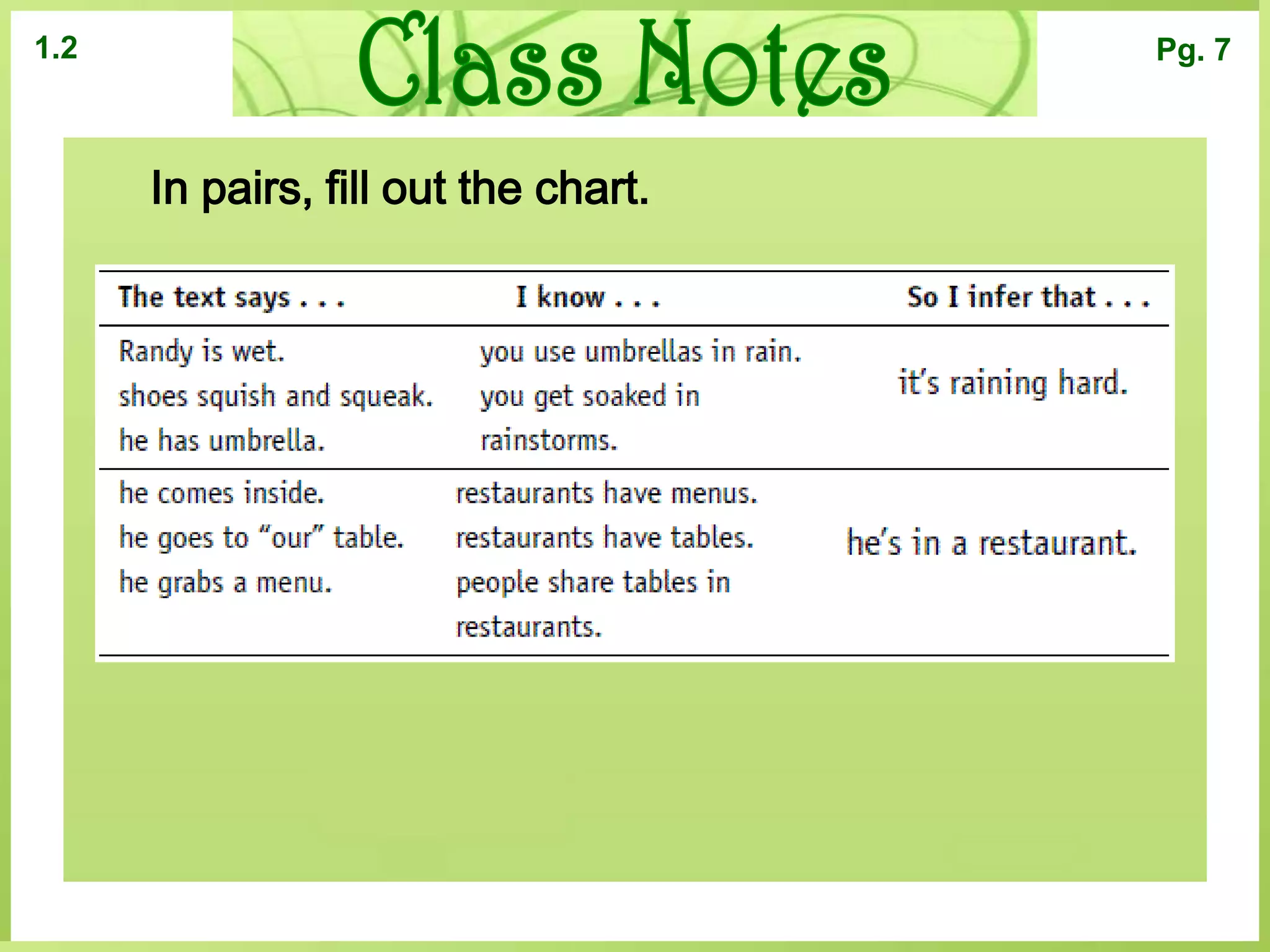
    Class Notes1.2Pg. 7Inpairs, fill out the chart.
  • 38.
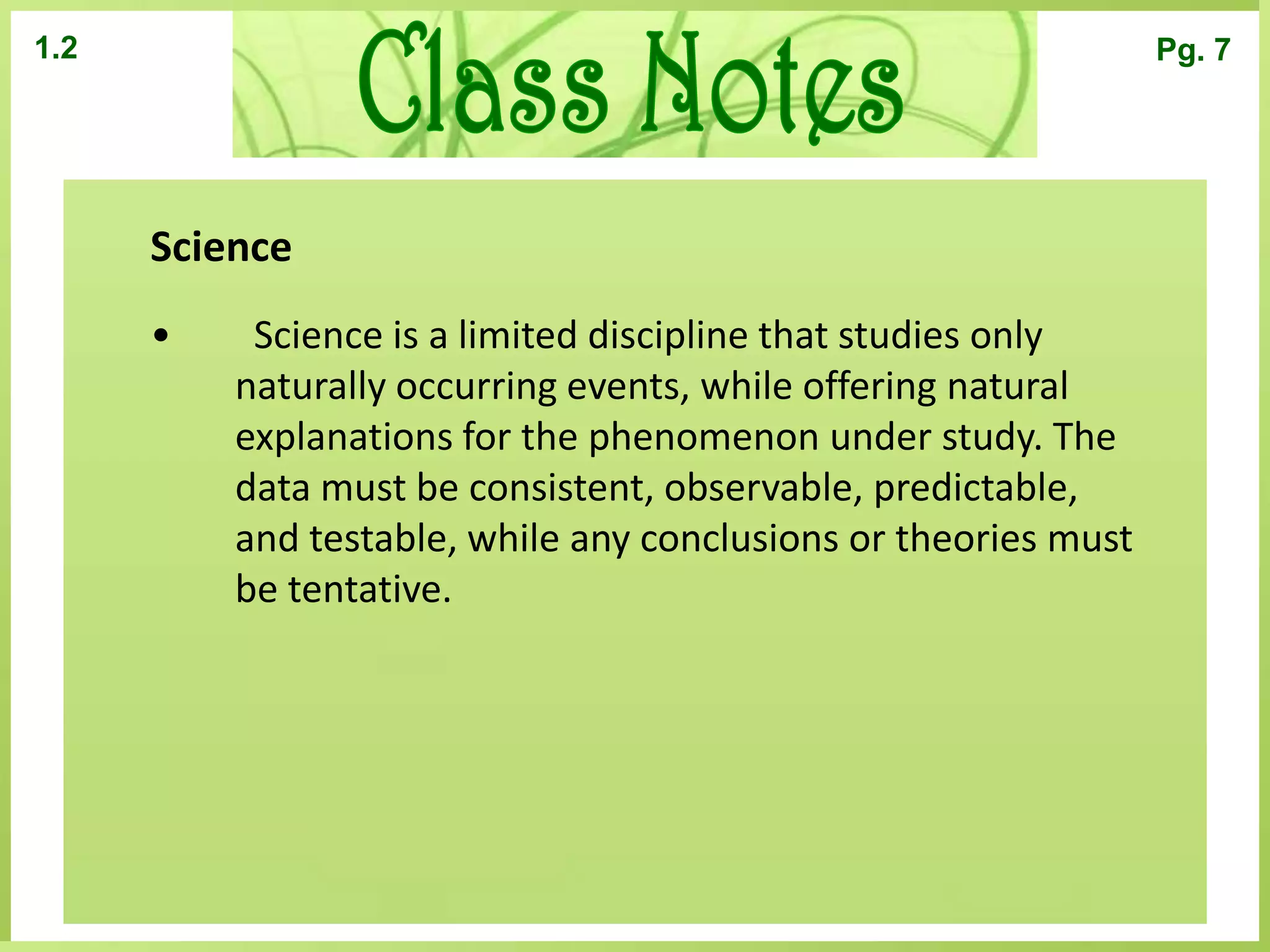
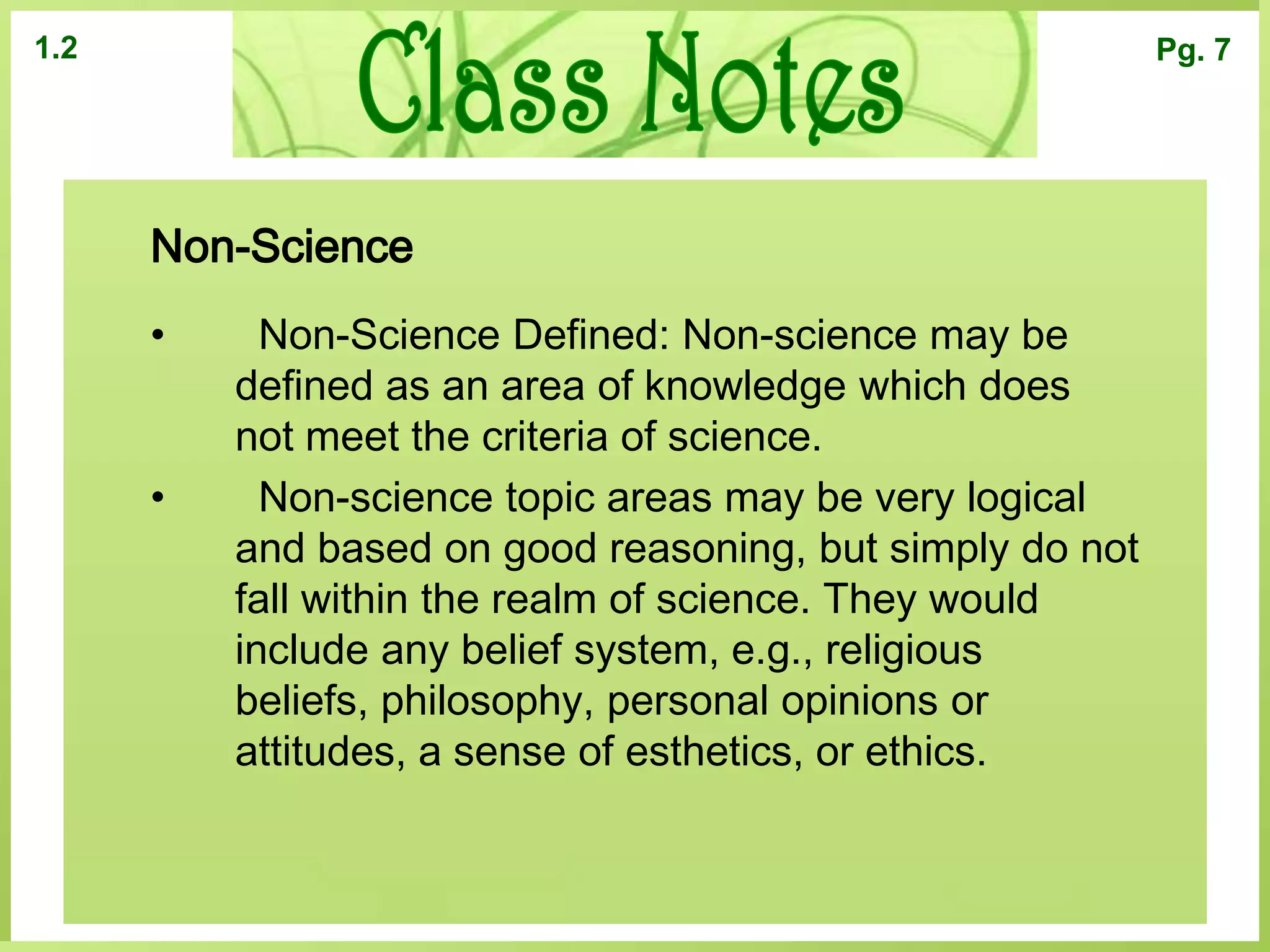
    Class Notes1.2Pg. 7Science Science is a limited discipline that studies only naturally occurring events, while offering natural explanations for the phenomenon under study. The data must be consistent, observable, predictable, and testable, while any conclusions or theories must be tentative.Class Notes1.2Pg. 7Non-Science Non-Science Defined: Non-science may be defined as an area of knowledge which does not meet the criteria of science.
  • 39.
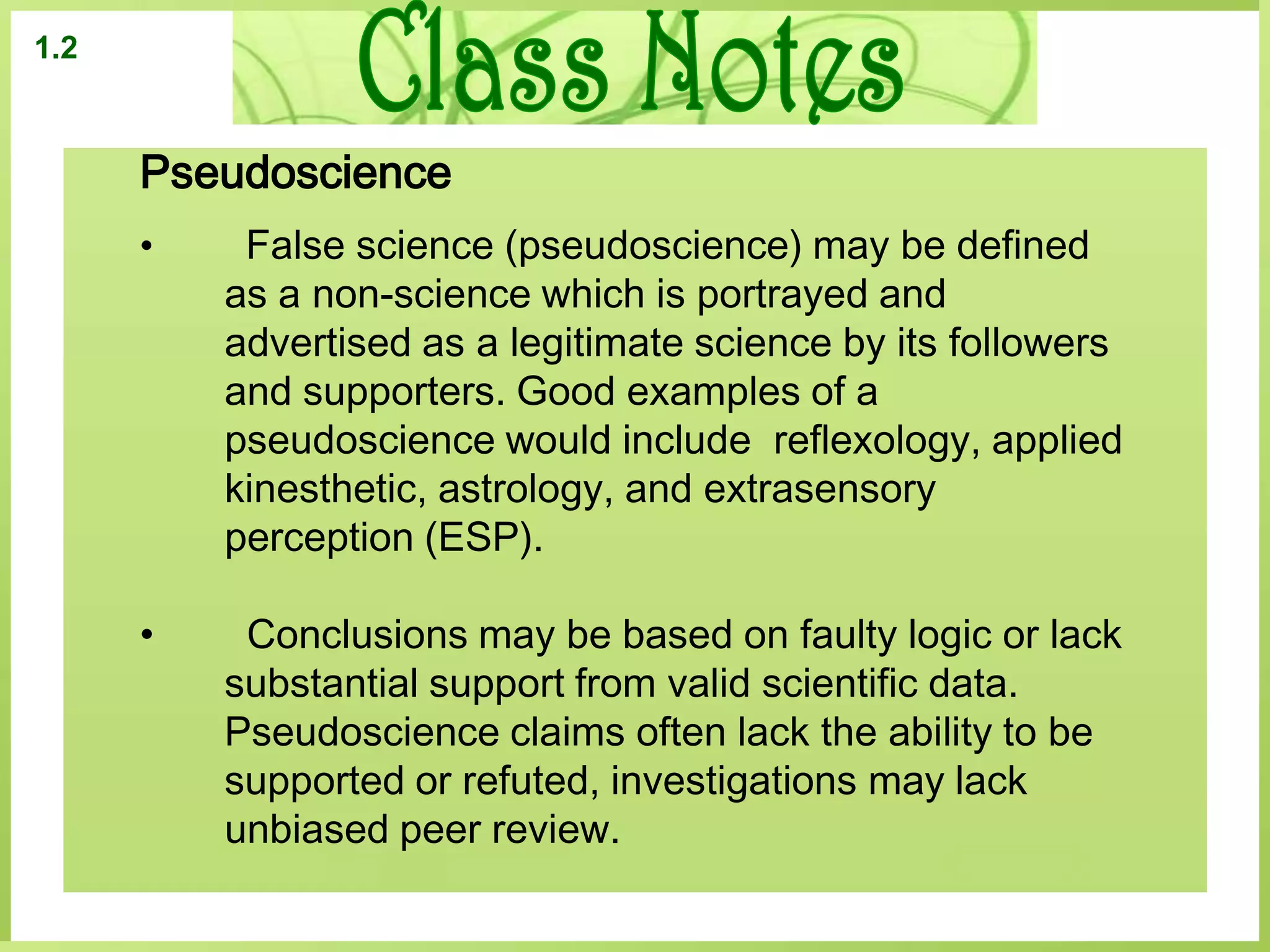
    Non-sciencetopic areas may be very logical and based on good reasoning, but simply do not fall within the realm of science. They would include any belief system, e.g., religious beliefs, philosophy, personal opinions or attitudes, a sense of esthetics, or ethics.Class Notes1.2PseudoscienceFalse science (pseudoscience) may be defined as a non-science which is portrayed and advertised as a legitimate science by its followers and supporters. Good examples of a pseudoscience would include  reflexology, applied kinesthetic, astrology, and extrasensory perception (ESP).
  • 40.
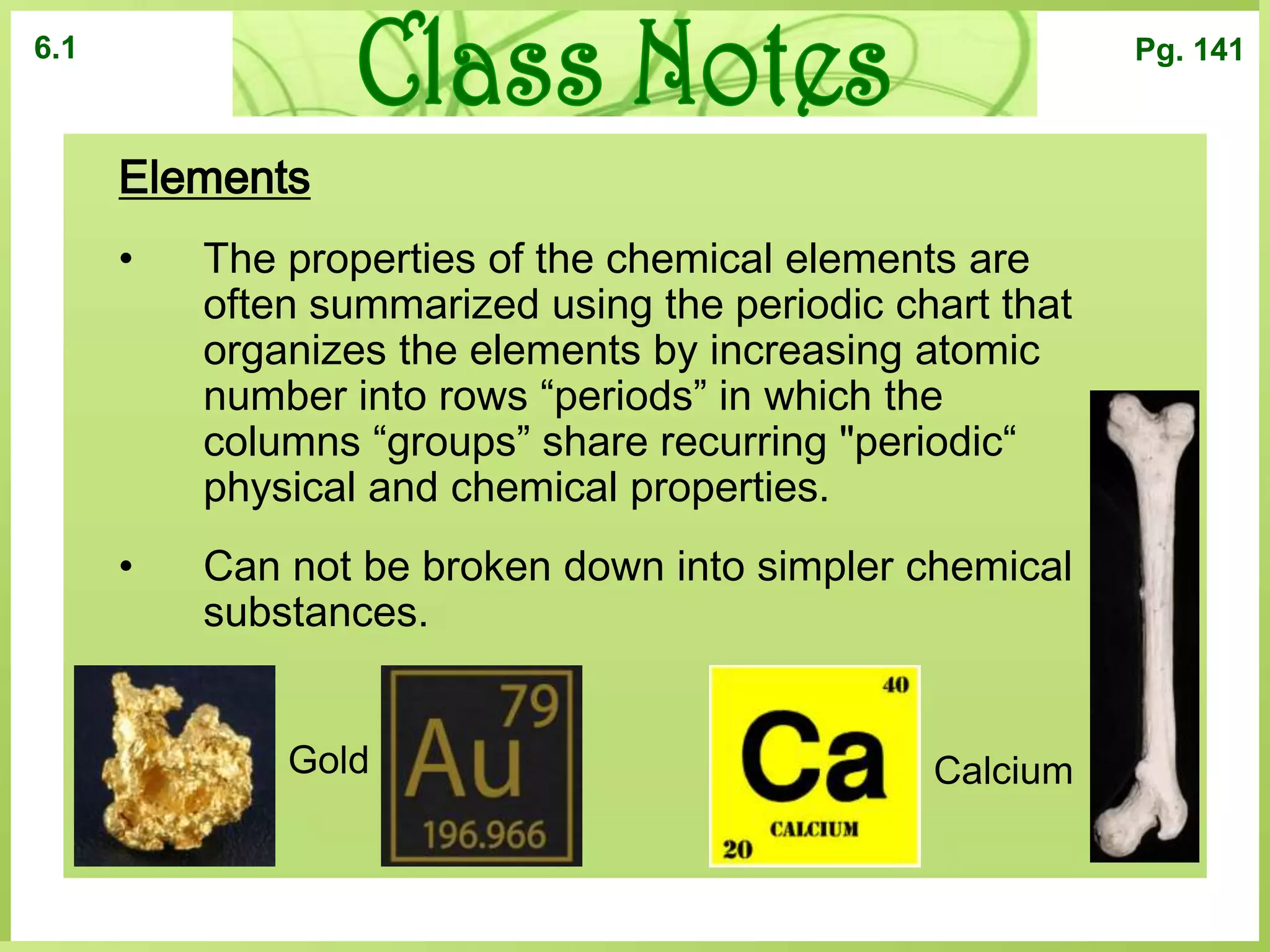
    Conclusionsmay be based on faulty logic or lack substantial support from valid scientific data. Pseudoscience claims often lack the ability to be supported or refuted, investigations may lack unbiased peer review.Class Notes6.1Pg. 141ElementsThe properties of the chemical elements are often summarized using the periodic chart that organizes the elements by increasing atomic number into rows “periods” in which the columns “groups” share recurring "periodic“ physical and chemical properties.
  • 41.
    Can not bebroken down into simpler chemical substances. GoldCalcium
  • 42.
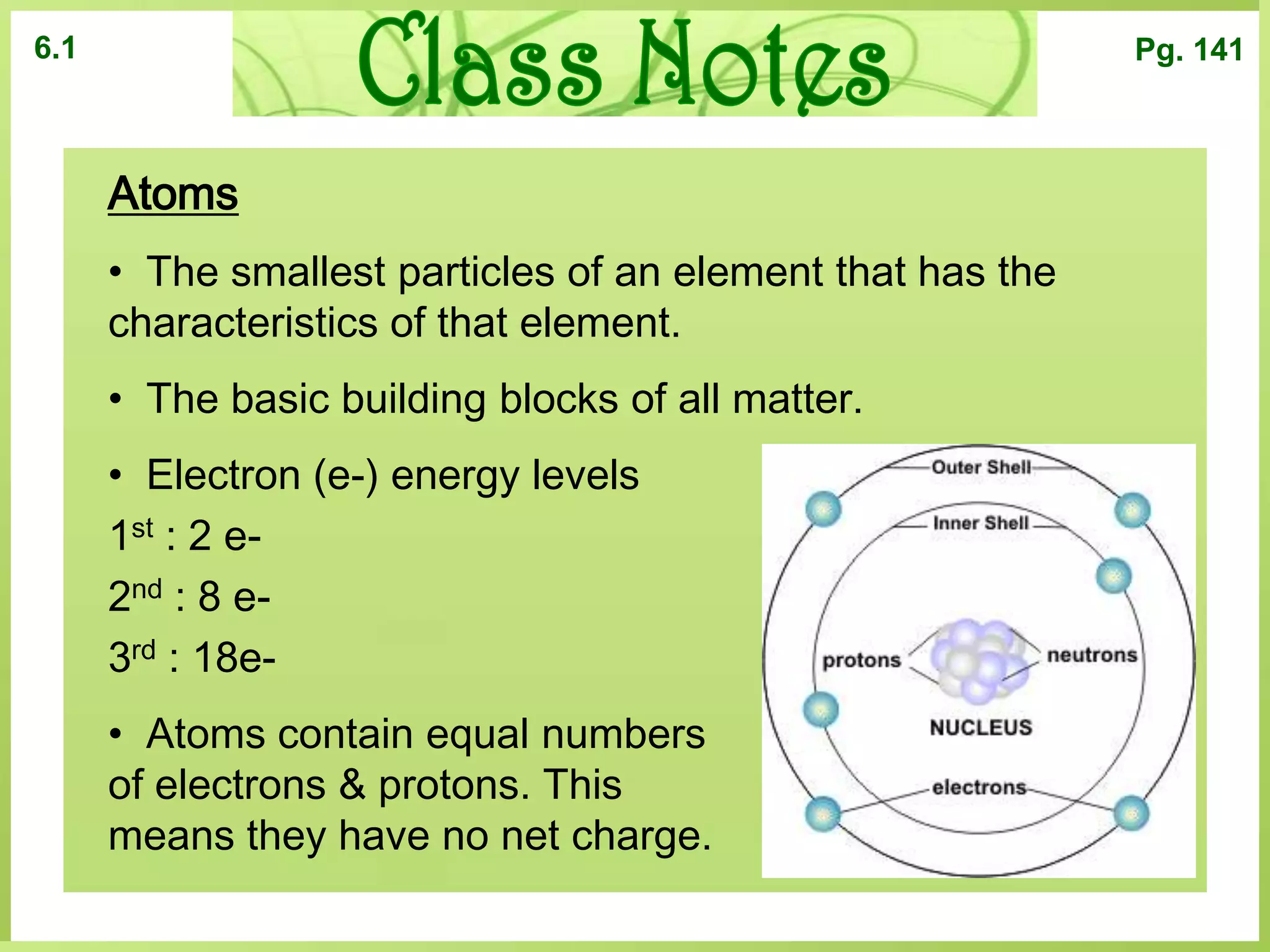
    Class Notes6.1Pg. 141Atoms The smallest particles of an element that has the characteristics of that element.
  • 43.
    Thebasic building blocks of all matter.
  • 44.
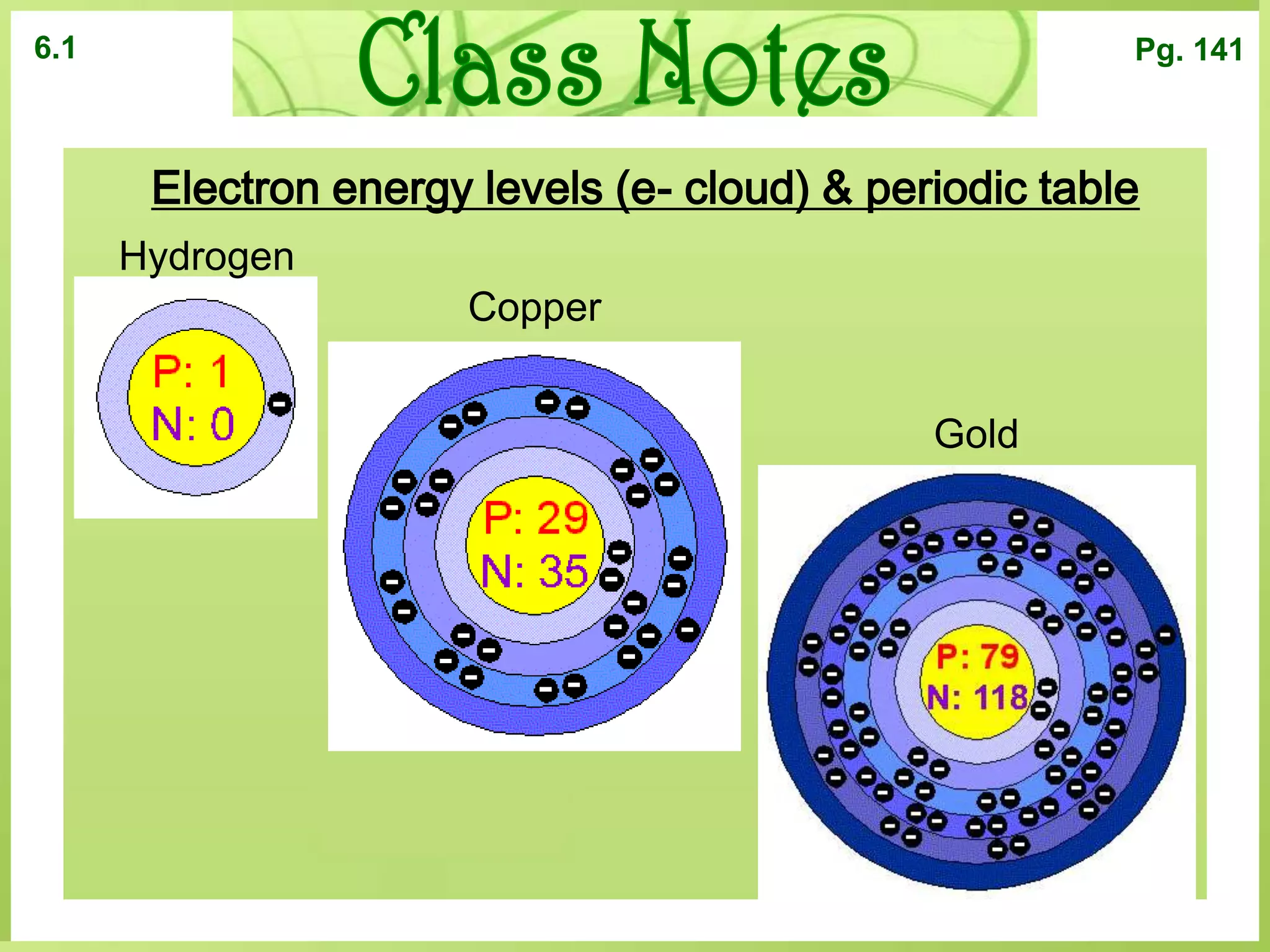
    Electron(e-) energy levels1st : 2 e-2nd : 8 e-3rd : 18e- Atoms contain equal numbers of electrons & protons. This means they have no net charge.
  • 45.
    Class Notes6.1Pg. 141Electronenergy levels (e- cloud) & periodic tableHydrogenCopperGold
  • 46.