 An impact or change in aquatic or terrestrial
environment by Human activity
 Introduction of non-indigenous and invasive
species in environment.
 Any harmful substance/ organism coming
from living organisms or by itself, effecting
the lives of organisms living in a particular
environment.
 Bacteria( E. coli)
 Viruses( Hepatitis A)
 Insects or just insect’s body parts
 Pollens fro plants/ trees
 Invasive species
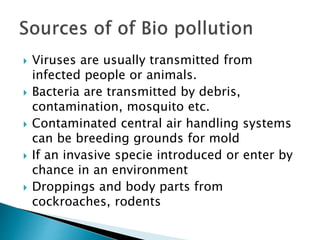
 Viruses are usually transmitted from
infected people or animals.
 Bacteria are transmitted by debris,
contamination, mosquito etc.
 Contaminated central air handling systems
can be breeding grounds for mold
 If an invasive specie introduced or enter by
chance in an environment
 Droppings and body parts from
cockroaches, rodents
 Parasitic germs effect at an individual level
 A change in genome may occur in a
population by introduction of an invasive
 A community may effected by dominance, or
elimination of native species
 Change in chemical/physical conditions may
effect a habitat
 Asthma
 Lethargy
 Allergic reaction by repeated exposure to an
allergen
 humidifier fever, associated with exposure to
toxins from microorganisms
 Legionella and influenza are known to be
transmitted by air.
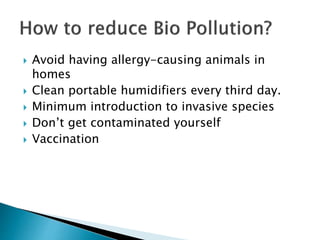
 Avoid having allergy-causing animals in
homes
 Clean portable humidifiers every third day.
 Minimum introduction to invasive species
 Don’t get contaminated yourself
 Vaccination
 Free online tool for calculating bio pollution
level
 It translate the existing data on miscellaneous
invasive alien species impacts into uniform
bio pollution measurement units.
 Elliott, Michael (2003). "Abstract: Biological pollutants and
biological pollution––an increasing cause for concern". Marine
Pollution Bulletin. 46 (3): 275–280
 Wang, H., Zhang, W., Chen, L., Wang, J., & Liu, T. (2013). The
contamination and control of biological pollutants in mass
cultivation of microalgae. Bioresource technology, 128, 745-
750.
 Olenin S, Minchin D, Daunys D, 2007. Assessment of
biopollution in aquatic ecosystems. Marine pollution bulletin,
55: 379 – 394.
 https://www.epa.gov/sites/default/files/2014-
08/documents/humidifier_factsheet.pdf

Biological Pollution.pptx

  • 2.
     An impactor change in aquatic or terrestrial environment by Human activity  Introduction of non-indigenous and invasive species in environment.
  • 3.
     Any harmfulsubstance/ organism coming from living organisms or by itself, effecting the lives of organisms living in a particular environment.
  • 4.
     Bacteria( E.coli)  Viruses( Hepatitis A)  Insects or just insect’s body parts  Pollens fro plants/ trees  Invasive species
  • 5.
     Viruses areusually transmitted from infected people or animals.  Bacteria are transmitted by debris, contamination, mosquito etc.  Contaminated central air handling systems can be breeding grounds for mold  If an invasive specie introduced or enter by chance in an environment  Droppings and body parts from cockroaches, rodents
  • 6.
     Parasitic germseffect at an individual level  A change in genome may occur in a population by introduction of an invasive  A community may effected by dominance, or elimination of native species  Change in chemical/physical conditions may effect a habitat
  • 7.
     Asthma  Lethargy Allergic reaction by repeated exposure to an allergen  humidifier fever, associated with exposure to toxins from microorganisms  Legionella and influenza are known to be transmitted by air.
  • 8.
     Avoid havingallergy-causing animals in homes  Clean portable humidifiers every third day.  Minimum introduction to invasive species  Don’t get contaminated yourself  Vaccination
  • 9.
     Free onlinetool for calculating bio pollution level  It translate the existing data on miscellaneous invasive alien species impacts into uniform bio pollution measurement units.
  • 10.
     Elliott, Michael(2003). "Abstract: Biological pollutants and biological pollution––an increasing cause for concern". Marine Pollution Bulletin. 46 (3): 275–280  Wang, H., Zhang, W., Chen, L., Wang, J., & Liu, T. (2013). The contamination and control of biological pollutants in mass cultivation of microalgae. Bioresource technology, 128, 745- 750.  Olenin S, Minchin D, Daunys D, 2007. Assessment of biopollution in aquatic ecosystems. Marine pollution bulletin, 55: 379 – 394.  https://www.epa.gov/sites/default/files/2014- 08/documents/humidifier_factsheet.pdf