Building defects due to
 biological agents and
 mechanical damage
  Shaken, stirred and eaten

                                   Royal
                              Agricultural
                                 College
Why is biology a problem?

• Many building materials have great
  attraction to living organisms
  – As food
  – As shelter
• Some organisms just push buildings
  out of their way
• Some organisms change the
  environment that a building exists in
                                               Royal
                                          Agricultural
                                             College
Fungi

• Fungi (moulds) are amongst the
  most damaging biological agents in
  buildings
• Fungal spores are present
  everywhere in the atmosphere
• They require water, heat and food
• Buildings provide the warmth and
  food, usually timber. If moisture is
                                              Royal
  present, fungi will always grow        Agricultural
                                            College
Types of fungi
• Black spot: not damaging but
  disfiguring. Lives on damp surfaces
• Wet rot: a range of moulds which
  grow in and digest wet timber
  (moisture content over 20%)
   – If the source of moisture is
     removed, the mould will die off
• Dry rot: a mould which grows in
  slightly damp, warm timber
  (moisture less than 20%.
   – Extremely damaging. The hyphae can
     grow through solid brick walls and
     carry water to dry locations.
   – Infected areas will need sterilisation to        Royal
                                                 Agricultural
     remove the mould                               College
Invertebrates
• Insects can eat buildings
   – Termites – only a tropical
     problem, currently, but a big one
   – Death watch beetle
   – Most other wood boring insects
     only live for a few weeks as adult
     beetles but can live as wood
     boring larvae for several years
   – “Woodworm”, the larvae of a
     range of insects
       •   Common furniture beetle
                                                Masonry Bees
       •   Powder post beetle – notifiable
                                                These don’t eat
       •   House longhorn beetle – notifiable
                                                limestone, but they do
       •   Ambrosia beetle – Dutch elm
           disease vector-doesn’t affect
                                                bore into it for nesting.
           buildings                            Rarely a serious                 Royal
                                                problem                     Agricultural
                                                                               College
Damage by large animals
• Building foundations
  can be undermined by
  burrowing animals
• The species depends
  on the location, in the
  UK badgers are the
  only significant one
• Problems usually occur
  when a building is
  constructed on an
  existing badger sett.             Royal
                               Agricultural
                                  College
Plants can push buildings over

• Slow growing plants can
  exert huge, destructive
  pressure on buildings
   – Trees: the roots can push
     into foundations, under
     floors, into cellars and into
     drainage pipes
   – Ivy: the stems grows into
     cracks in walls for support
     and protection. As they
     grow, they force the
     masonry units apart
   – Virginia Creeper is not a
                                          Royal
     serious problem as it just      Agricultural
     clings to the surface              College
Changing the environment
• Most building damage from
  trees results from the water
  content of the sub-soil being
  changed by the tree
• If a tree grows near a
  building it can dry out and
  shrink the clay under the
  building, causing it to
  subside.
• Conversely, removing a
  large tree can result in the If the sub soil is a
  ground swelling because       shrinkable clay, it will
  water is no longer extracted contract as water is                 Royal
                                    removed by transpiration   Agricultural
                                                                  College
What is mechanical damage?

• Wear and tear
  – Using a building wears it out. This is not a
    defect, just a fact of life. Rapid wear is a
    defect.
• Damage due to movement
  – Buildings are essentially designed to stay still.
    If they move, and they do, damage is likely
  – Rapid repetitive movement – vibration
  – Sudden movement – shock
  – Slow, possibly repetitive movement – stress
    and fatigue                                              Royal
                                                        Agricultural
                                                           College
Wear and tear

• Damage due to internal traffic.
  – People walking over floors
  – Rubbing against walls
• Damage due to other use.
  – Repeated opening and shutting of doors and
    windows, wears out ironmongery and can
    damage walls
  – Thermal cycling due to automatic central
    heating
    (heating/cooling = expanding/contracting)
                                                      Royal
                                                 Agricultural
                                                    College
Internal Traffic damage 1

     Stair treads wear
     from foot traffic. It
     is so slow as to be
     undetectable, but
     the damage
     accumulates


                                  Royal
                             Agricultural
                                College
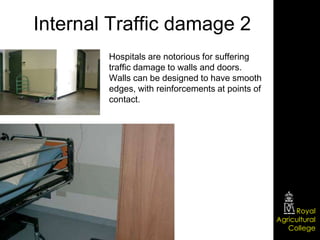
Internal Traffic damage 2
        Hospitals are notorious for suffering
        traffic damage to walls and doors.
        Walls can be designed to have smooth
        edges, with reinforcements at points of
        contact.


                                                       Royal
                                                  Agricultural
                                                     College
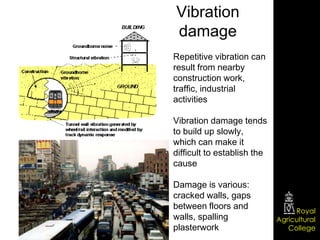
Vibration
damage
Repetitive vibration can
result from nearby
construction work,
traffic, industrial
activities

Vibration damage tends
to build up slowly,
which can make it
difficult to establish the
cause

Damage is various:
cracked walls, gaps
between floors and                Royal
walls, spalling              Agricultural
plasterwork                     College
Shock damage


Earthquake damage.
Masonry buildings
very prone to
earthquake damage.
Lincoln Cathedral was
demolished by an
                             Royal
earthquake prior to     Agricultural
1200.                      College
Thermal stress

• Buildings expand and
  contract with changes in
  temperature.
• The interior of inhabited
  buildings tend to be kept
  at constant
  temperature, the exterior
  varies with the weather.    Damage due to thermal
                              expansion on “short return
• Stress is set up between    walls”
  the interior and exterior   Most damage can be controlled
  elements where they are     through use of movement
  in contact.                 joints. Don’t try to stop
                                                                   Royal
                              movement, you can’t.
                                                              Agricultural
                                                                 College
Buildings do just wear out
           eventually…


                                                           Royal
                                                      Agricultural
The casings of the pyramids were removed by people,
                                                         College
but the sphinx eroded through wind-blown sand

Biological mechanical defects

  • 1.
    Building defects dueto biological agents and mechanical damage Shaken, stirred and eaten Royal Agricultural College
  • 2.
    Why is biologya problem? • Many building materials have great attraction to living organisms – As food – As shelter • Some organisms just push buildings out of their way • Some organisms change the environment that a building exists in Royal Agricultural College
  • 3.
    Fungi • Fungi (moulds)are amongst the most damaging biological agents in buildings • Fungal spores are present everywhere in the atmosphere • They require water, heat and food • Buildings provide the warmth and food, usually timber. If moisture is Royal present, fungi will always grow Agricultural College
  • 4.
    Types of fungi •Black spot: not damaging but disfiguring. Lives on damp surfaces • Wet rot: a range of moulds which grow in and digest wet timber (moisture content over 20%) – If the source of moisture is removed, the mould will die off • Dry rot: a mould which grows in slightly damp, warm timber (moisture less than 20%. – Extremely damaging. The hyphae can grow through solid brick walls and carry water to dry locations. – Infected areas will need sterilisation to Royal Agricultural remove the mould College
  • 5.
    Invertebrates • Insects caneat buildings – Termites – only a tropical problem, currently, but a big one – Death watch beetle – Most other wood boring insects only live for a few weeks as adult beetles but can live as wood boring larvae for several years – “Woodworm”, the larvae of a range of insects • Common furniture beetle Masonry Bees • Powder post beetle – notifiable These don’t eat • House longhorn beetle – notifiable limestone, but they do • Ambrosia beetle – Dutch elm disease vector-doesn’t affect bore into it for nesting. buildings Rarely a serious Royal problem Agricultural College
  • 6.
    Damage by largeanimals • Building foundations can be undermined by burrowing animals • The species depends on the location, in the UK badgers are the only significant one • Problems usually occur when a building is constructed on an existing badger sett. Royal Agricultural College
  • 7.
    Plants can pushbuildings over • Slow growing plants can exert huge, destructive pressure on buildings – Trees: the roots can push into foundations, under floors, into cellars and into drainage pipes – Ivy: the stems grows into cracks in walls for support and protection. As they grow, they force the masonry units apart – Virginia Creeper is not a Royal serious problem as it just Agricultural clings to the surface College
  • 8.
    Changing the environment •Most building damage from trees results from the water content of the sub-soil being changed by the tree • If a tree grows near a building it can dry out and shrink the clay under the building, causing it to subside. • Conversely, removing a large tree can result in the If the sub soil is a ground swelling because shrinkable clay, it will water is no longer extracted contract as water is Royal removed by transpiration Agricultural College
  • 9.
    What is mechanicaldamage? • Wear and tear – Using a building wears it out. This is not a defect, just a fact of life. Rapid wear is a defect. • Damage due to movement – Buildings are essentially designed to stay still. If they move, and they do, damage is likely – Rapid repetitive movement – vibration – Sudden movement – shock – Slow, possibly repetitive movement – stress and fatigue Royal Agricultural College
  • 10.
    Wear and tear •Damage due to internal traffic. – People walking over floors – Rubbing against walls • Damage due to other use. – Repeated opening and shutting of doors and windows, wears out ironmongery and can damage walls – Thermal cycling due to automatic central heating (heating/cooling = expanding/contracting) Royal Agricultural College
  • 11.
    Internal Traffic damage1 Stair treads wear from foot traffic. It is so slow as to be undetectable, but the damage accumulates Royal Agricultural College
  • 12.
    Internal Traffic damage2 Hospitals are notorious for suffering traffic damage to walls and doors. Walls can be designed to have smooth edges, with reinforcements at points of contact. Royal Agricultural College
  • 13.
    Vibration damage Repetitive vibration can resultfrom nearby construction work, traffic, industrial activities Vibration damage tends to build up slowly, which can make it difficult to establish the cause Damage is various: cracked walls, gaps between floors and Royal walls, spalling Agricultural plasterwork College
  • 14.
    Shock damage Earthquake damage. Masonrybuildings very prone to earthquake damage. Lincoln Cathedral was demolished by an Royal earthquake prior to Agricultural 1200. College
  • 15.
    Thermal stress • Buildingsexpand and contract with changes in temperature. • The interior of inhabited buildings tend to be kept at constant temperature, the exterior varies with the weather. Damage due to thermal expansion on “short return • Stress is set up between walls” the interior and exterior Most damage can be controlled elements where they are through use of movement in contact. joints. Don’t try to stop Royal movement, you can’t. Agricultural College
  • 16.
    Buildings do justwear out eventually… Royal Agricultural The casings of the pyramids were removed by people, College but the sphinx eroded through wind-blown sand