Shahida M. Qureshi
Consultant
Infectious Disease Research Lab
Department of Pediatrics
Aga Khan University
Biological and Chemical
Spill Management in Field
and Lab-Based Vector-
Borne Disease Research
Disclosure Statement
I declare:
I do not have any financial relationship with
proprietary entities producing, marketing, re-
selling, or distributing healthcare goods or
services consumed or used by Healthcare
workers.
Presentation Objectives
By the end of the presentation participants will learn:
Different kinds of spills and how to handle them
Knowledge of Standard Biohazard Labels
Understand about MSDS and how to use it
Chemical and Biological Spill Management and
Handling
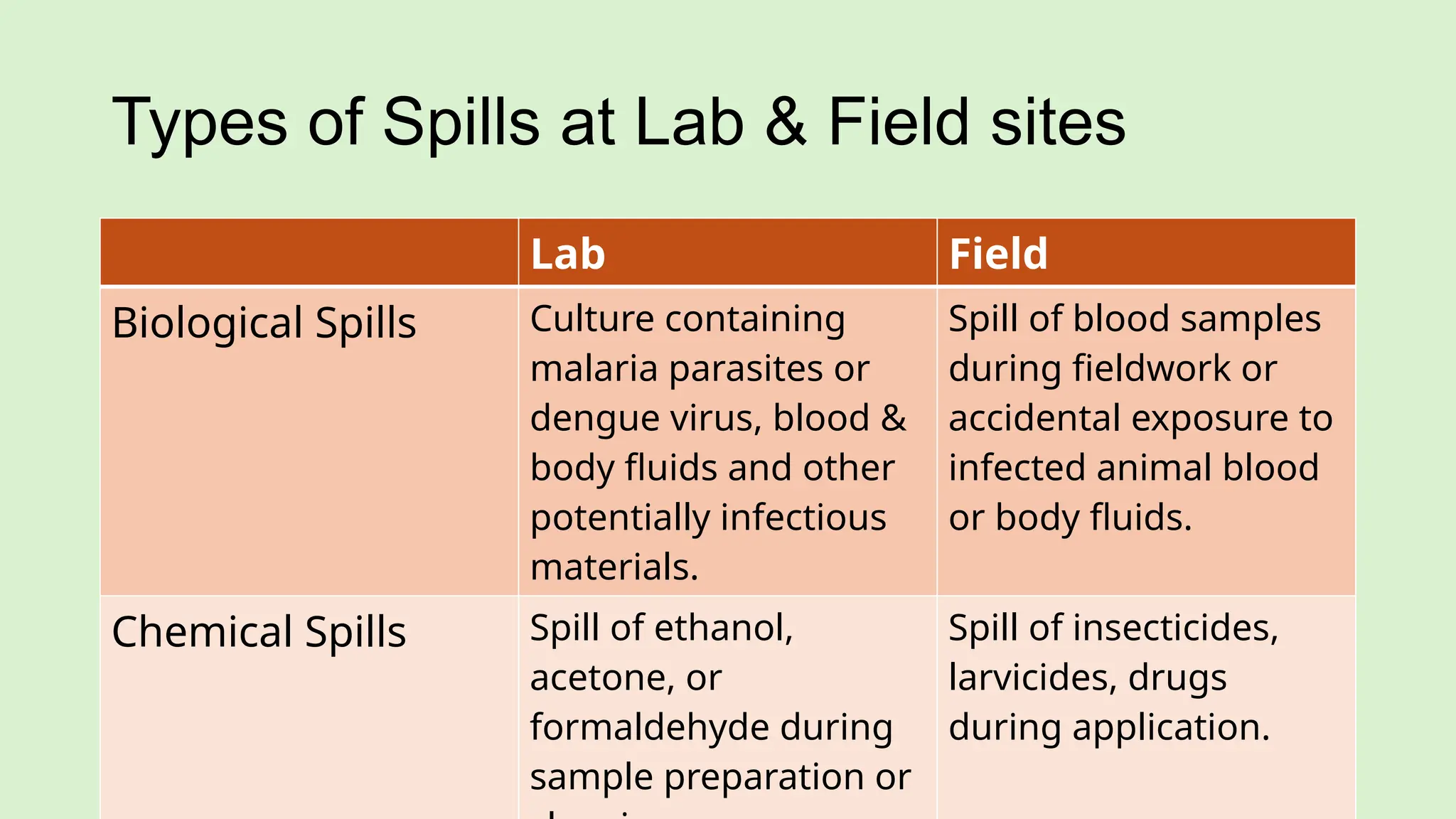
Types of Spills at Lab & Field sites
Lab Field
Biological Spills Culture containing
malaria parasites or
dengue virus, blood &
body fluids and other
potentially infectious
materials.
Spill of blood samples
during fieldwork or
accidental exposure to
infected animal blood
or body fluids.
Chemical Spills Spill of ethanol,
acetone, or
formaldehyde during
sample preparation or
Spill of insecticides,
larvicides, drugs
during application.
Spill Kit Contents
Note: Choose disposable
materials whenever
feasible, as cleanup tools
that come into contact with
contaminants are
categorized as
biohazardous waste.
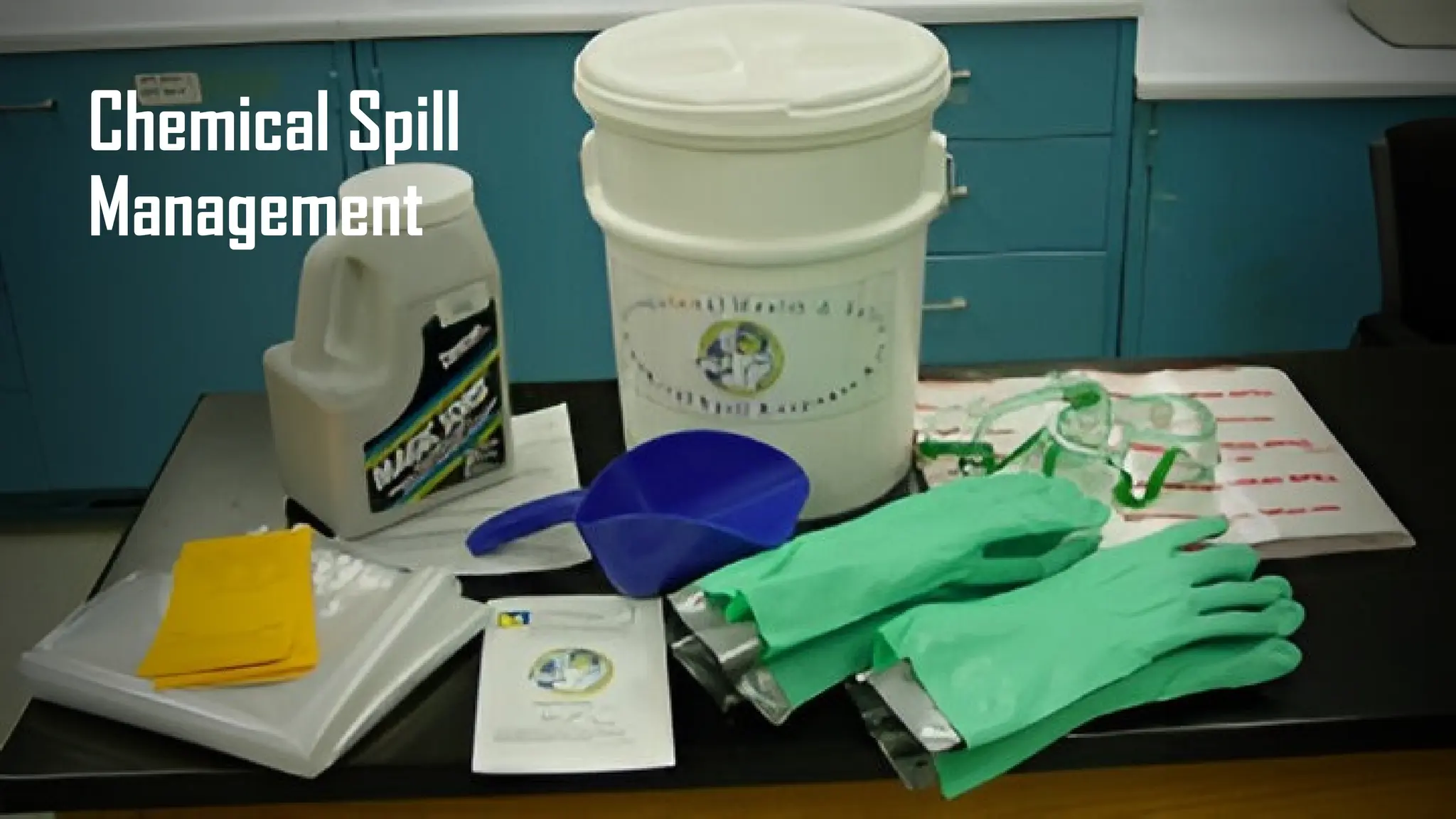
a 5-gallon plastic bucket
to hold the supplies
1. paper towels
2. spill pads
3. spill pillow for large spill
4. powder
5. vermiculite
Spill Kit Container
Absorption Materials
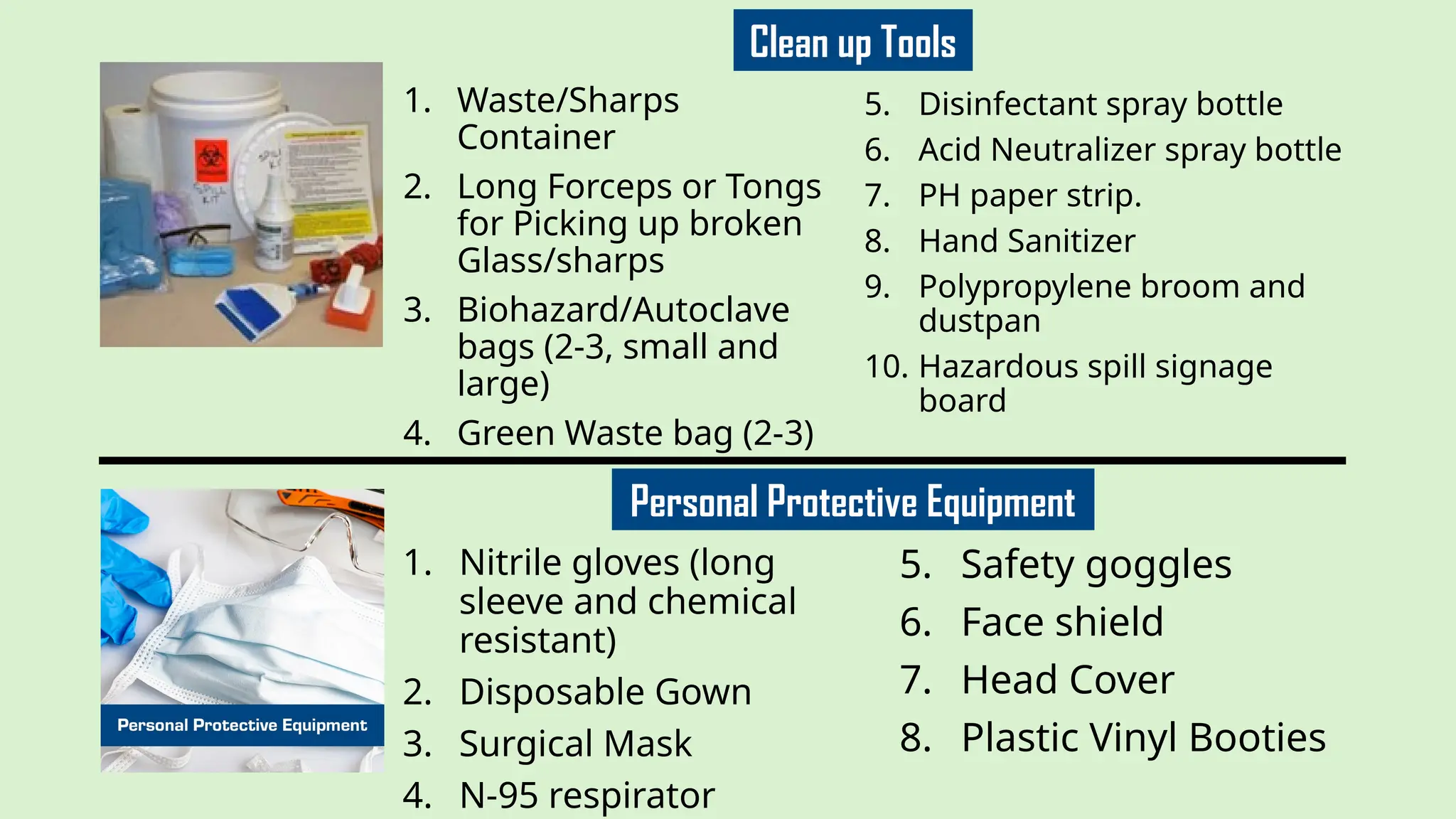
1. Waste/Sharps
Container
2. Long Forceps or Tongs
for Picking up broken
Glass/sharps
3. Biohazard/Autoclave
bags (2-3, small and
large)
4. Green Waste bag (2-3)
5. Disinfectant spray bottle
6. Acid Neutralizer spray bottle
7. PH paper strip.
8. Hand Sanitizer
9. Polypropylene broom and
dustpan
10. Hazardous spill signage
board
5. Safety goggles
6. Face shield
7. Head Cover
8. Plastic Vinyl Booties
1. Nitrile gloves (long
sleeve and chemical
resistant)
2. Disposable Gown
3. Surgical Mask
4. N-95 respirator
Clean up Tools
Personal Protective Equipment
PPE Protocol
Donning (Putting on)
1. Perform hand hygiene
2. Put on shoe covers (if
applicable)
3. Put on gown
4. Put on mask/respirator
(if applicable)
5. Put on eye protection
(if applicable)
6. Put on gloves
Doffing (Taking off) Dirty to
clean
1. Remove shoe covers (if
applicable)
2. Remove gown and gloves
together*
3. Perform hand hygiene
4. Remove eye protection (if
applicable)
5. Remove mask/respirator
(if applicable)
6. Perform hand hygiene
Biological Spill Management
Biological Spill Response
1. Follow standard guidelines for spill
management. Do not attempt to clean
biological spills as it occur.
2. Alert coworkers in the surroundings
immediately and put up spill signage.
3. Evacuate the area for 30 minutes for the
aerosols to settle.
4. Doff the spill-contaminated PPEs.
5. Report to the lab supervisor/biosafety
officer.
6. Don appropriate PPEs like Gloves,
Goggles, Vapor Masks, Respirators etc.
7. Confine the spill to a small area with
absorbent pads/paper towels around
the spill, then cover the actual spill with
absorbent pads/paper towels.
8. Spray disinfectant over the absorbent
materials.
9. Allow 30 minutes of Contact Time for
proper disinfection.
Biological Spill Response contd...
10.Use tongs to pick up absorbent
material from the outside to the
center of the spill and transfer into
a biohazard bag.
11.Use tongs and/or forceps to pick
up broken pieces of glass if any,
and discard in a sharp bin.
12.Clean and disinfect the spill area
with soap and water.
Biological Spill Response contd...
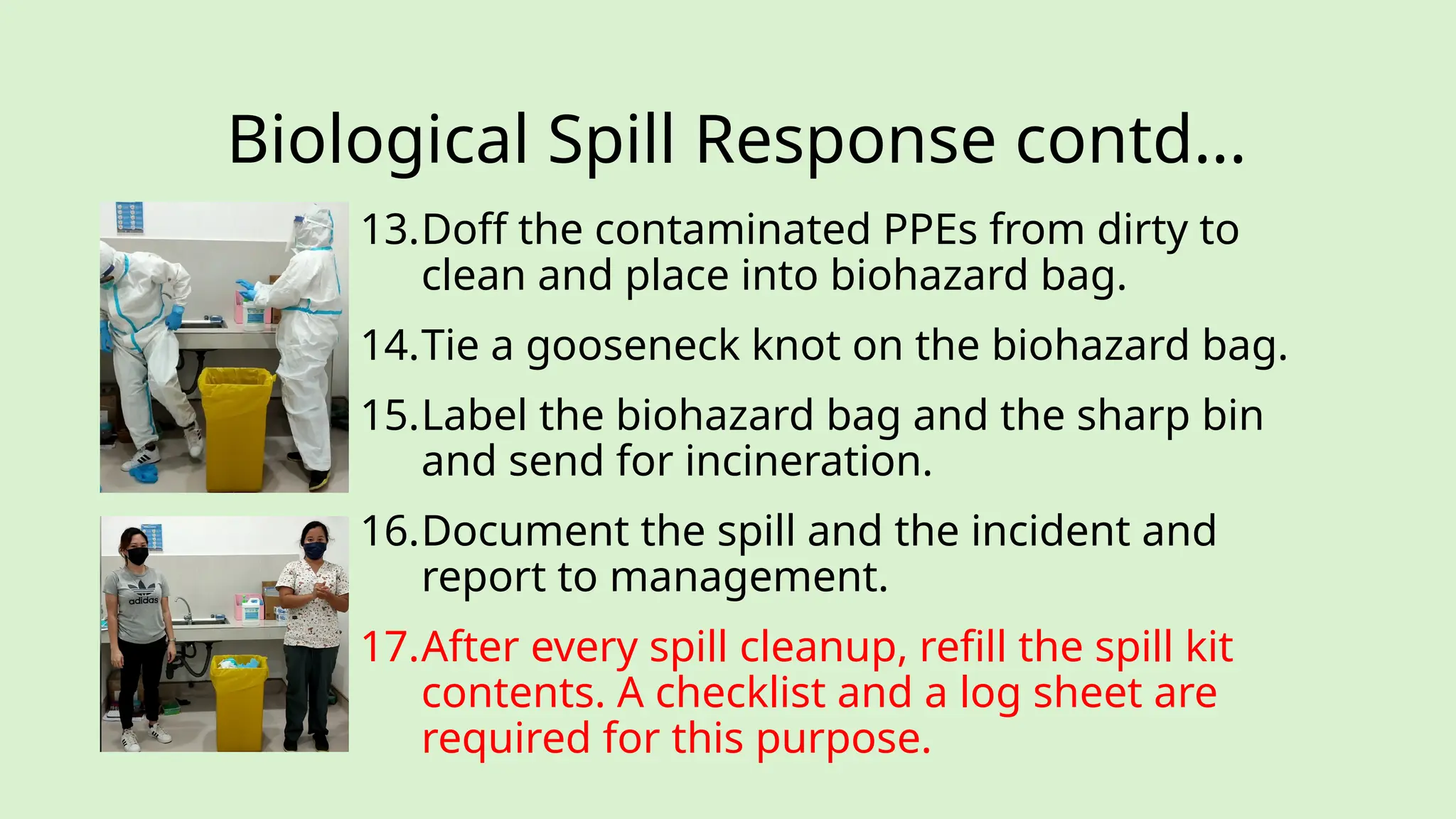
13.Doff the contaminated PPEs from dirty to
clean and place into biohazard bag.
14.Tie a gooseneck knot on the biohazard bag.
15.Label the biohazard bag and the sharp bin
and send for incineration.
16.Document the spill and the incident and
report to management.
17.After every spill cleanup, refill the spill kit
contents. A checklist and a log sheet are
required for this purpose.
Biological Spill Response contd...
Chemical Spill
Management
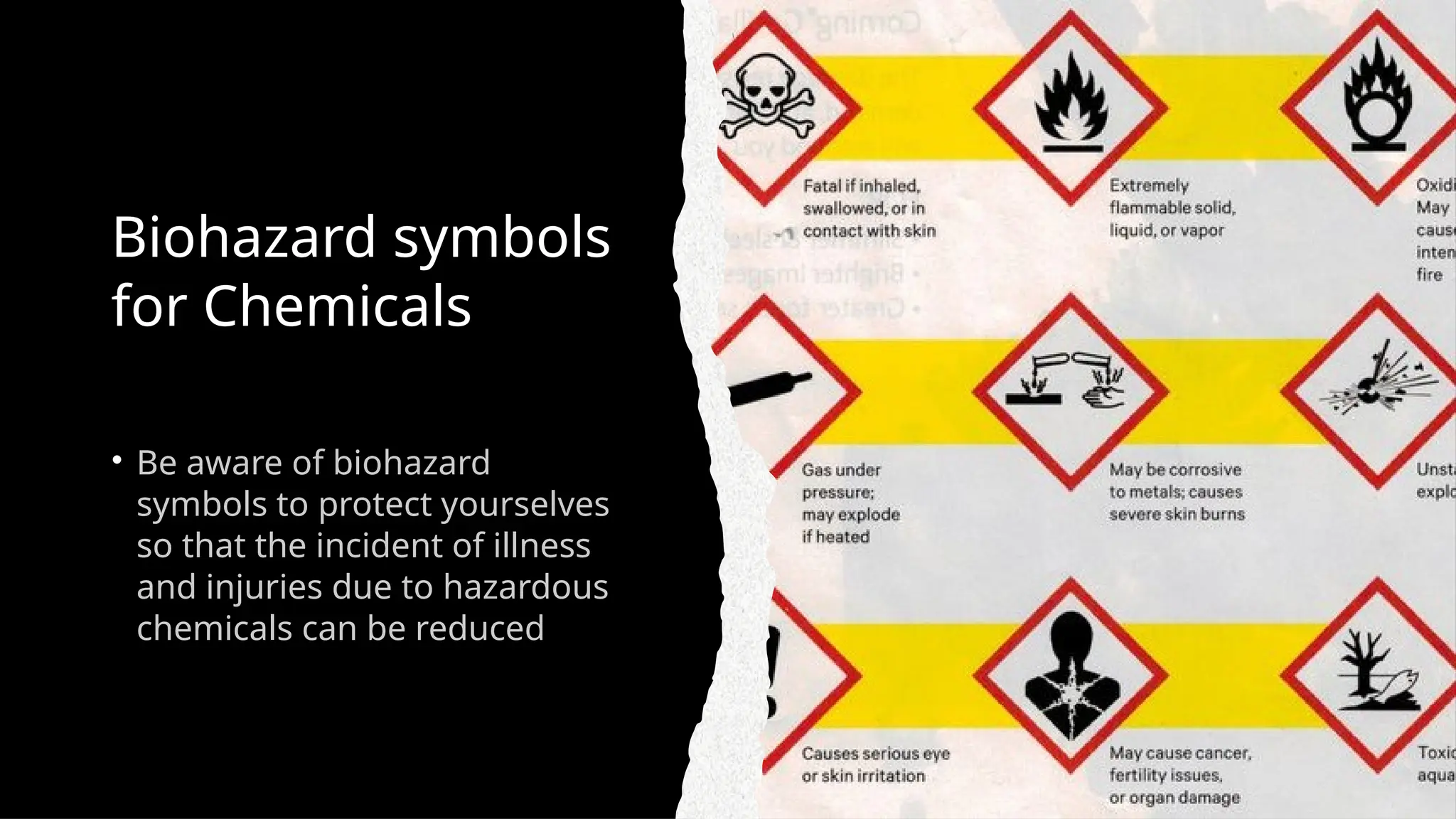
Biohazard symbols
for Chemicals
• Be aware of biohazard
symbols to protect yourselves
so that the incident of illness
and injuries due to hazardous
chemicals can be reduced
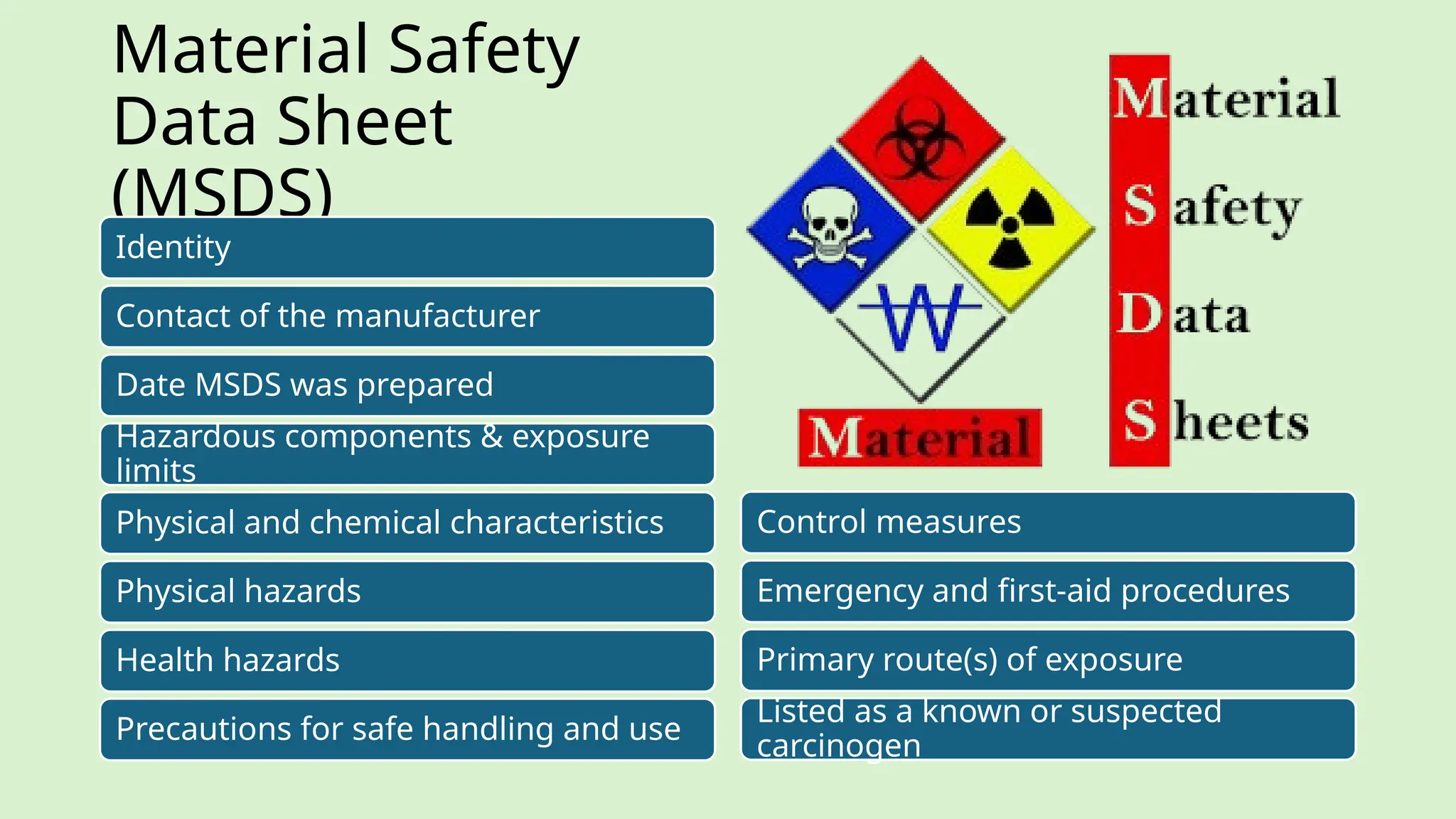
Material Safety
Data Sheet
(MSDS)
Identity
Contact of the manufacturer
Date MSDS was prepared
Hazardous components & exposure
limits
Physical and chemical characteristics
Physical hazards
Health hazards
Precautions for safe handling and use
Control measures
Emergency and first-aid procedures
Primary route(s) of exposure
Listed as a known or suspected
carcinogen
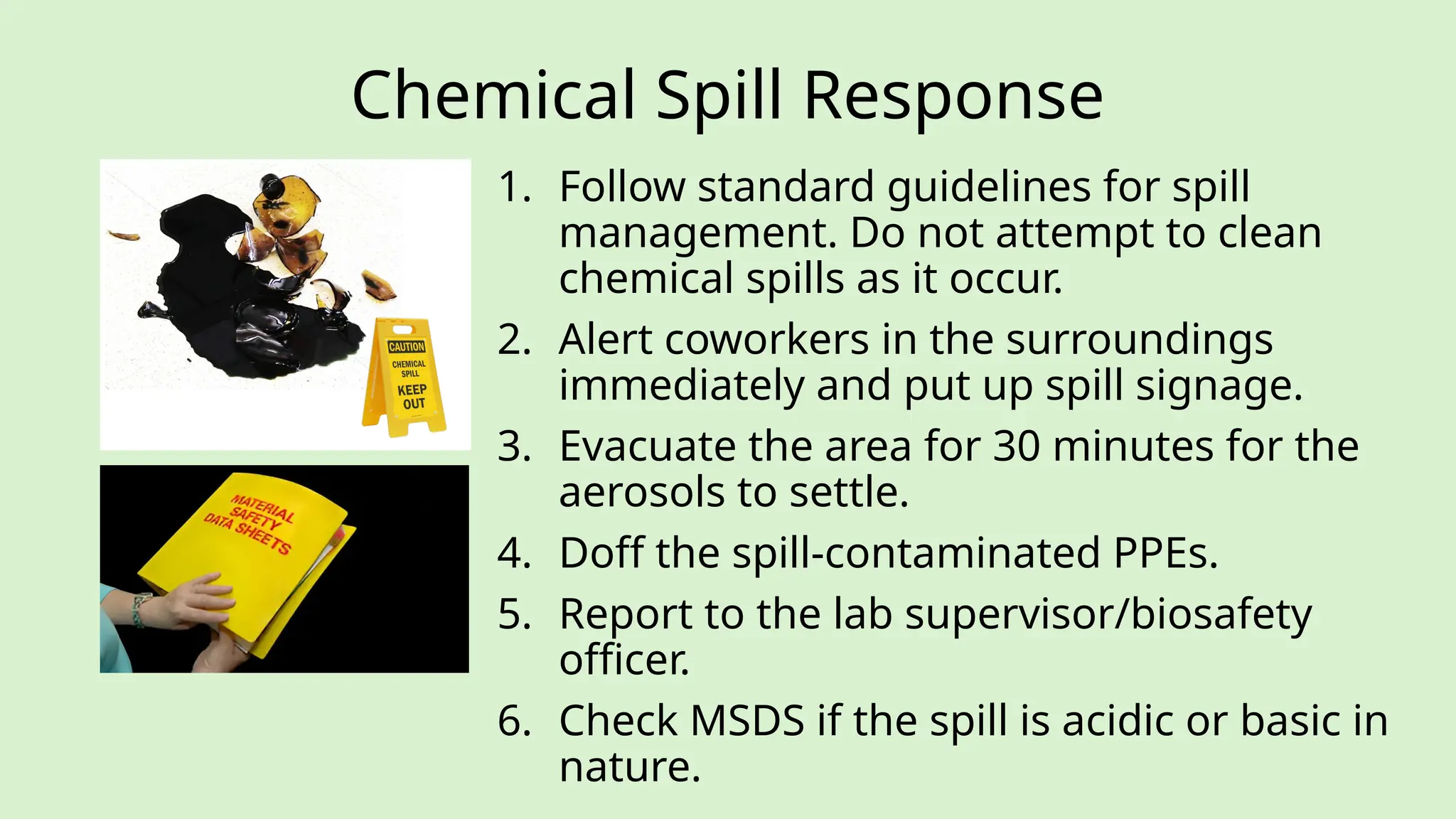
Chemical Spill Response
1. Follow standard guidelines for spill
management. Do not attempt to clean
chemical spills as it occur.
2. Alert coworkers in the surroundings
immediately and put up spill signage.
3. Evacuate the area for 30 minutes for the
aerosols to settle.
4. Doff the spill-contaminated PPEs.
5. Report to the lab supervisor/biosafety
officer.
6. Check MSDS if the spill is acidic or basic in
nature.
6. Don appropriate PPEs like Gloves,
Goggles, Vapor Masks, Respirators
etc.
7. Confine spill to a small area with
absorbent pads and check the pH.
8. Ensure complete neutralization of
the spill with an appropriate
neutralizer (Sodium Hypochlorite,
Cidex, & Spirit do not need
neutralization).
Note: Generally, neutralization can
occur rapidly, often within minutes.
However, for larger spills or highly
Chemical Spill Response contd...
9. After neutralization is done, put
absorbent materials on the spill.
10.Use tongs and/or forceps to pick up
broken pieces of glass if any and
discard them in a sharp bin.
11.Use tongs to pick up absorbent
material from the outside to the
center of the spill and transfer it into
a chemical waste container.
12.Clean and disinfect the spill area
with soap and water.
Chemical Spill Response contd...
13.Doff the contaminated PPEs from
dirty to clean and place into
biohazard bag.
14.Seal and label the chemical waste
container and the sharp bin and
send for incineration.
15.Document the spill and the
incident and report to
management.
16.After every spill cleanup, refill the
spill kit contents. A checklist and a
log sheet are required for this
purpose.
Chemical Spill Response contd...
Biological Spill Management Video
• https://www.youtube.com/watch?app=desktop&v=xjwTwsN
1hnU
Biological and Chemical Spill Management in Field and Lab .pptx

Biological and Chemical Spill Management in Field and Lab .pptx

  • 1.
    Shahida M. Qureshi Consultant InfectiousDisease Research Lab Department of Pediatrics Aga Khan University Biological and Chemical Spill Management in Field and Lab-Based Vector- Borne Disease Research
  • 2.
    Disclosure Statement I declare: Ido not have any financial relationship with proprietary entities producing, marketing, re- selling, or distributing healthcare goods or services consumed or used by Healthcare workers.
  • 3.
    Presentation Objectives By theend of the presentation participants will learn: Different kinds of spills and how to handle them Knowledge of Standard Biohazard Labels Understand about MSDS and how to use it Chemical and Biological Spill Management and Handling
  • 4.
    Types of Spillsat Lab & Field sites Lab Field Biological Spills Culture containing malaria parasites or dengue virus, blood & body fluids and other potentially infectious materials. Spill of blood samples during fieldwork or accidental exposure to infected animal blood or body fluids. Chemical Spills Spill of ethanol, acetone, or formaldehyde during sample preparation or Spill of insecticides, larvicides, drugs during application.
  • 5.
    Spill Kit Contents Note:Choose disposable materials whenever feasible, as cleanup tools that come into contact with contaminants are categorized as biohazardous waste. a 5-gallon plastic bucket to hold the supplies 1. paper towels 2. spill pads 3. spill pillow for large spill 4. powder 5. vermiculite Spill Kit Container Absorption Materials
  • 6.
    1. Waste/Sharps Container 2. LongForceps or Tongs for Picking up broken Glass/sharps 3. Biohazard/Autoclave bags (2-3, small and large) 4. Green Waste bag (2-3) 5. Disinfectant spray bottle 6. Acid Neutralizer spray bottle 7. PH paper strip. 8. Hand Sanitizer 9. Polypropylene broom and dustpan 10. Hazardous spill signage board 5. Safety goggles 6. Face shield 7. Head Cover 8. Plastic Vinyl Booties 1. Nitrile gloves (long sleeve and chemical resistant) 2. Disposable Gown 3. Surgical Mask 4. N-95 respirator Clean up Tools Personal Protective Equipment
  • 7.
    PPE Protocol Donning (Puttingon) 1. Perform hand hygiene 2. Put on shoe covers (if applicable) 3. Put on gown 4. Put on mask/respirator (if applicable) 5. Put on eye protection (if applicable) 6. Put on gloves Doffing (Taking off) Dirty to clean 1. Remove shoe covers (if applicable) 2. Remove gown and gloves together* 3. Perform hand hygiene 4. Remove eye protection (if applicable) 5. Remove mask/respirator (if applicable) 6. Perform hand hygiene
  • 8.
  • 9.
    Biological Spill Response 1.Follow standard guidelines for spill management. Do not attempt to clean biological spills as it occur. 2. Alert coworkers in the surroundings immediately and put up spill signage. 3. Evacuate the area for 30 minutes for the aerosols to settle. 4. Doff the spill-contaminated PPEs. 5. Report to the lab supervisor/biosafety officer.
  • 10.
    6. Don appropriatePPEs like Gloves, Goggles, Vapor Masks, Respirators etc. 7. Confine the spill to a small area with absorbent pads/paper towels around the spill, then cover the actual spill with absorbent pads/paper towels. 8. Spray disinfectant over the absorbent materials. 9. Allow 30 minutes of Contact Time for proper disinfection. Biological Spill Response contd...
  • 11.
    10.Use tongs topick up absorbent material from the outside to the center of the spill and transfer into a biohazard bag. 11.Use tongs and/or forceps to pick up broken pieces of glass if any, and discard in a sharp bin. 12.Clean and disinfect the spill area with soap and water. Biological Spill Response contd...
  • 12.
    13.Doff the contaminatedPPEs from dirty to clean and place into biohazard bag. 14.Tie a gooseneck knot on the biohazard bag. 15.Label the biohazard bag and the sharp bin and send for incineration. 16.Document the spill and the incident and report to management. 17.After every spill cleanup, refill the spill kit contents. A checklist and a log sheet are required for this purpose. Biological Spill Response contd...
  • 13.
  • 14.
    Biohazard symbols for Chemicals •Be aware of biohazard symbols to protect yourselves so that the incident of illness and injuries due to hazardous chemicals can be reduced
  • 15.
    Material Safety Data Sheet (MSDS) Identity Contactof the manufacturer Date MSDS was prepared Hazardous components & exposure limits Physical and chemical characteristics Physical hazards Health hazards Precautions for safe handling and use Control measures Emergency and first-aid procedures Primary route(s) of exposure Listed as a known or suspected carcinogen
  • 16.
    Chemical Spill Response 1.Follow standard guidelines for spill management. Do not attempt to clean chemical spills as it occur. 2. Alert coworkers in the surroundings immediately and put up spill signage. 3. Evacuate the area for 30 minutes for the aerosols to settle. 4. Doff the spill-contaminated PPEs. 5. Report to the lab supervisor/biosafety officer. 6. Check MSDS if the spill is acidic or basic in nature.
  • 17.
    6. Don appropriatePPEs like Gloves, Goggles, Vapor Masks, Respirators etc. 7. Confine spill to a small area with absorbent pads and check the pH. 8. Ensure complete neutralization of the spill with an appropriate neutralizer (Sodium Hypochlorite, Cidex, & Spirit do not need neutralization). Note: Generally, neutralization can occur rapidly, often within minutes. However, for larger spills or highly Chemical Spill Response contd...
  • 18.
    9. After neutralizationis done, put absorbent materials on the spill. 10.Use tongs and/or forceps to pick up broken pieces of glass if any and discard them in a sharp bin. 11.Use tongs to pick up absorbent material from the outside to the center of the spill and transfer it into a chemical waste container. 12.Clean and disinfect the spill area with soap and water. Chemical Spill Response contd...
  • 19.
    13.Doff the contaminatedPPEs from dirty to clean and place into biohazard bag. 14.Seal and label the chemical waste container and the sharp bin and send for incineration. 15.Document the spill and the incident and report to management. 16.After every spill cleanup, refill the spill kit contents. A checklist and a log sheet are required for this purpose. Chemical Spill Response contd...
  • 20.
    Biological Spill ManagementVideo • https://www.youtube.com/watch?app=desktop&v=xjwTwsN 1hnU