BIOL 3241
Medical Physiology
Professor Traci Welch Moritz
Heterick Memorial Library
Research and the Library
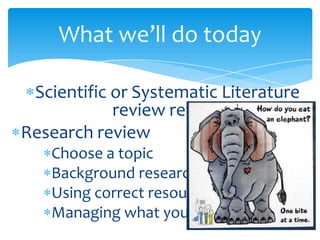
What we’ll do today
Scientific or Systematic Literature
review review
Research review
Choose a topic
Background research
Using correct resources
Managing what you find
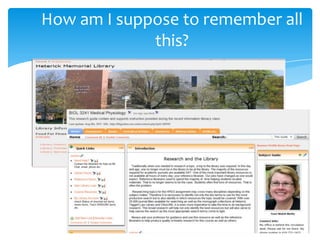
How am I suppose to remember all
this?
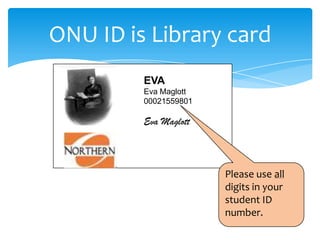
ONU ID is Library card
EVA
Eva Maglott
00021559801
Eva Maglott
Please use all
digits in your
student ID
number.
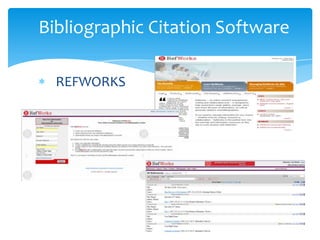
Bibliographic Citation Software
REFWORKS
Literature Review
What is it?
Survey of sources, scholarly
articles, government
docs, books, dissertations, conference
proceedings…
Overview of significant literature on a
topic often limited to a specific time
period
Scientific Literature Review
What is it not?
An academic research paper which is
most often constructed as an argument
and the information you are seeking is to
support said argument
An annotated bibliography as most
bibliographies contain sources found and
often read but not cited in the text
What is it?
Whatever your professors tell you
they want!
Bates College Department of Biology
University Library, UC Santa Cruz
Medical Sciences Divsion of University
of Oxford
Systematic Literature Review
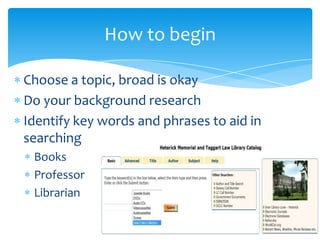
Choose a topic, broad is okay
Do your background research
Identify key words and phrases to aid in
searching
Books
Professor
Librarian
How to begin
So what next?
• Start big doing background reading
• Look for patterns
• Look at reference sources, your textbooks, LC
subject heading list, subject headings in
research tools to establish a controlled
vocabulary Ask a librarian
• Look at thesaurus in the research tools such
MeSH for Medline or CINAHL Headings (CH)
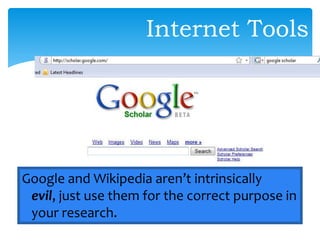
Google and Wikipedia aren’t intrinsically
evil, just use them for the correct purpose in
your research.
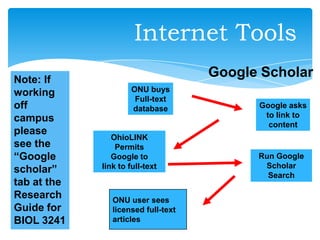
Internet Tools
Google Scholar
ONU buys
Full-text
database
OhioLINK
Permits
Google to
link to full-text
Google asks
to link to
content
ONU user sees
licensed full-text
articles
Run Google
Scholar
Search
Note: If
working
off
campus
please
see the
“Google
scholar”
tab at the
Research
Guide for
BIOL 3241
Internet Tools
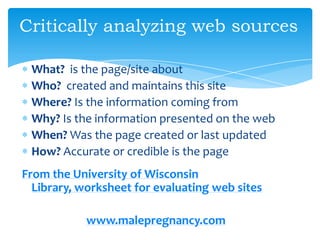
Critically analyzing web sources
What? is the page/site about
Who? created and maintains this site
Where? Is the information coming from
Why? Is the information presented on the web
When? Was the page created or last updated
How? Accurate or credible is the page
From the University of Wisconsin
Library, worksheet for evaluating web sites
www.malepregnancy.com
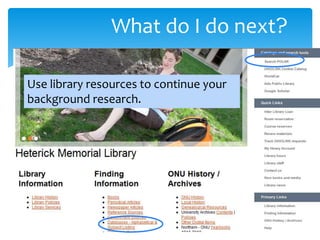
What do I do next?
Use library resources to continue your
background research.
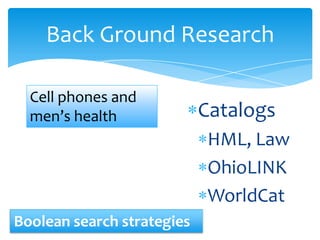
Back Ground Research
Catalogs
HML, Law
OhioLINK
WorldCat
Cell phones and
men’s health
Boolean search strategies
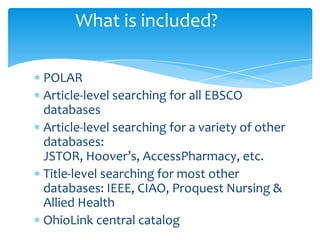
What is included?
POLAR
Article-level searching for all EBSCO
databases
Article-level searching for a variety of other
databases:
JSTOR, Hoover’s, AccessPharmacy, etc.
Title-level searching for most other
databases: IEEE, CIAO, Proquest Nursing &
Allied Health
OhioLink central catalog
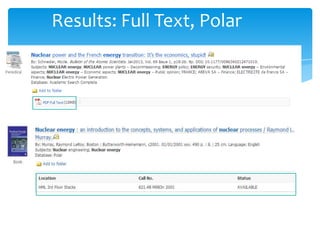
Results: Full Text, Polar
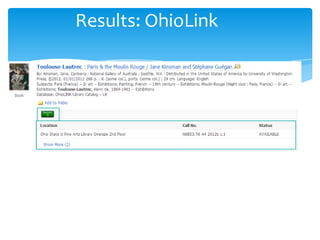
Results: OhioLink
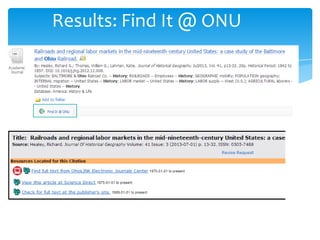
Results: Find It @ ONU
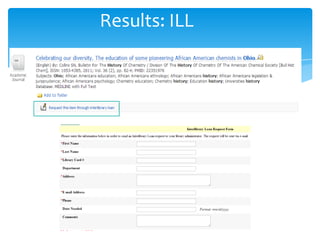
Results: ILL
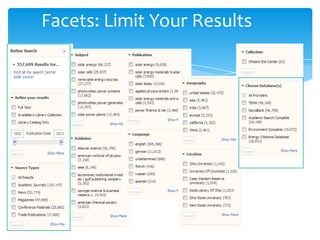
Facets: Limit Your Results
Things to Remember
Facets are your Friend: After you
search, limit your results to what you really
want
A tool not a solution: This is not the
solution to everything
Ask the librarians for help
There will still be some small changes
coming
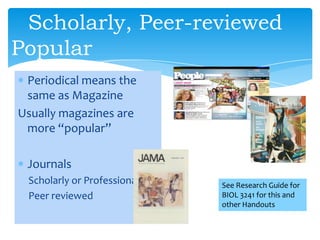
Scholarly, Peer-reviewed
Popular
Periodical means the
same as Magazine
Usually magazines are
more “popular”
Journals
Scholarly or Professional
Peer reviewed
See Research Guide for
BIOL 3241 for this and
other Handouts
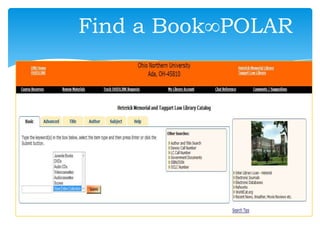
Find a Book∞POLAR
•Looks in several locations (usually
subject, article title, abstracts or contents)
•Does not require an exact match
•Generates comparatively large number of
hits (not precise)
•Good if you are not familiar with
terminology
•Look for the same or similar words which
keep appearing
Find a Book∞POLAR
•Looks in one place – subject
•Usually requires an exact match
between your term and a pre-set list of
terms
•Precise
•Can be used after keyword search has
identified specific subjects
•Click on the “Find Similar Items” link found on
each item record
Find a Book∞POLAR
Find a Book∞OhioLink
Materials owned by all Ohio
colleges, universities, several public libraries
Ca. 10 million items
Link from POLAR permits you to submit
requests. Available from Heterick home page
Most requests arrive in 2-3 working days
No charge
Limited to 100 items at a time
MAY RENEW UP TO 4 TIMES
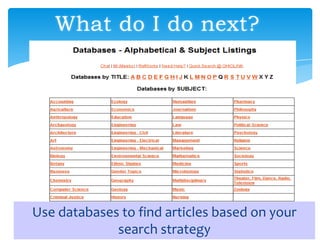
What do I do next?
Use databases to find articles based on your
search strategy
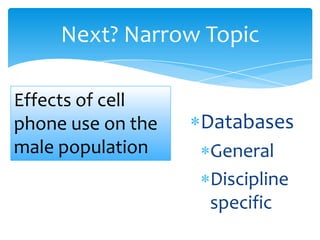
Next? Narrow Topic
Databases
General
Discipline
specific
Effects of cell
phone use on the
male population
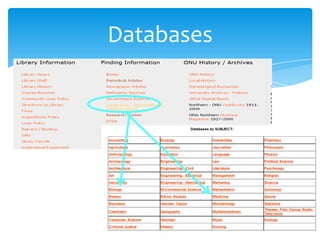
Databases
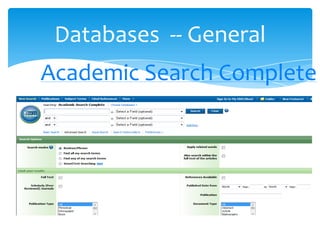
Databases -- General
Academic Search Complete
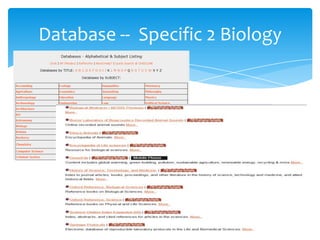
Database -- Specific 2 Biology
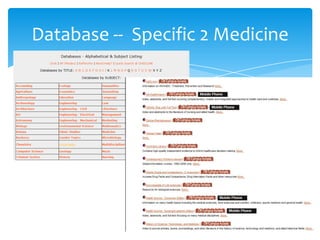
Database -- Specific 2 Medicine
CINAHL plus with full text
MEDLINE with full text
Proquest Nursing and Allied Health
Scopus
Biological Abstracts with BIOSIS
Preview
ISI Science Citation Index
Databases
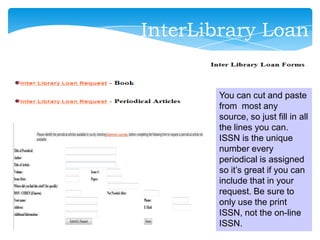
You can cut and paste
from most any
source, so just fill in all
the lines you can.
ISSN is the unique
number every
periodical is assigned
so it’s great if you can
include that in your
request. Be sure to
only use the print
ISSN, not the on-line
ISSN.
InterLibrary Loan
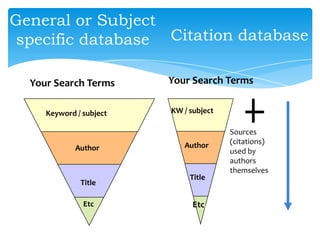
“General” databases – searchable
by subject, title, author, etc.
Citation databases – as above but
tells you who has cited a particular
article - significance
Citation Databases
Science Citation Index Expanded (SCI-
EXPANDED)--1980-present
Social Sciences Citation Index (SSCI)--
1980-present
Arts & Humanities Citation Index (A&HCI)-
-1980-present
Combined into product, Web of Knowledge
Citation Databases (ISI)
Your Search Terms Your Search Terms
Keyword / subject
Author
Title
Etc
KW / subject
Author
Title
Etc.
Sources
(citations)
used by
authors
themselves
General or Subject
specific database Citation database
Gauge significance of individual articles
& authors
Uses expertise of experts in the field
Gives insight into research patterns in
different disciplines
Can save you time – especially when
doing more rigorous research
Advantages
Need more help?
http://libguides.onu.edu/aecontent.php?
pid=199190&sid=2118629
Reference Desk
reference@onu.edu
2185
121 Research Consultations
with the
Librarians of
Heterick Memorial Library

Biol 3241

  • 1.
    BIOL 3241 Medical Physiology ProfessorTraci Welch Moritz Heterick Memorial Library Research and the Library
  • 2.
    What we’ll dotoday Scientific or Systematic Literature review review Research review Choose a topic Background research Using correct resources Managing what you find
  • 3.
    How am Isuppose to remember all this?
  • 4.
    ONU ID isLibrary card EVA Eva Maglott 00021559801 Eva Maglott Please use all digits in your student ID number.
  • 5.
  • 6.
    Literature Review What isit? Survey of sources, scholarly articles, government docs, books, dissertations, conference proceedings… Overview of significant literature on a topic often limited to a specific time period
  • 7.
    Scientific Literature Review Whatis it not? An academic research paper which is most often constructed as an argument and the information you are seeking is to support said argument An annotated bibliography as most bibliographies contain sources found and often read but not cited in the text
  • 8.
    What is it? Whateveryour professors tell you they want! Bates College Department of Biology University Library, UC Santa Cruz Medical Sciences Divsion of University of Oxford Systematic Literature Review
  • 9.
    Choose a topic,broad is okay Do your background research Identify key words and phrases to aid in searching Books Professor Librarian How to begin
  • 10.
    So what next? •Start big doing background reading • Look for patterns • Look at reference sources, your textbooks, LC subject heading list, subject headings in research tools to establish a controlled vocabulary Ask a librarian • Look at thesaurus in the research tools such MeSH for Medline or CINAHL Headings (CH)
  • 11.
    Google and Wikipediaaren’t intrinsically evil, just use them for the correct purpose in your research. Internet Tools
  • 12.
    Google Scholar ONU buys Full-text database OhioLINK Permits Googleto link to full-text Google asks to link to content ONU user sees licensed full-text articles Run Google Scholar Search Note: If working off campus please see the “Google scholar” tab at the Research Guide for BIOL 3241 Internet Tools
  • 13.
    Critically analyzing websources What? is the page/site about Who? created and maintains this site Where? Is the information coming from Why? Is the information presented on the web When? Was the page created or last updated How? Accurate or credible is the page From the University of Wisconsin Library, worksheet for evaluating web sites www.malepregnancy.com
  • 14.
    What do Ido next? Use library resources to continue your background research.
  • 15.
    Back Ground Research Catalogs HML,Law OhioLINK WorldCat Cell phones and men’s health Boolean search strategies
  • 16.
    What is included? POLAR Article-levelsearching for all EBSCO databases Article-level searching for a variety of other databases: JSTOR, Hoover’s, AccessPharmacy, etc. Title-level searching for most other databases: IEEE, CIAO, Proquest Nursing & Allied Health OhioLink central catalog
  • 17.
  • 18.
  • 19.
  • 20.
  • 21.
  • 22.
    Things to Remember Facetsare your Friend: After you search, limit your results to what you really want A tool not a solution: This is not the solution to everything Ask the librarians for help There will still be some small changes coming
  • 23.
    Scholarly, Peer-reviewed Popular Periodical meansthe same as Magazine Usually magazines are more “popular” Journals Scholarly or Professional Peer reviewed See Research Guide for BIOL 3241 for this and other Handouts
  • 24.
  • 25.
    •Looks in severallocations (usually subject, article title, abstracts or contents) •Does not require an exact match •Generates comparatively large number of hits (not precise) •Good if you are not familiar with terminology •Look for the same or similar words which keep appearing Find a Book∞POLAR
  • 26.
    •Looks in oneplace – subject •Usually requires an exact match between your term and a pre-set list of terms •Precise •Can be used after keyword search has identified specific subjects •Click on the “Find Similar Items” link found on each item record Find a Book∞POLAR
  • 27.
    Find a Book∞OhioLink Materialsowned by all Ohio colleges, universities, several public libraries Ca. 10 million items Link from POLAR permits you to submit requests. Available from Heterick home page Most requests arrive in 2-3 working days No charge Limited to 100 items at a time MAY RENEW UP TO 4 TIMES
  • 28.
    What do Ido next? Use databases to find articles based on your search strategy
  • 29.
  • 30.
  • 31.
  • 32.
  • 33.
  • 34.
    CINAHL plus withfull text MEDLINE with full text Proquest Nursing and Allied Health Scopus Biological Abstracts with BIOSIS Preview ISI Science Citation Index Databases
  • 35.
    You can cutand paste from most any source, so just fill in all the lines you can. ISSN is the unique number every periodical is assigned so it’s great if you can include that in your request. Be sure to only use the print ISSN, not the on-line ISSN. InterLibrary Loan
  • 36.
    “General” databases –searchable by subject, title, author, etc. Citation databases – as above but tells you who has cited a particular article - significance Citation Databases
  • 37.
    Science Citation IndexExpanded (SCI- EXPANDED)--1980-present Social Sciences Citation Index (SSCI)-- 1980-present Arts & Humanities Citation Index (A&HCI)- -1980-present Combined into product, Web of Knowledge Citation Databases (ISI)
  • 38.
    Your Search TermsYour Search Terms Keyword / subject Author Title Etc KW / subject Author Title Etc. Sources (citations) used by authors themselves General or Subject specific database Citation database
  • 39.
    Gauge significance ofindividual articles & authors Uses expertise of experts in the field Gives insight into research patterns in different disciplines Can save you time – especially when doing more rigorous research Advantages
  • 40.
    Need more help? http://libguides.onu.edu/aecontent.php? pid=199190&sid=2118629 ReferenceDesk reference@onu.edu 2185 121 Research Consultations with the Librarians of Heterick Memorial Library

Editor's Notes

  • #33 On campus access vs off campus accessMobile phone