Agenda
 Catalyst Review
 Evolution Test Class Averages
 Homework Review – We got it!
 What is biodiversity?
 Ecosystem stability
 Stations
 Exit Question
Biodiversity and Ecosystem
Stability
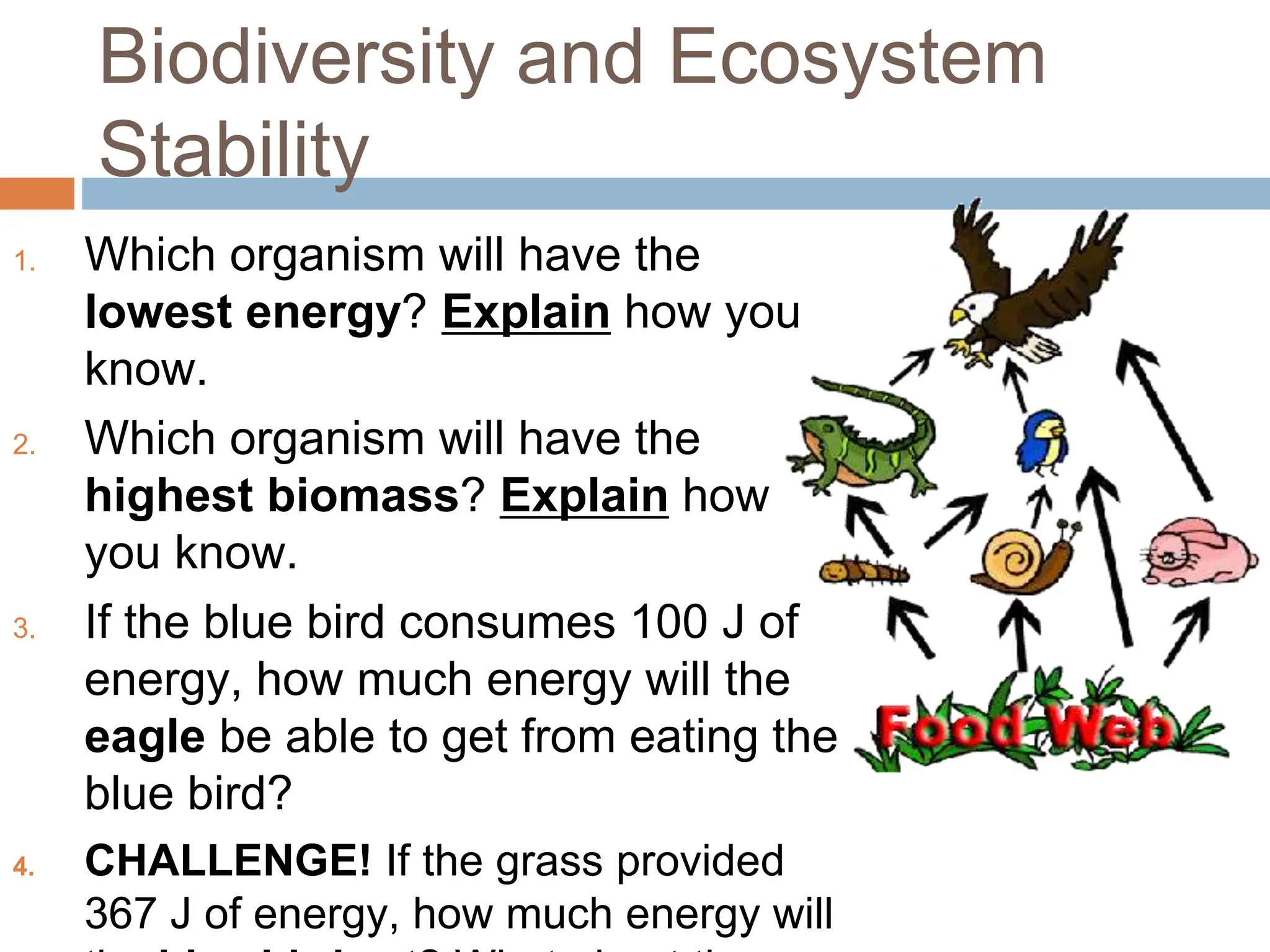
1. Which organism will have the
lowest energy? Explain how you
know.
2. Which organism will have the
highest biomass? Explain how
you know.
3. If the blue bird consumes 100 J of
energy, how much energy will the
eagle be able to get from eating the
blue bird?
4. CHALLENGE! If the grass provided
367 J of energy, how much energy will
Homework Review
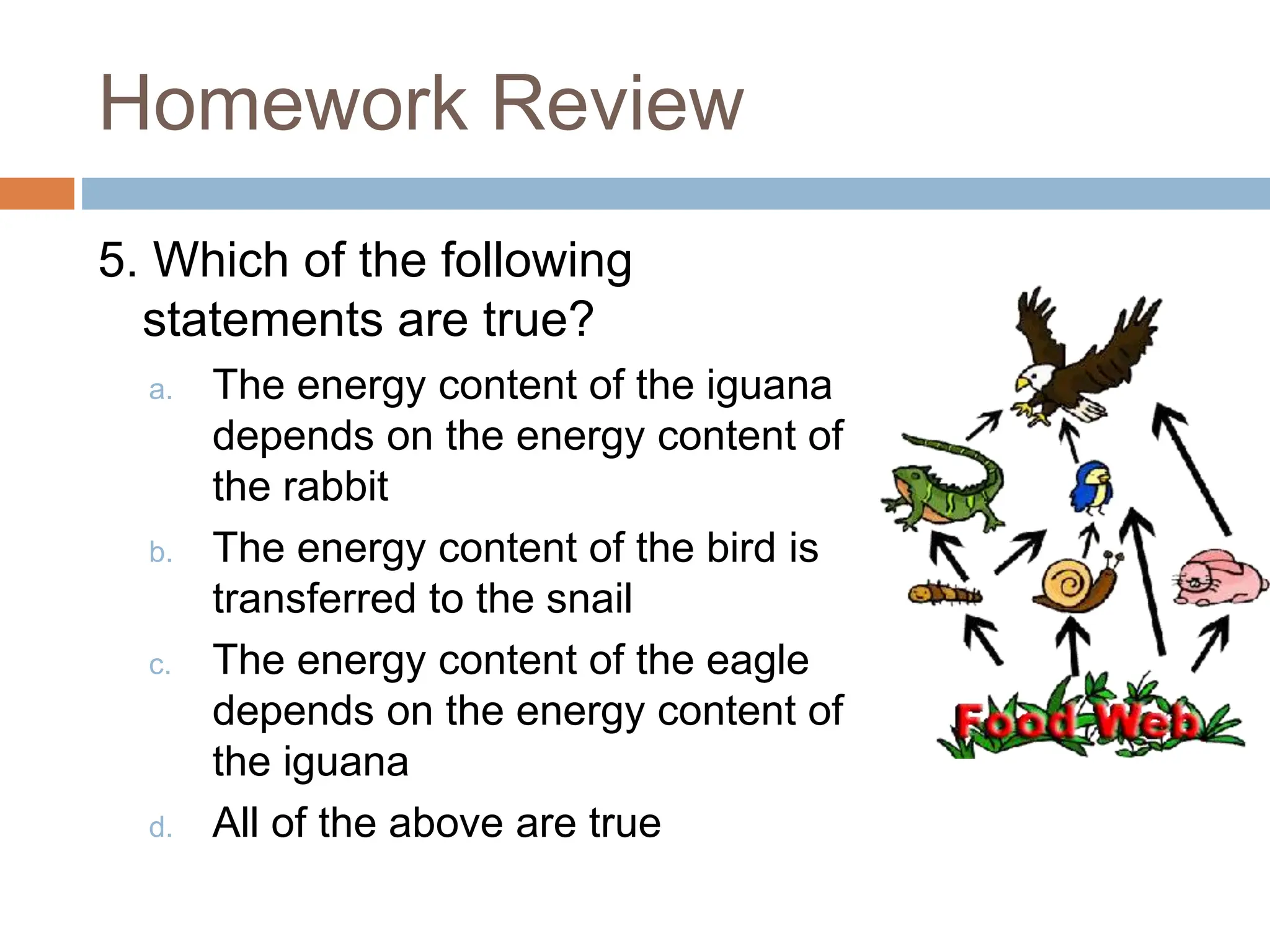
5. Which of the following
statements are true?
a. The energy content of the iguana
depends on the energy content of
the rabbit
b. The energy content of the bird is
transferred to the snail
c. The energy content of the eagle
depends on the energy content of
the iguana
d. All of the above are true
Homework Review
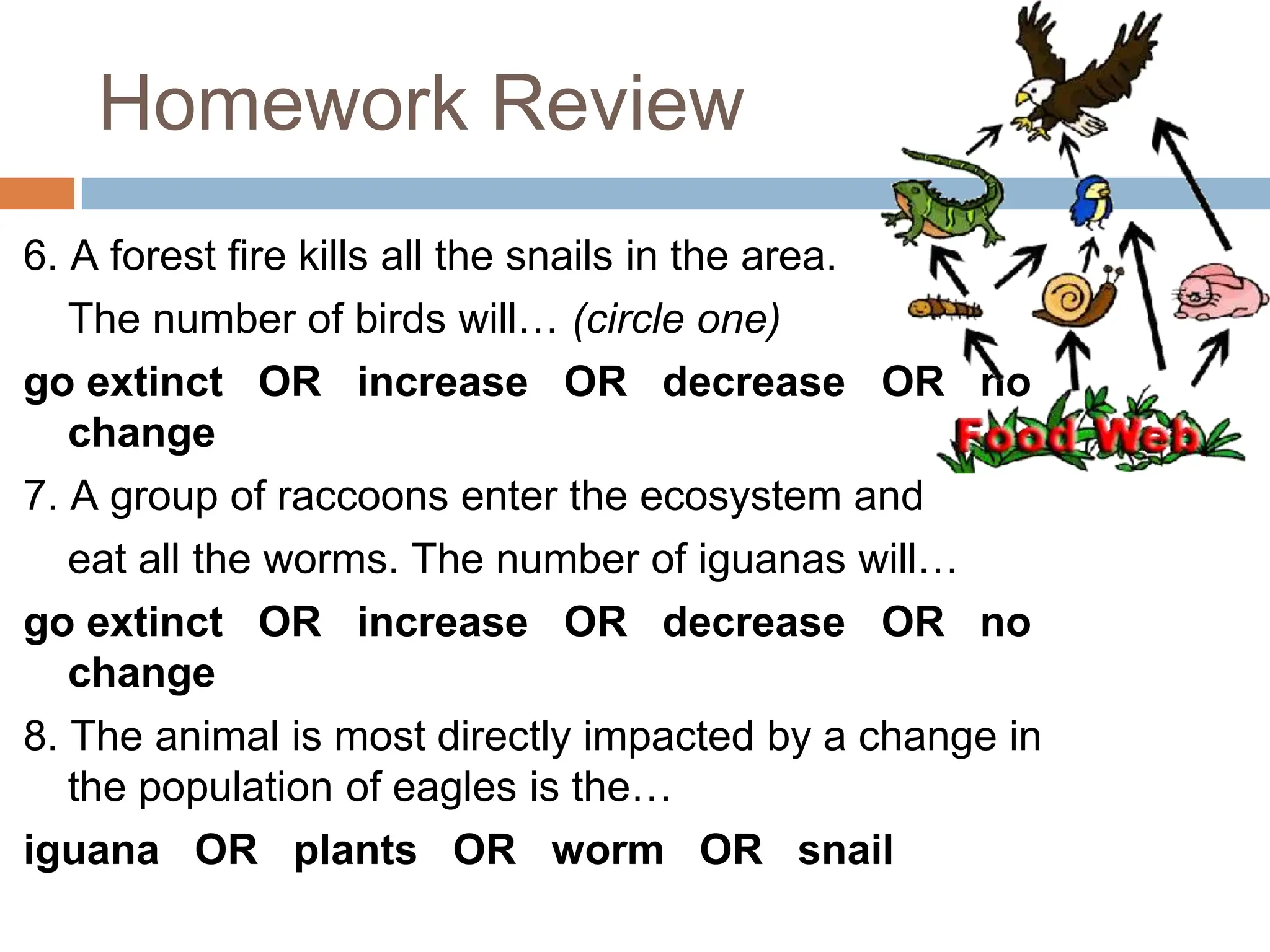
6. A forest fire kills all the snails in the area.
The number of birds will… (circle one)
go extinct OR increase OR decrease OR no
change
7. A group of raccoons enter the ecosystem and
eat all the worms. The number of iguanas will…
go extinct OR increase OR decrease OR no
change
8. The animal is most directly impacted by a change in
the population of eagles is the…
iguana OR plants OR worm OR snail
Homework Review
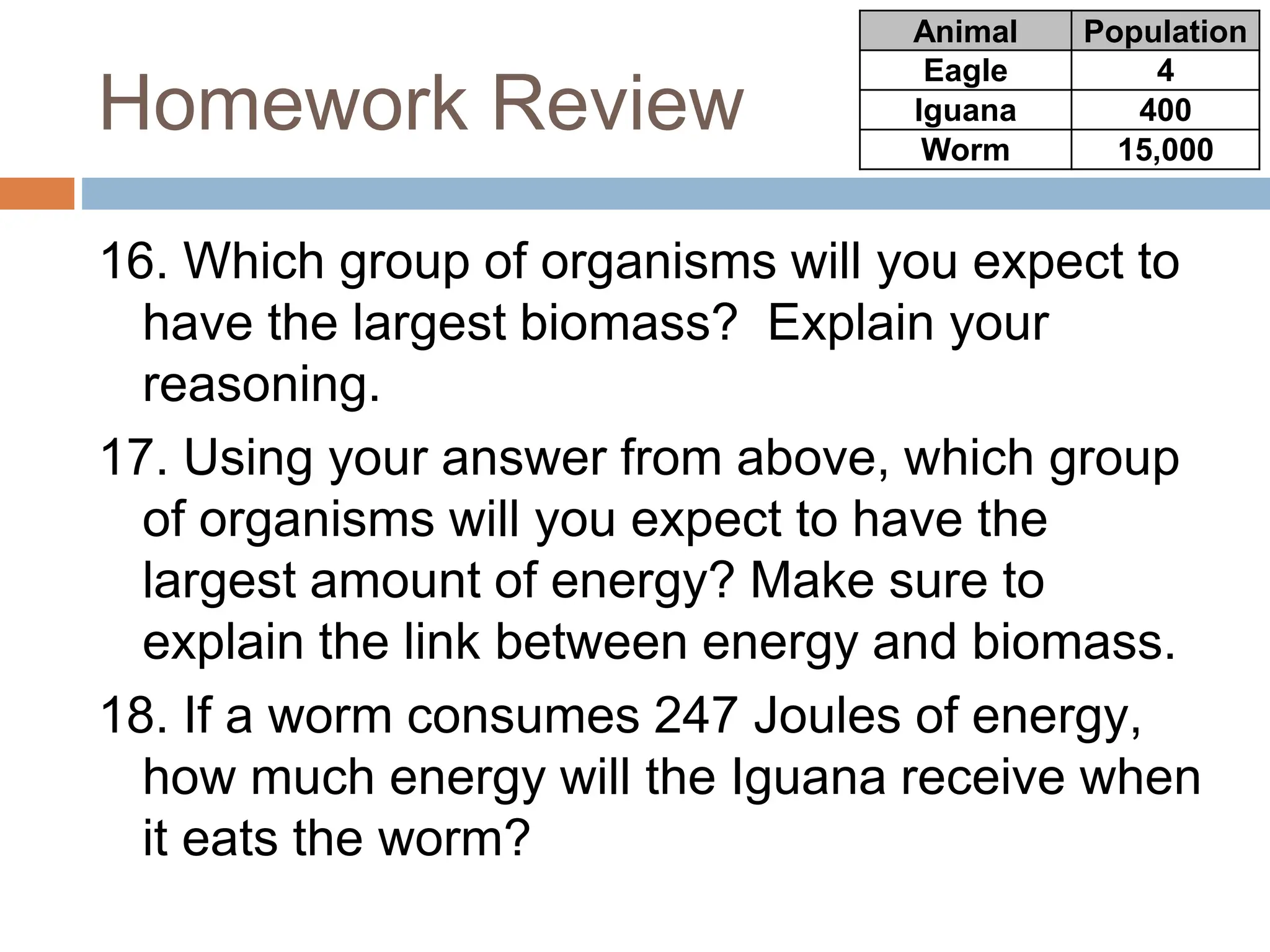
16. Which group of organisms will you expect to
have the largest biomass? Explain your
reasoning.
17. Using your answer from above, which group
of organisms will you expect to have the
largest amount of energy? Make sure to
explain the link between energy and biomass.
18. If a worm consumes 247 Joules of energy,
how much energy will the Iguana receive when
it eats the worm?
Animal Population
Eagle 4
Iguana 400
Worm 15,000
Biodiversity Definition
Biodiversity = number of
different species that live in an
ecosystem
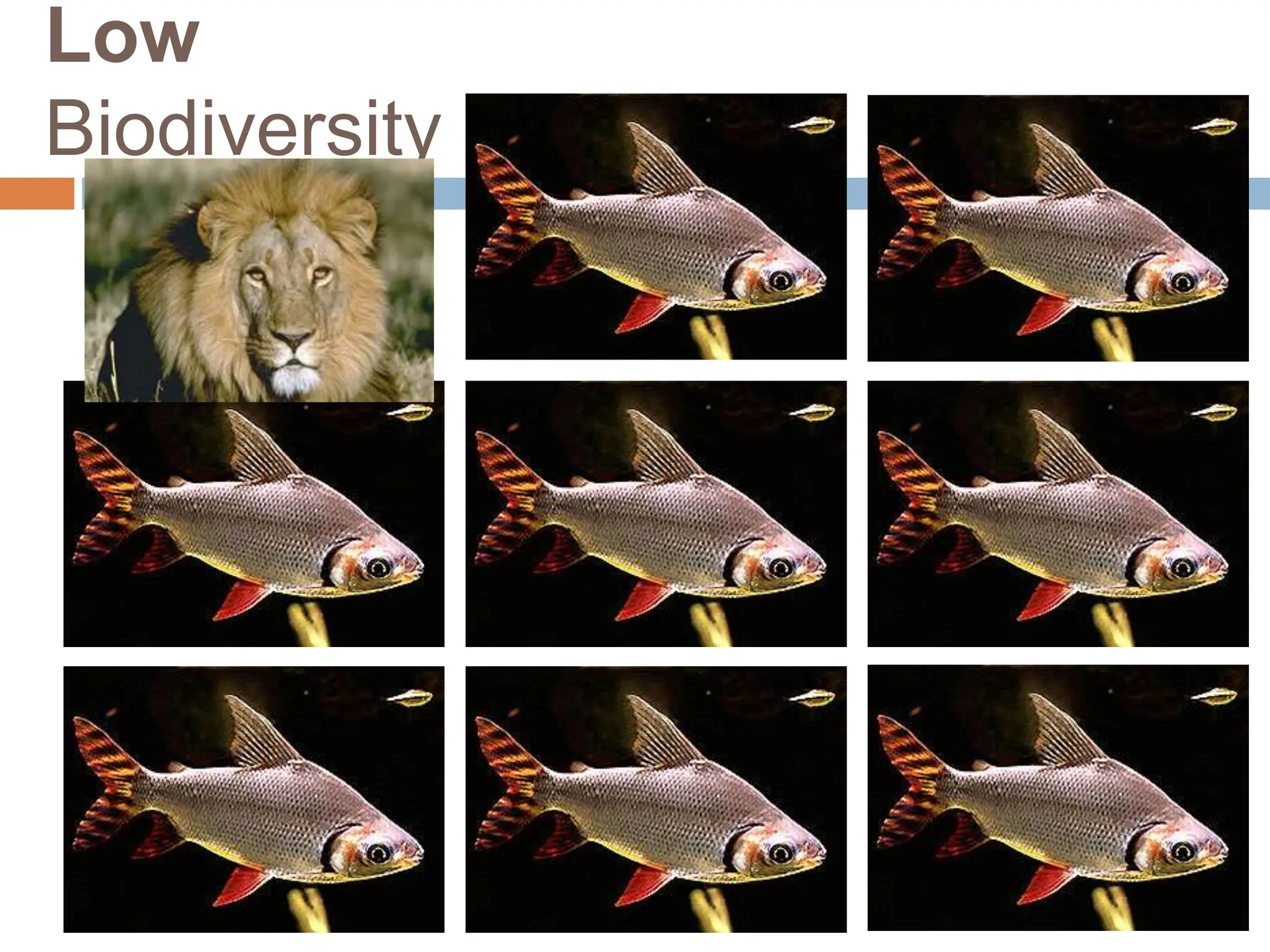
Low biodiversity: few species
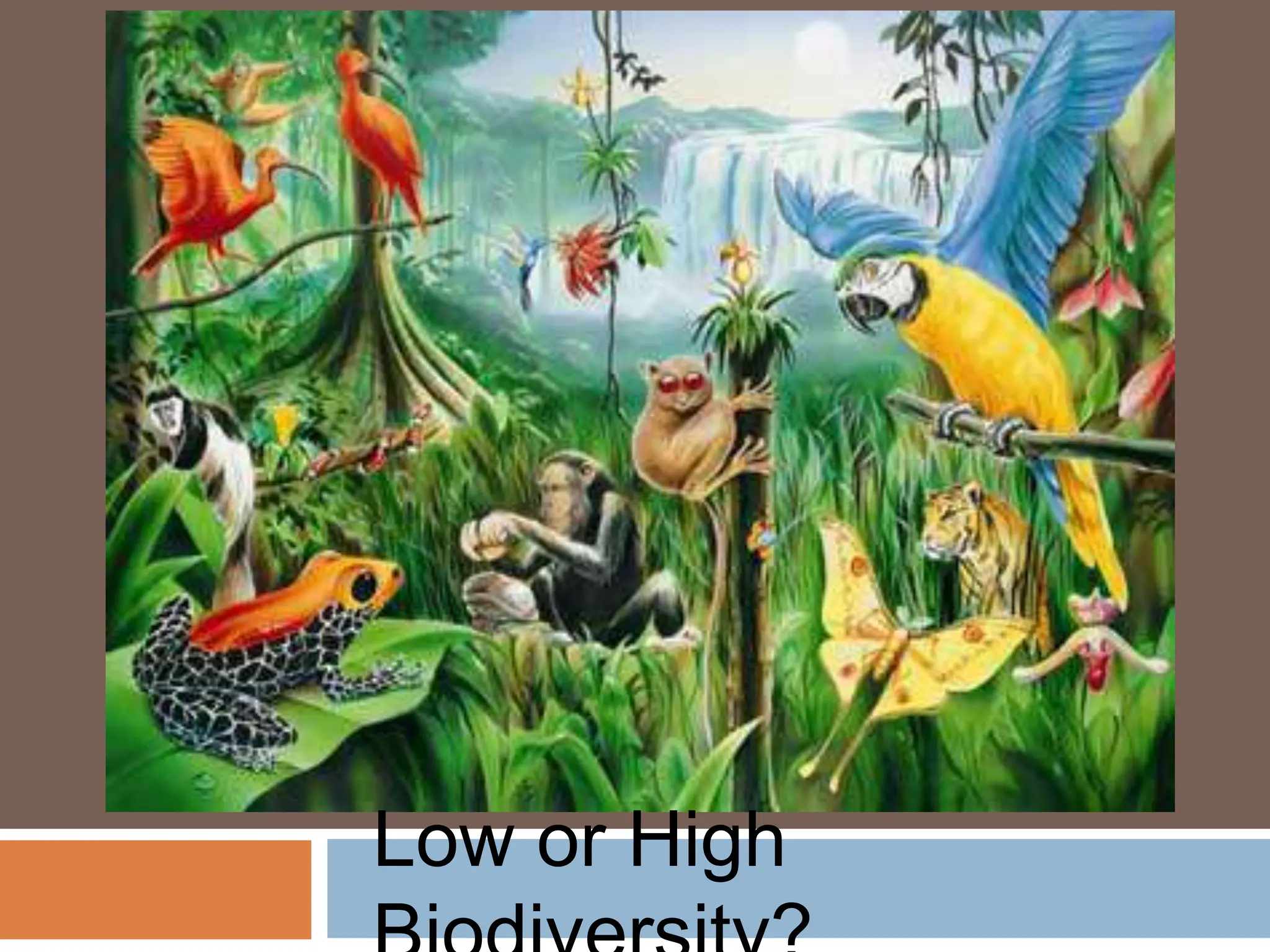
High: many species
Low
Biodiversity
High Biodiversity
Low or High
Low or High
Low or High
Low or High
Low or High
Benefits of Biodiversity
Key Point #1: There are three
main benefits to biodiversity
Many people find nature beautiful
Provides medicines
Preserves ecosystem stability
Ecosystem stability… What?
 Stable = things stay the same
 Key Point #2: High biodiversity =
stable ecosystem, low biodiversity =
unstable ecosystem
If an ecosystem is unstable, one small
change could cause many species to die
If an ecosystem is stable, it does not
change easily
Ms. S, show me another way to
write that!
 Key Point #2: High biodiversity =
stable ecosystem, low biodiversity =
unstable ecosystem
CHANGE!
Lots of species die  Unstable
Most species don’t change  Stable
This food web has low
biodiversity
Rabbits eat grass. Foxes eat rabbits
Grass
Rabbit
Foxes
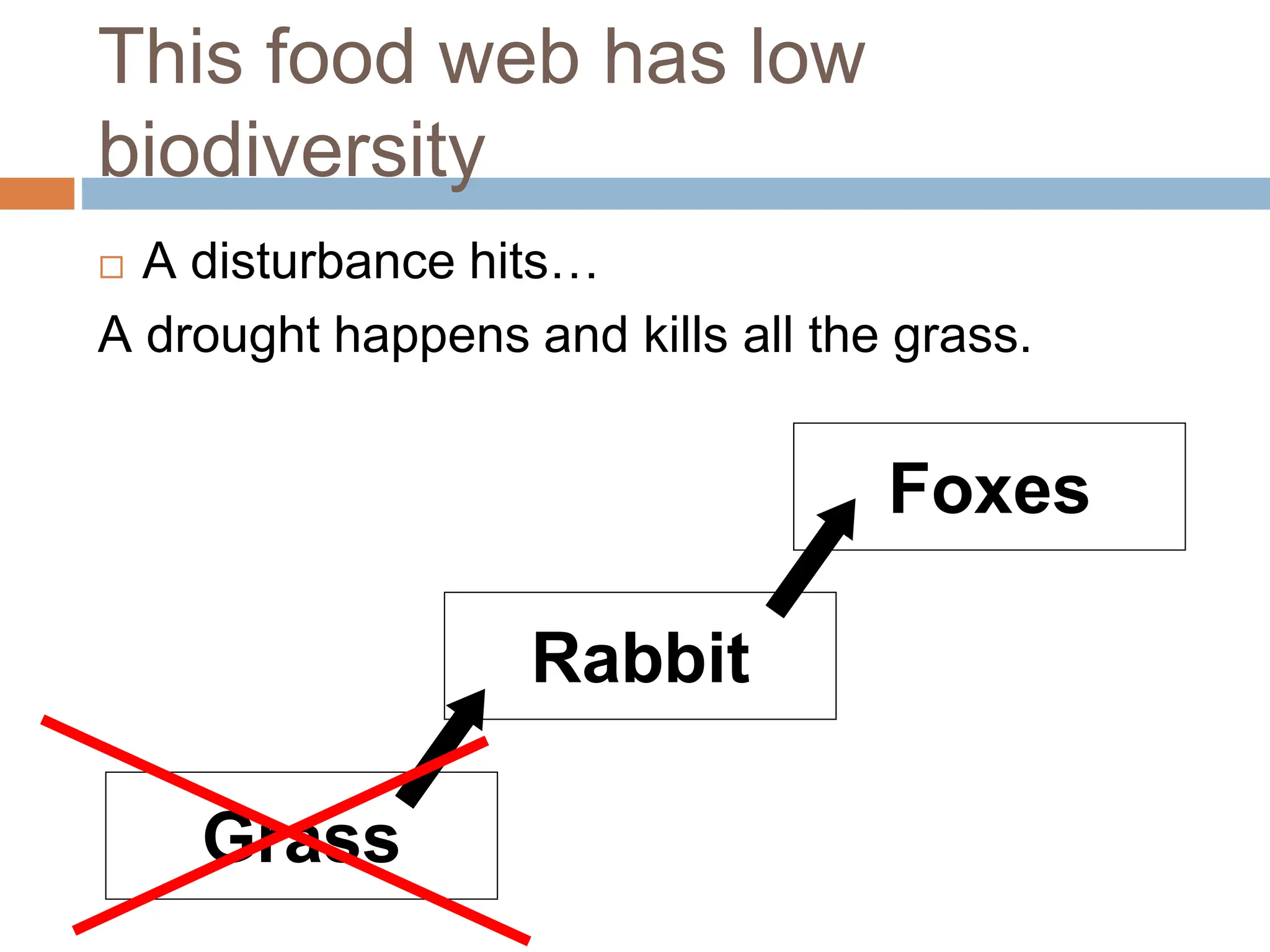
This food web has low
biodiversity
 A disturbance hits…
A drought happens and kills all the grass.
Grass
Rabbit
Foxes
This food web has low
biodiversity
 What happens to the foxes?
Grass
Rabbit
Foxes
How many species do we have left?
0!
BIG change?
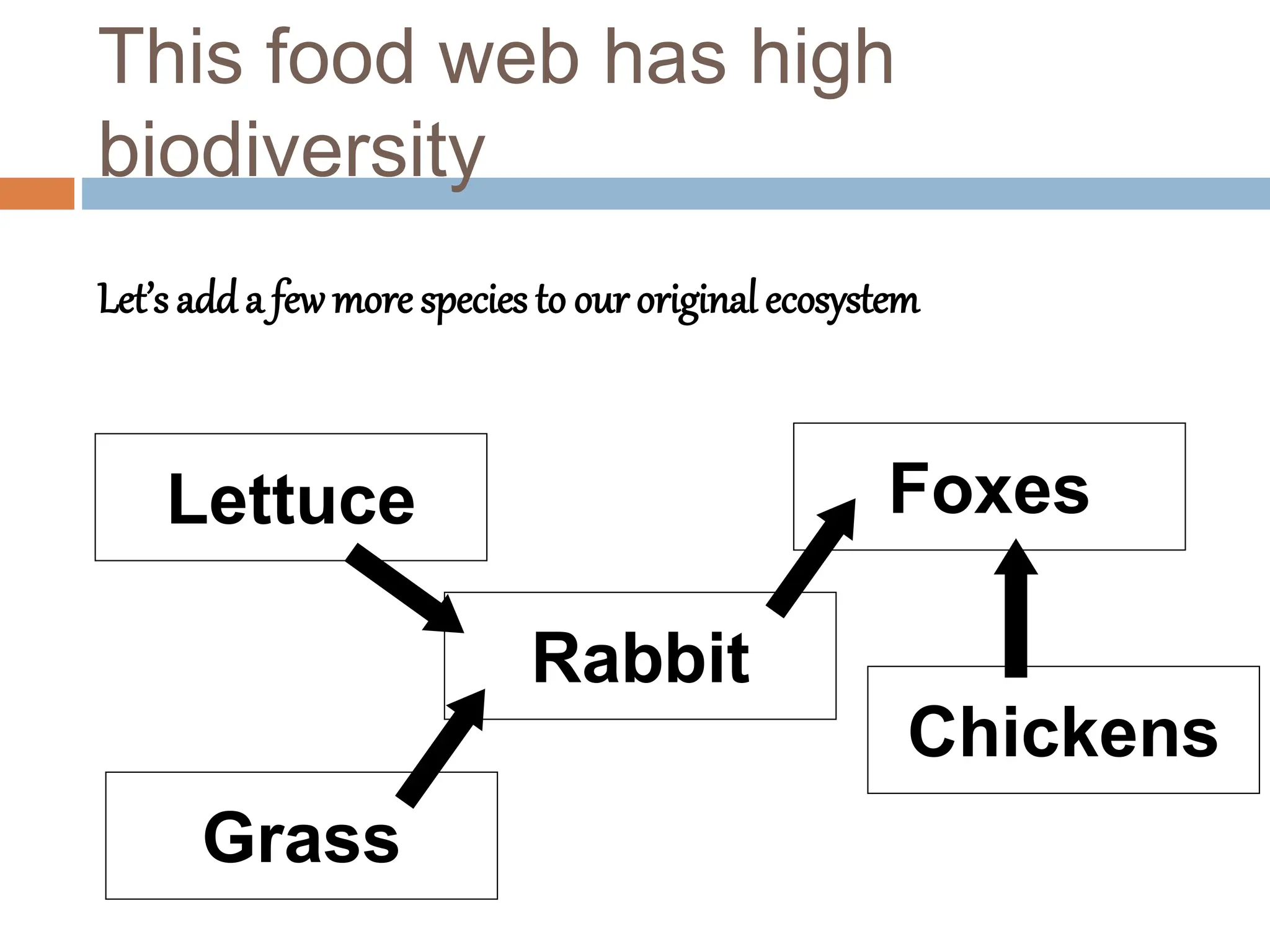
This food web has high
biodiversity
Let’s add a few more species to our original ecosystem
Grass
Rabbit
Foxes
Chickens
Lettuce
This food web has high
biodiversity
 A disturbance hits…
A drought happens and kills all the grass.
Grass
Rabbit
Foxes
Chickens
Lettuce
This food web has high
biodiversity
 What happens to the foxes?
Population size decreases… a little
BIG change?
Grass
Rabbit
Foxes
Chickens
Lettuce
 The food web started with high biodiversity
 High biodiversity = stable ecosystem
 One change… didn’t really do anything!
Comparing Multiple
Ecosystems
 Key Point #3: If we have two ecosystems,
the one that CHANGES LESS is the one
with HIGHER BIODIVERSITY
Let’s try this idea out…
Ms. S shoots all the bears in two forests. In the
first forest, everything dies as a result. In the
second forest, a couple of animals die, but things
remain mostly the same.
 Which has higher biodiversity?
 Which is more stable?
Stations (GP)
 Practice your new knowledge!
 6 stations
 7 minutes for each station
THINK about what you’re reading and what
you’re drawing. Really. Think. Seriously.
Work hard. Talk when you’re
finished, not before.
Stations Review (GP)
 Any questions?
Closing
 There are three primary benefits to biodiversity
 Beautiful, medicines, ecosystem stability
 An ecosystem is stable if it does not change
easily when disturbed
 “Change” = number of species that live there
 We can figure out which of two ecosystems
has higher biodiversity based on how stable
each one is
 More stable = higher biodiversity
 Less stable = lower biodiversity
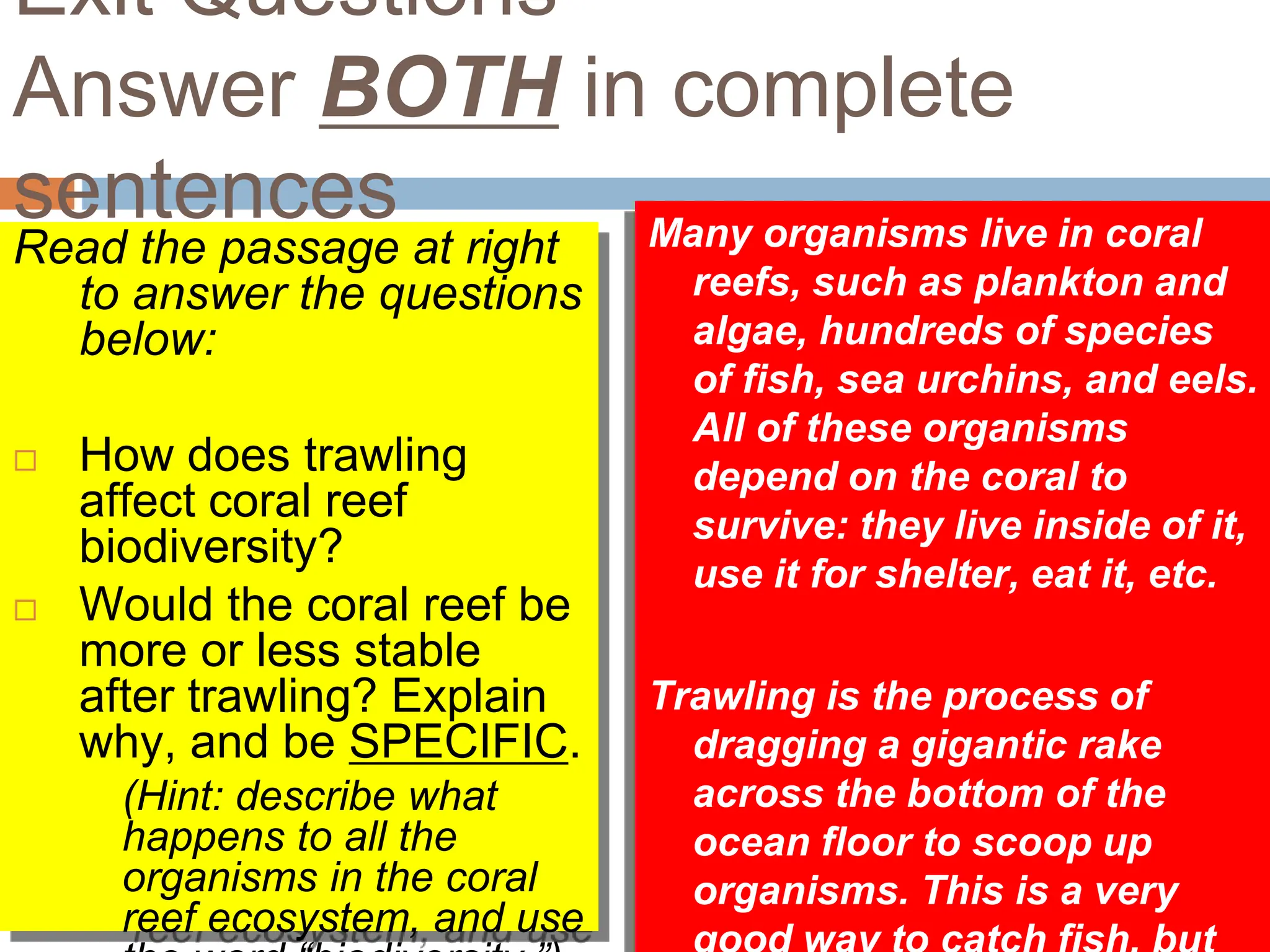
Exit Questions
Answer BOTH in complete
sentences
Read the passage at right
to answer the questions
below:
 How does trawling
affect coral reef
biodiversity?
 Would the coral reef be
more or less stable
after trawling? Explain
why, and be SPECIFIC.
(Hint: describe what
happens to all the
organisms in the coral
reef ecosystem, and use
Many organisms live in coral
reefs, such as plankton and
algae, hundreds of species
of fish, sea urchins, and eels.
All of these organisms
depend on the coral to
survive: they live inside of it,
use it for shelter, eat it, etc.
Trawling is the process of
dragging a gigantic rake
across the bottom of the
ocean floor to scoop up
organisms. This is a very

biodiversity-and-ecosystem-stability.ppt

  • 1.
    Agenda  Catalyst Review Evolution Test Class Averages  Homework Review – We got it!  What is biodiversity?  Ecosystem stability  Stations  Exit Question
  • 2.
    Biodiversity and Ecosystem Stability 1.Which organism will have the lowest energy? Explain how you know. 2. Which organism will have the highest biomass? Explain how you know. 3. If the blue bird consumes 100 J of energy, how much energy will the eagle be able to get from eating the blue bird? 4. CHALLENGE! If the grass provided 367 J of energy, how much energy will
  • 3.
    Homework Review 5. Whichof the following statements are true? a. The energy content of the iguana depends on the energy content of the rabbit b. The energy content of the bird is transferred to the snail c. The energy content of the eagle depends on the energy content of the iguana d. All of the above are true
  • 4.
    Homework Review 6. Aforest fire kills all the snails in the area. The number of birds will… (circle one) go extinct OR increase OR decrease OR no change 7. A group of raccoons enter the ecosystem and eat all the worms. The number of iguanas will… go extinct OR increase OR decrease OR no change 8. The animal is most directly impacted by a change in the population of eagles is the… iguana OR plants OR worm OR snail
  • 5.
    Homework Review 16. Whichgroup of organisms will you expect to have the largest biomass? Explain your reasoning. 17. Using your answer from above, which group of organisms will you expect to have the largest amount of energy? Make sure to explain the link between energy and biomass. 18. If a worm consumes 247 Joules of energy, how much energy will the Iguana receive when it eats the worm? Animal Population Eagle 4 Iguana 400 Worm 15,000
  • 6.
    Biodiversity Definition Biodiversity =number of different species that live in an ecosystem Low biodiversity: few species High: many species
  • 7.
  • 8.
  • 9.
  • 10.
  • 11.
  • 12.
  • 13.
  • 14.
    Benefits of Biodiversity KeyPoint #1: There are three main benefits to biodiversity Many people find nature beautiful Provides medicines Preserves ecosystem stability
  • 15.
    Ecosystem stability… What? Stable = things stay the same  Key Point #2: High biodiversity = stable ecosystem, low biodiversity = unstable ecosystem If an ecosystem is unstable, one small change could cause many species to die If an ecosystem is stable, it does not change easily
  • 16.
    Ms. S, showme another way to write that!  Key Point #2: High biodiversity = stable ecosystem, low biodiversity = unstable ecosystem CHANGE! Lots of species die  Unstable Most species don’t change  Stable
  • 17.
    This food webhas low biodiversity Rabbits eat grass. Foxes eat rabbits Grass Rabbit Foxes
  • 18.
    This food webhas low biodiversity  A disturbance hits… A drought happens and kills all the grass. Grass Rabbit Foxes
  • 19.
    This food webhas low biodiversity  What happens to the foxes? Grass Rabbit Foxes How many species do we have left? 0! BIG change?
  • 20.
    This food webhas high biodiversity Let’s add a few more species to our original ecosystem Grass Rabbit Foxes Chickens Lettuce
  • 21.
    This food webhas high biodiversity  A disturbance hits… A drought happens and kills all the grass. Grass Rabbit Foxes Chickens Lettuce
  • 22.
    This food webhas high biodiversity  What happens to the foxes? Population size decreases… a little BIG change? Grass Rabbit Foxes Chickens Lettuce  The food web started with high biodiversity  High biodiversity = stable ecosystem  One change… didn’t really do anything!
  • 23.
    Comparing Multiple Ecosystems  KeyPoint #3: If we have two ecosystems, the one that CHANGES LESS is the one with HIGHER BIODIVERSITY Let’s try this idea out… Ms. S shoots all the bears in two forests. In the first forest, everything dies as a result. In the second forest, a couple of animals die, but things remain mostly the same.  Which has higher biodiversity?  Which is more stable?
  • 24.
    Stations (GP)  Practiceyour new knowledge!  6 stations  7 minutes for each station THINK about what you’re reading and what you’re drawing. Really. Think. Seriously. Work hard. Talk when you’re finished, not before.
  • 25.
  • 26.
    Closing  There arethree primary benefits to biodiversity  Beautiful, medicines, ecosystem stability  An ecosystem is stable if it does not change easily when disturbed  “Change” = number of species that live there  We can figure out which of two ecosystems has higher biodiversity based on how stable each one is  More stable = higher biodiversity  Less stable = lower biodiversity
  • 27.
    Exit Questions Answer BOTHin complete sentences Read the passage at right to answer the questions below:  How does trawling affect coral reef biodiversity?  Would the coral reef be more or less stable after trawling? Explain why, and be SPECIFIC. (Hint: describe what happens to all the organisms in the coral reef ecosystem, and use Many organisms live in coral reefs, such as plankton and algae, hundreds of species of fish, sea urchins, and eels. All of these organisms depend on the coral to survive: they live inside of it, use it for shelter, eat it, etc. Trawling is the process of dragging a gigantic rake across the bottom of the ocean floor to scoop up organisms. This is a very