Global Custodian | Hedge Funds 2016globalcustodian.com30
GC IN-DEPTH | WOMEN IN HEDGE FUND OPERATIONS
Women in hedge fund operations are calling for more flexibility, a change in culture
and support in the form of technology and outsourcing to improve both gender
equality and their work/life balances, writes Jonathan Watkins.
Looking for
a brighter future
Contributions from Chitra Baskar, Shanti Vargas and David Ross of Viteos Fund Services
31globalcustodian.comGlobal Custodian | Hedge Funds 2016
GC IN-DEPTH | WOMEN IN HEDGE FUND OPERATIONS
W
omen in operations are
facing their own unique
challenges in the hedge fund
industry. While the alarmingly low
percentages of women occupying chief
executive roles are well publicised,
Global Custodian – in partnership with
Viteos Fund Services – launched a
survey to focus solely on the operations
side of hedge funds, an area rarely
under the spotlight.
We reached out to our readers to
gain an insight into the reasons for the
significant gender imbalance, highlight
where improvements can be made to
level this disproportion and discover
what life is like as a woman in a senior
hedge fund operations job.
A snapshot from the respondents
in our Hedge Fund Administration
survey from 2015 showed that only
18.9% of those operations executives
based in the US were women. Perhaps
unsurprisingly, 85% of those who then
answered our latest survey said that they
saw women as either ‘significantly’ or
‘somewhat’ under-represented in senior
operations roles.
After establishing that the majority
of our survey sample believed women
were underrepresented in the industry,
we dug deep into the reasons behind
the lack of women holding down
these roles.
We had a wide range of senior
operations job titles respond to the
survey, including chief operating
officers, chief financial officers, heads
of operations, operations directors and
others. Along with quantifiable data
responses, we included two questions
inviting written comment.
The first was in relation to the greatest
impediment to the involvement of more
women in operations roles in hedge
funds. The main barriers to greater
female participation were perceived
as being male attitudes, hedge fund
culture, education, career progression
opportunities and flexibility around
working hours and family.
‘Male attitudes’ – or answers along those lines – were cited
in 52% of responses. Comments included “it’s a man’s world”,
“the exclusion of women from the male only club” and “male
senior management still do not have full support for women to
be in senior roles in the business world”.
Male support and family orientation
One interesting comment put the role of males in another light,
suggesting that it should be made more acceptable for men to
be family orientated. The respondent highlighted that society
traditionally expects men to be career focused and doesn’t
offer the support which would allow more women to play a
senior operational role in the workplace.
Many of the references to culture pointed not only to male
attitudes, but to women’s as well. One survey participant stated
that women feel like they have to go the extra mile, while
another believed not enough women understood the operations
role, or wanted to work for a hedge fund. Another – which
encompassed both culture and women’s mindsets – said that
most women feel better suited to roles such as marketing,
feeling that it is a more traditionally “female role/career path”.
The second question inviting qualitative comment asked
participants to suggest one innovation in the workplace that
would improve their work/life balance. Greater flexibility was
by far the most prominent answer. Suggestions in this regard
included introducing a culture of working remotely, flexible
working hours, daycare at work and a four-day week. Key
to the question of flexibility, a number of respondents cited
the need to address negative perceptions in the workplace
attached to employees who take advantage of such facilities
when they are available.
Outsourcing
Many also listed the ability to outsource and automate
processes as crucial in achieving an appropriate work/life
balance. Asked what tools and support could be used to
minimise disruption in work/life balance, more than half
of respondents said implementing the newest operations
technology would help either “a great deal” or “a lot”, while
only 9% said it would not help at all. Similarly, around 48%
said that the use of outsourcing would contribute to a better
work/life balance.
Highlighting the tremendous pressure on senior operations
personnel alongside balancing family and hobbies outside
of work, one respondent noted that work/life balance could
benefit from a change in personal expectations: “Understanding
that you cannot be perfect or even good in all spheres of life
and that you are NOT obliged to be such a person.”
We also asked which aspects of operations are likely to
have the biggest negative impact on work/life balance when
problems arise. We provided eight options – reconciliation,
32 Global Custodian | Hedge Funds 2016globalcustodian.com
men and women alike. For female parents though, one CFO
pointed out to Global Custodian last year that “as a woman,
there is a lot of pressure society places on you as a parent”.
Because of this, we included a question around what parts of
respondents’ lives suffered most from the demands of their job.
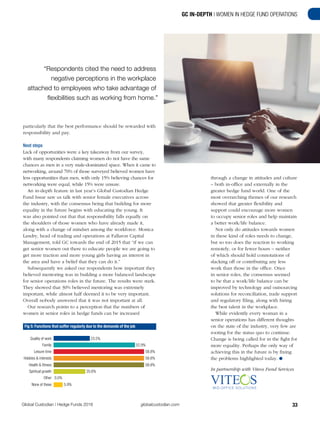
When it came to family, almost 53% said this was something
that was impacted by their work commitments (see Figure 5).
Health and fitness, leisure time, along with hobbies and other
interests appear to suffer even more with 59% selecting each as
being victims of a busy work life.
The solutions to these sacrifices were prompted in a
further question. Some 44% identified hiring the best talent as
helping “a great deal”, while almost a quarter pointed to the
implementation of the newest operations technology. Roughly
a fifth suggested a stay-at-home partner was a great help.
Fewer cited child support from their firm as a key factor.
One detailed response cited a major culture problem of
being stuck in a “late 90s definition of hard work” with face
time being associated with working hard. This particular
survey participant made a number of concrete suggestions:
first, the industry shouldn’t measure people on hours, but
rather the work they accomplish. Secondly, funds should
realise that women do care about accomplishing great work.
The other suggestions were surrounding remuneration;
GC IN-DEPTH | WOMEN IN HEDGE FUND OPERATIONS
accounting, reporting, regulatory
filing, trade support, technology,
risk management and other – asking
respondents to rank them in order. While
results varied, 70% had reconciliation in
their top four, while regulatory filing and
reporting also ranked highly on most
people’s lists. Risk management and
trade support were lower down on most
lists. Trade support and regulatory filing
were the most often cited in first place
(see Figure 4).
Pressure-cooker environment
Senior hedge fund operation jobs are
demanding and high-pressured for
“The main barriers to greater female participation
were perceived as being male attitudes, hedge
fund culture, education, career progression
opportunities and flexibility around working
hours and family.”
Significantly under-represented – 47.1%
Somewhat under-represented – 38.2%
Fairly represented – 14.7%
Not sure – 0.0%
Definitely yes – 14.7%
Probably yes – 55.9%
Not sure – 14.7%
Probably not – 11.8%
Definitely not – 2.9%
Extremely important – 29.4%
Very important – 47.1%
Moderately important – 14.71%
Slightly important – 8.8%
Not at all important – 0.0%
Reconcilliation – 10.0%
Accounting – 13.3%
Reporting – 6.7%
Regulatory filing – 20.0%
Trade support – 20.0%
Technology – 13.3%
Risk management – 16.7%
Other – 0.0%
Fig 1: Women in senior roles are Fig 3: Networking disadvantage?Fig 2: Importance of mentoring Fig 4: Work/life balance disrupters
Note: Some stats were rounded up for
reporting purposes
33globalcustodian.comGlobal Custodian | Hedge Funds 2016
through a change in attitudes and culture
– both in-office and externally in the
greater hedge fund world. One of the
most overarching themes of our research
showed that greater flexibility and
support could encourage more women
to occupy senior roles and help maintain
a better work/life balance.
Not only do attitudes towards women
in these kind of roles needs to change,
but so too does the reaction to working
remotely, or for fewer hours – neither
of which should hold connotations of
slacking off or contributing any less
work than those in the office. Once
in senior roles, the consensus seemed
to be that a work/life balance can be
improved by technology and outsourcing
solutions for reconciliation, trade support
and regulatory filing, along with hiring
the best talent in the workplace.
While evidently every woman in a
senior operations has different thoughts
on the state of the industry, very few are
rooting for the status quo to continue.
Change is being called for in the fight for
more equality. Perhaps the only way of
achieving this in the future is by fixing
the problems highlighted today. l
In partnership with Viteos Fund Services
MID-OFFICE SOLUTIONS
GC IN-DEPTH | WOMEN IN HEDGE FUND OPERATIONS
particularly that the best performance should be rewarded with
responsibility and pay.
Next steps
Lack of opportunities were a key takeaway from our survey,
with many respondents claiming women do not have the same
chances as men in a very male-dominated space. When it came to
networking, around 70% of those surveyed believed women have
less opportunities than men, with only 15% believing chances for
networking were equal, while 15% were unsure.
An in-depth feature in last year’s Global Custodian Hedge
Fund Issue saw us talk with senior female executives across
the industry, with the consensus being that building for more
equality in the future begins with educating the young. It
was also pointed out that that responsibility falls equally on
the shoulders of those women who have already made it,
along with a change of mindset among the workforce. Monica
Landry, head of trading and operations at Fallaron Capital
Management, told GC towards the end of 2015 that “if we can
get senior women out there to educate people we are going to
get more traction and more young girls having an interest in
the area and have a belief that they can do it.”
Subsequently we asked our respondents how important they
believed mentoring was in building a more balanced landscape
for senior operations roles in the future. The results were stark.
They showed that 30% believed mentoring was extremely
important, while almost half deemed it to be very important.
Overall nobody answered that it was not important at all.
Our research points to a perception that the numbers of
women in senior roles in hedge funds can be increased
“Respondents cited the need to address
negative perceptions in the workplace
attached to employees who take advantage of
flexibilities such as working from home.”
Quality of work 23.5%
Family 52.9%
Leisure time 58.8%
Hobbies & interests 58.8%
Health & fitness 58.8%
Spiritual growth 20.6%
Other 0.0%
None of these 5.9%
Fig 5: Functions that suffer regularly due to the demands of the job

GC Looking to a brighter future

  • 1.
    Global Custodian |Hedge Funds 2016globalcustodian.com30 GC IN-DEPTH | WOMEN IN HEDGE FUND OPERATIONS Women in hedge fund operations are calling for more flexibility, a change in culture and support in the form of technology and outsourcing to improve both gender equality and their work/life balances, writes Jonathan Watkins. Looking for a brighter future Contributions from Chitra Baskar, Shanti Vargas and David Ross of Viteos Fund Services
  • 2.
    31globalcustodian.comGlobal Custodian |Hedge Funds 2016 GC IN-DEPTH | WOMEN IN HEDGE FUND OPERATIONS W omen in operations are facing their own unique challenges in the hedge fund industry. While the alarmingly low percentages of women occupying chief executive roles are well publicised, Global Custodian – in partnership with Viteos Fund Services – launched a survey to focus solely on the operations side of hedge funds, an area rarely under the spotlight. We reached out to our readers to gain an insight into the reasons for the significant gender imbalance, highlight where improvements can be made to level this disproportion and discover what life is like as a woman in a senior hedge fund operations job. A snapshot from the respondents in our Hedge Fund Administration survey from 2015 showed that only 18.9% of those operations executives based in the US were women. Perhaps unsurprisingly, 85% of those who then answered our latest survey said that they saw women as either ‘significantly’ or ‘somewhat’ under-represented in senior operations roles. After establishing that the majority of our survey sample believed women were underrepresented in the industry, we dug deep into the reasons behind the lack of women holding down these roles. We had a wide range of senior operations job titles respond to the survey, including chief operating officers, chief financial officers, heads of operations, operations directors and others. Along with quantifiable data responses, we included two questions inviting written comment. The first was in relation to the greatest impediment to the involvement of more women in operations roles in hedge funds. The main barriers to greater female participation were perceived as being male attitudes, hedge fund culture, education, career progression opportunities and flexibility around working hours and family. ‘Male attitudes’ – or answers along those lines – were cited in 52% of responses. Comments included “it’s a man’s world”, “the exclusion of women from the male only club” and “male senior management still do not have full support for women to be in senior roles in the business world”. Male support and family orientation One interesting comment put the role of males in another light, suggesting that it should be made more acceptable for men to be family orientated. The respondent highlighted that society traditionally expects men to be career focused and doesn’t offer the support which would allow more women to play a senior operational role in the workplace. Many of the references to culture pointed not only to male attitudes, but to women’s as well. One survey participant stated that women feel like they have to go the extra mile, while another believed not enough women understood the operations role, or wanted to work for a hedge fund. Another – which encompassed both culture and women’s mindsets – said that most women feel better suited to roles such as marketing, feeling that it is a more traditionally “female role/career path”. The second question inviting qualitative comment asked participants to suggest one innovation in the workplace that would improve their work/life balance. Greater flexibility was by far the most prominent answer. Suggestions in this regard included introducing a culture of working remotely, flexible working hours, daycare at work and a four-day week. Key to the question of flexibility, a number of respondents cited the need to address negative perceptions in the workplace attached to employees who take advantage of such facilities when they are available. Outsourcing Many also listed the ability to outsource and automate processes as crucial in achieving an appropriate work/life balance. Asked what tools and support could be used to minimise disruption in work/life balance, more than half of respondents said implementing the newest operations technology would help either “a great deal” or “a lot”, while only 9% said it would not help at all. Similarly, around 48% said that the use of outsourcing would contribute to a better work/life balance. Highlighting the tremendous pressure on senior operations personnel alongside balancing family and hobbies outside of work, one respondent noted that work/life balance could benefit from a change in personal expectations: “Understanding that you cannot be perfect or even good in all spheres of life and that you are NOT obliged to be such a person.” We also asked which aspects of operations are likely to have the biggest negative impact on work/life balance when problems arise. We provided eight options – reconciliation,
  • 3.
    32 Global Custodian| Hedge Funds 2016globalcustodian.com men and women alike. For female parents though, one CFO pointed out to Global Custodian last year that “as a woman, there is a lot of pressure society places on you as a parent”. Because of this, we included a question around what parts of respondents’ lives suffered most from the demands of their job. When it came to family, almost 53% said this was something that was impacted by their work commitments (see Figure 5). Health and fitness, leisure time, along with hobbies and other interests appear to suffer even more with 59% selecting each as being victims of a busy work life. The solutions to these sacrifices were prompted in a further question. Some 44% identified hiring the best talent as helping “a great deal”, while almost a quarter pointed to the implementation of the newest operations technology. Roughly a fifth suggested a stay-at-home partner was a great help. Fewer cited child support from their firm as a key factor. One detailed response cited a major culture problem of being stuck in a “late 90s definition of hard work” with face time being associated with working hard. This particular survey participant made a number of concrete suggestions: first, the industry shouldn’t measure people on hours, but rather the work they accomplish. Secondly, funds should realise that women do care about accomplishing great work. The other suggestions were surrounding remuneration; GC IN-DEPTH | WOMEN IN HEDGE FUND OPERATIONS accounting, reporting, regulatory filing, trade support, technology, risk management and other – asking respondents to rank them in order. While results varied, 70% had reconciliation in their top four, while regulatory filing and reporting also ranked highly on most people’s lists. Risk management and trade support were lower down on most lists. Trade support and regulatory filing were the most often cited in first place (see Figure 4). Pressure-cooker environment Senior hedge fund operation jobs are demanding and high-pressured for “The main barriers to greater female participation were perceived as being male attitudes, hedge fund culture, education, career progression opportunities and flexibility around working hours and family.” Significantly under-represented – 47.1% Somewhat under-represented – 38.2% Fairly represented – 14.7% Not sure – 0.0% Definitely yes – 14.7% Probably yes – 55.9% Not sure – 14.7% Probably not – 11.8% Definitely not – 2.9% Extremely important – 29.4% Very important – 47.1% Moderately important – 14.71% Slightly important – 8.8% Not at all important – 0.0% Reconcilliation – 10.0% Accounting – 13.3% Reporting – 6.7% Regulatory filing – 20.0% Trade support – 20.0% Technology – 13.3% Risk management – 16.7% Other – 0.0% Fig 1: Women in senior roles are Fig 3: Networking disadvantage?Fig 2: Importance of mentoring Fig 4: Work/life balance disrupters Note: Some stats were rounded up for reporting purposes
  • 4.
    33globalcustodian.comGlobal Custodian |Hedge Funds 2016 through a change in attitudes and culture – both in-office and externally in the greater hedge fund world. One of the most overarching themes of our research showed that greater flexibility and support could encourage more women to occupy senior roles and help maintain a better work/life balance. Not only do attitudes towards women in these kind of roles needs to change, but so too does the reaction to working remotely, or for fewer hours – neither of which should hold connotations of slacking off or contributing any less work than those in the office. Once in senior roles, the consensus seemed to be that a work/life balance can be improved by technology and outsourcing solutions for reconciliation, trade support and regulatory filing, along with hiring the best talent in the workplace. While evidently every woman in a senior operations has different thoughts on the state of the industry, very few are rooting for the status quo to continue. Change is being called for in the fight for more equality. Perhaps the only way of achieving this in the future is by fixing the problems highlighted today. l In partnership with Viteos Fund Services MID-OFFICE SOLUTIONS GC IN-DEPTH | WOMEN IN HEDGE FUND OPERATIONS particularly that the best performance should be rewarded with responsibility and pay. Next steps Lack of opportunities were a key takeaway from our survey, with many respondents claiming women do not have the same chances as men in a very male-dominated space. When it came to networking, around 70% of those surveyed believed women have less opportunities than men, with only 15% believing chances for networking were equal, while 15% were unsure. An in-depth feature in last year’s Global Custodian Hedge Fund Issue saw us talk with senior female executives across the industry, with the consensus being that building for more equality in the future begins with educating the young. It was also pointed out that that responsibility falls equally on the shoulders of those women who have already made it, along with a change of mindset among the workforce. Monica Landry, head of trading and operations at Fallaron Capital Management, told GC towards the end of 2015 that “if we can get senior women out there to educate people we are going to get more traction and more young girls having an interest in the area and have a belief that they can do it.” Subsequently we asked our respondents how important they believed mentoring was in building a more balanced landscape for senior operations roles in the future. The results were stark. They showed that 30% believed mentoring was extremely important, while almost half deemed it to be very important. Overall nobody answered that it was not important at all. Our research points to a perception that the numbers of women in senior roles in hedge funds can be increased “Respondents cited the need to address negative perceptions in the workplace attached to employees who take advantage of flexibilities such as working from home.” Quality of work 23.5% Family 52.9% Leisure time 58.8% Hobbies & interests 58.8% Health & fitness 58.8% Spiritual growth 20.6% Other 0.0% None of these 5.9% Fig 5: Functions that suffer regularly due to the demands of the job