Enhancing emergency care in low-income countries
using mobile technology-based training tools
Hilary Edgcombe,1
Chris Paton,2
Mike English2,3
1
Nuffield Department of
Anaesthetics, Oxford University
Hospitals NHS Trust, Oxford,
UK
2
Nuffield Department of
Medicine, Centre for Tropical
Medicine and Global Health,
University of Oxford, Oxford,
UK
3
KEMRI-Wellcome Trust
Research Programme, Nairobi,
Kenya
Correspondence to
Dr Hilary Edgcombe, Nuffield
Department of Anaesthetics,
Oxford University Hospitals
NHS Trust, Oxford, UK;
hilary.edgcombe@nda.ox.ac.uk
Received 7 July 2016
Revised 10 August 2016
Accepted 16 August 2016
Published Online First
22 September 2016
To cite: Edgcombe H,
Paton C, English M. Arch
Dis Child 2016;101:1149–
1152.
ABSTRACT
In this paper, we discuss the role of mobile technology
in developing training tools for health workers, with
particular reference to low-income countries (LICs). The
global and technological context is outlined, followed by
a summary of approaches to using and evaluating
mobile technology for learning in healthcare. Finally,
recommendations are made for those developing and
using such tools, based on current literature and the
authors’ involvement in the field.
THE CONTEXT
The global need for more and better-trained health
workers, particularly in low-resourced regions, is
well established.1
Effective training enhances the
knowledge and skills of those already working and
supports and motivates those who consider joining
the healthcare workforce.2
However, delivery of
timely, effective and up-to-date teaching is challen-
ging in many low-income countries (LICs), for
reasons which may be financial, geographical, polit-
ical and/or institutional.2
Global child health is no
exception to this rule.3 4
The demand for better, more accessible training
is thus considerable and over recent decades many
solutions have been proposed and implemented,
some originating within local/national institutions,
others involving external (often high-income
country (HIC)) partnerships and initiatives (eg, the
Rwanda Human Resources for Health Program.5
)
The scope and nature of these solutions vary
widely from long-term international partnerships
to training delivered by regional associations to
one-off short courses taught by volunteers. It seems
likely that in LICs, as in HICs, a mix of approaches
is required.
Two aspects of this training challenge warrant
particular emphasis. The first is the need for
contextually appropriate training which has rele-
vance to the disease burden and resources encoun-
tered by health professionals in their workplaces.
Examples of such training exist already in a variety
of formats (such as “Emergency Triage Assessment
and Treatment plus admission care”6 7
and the
Helping Babies Breathe collaboration).8
The second
aspect is that of scale: even within the depleted
current workforce, tens of thousands of health
workers need to access initial and continuing
medical education. This challenge is considerable
even in well-resourced countries such as the UK:
as an illustration, despite recognition that knowl-
edge decay occurs in a matter of months after
resuscitation training,9
it is deemed impractical to
require recertification more often than once every
3–4 years. Developing tools and systems which can
provide health workers in even the remotest
regions with up-to-date information and timely
training must be a priority. Initiatives which
support self-driven learning using electronic
resources, such as the Bettercare system,10
seem
likely to become increasingly accessible and will
likely be supported by the burgeoning availability
of smart mobile technology.
In Africa, mobile phone use is now common-
place: in Kenya, for example, over 80% of the
population now have access to a mobile phone
(increased from only 10% in 2002).11
Farmers are
using text message services to price their goods and
citizens have quickly adopted the mPesa mobile
payments system. It is often said that the mobile
phone network in Africa has ‘leapfrogged’ the land-
line network; changes which took decades of
investment in HICs have been overtaken within a
few short years in Africa. Health initiatives using
voice and text features such as appointment remin-
ders9 12
and treatment adherence prompts10 13
are
thus increasing in number and scope. For profes-
sional health workers who might be most interested
in mobile-based learning, smartphone adoption has
accelerated sharply in the past 2–3 years. Already
28% of people in Kenya with secondary-level or
higher education now own a smartphone,11
as do
88% of Nairobi medical students.14
Many of these
smartphone owners may never have used a laptop
or desktop computer but are proficient application
(app) users. It could be argued that new interven-
tions should therefore adopt a ‘mobile-first’
approach instead of first designing for personal
computers with a mobile ‘option’.
Recognising that mobile devices and internet
connections bring their own strengths and weak-
nesses to the field of healthcare education, we
examine what has been established so far about
‘mobile learning in healthcare’ which is of rele-
vance to the low-resource setting. For the purposes
of this article, we focus on mobile devices provid-
ing touchscreen technology and internet connec-
tion via phone (2G, 3G or 4G) or wireless
networks.
MOBILE TECHNOLOGY AND LEARNING IN
HEALTHCARE
Models of learning using mobile technology
The challenge with any new tool, for training or
otherwise, is to establish where it is of most benefit
(and where it is not). The aims of training and
learning in healthcare include information accessi-
bility and transfer and encompass a far wider range
of cognitive, motor, attitudinal and other end
points. Mobile devices have some unique features
which may assist with information transfer and
Edgcombe H, et al. Arch Dis Child 2016;101:1149–1152. doi:10.1136/archdischild-2016-310875 1149
Global child health
knowledge retention and may assist with some of the wider
aims of training in healthcare. As an example, a particular
challenge in the emergency clinical setting is the ability to cor-
rectly sequence a complex series of actions appropriate to situ-
ational cues in real time, as in the resuscitation algorithm.
Opportunities to practise such sequences of fast, accurate
cue-response activity can be relatively rare in the clinical setting
and expensive using high-fidelity simulator technology; mobile
devices could enable rehearsal and assessment of both speed
and accuracy of algorithm recall, easily repeated to reinforce
learning. While such ideas are of considerable interest, it is im-
portant at the same time to acknowledge that there are aspects
of training which do not lend themselves to mobile-assisted
techniques: for example, learning motor skills is unfeasible
without (currently) expensive haptic feedback technology.
Communication (verbal and non-verbal) and team-working
skills are similarly not (yet) readily taught using these devices.
Such limitations and the little that is currently known about the
educational effectiveness of mobile technology in learning
mandate careful evaluation and development approaches, which
are further discussed below.
Several healthcare training apps have been developed to date
and the approaches used can broadly be divided into two cat-
egories. Some simply replicate existing teaching strategies ‘on a
screen’, for example, by providing questions and answers for
exam practice or displaying textbook graphics. Others take
advantage of features specific to mobile devices, examples of
which include the ability to respond with different pathways to
user choices, the use of animations with which the user can
interact and accelerometry (the detection of orientation and
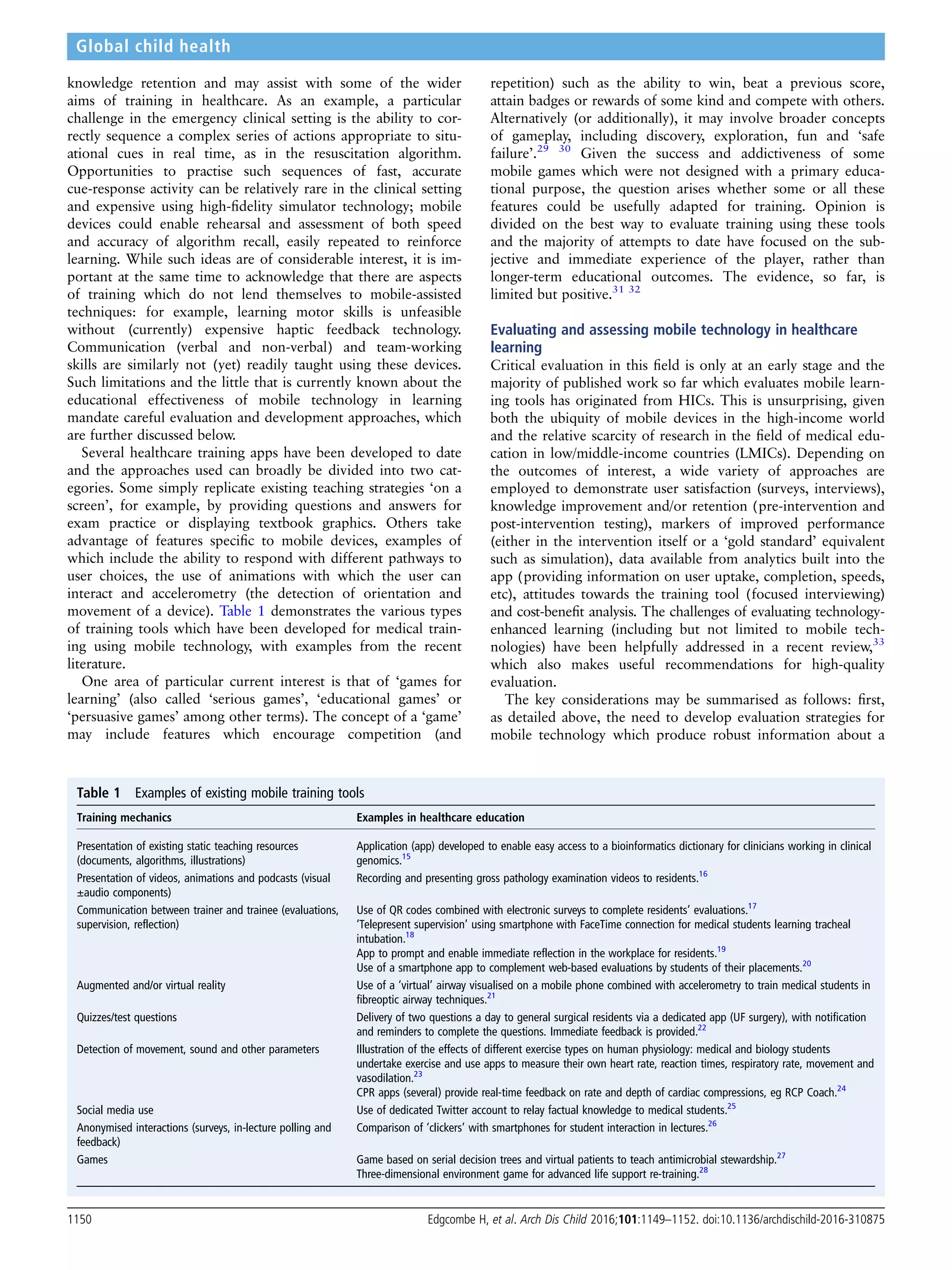
movement of a device). Table 1 demonstrates the various types
of training tools which have been developed for medical train-
ing using mobile technology, with examples from the recent
literature.
One area of particular current interest is that of ‘games for
learning’ (also called ‘serious games’, ‘educational games’ or
‘persuasive games’ among other terms). The concept of a ‘game’
may include features which encourage competition (and
repetition) such as the ability to win, beat a previous score,
attain badges or rewards of some kind and compete with others.
Alternatively (or additionally), it may involve broader concepts
of gameplay, including discovery, exploration, fun and ‘safe
failure’.29 30
Given the success and addictiveness of some
mobile games which were not designed with a primary educa-
tional purpose, the question arises whether some or all these
features could be usefully adapted for training. Opinion is
divided on the best way to evaluate training using these tools
and the majority of attempts to date have focused on the sub-
jective and immediate experience of the player, rather than
longer-term educational outcomes. The evidence, so far, is
limited but positive.31 32
Evaluating and assessing mobile technology in healthcare
learning
Critical evaluation in this field is only at an early stage and the
majority of published work so far which evaluates mobile learn-
ing tools has originated from HICs. This is unsurprising, given
both the ubiquity of mobile devices in the high-income world
and the relative scarcity of research in the field of medical edu-
cation in low/middle-income countries (LMICs). Depending on
the outcomes of interest, a wide variety of approaches are
employed to demonstrate user satisfaction (surveys, interviews),
knowledge improvement and/or retention (pre-intervention and
post-intervention testing), markers of improved performance
(either in the intervention itself or a ‘gold standard’ equivalent
such as simulation), data available from analytics built into the
app (providing information on user uptake, completion, speeds,
etc), attitudes towards the training tool (focused interviewing)
and cost-benefit analysis. The challenges of evaluating technology-
enhanced learning (including but not limited to mobile tech-
nologies) have been helpfully addressed in a recent review,33
which also makes useful recommendations for high-quality
evaluation.
The key considerations may be summarised as follows: first,
as detailed above, the need to develop evaluation strategies for
mobile technology which produce robust information about a
Table 1 Examples of existing mobile training tools
Training mechanics Examples in healthcare education
Presentation of existing static teaching resources
(documents, algorithms, illustrations)
Application (app) developed to enable easy access to a bioinformatics dictionary for clinicians working in clinical
genomics.15
Presentation of videos, animations and podcasts (visual
±audio components)
Recording and presenting gross pathology examination videos to residents.16
Communication between trainer and trainee (evaluations,
supervision, reflection)
Use of QR codes combined with electronic surveys to complete residents’ evaluations.17
‘Telepresent supervision’ using smartphone with FaceTime connection for medical students learning tracheal
intubation.18
App to prompt and enable immediate reflection in the workplace for residents.19
Use of a smartphone app to complement web-based evaluations by students of their placements.20
Augmented and/or virtual reality Use of a ‘virtual’ airway visualised on a mobile phone combined with accelerometry to train medical students in
fibreoptic airway techniques.21
Quizzes/test questions Delivery of two questions a day to general surgical residents via a dedicated app (UF surgery), with notification
and reminders to complete the questions. Immediate feedback is provided.22
Detection of movement, sound and other parameters Illustration of the effects of different exercise types on human physiology: medical and biology students
undertake exercise and use apps to measure their own heart rate, reaction times, respiratory rate, movement and
vasodilation.23
CPR apps (several) provide real-time feedback on rate and depth of cardiac compressions, eg RCP Coach.24
Social media use Use of dedicated Twitter account to relay factual knowledge to medical students.25
Anonymised interactions (surveys, in-lecture polling and
feedback)
Comparison of ‘clickers’ with smartphones for student interaction in lectures.26
Games Game based on serial decision trees and virtual patients to teach antimicrobial stewardship.27
Three-dimensional environment game for advanced life support re-training.28
1150 Edgcombe H, et al. Arch Dis Child 2016;101:1149–1152. doi:10.1136/archdischild-2016-310875
Global child health
training tool’s effectiveness. Second, the relevance of tools
designed for high-income settings to very different resource-
poor environments must be assessed, accepting that what works
in one place may not in another (for reasons which may be
related as much to differences in learning culture as to differ-
ences in clinical context).34
Third, there is great opportunity to
analyse and evaluate ways in which mobile technology may be
blended with other training modalities (such as face-to-face
training) to maximise benefit and ultimately to improve health-
care outcomes.
SUGGESTED APPROACHES
As a team working to develop mobile technology-assisted train-
ing in the field of paediatric emergency care in LMICs and
taking into account the situation outlined above, we suggest that
the following principles may be useful both for other developers
and for those considering using such tools in their professional
lives.
Principle 1: adopt a development strategy appropriate for
the rapidly moving world of mobile technology
The development challenge is to determine principles of design
and use for new software while anticipating and planning for
considerable changes in technology within a short space of time.
Characteristically, software apps for mobile devices such as
tablets and smartphones are developed so as to take advantage
of their ability to rapidly reach a large user-base through ‘app
stores’ and to gather data about how people use the software.
This process has been termed the ‘Lean Startup’ by author and
app developer Eric Ries and it incorporates the Agile software
development principles with a process of ‘customer develop-
ment’ (discovering and validating a market for the product).
Following this process, developers usually release an app at a
‘minimal viable product’ stage, then aim to continuously
improve the app through rapid cycles, building new versions of
the product and measuring changes in usage, to learn whether
the new version is better than the previous one. These cycles,
called ‘build-measure-learn’ loops, are often performed using a
process of randomisation whereby different users are randomly
assigned different versions of the app to test different function-
ality. These tests can number in the millions of users for some
of the most popular commercial apps. Such an approach of
rapid iterative development (which shares many characteristics
with the ‘design-based research’ paradigm)35
enables responsive-
ness to changes in technology and persistent improvement in
the app. This process may be combined with or ultimately lead
on to subsequent evaluation using more familiar qualitative and
quantitative study designs.
Principle 2: partnership and collaboration between
high-income and low-income settings
While it may seem obvious, training tools are likely to need
modification to be appropriate for different environments.
Mobile platforms offer an opportunity for ongoing updates and
changes with relative ease while maintaining a high-quality
learning framework, as content can be updated remotely. In
order to maximise accessibility, relevance and validity for the
learner in a particular setting, those from that setting must be
involved in the development process, either primarily or in part-
nerships. Missing this opportunity is likely to impair the
designers’ ability to develop the most useful software, to achieve
uptake and usage and may well lead to substandard outcomes.
In our practice, for example, to ensure stakeholders are
included in the design and development process, we have run
co-design workshops with potential end-users (Kenyan health-
care workers) in the UK and Kenya. We have used the ‘Lean
UX’ methodology, in which groups of stakeholders from both
countries work together to develop user personas, value propo-
sitions (identifying solutions to key ‘pain-points’ for the user),
co-design wireframes and metrics, ultimately leading to the
development of a minimal viable product which can be tested
using the iterative process described above. Such an approach
has increasing traction internationally. Additionally, start-up
incubators (such as the iHub in Nairobi, Kenya)36
may enable
linkage to local resources and knowledge locally helping such
projects to be increasingly driven by LMIC developers and
designers.
Principle 3: ambition to evaluate effectiveness in the
medium-to-long term
In the context of mobile technology, two aspects of evaluation
are possible. First (as for any training intervention), the assess-
ment of the training tool against educational outcomes and/or
clinical outcomes: what ‘educational success’ looks like deter-
mines the nature of this evaluation.33
Second, however, mobile
technology lends itself to a host of other analytic tools: uptake
(downloads), completion, repetition, scores in training and so
forth. If considered and incorporated at the design stage, these
analytics can reveal useful information about the ways in which
learners use training tools which in turn can inform
development.
Principle 4: recognition of the limitations and qualifications
of mobile technology
As outlined previously, not all relevant clinical skills can be
taught using a mobile device. This is obvious, but important to
remember amidst the hype and enthusiasm for new techno-
logical solutions. It is possible that overconfidence may be a
result of training using these tools, unless the learner is clear
about what they can and cannot learn effectively. Consequently,
any evaluation of such training tools should allow for the detec-
tion of possible harms.
CONCLUSION
We recognise and emphasise the ongoing need for training of
healthcare workers in LMICs. While workforce training is only
part of the global health story, it is crucial to improve health
outcomes. The worldwide shift to mobile technology, which is
occurring rapidly in both LMIC and HIC settings, offers the
opportunity to explore mobile-based training apps as potential
tools with which to improve access to training for health
workers worldwide. As yet little evidence exists on how to do
this most effectively, and what success might look like, and so
we urge developers and clinicians to produce training tools and
evaluate them rigorously, in partnership with learners, in order
to maximise their effectiveness and improve global health.
Contributors All authors contributed to the concept and design of the article. HE
and CP drafted and revised the work. ME critically revised and approved the final
draft.
Funding Funds from The Wellcome Trust (#097170) awarded to ME as a Senior
Fellowship supported his contributions. Funds from the Institutional Strategic Support
Fund and the Nuffield Department of Medicine support the work of CP together
with a small grant from the Skoll Centre for Social Entrepreneurship.
Competing interests The submitted work draws on the experience of the
authors’ group in developing a training game for medical education. This wider
(not-for-profit) project has been supported via the funders above and crowdfunding
through the University of Oxford which has attracted donations in the form of
Edgcombe H, et al. Arch Dis Child 2016;101:1149–1152. doi:10.1136/archdischild-2016-310875 1151
Global child health
gifts from private individuals and larger bodies including Medecins Sans Frontieres
and HTC.
Provenance and peer review Commissioned; externally peer reviewed.
Open Access This is an Open Access article distributed in accordance with the
terms of the Creative Commons Attribution (CC BY 4.0) license, which permits
others to distribute, remix, adapt and build upon this work, for commercial use,
provided the original work is properly cited. See: http://creativecommons.org/licenses/
by/4.0/
REFERENCES
1 Chen L, Evans T, Anand S, et al. Human resources for health: overcoming the crisis.
Lancet 2004;364:1984–90.
2 Frenk J, Chen L, Bhutta ZA, et al. Health professionals for a new century:
transforming education to strengthen health systems in an interdependent world.
Lancet 2010;376:1923–58.
3 Crisp N, Gawanas B, Sharp I, et al. Training the health workforce: scaling up,
saving lives. Lancet 2008;371:689–91.
4 Bhutta ZA, Black RE. Global maternal, newborn, and child health—so near and yet
so far. N Engl J Med 2013;369:2226–35.
5 Binagwaho A, Kyamanywa P, Farmer PE, et al. The human resources for health
program in Rwanda—a new partnership. N Engl J Med 2013;369:2054–9.
6 Irimu G, Wamae A, Wasunna A, et al. Developing and introducing evidence based
clinical practice guidelines for serious illness in Kenya. Arch Dis Child
2008;93:799–804.
7 Tuyisenge L, Kyamanya P, Van Steirteghem S, et al. Knowledge and skills retention
following Emergency Triage, Assessment and Treatment plus Admission course for
final year medical students in Rwanda: a longitudinal cohort study. Arch Dis Child
2014;99:993–7.
8 Helping Babies Breathe. http://www.helpingbabiesbreathe.org/ (accessed Jul 2016).
9 Mosley C, Dewhurst C, Molloy S, et al. What is the impact of structured resuscitation
training on healthcare practitioners, their clients and the wider service? A BEME
systematic review: BEME Guide No. 20. Med Teach 2012;34:e349–85.
10 Bettercare Learning System. http://bettercare.co.za/ (accessed Jul 2016).
11 Pew Research Centre. http://www.pewglobal.org/2015/04/15/
cell-phones-in-africa-communication-lifeline/ (accessed Jul 2016).
12 Free C, Phillips G, Watson L, et al. The effectiveness of mobile-health technologies
to improve health care service delivery processes: a systematic review and
meta-analysis. PLoS Med 2013;10:e1001363.
13 Finitsis DJ, Pellowski JA, Johnson BT. Text message intervention designs to promote
adherence to antiretroviral therapy (ART): a meta-analysis of randomized controlled
trials. PLoS ONE 2014;9:e88166.
14 Masika MM, Omondi GB, Natembeya DS, et al. Use of mobile learning technology
among final year medical students in Kenya. Pan Afr Med J 2015;21:127.
15 Tobias AP, Tobias ES. Developing educational iPhone, Android and Windows
smartphone cross-platform apps to facilitate understanding of clinical genomics
terminology. Appl Transl Genom 2015;6:15–17.
16 Bhattacharya S, Lubin D, Patel V, et al. The use of a smartphone (iPhone) as a tool
in teaching surgical pathology grossing techniques to pathology residents in
training. Am J Clin Pathol 2015;144:A182.
17 Reynolds K, Barnhill D, Sias J, et al. Use of the QR reader to provide real-time
evaluation of residents’ skills following surgical procedures. J Grad Med Educ
2014;6:738–41.
18 Prescher H, Grover E, Mosier J, et al. Telepresent intubation supervision is as
effective as in-person supervision of procedurally naive operators. Telemed J
E Health 2015;21:170–5.
19 Könings KD, van Berlo J, Koopmans R, et al. Using a smartphone app and
coaching group sessions to promote residents’ reflection in the workplace. Acad
Med 2016;91:365–70.
20 Hessius J, Johansson J. Smartphone-based evaluations of clinical placements—a
useful complement to web-based evaluation tools. J Educ Eval Health Prof
2015;12:55–6.
21 De Oliveira GSJr, Glassenberg R, Chang R, et al. Virtual airway simulation to
improve dexterity among novices performing fibreoptic intubation. Anaesthesia
2013;68:1053–8.
22 Shaw CM, Tan SA. Integration of Mobile Technology in Educational Materials
Improves Participation: creation of a novel smartphone application for resident
education. J Surg Educ 2015;72:670–3.
23 Nadal R, Lellis-Santos C. Using smartphones to learn exercise physiology. Med Educ
2015;49:1162–3.
24 Barcala-Furelos R, Abelairas-Gomez C, Enriquez-Trigas A. RCP coach: a new CPR
APP to learn and practice. Resuscitation 2013;84:S30–1.
25 Reames BN, Sheetz KH, Englesbe MJ, et al. Evaluating the use of twitter to
enhance the educational experience of a medical school surgery clerkship. J Surg
Educ 2016;73:73–8.
26 Morrell LJ, Joyce DA. Interactive lectures: clickers or personal devices? F1000Res
2015;4:64.
27 Castro-Sánchez E, Charani E, Moore LSP, et al. Taking antimicrobial stewardship
initiatives to the next level: development of a serious prescribing game for acute
care. Int J Infect Dis 2014;21:46–7.
28 Buttussi F, Pellis T, Cabas Vidani A, et al. Evaluation of a 3D serious game for
advanced life support retraining. Int J Med Inform 2013;82:798–809.
29 de Freitas S. Learning in Immersive worlds: a review of game-based learning.
Bristol, England: Joint Information Systems Committee, 2006. http://www.jisc.ac.uk/
media/documents/programmes/elearninginnovation/gamingreport_v3.pdf (accessed
Jul 2016).
30 Mitgutsch K, Alvarado N. Purposeful by design? New York, New York, USA: ACM
Press, 2012:121–8.
31 Clark DB, Tanner-Smith EE, Killingsworth SS. Digital games, design, and learning:
a systematic review and meta-analysis. Rev Educ Res 2016;86:79–122.
32 Graafland M, Schraagen JM, Schijven MP. Systematic review of serious games for
medical education and surgical skills training. Br J Surg 2012;99:1322–30.
33 Cook DA, Ellaway RH. Evaluating technology-enhanced learning: a comprehensive
framework. Med Teach 2015;37:961–70.
34 Hategekimana C, Shoveller J, Tuyisenge L, et al. Correlates of performance of
healthcare workers in emergency, triage, assessment and treatment plus admission
care (ETAT+) course in Rwanda: context matters. PLoS ONE 2016;11:e0152882.
35 Wang F, Hannafin MJ. Design-based research and technology-enhanced learning
environments. Educ Technol Res Dev 2005;53:5–23.
36 iHub. http://ihub.co.ke/ (accessed Jul 2016).
1152 Edgcombe H, et al. Arch Dis Child 2016;101:1149–1152. doi:10.1136/archdischild-2016-310875
Global child health

Enhancing emergency care in low-income countries using mobile technology-based training tools

  • 1.
    Enhancing emergency carein low-income countries using mobile technology-based training tools Hilary Edgcombe,1 Chris Paton,2 Mike English2,3 1 Nuffield Department of Anaesthetics, Oxford University Hospitals NHS Trust, Oxford, UK 2 Nuffield Department of Medicine, Centre for Tropical Medicine and Global Health, University of Oxford, Oxford, UK 3 KEMRI-Wellcome Trust Research Programme, Nairobi, Kenya Correspondence to Dr Hilary Edgcombe, Nuffield Department of Anaesthetics, Oxford University Hospitals NHS Trust, Oxford, UK; hilary.edgcombe@nda.ox.ac.uk Received 7 July 2016 Revised 10 August 2016 Accepted 16 August 2016 Published Online First 22 September 2016 To cite: Edgcombe H, Paton C, English M. Arch Dis Child 2016;101:1149– 1152. ABSTRACT In this paper, we discuss the role of mobile technology in developing training tools for health workers, with particular reference to low-income countries (LICs). The global and technological context is outlined, followed by a summary of approaches to using and evaluating mobile technology for learning in healthcare. Finally, recommendations are made for those developing and using such tools, based on current literature and the authors’ involvement in the field. THE CONTEXT The global need for more and better-trained health workers, particularly in low-resourced regions, is well established.1 Effective training enhances the knowledge and skills of those already working and supports and motivates those who consider joining the healthcare workforce.2 However, delivery of timely, effective and up-to-date teaching is challen- ging in many low-income countries (LICs), for reasons which may be financial, geographical, polit- ical and/or institutional.2 Global child health is no exception to this rule.3 4 The demand for better, more accessible training is thus considerable and over recent decades many solutions have been proposed and implemented, some originating within local/national institutions, others involving external (often high-income country (HIC)) partnerships and initiatives (eg, the Rwanda Human Resources for Health Program.5 ) The scope and nature of these solutions vary widely from long-term international partnerships to training delivered by regional associations to one-off short courses taught by volunteers. It seems likely that in LICs, as in HICs, a mix of approaches is required. Two aspects of this training challenge warrant particular emphasis. The first is the need for contextually appropriate training which has rele- vance to the disease burden and resources encoun- tered by health professionals in their workplaces. Examples of such training exist already in a variety of formats (such as “Emergency Triage Assessment and Treatment plus admission care”6 7 and the Helping Babies Breathe collaboration).8 The second aspect is that of scale: even within the depleted current workforce, tens of thousands of health workers need to access initial and continuing medical education. This challenge is considerable even in well-resourced countries such as the UK: as an illustration, despite recognition that knowl- edge decay occurs in a matter of months after resuscitation training,9 it is deemed impractical to require recertification more often than once every 3–4 years. Developing tools and systems which can provide health workers in even the remotest regions with up-to-date information and timely training must be a priority. Initiatives which support self-driven learning using electronic resources, such as the Bettercare system,10 seem likely to become increasingly accessible and will likely be supported by the burgeoning availability of smart mobile technology. In Africa, mobile phone use is now common- place: in Kenya, for example, over 80% of the population now have access to a mobile phone (increased from only 10% in 2002).11 Farmers are using text message services to price their goods and citizens have quickly adopted the mPesa mobile payments system. It is often said that the mobile phone network in Africa has ‘leapfrogged’ the land- line network; changes which took decades of investment in HICs have been overtaken within a few short years in Africa. Health initiatives using voice and text features such as appointment remin- ders9 12 and treatment adherence prompts10 13 are thus increasing in number and scope. For profes- sional health workers who might be most interested in mobile-based learning, smartphone adoption has accelerated sharply in the past 2–3 years. Already 28% of people in Kenya with secondary-level or higher education now own a smartphone,11 as do 88% of Nairobi medical students.14 Many of these smartphone owners may never have used a laptop or desktop computer but are proficient application (app) users. It could be argued that new interven- tions should therefore adopt a ‘mobile-first’ approach instead of first designing for personal computers with a mobile ‘option’. Recognising that mobile devices and internet connections bring their own strengths and weak- nesses to the field of healthcare education, we examine what has been established so far about ‘mobile learning in healthcare’ which is of rele- vance to the low-resource setting. For the purposes of this article, we focus on mobile devices provid- ing touchscreen technology and internet connec- tion via phone (2G, 3G or 4G) or wireless networks. MOBILE TECHNOLOGY AND LEARNING IN HEALTHCARE Models of learning using mobile technology The challenge with any new tool, for training or otherwise, is to establish where it is of most benefit (and where it is not). The aims of training and learning in healthcare include information accessi- bility and transfer and encompass a far wider range of cognitive, motor, attitudinal and other end points. Mobile devices have some unique features which may assist with information transfer and Edgcombe H, et al. Arch Dis Child 2016;101:1149–1152. doi:10.1136/archdischild-2016-310875 1149 Global child health
  • 2.
    knowledge retention andmay assist with some of the wider aims of training in healthcare. As an example, a particular challenge in the emergency clinical setting is the ability to cor- rectly sequence a complex series of actions appropriate to situ- ational cues in real time, as in the resuscitation algorithm. Opportunities to practise such sequences of fast, accurate cue-response activity can be relatively rare in the clinical setting and expensive using high-fidelity simulator technology; mobile devices could enable rehearsal and assessment of both speed and accuracy of algorithm recall, easily repeated to reinforce learning. While such ideas are of considerable interest, it is im- portant at the same time to acknowledge that there are aspects of training which do not lend themselves to mobile-assisted techniques: for example, learning motor skills is unfeasible without (currently) expensive haptic feedback technology. Communication (verbal and non-verbal) and team-working skills are similarly not (yet) readily taught using these devices. Such limitations and the little that is currently known about the educational effectiveness of mobile technology in learning mandate careful evaluation and development approaches, which are further discussed below. Several healthcare training apps have been developed to date and the approaches used can broadly be divided into two cat- egories. Some simply replicate existing teaching strategies ‘on a screen’, for example, by providing questions and answers for exam practice or displaying textbook graphics. Others take advantage of features specific to mobile devices, examples of which include the ability to respond with different pathways to user choices, the use of animations with which the user can interact and accelerometry (the detection of orientation and movement of a device). Table 1 demonstrates the various types of training tools which have been developed for medical train- ing using mobile technology, with examples from the recent literature. One area of particular current interest is that of ‘games for learning’ (also called ‘serious games’, ‘educational games’ or ‘persuasive games’ among other terms). The concept of a ‘game’ may include features which encourage competition (and repetition) such as the ability to win, beat a previous score, attain badges or rewards of some kind and compete with others. Alternatively (or additionally), it may involve broader concepts of gameplay, including discovery, exploration, fun and ‘safe failure’.29 30 Given the success and addictiveness of some mobile games which were not designed with a primary educa- tional purpose, the question arises whether some or all these features could be usefully adapted for training. Opinion is divided on the best way to evaluate training using these tools and the majority of attempts to date have focused on the sub- jective and immediate experience of the player, rather than longer-term educational outcomes. The evidence, so far, is limited but positive.31 32 Evaluating and assessing mobile technology in healthcare learning Critical evaluation in this field is only at an early stage and the majority of published work so far which evaluates mobile learn- ing tools has originated from HICs. This is unsurprising, given both the ubiquity of mobile devices in the high-income world and the relative scarcity of research in the field of medical edu- cation in low/middle-income countries (LMICs). Depending on the outcomes of interest, a wide variety of approaches are employed to demonstrate user satisfaction (surveys, interviews), knowledge improvement and/or retention (pre-intervention and post-intervention testing), markers of improved performance (either in the intervention itself or a ‘gold standard’ equivalent such as simulation), data available from analytics built into the app (providing information on user uptake, completion, speeds, etc), attitudes towards the training tool (focused interviewing) and cost-benefit analysis. The challenges of evaluating technology- enhanced learning (including but not limited to mobile tech- nologies) have been helpfully addressed in a recent review,33 which also makes useful recommendations for high-quality evaluation. The key considerations may be summarised as follows: first, as detailed above, the need to develop evaluation strategies for mobile technology which produce robust information about a Table 1 Examples of existing mobile training tools Training mechanics Examples in healthcare education Presentation of existing static teaching resources (documents, algorithms, illustrations) Application (app) developed to enable easy access to a bioinformatics dictionary for clinicians working in clinical genomics.15 Presentation of videos, animations and podcasts (visual ±audio components) Recording and presenting gross pathology examination videos to residents.16 Communication between trainer and trainee (evaluations, supervision, reflection) Use of QR codes combined with electronic surveys to complete residents’ evaluations.17 ‘Telepresent supervision’ using smartphone with FaceTime connection for medical students learning tracheal intubation.18 App to prompt and enable immediate reflection in the workplace for residents.19 Use of a smartphone app to complement web-based evaluations by students of their placements.20 Augmented and/or virtual reality Use of a ‘virtual’ airway visualised on a mobile phone combined with accelerometry to train medical students in fibreoptic airway techniques.21 Quizzes/test questions Delivery of two questions a day to general surgical residents via a dedicated app (UF surgery), with notification and reminders to complete the questions. Immediate feedback is provided.22 Detection of movement, sound and other parameters Illustration of the effects of different exercise types on human physiology: medical and biology students undertake exercise and use apps to measure their own heart rate, reaction times, respiratory rate, movement and vasodilation.23 CPR apps (several) provide real-time feedback on rate and depth of cardiac compressions, eg RCP Coach.24 Social media use Use of dedicated Twitter account to relay factual knowledge to medical students.25 Anonymised interactions (surveys, in-lecture polling and feedback) Comparison of ‘clickers’ with smartphones for student interaction in lectures.26 Games Game based on serial decision trees and virtual patients to teach antimicrobial stewardship.27 Three-dimensional environment game for advanced life support re-training.28 1150 Edgcombe H, et al. Arch Dis Child 2016;101:1149–1152. doi:10.1136/archdischild-2016-310875 Global child health
  • 3.
    training tool’s effectiveness.Second, the relevance of tools designed for high-income settings to very different resource- poor environments must be assessed, accepting that what works in one place may not in another (for reasons which may be related as much to differences in learning culture as to differ- ences in clinical context).34 Third, there is great opportunity to analyse and evaluate ways in which mobile technology may be blended with other training modalities (such as face-to-face training) to maximise benefit and ultimately to improve health- care outcomes. SUGGESTED APPROACHES As a team working to develop mobile technology-assisted train- ing in the field of paediatric emergency care in LMICs and taking into account the situation outlined above, we suggest that the following principles may be useful both for other developers and for those considering using such tools in their professional lives. Principle 1: adopt a development strategy appropriate for the rapidly moving world of mobile technology The development challenge is to determine principles of design and use for new software while anticipating and planning for considerable changes in technology within a short space of time. Characteristically, software apps for mobile devices such as tablets and smartphones are developed so as to take advantage of their ability to rapidly reach a large user-base through ‘app stores’ and to gather data about how people use the software. This process has been termed the ‘Lean Startup’ by author and app developer Eric Ries and it incorporates the Agile software development principles with a process of ‘customer develop- ment’ (discovering and validating a market for the product). Following this process, developers usually release an app at a ‘minimal viable product’ stage, then aim to continuously improve the app through rapid cycles, building new versions of the product and measuring changes in usage, to learn whether the new version is better than the previous one. These cycles, called ‘build-measure-learn’ loops, are often performed using a process of randomisation whereby different users are randomly assigned different versions of the app to test different function- ality. These tests can number in the millions of users for some of the most popular commercial apps. Such an approach of rapid iterative development (which shares many characteristics with the ‘design-based research’ paradigm)35 enables responsive- ness to changes in technology and persistent improvement in the app. This process may be combined with or ultimately lead on to subsequent evaluation using more familiar qualitative and quantitative study designs. Principle 2: partnership and collaboration between high-income and low-income settings While it may seem obvious, training tools are likely to need modification to be appropriate for different environments. Mobile platforms offer an opportunity for ongoing updates and changes with relative ease while maintaining a high-quality learning framework, as content can be updated remotely. In order to maximise accessibility, relevance and validity for the learner in a particular setting, those from that setting must be involved in the development process, either primarily or in part- nerships. Missing this opportunity is likely to impair the designers’ ability to develop the most useful software, to achieve uptake and usage and may well lead to substandard outcomes. In our practice, for example, to ensure stakeholders are included in the design and development process, we have run co-design workshops with potential end-users (Kenyan health- care workers) in the UK and Kenya. We have used the ‘Lean UX’ methodology, in which groups of stakeholders from both countries work together to develop user personas, value propo- sitions (identifying solutions to key ‘pain-points’ for the user), co-design wireframes and metrics, ultimately leading to the development of a minimal viable product which can be tested using the iterative process described above. Such an approach has increasing traction internationally. Additionally, start-up incubators (such as the iHub in Nairobi, Kenya)36 may enable linkage to local resources and knowledge locally helping such projects to be increasingly driven by LMIC developers and designers. Principle 3: ambition to evaluate effectiveness in the medium-to-long term In the context of mobile technology, two aspects of evaluation are possible. First (as for any training intervention), the assess- ment of the training tool against educational outcomes and/or clinical outcomes: what ‘educational success’ looks like deter- mines the nature of this evaluation.33 Second, however, mobile technology lends itself to a host of other analytic tools: uptake (downloads), completion, repetition, scores in training and so forth. If considered and incorporated at the design stage, these analytics can reveal useful information about the ways in which learners use training tools which in turn can inform development. Principle 4: recognition of the limitations and qualifications of mobile technology As outlined previously, not all relevant clinical skills can be taught using a mobile device. This is obvious, but important to remember amidst the hype and enthusiasm for new techno- logical solutions. It is possible that overconfidence may be a result of training using these tools, unless the learner is clear about what they can and cannot learn effectively. Consequently, any evaluation of such training tools should allow for the detec- tion of possible harms. CONCLUSION We recognise and emphasise the ongoing need for training of healthcare workers in LMICs. While workforce training is only part of the global health story, it is crucial to improve health outcomes. The worldwide shift to mobile technology, which is occurring rapidly in both LMIC and HIC settings, offers the opportunity to explore mobile-based training apps as potential tools with which to improve access to training for health workers worldwide. As yet little evidence exists on how to do this most effectively, and what success might look like, and so we urge developers and clinicians to produce training tools and evaluate them rigorously, in partnership with learners, in order to maximise their effectiveness and improve global health. Contributors All authors contributed to the concept and design of the article. HE and CP drafted and revised the work. ME critically revised and approved the final draft. Funding Funds from The Wellcome Trust (#097170) awarded to ME as a Senior Fellowship supported his contributions. Funds from the Institutional Strategic Support Fund and the Nuffield Department of Medicine support the work of CP together with a small grant from the Skoll Centre for Social Entrepreneurship. Competing interests The submitted work draws on the experience of the authors’ group in developing a training game for medical education. This wider (not-for-profit) project has been supported via the funders above and crowdfunding through the University of Oxford which has attracted donations in the form of Edgcombe H, et al. Arch Dis Child 2016;101:1149–1152. doi:10.1136/archdischild-2016-310875 1151 Global child health
  • 4.
    gifts from privateindividuals and larger bodies including Medecins Sans Frontieres and HTC. Provenance and peer review Commissioned; externally peer reviewed. Open Access This is an Open Access article distributed in accordance with the terms of the Creative Commons Attribution (CC BY 4.0) license, which permits others to distribute, remix, adapt and build upon this work, for commercial use, provided the original work is properly cited. See: http://creativecommons.org/licenses/ by/4.0/ REFERENCES 1 Chen L, Evans T, Anand S, et al. Human resources for health: overcoming the crisis. Lancet 2004;364:1984–90. 2 Frenk J, Chen L, Bhutta ZA, et al. Health professionals for a new century: transforming education to strengthen health systems in an interdependent world. Lancet 2010;376:1923–58. 3 Crisp N, Gawanas B, Sharp I, et al. Training the health workforce: scaling up, saving lives. Lancet 2008;371:689–91. 4 Bhutta ZA, Black RE. Global maternal, newborn, and child health—so near and yet so far. N Engl J Med 2013;369:2226–35. 5 Binagwaho A, Kyamanywa P, Farmer PE, et al. The human resources for health program in Rwanda—a new partnership. N Engl J Med 2013;369:2054–9. 6 Irimu G, Wamae A, Wasunna A, et al. Developing and introducing evidence based clinical practice guidelines for serious illness in Kenya. Arch Dis Child 2008;93:799–804. 7 Tuyisenge L, Kyamanya P, Van Steirteghem S, et al. Knowledge and skills retention following Emergency Triage, Assessment and Treatment plus Admission course for final year medical students in Rwanda: a longitudinal cohort study. Arch Dis Child 2014;99:993–7. 8 Helping Babies Breathe. http://www.helpingbabiesbreathe.org/ (accessed Jul 2016). 9 Mosley C, Dewhurst C, Molloy S, et al. What is the impact of structured resuscitation training on healthcare practitioners, their clients and the wider service? A BEME systematic review: BEME Guide No. 20. Med Teach 2012;34:e349–85. 10 Bettercare Learning System. http://bettercare.co.za/ (accessed Jul 2016). 11 Pew Research Centre. http://www.pewglobal.org/2015/04/15/ cell-phones-in-africa-communication-lifeline/ (accessed Jul 2016). 12 Free C, Phillips G, Watson L, et al. The effectiveness of mobile-health technologies to improve health care service delivery processes: a systematic review and meta-analysis. PLoS Med 2013;10:e1001363. 13 Finitsis DJ, Pellowski JA, Johnson BT. Text message intervention designs to promote adherence to antiretroviral therapy (ART): a meta-analysis of randomized controlled trials. PLoS ONE 2014;9:e88166. 14 Masika MM, Omondi GB, Natembeya DS, et al. Use of mobile learning technology among final year medical students in Kenya. Pan Afr Med J 2015;21:127. 15 Tobias AP, Tobias ES. Developing educational iPhone, Android and Windows smartphone cross-platform apps to facilitate understanding of clinical genomics terminology. Appl Transl Genom 2015;6:15–17. 16 Bhattacharya S, Lubin D, Patel V, et al. The use of a smartphone (iPhone) as a tool in teaching surgical pathology grossing techniques to pathology residents in training. Am J Clin Pathol 2015;144:A182. 17 Reynolds K, Barnhill D, Sias J, et al. Use of the QR reader to provide real-time evaluation of residents’ skills following surgical procedures. J Grad Med Educ 2014;6:738–41. 18 Prescher H, Grover E, Mosier J, et al. Telepresent intubation supervision is as effective as in-person supervision of procedurally naive operators. Telemed J E Health 2015;21:170–5. 19 Könings KD, van Berlo J, Koopmans R, et al. Using a smartphone app and coaching group sessions to promote residents’ reflection in the workplace. Acad Med 2016;91:365–70. 20 Hessius J, Johansson J. Smartphone-based evaluations of clinical placements—a useful complement to web-based evaluation tools. J Educ Eval Health Prof 2015;12:55–6. 21 De Oliveira GSJr, Glassenberg R, Chang R, et al. Virtual airway simulation to improve dexterity among novices performing fibreoptic intubation. Anaesthesia 2013;68:1053–8. 22 Shaw CM, Tan SA. Integration of Mobile Technology in Educational Materials Improves Participation: creation of a novel smartphone application for resident education. J Surg Educ 2015;72:670–3. 23 Nadal R, Lellis-Santos C. Using smartphones to learn exercise physiology. Med Educ 2015;49:1162–3. 24 Barcala-Furelos R, Abelairas-Gomez C, Enriquez-Trigas A. RCP coach: a new CPR APP to learn and practice. Resuscitation 2013;84:S30–1. 25 Reames BN, Sheetz KH, Englesbe MJ, et al. Evaluating the use of twitter to enhance the educational experience of a medical school surgery clerkship. J Surg Educ 2016;73:73–8. 26 Morrell LJ, Joyce DA. Interactive lectures: clickers or personal devices? F1000Res 2015;4:64. 27 Castro-Sánchez E, Charani E, Moore LSP, et al. Taking antimicrobial stewardship initiatives to the next level: development of a serious prescribing game for acute care. Int J Infect Dis 2014;21:46–7. 28 Buttussi F, Pellis T, Cabas Vidani A, et al. Evaluation of a 3D serious game for advanced life support retraining. Int J Med Inform 2013;82:798–809. 29 de Freitas S. Learning in Immersive worlds: a review of game-based learning. Bristol, England: Joint Information Systems Committee, 2006. http://www.jisc.ac.uk/ media/documents/programmes/elearninginnovation/gamingreport_v3.pdf (accessed Jul 2016). 30 Mitgutsch K, Alvarado N. Purposeful by design? New York, New York, USA: ACM Press, 2012:121–8. 31 Clark DB, Tanner-Smith EE, Killingsworth SS. Digital games, design, and learning: a systematic review and meta-analysis. Rev Educ Res 2016;86:79–122. 32 Graafland M, Schraagen JM, Schijven MP. Systematic review of serious games for medical education and surgical skills training. Br J Surg 2012;99:1322–30. 33 Cook DA, Ellaway RH. Evaluating technology-enhanced learning: a comprehensive framework. Med Teach 2015;37:961–70. 34 Hategekimana C, Shoveller J, Tuyisenge L, et al. Correlates of performance of healthcare workers in emergency, triage, assessment and treatment plus admission care (ETAT+) course in Rwanda: context matters. PLoS ONE 2016;11:e0152882. 35 Wang F, Hannafin MJ. Design-based research and technology-enhanced learning environments. Educ Technol Res Dev 2005;53:5–23. 36 iHub. http://ihub.co.ke/ (accessed Jul 2016). 1152 Edgcombe H, et al. Arch Dis Child 2016;101:1149–1152. doi:10.1136/archdischild-2016-310875 Global child health