Making an IMPACT
UHMLG Spring Forum
1 March 2010
Helen Bingham and Mark Bryant
Lies, damn lies, statistics, and impact
• NHS libraries better at collecting data relating to inputs
and outputs, than outcomes
• Need evidence to demonstrate that library/knowledge
services are enabling the organisations that they serve
to meet their objectives
• People – especially politicians and senior managers -
respond to story – need narrative and rich qualitative
data to augment the statistics
www.nesc.nhs.uk
The NHS Quality & Productivity Challenge – QIPP
• Need to measure and demonstrate value
NHS Library Quality Assurance Framework England - LQAF
• 1.3c “The positive impact of library/knowledge services
can be demonstrated”
• Full compliance = a variety of methods are used to systematically
gather information about the impact on organisational
objectives/patient care.....
Focusing our efforts
www.nesc.nhs.uk
• To support clinical decision making
• To support commissioning decisions and policy making
• To support lifelong learning by all NHS staff
• To support research
(Report of a national review of NHS health library services in England – Peter Hill –
March 2008)
Reminding ourselves of our key purposes
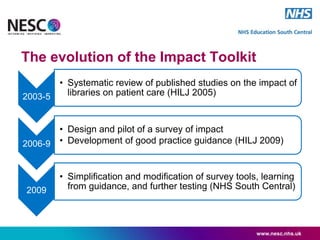
The evolution of the Impact Toolkit
www.nesc.nhs.uk
2003-5
• Systematic review of published studies on the impact of
libraries on patient care (HILJ 2005)
2006-9
• Design and pilot of a survey of impact
• Development of good practice guidance (HILJ 2009)
2009
• Simplification and modification of survey tools, learning
from guidance, and further testing (NHS South Central)
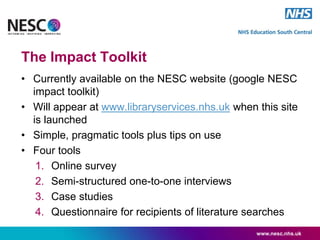
The Impact Toolkit
• Currently available on the NESC website (google NESC
impact toolkit)
• Will appear at www.libraryservices.nhs.uk when this site
is launched
• Simple, pragmatic tools plus tips on use
• Four tools
1. Online survey
2. Semi-structured one-to-one interviews
3. Case studies
4. Questionnaire for recipients of literature searches
www.nesc.nhs.uk
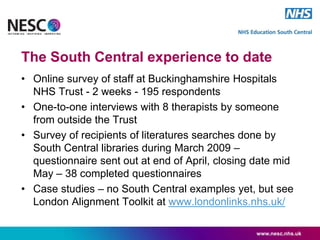
The South Central experience to date
• Online survey of staff at Buckinghamshire Hospitals
NHS Trust - 2 weeks - 195 respondents
• One-to-one interviews with 8 therapists by someone
from outside the Trust
• Survey of recipients of literatures searches done by
South Central libraries during March 2009 –
questionnaire sent out at end of April, closing date mid
May – 38 completed questionnaires
• Case studies – no South Central examples yet, but see
London Alignment Toolkit at www.londonlinks.nhs.uk/
www.nesc.nhs.uk
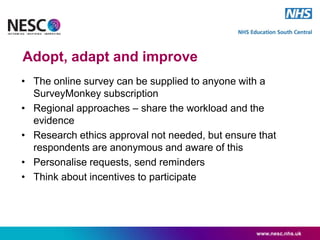
Adopt, adapt and improve
• The online survey can be supplied to anyone with a
SurveyMonkey subscription
• Regional approaches – share the workload and the
evidence
• Research ethics approval not needed, but ensure that
respondents are anonymous and aware of this
• Personalise requests, send reminders
• Think about incentives to participate
www.nesc.nhs.uk
Tips: online surveys
• The purpose is:
• To find out how staff look for information
• To assess impact on patient care
• The most statistically based tool – don’t expect much rich
data
• Provides management information for the library
• Pointers to areas for further work
• Place a link in an email, include in the body of the email or
attach - DO NOT INCLUDE IN A BULLETIN – more than
one click is oblivion
www.nesc.nhs.uk
Tips: interviews
• Objectives:
• To obtain rich qualitative data, illustrating the impact of
information provided by and through library services
• To identify narrative that could be used to ‘tell the story’ of the
services and their impact on patient care, for potential later use
in marketing library services
• Most difficult part is organising the interviews
• Keep informal and short - ask about specific, recent instances of
information use, rather than about library use in general
• Use ‘independent’ researchers if possible
• Staff time is an issue
www.nesc.nhs.uk
• Use case studies for more discursive richer information
• Remember that the respondents are self selecting and
will already be users of the service
• For searches, think about the time lapse between
receipt of results and use/impact
• Often provide the richest data for the minimum staff
effort
www.nesc.nhs.uk
Tips: case studies and
questionnaires for recipients of
searches
Applying the toolkit
• Consider the audience for the data
• Focus around a management event/marketing initiative
• Milton Keynes PCT – incorporated into library services
SLA
• Nuffield Orthopaedic Centre – revised service – is it
working?
• Ridgeway – incorporated into library strategy
• Oxford Healthcare Libraries – refined questionnaire
www.nesc.nhs.uk
Contacts
Mark Bryant
Co-author of toolkit, conducted interviews
Mark.Bryant@ridgeway.nhs.uk
Jennie Kelson
Library Services Manager, Buckinghamshire Hospitals
Jennie.Kelson@buckshosp.nhs.uk
Helen Bingham
Library & eLearning Lead, NHS South Central
Helen.Bingham@nesc.nhs.uk
www.nesc.nhs.uk
References
The value and impact of information provided through
library services for patient care: a systematic review
Weightman, A & Williamson, J HILJ 2005 22 4-25
The value and impact of information provided through
library services for patient care: developing guidance for
best practice Weightman, A, et al HILJ 2009 26 63-71
www.nesc.nhs.uk

Bingham2010

  • 1.
    Making an IMPACT UHMLGSpring Forum 1 March 2010 Helen Bingham and Mark Bryant
  • 2.
    Lies, damn lies,statistics, and impact • NHS libraries better at collecting data relating to inputs and outputs, than outcomes • Need evidence to demonstrate that library/knowledge services are enabling the organisations that they serve to meet their objectives • People – especially politicians and senior managers - respond to story – need narrative and rich qualitative data to augment the statistics
  • 3.
    www.nesc.nhs.uk The NHS Quality& Productivity Challenge – QIPP • Need to measure and demonstrate value NHS Library Quality Assurance Framework England - LQAF • 1.3c “The positive impact of library/knowledge services can be demonstrated” • Full compliance = a variety of methods are used to systematically gather information about the impact on organisational objectives/patient care..... Focusing our efforts
  • 4.
    www.nesc.nhs.uk • To supportclinical decision making • To support commissioning decisions and policy making • To support lifelong learning by all NHS staff • To support research (Report of a national review of NHS health library services in England – Peter Hill – March 2008) Reminding ourselves of our key purposes
  • 5.
    The evolution ofthe Impact Toolkit www.nesc.nhs.uk 2003-5 • Systematic review of published studies on the impact of libraries on patient care (HILJ 2005) 2006-9 • Design and pilot of a survey of impact • Development of good practice guidance (HILJ 2009) 2009 • Simplification and modification of survey tools, learning from guidance, and further testing (NHS South Central)
  • 6.
    The Impact Toolkit •Currently available on the NESC website (google NESC impact toolkit) • Will appear at www.libraryservices.nhs.uk when this site is launched • Simple, pragmatic tools plus tips on use • Four tools 1. Online survey 2. Semi-structured one-to-one interviews 3. Case studies 4. Questionnaire for recipients of literature searches www.nesc.nhs.uk
  • 7.
    The South Centralexperience to date • Online survey of staff at Buckinghamshire Hospitals NHS Trust - 2 weeks - 195 respondents • One-to-one interviews with 8 therapists by someone from outside the Trust • Survey of recipients of literatures searches done by South Central libraries during March 2009 – questionnaire sent out at end of April, closing date mid May – 38 completed questionnaires • Case studies – no South Central examples yet, but see London Alignment Toolkit at www.londonlinks.nhs.uk/ www.nesc.nhs.uk
  • 8.
    Adopt, adapt andimprove • The online survey can be supplied to anyone with a SurveyMonkey subscription • Regional approaches – share the workload and the evidence • Research ethics approval not needed, but ensure that respondents are anonymous and aware of this • Personalise requests, send reminders • Think about incentives to participate www.nesc.nhs.uk
  • 9.
    Tips: online surveys •The purpose is: • To find out how staff look for information • To assess impact on patient care • The most statistically based tool – don’t expect much rich data • Provides management information for the library • Pointers to areas for further work • Place a link in an email, include in the body of the email or attach - DO NOT INCLUDE IN A BULLETIN – more than one click is oblivion www.nesc.nhs.uk
  • 10.
    Tips: interviews • Objectives: •To obtain rich qualitative data, illustrating the impact of information provided by and through library services • To identify narrative that could be used to ‘tell the story’ of the services and their impact on patient care, for potential later use in marketing library services • Most difficult part is organising the interviews • Keep informal and short - ask about specific, recent instances of information use, rather than about library use in general • Use ‘independent’ researchers if possible • Staff time is an issue www.nesc.nhs.uk
  • 11.
    • Use casestudies for more discursive richer information • Remember that the respondents are self selecting and will already be users of the service • For searches, think about the time lapse between receipt of results and use/impact • Often provide the richest data for the minimum staff effort www.nesc.nhs.uk Tips: case studies and questionnaires for recipients of searches
  • 12.
    Applying the toolkit •Consider the audience for the data • Focus around a management event/marketing initiative • Milton Keynes PCT – incorporated into library services SLA • Nuffield Orthopaedic Centre – revised service – is it working? • Ridgeway – incorporated into library strategy • Oxford Healthcare Libraries – refined questionnaire www.nesc.nhs.uk
  • 13.
    Contacts Mark Bryant Co-author oftoolkit, conducted interviews Mark.Bryant@ridgeway.nhs.uk Jennie Kelson Library Services Manager, Buckinghamshire Hospitals Jennie.Kelson@buckshosp.nhs.uk Helen Bingham Library & eLearning Lead, NHS South Central Helen.Bingham@nesc.nhs.uk www.nesc.nhs.uk
  • 14.
    References The value andimpact of information provided through library services for patient care: a systematic review Weightman, A & Williamson, J HILJ 2005 22 4-25 The value and impact of information provided through library services for patient care: developing guidance for best practice Weightman, A, et al HILJ 2009 26 63-71 www.nesc.nhs.uk