Microsoft Confidential
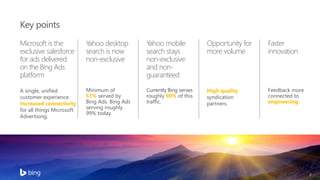
Key points
Microsoft is the
exclusive salesforce
for ads delivered
on the Bing Ads
platform
A single, unified
customer experience.
Increased connectivity
for all things Microsoft
Advertising.
Yahoo desktop
search is now
non-exclusive
Minimum of
51% served by
Bing Ads. Bing Ads
serving roughly
99% today.
Yahoo mobile
search stays
non-exclusive
and non-
guaranteed
Currently Bing serves
roughly 90% of this
traffic.
Opportunity for
more volume
High quality
syndication
partners.
Faster
innovation
Feedback more
connected to
engineering.
2
Microsoft Confidential
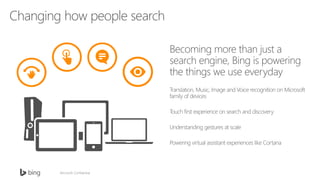
Changing how people search
Microsoft Confidential
CORTANA
SPOTLIGHT
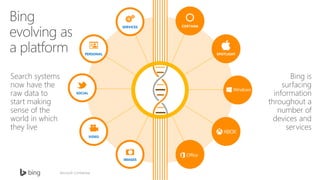
Search systems
now have the
raw data to
start making
sense of the
world in which
they live
Bing is
surfacing
information
throughout a
number of
devices and
services
Microsoft ConfidentialMicrosoft Confidential
Microsoft Confidential
−
−
−
−
−
−
−
−
−
−
−
−
−
−
Microsoft Confidential
Bing

Bing

Editor's Notes

  • #3 With the new deal. There a few important points I want you to take away. And they are centered around Sales and Volume. Microsoft is now the exclusive salesforce for Bing Ads. We will own the relationships for all our customers – big and/or small. This is great for customers because it simplifies their account contacts and increases the connectivity to all things Microsoft Advertising. This closer connection will also enable us to innovate faster. With MSFT owning the relationship with customers, we’ll be able to solicit feedback more directly and connect the feedback with engineering. We will be listening just as hard, but now our ear is closer to the teams that can enact change. The second point is around volume. Today, Bing Ads serves nearly 100% of Yahoo’s desktop traffic (~99.5% from May IE logs). Moving forward, Yahoo now has the flexibility to serve 49% of their PC traffic however they want. But at a minimum Bing Ads is guaranteed to serve the majority - 51% - of Yahoo’s desktop traffic. Although not a revised term, but an important one to know. Yahoo’s mobile traffic will continue to be non-exclusive and non-guaranteed. Today we serve roughly 90% of Yahoo’s mobile traffic. Next, we now have an opportunity to deliver more volume with our syndication business. The new terms allow us to compete more aggressively in landing new supply partners. Bing Ads volume will remain substantial and according to comScore, we’ve achieved 20% market share for Bing alone, and with search being built into the Windows 10 experience, we expect further growth. 1.5 billion users use Windows everyday.
  • #4 Search at Microsoft is core to the companies strategy around productivity. Each day our world creates new technology. New devices, new apps, new services. Which means new ways to do things, new ways to connect, new things to learn. And while each holds the promise of helping us get more done, with less effort, too often they simply become one more thing competing for our finite time and attention.   That’s why we need to rethink the way we make technology, and not simply make more. At Microsoft, our goal is to create technology that empowers people to be more productive.   And search is a key tool that everyone uses to enable them to be productive. Whether it’s researching a product, finding a place to eat, getting directions; these are all search activities that help me complete a task and get more done.   But in order to push people to be even more productive and achieve more, we need to rethink of how people search because today, people search differenlty. You can no longer think of search as a textbox and a list of links. It’s just no longer sufficient in the infinite devices and data world we live in today.   Search has really transformed over the course of the past few years.  
  • #5 We know that search experiences must change as more and more devices get connected and come in different form factors.   This explosion of devices is changing how people search. It’s no longer just about typing a keyword in a search box on your PC. This is because a search box is no longer sufficient in experiences like using a smart phone on-the-go, or sitting 10 feet away from a smart-TV.   We must think about devices and users and about how they expect to interact.   How can we better understand user intent beyond just keyword queries: from voice, to gesture, to touch.   With new inputs, devices, different modality's and signals (voice, context, gestures and location), we can augment search and map a better intent.   The combination of more and new devices and a search platform enables users to naturally interact with different devices and services, and also make the devices and experiences highly intelligent.
  • #6 Here at Microsoft, we no longer think of Bing as a search engine but as a platform. We talk about how search has evolved to not just a search engine with a list of links but a platform.   We believe that the technologies that power search are uniquely positioned to provide productivity to people with a more natural and personal approach to all of the information that surrounds us in our digital life.   Search engines have been indexing the real world with investments in areas like speech recognition, language and entity understanding. Our Bing platform processes these events in near real-time, and delivers to you information you need at the right time.   Search is no longer confined to search box. It’s providing information across a number of devices and services to enable you to be more productive. You’ll see search and Bing manifest itself in a number of scenarios. 1st party examples: maps in Office products, integrated search in Windows and Xbox, MSN apps. 3rd party Examples: Siri and Spotlight on iOS.   Bing and search is turning into a platform.
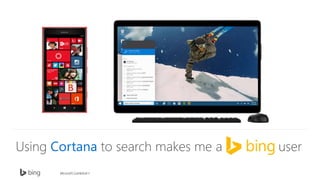
  • #7 I see Cortana as a great example of how we’re bringing “Bing as a platform” to users. With Cortana it’s all about deeply understanding users.   Cortana helps you get to meetings on time by understanding your calendar. You can tell Cortana your interests and it will tailor your results. You can set reminders with voice. You can have an almost real-time conversation with her.   Search is a ubiquitous service, not limited to a SERP. People are always looking for things: places, people, products, facts – and we are going to put it at their fingertips, or the end of a thought or sentence.  
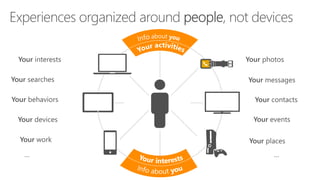
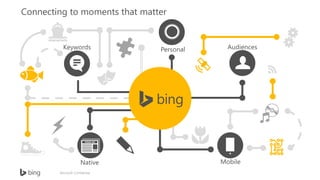
  • #8 This evolution of search and additional data signals also has meaningful impact to marketers. The experiences for both search and search advertising is clear: It’s about putting people and audiences at the center. Making very personal experiences that are relevant for the user.   Because we have more signals and data today, we should not only deliver a really great search experience but really great and relevant ads.   Overlaying behavioral data with keywords will give marketers a better way to target and serve better ads.   And we’re at this stage where search is moving beyond keywords to audiences….
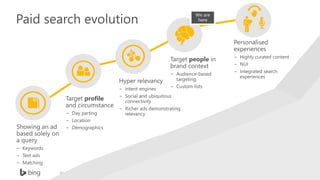
  • #9 If you look at the paid search evolution, there’s been remarkable progress over the past few years. It started off with just keywords but every year we get more signals to overlay it with keyword data. To be clear, keywords will never go away. It’s one of, if not the best, signal for intent. But we’ve made tremendous progress in adding additional dimensions that help our understanding of a searcher to ultimately empower marketers to serve better ads. We’ve added targeting components, richer ad formats, better relevancy and with the access and amount of data available today, we’re able to target people. Instead of buying keywords, we’re able to buy audiences within search. A great example is Google’s RLSA and our Remarketing in Paid search product, currently in pilot. We’re at the early-middle stages of taking behavioral data and empowering advertiser to utilize this data within their search campaigns. Today, it’s site level data we have available but the possibilities to add custom data, 1st part data, CRM data is only going to strengthen this idea of audience based buying in search.
  • #10 Search has evolved quite a bit.   Every year we get more and more signals that allows us to better understand a user.   It’s no longer about a search box but search as a platform. It’s no longer just about keywords but keywords and audiences.   Marketers who have the best understanding of who their audiences are and deliver ads that are personal, relevant and helpful will be the ones who succeed. And we’re certainly have a number of items on our roadmap that will enable marketers to tap into this exciting change with Bing Ads. Remarketing in Paid Search. Our Remarketing product will enable advertisers to retarget users based on past behavior they have taken on their site - through our UET tags. And we’re also thinking about how we can take the signals we have in search and apply them through new ad formats like native advertising on some our MSFT properties. INTERNAL GUIDANCE: Keep this at a high level, do not mention pilot or beta opportunities during the presentation but if customers as during 1:1 conversations please feel free to mention it. It’s an exciting time to be in the search industry. New inputs, new data sets will give everyone here the potential to connect with their customers in a way that matters and at Bing Ads we have the solutions to enable you to reach these users.