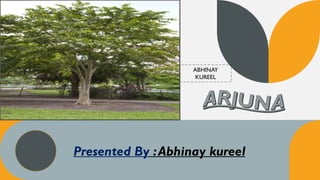
ARJUNA
Presented By :Abhinay kureel
ABHINAY
KUREEL
1)Introduction
2)Synonyms
3)External Morphology
4)Uses
5)Grahya lakshana
6)PhytoConstituents
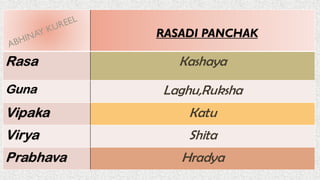
7)Rasadi Panchak
8)Action on Dosa
9)Karma and Pharmacological action
10)Therapeutic Indications
11)Amyika Prayoga
12)Matra & Adulteration
13)Formulation
14)Research Corner
Content
ABHINAY
KUREEL
INTRODUCTION
➢Botanical Name : Terminalia arjuna
Terminalia – Disposition of leaves of some species towards the end of branchlets
Arjuna – Derived from Sanskrit word “Arjuna”
➢Family : Combretaceae
➢English name : White Murdah
➢Hindi Name :Arjan, कहु, कोह
➢Marathi Name :Anjan
Classification of Dravya
caraka ज्वरहर, ववरेचनोपग
Susruta त्रिफला, मुस्तादि
Bh.Pr.Ni Vatadi varga 26-27
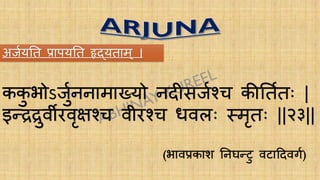
कक
ु भोऽर्ुुननामाख्यो निीसर्ुश्च कीर्तुतः |
इन्द्ररुवीरवृक्षश्च वीरश्च धवलः स्मृतः ||२३||
(भावप्रकाश र्नघन्द्टु वटादिवगु)
ARJUNA
अर्ुयर्त प्रापयर्त हृद्यताम् ।
SYNONYMS
❑नदीसर्ज : Commonly grows on
river banks
❑धवल : Arjuna Bark is white in
colour
❑इन्द्ररु : Tree which is very
potent medicine
❑वीरवृक्ष : A potent tree
❑कक
ु भ : A Large tree covers
large area
❑सर्जणः Arjuna is a large tree
with spreading branches
❑मधुगन्न्द्धप्रसूनकः : Arjuna flowers
are sweet scented
❑ देवसालः Tree with strong
action
❑हृरोगवैरर : Arjuna is very useful
for cardiac problem
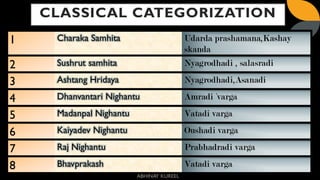
CLASSICAL CATEGORIZATION
1 Charaka Samhita Udarda prashamana,Kashay
skanda
2 Sushrut samhita Nyagrodhadi , salasradi
3 Ashtang Hridaya Nyagrodhadi,Asanadi
4 Dhanvantari Nighantu Amradi `varga
5 Madanpal Nighantu Vatadi varga
6 Kaiyadev Nighantu Oushadi varga
7 Raj Nighantu Prabhadradi varga
8 Bhavprakash Vatadi varga
ABHINAY KUREEL
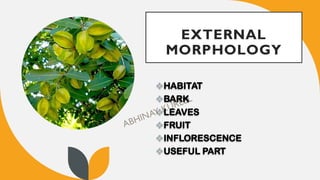
EXTERNAL
MORPHOLOGY
❖HABITAT
❖BARK
❖LEAVES
❖FRUIT
❖INFLORESCENCE
❖USEFUL PART
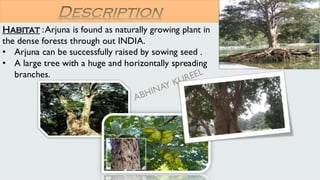
Habitat :Arjuna is found as naturally growing plant in
the dense forests through out INDIA.
• Arjuna can be successfully raised by sowing seed .
• A large tree with a huge and horizontally spreading
branches.
Description
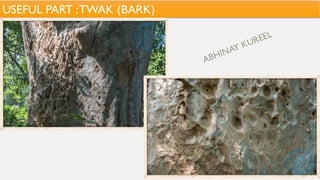
BARK
❑Smooth Grey
❑Epidermis is white outside and inner skin is
thick (brownish)
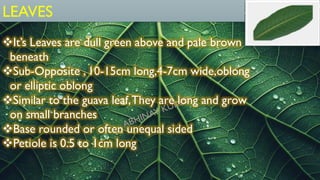
LEAVES
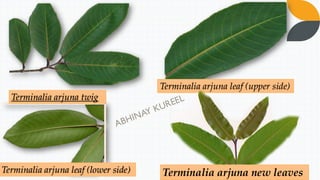
❖It’s Leaves are dull green above and pale brown
beneath
❖Sub-Opposite , 10-15cm long,4-7cm wide,oblong
or elliptic oblong
❖Similar to the guava leaf,They are long and grow
on small branches
❖Base rounded or often unequal sided
❖Petiole is 0.5 to 1cm long
Terminalia arjuna twig
Terminalia arjuna leaf (upper side)
Terminalia arjuna leaf (lower side) Terminalia arjuna new leaves
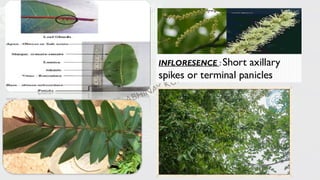
INFLORESENCE : Short axillary
spikes or terminal panicles
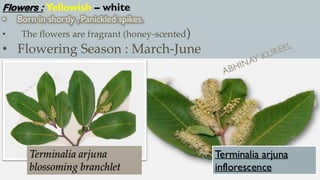
Flowers : Yellowish – white
• Born in shortly , Panickled spikes.
• The flowers are fragrant (honey-scented)
• Flowering Season : March-June
Terminalia arjuna
inflorescence
Terminalia arjuna
blossoming branchlet
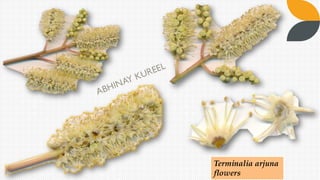
Terminalia arjuna
flowers
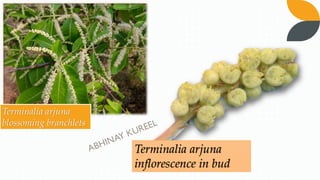
Terminalia arjuna
inflorescence in bud
Terminalia arjuna
blossoming branchlets
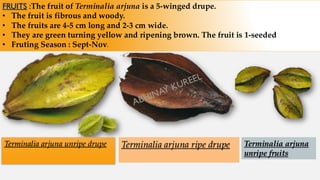
FRUITS :The fruit of Terminalia arjuna is a 5-winged drupe.
• The fruit is fibrous and woody.
• The fruits are 4-5 cm long and 2-3 cm wide.
• They are green turning yellow and ripening brown. The fruit is 1-seeded
• Fruting Season : Sept-Nov.
Terminalia arjuna unripe drupe Terminalia arjuna ripe drupe Terminalia arjuna
unripe fruits
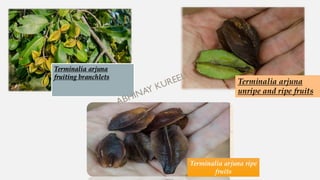
Terminalia arjuna
fruiting branchlets
Terminalia arjuna
unripe and ripe fruits
Terminalia arjuna ripe
fruits
USEFUL PART :TWAK (BARK)
CARDIOVASCULAR
• Arjuna bark is renowned for its heart-friendly properties.
• Studies suggest that it helps in improving cardiovascular
endurance, stabilizing blood pressure, and reducing cholesterol
levels, making it beneficial for overall heart health
•
•
ANTI-OXIDANT
• The bark contains powerful antioxidants such as flavonoids and
tannins.
• These compounds help in neutralizing free radicals, which can
reduce oxidative stress and mitigate the risk of chronic diseases.
WOUND HEALING
• Arjuna bark has been found to have antimicrobial properties, which
can aid in faster wound healing.
• It helps in preventing infections and promoting the regeneration of
damaged tissues.
ACCORDINGTO MODERN
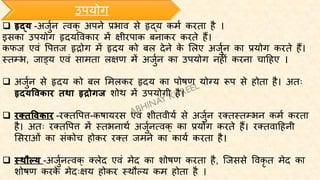
❑ हृद्य -अर्ुुन त्वक् अपने प्रभाव से हृद्य कमु करता है ।
इसका उपयोग हृियववकार में क्षीरपाक बनाकर करते हैं।
कफर् एवं वपत्तर् हृरोग में हृिय को बल िेने के ललए अर्ुुन का प्रयोग करते हैं।
स्तम्भ, र्ाड्य एवं सामता लक्षण में अर्ुुन का उपयोग नहीं करना चादहए ।
❑ अर्ुुन से हृिय को बल लमलकर हृिय का पोषण योग्य रूप से होता है। अतः
हृदयववकार तथा हृरोगर् शोथ में उपयोगी है।
❑ रक्तववकार -रक्तवपत्त-कषायरस एवं शीतवीयु से अर्ुुन रक्तस्तम्भन कमु करता
है। अतः रक्तवपत्त में स्तभनाथु अर्ुुनत्वक् का प्रयोग करते हैं। रक्तवादहनी
लसराओं का संकोच होकर रक्त र्मने का कायु करता है।
❑ स्थौल्य -अर्ुुनत्वक् क्लेि एवं मेि का शोषण करता है, जर्ससे ववकृ त मेि का
शोषण करक
े मेिःक्षय होकर स्थौल्य कम होता है ।
उपयोग
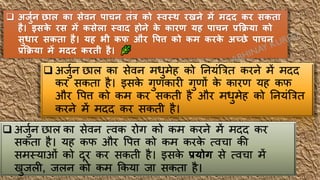
❑ अर्ुजन छाल का सेवन र्ाचन तंत्र को स्वस्थ रखने में मदद कर सकता
है। इसक
े रस में कसेला स्वाद होने क
े कारण यह र्ाचन प्रक्रिया को
सुधार सकता है। यह भी कफ और वर्त्त को कम करक
े अच्छे र्ाचन
प्रक्रिया में मदद करती है।
❑ अर्ुुन छाल का सेवन मधुमेह को र्नयंत्रित करने में मिि
कर सकता है। इसक
े गुणकारी गुणों क
े कारण यह कफ
और वपत्त को कम कर सकती है और मधुमेह को र्नयंत्रित
करने में मिि कर सकती है।
❑ अर्ुुन छाल का सेवन त्वक रोग को कम करने में मिि कर
सकता है। यह कफ और वपत्त को कम करक
े त्वचा की
समस्याओं को िूर कर सकती है। इसक
े प्रयोग से त्वचा में
खुर्ली, र्लन को कम ककया र्ा सकता है।
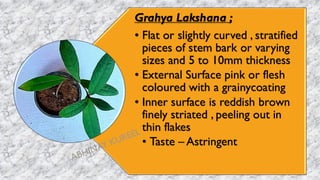
Grahya Lakshana ;
• Flat or slightly curved , stratified
pieces of stem bark or varying
sizes and 5 to 10mm thickness
• External Surface pink or flesh
coloured with a grainycoating
• Inner surface is reddish brown
finely striated , peeling out in
thin flakes
• Taste – Astringent
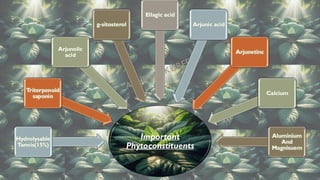
Important
Phytoconstituents
Hydrolysable
Tannis(15%)
Triterpenoid
saponin
Arjunolic
acid
g-sitosterol
Ellagic acid
Arjunic acid
Arjunetinc
Calcium
Aluminium
And
Magnisuem
RASADI PANCHAK
Rasa Kashaya
Guna Laghu,Ruksha
Vipaka Katu
Virya Shita
Prabhava Hradya
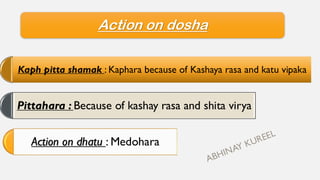
Action on dosha
Kaph pitta shamak : Kaphara because of Kashaya rasa and katu vipaka
Pittahara : Because of kashay rasa and shita virya
Action on dhatu : Medohara
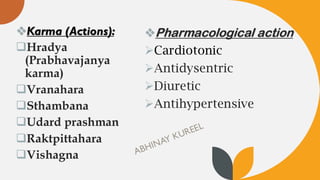
❖Karma (Actions):
❑Hradya
(Prabhavajanya
karma)
❑Vranahara
❑Sthambana
❑Udard prashman
❑Raktpittahara
❑Vishagna
❖Pharmacological action
➢Cardiotonic
➢Antidysentric
➢Diuretic
➢Antihypertensive
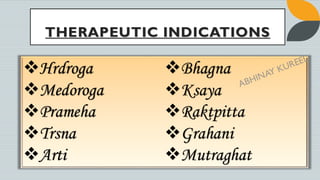
THERAPEUTIC INDICATIONS
❖Hrdroga
❖Medoroga
❖Prameha
❖Trsna
❖Arti
❖Bhagna
❖Ksaya
❖Raktpitta
❖Grahani
❖Mutraghat
Amayika PrayogaTherapeutic Administration)
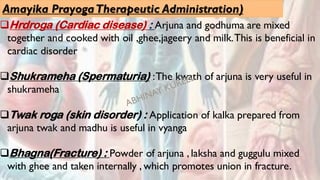
❑Hrdroga (Cardiac disease) : Arjuna and godhuma are mixed
together and cooked with oil ,ghee,jageery and milk.This is beneficial in
cardiac disorder
❑Shukrameha (Spermaturia) :The kwath of arjuna is very useful in
shukrameha
❑Twak roga (skin disorder) : Application of kalka prepared from
arjuna twak and madhu is useful in vyanga
❑Bhagna(Fracture) : Powder of arjuna , laksha and guggulu mixed
with ghee and taken internally , which promotes union in fracture.
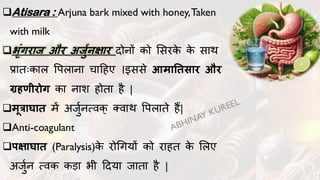
❑Atisara : Arjuna bark mixed with honey,Taken
with milk
❑भृंगरार् और अर्ुजनक्षार िोनों को लसरक
े क
े साथ
प्रातःकाल वपलाना चादहए ।इससे आमाततसार और
ग्रहणीरोग का नाश होता है |
❑मूत्राघात में अर्ुुनत्वक् क्वाथ वपलाते हैं|
❑Anti-coagulant
❑र्क्षाघात (Paralysis)क
े रोगगयों को राहत क
े ललए
अर्ुुन त्वक कडा भी दिया र्ाता है |
CONTRA-INDICATION
❖ Diarrhea and Dysentery: Arjuna bark may worsen diarrhea and dysentery due to its astringent
properties.
❖ Gallstones: Arjuna bark may increase bile secretion, which may worsen gallstone symptoms or complicate
gallstone treatment.
❖ Bleeding Disorders: Arjuna bark may worsen bleeding disorders like hemophilia or increase the risk of
bleeding in individuals taking anticoagulant medications.
❖ Additionally,Arjuna is known to possess astringent properties, which can affect the smooth muscle tone of
the uterus.Ayurveda suggests avoiding herbs with strong astringent properties during pregnancy as they
may stimulate uterine contractions, potentially leading to miscarriage
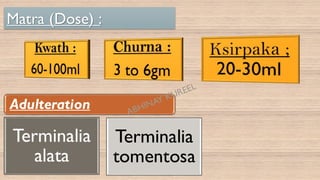
Adulteration
Terminalia
alata
Terminalia
tomentosa
Matra (Dose) :
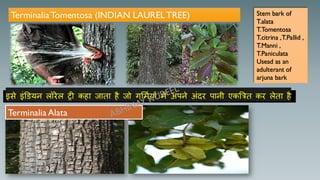
TerminaliaTomentosa (INDIAN LAUREL TREE)
इसे इंडियन लॉरेल ट्री कहा र्ाता है र्ो गलमुयों में अपने अंिर पानी एकत्रित कर लेता है
Terminalia Alata
Stem bark of
T.alata
T.Tomentosa
T.citrina ,T.Pallid ,
T.Manni ,
T.Paniculata
Usead as an
adulterant of
arjuna bark
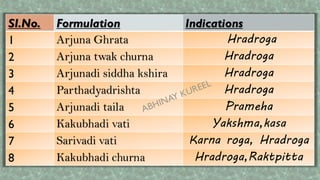
SI.No. Formulation Indications
1 Arjuna Ghrata Hradroga
2 Arjuna twak churna Hradroga
3 Arjunadi siddha kshira Hradroga
4 Parthadyadrishta Hradroga
5 Arjunadi taila Prameha
6 Kakubhadi vati Yakshma,kasa
7 Sarivadi vati Karna roga, Hradroga
8 Kakubhadi churna Hradroga,Raktpitta
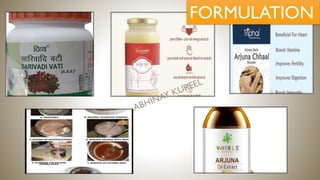
FORMULATION
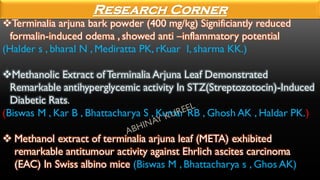
❖Terminalia arjuna bark powder (400 mg/kg) Significiantly reduced
formalin-induced odema , showed anti –inflammatory potential
(Halder s , bharal N , Mediratta PK, rKuar I, sharma KK.)
❖Methanolic Extract ofTerminalia Arjuna Leaf Demonstrated
Remarkable antihyperglycemic activity In STZ(Streptozotocin)-Induced
Diabetic Rats.
(Biswas M , Kar B , Bhattacharya S , Kumar RB , Ghosh AK , Haldar PK.)
❖ Methanol extract of terminalia arjuna leaf (META) exhibited
remarkable antitumour activity against Ehrlich ascites carcinoma
(EAC) In Swiss albino mice (Biswas M , Bhattacharya s , Ghos AK)
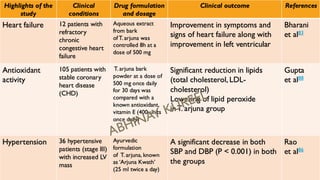
Research Corner
Highlights of the
study
Clinical
conditions
Drug formulation
and dosage
Clinical outcome References
Heart failure 12 patients with
refractory
chronic
congestive heart
failure
Aqueous extract
from bark
of T. arjuna was
controlled 8h at a
dose of 500 mg
Improvement in symptoms and
signs of heart failure along with
improvement in left ventricular
Bharani
et al83
Antioxidant
activity
105 patients with
stable coronary
heart disease
(CHD)
T. arjuna bark
powder at a dose of
500 mg once daily
for 30 days was
compared with a
known antioxidant,
vitamin E (400 units
once daily)
Significant reduction in lipids
(total cholesterol, LDL-
cholesterol)
Lowering of lipid peroxide
in T. arjuna group
Gupta
et al88
Hypertension 36 hypertensive
patients (stage III)
with increased LV
mass
Ayurvedic
formulation
of T. arjuna, known
as ‘Arjuna Kwath’
(25 ml twice a day)
A significant decrease in both
SBP and DBP (P < 0.001) in both
the groups
Rao
et al86
THANK YOU

ARJUNA PPT || (Terminalia Arjuna)

  • 1.
    ARJUNA Presented By :Abhinaykureel ABHINAY KUREEL
  • 2.
    1)Introduction 2)Synonyms 3)External Morphology 4)Uses 5)Grahya lakshana 6)PhytoConstituents 7)RasadiPanchak 8)Action on Dosa 9)Karma and Pharmacological action 10)Therapeutic Indications 11)Amyika Prayoga 12)Matra & Adulteration 13)Formulation 14)Research Corner Content ABHINAY KUREEL
  • 3.
    INTRODUCTION ➢Botanical Name :Terminalia arjuna Terminalia – Disposition of leaves of some species towards the end of branchlets Arjuna – Derived from Sanskrit word “Arjuna” ➢Family : Combretaceae ➢English name : White Murdah ➢Hindi Name :Arjan, कहु, कोह ➢Marathi Name :Anjan Classification of Dravya caraka ज्वरहर, ववरेचनोपग Susruta त्रिफला, मुस्तादि Bh.Pr.Ni Vatadi varga 26-27
  • 4.
    कक ु भोऽर्ुुननामाख्यो निीसर्ुश्चकीर्तुतः | इन्द्ररुवीरवृक्षश्च वीरश्च धवलः स्मृतः ||२३|| (भावप्रकाश र्नघन्द्टु वटादिवगु) ARJUNA अर्ुयर्त प्रापयर्त हृद्यताम् ।
  • 5.
    SYNONYMS ❑नदीसर्ज : Commonlygrows on river banks ❑धवल : Arjuna Bark is white in colour ❑इन्द्ररु : Tree which is very potent medicine ❑वीरवृक्ष : A potent tree ❑कक ु भ : A Large tree covers large area ❑सर्जणः Arjuna is a large tree with spreading branches ❑मधुगन्न्द्धप्रसूनकः : Arjuna flowers are sweet scented ❑ देवसालः Tree with strong action ❑हृरोगवैरर : Arjuna is very useful for cardiac problem
  • 6.
    CLASSICAL CATEGORIZATION 1 CharakaSamhita Udarda prashamana,Kashay skanda 2 Sushrut samhita Nyagrodhadi , salasradi 3 Ashtang Hridaya Nyagrodhadi,Asanadi 4 Dhanvantari Nighantu Amradi `varga 5 Madanpal Nighantu Vatadi varga 6 Kaiyadev Nighantu Oushadi varga 7 Raj Nighantu Prabhadradi varga 8 Bhavprakash Vatadi varga ABHINAY KUREEL
  • 7.
  • 8.
    Habitat :Arjuna isfound as naturally growing plant in the dense forests through out INDIA. • Arjuna can be successfully raised by sowing seed . • A large tree with a huge and horizontally spreading branches. Description
  • 9.
    BARK ❑Smooth Grey ❑Epidermis iswhite outside and inner skin is thick (brownish)
  • 10.
    LEAVES ❖It’s Leaves aredull green above and pale brown beneath ❖Sub-Opposite , 10-15cm long,4-7cm wide,oblong or elliptic oblong ❖Similar to the guava leaf,They are long and grow on small branches ❖Base rounded or often unequal sided ❖Petiole is 0.5 to 1cm long
  • 11.
    Terminalia arjuna twig Terminaliaarjuna leaf (upper side) Terminalia arjuna leaf (lower side) Terminalia arjuna new leaves
  • 12.
    INFLORESENCE : Shortaxillary spikes or terminal panicles
  • 13.
    Flowers : Yellowish– white • Born in shortly , Panickled spikes. • The flowers are fragrant (honey-scented) • Flowering Season : March-June Terminalia arjuna inflorescence Terminalia arjuna blossoming branchlet
  • 14.
  • 15.
    Terminalia arjuna inflorescence inbud Terminalia arjuna blossoming branchlets
  • 16.
    FRUITS :The fruitof Terminalia arjuna is a 5-winged drupe. • The fruit is fibrous and woody. • The fruits are 4-5 cm long and 2-3 cm wide. • They are green turning yellow and ripening brown. The fruit is 1-seeded • Fruting Season : Sept-Nov. Terminalia arjuna unripe drupe Terminalia arjuna ripe drupe Terminalia arjuna unripe fruits
  • 17.
    Terminalia arjuna fruiting branchlets Terminaliaarjuna unripe and ripe fruits Terminalia arjuna ripe fruits
  • 18.
  • 19.
    CARDIOVASCULAR • Arjuna barkis renowned for its heart-friendly properties. • Studies suggest that it helps in improving cardiovascular endurance, stabilizing blood pressure, and reducing cholesterol levels, making it beneficial for overall heart health • • ANTI-OXIDANT • The bark contains powerful antioxidants such as flavonoids and tannins. • These compounds help in neutralizing free radicals, which can reduce oxidative stress and mitigate the risk of chronic diseases. WOUND HEALING • Arjuna bark has been found to have antimicrobial properties, which can aid in faster wound healing. • It helps in preventing infections and promoting the regeneration of damaged tissues. ACCORDINGTO MODERN
  • 20.
    ❑ हृद्य -अर्ुुनत्वक् अपने प्रभाव से हृद्य कमु करता है । इसका उपयोग हृियववकार में क्षीरपाक बनाकर करते हैं। कफर् एवं वपत्तर् हृरोग में हृिय को बल िेने के ललए अर्ुुन का प्रयोग करते हैं। स्तम्भ, र्ाड्य एवं सामता लक्षण में अर्ुुन का उपयोग नहीं करना चादहए । ❑ अर्ुुन से हृिय को बल लमलकर हृिय का पोषण योग्य रूप से होता है। अतः हृदयववकार तथा हृरोगर् शोथ में उपयोगी है। ❑ रक्तववकार -रक्तवपत्त-कषायरस एवं शीतवीयु से अर्ुुन रक्तस्तम्भन कमु करता है। अतः रक्तवपत्त में स्तभनाथु अर्ुुनत्वक् का प्रयोग करते हैं। रक्तवादहनी लसराओं का संकोच होकर रक्त र्मने का कायु करता है। ❑ स्थौल्य -अर्ुुनत्वक् क्लेि एवं मेि का शोषण करता है, जर्ससे ववकृ त मेि का शोषण करक े मेिःक्षय होकर स्थौल्य कम होता है । उपयोग
  • 21.
    ❑ अर्ुजन छालका सेवन र्ाचन तंत्र को स्वस्थ रखने में मदद कर सकता है। इसक े रस में कसेला स्वाद होने क े कारण यह र्ाचन प्रक्रिया को सुधार सकता है। यह भी कफ और वर्त्त को कम करक े अच्छे र्ाचन प्रक्रिया में मदद करती है। ❑ अर्ुुन छाल का सेवन मधुमेह को र्नयंत्रित करने में मिि कर सकता है। इसक े गुणकारी गुणों क े कारण यह कफ और वपत्त को कम कर सकती है और मधुमेह को र्नयंत्रित करने में मिि कर सकती है। ❑ अर्ुुन छाल का सेवन त्वक रोग को कम करने में मिि कर सकता है। यह कफ और वपत्त को कम करक े त्वचा की समस्याओं को िूर कर सकती है। इसक े प्रयोग से त्वचा में खुर्ली, र्लन को कम ककया र्ा सकता है।
  • 22.
    Grahya Lakshana ; •Flat or slightly curved , stratified pieces of stem bark or varying sizes and 5 to 10mm thickness • External Surface pink or flesh coloured with a grainycoating • Inner surface is reddish brown finely striated , peeling out in thin flakes • Taste – Astringent
  • 23.
  • 24.
    RASADI PANCHAK Rasa Kashaya GunaLaghu,Ruksha Vipaka Katu Virya Shita Prabhava Hradya
  • 25.
    Action on dosha Kaphpitta shamak : Kaphara because of Kashaya rasa and katu vipaka Pittahara : Because of kashay rasa and shita virya Action on dhatu : Medohara
  • 26.
  • 27.
  • 28.
    Amayika PrayogaTherapeutic Administration) ❑Hrdroga(Cardiac disease) : Arjuna and godhuma are mixed together and cooked with oil ,ghee,jageery and milk.This is beneficial in cardiac disorder ❑Shukrameha (Spermaturia) :The kwath of arjuna is very useful in shukrameha ❑Twak roga (skin disorder) : Application of kalka prepared from arjuna twak and madhu is useful in vyanga ❑Bhagna(Fracture) : Powder of arjuna , laksha and guggulu mixed with ghee and taken internally , which promotes union in fracture.
  • 29.
    ❑Atisara : Arjunabark mixed with honey,Taken with milk ❑भृंगरार् और अर्ुजनक्षार िोनों को लसरक े क े साथ प्रातःकाल वपलाना चादहए ।इससे आमाततसार और ग्रहणीरोग का नाश होता है | ❑मूत्राघात में अर्ुुनत्वक् क्वाथ वपलाते हैं| ❑Anti-coagulant ❑र्क्षाघात (Paralysis)क े रोगगयों को राहत क े ललए अर्ुुन त्वक कडा भी दिया र्ाता है |
  • 30.
    CONTRA-INDICATION ❖ Diarrhea andDysentery: Arjuna bark may worsen diarrhea and dysentery due to its astringent properties. ❖ Gallstones: Arjuna bark may increase bile secretion, which may worsen gallstone symptoms or complicate gallstone treatment. ❖ Bleeding Disorders: Arjuna bark may worsen bleeding disorders like hemophilia or increase the risk of bleeding in individuals taking anticoagulant medications. ❖ Additionally,Arjuna is known to possess astringent properties, which can affect the smooth muscle tone of the uterus.Ayurveda suggests avoiding herbs with strong astringent properties during pregnancy as they may stimulate uterine contractions, potentially leading to miscarriage
  • 31.
  • 32.
    TerminaliaTomentosa (INDIAN LAURELTREE) इसे इंडियन लॉरेल ट्री कहा र्ाता है र्ो गलमुयों में अपने अंिर पानी एकत्रित कर लेता है Terminalia Alata Stem bark of T.alata T.Tomentosa T.citrina ,T.Pallid , T.Manni , T.Paniculata Usead as an adulterant of arjuna bark
  • 33.
    SI.No. Formulation Indications 1Arjuna Ghrata Hradroga 2 Arjuna twak churna Hradroga 3 Arjunadi siddha kshira Hradroga 4 Parthadyadrishta Hradroga 5 Arjunadi taila Prameha 6 Kakubhadi vati Yakshma,kasa 7 Sarivadi vati Karna roga, Hradroga 8 Kakubhadi churna Hradroga,Raktpitta
  • 34.
  • 35.
    ❖Terminalia arjuna barkpowder (400 mg/kg) Significiantly reduced formalin-induced odema , showed anti –inflammatory potential (Halder s , bharal N , Mediratta PK, rKuar I, sharma KK.) ❖Methanolic Extract ofTerminalia Arjuna Leaf Demonstrated Remarkable antihyperglycemic activity In STZ(Streptozotocin)-Induced Diabetic Rats. (Biswas M , Kar B , Bhattacharya S , Kumar RB , Ghosh AK , Haldar PK.) ❖ Methanol extract of terminalia arjuna leaf (META) exhibited remarkable antitumour activity against Ehrlich ascites carcinoma (EAC) In Swiss albino mice (Biswas M , Bhattacharya s , Ghos AK) Research Corner
  • 36.
    Highlights of the study Clinical conditions Drugformulation and dosage Clinical outcome References Heart failure 12 patients with refractory chronic congestive heart failure Aqueous extract from bark of T. arjuna was controlled 8h at a dose of 500 mg Improvement in symptoms and signs of heart failure along with improvement in left ventricular Bharani et al83 Antioxidant activity 105 patients with stable coronary heart disease (CHD) T. arjuna bark powder at a dose of 500 mg once daily for 30 days was compared with a known antioxidant, vitamin E (400 units once daily) Significant reduction in lipids (total cholesterol, LDL- cholesterol) Lowering of lipid peroxide in T. arjuna group Gupta et al88 Hypertension 36 hypertensive patients (stage III) with increased LV mass Ayurvedic formulation of T. arjuna, known as ‘Arjuna Kwath’ (25 ml twice a day) A significant decrease in both SBP and DBP (P < 0.001) in both the groups Rao et al86
  • 37.