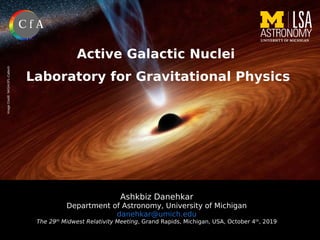
Active Galactic Nuclei
Laboratory for Gravitational Physics
Image
Credit:
NASA/JPL-Caltech
Image
Credit:
NASA/JPL-Caltech
Ashkbiz Danehkar
Department of Astronomy, University of Michigan
danehkar@umich.edu
The 29th
Midwest Relativity Meeting, Grand Rapids, Michigan, USA, October 4th
, 2019
10/04/2019 Midwest Relativity Meeting
2
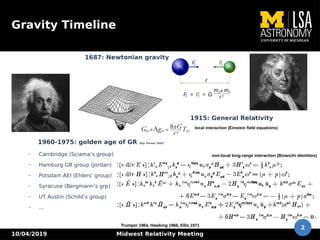
Gravity Timeline
1687: Newtonian gravity
1915: General Relativity
1960-1975: golden age of GR (Kip Throne 1995)
– Cambridge (Sciama’s group)
– Hamburg GR group (Jordan)
– Potsdam AEI (Ehlers’ group)
– Syracuse (Bergmann’s grp)
– UT Austin (Schild’s group)
– ...
local interaction (Einstein field equations)
non-local long-range interaction (Binanchi identities)
Trumper 1964, Hawking 1966, Ellis 1971
10/04/2019 Midwest Relativity Meeting
3
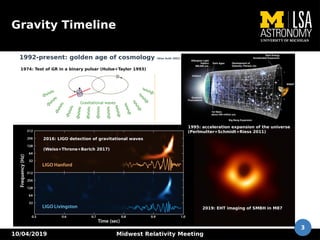
Gravity Timeline
1992-present: golden age of cosmology (Alan Guth 2001)
2019: EHT imaging of SMBH in M87
2016: LIGO detection of gravitational waves
●
(Weiss+Throne+Barich 2017)
1995: acceleration expansion of the universe
(Perlmutter+Schmidt+Riess 2011)
1974: Test of GR in a binary pulsar (Hulse+Taylor 1993)
10/04/2019 Midwest Relativity Meeting
4
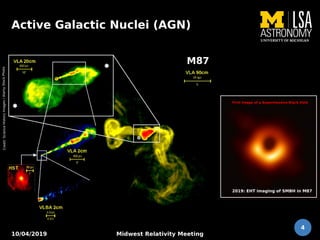
Active Galactic Nuclei (AGN)
2019: EHT imaging of SMBH in M87
First Image of a Supermassive Black Hole
Credit:
Science
History
Images
/
Alamy
Stock
Photo
10/04/2019 Midwest Relativity Meeting
5
Active Galactic Nuclei (AGN)
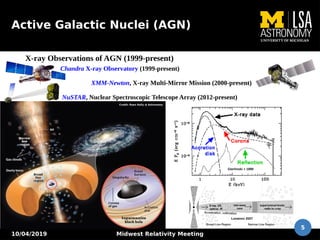
X-ray Observations of AGN (1999-present)
Chandra X-ray Observatory (1999-present)
XMM-Newton, X-ray Multi-Mirror Mission (2000-present)
NuSTAR, Nuclear Spectroscopic Telescope Array (2012-present)
Gierlinski + 1999
Lonanov 2007
Credit: Roen Kelly @ Astronomy
10/04/2019 Midwest Relativity Meeting
6
Active Galactic Nuclei (AGN)
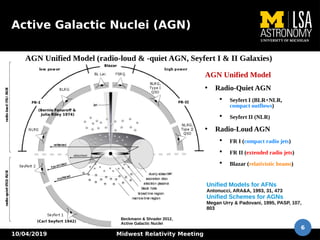
AGN Unified Model (radio-loud & -quiet AGN, Seyfert I & II Galaxies)
Beckmann & Shrader 2012,
Active Galactic Nuclei
Unified Models for AFNs
Antonucci, ARA&A, 1993, 31, 473
Unified Schemes for AGNs
Megan Urry & Padovani, 1995, PASP, 107,
803
(Bernie Fanaroff &
Julia Riley 1974)
AGN Unified Model
• Radio-Quiet AGN
 Seyfert I (BLR+NLR,
compact outflows)
 Seyfert II (NLR)
• Radio-Loud AGN
 FR I (compact radio jets)
 FR II (extended radio jets)
 Blazar (relativistic beams)
(Carl Seyfert 1942)
10/04/2019 Midwest Relativity Meeting
7
Active Galactic Nuclei (AGN)
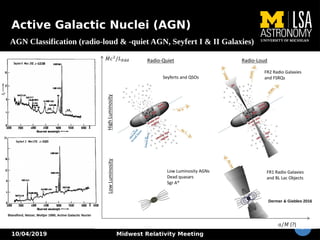
Dermer & Giebles 2016
AGN Classification (radio-loud & -quiet AGN, Seyfert I & II Galaxies)
Blandford, Netzer, Woltjer 1990, Active Galactic Nuclei
10/04/2019 Midwest Relativity Meeting
8
Ultra-fast Outflow in AGN
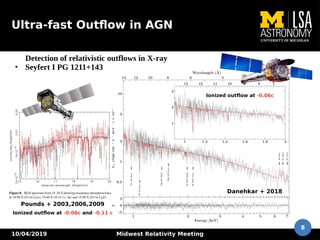
Detection of relativistic outflows in X-ray
●
Seyfert I PG 1211+143
Ionized outflow at -0.06c and -0.11 c
Danehkar + 2018
Pounds + 2003,2006,2009
Ionized outflow at -0.06c
10/04/2019 Midwest Relativity Meeting
9
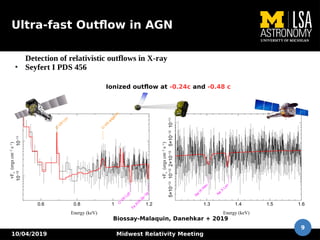
Ultra-fast Outflow in AGN
Detection of relativistic outflows in X-ray
●
Seyfert I PDS 456
Ionized outflow at -0.24c and -0.48 c
Biossay-Malaquin, Danehkar + 2019
10/04/2019 Midwest Relativity Meeting
10
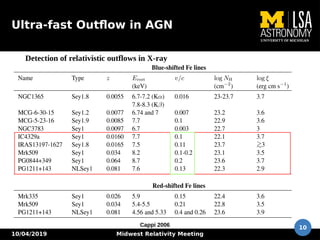
Ultra-fast Outflow in AGN
Detection of relativistic outflows in X-ray
Cappi 2006
10/04/2019 Midwest Relativity Meeting
11
Ultra-fast Outflow in AGN
Correlation between outflow kinematics and physical conditions
Tombesi + 2013
(Ultra-fast outflows)
(Warm Absorbers)
10/04/2019 Midwest Relativity Meeting
12
Ultra-fast Outflow in AGN
X-ray Ionized Outflows in AGN
Ionization parameter
Gas density
Radius
Column
density Shell thickness
Outflow
velocity
Luminosity (0.0136-
13.6 keV)
King & Pounds 2015; XMM-Newton & Suzaku
(42 radio-quiet, Tombesi et al 2011; 51 AGN, Gofford et al. 2013)
BH
mass
10/04/2019 Midwest Relativity Meeting
13
Ultra-fast Outflow in AGN
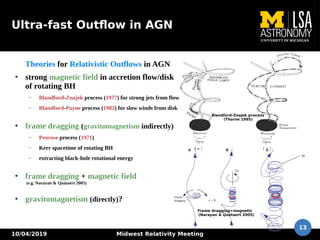
Theories for Relativistic Outflows in AGN
●
strong magnetic field in accretion flow/disk
of rotating BH
– Blandford-Znajek process (1977) for strong jets from flow
– Blandford-Payne process (1982) for slow winds from disk
●
frame dragging (gravitomagnetism indirectly)
– Penrose process (1971)
– Kerr spacetime of rotating BH
– extracting black-hole rotational energy
●
frame dragging + magnetic field
(e.g. Narayan & Quataert 2005)
●
gravitomagnetism (directly)?
Frame dragging+magnetic
(Narayan & Quataert 2005)
Blandford-Znajek process
(Thorne 1995)
10/04/2019 Midwest Relativity Meeting
14
Supermassive Black Hole Spin
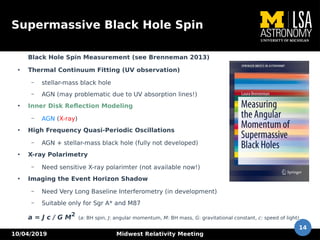
Black Hole Spin Measurement (see Brenneman 2013)
●
Thermal Continuum Fitting (UV observation)
– stellar-mass black hole
– AGN (may problematic due to UV absorption lines!)
●
Inner Disk Reflection Modeling
– AGN (X-ray)
●
High Frequency Quasi-Periodic Oscillations
– AGN + stellar-mass black hole (fully not developed)
●
X-ray Polarimetry
– Need sensitive X-ray polarimter (not available now!)
●
Imaging the Event Horizon Shadow
– Need Very Long Baseline Interferometry (in development)
– Suitable only for Sgr A* and M87
a = J c / G M2
(a: BH spin, J: angular momentum, M: BH mass, G: gravitational constant, c: speed of light)
10/04/2019 Midwest Relativity Meeting
15
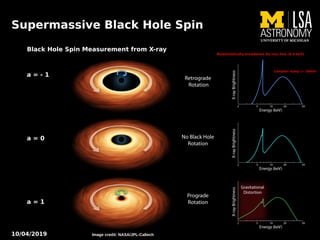
Supermassive Black Hole Spin
Relativistically broadened Kα iron line (6.4 keV)
Compton hump (> 10keV)
Black Hole Spin Measurement from X-ray
a = - 1
a = 0
a = 1
Image credit: NASA/JPL-Caltech
10/04/2019 Midwest Relativity Meeting
16
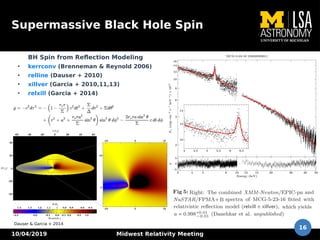
Supermassive Black Hole Spin
BH Spin from Reflection Modeling
●
kerrconv (Brenneman & Reynold 2006)
●
relline (Dauser + 2010)
●
xillver (Garcia + 2010,11,13)
●
relxill (Garcia + 2014)
Dauser & Garcia + 2014
10/04/2019 Midwest Relativity Meeting
17
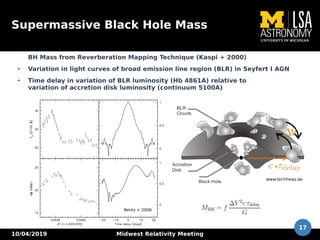
Supermassive Black Hole Mass
BH Mass from Reverberation Mapping Technique (Kaspi + 2000)
●
Variation in light curves of broad emission line region (BLR) in Seyfert I AGN
●
Time delay in variation of BLR luminosity (Hb 4861A) relative to
variation of accretion disk luminosity (continuum 5100A)
www.techfreaq.de
Bentz + 2006
10/04/2019 Midwest Relativity Meeting
18
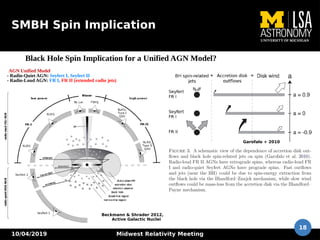
SMBH Spin Implication
Black Hole Spin Implication for a Unified AGN Model?
Garofalo + 2010
Beckmann & Shrader 2012,
Active Galactic Nuclei
AGN Unified Model
- Radio-Quiet AGN: Seyfert I, Seyfert II
- Radio-Loud AGN: FR I, FR II (extended radio jets)
10/04/2019 Midwest Relativity Meeting
19
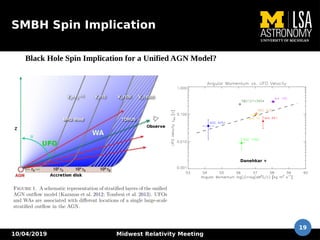
SMBH Spin Implication
Black Hole Spin Implication for a Unified AGN Model?
Danehkar +
10/04/2019 Midwest Relativity Meeting
20
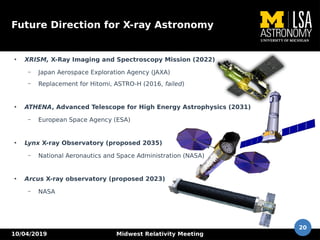
Future Direction for X-ray Astronomy
●
XRISM, X-Ray Imaging and Spectroscopy Mission (2022)
– Japan Aerospace Exploration Agency (JAXA)
– Replacement for Hitomi, ASTRO-H (2016, failed)
●
ATHENA, Advanced Telescope for High Energy Astrophysics (2031)
– European Space Agency (ESA)
●
Lynx X-ray Observatory (proposed 2035)
– National Aeronautics and Space Administration (NASA)
●
Arcus X-ray observatory (proposed 2023)
– NASA
10/04/2019 Midwest Relativity Meeting
21
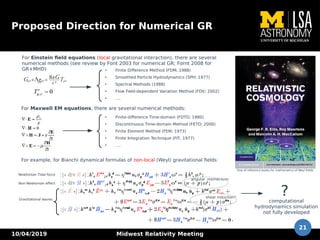
Proposed Direction for Numerical GR
●
Finite-difference Time-domain (FDTD; 1980)
●
Discontinuous Time-domain Method (FETD; 2000)
●
Finite Element Method (FEM; 1973)
●
Finite Integration Technique (FIT, 1977)
●
….
?
For Maxwell EM equations, there are several numerical methods:
For Einstein field equations (local gravitational interaction), there are several
numerical methods (see review by Font 2003 for numerical GR; Fornt 2008 for
GR+MHD)
For example, for Bianchi dynamical formulas of non-local (Weyl) gravitational fields:
Newtonian Tidal force
Non-Newtonian effect
Gravitational waves
shear induction?
computational
hydrodynamics simulation
not fully developed
angular momentum
●
Finite Difference Method (FDM; 1988)
●
Smoothed Particle Hydrodynamics (SPH; 1977)
●
Spectral Methods (1988)
●
Flow Field-dependent Variation Method (FDV; 2002)
●
….
One of reference books for mathematics of Weyl fields
10/04/2019 Midwest Relativity Meeting
22
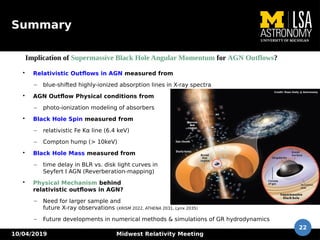
Summary
Implication of Supermassive Black Hole Angular Momentum for AGN Outflows?

Relativistic Outflows in AGN measured from
– blue-shifted highly-ionized absorption lines in X-ray spectra

AGN Outflow Physical conditions from
– photo-ionization modeling of absorbers

Black Hole Spin measured from
– relativistic Fe Kα line (6.4 keV)
– Compton hump (> 10keV)

Black Hole Mass measured from
– time delay in BLR vs. disk light curves in
Seyfert I AGN (Reverberation-mapping)

Physical Mechanism behind
relativistic outflows in AGN?
– Need for larger sample and
future X-ray observations (XRISM 2022, ATHENA 2031, Lynx 2035)
– Future developments in numerical methods & simulations of GR hydrodynamics
Credit: Roen Kelly @ Astronomy
Image
Credit:
NASA/JPL-Caltech
Image
Credit:
NASA/JPL-Caltech
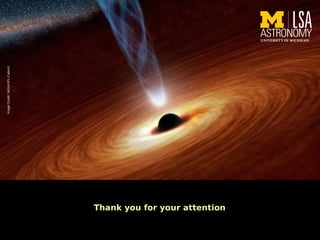
Thank you for your attention

Active Galactic Nuclei: Laboratory for Gravitational Physics

  • 1.
    Active Galactic Nuclei Laboratoryfor Gravitational Physics Image Credit: NASA/JPL-Caltech Image Credit: NASA/JPL-Caltech Ashkbiz Danehkar Department of Astronomy, University of Michigan danehkar@umich.edu The 29th Midwest Relativity Meeting, Grand Rapids, Michigan, USA, October 4th , 2019
  • 2.
    10/04/2019 Midwest RelativityMeeting 2 Gravity Timeline 1687: Newtonian gravity 1915: General Relativity 1960-1975: golden age of GR (Kip Throne 1995) – Cambridge (Sciama’s group) – Hamburg GR group (Jordan) – Potsdam AEI (Ehlers’ group) – Syracuse (Bergmann’s grp) – UT Austin (Schild’s group) – ... local interaction (Einstein field equations) non-local long-range interaction (Binanchi identities) Trumper 1964, Hawking 1966, Ellis 1971
  • 3.
    10/04/2019 Midwest RelativityMeeting 3 Gravity Timeline 1992-present: golden age of cosmology (Alan Guth 2001) 2019: EHT imaging of SMBH in M87 2016: LIGO detection of gravitational waves ● (Weiss+Throne+Barich 2017) 1995: acceleration expansion of the universe (Perlmutter+Schmidt+Riess 2011) 1974: Test of GR in a binary pulsar (Hulse+Taylor 1993)
  • 4.
    10/04/2019 Midwest RelativityMeeting 4 Active Galactic Nuclei (AGN) 2019: EHT imaging of SMBH in M87 First Image of a Supermassive Black Hole Credit: Science History Images / Alamy Stock Photo
  • 5.
    10/04/2019 Midwest RelativityMeeting 5 Active Galactic Nuclei (AGN) X-ray Observations of AGN (1999-present) Chandra X-ray Observatory (1999-present) XMM-Newton, X-ray Multi-Mirror Mission (2000-present) NuSTAR, Nuclear Spectroscopic Telescope Array (2012-present) Gierlinski + 1999 Lonanov 2007 Credit: Roen Kelly @ Astronomy
  • 6.
    10/04/2019 Midwest RelativityMeeting 6 Active Galactic Nuclei (AGN) AGN Unified Model (radio-loud & -quiet AGN, Seyfert I & II Galaxies) Beckmann & Shrader 2012, Active Galactic Nuclei Unified Models for AFNs Antonucci, ARA&A, 1993, 31, 473 Unified Schemes for AGNs Megan Urry & Padovani, 1995, PASP, 107, 803 (Bernie Fanaroff & Julia Riley 1974) AGN Unified Model • Radio-Quiet AGN  Seyfert I (BLR+NLR, compact outflows)  Seyfert II (NLR) • Radio-Loud AGN  FR I (compact radio jets)  FR II (extended radio jets)  Blazar (relativistic beams) (Carl Seyfert 1942)
  • 7.
    10/04/2019 Midwest RelativityMeeting 7 Active Galactic Nuclei (AGN) Dermer & Giebles 2016 AGN Classification (radio-loud & -quiet AGN, Seyfert I & II Galaxies) Blandford, Netzer, Woltjer 1990, Active Galactic Nuclei
  • 8.
    10/04/2019 Midwest RelativityMeeting 8 Ultra-fast Outflow in AGN Detection of relativistic outflows in X-ray ● Seyfert I PG 1211+143 Ionized outflow at -0.06c and -0.11 c Danehkar + 2018 Pounds + 2003,2006,2009 Ionized outflow at -0.06c
  • 9.
    10/04/2019 Midwest RelativityMeeting 9 Ultra-fast Outflow in AGN Detection of relativistic outflows in X-ray ● Seyfert I PDS 456 Ionized outflow at -0.24c and -0.48 c Biossay-Malaquin, Danehkar + 2019
  • 10.
    10/04/2019 Midwest RelativityMeeting 10 Ultra-fast Outflow in AGN Detection of relativistic outflows in X-ray Cappi 2006
  • 11.
    10/04/2019 Midwest RelativityMeeting 11 Ultra-fast Outflow in AGN Correlation between outflow kinematics and physical conditions Tombesi + 2013 (Ultra-fast outflows) (Warm Absorbers)
  • 12.
    10/04/2019 Midwest RelativityMeeting 12 Ultra-fast Outflow in AGN X-ray Ionized Outflows in AGN Ionization parameter Gas density Radius Column density Shell thickness Outflow velocity Luminosity (0.0136- 13.6 keV) King & Pounds 2015; XMM-Newton & Suzaku (42 radio-quiet, Tombesi et al 2011; 51 AGN, Gofford et al. 2013) BH mass
  • 13.
    10/04/2019 Midwest RelativityMeeting 13 Ultra-fast Outflow in AGN Theories for Relativistic Outflows in AGN ● strong magnetic field in accretion flow/disk of rotating BH – Blandford-Znajek process (1977) for strong jets from flow – Blandford-Payne process (1982) for slow winds from disk ● frame dragging (gravitomagnetism indirectly) – Penrose process (1971) – Kerr spacetime of rotating BH – extracting black-hole rotational energy ● frame dragging + magnetic field (e.g. Narayan & Quataert 2005) ● gravitomagnetism (directly)? Frame dragging+magnetic (Narayan & Quataert 2005) Blandford-Znajek process (Thorne 1995)
  • 14.
    10/04/2019 Midwest RelativityMeeting 14 Supermassive Black Hole Spin Black Hole Spin Measurement (see Brenneman 2013) ● Thermal Continuum Fitting (UV observation) – stellar-mass black hole – AGN (may problematic due to UV absorption lines!) ● Inner Disk Reflection Modeling – AGN (X-ray) ● High Frequency Quasi-Periodic Oscillations – AGN + stellar-mass black hole (fully not developed) ● X-ray Polarimetry – Need sensitive X-ray polarimter (not available now!) ● Imaging the Event Horizon Shadow – Need Very Long Baseline Interferometry (in development) – Suitable only for Sgr A* and M87 a = J c / G M2 (a: BH spin, J: angular momentum, M: BH mass, G: gravitational constant, c: speed of light)
  • 15.
    10/04/2019 Midwest RelativityMeeting 15 Supermassive Black Hole Spin Relativistically broadened Kα iron line (6.4 keV) Compton hump (> 10keV) Black Hole Spin Measurement from X-ray a = - 1 a = 0 a = 1 Image credit: NASA/JPL-Caltech
  • 16.
    10/04/2019 Midwest RelativityMeeting 16 Supermassive Black Hole Spin BH Spin from Reflection Modeling ● kerrconv (Brenneman & Reynold 2006) ● relline (Dauser + 2010) ● xillver (Garcia + 2010,11,13) ● relxill (Garcia + 2014) Dauser & Garcia + 2014
  • 17.
    10/04/2019 Midwest RelativityMeeting 17 Supermassive Black Hole Mass BH Mass from Reverberation Mapping Technique (Kaspi + 2000) ● Variation in light curves of broad emission line region (BLR) in Seyfert I AGN ● Time delay in variation of BLR luminosity (Hb 4861A) relative to variation of accretion disk luminosity (continuum 5100A) www.techfreaq.de Bentz + 2006
  • 18.
    10/04/2019 Midwest RelativityMeeting 18 SMBH Spin Implication Black Hole Spin Implication for a Unified AGN Model? Garofalo + 2010 Beckmann & Shrader 2012, Active Galactic Nuclei AGN Unified Model - Radio-Quiet AGN: Seyfert I, Seyfert II - Radio-Loud AGN: FR I, FR II (extended radio jets)
  • 19.
    10/04/2019 Midwest RelativityMeeting 19 SMBH Spin Implication Black Hole Spin Implication for a Unified AGN Model? Danehkar +
  • 20.
    10/04/2019 Midwest RelativityMeeting 20 Future Direction for X-ray Astronomy ● XRISM, X-Ray Imaging and Spectroscopy Mission (2022) – Japan Aerospace Exploration Agency (JAXA) – Replacement for Hitomi, ASTRO-H (2016, failed) ● ATHENA, Advanced Telescope for High Energy Astrophysics (2031) – European Space Agency (ESA) ● Lynx X-ray Observatory (proposed 2035) – National Aeronautics and Space Administration (NASA) ● Arcus X-ray observatory (proposed 2023) – NASA
  • 21.
    10/04/2019 Midwest RelativityMeeting 21 Proposed Direction for Numerical GR ● Finite-difference Time-domain (FDTD; 1980) ● Discontinuous Time-domain Method (FETD; 2000) ● Finite Element Method (FEM; 1973) ● Finite Integration Technique (FIT, 1977) ● …. ? For Maxwell EM equations, there are several numerical methods: For Einstein field equations (local gravitational interaction), there are several numerical methods (see review by Font 2003 for numerical GR; Fornt 2008 for GR+MHD) For example, for Bianchi dynamical formulas of non-local (Weyl) gravitational fields: Newtonian Tidal force Non-Newtonian effect Gravitational waves shear induction? computational hydrodynamics simulation not fully developed angular momentum ● Finite Difference Method (FDM; 1988) ● Smoothed Particle Hydrodynamics (SPH; 1977) ● Spectral Methods (1988) ● Flow Field-dependent Variation Method (FDV; 2002) ● …. One of reference books for mathematics of Weyl fields
  • 22.
    10/04/2019 Midwest RelativityMeeting 22 Summary Implication of Supermassive Black Hole Angular Momentum for AGN Outflows?  Relativistic Outflows in AGN measured from – blue-shifted highly-ionized absorption lines in X-ray spectra  AGN Outflow Physical conditions from – photo-ionization modeling of absorbers  Black Hole Spin measured from – relativistic Fe Kα line (6.4 keV) – Compton hump (> 10keV)  Black Hole Mass measured from – time delay in BLR vs. disk light curves in Seyfert I AGN (Reverberation-mapping)  Physical Mechanism behind relativistic outflows in AGN? – Need for larger sample and future X-ray observations (XRISM 2022, ATHENA 2031, Lynx 2035) – Future developments in numerical methods & simulations of GR hydrodynamics Credit: Roen Kelly @ Astronomy
  • 23.