time
VIRGO/
LIGO
LISA
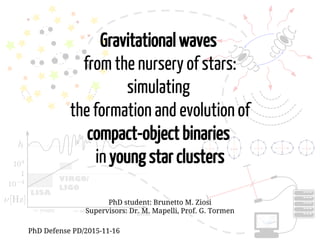
Gravitational waves
from the nursery of stars:
simulating
the formation and evolution of
compact-object binaries
in young star clusters
PhD student: Brunetto M. Ziosi
Supervisors: Dr. M. Mapelli, Prof. G. Tormen
PhD Defense PD/2015-11-16
My work
How do ...
  1 
... dynamics and metallicity...
  2 
... different initial structural
properties of SCs...
  3 
... a galactic tidal field...
impact on the population of double
compact-object binaries?
Introduction
Gravitational
Waves
Dynamics
Stellar
evolution
Outline
Gravitational waves
Gravitational
Waves
Dynamics
Stellar
evolution
GWs | What?
"... perturbations in the spacetime propagating at the speed of light... "
They propagate as waves
Spacetime is stretched by their passage
Predicted but never observed directly
2 / 38
Gw | PSR B1913+16
A.K.A. Hulse-Taylor binary pulsar
Provided the first indirect GW evidence
Discovered in 1974, Nobel prize in 1993
NS + pulsar system
Credits: Dr. K. Y. Michael WONG
3 / 38
GWs emission causes decrease
decrease
Very good measurement of the
period change
In perfect agreement with GR
predictions
Gw | PSR B1913+16
A.K.A. Hulse-Taylor binary pulsar
Provided the first indirect GW evidence
a
⇒ Pb
4 / 38
GWs emission causes decrease
decrease
Very good measurement of the
period change
In perfect agreement with GR
predictions
0
−5
−10
−15
−20
−25
−30
−35
−40
Cumulativeperiodshift(s)
1975 1980 1985 1990 1995 2000 2005
Year
Credits: Public domain
Gw | PSR B1913+16
A.K.A. Hulse-Taylor binary pulsar
Provided the first indirect GW evidence
a
⇒ Pb
4 / 38
Observations | NS-NS binaries
The Hulse-Taylor pulsar is not the only one observed
Few pulsar-NS system since 1974
from Duncan R. Lorimer 2008, Binary and Millisecond Pulsars
Hulse-Taylor
J0737-3039
5 / 38
Gw | Sources summary
Credits: NASA
6 / 38
GWs | Virgo/LIGO
Ground based GW detector: huge Michelson interferometer
Baseline required for these GWs observations: 100 km
impractical
Virgo arms ~ 3 km advanced optics tricks
Avd. LIGO already started scientific runs, Adv. Virgo starting in 2016!!
→
⇐
7 / 38
Double compact
object binaries are
expected to emit
detectable GWs
during inspiral and
merger events
Inspiral Merger Ringdown
Gw | Compact Binary Coalescence
8 / 38
Double compact
object binaries are
expected to emit
detectable GWs
during inspiral and
merger events
Inspiral Merger Ringdown
Gw | Compact Binary Coalescence
During the inspiral:
GW frequency:
Relative deformation (strain)
On the distance Earth-Sun it correspond to the diameter of an
Hydrogen atom
= 2ωGW ωorb
∼ 1 ×hGW 10
−21
( )
mchirp
M⊙
5/3
( )Pb
hours
−2/3
( )d
1 kpc
−1
with chirp mass  =mchirp
(m1 m2 )
3/5
( +m1 m2 )
1/5
8 / 38
GW frequency:
Strain:
Double compact
object binaries are
expected to emit
detectable GWs
during inspiral and
merger events
Inspiral Merger Ringdown
Gw | Compact Binary Coalescence
An example
= 11.5m1 M⊙
= 15.0m2 M⊙
a = 10.5 × km10
6
= 1.4 daysPb
d set to 1 Mpc
= 2 = 1.6 × HzfGW [ ]
G( )m1 m2
4π2
a3
1/2
10
−5
∼ = 6.1 ×hGW 10
−21
m5/3
chirp
P−2/3
b
d−1
10
−22
8 / 38
GW frequency:
Strain:
Double compact
object binaries are
expected to emit
detectable GWs
during inspiral and
merger events
Inspiral Merger Ringdown
Gw | Compact Binary Coalescence
An example (just before the merger: ISCO)
= 11.5m1 M⊙
= 15.0m2 M⊙
= 224 kmaISCO
= 0.004 sPb,ISCO
d set to 1 Mpc
= = 546.9 HzfGW,ISCO
c3
πG6
3/2
1
+m1 m2
= = 3.1 ×hGW,ISCO
G
c2
1
d
m1 m2
+m1 m2
10
−19
8 / 38
Dynamics
Gravitational
Waves
Dynamics
Stellar
evolution
Dynamics | Environment
Young Star Clusters are birthplace for ∼ 80% of stars in the local universe
(Lada&Lada, 2003)
They are building blocks of the galactic disks
Previous studies: Monte Carlo or population synthesis for the field
First study of YSCs with direct N-body simulations
9 / 38
Dynamics | YSC Facts
Young Star Clusters are birthplace for ∼ 80% of stars in the local universe
(Lada&Lada, 2003)
Previous studies: Monte Carlo or population synthesis for the field
(Collisional) YSCs are
young (< 100 Myr)
relatively massive ( ),
dense ( pc )
self-gravitating systems of stars
Dense YSCs are sites of intense dynamical activity:
Myr
−103
105
M⊙
−103
106 −3
∼ 10 − 100trelax
10 / 38
Dynamics | Relevant processes
11 / 38
3-body exchanges:
A single star take the place of
one of the binary members
higher probability if
BHs can acquire a
companion
Dynamics | Relevant processes
>mintruder mi
11 / 38
3-body encounters:
A single star take the place of
one of the binary members
higher probability if
BHs can acquire a
companion
Hardening: kinetic energy
transfer from the binary to the
perturber
semi-major axis decreases
effective GW sources in
shorter times
Dynamics | Relevant processes
>mintruder mi
11 / 38
Stellar evolution
Gravitational
Waves
Dynamics
Stellar
evolution
11 / 38
Massive stars lose mass by
stellar winds depending on
Compact object formation | Metallicity
Z
12 / 38
Massive stars lose mass by
stellar winds depending on
MS winds (Vink+2001)
LBV (Belczynski+2010, Humphreys+1994)
WR (Belczynski+2010)
Naked helium giants with
Compact object formation | Metallicity
Z
log ∝ f(L)M˙ 10
−6
( )Z
z⊙
0.86
M⊙ yr−1
> 6 × , ( ) >
L
L⊙
10
5 R
R⊙
( )L
L⊙
0.5
10
5
⇒ ∼ 1.5 ×M˙ 10
−4
M⊙ yr−1
> 25mZAMS M⊙
⇒ ∼M˙ 10
−5
( )L
10
5
L⊙
1.5
( )Z
Z⊙
0.86
M⊙ yr−1
12 / 38
Massive stars lose mass by
stellar winds depending on
MS winds (Vink+2001)
LBV (Belczynski+2010, Humphreys+1994)
WR (Belczynski+2010)
Naked helium giants with
Direct collapse to a BH without
SN explosion if
(Fryer 1999, Fryer&Kalogera 2001)
Direct collapse ⇒ more massive
BHs
Metal-poor stars ⇒ more likely
to collapse to BH directly
Metal poor stars can form more
massive remnants
Compact object formation | Metallicity
Z
log ∝ f(L)M˙ 10
−6
( )Z
z⊙
0.86
M⊙ yr−1
> 6 × , ( ) >
L
L⊙
10
5 R
R⊙
( )L
L⊙
0.5
10
5
⇒ ∼ 1.5 ×M˙ 10
−4
M⊙ yr−1
> 25mZAMS M⊙
⇒ ∼M˙ 10
−5
( )L
10
5
L⊙
1.5
( )Z
Z⊙
0.86
M⊙ yr−1
≥ 40 M ⊙Mfin
12 / 38
Compact object formation | Metallicity
13 / 38
(Portegies Zwart+2001)
N-body on GPU + stellar
evolution
Each particle is a star
(with its physics)
Updated to take into account
different metallicities
(Mapelli+2013)
Methods |StarLab
14 / 38
(Portegies Zwart+2001)
N-body on GPU + stellar
evolution
Each particle is a star
(with its physics)
Updated to take into account
different metallicities
(Mapelli+2013)
Methods |StarLab
N-body: kira
4th order Predictor-Corrector Hermite integrator
Approximate solution
Language: C++ and GRAPE / CUDA (Sapporo, Gaburov+2009)
15 / 38
(Portegies Zwart+2001)
N-body on GPU + stellar
evolution
Each particle is a star
(with its physics)
Updated to take into account
different metallicities
(Mapelli+2013)
Methods |StarLab
Stellar evolution: SeBa public version
MS stellar winds: only at
Post MS stellar winds: only at
Stellar parameters: at (Portegies Zwar+2001)
Z = Z⊙
Z = Z⊙
R, T, L = f(M) Z⊙
16 / 38
(Portegies Zwart+2001)
N-body on GPU + stellar
evolution
Each particle is a star
(with its physics)
Updated to take into account
different metallicities
(Mapelli+2013)
Methods |StarLab
Stellar evolution: SeBa Mapelli+2013
MS stellar winds: -dependent fitting formulas (Vink+2001)
Post MS stellar winds: LBV and WR evolution (Belczynski+2010,
Humphreys+1994)
Stellar parameters: polinomial fitting formulas
(Hurley+2000)
Z
R, T, L = f(M, Z)
17 / 38
Go(lang) wrapper for StarLab +
cluster monitors + simulation
management
Python seeker to extract the
binaries + analysis routines
Trace the complete history of
compact objects (BH, NS) in
binary
Move to database to include
positions and to simplify and
speed up future analyses
Methods |SlTools
(on GitHub)
18 / 38
time
VIRGO/
LIGO
LISA
My results
Ziosi et al. (2014)
600 N-body realizations of the
same cluster at
D&M | Simulations
Z = 0.01, 0.1, 1Z⊙
19 / 38
Ziosi et al. (2014)
600 N-body realizations of the
same cluster at
D&M | Simulations
Simulations parameters
Z = 0.01, 0.1, 1Z⊙
19 / 38
Mean number of
BH-BHs:
# BH-BH 10 # NS-
NS due to dynamics
# NS 4 # BH
Max number of
BH-BHs: 18
Negligible
dependence on Z,
but... (see after)
D&M | How many BH-BH?
∼ 3
∼
∼
20 / 38
D&M | BH-BH evolution in time
Lower Z case...
... build up the BH-BH population before...
have more stable binaries & longer lifetime than...
... higher metallicities ones because higher BH masses are allowed
BH­BH
Ziosi+2014
21 / 38
Distributions of
minimum semi-
major axis
spans a wide
range
NS-NS are 10 times
less numerous but
have small
Critical for
coalescence times
and merger
detection
D&M | Orbital properties ( )a
a
a
a
22 / 38
D&M | Masses
Higher BH masses at low Z because of direct collapse
Ziosi+2014
23 / 38
Chirp mass
Why chirp mass:
,
From observations we can
reconstruct
In our model
depends on Z test the
model
In black, of the best
merger candidates
Ziosi+2014
D&M | Chirp masses
=mchirp
(m1m2)
3/5
( +m1 m2)
1/5
∝νGW m−5/8
chirp
∝hGW m5/3
chirp
mchirp
mchirp
⇒
mchirp
24 / 38
D&M | Coalescence
timescale
Time a binary needs to merge
only for GWs emission (Peters 1964):
5 BH-BH merging in less than
over 600
simulations
17 NS-NS with ,
11 NS-NS merge during the
simulations
Starting point to compute the
merger and detection rates
∝tGW
(1−a4
e2
)
7/2
m1m2mT
∼ 14 GyrtH
<tGW tH
25 / 38
What else?
The results I obtained, however, stand on two critical assumptions:
Random realizations of a single SC model
SCs live unperturbed in isolation for 100 Myr
Both these assumptions can heavily affect my estimate of BH-BH
demographics.
26 / 38
Impact of YSC structural parameters on DCOBs
Grid of ~ simulations
Number of stars :
Central adimensional potential : 3, 5, 9
Virial radius [pc]: 1, 3, 5
Metallicity [Z ]: 0.1, 1
Primordial binaries fraction : 0.05, 0.1, 0.2
103
N∗ 1 × 104
W0
rv
Z ⊙
fPB
27 / 38
Sanity check
No BH-BH observations
Few NS-NS
from Duncan R. Lorimer 2008,
Binary and Millisecond Pulsars
Good agreement
Observations | NS-NS binaries
28 / 38
Consistent with
Ziosi+2014
~ 4 BH-BH / SC
but ~ 1 hard BH-BH /
SC
The soft binaries
dominate the
statistics
BH-BH favoured by
high density, high
concentration, low
Demographics | Average number of BH-BH
fPB
29 / 38
~ 0.1 NS-NS / SC
but 0 soft NS-NS / SC:
selection effect!
Higher favour
NS-NS
reflects
(no NS-NS from
dynamics)
BH-NS averages are
similar to NS-NS
ones
Demographics | Average number of NS-NS
Z
⟨nNS−NS⟩SC
fPB
30 / 38
High density favour
stable BH-BH
formation
High concentration
too
Small differences
between different
in the new
simulations
Vertical lines
highlight the core
collapse
Demographics | Average BH-BH per cluster per timestep
Z
∼ 2 Myrtcc [ ]
rvir
0.8 pc
3/2
[ ]
Mtot
3500 M⊙
1/2
31 / 38
All DCOB systems with
(BMCs)
BH-BH and NS-NS BMCs are in
agreement with Ziosi+2014
NS-NS are harder than BH-BH
shorter
Presence of BH-NS BMCs in the
new simulations
14 BH-BH and 45 NS-NS merging
within (in total)
34 NS-NS merging within 100
Myr
Demographics | Coalescence timescales
≤tGW tH
⇒ tGW
tH
32 / 38
BH-BH merger rate
shows no significant
dependence on the
YSC structural
properties
Errors through
MonteCarlo
approach
(underestimated)
Demographics | Merger rate
33 / 38
Demographics | Merger rate comparison with literature
34 / 38
BH-BH detection
rates are higher at:
higher densities
higher
concentrations
NS-NS and BH-NS
detection rates
follow the trends of
the merger rates
Demographics | Detection rate
∼ O(1 )Rdet yr−1
35 / 38
Starlab public version
Spherical bulge (Plummer) only
My upgraded version
Bulge + disk + halo
(Milky Way-like potential)
(Allen&Santillan 1991)
Tidal field | Before and after
36 / 38
Tidal field Example
37 / 38
Summary & Future prospects
➡ Adv. Virgo/LIGO are starting their science runs NOW!!
✔ BHs are likely to acquire a companion through dynamical exchanges
✔ Low metallicity favours the early formation of heavy and stable BH-BH
✔ Higher density and concentration and smaller favour BH-BH formation
✔ Good agreement with NS-NS observations
✔ Merger and detection rates do not depend on cluster properties
significantly and are compatible with literature
➡ Tidal field routines ready to investigate the role of tidal field
➡ Increase statistical sample
➡ Add Mikkola's regularization
➡ Multiple systems
➡ SC formation from a gas cloud
fPB
O(1 )yr−1
38 / 38
time
VIRGO/
LIGO
LISA
Thanks!! 恀

PhD Defense presentation

  • 1.
    time VIRGO/ LIGO LISA Gravitational waves from thenursery of stars: simulating the formation and evolution of compact-object binaries in young star clusters PhD student: Brunetto M. Ziosi Supervisors: Dr. M. Mapelli, Prof. G. Tormen PhD Defense PD/2015-11-16
  • 2.
    My work How do...   1  ... dynamics and metallicity...   2  ... different initial structural properties of SCs...   3  ... a galactic tidal field... impact on the population of double compact-object binaries? Introduction Gravitational Waves Dynamics Stellar evolution Outline
  • 3.
  • 4.
    GWs | What? "...perturbations in the spacetime propagating at the speed of light... " They propagate as waves Spacetime is stretched by their passage Predicted but never observed directly 2 / 38
  • 5.
    Gw | PSRB1913+16 A.K.A. Hulse-Taylor binary pulsar Provided the first indirect GW evidence Discovered in 1974, Nobel prize in 1993 NS + pulsar system Credits: Dr. K. Y. Michael WONG 3 / 38
  • 6.
    GWs emission causesdecrease decrease Very good measurement of the period change In perfect agreement with GR predictions Gw | PSR B1913+16 A.K.A. Hulse-Taylor binary pulsar Provided the first indirect GW evidence a ⇒ Pb 4 / 38
  • 7.
    GWs emission causesdecrease decrease Very good measurement of the period change In perfect agreement with GR predictions 0 −5 −10 −15 −20 −25 −30 −35 −40 Cumulativeperiodshift(s) 1975 1980 1985 1990 1995 2000 2005 Year Credits: Public domain Gw | PSR B1913+16 A.K.A. Hulse-Taylor binary pulsar Provided the first indirect GW evidence a ⇒ Pb 4 / 38
  • 8.
    Observations | NS-NSbinaries The Hulse-Taylor pulsar is not the only one observed Few pulsar-NS system since 1974 from Duncan R. Lorimer 2008, Binary and Millisecond Pulsars Hulse-Taylor J0737-3039 5 / 38
  • 9.
    Gw | Sourcessummary Credits: NASA 6 / 38
  • 10.
    GWs | Virgo/LIGO Groundbased GW detector: huge Michelson interferometer Baseline required for these GWs observations: 100 km impractical Virgo arms ~ 3 km advanced optics tricks Avd. LIGO already started scientific runs, Adv. Virgo starting in 2016!! → ⇐ 7 / 38
  • 11.
    Double compact object binariesare expected to emit detectable GWs during inspiral and merger events Inspiral Merger Ringdown Gw | Compact Binary Coalescence 8 / 38
  • 12.
    Double compact object binariesare expected to emit detectable GWs during inspiral and merger events Inspiral Merger Ringdown Gw | Compact Binary Coalescence During the inspiral: GW frequency: Relative deformation (strain) On the distance Earth-Sun it correspond to the diameter of an Hydrogen atom = 2ωGW ωorb ∼ 1 ×hGW 10 −21 ( ) mchirp M⊙ 5/3 ( )Pb hours −2/3 ( )d 1 kpc −1 with chirp mass  =mchirp (m1 m2 ) 3/5 ( +m1 m2 ) 1/5 8 / 38
  • 13.
    GW frequency: Strain: Double compact objectbinaries are expected to emit detectable GWs during inspiral and merger events Inspiral Merger Ringdown Gw | Compact Binary Coalescence An example = 11.5m1 M⊙ = 15.0m2 M⊙ a = 10.5 × km10 6 = 1.4 daysPb d set to 1 Mpc = 2 = 1.6 × HzfGW [ ] G( )m1 m2 4π2 a3 1/2 10 −5 ∼ = 6.1 ×hGW 10 −21 m5/3 chirp P−2/3 b d−1 10 −22 8 / 38
  • 14.
    GW frequency: Strain: Double compact objectbinaries are expected to emit detectable GWs during inspiral and merger events Inspiral Merger Ringdown Gw | Compact Binary Coalescence An example (just before the merger: ISCO) = 11.5m1 M⊙ = 15.0m2 M⊙ = 224 kmaISCO = 0.004 sPb,ISCO d set to 1 Mpc = = 546.9 HzfGW,ISCO c3 πG6 3/2 1 +m1 m2 = = 3.1 ×hGW,ISCO G c2 1 d m1 m2 +m1 m2 10 −19 8 / 38
  • 15.
  • 16.
    Dynamics | Environment YoungStar Clusters are birthplace for ∼ 80% of stars in the local universe (Lada&Lada, 2003) They are building blocks of the galactic disks Previous studies: Monte Carlo or population synthesis for the field First study of YSCs with direct N-body simulations 9 / 38
  • 17.
    Dynamics | YSCFacts Young Star Clusters are birthplace for ∼ 80% of stars in the local universe (Lada&Lada, 2003) Previous studies: Monte Carlo or population synthesis for the field (Collisional) YSCs are young (< 100 Myr) relatively massive ( ), dense ( pc ) self-gravitating systems of stars Dense YSCs are sites of intense dynamical activity: Myr −103 105 M⊙ −103 106 −3 ∼ 10 − 100trelax 10 / 38
  • 18.
    Dynamics | Relevantprocesses 11 / 38
  • 19.
    3-body exchanges: A singlestar take the place of one of the binary members higher probability if BHs can acquire a companion Dynamics | Relevant processes >mintruder mi 11 / 38
  • 20.
    3-body encounters: A singlestar take the place of one of the binary members higher probability if BHs can acquire a companion Hardening: kinetic energy transfer from the binary to the perturber semi-major axis decreases effective GW sources in shorter times Dynamics | Relevant processes >mintruder mi 11 / 38
  • 21.
  • 22.
    Massive stars losemass by stellar winds depending on Compact object formation | Metallicity Z 12 / 38
  • 23.
    Massive stars losemass by stellar winds depending on MS winds (Vink+2001) LBV (Belczynski+2010, Humphreys+1994) WR (Belczynski+2010) Naked helium giants with Compact object formation | Metallicity Z log ∝ f(L)M˙ 10 −6 ( )Z z⊙ 0.86 M⊙ yr−1 > 6 × , ( ) > L L⊙ 10 5 R R⊙ ( )L L⊙ 0.5 10 5 ⇒ ∼ 1.5 ×M˙ 10 −4 M⊙ yr−1 > 25mZAMS M⊙ ⇒ ∼M˙ 10 −5 ( )L 10 5 L⊙ 1.5 ( )Z Z⊙ 0.86 M⊙ yr−1 12 / 38
  • 24.
    Massive stars losemass by stellar winds depending on MS winds (Vink+2001) LBV (Belczynski+2010, Humphreys+1994) WR (Belczynski+2010) Naked helium giants with Direct collapse to a BH without SN explosion if (Fryer 1999, Fryer&Kalogera 2001) Direct collapse ⇒ more massive BHs Metal-poor stars ⇒ more likely to collapse to BH directly Metal poor stars can form more massive remnants Compact object formation | Metallicity Z log ∝ f(L)M˙ 10 −6 ( )Z z⊙ 0.86 M⊙ yr−1 > 6 × , ( ) > L L⊙ 10 5 R R⊙ ( )L L⊙ 0.5 10 5 ⇒ ∼ 1.5 ×M˙ 10 −4 M⊙ yr−1 > 25mZAMS M⊙ ⇒ ∼M˙ 10 −5 ( )L 10 5 L⊙ 1.5 ( )Z Z⊙ 0.86 M⊙ yr−1 ≥ 40 M ⊙Mfin 12 / 38
  • 25.
    Compact object formation| Metallicity 13 / 38
  • 26.
    (Portegies Zwart+2001) N-body onGPU + stellar evolution Each particle is a star (with its physics) Updated to take into account different metallicities (Mapelli+2013) Methods |StarLab 14 / 38
  • 27.
    (Portegies Zwart+2001) N-body onGPU + stellar evolution Each particle is a star (with its physics) Updated to take into account different metallicities (Mapelli+2013) Methods |StarLab N-body: kira 4th order Predictor-Corrector Hermite integrator Approximate solution Language: C++ and GRAPE / CUDA (Sapporo, Gaburov+2009) 15 / 38
  • 28.
    (Portegies Zwart+2001) N-body onGPU + stellar evolution Each particle is a star (with its physics) Updated to take into account different metallicities (Mapelli+2013) Methods |StarLab Stellar evolution: SeBa public version MS stellar winds: only at Post MS stellar winds: only at Stellar parameters: at (Portegies Zwar+2001) Z = Z⊙ Z = Z⊙ R, T, L = f(M) Z⊙ 16 / 38
  • 29.
    (Portegies Zwart+2001) N-body onGPU + stellar evolution Each particle is a star (with its physics) Updated to take into account different metallicities (Mapelli+2013) Methods |StarLab Stellar evolution: SeBa Mapelli+2013 MS stellar winds: -dependent fitting formulas (Vink+2001) Post MS stellar winds: LBV and WR evolution (Belczynski+2010, Humphreys+1994) Stellar parameters: polinomial fitting formulas (Hurley+2000) Z R, T, L = f(M, Z) 17 / 38
  • 30.
    Go(lang) wrapper forStarLab + cluster monitors + simulation management Python seeker to extract the binaries + analysis routines Trace the complete history of compact objects (BH, NS) in binary Move to database to include positions and to simplify and speed up future analyses Methods |SlTools (on GitHub) 18 / 38
  • 31.
  • 32.
    Ziosi et al.(2014) 600 N-body realizations of the same cluster at D&M | Simulations Z = 0.01, 0.1, 1Z⊙ 19 / 38
  • 33.
    Ziosi et al.(2014) 600 N-body realizations of the same cluster at D&M | Simulations Simulations parameters Z = 0.01, 0.1, 1Z⊙ 19 / 38
  • 34.
    Mean number of BH-BHs: #BH-BH 10 # NS- NS due to dynamics # NS 4 # BH Max number of BH-BHs: 18 Negligible dependence on Z, but... (see after) D&M | How many BH-BH? ∼ 3 ∼ ∼ 20 / 38
  • 35.
    D&M | BH-BHevolution in time Lower Z case... ... build up the BH-BH population before... have more stable binaries & longer lifetime than... ... higher metallicities ones because higher BH masses are allowed BH­BH Ziosi+2014 21 / 38
  • 36.
    Distributions of minimum semi- majoraxis spans a wide range NS-NS are 10 times less numerous but have small Critical for coalescence times and merger detection D&M | Orbital properties ( )a a a a 22 / 38
  • 37.
    D&M | Masses HigherBH masses at low Z because of direct collapse Ziosi+2014 23 / 38
  • 38.
    Chirp mass Why chirpmass: , From observations we can reconstruct In our model depends on Z test the model In black, of the best merger candidates Ziosi+2014 D&M | Chirp masses =mchirp (m1m2) 3/5 ( +m1 m2) 1/5 ∝νGW m−5/8 chirp ∝hGW m5/3 chirp mchirp mchirp ⇒ mchirp 24 / 38
  • 39.
    D&M | Coalescence timescale Timea binary needs to merge only for GWs emission (Peters 1964): 5 BH-BH merging in less than over 600 simulations 17 NS-NS with , 11 NS-NS merge during the simulations Starting point to compute the merger and detection rates ∝tGW (1−a4 e2 ) 7/2 m1m2mT ∼ 14 GyrtH <tGW tH 25 / 38
  • 40.
    What else? The resultsI obtained, however, stand on two critical assumptions: Random realizations of a single SC model SCs live unperturbed in isolation for 100 Myr Both these assumptions can heavily affect my estimate of BH-BH demographics. 26 / 38
  • 41.
    Impact of YSCstructural parameters on DCOBs Grid of ~ simulations Number of stars : Central adimensional potential : 3, 5, 9 Virial radius [pc]: 1, 3, 5 Metallicity [Z ]: 0.1, 1 Primordial binaries fraction : 0.05, 0.1, 0.2 103 N∗ 1 × 104 W0 rv Z ⊙ fPB 27 / 38
  • 42.
    Sanity check No BH-BHobservations Few NS-NS from Duncan R. Lorimer 2008, Binary and Millisecond Pulsars Good agreement Observations | NS-NS binaries 28 / 38
  • 43.
    Consistent with Ziosi+2014 ~ 4BH-BH / SC but ~ 1 hard BH-BH / SC The soft binaries dominate the statistics BH-BH favoured by high density, high concentration, low Demographics | Average number of BH-BH fPB 29 / 38
  • 44.
    ~ 0.1 NS-NS/ SC but 0 soft NS-NS / SC: selection effect! Higher favour NS-NS reflects (no NS-NS from dynamics) BH-NS averages are similar to NS-NS ones Demographics | Average number of NS-NS Z ⟨nNS−NS⟩SC fPB 30 / 38
  • 45.
    High density favour stableBH-BH formation High concentration too Small differences between different in the new simulations Vertical lines highlight the core collapse Demographics | Average BH-BH per cluster per timestep Z ∼ 2 Myrtcc [ ] rvir 0.8 pc 3/2 [ ] Mtot 3500 M⊙ 1/2 31 / 38
  • 46.
    All DCOB systemswith (BMCs) BH-BH and NS-NS BMCs are in agreement with Ziosi+2014 NS-NS are harder than BH-BH shorter Presence of BH-NS BMCs in the new simulations 14 BH-BH and 45 NS-NS merging within (in total) 34 NS-NS merging within 100 Myr Demographics | Coalescence timescales ≤tGW tH ⇒ tGW tH 32 / 38
  • 47.
    BH-BH merger rate showsno significant dependence on the YSC structural properties Errors through MonteCarlo approach (underestimated) Demographics | Merger rate 33 / 38
  • 48.
    Demographics | Mergerrate comparison with literature 34 / 38
  • 49.
    BH-BH detection rates arehigher at: higher densities higher concentrations NS-NS and BH-NS detection rates follow the trends of the merger rates Demographics | Detection rate ∼ O(1 )Rdet yr−1 35 / 38
  • 50.
    Starlab public version Sphericalbulge (Plummer) only My upgraded version Bulge + disk + halo (Milky Way-like potential) (Allen&Santillan 1991) Tidal field | Before and after 36 / 38
  • 51.
  • 52.
    Summary & Futureprospects ➡ Adv. Virgo/LIGO are starting their science runs NOW!! ✔ BHs are likely to acquire a companion through dynamical exchanges ✔ Low metallicity favours the early formation of heavy and stable BH-BH ✔ Higher density and concentration and smaller favour BH-BH formation ✔ Good agreement with NS-NS observations ✔ Merger and detection rates do not depend on cluster properties significantly and are compatible with literature ➡ Tidal field routines ready to investigate the role of tidal field ➡ Increase statistical sample ➡ Add Mikkola's regularization ➡ Multiple systems ➡ SC formation from a gas cloud fPB O(1 )yr−1 38 / 38
  • 53.