ASBM International
Conference
ASBM International
Conference Date-8/3/2013Date-8/3/2013
TopicTopic
Inclusive Growth need to retrieve by Agricultural
Business Models through SMEs by Small Farming
Community
Inclusive Growth need to retrieve by Agricultural
Business Models through SMEs by Small Farming
Community
Department of Agricultural Extension
Faculty of Social Science
College Of Agriculture
Odisha University Of Agriculture & Technology
Bhubaneswar-3
Seminar-ISeminar-I
Speaker: Bibhu Santosh BeheraSpeaker: Bibhu Santosh Behera
Post Graduate Research ScholarPost Graduate Research Scholar
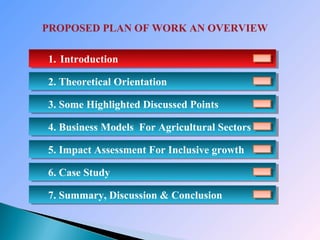
1. Introduction1. Introduction
2. Theoretical Orientation2. Theoretical Orientation
3. Some Highlighted Discussed Points3. Some Highlighted Discussed Points
4. Business Models For Agricultural Sectors4. Business Models For Agricultural Sectors
5. Impact Assessment For Inclusive growth5. Impact Assessment For Inclusive growth
6. Case Study6. Case Study
7. Summary, Discussion & Conclusion7. Summary, Discussion & Conclusion
PROPOSED PLAN OF WORK AN OVERVIEW
 Agrifood markets are in an unprecedented state of flux, with domestic markets
undergoing rapid but uneven modernization. Market modernization offers increased
economic opportunities for producers, small and medium-sized enterprises (SMEs),
and other actors in the value chain, but there are also risks of local producers and
domestic businesses being bypassed, or failing to meet costly market entry
requirements which favour the better-resourced. If the Millennium Development
Goals (MDGs) are to be even partially met by 2015, then market modernization and
restructuring has to deliver a growth and equity ‘win-win’. There is a growing body of
experience showing that “win-win” outcomes are possible through commercially
viable business models – ways of creating value within a market network of
producers, suppliers and consumers – which involve small farmers and SMEs. These
business models for small farmers and SMEs must deliver essential services to
producers and ensure reliable supply to buyers, while also addressing the high
transaction costs and risks that buyers face when purchasing from large numbers of
fragmented, cash-strapped small farmers and SMEs. This brief gives an overview of
lessons learned about business models for including small farmers and SMEs in
modernizing markets and agro-industries.
 Policies of privatization, liberalization and accession to the WTO or EU in the 1980s to
2000s were followed by a wave of investments by food manufacturers and retailers.
Combined with rising urbanization and changes in consumer preferences and purchasing
power, these have led to a growth of modern food processing and retailing which often
have requirements or industry standards for quality and safety built on traceability and
certification. Conformity with labour and environmental standards may also be required,
with compliance costs proportionately much higher for smallholders. To achieve the
multiple objectives of quality, safety and consumer assurance, reliability of supply, lower
prices and sustainability, the business models of modern processors and retailers are
being built on collaboration, co-investment and knowledge sharing between producers,
suppliers, processors and retailers. Ultimately, the extent of collaboration and
coinvestment depends on the nature of the product (perishable, differentiated or branded
product, or bulk commodity) and the nature of the end buyer (branded retailer, wholesale,
etc.), but there is a general trend in most sectors and locations towards increased
collaboration and co-investment among chain participants. The most collaborative supply
chains are for perishable commodities such as fresh vegetables, and certified products
such as organic or Freetrade coffee. Empirical research shows that modern market
channels are not inherently exclusionary to small-scale farms. However, buyers generally
seek out larger suppliers and also seek out areas that are already favoured by
agribusiness, such as zones involved in export production. Proactive initiatives and
innovative business models are needed to create the incentives and conditions for
sustained inclusion of small farmers and SMEs.
 Facilities From Govt.schemes/Yojana
 1.SFURTI 2.KVIC 3.MSME 4.ACAABC(By IMAGE,MANAGE &
NABARD) 4.Rajiv Gandhi Udyogi Mitra Yojana 5.R.I.D.C
 Tribal Business Models:-TDF-WADI Horticultural Models in tribal
pockets.Organic Farming Business Models,Integrated livelihood
business models.
 Business Entrepreneur/Agripreneur Models, Occupation based
business models.
 Gender based business models:-Women Enterpreneur Business
Models,Feminization of agripreneur models.National Alliance on
Youth enterpreneurship business models.
 Miscellaneous models:-Crop specific, Input specific,Storage & PHT
specific,Non-farm rural Cottage based Intervention models.ICT
based Business Models.
 Contract Farming Integrated Business Models etc.
 PMEGP/PMRY
 MSE-CLUSTER DEVT. MODEL
 CGMSE/NATIONAL AWARD SCHEME
 MAHILA UDYAMI YOJANA
 SBI STREE SHAKTI PACKAGE
 PRIYA DARSHINI YOJANA
 NAYE/FLO
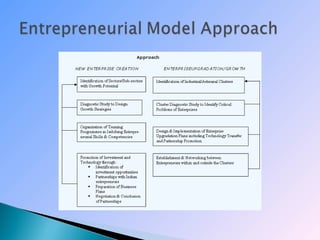
 CONTRACT FARMING ENTERPRENEURSHIP MODELS
 1.CENTRALIZED,2.NUCLEUS ESTATE 3.MULTIPARTITE 4.INFORMAL
5.INTERMEDIARY
 MISCELENOUS:-PPP MODEL/CCC MODEL/PCP MODEL
 BSB MODEL,BVB MODEL, BPB MODEL
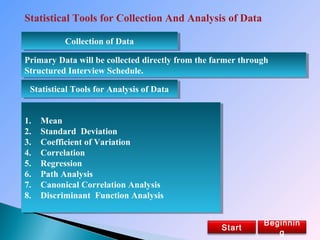
1. Mean
2. Standard Deviation
3. Coefficient of Variation
4. Correlation
5. Regression
6. Path Analysis
7. Canonical Correlation Analysis
8. Discriminant Function Analysis
1. Mean
2. Standard Deviation
3. Coefficient of Variation
4. Correlation
5. Regression
6. Path Analysis
7. Canonical Correlation Analysis
8. Discriminant Function Analysis
Statistical Tools for Analysis of DataStatistical Tools for Analysis of Data
Collection of DataCollection of Data
Primary Data will be collected directly from the farmer through
Structured Interview Schedule.
Primary Data will be collected directly from the farmer through
Structured Interview Schedule.
Statistical Tools for Collection And Analysis of Data
Beginnin
g
Start
 The nature of the business model for linking small farmers and SMEs to
modern markets and agro-industries is one of the most important
determinants of how value is created or lost by supply chain actors,
including smallholders and SMEs. Effective business models help farmers
and other chain actors by building alliances and linkages by all chain
participants. This rarely occurs spontaneously, given the often adversarial
relationships that characterize commercial links in the agrifood sector. As a
result, specific actions to clarify and develop plans for joint action at the
chain scale are needed. Some good tools can be found in participatory
chain analysis and upgrading manuals (e.g. Lundy et al., 2006; Vermeulen
et al., 2008).The models may be economically viable,technically feasible &
socially acceptable until unless the models as per their occupation/livelihood
based.The concept road map for developing Agribusiness models should be
should be developed.Hence contigent action plan should be framed which
may fit for the fruitful result.Agriculture means growth & never ending
process.As per Jawahar Lal Nehru “ Every one stops but not
Agriculture”.Growth is measured by production, productivity , augmentivity,
& Promotion.So finally we need to give a big hand to the
“Agripreneurship /Agritrading “ activities in Green Sustainable way to rethink
about our future.
 
 Berdegué, J.A., Biénabe, E., and Peppelenbos, L. (2008). Innovative Practice in Connecting
Smallscale Producers with
 Dynamic Markets. www.regoverningmarkets.org
 Lundy, M., Gottret, M.V., Best, R., and Ferris, R.S.B. (2006). A guide to evaluating and
strengthening rural business
 development services. Field Manual. Centre Internacional de Agricultura Tropical (CIAT), Cali,
Colombia.
 Shepherd, A (2007). Approaches to Linking Producers to Markets. FAO Agricultural Support
Systems Division, Rome.
 http://www.fao.org/ag/ags/subjects/en/agmarket/linkages/agsf13.pdf
 FAO support: Doyle Baker
 Suggested web resources
 Empowering Smallholder Farmers in Markets www.esfim.org
 FAO Linking Farmers to Markets www.fao.org/ag/Ags/subjects/en/agmarket/linkages
 Inter-agency BDS website www.bdsknowledge.org
 Making Markets Work Better for the Poor project www.markets4poor.org
 Regoverning Markets programme www.regoverningmarkets.org
 Sustainable Food Lab www.sustainablefood.org
 Alliance on Business Solutions for Development www.inclusivebusiness.org
Thank You
Start

Bibhu international conf-ouat 2003

  • 1.
    ASBM International Conference ASBM International ConferenceDate-8/3/2013Date-8/3/2013 TopicTopic Inclusive Growth need to retrieve by Agricultural Business Models through SMEs by Small Farming Community Inclusive Growth need to retrieve by Agricultural Business Models through SMEs by Small Farming Community Department of Agricultural Extension Faculty of Social Science College Of Agriculture Odisha University Of Agriculture & Technology Bhubaneswar-3 Seminar-ISeminar-I Speaker: Bibhu Santosh BeheraSpeaker: Bibhu Santosh Behera Post Graduate Research ScholarPost Graduate Research Scholar
  • 2.
    1. Introduction1. Introduction 2.Theoretical Orientation2. Theoretical Orientation 3. Some Highlighted Discussed Points3. Some Highlighted Discussed Points 4. Business Models For Agricultural Sectors4. Business Models For Agricultural Sectors 5. Impact Assessment For Inclusive growth5. Impact Assessment For Inclusive growth 6. Case Study6. Case Study 7. Summary, Discussion & Conclusion7. Summary, Discussion & Conclusion PROPOSED PLAN OF WORK AN OVERVIEW
  • 3.
     Agrifood marketsare in an unprecedented state of flux, with domestic markets undergoing rapid but uneven modernization. Market modernization offers increased economic opportunities for producers, small and medium-sized enterprises (SMEs), and other actors in the value chain, but there are also risks of local producers and domestic businesses being bypassed, or failing to meet costly market entry requirements which favour the better-resourced. If the Millennium Development Goals (MDGs) are to be even partially met by 2015, then market modernization and restructuring has to deliver a growth and equity ‘win-win’. There is a growing body of experience showing that “win-win” outcomes are possible through commercially viable business models – ways of creating value within a market network of producers, suppliers and consumers – which involve small farmers and SMEs. These business models for small farmers and SMEs must deliver essential services to producers and ensure reliable supply to buyers, while also addressing the high transaction costs and risks that buyers face when purchasing from large numbers of fragmented, cash-strapped small farmers and SMEs. This brief gives an overview of lessons learned about business models for including small farmers and SMEs in modernizing markets and agro-industries.
  • 4.
     Policies ofprivatization, liberalization and accession to the WTO or EU in the 1980s to 2000s were followed by a wave of investments by food manufacturers and retailers. Combined with rising urbanization and changes in consumer preferences and purchasing power, these have led to a growth of modern food processing and retailing which often have requirements or industry standards for quality and safety built on traceability and certification. Conformity with labour and environmental standards may also be required, with compliance costs proportionately much higher for smallholders. To achieve the multiple objectives of quality, safety and consumer assurance, reliability of supply, lower prices and sustainability, the business models of modern processors and retailers are being built on collaboration, co-investment and knowledge sharing between producers, suppliers, processors and retailers. Ultimately, the extent of collaboration and coinvestment depends on the nature of the product (perishable, differentiated or branded product, or bulk commodity) and the nature of the end buyer (branded retailer, wholesale, etc.), but there is a general trend in most sectors and locations towards increased collaboration and co-investment among chain participants. The most collaborative supply chains are for perishable commodities such as fresh vegetables, and certified products such as organic or Freetrade coffee. Empirical research shows that modern market channels are not inherently exclusionary to small-scale farms. However, buyers generally seek out larger suppliers and also seek out areas that are already favoured by agribusiness, such as zones involved in export production. Proactive initiatives and innovative business models are needed to create the incentives and conditions for sustained inclusion of small farmers and SMEs.
  • 6.
     Facilities FromGovt.schemes/Yojana  1.SFURTI 2.KVIC 3.MSME 4.ACAABC(By IMAGE,MANAGE & NABARD) 4.Rajiv Gandhi Udyogi Mitra Yojana 5.R.I.D.C  Tribal Business Models:-TDF-WADI Horticultural Models in tribal pockets.Organic Farming Business Models,Integrated livelihood business models.  Business Entrepreneur/Agripreneur Models, Occupation based business models.  Gender based business models:-Women Enterpreneur Business Models,Feminization of agripreneur models.National Alliance on Youth enterpreneurship business models.  Miscellaneous models:-Crop specific, Input specific,Storage & PHT specific,Non-farm rural Cottage based Intervention models.ICT based Business Models.  Contract Farming Integrated Business Models etc.
  • 7.
     PMEGP/PMRY  MSE-CLUSTERDEVT. MODEL  CGMSE/NATIONAL AWARD SCHEME  MAHILA UDYAMI YOJANA  SBI STREE SHAKTI PACKAGE  PRIYA DARSHINI YOJANA  NAYE/FLO  CONTRACT FARMING ENTERPRENEURSHIP MODELS  1.CENTRALIZED,2.NUCLEUS ESTATE 3.MULTIPARTITE 4.INFORMAL 5.INTERMEDIARY  MISCELENOUS:-PPP MODEL/CCC MODEL/PCP MODEL  BSB MODEL,BVB MODEL, BPB MODEL
  • 9.
    1. Mean 2. StandardDeviation 3. Coefficient of Variation 4. Correlation 5. Regression 6. Path Analysis 7. Canonical Correlation Analysis 8. Discriminant Function Analysis 1. Mean 2. Standard Deviation 3. Coefficient of Variation 4. Correlation 5. Regression 6. Path Analysis 7. Canonical Correlation Analysis 8. Discriminant Function Analysis Statistical Tools for Analysis of DataStatistical Tools for Analysis of Data Collection of DataCollection of Data Primary Data will be collected directly from the farmer through Structured Interview Schedule. Primary Data will be collected directly from the farmer through Structured Interview Schedule. Statistical Tools for Collection And Analysis of Data Beginnin g Start
  • 10.
     The natureof the business model for linking small farmers and SMEs to modern markets and agro-industries is one of the most important determinants of how value is created or lost by supply chain actors, including smallholders and SMEs. Effective business models help farmers and other chain actors by building alliances and linkages by all chain participants. This rarely occurs spontaneously, given the often adversarial relationships that characterize commercial links in the agrifood sector. As a result, specific actions to clarify and develop plans for joint action at the chain scale are needed. Some good tools can be found in participatory chain analysis and upgrading manuals (e.g. Lundy et al., 2006; Vermeulen et al., 2008).The models may be economically viable,technically feasible & socially acceptable until unless the models as per their occupation/livelihood based.The concept road map for developing Agribusiness models should be should be developed.Hence contigent action plan should be framed which may fit for the fruitful result.Agriculture means growth & never ending process.As per Jawahar Lal Nehru “ Every one stops but not Agriculture”.Growth is measured by production, productivity , augmentivity, & Promotion.So finally we need to give a big hand to the “Agripreneurship /Agritrading “ activities in Green Sustainable way to rethink about our future.  
  • 11.
     Berdegué, J.A.,Biénabe, E., and Peppelenbos, L. (2008). Innovative Practice in Connecting Smallscale Producers with  Dynamic Markets. www.regoverningmarkets.org  Lundy, M., Gottret, M.V., Best, R., and Ferris, R.S.B. (2006). A guide to evaluating and strengthening rural business  development services. Field Manual. Centre Internacional de Agricultura Tropical (CIAT), Cali, Colombia.  Shepherd, A (2007). Approaches to Linking Producers to Markets. FAO Agricultural Support Systems Division, Rome.  http://www.fao.org/ag/ags/subjects/en/agmarket/linkages/agsf13.pdf  FAO support: Doyle Baker  Suggested web resources  Empowering Smallholder Farmers in Markets www.esfim.org  FAO Linking Farmers to Markets www.fao.org/ag/Ags/subjects/en/agmarket/linkages  Inter-agency BDS website www.bdsknowledge.org  Making Markets Work Better for the Poor project www.markets4poor.org  Regoverning Markets programme www.regoverningmarkets.org  Sustainable Food Lab www.sustainablefood.org  Alliance on Business Solutions for Development www.inclusivebusiness.org
  • 12.