BUSINESS INTELLIGENCE
Presented By : Hinesh Rathod
What is Business Intelligence?
Business Intelligence is the processes,
technologies, and tools that help us change data
into information, information into knowledge
and knowledge into plans that guide
organization
Technologies for gathering, storing,
analyzing and providing access to data to
help enterprise users make better business
Decisions
Why BI?
3
What happened?
What is happening?
Why did it happen?
What will happen?
What do I want to happen?
Past
Present
Future
The characteristics of a Business
intelligence solution
Single point of access to information
Timely answers to Business questions
Using BI in all Departments of an organization
Key Stages of BI
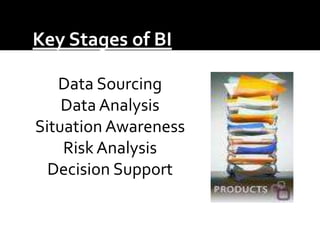
Data Sourcing
Data Analysis
Situation Awareness
Risk Analysis
Decision Support
BI applications and technologies
can help companies analyze:
changing trends in market
share
changes in customer behavior
and spending patterns
customers' preferences
company capabilities
market conditions
Significance of BI…
Companies need to have accurate, up-to-date information on
customer preferences ,
So that company can quickly adapt to their changing demands
 BI applications can also help managers to be better informed
about actions that a company’s competitors are taking
 It help analysts and managers to determine which
adjustments are mostly likely to respond to changing trends
IT can help companies develop a more consistent,data-based
decision,which can produce better results than making business
decisions by “guesswork”
MODULES
Dashboards
Key Performance Indicators
Graphical OLAP
Forecasting
Graphical Reporting
MODULE DESCRIPTION
 Dashboards –
BI dashboards can provide a customized
snapshot of daily operations, and assist the user
in identifying problems and the source of those
problems, as well as providing valuable, up-to-
date information about financial results, sales and
other critical information – all in one place
Key Performance Indicators –
BI provides simplified KPI management and
tracking with powerful features, formulae and
expressions, and flexible frequency, and
threshold levels.This module enables clear,
concise definition and tracking of performance
indicators for a period, and measures
performance as compared to a previous period.
Intuitive, color highlighters ensure that users can
see these indicators in a clear manner and
accurately present information to management
Graphical OLAP –
 Graphical Business Intelligence (BI) OLAP
technology makes it easy for your users to find,
filter and analyse data, going beyond numbers,
and allowing users to visualize the information
with eye-catching, stunning displays, and
valuable indicators and gauges, charts, and a
variety of graph types from which to choose
Forecasting and Predictive Analysis –
 Our predictive analysis uses historical product,
sales, pricing, financial, budget and other data,
and forecasts the measures with numerous time
series options, e.g., year, quarter, month, week,
day, hour or even second to improve your
planning process
Reports –
BI Reports delivers web-based BI reports to
anyone (or everyone) in the organization within
minutes!The BI suite is simple to use, practical to
implement and affordable for every
organization.With our BI reporting and
performance reporting module, you just point-
and-click and drag-and-drop and you can
instantly create a report to summarize your
performance metrics, or operational data
CLASS DIAGRAMS
EXTERNAL
ENTITY BI
Gather information
from corresponding
depts
DB
Future
Recognisation
Analysis and
Determine
Suggestions
DFD
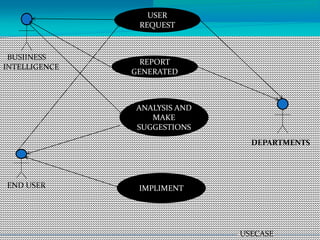
REPORT
GENERATED
ANALYSIS AND
MAKE
SUGGESTIONS
IMPLIMENT
USER
REQUEST
BUSIINESS
INTELLIGENCE
END USER
DEPARTMENTS
USECASE
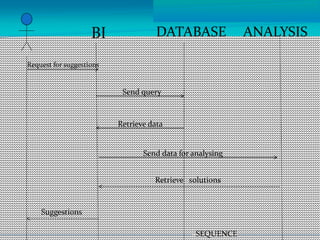
BI DATABASE ANALYSIS
Request for suggestions
Send query
Retrieve data
Send data for analysing
Retrieve solutions
Suggestions
SEQUENCE
HANK YOU……….

BI- Basics

  • 1.
  • 2.
    What is BusinessIntelligence? Business Intelligence is the processes, technologies, and tools that help us change data into information, information into knowledge and knowledge into plans that guide organization Technologies for gathering, storing, analyzing and providing access to data to help enterprise users make better business Decisions
  • 3.
    Why BI? 3 What happened? Whatis happening? Why did it happen? What will happen? What do I want to happen? Past Present Future
  • 4.
    The characteristics ofa Business intelligence solution Single point of access to information Timely answers to Business questions Using BI in all Departments of an organization
  • 5.
    Key Stages ofBI Data Sourcing Data Analysis Situation Awareness Risk Analysis Decision Support
  • 6.
    BI applications andtechnologies can help companies analyze: changing trends in market share changes in customer behavior and spending patterns customers' preferences company capabilities market conditions
  • 7.
    Significance of BI… Companiesneed to have accurate, up-to-date information on customer preferences , So that company can quickly adapt to their changing demands  BI applications can also help managers to be better informed about actions that a company’s competitors are taking  It help analysts and managers to determine which adjustments are mostly likely to respond to changing trends IT can help companies develop a more consistent,data-based decision,which can produce better results than making business decisions by “guesswork”
  • 8.
    MODULES Dashboards Key Performance Indicators GraphicalOLAP Forecasting Graphical Reporting
  • 9.
    MODULE DESCRIPTION  Dashboards– BI dashboards can provide a customized snapshot of daily operations, and assist the user in identifying problems and the source of those problems, as well as providing valuable, up-to- date information about financial results, sales and other critical information – all in one place
  • 10.
    Key Performance Indicators– BI provides simplified KPI management and tracking with powerful features, formulae and expressions, and flexible frequency, and threshold levels.This module enables clear, concise definition and tracking of performance indicators for a period, and measures performance as compared to a previous period. Intuitive, color highlighters ensure that users can see these indicators in a clear manner and accurately present information to management
  • 11.
    Graphical OLAP – Graphical Business Intelligence (BI) OLAP technology makes it easy for your users to find, filter and analyse data, going beyond numbers, and allowing users to visualize the information with eye-catching, stunning displays, and valuable indicators and gauges, charts, and a variety of graph types from which to choose
  • 12.
    Forecasting and PredictiveAnalysis –  Our predictive analysis uses historical product, sales, pricing, financial, budget and other data, and forecasts the measures with numerous time series options, e.g., year, quarter, month, week, day, hour or even second to improve your planning process
  • 13.
    Reports – BI Reportsdelivers web-based BI reports to anyone (or everyone) in the organization within minutes!The BI suite is simple to use, practical to implement and affordable for every organization.With our BI reporting and performance reporting module, you just point- and-click and drag-and-drop and you can instantly create a report to summarize your performance metrics, or operational data
  • 14.
  • 15.
    EXTERNAL ENTITY BI Gather information fromcorresponding depts DB Future Recognisation Analysis and Determine Suggestions DFD
  • 16.
  • 17.
    BI DATABASE ANALYSIS Requestfor suggestions Send query Retrieve data Send data for analysing Retrieve solutions Suggestions SEQUENCE
  • 18.