PRESENTATION ON:-
1
Submitted By:
Vishwadeep Kapoor
AEI-4th year
INTRODUCTION TO TURBO GENERATOR & THEIR
AUXILLIARIES
Submitted to:
Mr. Anuj Kumar
(HOD &
ITP Co-ordinator)
Raj Kumar Goel Institute of
Technology, Ghaziabad
CONTENT:
 BHEL Over-View 3
 Introduction 4
 Blocks in HEEP 5
 Designing Process Of Turbo Generator 6
 Applications of Turbo Generators 8
 Over Speed Balancing Tunnel 10
 Manufacturing Of Rotor Windings 11
 Advantages Of Turbo Generators 12
 Dis-Advantages of Turbo Generators 13
 Conclusion 14
 Future Scope 15
2
OVERVIEW
3
BHEL is the largest engineering and manufacturing enterprise in
India in the energy-related/infrastructure sector, today. BHEL was
established more than 40 years ago, ushering in the indigenous
Heavy Electrical Equipment industry in India - a dream that has
been more than realized with a well-recognized track record of
performance.
BHEL manufactures over 180 products under 30 major product
groups and caters to core sectors of the Indian Economy viz.,
Power Generation & Transmission, Industry, Transportation,
Telecommunication, Renewable Energy, etc. The wide network of
BHEL's 15 manufacturing divisions, four Power Sector regional
centers, over 100 project sites.
INTRODUCTION
 Stream turbines generators
 Gas turbine generators
 Hydro turbine generators
4
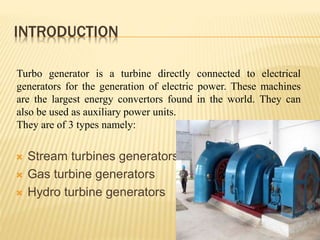
Turbo generator is a turbine directly connected to electrical
generators for the generation of electric power. These machines
are the largest energy convertors found in the world. They can
also be used as auxiliary power units.
They are of 3 types namely:
BLOCKS IN HEEP:
5
1. BLOCK-1: Electrical Machine Shop
2. BLOCK-2: Heavy Fabrication Shop
3. BLOCK-3: Turbine Manufacturing Shop
4. BLOCK-4: CIM (Coils & Insulation Manuf.)
5. BLOCK-5: Condenser Fabrication & Forge Shop
6. BLOCK-6: Fabrication Shop & Die Shop
7. BLOCK-7: Carpentry & Heat Treatment Shop
8. BLOCK-8: Heat Exchanger Shop
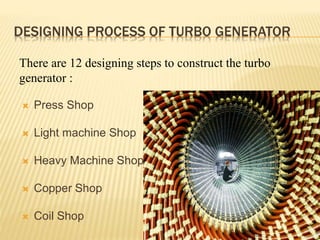
DESIGNING PROCESS OF TURBO GENERATOR
 Press Shop
 Light machine Shop
 Heavy Machine Shop
 Copper Shop
 Coil Shop
6
There are 12 designing steps to construct the turbo
generator :
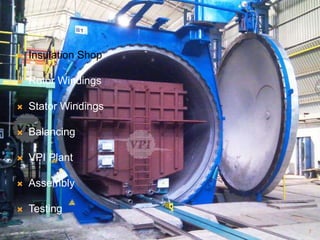
 Insulation Shop
 Rotor Windings
 Stator Windings
 Balancing
 VPI Plant
 Assembly
 Testing
7
APPLICATIONS OF TURBO GENERATORS
 Gas Turbines drive the smallest class of turbo-
generators. The motive force for these turbines
is the burning of gaseous fuels. Because they
can be started and stopped easily, they are
used for a variety of intermitted applications
including emergency power.
 Stream turbines drive much bigger turbo-
generators . The stream is generated by a
variety of methods including burning coal,
nuclear power and geothermal energy. There
types of turbo-generator supply the bulk of the
electrical power in the US and other countries.
8
 The third class of Turbo-generator are powered by
water turbines. Invented in the 19th century water
turbines are very efficient devices for extracting
energy for moving water. They are used in virtually
all hydro-electric power plants world wide.
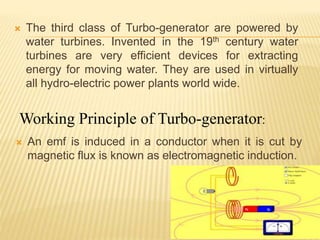
 An emf is induced in a conductor when it is cut by
magnetic flux is known as electromagnetic induction.
9
Working Principle of Turbo-generator:
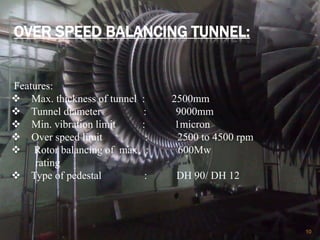
OVER SPEED BALANCING TUNNEL:
10
Features:
 Max. thickness of tunnel : 2500mm
 Tunnel diameter : 9000mm
 Min. vibration limit : 1micron
 Over speed limit : 2500 to 4500 rpm
 Rotor balancing of max. : 600Mw
rating
 Type of pedestal : DH 90/ DH 12
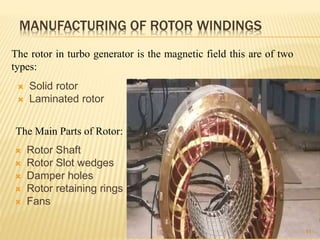
MANUFACTURING OF ROTOR WINDINGS
 Solid rotor
 Laminated rotor
 Rotor Shaft
 Rotor Slot wedges
 Damper holes
 Rotor retaining rings
 Fans
11
The rotor in turbo generator is the magnetic field this are of two
types:
The Main Parts of Rotor:
ADVANTAGES OF TURBO GENERATORS
 Turbo generator concept is simple and time testing.
 It can be generated from the renewable energy
sources which are environmental friendly.
 The life span of the machine is long.
 Economic in cost compare to other generators, hence
in US 90% of electrical generation is done by turbo
generators.
12
DIS-ADVANTAGES OF TURBO GENERATORS
 As the turbo generators is high voltage
machine the possibility of causing a spark
in air and the danger of electric shock by
contact may occur.
 Repairing cost is high.
 Maintenance cost is high.
13
CONCLUSION
14
As turbo generators are high voltage machines
which are ranging from less than 1500volts.
Hence the machine efficiency is accurate. Turbo
generators are also more reliable in nature. As
the production of sources are taken from the
non-renewable energy sources the cost is
economic.
FUTURE SCOPE
15
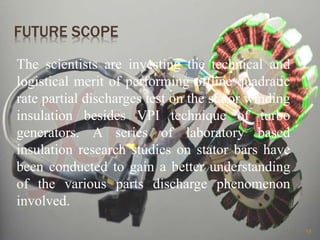
The scientists are investing the technical and
logistical merit of performing offline quadratic
rate partial discharges test on the stator winding
insulation besides VPI technique of turbo
generators. A series of laboratory based
insulation research studies on stator bars have
been conducted to gain a better understanding
of the various parts discharge phenomenon
involved.
16

Bhel HaridwarTraing Report

  • 1.
    PRESENTATION ON:- 1 Submitted By: VishwadeepKapoor AEI-4th year INTRODUCTION TO TURBO GENERATOR & THEIR AUXILLIARIES Submitted to: Mr. Anuj Kumar (HOD & ITP Co-ordinator) Raj Kumar Goel Institute of Technology, Ghaziabad
  • 2.
    CONTENT:  BHEL Over-View3  Introduction 4  Blocks in HEEP 5  Designing Process Of Turbo Generator 6  Applications of Turbo Generators 8  Over Speed Balancing Tunnel 10  Manufacturing Of Rotor Windings 11  Advantages Of Turbo Generators 12  Dis-Advantages of Turbo Generators 13  Conclusion 14  Future Scope 15 2
  • 3.
    OVERVIEW 3 BHEL is thelargest engineering and manufacturing enterprise in India in the energy-related/infrastructure sector, today. BHEL was established more than 40 years ago, ushering in the indigenous Heavy Electrical Equipment industry in India - a dream that has been more than realized with a well-recognized track record of performance. BHEL manufactures over 180 products under 30 major product groups and caters to core sectors of the Indian Economy viz., Power Generation & Transmission, Industry, Transportation, Telecommunication, Renewable Energy, etc. The wide network of BHEL's 15 manufacturing divisions, four Power Sector regional centers, over 100 project sites.
  • 4.
    INTRODUCTION  Stream turbinesgenerators  Gas turbine generators  Hydro turbine generators 4 Turbo generator is a turbine directly connected to electrical generators for the generation of electric power. These machines are the largest energy convertors found in the world. They can also be used as auxiliary power units. They are of 3 types namely:
  • 5.
    BLOCKS IN HEEP: 5 1.BLOCK-1: Electrical Machine Shop 2. BLOCK-2: Heavy Fabrication Shop 3. BLOCK-3: Turbine Manufacturing Shop 4. BLOCK-4: CIM (Coils & Insulation Manuf.) 5. BLOCK-5: Condenser Fabrication & Forge Shop 6. BLOCK-6: Fabrication Shop & Die Shop 7. BLOCK-7: Carpentry & Heat Treatment Shop 8. BLOCK-8: Heat Exchanger Shop
  • 6.
    DESIGNING PROCESS OFTURBO GENERATOR  Press Shop  Light machine Shop  Heavy Machine Shop  Copper Shop  Coil Shop 6 There are 12 designing steps to construct the turbo generator :
  • 7.
     Insulation Shop Rotor Windings  Stator Windings  Balancing  VPI Plant  Assembly  Testing 7
  • 8.
    APPLICATIONS OF TURBOGENERATORS  Gas Turbines drive the smallest class of turbo- generators. The motive force for these turbines is the burning of gaseous fuels. Because they can be started and stopped easily, they are used for a variety of intermitted applications including emergency power.  Stream turbines drive much bigger turbo- generators . The stream is generated by a variety of methods including burning coal, nuclear power and geothermal energy. There types of turbo-generator supply the bulk of the electrical power in the US and other countries. 8
  • 9.
     The thirdclass of Turbo-generator are powered by water turbines. Invented in the 19th century water turbines are very efficient devices for extracting energy for moving water. They are used in virtually all hydro-electric power plants world wide.  An emf is induced in a conductor when it is cut by magnetic flux is known as electromagnetic induction. 9 Working Principle of Turbo-generator:
  • 10.
    OVER SPEED BALANCINGTUNNEL: 10 Features:  Max. thickness of tunnel : 2500mm  Tunnel diameter : 9000mm  Min. vibration limit : 1micron  Over speed limit : 2500 to 4500 rpm  Rotor balancing of max. : 600Mw rating  Type of pedestal : DH 90/ DH 12
  • 11.
    MANUFACTURING OF ROTORWINDINGS  Solid rotor  Laminated rotor  Rotor Shaft  Rotor Slot wedges  Damper holes  Rotor retaining rings  Fans 11 The rotor in turbo generator is the magnetic field this are of two types: The Main Parts of Rotor:
  • 12.
    ADVANTAGES OF TURBOGENERATORS  Turbo generator concept is simple and time testing.  It can be generated from the renewable energy sources which are environmental friendly.  The life span of the machine is long.  Economic in cost compare to other generators, hence in US 90% of electrical generation is done by turbo generators. 12
  • 13.
    DIS-ADVANTAGES OF TURBOGENERATORS  As the turbo generators is high voltage machine the possibility of causing a spark in air and the danger of electric shock by contact may occur.  Repairing cost is high.  Maintenance cost is high. 13
  • 14.
    CONCLUSION 14 As turbo generatorsare high voltage machines which are ranging from less than 1500volts. Hence the machine efficiency is accurate. Turbo generators are also more reliable in nature. As the production of sources are taken from the non-renewable energy sources the cost is economic.
  • 15.
    FUTURE SCOPE 15 The scientistsare investing the technical and logistical merit of performing offline quadratic rate partial discharges test on the stator winding insulation besides VPI technique of turbo generators. A series of laboratory based insulation research studies on stator bars have been conducted to gain a better understanding of the various parts discharge phenomenon involved.
  • 16.