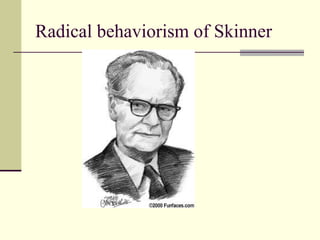
Radical behaviorism of Skinner
Skinner (1904 – 1990)
 Explain Skinner’s ideas about evolutionism and
environmental determinism influencing his view of
human functioning
 Understand how (according to Skinner) behavior is
learnt through the processes of respondent and
operant conditioning
 Understand the advantages and disadvantages of
different schedules of reinforcement
 Realise the value of Skinner’s behavior theory for
various contexts.
Skinner: Background
Skinner constructed a radical behaviorist theory
that which behavior is explained as the lawful
result of environmental factors. There is no
reference to factors within the organism.
 He grew up in a stable, loving but strict home in
Pennsylvania. He loved building as a child, was a
good student and enjoyed music and other extra-
curricular activities.
 Obtained a BA degree in English Literature in 1926,
attempting to become a writer, and then enrolling in
Psychology at a post-graduate level.
Skinner: Background ctd
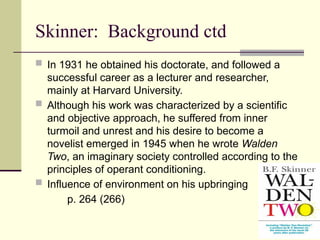
 In 1931 he obtained his doctorate, and followed a
successful career as a lecturer and researcher,
mainly at Harvard University.
 Although his work was characterized by a scientific
and objective approach, he suffered from inner
turmoil and unrest and his desire to become a
novelist emerged in 1945 when he wrote Walden
Two, an imaginary society controlled according to the
principles of operant conditioning.
 Influence of environment on his upbringing
p. 264 (266)
Skinner: View of the person
 Skinner writes about behavior, which he regards as
psychology’s object of study – his view of humanity is based on
evolutionism and environmental determinism.
 He believes that humans, like any other organism, are the
outcome of a process of evolution. The only difference between
humans and animals is complexity. It is better to start with
simpler studies; hence the study of animals, which he does not
hesitate to apply the findings to humans.
 He maintains that human organisms produce a large number of
behaviors, some of which survive because they are reinforced
while others are not repeated.
Skinner: View of the person
Read enrichment, pg. 268.
 Skinner describes the personality as a “black box”
whose internal structure and functioning is not
accessible to scientific functioning.
 He believes that humans have no freedom of choice.
For him, people’s choices are no more than operant
behavior, controlled by positive reinforcers of which
the individual is unaware at the time.
 Challenge: How do we improve society if we have no
freedom to act?
Skinner:
Structure of the personality
Behavior is regarded as Skinner’s structural
concept; it is important to make a distinction
between respondent and operant behavior.
 Respondent behavior is stimulated by something to
which the organism responds. The stimulus
precedes and controls the behavior. The stimulus
therefore causes the response.
 Reflexes – blinking an eye in bright light
(conditioning) and turning the head when hearing the
click of a gun – as respondent behavior. There is no
distinction between the two.
Skinner:
Structure of the personality
Operant behavior, which is Skinner’s main
concern, is distinguished from respondent
behavior by 2 characteristics:
1. Emergent behavior: It is not preceded by any
specific identifiable stimuli, and therefore appears to
be produced simultaneously by the organism.
2. Effect on environment: Operant behavior has an
effect on the environment and is controlled by this
effect.
Enrichment pg. 270.
Skinner:
Dynamics of the personality
Skinner is primarily interested in one aspect of
behavioral control: namely the acquisition of behavior.
He uses no motivational concepts whatsoever.
He uses only two concepts to explain learning –
behavior and reinforcement.
1. The organism learns by producing behavior
randomly which subsequently may or may not be
repeated, depending on the outcome of the
behavior.
2. When behavior is repeated, it has been reinforced,
or learnt.
Skinner:
Dynamics of the personality
Classical or respondent conditioning
Skinner calls Pavlov’s classical conditioning method
respondent conditioning because this entails teaching
the organism to associate a familiar response with a
new stimulus. This is done by repeatedly presenting the
new stimulus together with another stimulus that
automatically evokes the response concerned.
See Pavlov’s experiment, pg 271-272.
Skinner is not so interested in classical or respondent
conditioning as it does not bring about new behavior –
he prefers operant conditioning for the learning of new
responses.
Skinner:
Dynamics of the personality
Operant conditioning
Operant conditioning is controlled by the stimuli that succeed
(come after) it. Eg if we work hard and get an increase, we will
work hard. If our efforts are ignored, we will make less effort. He
attributes this change to reinforcement, rather than drive
satisfaction or any other explanation.
See operant conditioning example, pg. 273.
Reinforcement and related behavior:
Both positive and negative reinforcement increase specific
behavior:
 Positive reinforcement: behavior is likely to be increased
(pigeon receives food after pecking a red disk)
 Negative reinforcement: when negative response taken away,
likelihood of behavior being repeated increases (shock when
bird pecks red disc is turned off).
Skinner:
Dynamics of the personality
Operant conditioning
Reinforcement and related behavior
In addition to positive and negative reinforcement processes:
punishment and extinction.
Punishment is aimed at decreasing behavior . Punishment occurs
as a result of one of the following two contingencies:
 The administration of an aversive stimulus after the behavior to
decrease the behavior – eg time out;
 The removal of a positive stimulus to decrease the behavior –
refusal to watch favorite TV program.
Extinction occurs when the behavior decreases and disappears as
a result of stimulation being withheld eg negative or positive stimuli.
Pg. 275 bottom – table with summary of controlling behavior
Skinner:
Dynamics of the personality
Reinforcers: Primary, secondary and conditioned
Primary reinforcer is anything of biological value to the organism eg
food and water
Secondary reinforcer: stimulus which has acquired value as a
result of association with primary reinforcer eg money for buying
food.
Schedules of reinforcement: Continuous and intermittent
reinforcement
Continuous reinforcement: Repeated behavior eg kissing a child
every time she washed her hands before dinner. Difficult to
implement consistently.
Intermittent reinforcement: Desired behavior is not always
reinforced – part of everyday life. Can have a fixed or variable
pattern. Fixed: monthly salary; variable: odd treats for child.
Skinner:
Dynamics of the personality
Schedules of reinforcement: Continuous and intermittent
reinforcement
Fixed ratio reinforcement: Reinforcer given after a fixed number of
desired responses: eg child given star by teacher when 10 tests
are passed 100%.
Variable ratio reinforcement: Reinforcer is presented after an
irregular number of correct responses: eg gambling on slot
machine.
General principles: behavior is learnt most rapidly when a
continuous reinforcement schedule is used.
Most difficult behavior to extinguish is variable ratio reinforcement
eg gambling. Even if stopped for a long time, it may be mistaken
for a long interval between reinforcement.
Enrichment: Superstitions and operant conditioning - pg. 278.
Skinner:
Dynamics of the personality
Operant conditioning
Shaping: Shaping is used to teach complex/unusual behaviors.
This technique usually entails dividing the behavior which must be
learnt into a number of small steps, each part of a successive
approximation of the total behavior. This has been used by animal
trainers for centuries.
Skinner did not discover a new technique but demonstrated that it
works in laboratory conditions and without requiring any
assumptions re unobservable drives or inborn talents.
Shaping demonstrates that behavior can be controlled by
manipulating environmental variables. Human behavior can be
controlled in the same way and does not require internal factor
explanations.
Skinner:
Development of the personality
Although Skinner did not produce a complete developmental
theory, his work has implications for development psychology. He
is interested in the effect of learning on behavior, rather than
genetic factors or maturation.
Example: pg 279 - baby saying Dah-Dah
Skinner: Optimal development
Optimal development is learning to behave in such a way that one
receives positive primary and secondary reinforcers and avoids
aversive reinforcers.
The question is: Do individuals contribute to their optimal
development? We will try to answer this question more fully in the
Evaluation of the Theory.
Skinner: Views on psychopathology
For Skinner, undesirable behavior is the result of
learning principles rather than internal conflicts or guilt
feelings.
Implications and application:
Education: Programmed instruction draws on the
principle of step-by-step learning. Application in
remedial teaching and behaviors like prizes at school.
Psychotherapy: Behavior therapy – expansion of
behavior repertoire by teaching desirable behavior;
elimination of unacceptable behavior through learning.
Methods include operant conditioning, respondent or
classical conditioning and systematic desensitization.
Skinner: Views on psychopathology
 Operant conditioning - Read Token economy pg 283
for example in therapy
 Classical/respondent conditioning - Read enuresis pg
283 for example.
 Eliminating behavior: Reciprocal inhibition (SA
researcher, Wolpe) – replace fear response with
relaxation, humor; Implosive therapy – encouraged
flooding or over-stimulation in the presence of fear
object.
 Aversive counter-conditioning: form of punishment
used in therapy – eg drug which makes alcoholic
nauseous.
Skinner: Views on psychopathology
Removing or changing stimuli: When people go on
holiday, the tension-inducing stimuli are removed.
Disadvantage is that undesirable behavior usually
reappears when people go back to the old environment.
Extinction: When behavior is consistently not reinforced,
it weakens and eventually disappears completely.
Intermittent schedules of reinforcement can be the most
difficult to achieve extinction because it is sometimes
impossible to remove secondary reinforcers.
Eg child misbehaving at school could be result of
multiple factors.
Skinner: Research
More than other theorists, Skinner underlined
the importance of empirical research in the
development of personality theory.
Mostly used single subject design rather than
samples and statistical tests.
Skinner: Aggression
He regards aggression as a result of operant
behavior - behavior organism is capable of
producing and which is part of its behavioral
repertoire. Aggression, like any other behavior
can be managed by controlling the
environment.
While his work is valued for its strong empirical
foundation, animal research is considered an
invalid basis for the study of human behavior.
However, his theory can be successfully applied
in the treatment of human problems.
Skinner: Evaluation of theory
After Freud, Skinner is one of the most well-
known and controversial psychologists. While
being one of the most scientific of all
psychological theories, it is criticized because it
presents people as beings without freedom or
dignity.
If people are controlled by their environment,
how do they improve their lives? Skinner
believed we can change our environment to
improve our lives: a logical error or is he
exempt from the rules governing others?
Skinner: Definitions
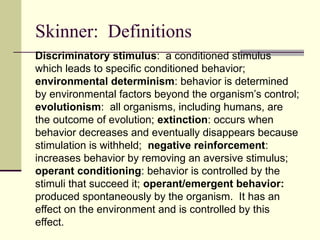
Discriminatory stimulus: a conditioned stimulus
which leads to specific conditioned behavior;
environmental determinism: behavior is determined
by environmental factors beyond the organism’s control;
evolutionism: all organisms, including humans, are
the outcome of evolution; extinction: occurs when
behavior decreases and eventually disappears because
stimulation is withheld; negative reinforcement:
increases behavior by removing an aversive stimulus;
operant conditioning: behavior is controlled by the
stimuli that succeed it; operant/emergent behavior:
produced spontaneously by the organism. It has an
effect on the environment and is controlled by this
effect.
Skinner: Definitions
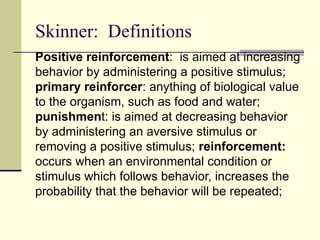
Positive reinforcement: is aimed at increasing
behavior by administering a positive stimulus;
primary reinforcer: anything of biological value
to the organism, such as food and water;
punishment: is aimed at decreasing behavior
by administering an aversive stimulus or
removing a positive stimulus; reinforcement:
occurs when an environmental condition or
stimulus which follows behavior, increases the
probability that the behavior will be repeated;
Skinner: Definitions
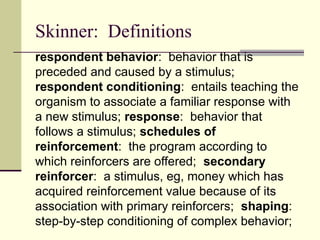
respondent behavior: behavior that is
preceded and caused by a stimulus;
respondent conditioning: entails teaching the
organism to associate a familiar response with
a new stimulus; response: behavior that
follows a stimulus; schedules of
reinforcement: the program according to
which reinforcers are offered; secondary
reinforcer: a stimulus, eg, money which has
acquired reinforcement value because of its
association with primary reinforcers; shaping:
step-by-step conditioning of complex behavior;
Skinner: Definitions
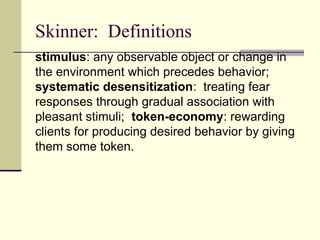
stimulus: any observable object or change in
the environment which precedes behavior;
systematic desensitization: treating fear
responses through gradual association with
pleasant stimuli; token-economy: rewarding
clients for producing desired behavior by giving
them some token.
Power Point - BEHAVIORISM BF_Skinner.pptx

  • 1.
  • 2.
    Skinner (1904 –1990)  Explain Skinner’s ideas about evolutionism and environmental determinism influencing his view of human functioning  Understand how (according to Skinner) behavior is learnt through the processes of respondent and operant conditioning  Understand the advantages and disadvantages of different schedules of reinforcement  Realise the value of Skinner’s behavior theory for various contexts.
  • 3.
    Skinner: Background Skinner constructeda radical behaviorist theory that which behavior is explained as the lawful result of environmental factors. There is no reference to factors within the organism.  He grew up in a stable, loving but strict home in Pennsylvania. He loved building as a child, was a good student and enjoyed music and other extra- curricular activities.  Obtained a BA degree in English Literature in 1926, attempting to become a writer, and then enrolling in Psychology at a post-graduate level.
  • 4.
    Skinner: Background ctd In 1931 he obtained his doctorate, and followed a successful career as a lecturer and researcher, mainly at Harvard University.  Although his work was characterized by a scientific and objective approach, he suffered from inner turmoil and unrest and his desire to become a novelist emerged in 1945 when he wrote Walden Two, an imaginary society controlled according to the principles of operant conditioning.  Influence of environment on his upbringing p. 264 (266)
  • 5.
    Skinner: View ofthe person  Skinner writes about behavior, which he regards as psychology’s object of study – his view of humanity is based on evolutionism and environmental determinism.  He believes that humans, like any other organism, are the outcome of a process of evolution. The only difference between humans and animals is complexity. It is better to start with simpler studies; hence the study of animals, which he does not hesitate to apply the findings to humans.  He maintains that human organisms produce a large number of behaviors, some of which survive because they are reinforced while others are not repeated.
  • 6.
    Skinner: View ofthe person Read enrichment, pg. 268.  Skinner describes the personality as a “black box” whose internal structure and functioning is not accessible to scientific functioning.  He believes that humans have no freedom of choice. For him, people’s choices are no more than operant behavior, controlled by positive reinforcers of which the individual is unaware at the time.  Challenge: How do we improve society if we have no freedom to act?
  • 7.
    Skinner: Structure of thepersonality Behavior is regarded as Skinner’s structural concept; it is important to make a distinction between respondent and operant behavior.  Respondent behavior is stimulated by something to which the organism responds. The stimulus precedes and controls the behavior. The stimulus therefore causes the response.  Reflexes – blinking an eye in bright light (conditioning) and turning the head when hearing the click of a gun – as respondent behavior. There is no distinction between the two.
  • 8.
    Skinner: Structure of thepersonality Operant behavior, which is Skinner’s main concern, is distinguished from respondent behavior by 2 characteristics: 1. Emergent behavior: It is not preceded by any specific identifiable stimuli, and therefore appears to be produced simultaneously by the organism. 2. Effect on environment: Operant behavior has an effect on the environment and is controlled by this effect. Enrichment pg. 270.
  • 9.
    Skinner: Dynamics of thepersonality Skinner is primarily interested in one aspect of behavioral control: namely the acquisition of behavior. He uses no motivational concepts whatsoever. He uses only two concepts to explain learning – behavior and reinforcement. 1. The organism learns by producing behavior randomly which subsequently may or may not be repeated, depending on the outcome of the behavior. 2. When behavior is repeated, it has been reinforced, or learnt.
  • 10.
    Skinner: Dynamics of thepersonality Classical or respondent conditioning Skinner calls Pavlov’s classical conditioning method respondent conditioning because this entails teaching the organism to associate a familiar response with a new stimulus. This is done by repeatedly presenting the new stimulus together with another stimulus that automatically evokes the response concerned. See Pavlov’s experiment, pg 271-272. Skinner is not so interested in classical or respondent conditioning as it does not bring about new behavior – he prefers operant conditioning for the learning of new responses.
  • 11.
    Skinner: Dynamics of thepersonality Operant conditioning Operant conditioning is controlled by the stimuli that succeed (come after) it. Eg if we work hard and get an increase, we will work hard. If our efforts are ignored, we will make less effort. He attributes this change to reinforcement, rather than drive satisfaction or any other explanation. See operant conditioning example, pg. 273. Reinforcement and related behavior: Both positive and negative reinforcement increase specific behavior:  Positive reinforcement: behavior is likely to be increased (pigeon receives food after pecking a red disk)  Negative reinforcement: when negative response taken away, likelihood of behavior being repeated increases (shock when bird pecks red disc is turned off).
  • 12.
    Skinner: Dynamics of thepersonality Operant conditioning Reinforcement and related behavior In addition to positive and negative reinforcement processes: punishment and extinction. Punishment is aimed at decreasing behavior . Punishment occurs as a result of one of the following two contingencies:  The administration of an aversive stimulus after the behavior to decrease the behavior – eg time out;  The removal of a positive stimulus to decrease the behavior – refusal to watch favorite TV program. Extinction occurs when the behavior decreases and disappears as a result of stimulation being withheld eg negative or positive stimuli. Pg. 275 bottom – table with summary of controlling behavior
  • 13.
    Skinner: Dynamics of thepersonality Reinforcers: Primary, secondary and conditioned Primary reinforcer is anything of biological value to the organism eg food and water Secondary reinforcer: stimulus which has acquired value as a result of association with primary reinforcer eg money for buying food. Schedules of reinforcement: Continuous and intermittent reinforcement Continuous reinforcement: Repeated behavior eg kissing a child every time she washed her hands before dinner. Difficult to implement consistently. Intermittent reinforcement: Desired behavior is not always reinforced – part of everyday life. Can have a fixed or variable pattern. Fixed: monthly salary; variable: odd treats for child.
  • 14.
    Skinner: Dynamics of thepersonality Schedules of reinforcement: Continuous and intermittent reinforcement Fixed ratio reinforcement: Reinforcer given after a fixed number of desired responses: eg child given star by teacher when 10 tests are passed 100%. Variable ratio reinforcement: Reinforcer is presented after an irregular number of correct responses: eg gambling on slot machine. General principles: behavior is learnt most rapidly when a continuous reinforcement schedule is used. Most difficult behavior to extinguish is variable ratio reinforcement eg gambling. Even if stopped for a long time, it may be mistaken for a long interval between reinforcement. Enrichment: Superstitions and operant conditioning - pg. 278.
  • 15.
    Skinner: Dynamics of thepersonality Operant conditioning Shaping: Shaping is used to teach complex/unusual behaviors. This technique usually entails dividing the behavior which must be learnt into a number of small steps, each part of a successive approximation of the total behavior. This has been used by animal trainers for centuries. Skinner did not discover a new technique but demonstrated that it works in laboratory conditions and without requiring any assumptions re unobservable drives or inborn talents. Shaping demonstrates that behavior can be controlled by manipulating environmental variables. Human behavior can be controlled in the same way and does not require internal factor explanations.
  • 16.
    Skinner: Development of thepersonality Although Skinner did not produce a complete developmental theory, his work has implications for development psychology. He is interested in the effect of learning on behavior, rather than genetic factors or maturation. Example: pg 279 - baby saying Dah-Dah
  • 17.
    Skinner: Optimal development Optimaldevelopment is learning to behave in such a way that one receives positive primary and secondary reinforcers and avoids aversive reinforcers. The question is: Do individuals contribute to their optimal development? We will try to answer this question more fully in the Evaluation of the Theory.
  • 18.
    Skinner: Views onpsychopathology For Skinner, undesirable behavior is the result of learning principles rather than internal conflicts or guilt feelings. Implications and application: Education: Programmed instruction draws on the principle of step-by-step learning. Application in remedial teaching and behaviors like prizes at school. Psychotherapy: Behavior therapy – expansion of behavior repertoire by teaching desirable behavior; elimination of unacceptable behavior through learning. Methods include operant conditioning, respondent or classical conditioning and systematic desensitization.
  • 19.
    Skinner: Views onpsychopathology  Operant conditioning - Read Token economy pg 283 for example in therapy  Classical/respondent conditioning - Read enuresis pg 283 for example.  Eliminating behavior: Reciprocal inhibition (SA researcher, Wolpe) – replace fear response with relaxation, humor; Implosive therapy – encouraged flooding or over-stimulation in the presence of fear object.  Aversive counter-conditioning: form of punishment used in therapy – eg drug which makes alcoholic nauseous.
  • 20.
    Skinner: Views onpsychopathology Removing or changing stimuli: When people go on holiday, the tension-inducing stimuli are removed. Disadvantage is that undesirable behavior usually reappears when people go back to the old environment. Extinction: When behavior is consistently not reinforced, it weakens and eventually disappears completely. Intermittent schedules of reinforcement can be the most difficult to achieve extinction because it is sometimes impossible to remove secondary reinforcers. Eg child misbehaving at school could be result of multiple factors.
  • 21.
    Skinner: Research More thanother theorists, Skinner underlined the importance of empirical research in the development of personality theory. Mostly used single subject design rather than samples and statistical tests.
  • 22.
    Skinner: Aggression He regardsaggression as a result of operant behavior - behavior organism is capable of producing and which is part of its behavioral repertoire. Aggression, like any other behavior can be managed by controlling the environment. While his work is valued for its strong empirical foundation, animal research is considered an invalid basis for the study of human behavior. However, his theory can be successfully applied in the treatment of human problems.
  • 23.
    Skinner: Evaluation oftheory After Freud, Skinner is one of the most well- known and controversial psychologists. While being one of the most scientific of all psychological theories, it is criticized because it presents people as beings without freedom or dignity. If people are controlled by their environment, how do they improve their lives? Skinner believed we can change our environment to improve our lives: a logical error or is he exempt from the rules governing others?
  • 24.
    Skinner: Definitions Discriminatory stimulus:a conditioned stimulus which leads to specific conditioned behavior; environmental determinism: behavior is determined by environmental factors beyond the organism’s control; evolutionism: all organisms, including humans, are the outcome of evolution; extinction: occurs when behavior decreases and eventually disappears because stimulation is withheld; negative reinforcement: increases behavior by removing an aversive stimulus; operant conditioning: behavior is controlled by the stimuli that succeed it; operant/emergent behavior: produced spontaneously by the organism. It has an effect on the environment and is controlled by this effect.
  • 25.
    Skinner: Definitions Positive reinforcement:is aimed at increasing behavior by administering a positive stimulus; primary reinforcer: anything of biological value to the organism, such as food and water; punishment: is aimed at decreasing behavior by administering an aversive stimulus or removing a positive stimulus; reinforcement: occurs when an environmental condition or stimulus which follows behavior, increases the probability that the behavior will be repeated;
  • 26.
    Skinner: Definitions respondent behavior:behavior that is preceded and caused by a stimulus; respondent conditioning: entails teaching the organism to associate a familiar response with a new stimulus; response: behavior that follows a stimulus; schedules of reinforcement: the program according to which reinforcers are offered; secondary reinforcer: a stimulus, eg, money which has acquired reinforcement value because of its association with primary reinforcers; shaping: step-by-step conditioning of complex behavior;
  • 27.
    Skinner: Definitions stimulus: anyobservable object or change in the environment which precedes behavior; systematic desensitization: treating fear responses through gradual association with pleasant stimuli; token-economy: rewarding clients for producing desired behavior by giving them some token.