Yujian Tang | Zilliz
Beyond RAG: Vector
Databases
Yujian Tang
Senior Developer Advocate, Zilliz
yujian@zilliz.com
https://www.linkedin.com/in/yujiantang
https://www.twitter.com/yujian_tang
Speaker
01 Why Vector Databases?
CONTENTS
03
04 Vector Database Architecture
02 How Do Vector Databases Work?
Use Cases
01 Why Vector Databases?
Compare data that you couldn’t compare before
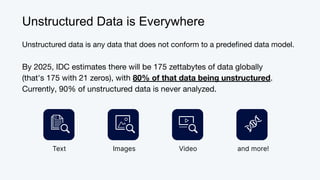
Unstructured Data is Everywhere
Unstructured data is any data that does not conform to a predefined data model.
By 2025, IDC estimates there will be 175 zettabytes of data globally
(that's 175 with 21 zeros), with 80% of that data being unstructured.
Currently, 90% of unstructured data is never analyzed.
Text Images Video and more!
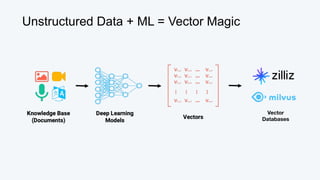
Vector
Databases
Unstructured Data + ML = Vector Magic
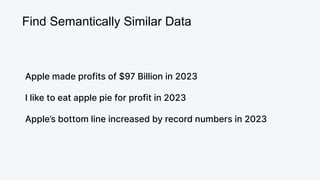
Find Semantically Similar Data
Apple made profits of $97 Billion in 2023
I like to eat apple pie for profit in 2023
Apple’s bottom line increased by record numbers in 2023
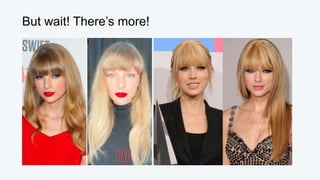
But wait! There’s more!
Use math to quantify relationships between
entities
02 How Do Vector Databases Work?
Vector similarity is a mathematical measure of
how close two vectors are
Semantic Similarity
Image from Sutor et al
Woman = [0.3, 0.4]
Queen = [0.3, 0.9]
King = [0.5, 0.7]
Woman = [0.3, 0.4]
Queen = [0.3, 0.9]
King = [0.5, 0.7]
Man = [0.5, 0.2]
Queen - Woman + Man = King
Queen = [0.3, 0.9]
- Woman = [0.3, 0.4]
[0.0, 0.5]
+ Man = [0.5, 0.2]
King = [0.5, 0.7]
Man = [0.5, 0.2]
Similarity metrics are ways to measure distance in
vector space
Vector Similarity Metric: L2 (Euclidean)
Queen = [0.3, 0.9]
King = [0.5, 0.7]
d(Queen, King) = √(0.3-0.5)2
+ (0.9-0.7)2
= √(0.2)2
+ (0.2)2
= √0.04 + 0.04
= √0.08 ≅ 0.28
Vector Similarity Metric: Inner Product (IP)
Queen = [0.3, 0.9]
King = [0.5, 0.7]
Queen · King = (0.3*0.5) + (0.9*0.7)
= 0.15 + 0.63 = 0.78
Queen = [0.3, 0.9]
King = [0.5, 0.7]
Vector Similarity Metric: Cosine
𝚹
cos(Queen, King) = (0.3*0.5)+(0.9*0.7)
√0.32
+0.92
* √0.52
+0.72
= 0.15+0.63 _
√0.9 * √0.74
= 0.78 _
√0.666
≅ 0.03
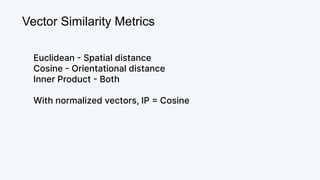
Vector Similarity Metrics
Euclidean - Spatial distance
Cosine - Orientational distance
Inner Product - Both
With normalized vectors, IP = Cosine
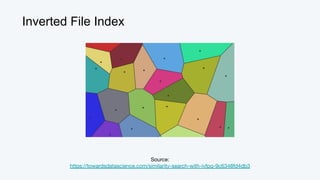
Indexes organize the way we access our data
Inverted File Index
Source:
https://towardsdatascience.com/similarity-search-with-ivfpq-9c6348fd4db3
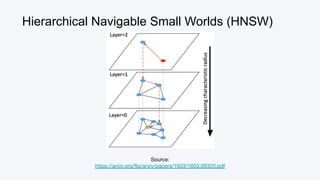
Hierarchical Navigable Small Worlds (HNSW)
Source:
https://arxiv.org/ftp/arxiv/papers/1603/1603.09320.pdf
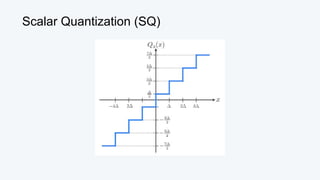
Scalar Quantization (SQ)
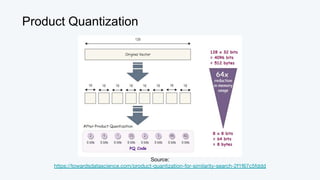
Product Quantization
Source:
https://towardsdatascience.com/product-quantization-for-similarity-search-2f1f67c5fddd
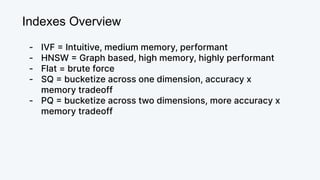
Indexes Overview
- IVF = Intuitive, medium memory, performant
- HNSW = Graph based, high memory, highly performant
- Flat = brute force
- SQ = bucketize across one dimension, accuracy x
memory tradeoff
- PQ = bucketize across two dimensions, more accuracy x
memory tradeoff
Vector databases efficiently store, index, and
relate entities by a quantitative value
03 Use Cases
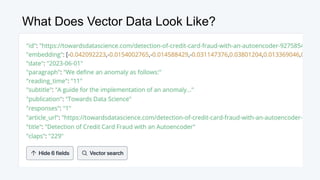
What Does Vector Data Look Like?
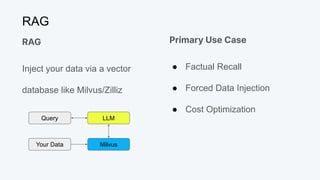
RAG
RAG
Inject your data via a vector
database like Milvus/Zilliz
Query LLM
Milvus
Your Data
Primary Use Case
● Factual Recall
● Forced Data Injection
● Cost Optimization
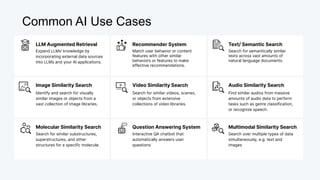
Common AI Use Cases
LLM Augmented Retrieval
Expand LLMs' knowledge by
incorporating external data sources
into LLMs and your AI applications.
Match user behavior or content
features with other similar
behaviors or features to make
effective recommendations.
Recommender System
Search for semantically similar
texts across vast amounts of
natural language documents.
Text/ Semantic Search
Image Similarity Search
Identify and search for visually
similar images or objects from a
vast collection of image libraries.
Video Similarity Search
Search for similar videos, scenes,
or objects from extensive
collections of video libraries.
Audio Similarity Search
Find similar audios from massive
amounts of audio data to perform
tasks such as genre classification,
or recognize speech.
Molecular Similarity Search
Search for similar substructures,
superstructures, and other
structures for a specific molecule.
Question Answering System
Interactive QA chatbot that
automatically answers user
questions
Multimodal Similarity Search
Search over multiple types of data
simultaneously, e.g. text and
images
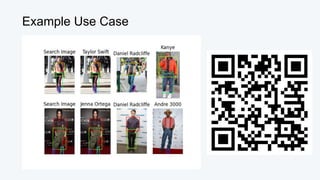
Example Use Case
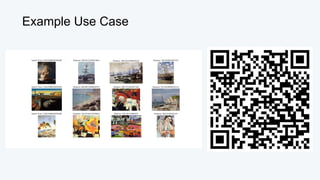
Example Use Case
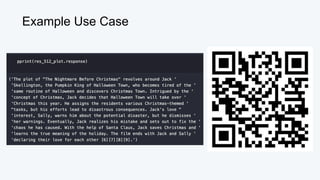
Example Use Case
04 Vector Database Architecture
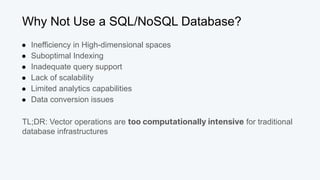
Why Not Use a SQL/NoSQL Database?
● Inefficiency in High-dimensional spaces
● Suboptimal Indexing
● Inadequate query support
● Lack of scalability
● Limited analytics capabilities
● Data conversion issues
TL;DR: Vector operations are too computationally intensive for traditional
database infrastructures
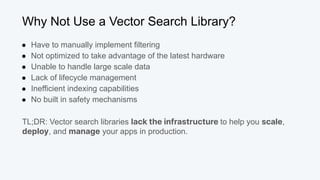
Why Not Use a Vector Search Library?
● Have to manually implement filtering
● Not optimized to take advantage of the latest hardware
● Unable to handle large scale data
● Lack of lifecycle management
● Inefficient indexing capabilities
● No built in safety mechanisms
TL;DR: Vector search libraries lack the infrastructure to help you scale,
deploy, and manage your apps in production.
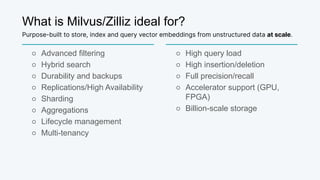
What is Milvus/Zilliz ideal for?
○ Advanced filtering
○ Hybrid search
○ Durability and backups
○ Replications/High Availability
○ Sharding
○ Aggregations
○ Lifecycle management
○ Multi-tenancy
○ High query load
○ High insertion/deletion
○ Full precision/recall
○ Accelerator support (GPU,
FPGA)
○ Billion-scale storage
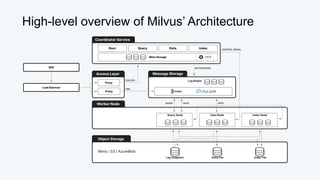
Purpose-built to store, index and query vector embeddings from unstructured data at scale.
Meta Storage
Root Query Data Index
Coordinator Service
Proxy
Proxy
etcd
Log Broker
SDK
Load Balancer
DDL/DCL
DML
NOTIFICATION
CONTROL SIGNAL
Object Storage
Minio / S3 / AzureBlob
Log Snapshot Delta File Index File
Worker Node QUERY DATA DATA
Message Storage
Access Layer
Query Node Data Node Index Node
High-level overview of Milvus’ Architecture
Start building
with Zilliz Cloud today!
zilliz.com/cloud
| © Copyright 9/25/23 Zilliz
39
Appendix
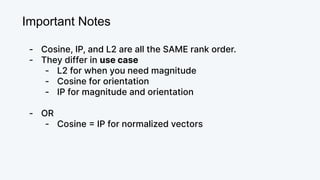
Important Notes
- Cosine, IP, and L2 are all the SAME rank order.
- They differ in use case
- L2 for when you need magnitude
- Cosine for orientation
- IP for magnitude and orientation
- OR
- Cosine = IP for normalized vectors
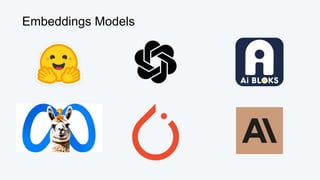
Embeddings Models
Basic Idea
You want to use your data with a large language
model
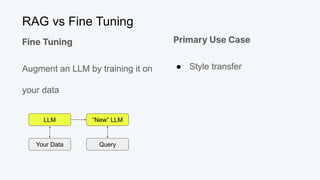
RAG vs Fine Tuning
LLM
Fine Tuning
Augment an LLM by training it on
your data
Your Data
“New” LLM
Query
Primary Use Case
● Style transfer
Takeaway
Use RAG to force the LLM to work with your data by injecting it via a
vector database like Milvus or Zilliz
Chunking Considerations
Chunk Size
Chunk Overlap
Character Splitters
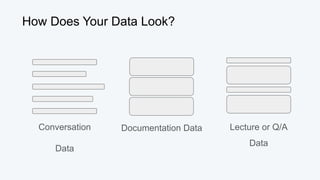
How Does Your Data Look?
Conversation
Data
Documentation Data Lecture or Q/A
Data
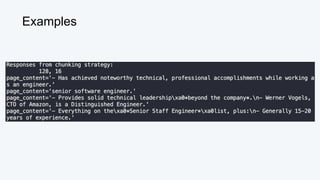
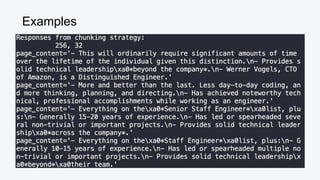
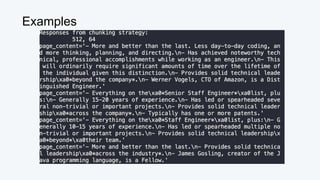
Examples
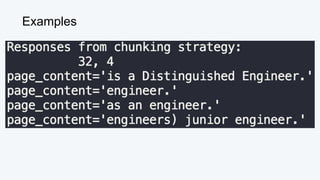
Examples
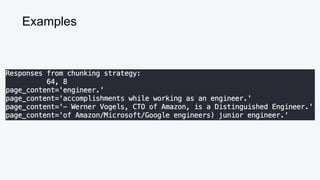
Examples
Examples
Examples
Examples
Your chunking strategy depends on what your data looks
like and what you need from it.
Takeaway:
Examining Embeddings
Picking a model
What to embed
Metadata
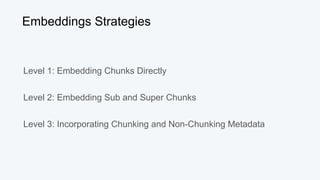
Embeddings Strategies
Level 1: Embedding Chunks Directly
Level 2: Embedding Sub and Super Chunks
Level 3: Incorporating Chunking and Non-Chunking Metadata
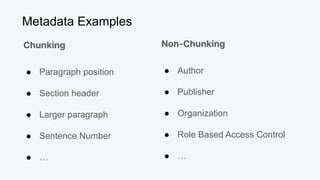
Metadata Examples
Chunking
● Paragraph position
● Section header
● Larger paragraph
● Sentence Number
● …
Non-Chunking
● Author
● Publisher
● Organization
● Role Based Access Control
● …
Your embeddings strategy depends on your accuracy,
cost, and use case needs
Takeaway:
Basic Idea
Vector Databases provide the ability to inject your data via
semantic similarity
Considerations include: scale, performance, and flexibility
Milvus Architecture: Differentiation
1. Cloud Native, Distributed System Architecture
2. True Separation of Concerns
3. Scalable Index Creation Strategy with 512 MB Segments
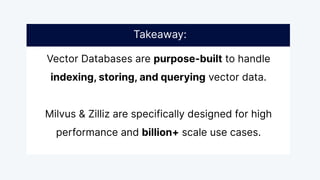
Vector Databases are purpose-built to handle
indexing, storing, and querying vector data.
Milvus & Zilliz are specifically designed for high
performance and billion+ scale use cases.
Takeaway:
Vector Database Resources
Give Milvus a Star! Chat with me on Discord!
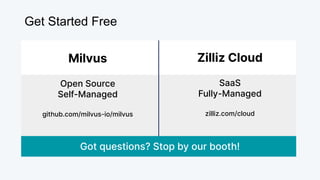
Get Started Free
Got questions? Stop by our booth!
Milvus
Open Source
Self-Managed
github.com/milvus-io/milvus
Zilliz Cloud
SaaS
Fully-Managed
zilliz.com/cloud

Beyond Retrieval Augmented Generation (RAG): Vector Databases

  • 1.
    Yujian Tang |Zilliz Beyond RAG: Vector Databases
  • 2.
    Yujian Tang Senior DeveloperAdvocate, Zilliz yujian@zilliz.com https://www.linkedin.com/in/yujiantang https://www.twitter.com/yujian_tang Speaker
  • 3.
    01 Why VectorDatabases? CONTENTS 03 04 Vector Database Architecture 02 How Do Vector Databases Work? Use Cases
  • 4.
    01 Why VectorDatabases?
  • 5.
    Compare data thatyou couldn’t compare before
  • 6.
    Unstructured Data isEverywhere Unstructured data is any data that does not conform to a predefined data model. By 2025, IDC estimates there will be 175 zettabytes of data globally (that's 175 with 21 zeros), with 80% of that data being unstructured. Currently, 90% of unstructured data is never analyzed. Text Images Video and more!
  • 7.
  • 8.
    Find Semantically SimilarData Apple made profits of $97 Billion in 2023 I like to eat apple pie for profit in 2023 Apple’s bottom line increased by record numbers in 2023
  • 9.
  • 10.
    Use math toquantify relationships between entities
  • 11.
    02 How DoVector Databases Work?
  • 12.
    Vector similarity isa mathematical measure of how close two vectors are
  • 13.
    Semantic Similarity Image fromSutor et al Woman = [0.3, 0.4] Queen = [0.3, 0.9] King = [0.5, 0.7] Woman = [0.3, 0.4] Queen = [0.3, 0.9] King = [0.5, 0.7] Man = [0.5, 0.2] Queen - Woman + Man = King Queen = [0.3, 0.9] - Woman = [0.3, 0.4] [0.0, 0.5] + Man = [0.5, 0.2] King = [0.5, 0.7] Man = [0.5, 0.2]
  • 14.
    Similarity metrics areways to measure distance in vector space
  • 15.
    Vector Similarity Metric:L2 (Euclidean) Queen = [0.3, 0.9] King = [0.5, 0.7] d(Queen, King) = √(0.3-0.5)2 + (0.9-0.7)2 = √(0.2)2 + (0.2)2 = √0.04 + 0.04 = √0.08 ≅ 0.28
  • 16.
    Vector Similarity Metric:Inner Product (IP) Queen = [0.3, 0.9] King = [0.5, 0.7] Queen · King = (0.3*0.5) + (0.9*0.7) = 0.15 + 0.63 = 0.78
  • 17.
    Queen = [0.3,0.9] King = [0.5, 0.7] Vector Similarity Metric: Cosine 𝚹 cos(Queen, King) = (0.3*0.5)+(0.9*0.7) √0.32 +0.92 * √0.52 +0.72 = 0.15+0.63 _ √0.9 * √0.74 = 0.78 _ √0.666 ≅ 0.03
  • 18.
    Vector Similarity Metrics Euclidean- Spatial distance Cosine - Orientational distance Inner Product - Both With normalized vectors, IP = Cosine
  • 19.
    Indexes organize theway we access our data
  • 20.
  • 21.
    Hierarchical Navigable SmallWorlds (HNSW) Source: https://arxiv.org/ftp/arxiv/papers/1603/1603.09320.pdf
  • 22.
  • 23.
  • 24.
    Indexes Overview - IVF= Intuitive, medium memory, performant - HNSW = Graph based, high memory, highly performant - Flat = brute force - SQ = bucketize across one dimension, accuracy x memory tradeoff - PQ = bucketize across two dimensions, more accuracy x memory tradeoff
  • 25.
    Vector databases efficientlystore, index, and relate entities by a quantitative value
  • 26.
  • 27.
    What Does VectorData Look Like?
  • 28.
    RAG RAG Inject your datavia a vector database like Milvus/Zilliz Query LLM Milvus Your Data Primary Use Case ● Factual Recall ● Forced Data Injection ● Cost Optimization
  • 29.
    Common AI UseCases LLM Augmented Retrieval Expand LLMs' knowledge by incorporating external data sources into LLMs and your AI applications. Match user behavior or content features with other similar behaviors or features to make effective recommendations. Recommender System Search for semantically similar texts across vast amounts of natural language documents. Text/ Semantic Search Image Similarity Search Identify and search for visually similar images or objects from a vast collection of image libraries. Video Similarity Search Search for similar videos, scenes, or objects from extensive collections of video libraries. Audio Similarity Search Find similar audios from massive amounts of audio data to perform tasks such as genre classification, or recognize speech. Molecular Similarity Search Search for similar substructures, superstructures, and other structures for a specific molecule. Question Answering System Interactive QA chatbot that automatically answers user questions Multimodal Similarity Search Search over multiple types of data simultaneously, e.g. text and images
  • 30.
  • 31.
  • 32.
  • 33.
    04 Vector DatabaseArchitecture
  • 34.
    Why Not Usea SQL/NoSQL Database? ● Inefficiency in High-dimensional spaces ● Suboptimal Indexing ● Inadequate query support ● Lack of scalability ● Limited analytics capabilities ● Data conversion issues TL;DR: Vector operations are too computationally intensive for traditional database infrastructures
  • 35.
    Why Not Usea Vector Search Library? ● Have to manually implement filtering ● Not optimized to take advantage of the latest hardware ● Unable to handle large scale data ● Lack of lifecycle management ● Inefficient indexing capabilities ● No built in safety mechanisms TL;DR: Vector search libraries lack the infrastructure to help you scale, deploy, and manage your apps in production.
  • 36.
    What is Milvus/Zillizideal for? ○ Advanced filtering ○ Hybrid search ○ Durability and backups ○ Replications/High Availability ○ Sharding ○ Aggregations ○ Lifecycle management ○ Multi-tenancy ○ High query load ○ High insertion/deletion ○ Full precision/recall ○ Accelerator support (GPU, FPGA) ○ Billion-scale storage Purpose-built to store, index and query vector embeddings from unstructured data at scale.
  • 37.
    Meta Storage Root QueryData Index Coordinator Service Proxy Proxy etcd Log Broker SDK Load Balancer DDL/DCL DML NOTIFICATION CONTROL SIGNAL Object Storage Minio / S3 / AzureBlob Log Snapshot Delta File Index File Worker Node QUERY DATA DATA Message Storage Access Layer Query Node Data Node Index Node High-level overview of Milvus’ Architecture
  • 38.
    Start building with ZillizCloud today! zilliz.com/cloud
  • 39.
    | © Copyright9/25/23 Zilliz 39 Appendix
  • 40.
    Important Notes - Cosine,IP, and L2 are all the SAME rank order. - They differ in use case - L2 for when you need magnitude - Cosine for orientation - IP for magnitude and orientation - OR - Cosine = IP for normalized vectors
  • 41.
  • 42.
    Basic Idea You wantto use your data with a large language model
  • 43.
    RAG vs FineTuning LLM Fine Tuning Augment an LLM by training it on your data Your Data “New” LLM Query Primary Use Case ● Style transfer
  • 44.
    Takeaway Use RAG toforce the LLM to work with your data by injecting it via a vector database like Milvus or Zilliz
  • 45.
    Chunking Considerations Chunk Size ChunkOverlap Character Splitters
  • 46.
    How Does YourData Look? Conversation Data Documentation Data Lecture or Q/A Data
  • 47.
  • 48.
  • 49.
  • 50.
  • 51.
  • 52.
  • 53.
    Your chunking strategydepends on what your data looks like and what you need from it. Takeaway:
  • 54.
    Examining Embeddings Picking amodel What to embed Metadata
  • 55.
    Embeddings Strategies Level 1:Embedding Chunks Directly Level 2: Embedding Sub and Super Chunks Level 3: Incorporating Chunking and Non-Chunking Metadata
  • 56.
    Metadata Examples Chunking ● Paragraphposition ● Section header ● Larger paragraph ● Sentence Number ● … Non-Chunking ● Author ● Publisher ● Organization ● Role Based Access Control ● …
  • 57.
    Your embeddings strategydepends on your accuracy, cost, and use case needs Takeaway:
  • 58.
    Basic Idea Vector Databasesprovide the ability to inject your data via semantic similarity Considerations include: scale, performance, and flexibility
  • 59.
    Milvus Architecture: Differentiation 1.Cloud Native, Distributed System Architecture 2. True Separation of Concerns 3. Scalable Index Creation Strategy with 512 MB Segments
  • 60.
    Vector Databases arepurpose-built to handle indexing, storing, and querying vector data. Milvus & Zilliz are specifically designed for high performance and billion+ scale use cases. Takeaway:
  • 61.
    Vector Database Resources GiveMilvus a Star! Chat with me on Discord!
  • 62.
    Get Started Free Gotquestions? Stop by our booth! Milvus Open Source Self-Managed github.com/milvus-io/milvus Zilliz Cloud SaaS Fully-Managed zilliz.com/cloud