The pupils of Confucius meet Socratic   The Taiwanese Students ' Adjustment in the Western Teachers’ language Class Course  : Research Writing and Publish I Presenter: Chi-Ying Betty Hu  Date  : 2008/1/5
Content I . INTRODUCTION II. LITERATURE REVIEW III. METHODOLOGY
Introduction Because learning a second language implies some degree of learning a second cultural, it is important to understand what we mean by the cultural learning. (Brown, 2007)
Introduction Certain factors – namely ESL/EFL  students’ identity ,  students’ motivation , and  teachers’ recognition  toward their students, would be one of crucial parts that may influence students’ foreign language learning. (Lin, & Yung, 2008)
Introduction Students will gain more knowledge, retain more information, and perform far better when teaching styles match learning styles. (Lage, Platt, & Treglia, 2000)
Statement of the problems Many studies argue for the need of exploring the  mismatch between EFL students’ attitudes/expectations about learning/teaching and  their American teachers’, however, few studies  explore Taiwanese students’ adjustment in  the foreign teachers’ class.
Purpose of the study To investigate the  Taiwanese students’ perspective  on the foreign  teachers’ teaching style. To investigate the  Taiwanese students’ adjustment  to  the foreign teachers’ teaching style. To investigate the  influence  of the foreign teachers’  teaching style  on Taiwanese student’s learning attitude.
Research Questions  (1) what  are the Taiwanese students' perspective on foreign teachers’ teaching style? (2)  how  do the Taiwanese students adjust to  the foreign teachers’ teaching style?  (3)  what  are the influence of the foreign teachers' teaching  style on Taiwanese students’ learning attitude?
Literature  Review Culture Academic culture in distance Teaching style Learning style and strategy
Culture Brown (2007) explained that  cultural is the way of life . It is the context within which we exist, think, feel and related to others and it’s is also the “glue” that  binds a group of people together
Academic cultural in distances The academic cultures in distance occur more often in the  academic setting  where the classroom consists of two main roles of  nonnative students  of English and  native teachers  of English (Lin, 2007)
Teaching Style Main teaching style Formal Authority Demonstrator or Personal Model Facilitator Delegator (Felder & Soloman, 1992 )
Learning style and strategy “ Style , whether related to personality or to cognition, characterizes the consistent and enduring trials, tendencies, or preferences that  differentiate you from another person” (Brown, 2007)
Learning style and strategy “ Strategies , on the other hand, are specific methods of approaching a problem or task, modes of operation for achieving a particular end, or planned designs for  controlling and manipulating certain information.”  (Brown, 2007)
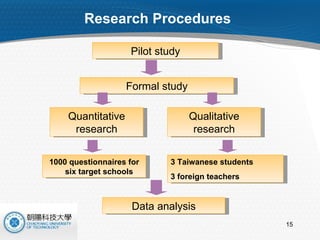
Research Procedures  Pilot study Formal study Quantitative research 1000 questionnaires for six target schools  3 Taiwanese students 3 foreign teachers Qualitative research Data analysis
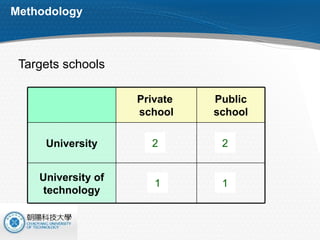
Methodology Targets schools 2 1 2 1 Private  school Public school University University of technology
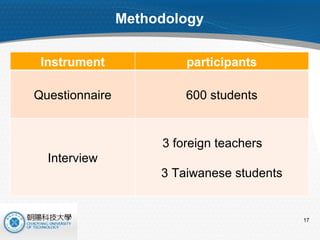
Methodology Instrument participants Questionnaire 600 students Interview 3 foreign teachers 3 Taiwanese students
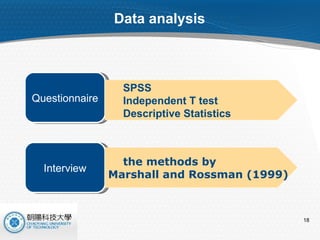
Data analysis Questionnaire SPSS Independent T test Descriptive Statistics   Interview the methods by  Marshall and Rossman (1999)
Thank you for your attention!

Betty Final Proposal3

  • 1.
    The pupils ofConfucius meet Socratic The Taiwanese Students ' Adjustment in the Western Teachers’ language Class Course : Research Writing and Publish I Presenter: Chi-Ying Betty Hu Date : 2008/1/5
  • 2.
    Content I .INTRODUCTION II. LITERATURE REVIEW III. METHODOLOGY
  • 3.
    Introduction Because learninga second language implies some degree of learning a second cultural, it is important to understand what we mean by the cultural learning. (Brown, 2007)
  • 4.
    Introduction Certain factors– namely ESL/EFL students’ identity , students’ motivation , and teachers’ recognition toward their students, would be one of crucial parts that may influence students’ foreign language learning. (Lin, & Yung, 2008)
  • 5.
    Introduction Students willgain more knowledge, retain more information, and perform far better when teaching styles match learning styles. (Lage, Platt, & Treglia, 2000)
  • 6.
    Statement of theproblems Many studies argue for the need of exploring the mismatch between EFL students’ attitudes/expectations about learning/teaching and their American teachers’, however, few studies explore Taiwanese students’ adjustment in the foreign teachers’ class.
  • 7.
    Purpose of thestudy To investigate the Taiwanese students’ perspective on the foreign teachers’ teaching style. To investigate the Taiwanese students’ adjustment to the foreign teachers’ teaching style. To investigate the influence of the foreign teachers’ teaching style on Taiwanese student’s learning attitude.
  • 8.
    Research Questions (1) what are the Taiwanese students' perspective on foreign teachers’ teaching style? (2) how do the Taiwanese students adjust to the foreign teachers’ teaching style? (3) what are the influence of the foreign teachers' teaching style on Taiwanese students’ learning attitude?
  • 9.
    Literature ReviewCulture Academic culture in distance Teaching style Learning style and strategy
  • 10.
    Culture Brown (2007)explained that cultural is the way of life . It is the context within which we exist, think, feel and related to others and it’s is also the “glue” that binds a group of people together
  • 11.
    Academic cultural indistances The academic cultures in distance occur more often in the academic setting where the classroom consists of two main roles of nonnative students of English and native teachers of English (Lin, 2007)
  • 12.
    Teaching Style Mainteaching style Formal Authority Demonstrator or Personal Model Facilitator Delegator (Felder & Soloman, 1992 )
  • 13.
    Learning style andstrategy “ Style , whether related to personality or to cognition, characterizes the consistent and enduring trials, tendencies, or preferences that differentiate you from another person” (Brown, 2007)
  • 14.
    Learning style andstrategy “ Strategies , on the other hand, are specific methods of approaching a problem or task, modes of operation for achieving a particular end, or planned designs for controlling and manipulating certain information.” (Brown, 2007)
  • 15.
    Research Procedures Pilot study Formal study Quantitative research 1000 questionnaires for six target schools 3 Taiwanese students 3 foreign teachers Qualitative research Data analysis
  • 16.
    Methodology Targets schools2 1 2 1 Private school Public school University University of technology
  • 17.
    Methodology Instrument participantsQuestionnaire 600 students Interview 3 foreign teachers 3 Taiwanese students
  • 18.
    Data analysis QuestionnaireSPSS Independent T test Descriptive Statistics Interview the methods by Marshall and Rossman (1999)
  • 19.
    Thank you foryour attention!