Remote Work Starter Kit
REMOTE WORK
STARTER KIT
We can still connect as humans, work together and support each other
even when we’re not in the same room.
That’s why we’ve created the Remote Work Starter Kit, the people side of
going remote, to help you to establish a healthy and human way of
working remotely with your team.
Attribution-NonCommercial-ShareAlike 4.0 International (CC BY-NC-SA 4.0)
Remote Work Starter Kit
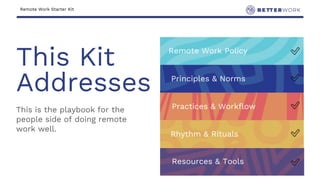
This is the playbook for the
people side of doing remote
work well.
This Kit
Addresses
Remote Work Policy
Principles & Norms
Rhythm & Rituals
Resources & Tools
Practices & Workflow
āœ…
āœ…
āœ…
āœ…
āœ…
Remote Work Starter Kit
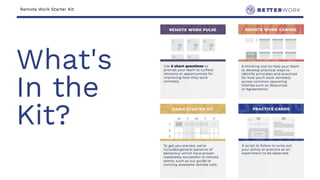
What's
In the
Kit?
Remote Work Starter Kit
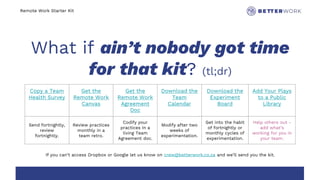
What if ain’t nobody got time
for that kit? (tl;dr)
Copy a Team
Health Survey
Get the
Remote Work
Canvas
Get the
Remote Work
Agreement
Doc
Download the
Team
Calendar
Download the
Experiment
Board
Add Your Plays
to a Public
Library
Send fortnightly,
review
fortnightly.
Review practices
monthly in a
team retro.
Codify your
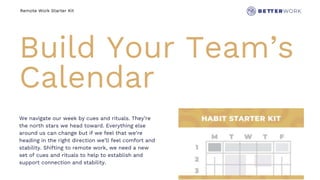
practices in a
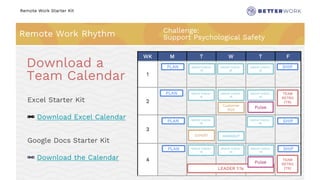
living Team
Agreement doc.
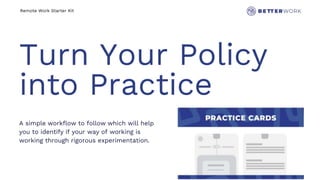
Modify after two
weeks of
experimentation.
Get into the habit
of fortnightly or
monthly cycles of
experimentation.
Help others out -
add what’s
working for you in
your team.
If you can’t access Dropbox or Google let us know on crew@betterwork.co.za and we’ll send you the kit.
Remote Work Starter Kit
PRINCIPLES TO
INFORM YOUR
PRACTICE
Remote Work Starter Kit
People-Positive
Principles
Climatic forces have prompted your team to go remote, fast. At high
speed you’re asking that people in your team change their mental
models about work, adapt their routine and habits but still maintain
their productivity.
Remote Work Starter Kit
Let the team doing the work decide how it gets done
Grant teams the agency to align on the outcomes of their
work. Encourage them to make decisions autonomously
and build trust with one another in ways that might not
adhere to your organisation’s structure or way of working.
1. Change is a team sport šŸ™
Empowering over
Controlling
šŸ™ https://www.responsive.org/manifesto šŸ™ https://agilemanifesto.org šŸ™ Adidas ā€˜Change is a Team Sport’
Remote Work Starter Kit
Change is complex which means it’s
unpredictable. Good practice will rise out of
your context and deliberate, ongoing
experimentation - not copying the startup next
door.
2. Don’t copy-and-paste culture šŸ™
Experimenting over
ā€˜Best Practice’
šŸ™ Bud Caddell, Nobl, from https://openviewpartners.com/blog/where-companies-get-culture-wrong-and-how-to-fix-
it/
Remote Work Starter Kit
When everything around you is emerging or you’re
trying things out for the first time, a regular cadence
for getting things done provides a sturdy scaffold on
which to build new ways of working.
3. Slow and steady wins the race šŸ™
Build ā€˜scaffolding’ to
Support Teamwork
šŸ™ Notes on Scaffolding and Constraints in Complexity by Mark Rettig
Remote Work Starter Kit
ā€œIn this world of abundant information and connectedness the
potential benefits of trusting people who share the organisation’s
purpose to act on information as they see fit often outweighs the
potential risks of open information being used in counter-
productive ways.ā€ - Responsive.org Manifesto
4. No team member gets left behind šŸ™
Access over
Ownership
šŸ™ ā€˜Mentally Friendly’ - Remote teamwork guide
Remote Work Starter Kit
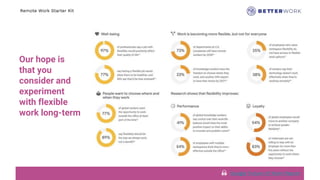
Our hope is
that you
consider and
experiment
with flexible
work long-term
šŸ™ Google Future of Work Report
Remote Work Starter Kit
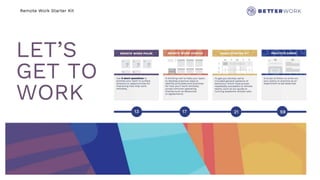
LET’S
GET TO
WORK
113 1 117 21 59
Remote Work Starter Kit
REMOTE WORK
PULSE
Remote Work Starter Kit
Take Your Team’s
Pulse
To measure a team’s level of psychological
safety, Amy Edmondson, Harvard’s
organisational behavioural scientist, surveyed
team members on how strongly they agreed or
disagreed with 7 statements.
Remote Work Starter Kit
Remote Work Pulse Challenge:
Support Psychological Safety
2
3
4
5
6
Challenge
Rhythm
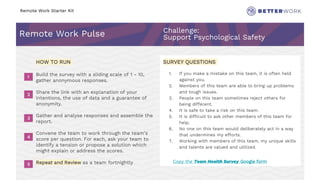
HOW TO RUN
Build the survey with a sliding scale of 1 - 10,
gather anonymous responses.
Share the link with an explanation of your
intentions, the use of data and a guarantee of
anonymity.
Gather and analyse responses and assemble the
report.
Convene the team to work through the team’s
score per question. For each, ask your team to

identify a tension or propose a solution which
might explain or address the scores.
Repeat and Review as a team fortnightly
SURVEY QUESTIONS
1. If you make a mistake on this team, it is often held
against you.
2. Members of this team are able to bring up problems
and tough issues.
3. People on this team sometimes reject others for
being different.
4. It is safe to take a risk on this team.
5. It is difficult to ask other members of this team for
help.
6. No one on this team would deliberately act in a way
that undermines my efforts.
7. Working with members of this team, my unique skills
and talents are valued and utilized.
1
2
3
4
5
Copy the Team Health Survey Google form
Remote Work Starter Kit
Remote Work Pulse Inspiration
6
Challenge
Rhythm
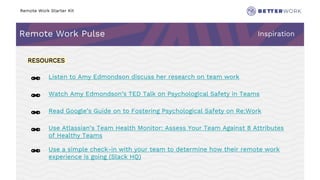
RESOURCES
šŸ”— Listen to Amy Edmondson discuss her research on team work
šŸ”— Watch Amy Edmondson’s TED Talk on Psychological Safety in Teams
šŸ”— Read Google’s Guide on to Fostering Psychological Safety on Re:Work
šŸ”— Use Atlassian’s Team Health Monitor: Assess Your Team Against 8 Attributes
of Healthy Teams
šŸ”— Use a simple check-in with your team to determine how their remote work
experience is going (Slack HQ)
Remote Work Starter Kit
REMOTE WORK
CANVAS
Remote Work Starter Kit
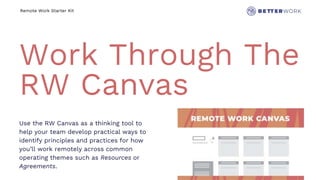
Work Through The
RW Canvas
Use the RW Canvas as a thinking tool to
help your team develop practical ways to
identify principles and practices for how
you’ll work remotely across common
operating themes such as Resources or
Agreements.
Remote Work Starter Kit
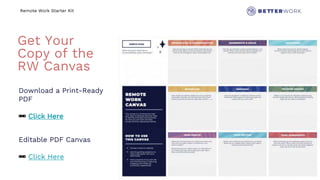
Get Your
Copy of the
RW Canvas
Download a Print-Ready
PDF
šŸ”— Click Here
Editable PDF Canvas
šŸ”— Click Here
Remote Work Starter Kit
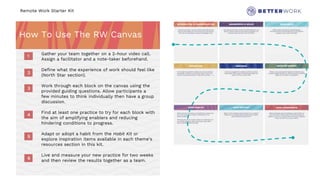
How To Use The RW Canvas
1
2
3
4
5
Gather your team together on a 2-hour video call.
Assign a facilitator and a note-taker beforehand.
Define what the experience of work should feel like
(North Star section).
Work through each block on the canvas using the
provided guiding questions. Allow participants a
few minutes to think individually then have a group
discussion.
Find at least one practice to try for each block with
the aim of amplifying enablers and reducing
hindering conditions to progress.
Adapt or adopt a habit from the Habit Kit or
explore inspiration items available in each theme’s
resources section in this kit.
Live and measure your new practice for two weeks
and then review the results together as a team.6
Remote Work Starter Kit
ADOPT A
HEALTHY TEAM
HABIT
Remote Work Starter Kit
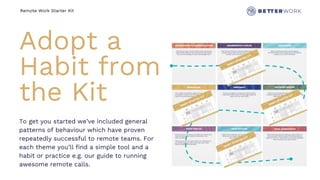
Adopt a
Habit from
the Kit
To get you started we’ve included general
patterns of behaviour which have proven
repeatedly successful to remote teams. For
each theme you’ll find a simple tool and a
habit or practice e.g. our guide to running
awesome remote calls.
Remote Work Starter Kit
INFORMATION &
COMMUNICATION
Remote Work Starter Kit
DEFINE KNOWLEDGE-SHARING STANDARDS
Challenge
Rhythm
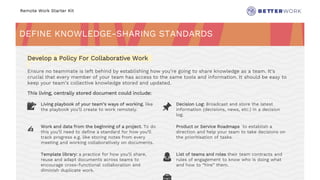
Develop a Policy For Collaborative Work
Ensure no teammate is left behind by establishing how you’re going to share knowledge as a team. It’s
crucial that every member of your team has access to the same tools and information. It should be easy to
keep your team’s collective knowledge stored and updated.
This living, centrally stored document could include:
šŸ“ Living playbook of your team’s ways of working, like
the playbook you’ll create to work remotely. šŸ“Œ Decision Log: Broadcast and store the latest
information (decisions, news, etc.) in a decision
log.
āœ Work and data from the beginning of a project. To do
this you’ll need to define a standard for how you’ll
track progress e.g. like storing notes from every
meeting and working collaboratively on documents.
Product or Service Roadmaps to establish a
direction and help your team to take decisions on
the prioritisation of tasks.
Template library: a practice for how you’ll share,
reuse and adapt documents across teams to
encourage cross-functional collaboration and
diminish duplicate work.
šŸ‘© List of teams and roles their team contracts and
rules of engagement to know who is doing what
and how to ā€œhireā€ them.
Remote Work Starter Kit
Challenge
Rhythm
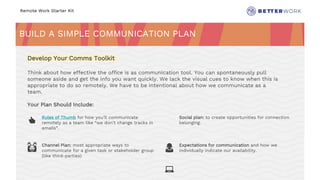
BUILD A SIMPLE COMMUNICATION PLAN
Develop Your Comms Toolkit
Think about how effective the office is as communication tool. You can spontaneously pull
someone aside and get the info you want quickly. We lack the visual cues to know when this is
appropriate to do so remotely. We have to be intentional about how we communicate as a
team.
Your Plan Should Include:
šŸ‘ Rules of Thumb for how you’ll communicate
remotely as a team like ā€œwe don’t change tracks in
emailsā€.
Social plan: to create opportunities for connection
belonging.
šŸ™Œ Channel Plan: most appropriate ways to
communicate for a given task or stakeholder group
(like third-parties)
šŸ‘©
šŸ’»
Expectations for communication and how we
individually indicate our availability.
Remote Work Starter Kit
Information & Communication
Challenge
Rhythm
Inspiration
āœ Get August’s Team Working
Agreements Document
šŸ”— The Art of Asynchronous
Communication
Asynchronous Communication for
Remote Teams
šŸ”— Slack’s Mini Internal
Communication Guide
šŸ”— Basecamp’s Employee Handbook
(comms)
RESOURCES
šŸ”— GitLab Communication Plan
šŸ”— G Suites’ (Google) 10 tips to improve
communication
šŸ”— Gov.uk’s Guidance on Open Standards
šŸ”— View the Gov.uk Design Team’s
Product Roadmap
šŸ”— Download Google Suite Way of Work
Report
Remote Work Starter Kit
INFORMATION &
COMMUNICATION
MEMBERSHIP &
ROLES
Remote Work Starter Kit
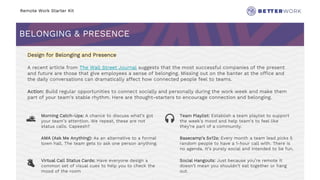
BELONGING & PRESENCE
Challenge
Rhythm
Design for Belonging and Presence
A recent article from The Wall Street Journal suggests that the most successful companies of the present
and future are those that give employees a sense of belonging. Missing out on the banter at the office and
the daily conversations can dramatically affect how connected people feel to teams.
Action: Build regular opportunities to connect socially and personally during the work week and make them
part of your team’s stable rhythm. Here are thought-starters to encourage connection and belonging.
šŸŒ… Morning Catch-Ups: A chance to discuss what’s got
your team’s attention. We repeat, these are not

status calls. Capeesh?
šŸŽ§ Team Playlist: Establish a team playlist to support
the week’s mood and help team’s to feel like
they’re part of a community.
AMA (Ask Me Anything): As an alternative to a formal
town hall. The team gets to ask one person anything.
Basecamp’s 5x12s: Every month a team lead picks 5
random people to have a 1-hour call with. There is
no agenda. It’s purely social and intended to be fun.
šŸ‘Œ Virtual Call Status Cards: Have everyone design a
common set of visual cues to help you to check the
mood of the room
Social Hangouts: Just because you’re remote it
doesn’t mean you shouldn’t eat together or hang
out.
Remote Work Starter Kit
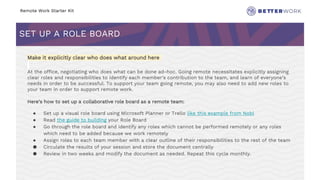
SET UP A ROLE BOARD
Challenge
Rhythm
Make it explicitly clear who does what around here
At the office, negotiating who does what can be done ad-hoc. Going remote necessitates explicitly assigning
clear roles and responsibilities to identify each member's contribution to the team, and learn of everyone’s
needs in order to be successful. To support your team going remote, you may also need to add new roles to
your team in order to support remote work.
Here’s how to set up a collaborative role board as a remote team:
ā— Set up a visual role board using Microsoft Planner or Trello like this example from Nobl
ā— Read the guide to building your Role Board
ā— Go through the role board and identify any roles which cannot be performed remotely or any roles
which need to be added because we work remotely
ā— Assign roles to each team member with a clear outline of their responsibilities to the rest of the team
ā— Circulate the results of your session and store the document centrally
ā— Review in two weeks and modify the document as needed. Repeat this cycle monthly.
Remote Work Starter Kit
MEMBERSHIP & ROLES Inspiration
Challenge
Rhythm
šŸ”— How to Let Your Employees Job Craft
šŸ”— How to Define Roles & Responsibilities Using A Role Board (Nobl)
šŸ”— Managing Cultural Differences in Remote Work (No Border)
šŸ”— The Perception of Presence in Remote Teams (Intense Minimalism)
šŸ”— Atlassian’s Roles & Responsibilities Play
šŸ”— How to Create Belonging In Remote Teams (MIT Sloan)
RESOURCES
Remote Work Starter Kit
RESOURCES
Remote Work Starter Kit
EMPATHY MAPPING TO IDENTIFY NEEDS, PAINS & GAINS
Challenge
Rhythm
1
2
3
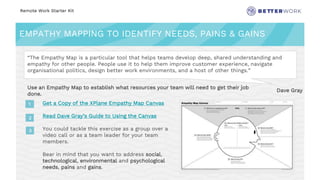
ā€œThe Empathy Map is a particular tool that helps teams develop deep, shared understanding and
empathy for other people. People use it to help them improve customer experience, navigate
organisational politics, design better work environments, and a host of other things.ā€
Dave Gray
Get a Copy of the XPlane Empathy Map Canvas
Read Dave Gray’s Guide to Using the Canvas
You could tackle this exercise as a group over a
video call or as a team leader for your team
members.
Bear in mind that you want to address social,
technological, environmental and psychological
needs, pains and gains.
Use an Empathy Map to establish what resources your team will need to get their job
done.
Remote Work Starter Kit
Resources
Challenge
Rhythm
Inspiration
šŸ”— Formstack’s Remote Team Tech Kit
šŸ”— Fred Perrotta’s Tech Stack for Remote Teams
šŸ”— What’s Your Company’s Emergency Remote Plan (HBR)
šŸ”— Establish Clear Priorities Using Even-Over Statements (Liberationist)
RESOURCES
Remote Work Starter Kit
WORKFLOW
Remote Work Starter Kit
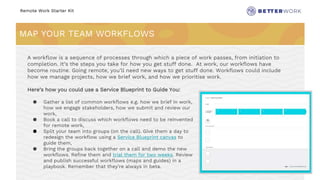
MAP YOUR TEAM WORKFLOWS
Challenge
Rhythm
A workflow is a sequence of processes through which a piece of work passes, from initiation to
completion. It’s the steps you take for how you get stuff done. At work, our workflows have
become routine. Going remote, you’ll need new ways to get stuff done. Workflows could include
how we manage projects, how we brief work, and how we prioritise work.
Here’s how you could use a Service Blueprint to Guide You:
ā— Gather a list of common workflows e.g. how we brief in work,
how we engage stakeholders, how we submit and review our
work,
ā— Book a call to discuss which workflows need to be reinvented
for remote work,
ā— Split your team into groups (on the call). Give them a day to
redesign the workflow using a Service Blueprint canvas to
guide them,
ā— Bring the groups back together on a call and demo the new
workflows. Refine them and trial them for two weeks. Review
and publish successful workflows (maps and guides) in a
playbook. Remember that they’re always in beta.
Remote Work Starter Kit
Workflow Inspiration
Challenge
Rhythm
šŸ”— How to Design a Workflow (Rindle)
šŸ”— 5 Steps to Service Blueprinting (NNG)
šŸ”— How to establish your team’s workflow (Asana)
šŸ”— What’s a workflow and why do you need it? (Trello)
šŸ”— How to Collaborate Remotely: Remote Ideation (NNG)
RESOURCES
Remote Work Starter Kit
MEETINGS
Remote Work Starter Kit
ESTABLISH RE-USABLE MEETING GUIDES
Challenge
Rhythm
1
2
DESIGN YOUR OWN REMOTE MEETINGS FACILITATOR GUIDE FOR CONSISTENT,
EFFECTIVE OUTCOMES
Every remote meeting requires a facilitator and an associated, context-specific guide
to facilitate remote meetings. Get started with your own by adding the general
guidelines below:
Download the Guide on Running Awesome Remote Meetings
Download a Facilitation Guide Template to build repeatable templates for your
most common meetings and rituals.
šŸ™ BetterWork’s Remote Call Guide
Remote Work Starter Kit
Meetings Inspiration
Challenge
Rhythm
šŸ”— Why a Quick ā€œCheck-Inā€ Makes Meetings More Effective (Nobl Academy)
šŸ”— Quickly find out ā€œWhen to Chatā€ to your colleague from a different time-zone.
šŸ”— Watch Miro’s ā€˜Remote Facilitation Best Practices’ webinar
šŸ”— Icebreakers and Rituals for Remote Work: Highlights from NOBL Collective's
Virtual 'Change At Work' Conference
šŸ”— Meeting and Webinar Best Practices from Zoom
šŸ”— 16 tips for engaging teams on video calls
RESOURCES
Remote Work Starter Kit
DECISION-
MAKING
Remote Work Starter Kit
DEFINE DECISION-MAKING RIGHTS WITH ā€˜DACI’
Challenge
Rhythm
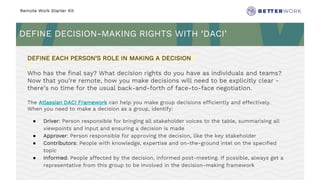
DEFINE EACH PERSON’S ROLE IN MAKING A DECISION
Who has the final say? What decision rights do you have as individuals and teams?
Now that you’re remote, how you make decisions will need to be explicitly clear -
there’s no time for the usual back-and-forth of face-to-face negotiation.
The Atlassian DACI Framework can help you make group decisions efficiently and effectively.
When you need to make a decision as a group, identify:
ā— Driver: Person responsible for bringing all stakeholder voices to the table, summarising all
viewpoints and input and ensuring a decision is made
ā— Approver: Person responsible for approving the decision, like the key stakeholder
ā— Contributors: People with knowledge, expertise and on-the-ground intel on the specified
topic
ā— Informed: People affected by the decision, informed post-meeting. If possible, always get a
representative from this group to be involved in the decision-making framework
Remote Work Starter Kit
DECISION LOG
Challenge
Rhythm
TRACK YOUR DECISIONS
All projects (not tasks) could benefit from recording the decisions that materially
impacted progress. Think of it like a captain’s log. If anyone found it they’d get a
quick look at the climate, your team’s considerations and recommendations. You
can see how this would be beneficial to remote teams who can’t always be on
every call, or a part of every chat.
On a project document list each major decision you made as a team. Bonus points
if you can identify people from the DACI per decision.
A decision log should include: what’s being considered, relevant research, trade-
offs, recommendations and the final decision.
šŸ™ Build Up Decisive Work Habits - Start a Decision Log (Forbes)
Remote Work Starter Kit
BE A BETTER PRESENTER OF IDEAS (SCIPAB METHOD)
Challenge
Rhythm
FAST-TRACK REMOTE DECISIONS
Lack of clarity when presenting an idea in the real world results in ā€œlet’s book another meeting to
discuss.ā€ The same when working remotely creates multiple threads of overlapping
communication and huge waste. Mandel Communications refers to SCIPAB as the "sure-fire, six-
step method for starting any conversation or presentationā€.
The Six Steps to presenting an idea effectively:
ā— Situation: Expresses the current state for discussion.
ā— Complication: Summarises the critical issues, challenges, or opportunities.
ā— Implication: Provides insight into the consequences that will be a result of the Complications not
being addressed.
ā— Position: Notes the presenter's opinion on the necessary changes which should be made.
ā— Action: Defines the expectations of the target audience/listeners.
ā— Benefit: Clearly concludes how the Position and Action sections will address the
ā— Complications: This method can be used in presentations, emails, and everyday conversations.
šŸ™ Six Steps to Start any Conversation or Presentation
Remote Work Starter Kit
Decision-Making Inspiration
Challenge
Rhythm
šŸ”— Use the Decider bot to help your team pick the right decision-making process
(Nobl)
šŸ”— Atlassian’s DACI Framework and Template
šŸ”— Avoid Decision-Making Mistakes Use A Decision Log (Forbes)
šŸ”— Establish Clear Priorities Using Even-Over Statements (Liberationist)
RESOURCES
Remote Work Starter Kit
TEAM HEALTH
Remote Work Starter Kit
PERSONAL USER MANUAL
Challenge
Rhythm
HOW TO WORK WITH ME MANUAL
A personal user manual is a fun way to share your individual preferences for how
you like to collaborate and communicate. The manual will help people in your team
regain some control over how they would like to work dampening the effects of
loss-aversion, i.e. losing a routine and habits.
How to Make Yours
ā— Best suited for your immediate team i.e not division.
ā— Introduce the idea of a ā€œmanual of meā€ to your team via email and have them think about
and record their answers to the 10 prompts Atlassian recommends.
ā— Convene a remote call (2 hrs) and have each team member quickly share their manual.
ā— Store the manuals in a central location which can be accessed.
ā— Check-in on the team in a week to see if the manuals need to be revised or upon reflection
if any new Team Norms need to be established.
šŸ™ Atlassian’s How To Work With Me Manual
Remote Work Starter Kit
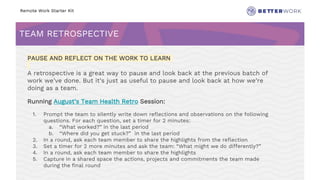
TEAM RETROSPECTIVE
Challenge
Rhythm
PAUSE AND REFLECT ON THE WORK TO LEARN
A retrospective is a great way to pause and look back at the previous batch of
work we’ve done. But it’s just as useful to pause and look back at how we’re
doing as a team.
Running August’s Team Health Retro Session:
1. Prompt the team to silently write down reflections and observations on the following
questions. For each question, set a timer for 2 minutes:
a. ā€œWhat worked?ā€ in the last period
b. ā€œWhere did you get stuck?ā€ in the last period
2. In a round, ask each team member to share the highlights from the reflection
3. Set a timer for 2 more minutes and ask the team: ā€œWhat might we do differently?ā€
4. In a round, ask each team member to share the highlights
5. Capture in a shared space the actions, projects and commitments the team made
during the final round
Remote Work Starter Kit
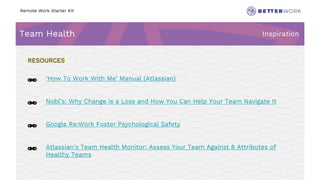
Team Health Inspiration
Challenge
Rhythm
šŸ”— ’How To Work With Me’ Manual (Atlassian)
šŸ”— Nobl’s: Why Change is a Loss and How You Can Help Your Team Navigate It
šŸ”— Google Re:Work Foster Psychological Safety
šŸ”— Atlassian’s Team Health Monitor: Assess Your Team Against 8 Attributes of
Healthy Teams
RESOURCES
Remote Work Starter Kit
TEAM RHYTHM
Remote Work Starter Kit
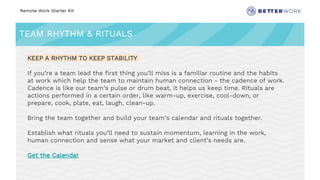
TEAM RHYTHM & RITUALS
Challenge
Rhythm
KEEP A RHYTHM TO KEEP STABILITY
If you’re a team lead the first thing you’ll miss is a familiar routine and the habits
at work which help the team to maintain human connection - the cadence of work.
Cadence is like our team’s pulse or drum beat, it helps us keep time. Rituals are
actions performed in a certain order, like warm-up, exercise, cool-down, or
prepare, cook, plate, eat, laugh, clean-up.
Bring the team together and build your team’s calendar and rituals together.
Establish what rituals you’ll need to sustain momentum, learning in the work,
human connection and sense what your market and client’s needs are.
Get the Calendar
Remote Work Starter Kit
Team Rhythm Inspiration
Challenge
Rhythm
šŸ”— Buy Nobl’s Team Tempo - a guide to keeping a rhythm in a team
šŸ”— Four agile ceremonies, demystified (Atlassian)
šŸ”— The role of cadence and ritual in work (Asana)
šŸ”— Want to strengthen workplace culture? Design a ritual (Huffington Post)
RESOURCES
Remote Work Starter Kit
TEAM
AGREEMENTS
Remote Work Starter Kit
TEAM PRINCIPLES
Challenge
Rhythm
Teamwork is hard, but a winning team culture helps a lot. Collaboratively define the
social norms that will become your team's customised secret sauce.
Use the Atlassian Rules of Engagement session to establish your team’s norms.
This play will help you to:
ā— Codify your team's values and build team culture.
ā— Openly discuss the practices, results, and behaviors you expect from one
another.
Remote Hack
We advocate that you establish your team’s norms first and then apply the
constraint of remote work second. In that way this play will serve your team well
long-term.
Remote Work Starter Kit
TEAM CONTRACT
Challenge
Rhythm
To avoid misunderstandings—and address culture fails—outline what the team
should expect from each other, and from the organisation.
1. Read Nobl’s guide to developing your Team Contract
1. Download Nobl’s Team Contract Template
1. Gather the team (on a video call), setting aside 2 hours for this, work through
the team contract guide and then imagine how you might need to contract
now that you’re working remotely.
Remote Work Starter Kit
TEAM AGREEMENTS Inspiration
Challenge
Rhythm
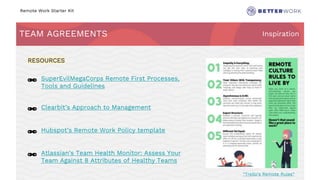
šŸ”— SuperEvilMegaCorps Remote First Processes,
Tools and Guidelines
šŸ”— Clearbit’s Approach to Management
šŸ”— Hubspot’s Remote Work Policy template
šŸ”— Atlassian’s Team Health Monitor: Assess Your
Team Against 8 Attributes of Healthy Teams
RESOURCES
ā€œTrello’s Remote Rulesā€
Remote Work Starter Kit
A PRODUCTIVE
ROUTINE
Remote Work Starter Kit
Build Your Team’s
Calendar
We navigate our week by cues and rituals. They’re
the north stars we head toward. Everything else
around us can change but if we feel that we’re
heading in the right direction we’ll feel comfort and
stability. Shifting to remote work, we need a new
set of cues and rituals to help to establish and
support connection and stability.
Remote Work Starter Kit
Challenge
Rhythm
Remote Work Rhythm Challenge:
Support Psychological Safety
WK M T W T F
1
2
3
4
TEAM
RETRO
(TR)
PLAN SHIPGROUP CHECK-
IN
GROUP CHECK-
IN
GROUP CHECK-
IN
GROUP CHECK-
IN
GROUP CHECK-
IN
GROUP CHECK-
IN
PLAN
HANGOUT
LEADER 1:1s
EXPERT
PLAN SHIP
PLAN SHIP
GROUP CHECK-
IN
GROUP CHECK-
IN
GROUP CHECK-
IN
GROUP CHECK-
IN
GROUP CHECK-
IN
TEAM
RETRO
(TR)
Customer
POV
Pulse
Pulse
Excel Starter Kit
šŸ”— Download Excel Calendar
Google Docs Starter Kit
šŸ”— Download the Calendar
Download a
Team Calendar
Remote Work Starter Kit
START
EXPERIMENTING
Remote Work Starter Kit
Turn Your Policy
into Practice
A simple workflow to follow which will help
you to identify if your way of working is
working through rigorous experimentation.
Remote Work Starter Kit
Continuous Improvement Experiments
Challenge
Rhythm
Instead of assuming that our new ways of working are going to be a success we should subject
ideas to rigorous experimentation. That’s because it’s easier to draw the right conclusions using
information revealed through experiments than by relying on our intuitive sense of cause and
effect. This will also reveal organisational drivers of success which might be otherwise invisible to
us.
ā€œOne of the main (if not the main)
strategies for dealing with a complex
system is to create a range of safe-fail
experiments or probes that will allow the
nature of emergent possibilities to
become more visible…
Everyone with an idea that has even the
remotest possibility of being true or
useful creates a safe fail experiment
based on the idea.ā€
Dave Snowden
šŸ™ Snowden, D and Boone, M (2007) A leader's framework for decision-making, Harvard Business Review pp. 68–76
Dave Snowden’s Criteria for an experiment šŸ™
ā— Any experiment must be something you can do something about
and that you believe stands a chance of having a positive effect.
ā— Secondly, it has to be a change with an observable or measurable
effect so that you can see if the change was good or bad.
ā— The experiment must be something you believe you can dampen if
it goes wrong (i.e. safe-to-fail) or amplify the effect if it goes well.
Remote Work Starter Kit
Continuous Improvement Experiments
Challenge
Rhythm
In complex systems with lots of
moving parts, our ā€œexperimentsā€
are more like safe-to-fail
interventions.
Try something. Sense impact.
Amplify the good. Dampen the
bad. Try something again. Keep
tightening the sense and
respond loop.
John Cutler
To start your first work experiment you will need to turn any
solutions proposed in your Remote Work Canvas session into
experiments.
1. Download the Experiment Template or Copy the Google
Sheet
1. Gather your team (on a video call), setting aside 1 hour to
design a manageable portfolio of experiments i.e. what you
can feasibly do within your team in 2 weeks.
1. Agree on when you’ll review the data and then modify or
change the experiments based on what has emerged in the
trial. Note what works into your Remote Work playbook and
store your unsuccessful experiments.
Remote Work Starter Kit
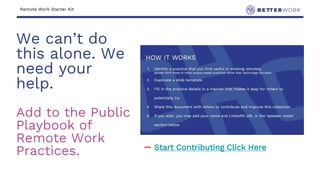
We can’t do
this alone. We
need your
help.
Add to the Public
Playbook of
Remote Work
Practices. āž” Start Contributing Click Here
Remote Work Starter Kit
Challenge
Rhythm
Playbook Inspiration
šŸ”— Zapier’s Ultimate Guide to
Working Remotely
šŸ”— How to Embrace Remote Work -
The Trello Guide
šŸ”— GitLab’s Guide to Remote Work
šŸ”— Kunik’s Suddenly Remote
Workforce (includes tips for
working parents)
PLAYBOOK EXAMPLES
šŸ”— Humaan’s Remote Work Resources:
Onboarding, Trust, Difficult
Conversations...
šŸ”— Remote Work Survival Toolkit
šŸ”— SEMC Q1 2020 Remote First Guidelines
šŸ”— Overcoming Challenges While Working
Remotely (Atlassian)
šŸ”— Evernote’s Leading Virtual Teams
Handbook
Remote Work Starter Kit
YOUR
HEALTH
Remote Work Starter Kit
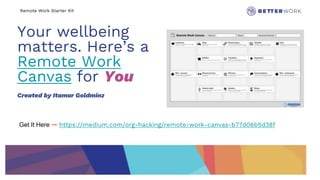
Your wellbeing
matters. Here’s a
Remote Work
Canvas for You
Created by Itamar Goldminz
Get It Here āž” https://medium.com/org-hacking/remote-work-canvas-b77d06b5d38f
Remote Work Starter Kit
Here’s To
Happy
Mondays

Betterwork - Remote Work Starter Kit

  • 1.
    Remote Work StarterKit REMOTE WORK STARTER KIT We can still connect as humans, work together and support each other even when we’re not in the same room. That’s why we’ve created the Remote Work Starter Kit, the people side of going remote, to help you to establish a healthy and human way of working remotely with your team. Attribution-NonCommercial-ShareAlike 4.0 International (CC BY-NC-SA 4.0)
  • 2.
    Remote Work StarterKit This is the playbook for the people side of doing remote work well. This Kit Addresses Remote Work Policy Principles & Norms Rhythm & Rituals Resources & Tools Practices & Workflow āœ… āœ… āœ… āœ… āœ…
  • 3.
    Remote Work StarterKit What's In the Kit?
  • 4.
    Remote Work StarterKit What if ain’t nobody got time for that kit? (tl;dr) Copy a Team Health Survey Get the Remote Work Canvas Get the Remote Work Agreement Doc Download the Team Calendar Download the Experiment Board Add Your Plays to a Public Library Send fortnightly, review fortnightly. Review practices monthly in a team retro. Codify your practices in a living Team Agreement doc. Modify after two weeks of experimentation. Get into the habit of fortnightly or monthly cycles of experimentation. Help others out - add what’s working for you in your team. If you can’t access Dropbox or Google let us know on crew@betterwork.co.za and we’ll send you the kit.
  • 5.
    Remote Work StarterKit PRINCIPLES TO INFORM YOUR PRACTICE
  • 6.
    Remote Work StarterKit People-Positive Principles Climatic forces have prompted your team to go remote, fast. At high speed you’re asking that people in your team change their mental models about work, adapt their routine and habits but still maintain their productivity.
  • 7.
    Remote Work StarterKit Let the team doing the work decide how it gets done Grant teams the agency to align on the outcomes of their work. Encourage them to make decisions autonomously and build trust with one another in ways that might not adhere to your organisation’s structure or way of working. 1. Change is a team sport šŸ™ Empowering over Controlling šŸ™ https://www.responsive.org/manifesto šŸ™ https://agilemanifesto.org šŸ™ Adidas ā€˜Change is a Team Sport’
  • 8.
    Remote Work StarterKit Change is complex which means it’s unpredictable. Good practice will rise out of your context and deliberate, ongoing experimentation - not copying the startup next door. 2. Don’t copy-and-paste culture šŸ™ Experimenting over ā€˜Best Practice’ šŸ™ Bud Caddell, Nobl, from https://openviewpartners.com/blog/where-companies-get-culture-wrong-and-how-to-fix- it/
  • 9.
    Remote Work StarterKit When everything around you is emerging or you’re trying things out for the first time, a regular cadence for getting things done provides a sturdy scaffold on which to build new ways of working. 3. Slow and steady wins the race šŸ™ Build ā€˜scaffolding’ to Support Teamwork šŸ™ Notes on Scaffolding and Constraints in Complexity by Mark Rettig
  • 10.
    Remote Work StarterKit ā€œIn this world of abundant information and connectedness the potential benefits of trusting people who share the organisation’s purpose to act on information as they see fit often outweighs the potential risks of open information being used in counter- productive ways.ā€ - Responsive.org Manifesto 4. No team member gets left behind šŸ™ Access over Ownership šŸ™ ā€˜Mentally Friendly’ - Remote teamwork guide
  • 11.
    Remote Work StarterKit Our hope is that you consider and experiment with flexible work long-term šŸ™ Google Future of Work Report
  • 12.
    Remote Work StarterKit LET’S GET TO WORK 113 1 117 21 59
  • 13.
    Remote Work StarterKit REMOTE WORK PULSE
  • 14.
    Remote Work StarterKit Take Your Team’s Pulse To measure a team’s level of psychological safety, Amy Edmondson, Harvard’s organisational behavioural scientist, surveyed team members on how strongly they agreed or disagreed with 7 statements.
  • 15.
    Remote Work StarterKit Remote Work Pulse Challenge: Support Psychological Safety 2 3 4 5 6 Challenge Rhythm HOW TO RUN Build the survey with a sliding scale of 1 - 10, gather anonymous responses. Share the link with an explanation of your intentions, the use of data and a guarantee of anonymity. Gather and analyse responses and assemble the report. Convene the team to work through the team’s score per question. For each, ask your team to identify a tension or propose a solution which might explain or address the scores. Repeat and Review as a team fortnightly SURVEY QUESTIONS 1. If you make a mistake on this team, it is often held against you. 2. Members of this team are able to bring up problems and tough issues. 3. People on this team sometimes reject others for being different. 4. It is safe to take a risk on this team. 5. It is difficult to ask other members of this team for help. 6. No one on this team would deliberately act in a way that undermines my efforts. 7. Working with members of this team, my unique skills and talents are valued and utilized. 1 2 3 4 5 Copy the Team Health Survey Google form
  • 16.
    Remote Work StarterKit Remote Work Pulse Inspiration 6 Challenge Rhythm RESOURCES šŸ”— Listen to Amy Edmondson discuss her research on team work šŸ”— Watch Amy Edmondson’s TED Talk on Psychological Safety in Teams šŸ”— Read Google’s Guide on to Fostering Psychological Safety on Re:Work šŸ”— Use Atlassian’s Team Health Monitor: Assess Your Team Against 8 Attributes of Healthy Teams šŸ”— Use a simple check-in with your team to determine how their remote work experience is going (Slack HQ)
  • 17.
    Remote Work StarterKit REMOTE WORK CANVAS
  • 18.
    Remote Work StarterKit Work Through The RW Canvas Use the RW Canvas as a thinking tool to help your team develop practical ways to identify principles and practices for how you’ll work remotely across common operating themes such as Resources or Agreements.
  • 19.
    Remote Work StarterKit Get Your Copy of the RW Canvas Download a Print-Ready PDF šŸ”— Click Here Editable PDF Canvas šŸ”— Click Here
  • 20.
    Remote Work StarterKit How To Use The RW Canvas 1 2 3 4 5 Gather your team together on a 2-hour video call. Assign a facilitator and a note-taker beforehand. Define what the experience of work should feel like (North Star section). Work through each block on the canvas using the provided guiding questions. Allow participants a few minutes to think individually then have a group discussion. Find at least one practice to try for each block with the aim of amplifying enablers and reducing hindering conditions to progress. Adapt or adopt a habit from the Habit Kit or explore inspiration items available in each theme’s resources section in this kit. Live and measure your new practice for two weeks and then review the results together as a team.6
  • 21.
    Remote Work StarterKit ADOPT A HEALTHY TEAM HABIT
  • 22.
    Remote Work StarterKit Adopt a Habit from the Kit To get you started we’ve included general patterns of behaviour which have proven repeatedly successful to remote teams. For each theme you’ll find a simple tool and a habit or practice e.g. our guide to running awesome remote calls.
  • 23.
    Remote Work StarterKit INFORMATION & COMMUNICATION
  • 24.
    Remote Work StarterKit DEFINE KNOWLEDGE-SHARING STANDARDS Challenge Rhythm Develop a Policy For Collaborative Work Ensure no teammate is left behind by establishing how you’re going to share knowledge as a team. It’s crucial that every member of your team has access to the same tools and information. It should be easy to keep your team’s collective knowledge stored and updated. This living, centrally stored document could include: šŸ“ Living playbook of your team’s ways of working, like the playbook you’ll create to work remotely. šŸ“Œ Decision Log: Broadcast and store the latest information (decisions, news, etc.) in a decision log. āœ Work and data from the beginning of a project. To do this you’ll need to define a standard for how you’ll track progress e.g. like storing notes from every meeting and working collaboratively on documents. Product or Service Roadmaps to establish a direction and help your team to take decisions on the prioritisation of tasks. Template library: a practice for how you’ll share, reuse and adapt documents across teams to encourage cross-functional collaboration and diminish duplicate work. šŸ‘© List of teams and roles their team contracts and rules of engagement to know who is doing what and how to ā€œhireā€ them.
  • 25.
    Remote Work StarterKit Challenge Rhythm BUILD A SIMPLE COMMUNICATION PLAN Develop Your Comms Toolkit Think about how effective the office is as communication tool. You can spontaneously pull someone aside and get the info you want quickly. We lack the visual cues to know when this is appropriate to do so remotely. We have to be intentional about how we communicate as a team. Your Plan Should Include: šŸ‘ Rules of Thumb for how you’ll communicate remotely as a team like ā€œwe don’t change tracks in emailsā€. Social plan: to create opportunities for connection belonging. šŸ™Œ Channel Plan: most appropriate ways to communicate for a given task or stakeholder group (like third-parties) šŸ‘© šŸ’» Expectations for communication and how we individually indicate our availability.
  • 26.
    Remote Work StarterKit Information & Communication Challenge Rhythm Inspiration āœ Get August’s Team Working Agreements Document šŸ”— The Art of Asynchronous Communication Asynchronous Communication for Remote Teams šŸ”— Slack’s Mini Internal Communication Guide šŸ”— Basecamp’s Employee Handbook (comms) RESOURCES šŸ”— GitLab Communication Plan šŸ”— G Suites’ (Google) 10 tips to improve communication šŸ”— Gov.uk’s Guidance on Open Standards šŸ”— View the Gov.uk Design Team’s Product Roadmap šŸ”— Download Google Suite Way of Work Report
  • 27.
    Remote Work StarterKit INFORMATION & COMMUNICATION MEMBERSHIP & ROLES
  • 28.
    Remote Work StarterKit BELONGING & PRESENCE Challenge Rhythm Design for Belonging and Presence A recent article from The Wall Street Journal suggests that the most successful companies of the present and future are those that give employees a sense of belonging. Missing out on the banter at the office and the daily conversations can dramatically affect how connected people feel to teams. Action: Build regular opportunities to connect socially and personally during the work week and make them part of your team’s stable rhythm. Here are thought-starters to encourage connection and belonging. šŸŒ… Morning Catch-Ups: A chance to discuss what’s got your team’s attention. We repeat, these are not status calls. Capeesh? šŸŽ§ Team Playlist: Establish a team playlist to support the week’s mood and help team’s to feel like they’re part of a community. AMA (Ask Me Anything): As an alternative to a formal town hall. The team gets to ask one person anything. Basecamp’s 5x12s: Every month a team lead picks 5 random people to have a 1-hour call with. There is no agenda. It’s purely social and intended to be fun. šŸ‘Œ Virtual Call Status Cards: Have everyone design a common set of visual cues to help you to check the mood of the room Social Hangouts: Just because you’re remote it doesn’t mean you shouldn’t eat together or hang out.
  • 29.
    Remote Work StarterKit SET UP A ROLE BOARD Challenge Rhythm Make it explicitly clear who does what around here At the office, negotiating who does what can be done ad-hoc. Going remote necessitates explicitly assigning clear roles and responsibilities to identify each member's contribution to the team, and learn of everyone’s needs in order to be successful. To support your team going remote, you may also need to add new roles to your team in order to support remote work. Here’s how to set up a collaborative role board as a remote team: ā— Set up a visual role board using Microsoft Planner or Trello like this example from Nobl ā— Read the guide to building your Role Board ā— Go through the role board and identify any roles which cannot be performed remotely or any roles which need to be added because we work remotely ā— Assign roles to each team member with a clear outline of their responsibilities to the rest of the team ā— Circulate the results of your session and store the document centrally ā— Review in two weeks and modify the document as needed. Repeat this cycle monthly.
  • 30.
    Remote Work StarterKit MEMBERSHIP & ROLES Inspiration Challenge Rhythm šŸ”— How to Let Your Employees Job Craft šŸ”— How to Define Roles & Responsibilities Using A Role Board (Nobl) šŸ”— Managing Cultural Differences in Remote Work (No Border) šŸ”— The Perception of Presence in Remote Teams (Intense Minimalism) šŸ”— Atlassian’s Roles & Responsibilities Play šŸ”— How to Create Belonging In Remote Teams (MIT Sloan) RESOURCES
  • 31.
    Remote Work StarterKit RESOURCES
  • 32.
    Remote Work StarterKit EMPATHY MAPPING TO IDENTIFY NEEDS, PAINS & GAINS Challenge Rhythm 1 2 3 ā€œThe Empathy Map is a particular tool that helps teams develop deep, shared understanding and empathy for other people. People use it to help them improve customer experience, navigate organisational politics, design better work environments, and a host of other things.ā€ Dave Gray Get a Copy of the XPlane Empathy Map Canvas Read Dave Gray’s Guide to Using the Canvas You could tackle this exercise as a group over a video call or as a team leader for your team members. Bear in mind that you want to address social, technological, environmental and psychological needs, pains and gains. Use an Empathy Map to establish what resources your team will need to get their job done.
  • 33.
    Remote Work StarterKit Resources Challenge Rhythm Inspiration šŸ”— Formstack’s Remote Team Tech Kit šŸ”— Fred Perrotta’s Tech Stack for Remote Teams šŸ”— What’s Your Company’s Emergency Remote Plan (HBR) šŸ”— Establish Clear Priorities Using Even-Over Statements (Liberationist) RESOURCES
  • 34.
    Remote Work StarterKit WORKFLOW
  • 35.
    Remote Work StarterKit MAP YOUR TEAM WORKFLOWS Challenge Rhythm A workflow is a sequence of processes through which a piece of work passes, from initiation to completion. It’s the steps you take for how you get stuff done. At work, our workflows have become routine. Going remote, you’ll need new ways to get stuff done. Workflows could include how we manage projects, how we brief work, and how we prioritise work. Here’s how you could use a Service Blueprint to Guide You: ā— Gather a list of common workflows e.g. how we brief in work, how we engage stakeholders, how we submit and review our work, ā— Book a call to discuss which workflows need to be reinvented for remote work, ā— Split your team into groups (on the call). Give them a day to redesign the workflow using a Service Blueprint canvas to guide them, ā— Bring the groups back together on a call and demo the new workflows. Refine them and trial them for two weeks. Review and publish successful workflows (maps and guides) in a playbook. Remember that they’re always in beta.
  • 36.
    Remote Work StarterKit Workflow Inspiration Challenge Rhythm šŸ”— How to Design a Workflow (Rindle) šŸ”— 5 Steps to Service Blueprinting (NNG) šŸ”— How to establish your team’s workflow (Asana) šŸ”— What’s a workflow and why do you need it? (Trello) šŸ”— How to Collaborate Remotely: Remote Ideation (NNG) RESOURCES
  • 37.
    Remote Work StarterKit MEETINGS
  • 38.
    Remote Work StarterKit ESTABLISH RE-USABLE MEETING GUIDES Challenge Rhythm 1 2 DESIGN YOUR OWN REMOTE MEETINGS FACILITATOR GUIDE FOR CONSISTENT, EFFECTIVE OUTCOMES Every remote meeting requires a facilitator and an associated, context-specific guide to facilitate remote meetings. Get started with your own by adding the general guidelines below: Download the Guide on Running Awesome Remote Meetings Download a Facilitation Guide Template to build repeatable templates for your most common meetings and rituals. šŸ™ BetterWork’s Remote Call Guide
  • 39.
    Remote Work StarterKit Meetings Inspiration Challenge Rhythm šŸ”— Why a Quick ā€œCheck-Inā€ Makes Meetings More Effective (Nobl Academy) šŸ”— Quickly find out ā€œWhen to Chatā€ to your colleague from a different time-zone. šŸ”— Watch Miro’s ā€˜Remote Facilitation Best Practices’ webinar šŸ”— Icebreakers and Rituals for Remote Work: Highlights from NOBL Collective's Virtual 'Change At Work' Conference šŸ”— Meeting and Webinar Best Practices from Zoom šŸ”— 16 tips for engaging teams on video calls RESOURCES
  • 40.
    Remote Work StarterKit DECISION- MAKING
  • 41.
    Remote Work StarterKit DEFINE DECISION-MAKING RIGHTS WITH ā€˜DACI’ Challenge Rhythm DEFINE EACH PERSON’S ROLE IN MAKING A DECISION Who has the final say? What decision rights do you have as individuals and teams? Now that you’re remote, how you make decisions will need to be explicitly clear - there’s no time for the usual back-and-forth of face-to-face negotiation. The Atlassian DACI Framework can help you make group decisions efficiently and effectively. When you need to make a decision as a group, identify: ā— Driver: Person responsible for bringing all stakeholder voices to the table, summarising all viewpoints and input and ensuring a decision is made ā— Approver: Person responsible for approving the decision, like the key stakeholder ā— Contributors: People with knowledge, expertise and on-the-ground intel on the specified topic ā— Informed: People affected by the decision, informed post-meeting. If possible, always get a representative from this group to be involved in the decision-making framework
  • 42.
    Remote Work StarterKit DECISION LOG Challenge Rhythm TRACK YOUR DECISIONS All projects (not tasks) could benefit from recording the decisions that materially impacted progress. Think of it like a captain’s log. If anyone found it they’d get a quick look at the climate, your team’s considerations and recommendations. You can see how this would be beneficial to remote teams who can’t always be on every call, or a part of every chat. On a project document list each major decision you made as a team. Bonus points if you can identify people from the DACI per decision. A decision log should include: what’s being considered, relevant research, trade- offs, recommendations and the final decision. šŸ™ Build Up Decisive Work Habits - Start a Decision Log (Forbes)
  • 43.
    Remote Work StarterKit BE A BETTER PRESENTER OF IDEAS (SCIPAB METHOD) Challenge Rhythm FAST-TRACK REMOTE DECISIONS Lack of clarity when presenting an idea in the real world results in ā€œlet’s book another meeting to discuss.ā€ The same when working remotely creates multiple threads of overlapping communication and huge waste. Mandel Communications refers to SCIPAB as the "sure-fire, six- step method for starting any conversation or presentationā€. The Six Steps to presenting an idea effectively: ā— Situation: Expresses the current state for discussion. ā— Complication: Summarises the critical issues, challenges, or opportunities. ā— Implication: Provides insight into the consequences that will be a result of the Complications not being addressed. ā— Position: Notes the presenter's opinion on the necessary changes which should be made. ā— Action: Defines the expectations of the target audience/listeners. ā— Benefit: Clearly concludes how the Position and Action sections will address the ā— Complications: This method can be used in presentations, emails, and everyday conversations. šŸ™ Six Steps to Start any Conversation or Presentation
  • 44.
    Remote Work StarterKit Decision-Making Inspiration Challenge Rhythm šŸ”— Use the Decider bot to help your team pick the right decision-making process (Nobl) šŸ”— Atlassian’s DACI Framework and Template šŸ”— Avoid Decision-Making Mistakes Use A Decision Log (Forbes) šŸ”— Establish Clear Priorities Using Even-Over Statements (Liberationist) RESOURCES
  • 45.
    Remote Work StarterKit TEAM HEALTH
  • 46.
    Remote Work StarterKit PERSONAL USER MANUAL Challenge Rhythm HOW TO WORK WITH ME MANUAL A personal user manual is a fun way to share your individual preferences for how you like to collaborate and communicate. The manual will help people in your team regain some control over how they would like to work dampening the effects of loss-aversion, i.e. losing a routine and habits. How to Make Yours ā— Best suited for your immediate team i.e not division. ā— Introduce the idea of a ā€œmanual of meā€ to your team via email and have them think about and record their answers to the 10 prompts Atlassian recommends. ā— Convene a remote call (2 hrs) and have each team member quickly share their manual. ā— Store the manuals in a central location which can be accessed. ā— Check-in on the team in a week to see if the manuals need to be revised or upon reflection if any new Team Norms need to be established. šŸ™ Atlassian’s How To Work With Me Manual
  • 47.
    Remote Work StarterKit TEAM RETROSPECTIVE Challenge Rhythm PAUSE AND REFLECT ON THE WORK TO LEARN A retrospective is a great way to pause and look back at the previous batch of work we’ve done. But it’s just as useful to pause and look back at how we’re doing as a team. Running August’s Team Health Retro Session: 1. Prompt the team to silently write down reflections and observations on the following questions. For each question, set a timer for 2 minutes: a. ā€œWhat worked?ā€ in the last period b. ā€œWhere did you get stuck?ā€ in the last period 2. In a round, ask each team member to share the highlights from the reflection 3. Set a timer for 2 more minutes and ask the team: ā€œWhat might we do differently?ā€ 4. In a round, ask each team member to share the highlights 5. Capture in a shared space the actions, projects and commitments the team made during the final round
  • 48.
    Remote Work StarterKit Team Health Inspiration Challenge Rhythm šŸ”— ’How To Work With Me’ Manual (Atlassian) šŸ”— Nobl’s: Why Change is a Loss and How You Can Help Your Team Navigate It šŸ”— Google Re:Work Foster Psychological Safety šŸ”— Atlassian’s Team Health Monitor: Assess Your Team Against 8 Attributes of Healthy Teams RESOURCES
  • 49.
    Remote Work StarterKit TEAM RHYTHM
  • 50.
    Remote Work StarterKit TEAM RHYTHM & RITUALS Challenge Rhythm KEEP A RHYTHM TO KEEP STABILITY If you’re a team lead the first thing you’ll miss is a familiar routine and the habits at work which help the team to maintain human connection - the cadence of work. Cadence is like our team’s pulse or drum beat, it helps us keep time. Rituals are actions performed in a certain order, like warm-up, exercise, cool-down, or prepare, cook, plate, eat, laugh, clean-up. Bring the team together and build your team’s calendar and rituals together. Establish what rituals you’ll need to sustain momentum, learning in the work, human connection and sense what your market and client’s needs are. Get the Calendar
  • 51.
    Remote Work StarterKit Team Rhythm Inspiration Challenge Rhythm šŸ”— Buy Nobl’s Team Tempo - a guide to keeping a rhythm in a team šŸ”— Four agile ceremonies, demystified (Atlassian) šŸ”— The role of cadence and ritual in work (Asana) šŸ”— Want to strengthen workplace culture? Design a ritual (Huffington Post) RESOURCES
  • 52.
    Remote Work StarterKit TEAM AGREEMENTS
  • 53.
    Remote Work StarterKit TEAM PRINCIPLES Challenge Rhythm Teamwork is hard, but a winning team culture helps a lot. Collaboratively define the social norms that will become your team's customised secret sauce. Use the Atlassian Rules of Engagement session to establish your team’s norms. This play will help you to: ā— Codify your team's values and build team culture. ā— Openly discuss the practices, results, and behaviors you expect from one another. Remote Hack We advocate that you establish your team’s norms first and then apply the constraint of remote work second. In that way this play will serve your team well long-term.
  • 54.
    Remote Work StarterKit TEAM CONTRACT Challenge Rhythm To avoid misunderstandings—and address culture fails—outline what the team should expect from each other, and from the organisation. 1. Read Nobl’s guide to developing your Team Contract 1. Download Nobl’s Team Contract Template 1. Gather the team (on a video call), setting aside 2 hours for this, work through the team contract guide and then imagine how you might need to contract now that you’re working remotely.
  • 55.
    Remote Work StarterKit TEAM AGREEMENTS Inspiration Challenge Rhythm šŸ”— SuperEvilMegaCorps Remote First Processes, Tools and Guidelines šŸ”— Clearbit’s Approach to Management šŸ”— Hubspot’s Remote Work Policy template šŸ”— Atlassian’s Team Health Monitor: Assess Your Team Against 8 Attributes of Healthy Teams RESOURCES ā€œTrello’s Remote Rulesā€
  • 56.
    Remote Work StarterKit A PRODUCTIVE ROUTINE
  • 57.
    Remote Work StarterKit Build Your Team’s Calendar We navigate our week by cues and rituals. They’re the north stars we head toward. Everything else around us can change but if we feel that we’re heading in the right direction we’ll feel comfort and stability. Shifting to remote work, we need a new set of cues and rituals to help to establish and support connection and stability.
  • 58.
    Remote Work StarterKit Challenge Rhythm Remote Work Rhythm Challenge: Support Psychological Safety WK M T W T F 1 2 3 4 TEAM RETRO (TR) PLAN SHIPGROUP CHECK- IN GROUP CHECK- IN GROUP CHECK- IN GROUP CHECK- IN GROUP CHECK- IN GROUP CHECK- IN PLAN HANGOUT LEADER 1:1s EXPERT PLAN SHIP PLAN SHIP GROUP CHECK- IN GROUP CHECK- IN GROUP CHECK- IN GROUP CHECK- IN GROUP CHECK- IN TEAM RETRO (TR) Customer POV Pulse Pulse Excel Starter Kit šŸ”— Download Excel Calendar Google Docs Starter Kit šŸ”— Download the Calendar Download a Team Calendar
  • 59.
    Remote Work StarterKit START EXPERIMENTING
  • 60.
    Remote Work StarterKit Turn Your Policy into Practice A simple workflow to follow which will help you to identify if your way of working is working through rigorous experimentation.
  • 61.
    Remote Work StarterKit Continuous Improvement Experiments Challenge Rhythm Instead of assuming that our new ways of working are going to be a success we should subject ideas to rigorous experimentation. That’s because it’s easier to draw the right conclusions using information revealed through experiments than by relying on our intuitive sense of cause and effect. This will also reveal organisational drivers of success which might be otherwise invisible to us. ā€œOne of the main (if not the main) strategies for dealing with a complex system is to create a range of safe-fail experiments or probes that will allow the nature of emergent possibilities to become more visible… Everyone with an idea that has even the remotest possibility of being true or useful creates a safe fail experiment based on the idea.ā€ Dave Snowden šŸ™ Snowden, D and Boone, M (2007) A leader's framework for decision-making, Harvard Business Review pp. 68–76 Dave Snowden’s Criteria for an experiment šŸ™ ā— Any experiment must be something you can do something about and that you believe stands a chance of having a positive effect. ā— Secondly, it has to be a change with an observable or measurable effect so that you can see if the change was good or bad. ā— The experiment must be something you believe you can dampen if it goes wrong (i.e. safe-to-fail) or amplify the effect if it goes well.
  • 62.
    Remote Work StarterKit Continuous Improvement Experiments Challenge Rhythm In complex systems with lots of moving parts, our ā€œexperimentsā€ are more like safe-to-fail interventions. Try something. Sense impact. Amplify the good. Dampen the bad. Try something again. Keep tightening the sense and respond loop. John Cutler To start your first work experiment you will need to turn any solutions proposed in your Remote Work Canvas session into experiments. 1. Download the Experiment Template or Copy the Google Sheet 1. Gather your team (on a video call), setting aside 1 hour to design a manageable portfolio of experiments i.e. what you can feasibly do within your team in 2 weeks. 1. Agree on when you’ll review the data and then modify or change the experiments based on what has emerged in the trial. Note what works into your Remote Work playbook and store your unsuccessful experiments.
  • 63.
    Remote Work StarterKit We can’t do this alone. We need your help. Add to the Public Playbook of Remote Work Practices. āž” Start Contributing Click Here
  • 64.
    Remote Work StarterKit Challenge Rhythm Playbook Inspiration šŸ”— Zapier’s Ultimate Guide to Working Remotely šŸ”— How to Embrace Remote Work - The Trello Guide šŸ”— GitLab’s Guide to Remote Work šŸ”— Kunik’s Suddenly Remote Workforce (includes tips for working parents) PLAYBOOK EXAMPLES šŸ”— Humaan’s Remote Work Resources: Onboarding, Trust, Difficult Conversations... šŸ”— Remote Work Survival Toolkit šŸ”— SEMC Q1 2020 Remote First Guidelines šŸ”— Overcoming Challenges While Working Remotely (Atlassian) šŸ”— Evernote’s Leading Virtual Teams Handbook
  • 65.
    Remote Work StarterKit YOUR HEALTH
  • 66.
    Remote Work StarterKit Your wellbeing matters. Here’s a Remote Work Canvas for You Created by Itamar Goldminz Get It Here āž” https://medium.com/org-hacking/remote-work-canvas-b77d06b5d38f
  • 67.
    Remote Work StarterKit Here’s To Happy Mondays