Better Study Strategies By b4ckd00r (YGN Ethical Hacker Group)
Why use better strategies What it takes to learn something from sources such as ebooks, presentation, web libraries ..etc First you have to get it (=understand) Then ensure you don’t forget it It’s not about pushing facts into your head blindly
Nice Characters Always start from beginner level when you approach to stranger technology/concept This avoids lack-of-foundations problem in higher/more complex project It takes time. Be patient!  Learn step-by-step unless you’re genius E.g. Google : ‘Perl Beginner Level’
Use Analytical Approach If it seems you can’t get most from a resource in spite of some long time learning, just drop it Because language may be complicated or you need some background foundations Not all ebooks suit to you Not all ebooks are perfect You must be smart enough which one is best to start
Starter Keywords Demystified How-to QuickStart Easy Guide For Dummies
But … They leave a great deal at start If you want to learn something from scratch, take great care of choosing resources This save your time a lot more later Personally, I don’t use google for learning entire subject Google surely gives inconsistent or random topics which make your mind a bit confused or make you lack of foundations
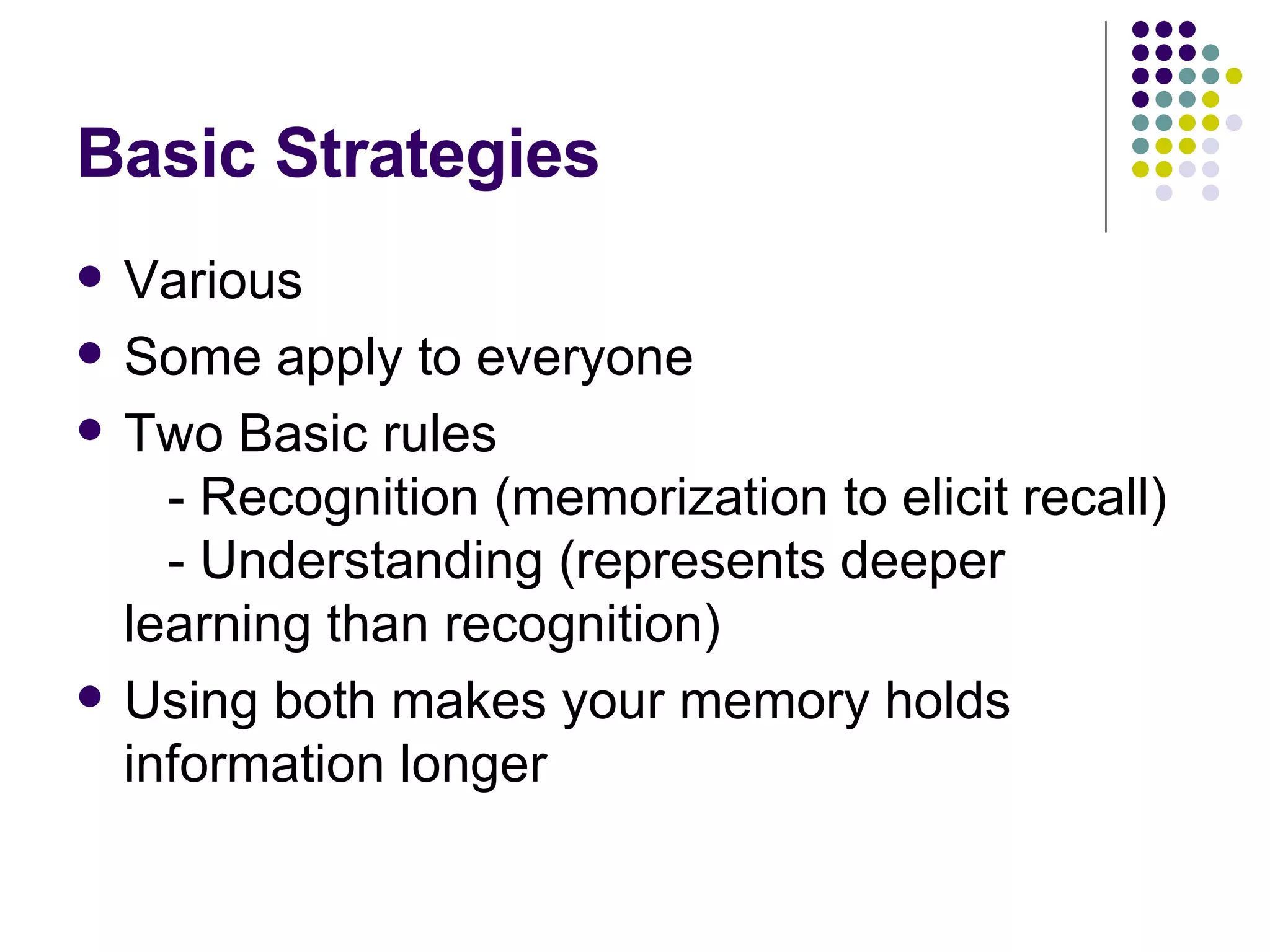
Basic Strategies Various Some apply to everyone Two Basic rules    - Recognition (memorization to elicit recall)   - Understanding (represents deeper learning than recognition) Using both makes your memory holds information longer
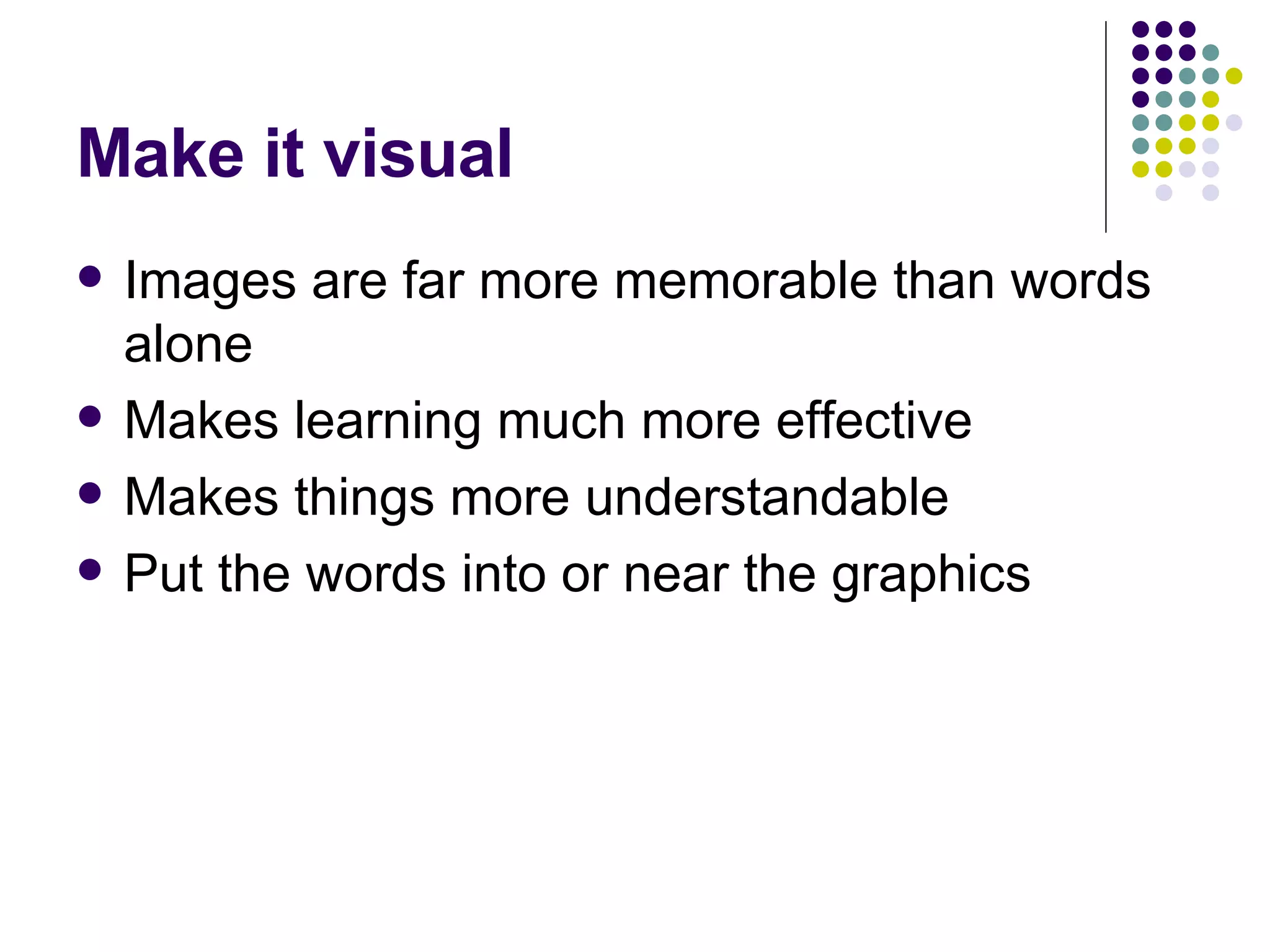
Make it visual Images are far more memorable than words alone Makes learning much more effective Makes things more understandable Put the words into or near the graphics
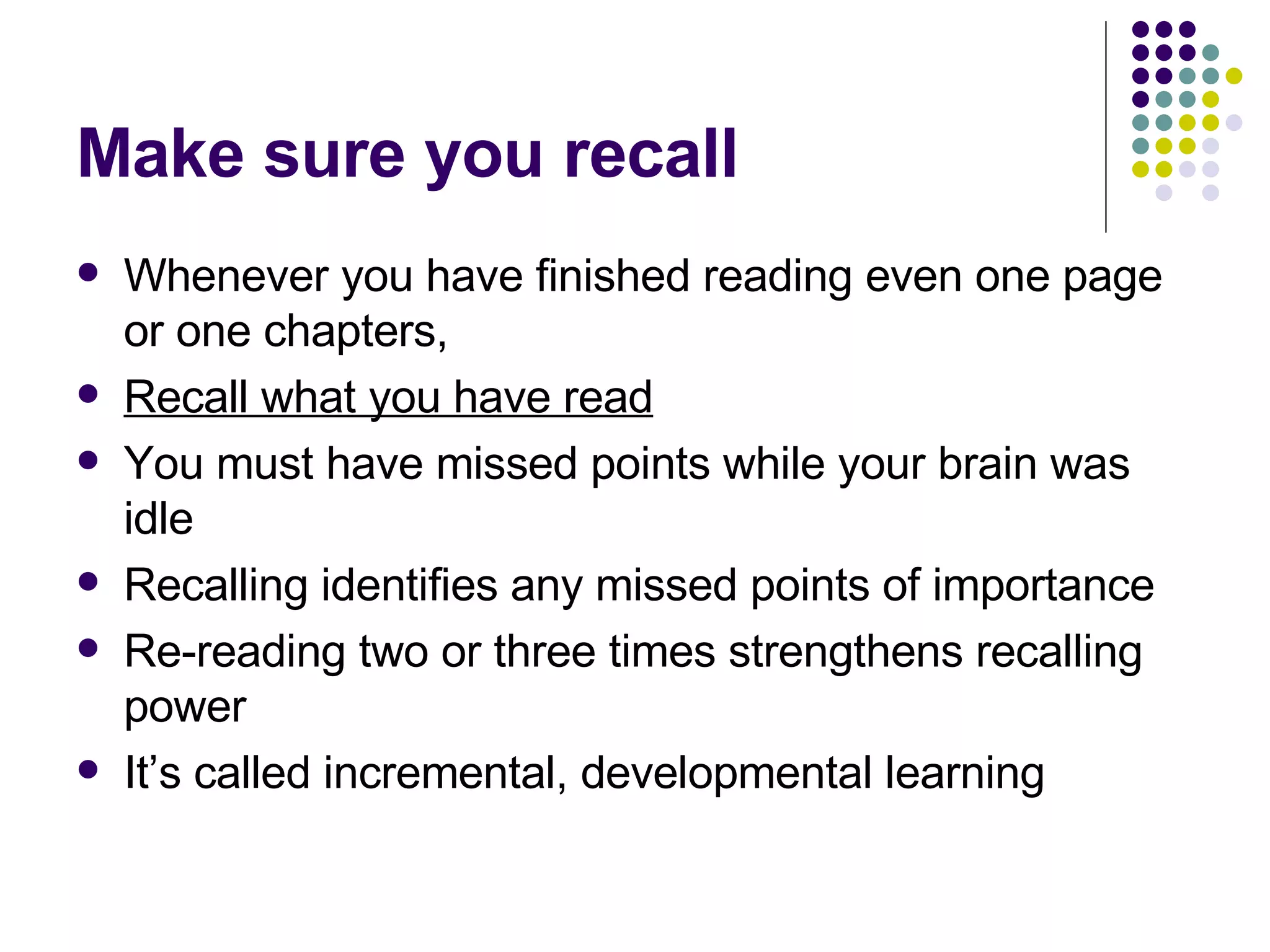
Make sure you recall Whenever you have finished reading even one page or one chapters,  Recall what you have read You must have missed points while your brain was idle Recalling identifies any missed points of importance Re-reading two or three times strengthens recalling power It’s called incremental, developmental learning
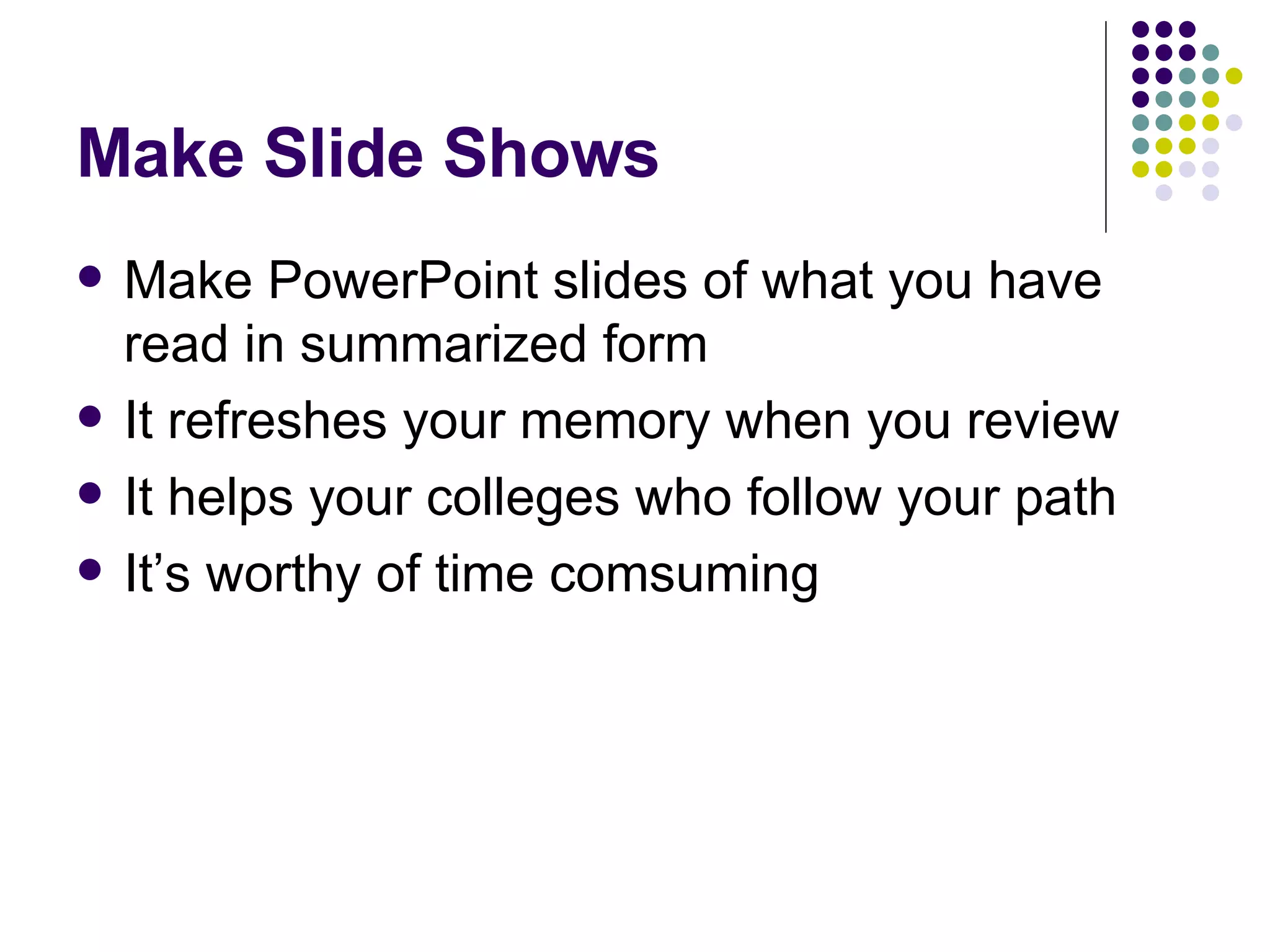
Make Slide Shows Make PowerPoint slides of what you have read in summarized form It refreshes your memory when you review It helps your colleges who follow your path It’s worthy of time comsuming
Macro & Micro Strategies Prepare an outline that covers all objectives of your particular area (or exam) An outline provides two approaches to studying.  First, you can study the outline by focusing on the organization of the material.  Work your way through the points and subpoints of your outline, with the goal of learning how they relate to one another.
Macro & Micro Strategies (II) Next, work through the outline, focusing on learning the details. Memorize and understand terms and their definitions, facts, rules and tactics, advantages and disadvantages, and so on.  In this pass through the outline, you should attempt to learn detail rather than the big picture
Active Study Strategies Process of writing down and defining objectives, subobjectives, terms, facts, and definitions promotes a more active learning strategy than merely reading the material does Writing forces you to engage in more active encoding of the information Simply reading over the information leads to more passive processing.
Common-Sense Strategies Follow common-sense practices when studying Study when you are alert, reduces or eliminates distractions Take breaks when you become fatigued.

Better Study Strategies

  • 1.
    Better Study StrategiesBy b4ckd00r (YGN Ethical Hacker Group)
  • 2.
    Why use betterstrategies What it takes to learn something from sources such as ebooks, presentation, web libraries ..etc First you have to get it (=understand) Then ensure you don’t forget it It’s not about pushing facts into your head blindly
  • 3.
    Nice Characters Alwaysstart from beginner level when you approach to stranger technology/concept This avoids lack-of-foundations problem in higher/more complex project It takes time. Be patient! Learn step-by-step unless you’re genius E.g. Google : ‘Perl Beginner Level’
  • 4.
    Use Analytical ApproachIf it seems you can’t get most from a resource in spite of some long time learning, just drop it Because language may be complicated or you need some background foundations Not all ebooks suit to you Not all ebooks are perfect You must be smart enough which one is best to start
  • 5.
    Starter Keywords DemystifiedHow-to QuickStart Easy Guide For Dummies
  • 6.
    But … Theyleave a great deal at start If you want to learn something from scratch, take great care of choosing resources This save your time a lot more later Personally, I don’t use google for learning entire subject Google surely gives inconsistent or random topics which make your mind a bit confused or make you lack of foundations
  • 7.
    Basic Strategies VariousSome apply to everyone Two Basic rules - Recognition (memorization to elicit recall) - Understanding (represents deeper learning than recognition) Using both makes your memory holds information longer
  • 8.
    Make it visualImages are far more memorable than words alone Makes learning much more effective Makes things more understandable Put the words into or near the graphics
  • 9.
    Make sure yourecall Whenever you have finished reading even one page or one chapters, Recall what you have read You must have missed points while your brain was idle Recalling identifies any missed points of importance Re-reading two or three times strengthens recalling power It’s called incremental, developmental learning
  • 10.
    Make Slide ShowsMake PowerPoint slides of what you have read in summarized form It refreshes your memory when you review It helps your colleges who follow your path It’s worthy of time comsuming
  • 11.
    Macro & MicroStrategies Prepare an outline that covers all objectives of your particular area (or exam) An outline provides two approaches to studying. First, you can study the outline by focusing on the organization of the material. Work your way through the points and subpoints of your outline, with the goal of learning how they relate to one another.
  • 12.
    Macro & MicroStrategies (II) Next, work through the outline, focusing on learning the details. Memorize and understand terms and their definitions, facts, rules and tactics, advantages and disadvantages, and so on. In this pass through the outline, you should attempt to learn detail rather than the big picture
  • 13.
    Active Study StrategiesProcess of writing down and defining objectives, subobjectives, terms, facts, and definitions promotes a more active learning strategy than merely reading the material does Writing forces you to engage in more active encoding of the information Simply reading over the information leads to more passive processing.
  • 14.
    Common-Sense Strategies Followcommon-sense practices when studying Study when you are alert, reduces or eliminates distractions Take breaks when you become fatigued.