What are some study
techniques which I could
use?
15/07/2020 14:57
1. Spaced repetition​ (e.g. via ​Anki​, check ​r/Anki​)
2. Incremental reading​ (e.g. via ​SuperMemo​ or ​Polar Bookshelf​)
3. Fractal learning​ i.e. learning the general and abstract models first before diving
into the concrete details (making use of ​construal level theory​ and the ​Pareto
principle​).
4. Top-down and bottom-up approaches​ → it's usually more efficient to work toward
a goal than to do random things (e.g. because you are wasting less resources on
irrelevancies).
5. Levels of Processing model​ → the more neural resources you spend on
something (e.g. recalling something), the stronger you create the connections in
your mind and make them deteriorate more slowly.
6. Metacognition​. The most important thing I have learned from this, is to try to turn
as much declarative knowledge into procedural knowledge (i.e. how and when to
do things). This can be achieved by e.g. ​interleaved practice​.
7. E-learning theory​ → reduce extraneous cognitive load by removing distracting
stimuli, reduce instrinsic cognitive load by decreasing the processing speed (e.g.
calculating things more slowly and more accurately), and reducing germane
cognitive load via e.g. the ​Levels of Processing​ model.
8. Mind mapping​ (best used in combination with spaced repetition).
9. Freeing up your short-term working memory by e.g. writing things down (and use
your freed up working memory for procedural tasks rather than memorizing stuff).
10. Physical exercise, mindfulness, nutrition, sleep etc. the basic stuff.
11. A guide to overcoming procrastination
12. Reflecting on what you have learned (or ​backpropagation​ like it's called in
machine learning) → updating your thought processes to minimize loss and
increase accuracy, speed, etc.
13. Inversion thinking​ → knowing what not to do and avoiding that.
14. Progression via deliberate mistakes → when not knowing how to answer
something, simply give a random answer and ask yourself "so why is this
incorrect?" and "what about it is correct?" and keep making deliberate mistakes
until you get closer to the actual answer. It's from the book ​The 5 Elements of
Effective Thinking​.
I'm pretty sure I got more, but I would advise, as the first step, that the most gains can be
made in:
1. Spaced repetition (e.g. Anki software, check ​r/Anki​), and;
5 main components of ​construal level theory​:
1. Temporal → the longer something is valuable, the more generally applicable it
probably is (​Lindy effect​)
2. Spatial → e.g. how applicable something is across distance (e.g. in your own
country vs. world wide)
3. Social → e.g. learning general psychological concepts before focusing on
individuals
4. Hypothetical → the higher the probability, the more applicable something
probably is (considering the ​principle of indifference​)
5. Informational → the more you already know about something, the easier it is
probably to learn
A nice quote to end with:
"If you want to think like a genius, you first have to LEARN like a genius."
Source:
https://www.reddit.com/r/study/comments/hqr5un/what_are_some_study_techniques_which
_i_could_use/fy51dbz?utm_source=share&utm_medium=web2x 

What are some study techniques which I could use?

  • 1.
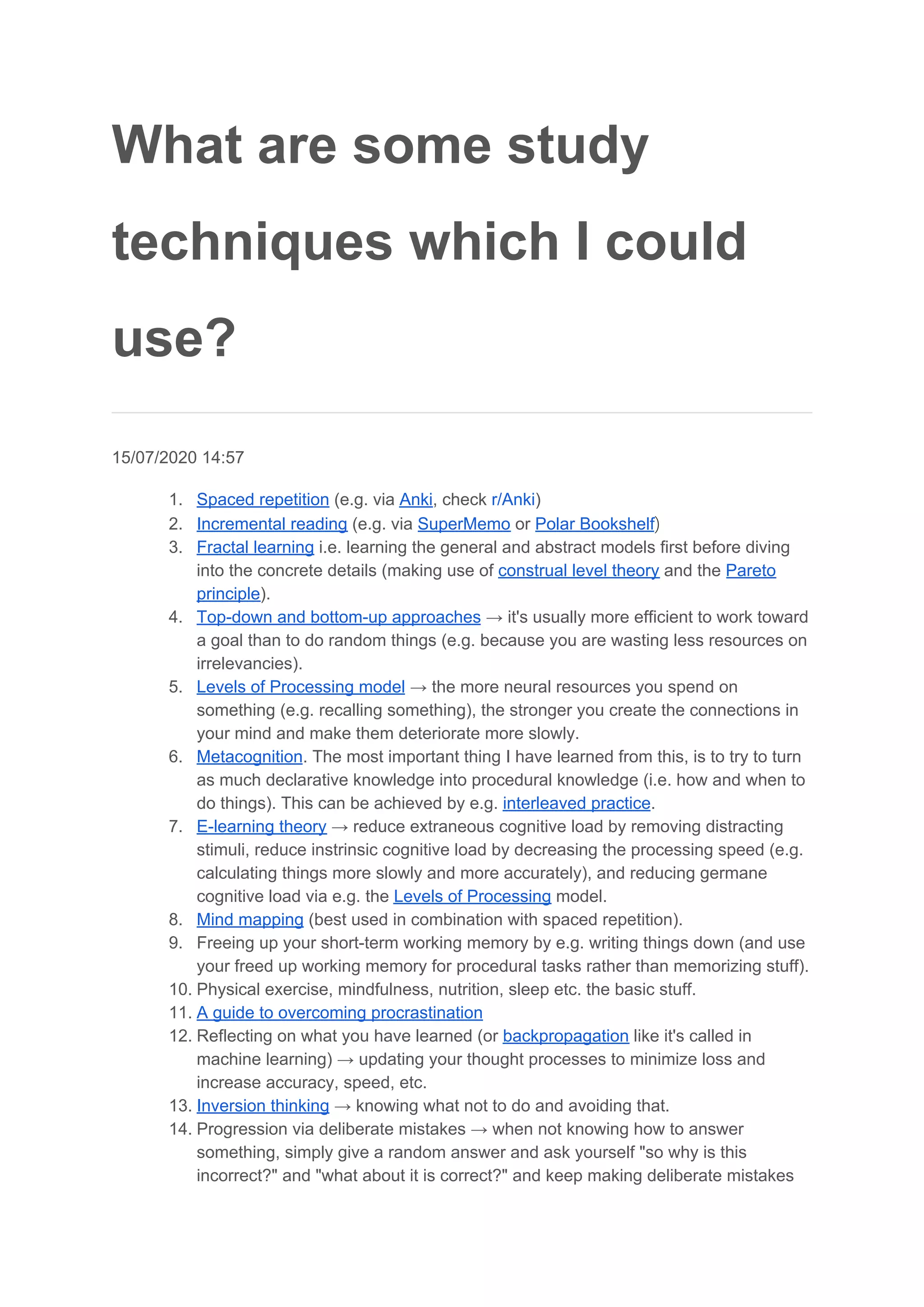
    What are somestudy techniques which I could use? 15/07/2020 14:57 1. Spaced repetition​ (e.g. via ​Anki​, check ​r/Anki​) 2. Incremental reading​ (e.g. via ​SuperMemo​ or ​Polar Bookshelf​) 3. Fractal learning​ i.e. learning the general and abstract models first before diving into the concrete details (making use of ​construal level theory​ and the ​Pareto principle​). 4. Top-down and bottom-up approaches​ → it's usually more efficient to work toward a goal than to do random things (e.g. because you are wasting less resources on irrelevancies). 5. Levels of Processing model​ → the more neural resources you spend on something (e.g. recalling something), the stronger you create the connections in your mind and make them deteriorate more slowly. 6. Metacognition​. The most important thing I have learned from this, is to try to turn as much declarative knowledge into procedural knowledge (i.e. how and when to do things). This can be achieved by e.g. ​interleaved practice​. 7. E-learning theory​ → reduce extraneous cognitive load by removing distracting stimuli, reduce instrinsic cognitive load by decreasing the processing speed (e.g. calculating things more slowly and more accurately), and reducing germane cognitive load via e.g. the ​Levels of Processing​ model. 8. Mind mapping​ (best used in combination with spaced repetition). 9. Freeing up your short-term working memory by e.g. writing things down (and use your freed up working memory for procedural tasks rather than memorizing stuff). 10. Physical exercise, mindfulness, nutrition, sleep etc. the basic stuff. 11. A guide to overcoming procrastination 12. Reflecting on what you have learned (or ​backpropagation​ like it's called in machine learning) → updating your thought processes to minimize loss and increase accuracy, speed, etc. 13. Inversion thinking​ → knowing what not to do and avoiding that. 14. Progression via deliberate mistakes → when not knowing how to answer something, simply give a random answer and ask yourself "so why is this incorrect?" and "what about it is correct?" and keep making deliberate mistakes
  • 2.
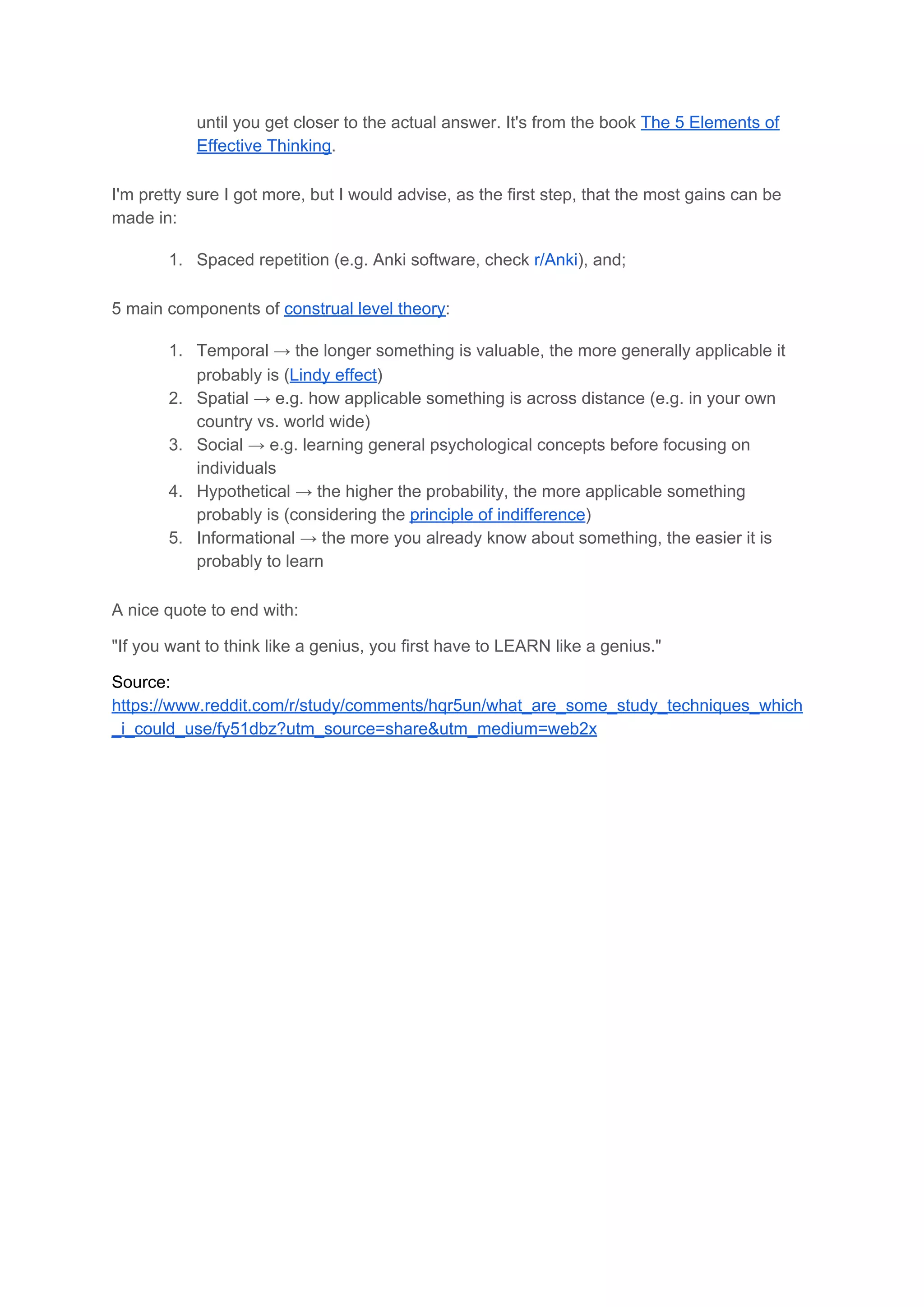
    until you getcloser to the actual answer. It's from the book ​The 5 Elements of Effective Thinking​. I'm pretty sure I got more, but I would advise, as the first step, that the most gains can be made in: 1. Spaced repetition (e.g. Anki software, check ​r/Anki​), and; 5 main components of ​construal level theory​: 1. Temporal → the longer something is valuable, the more generally applicable it probably is (​Lindy effect​) 2. Spatial → e.g. how applicable something is across distance (e.g. in your own country vs. world wide) 3. Social → e.g. learning general psychological concepts before focusing on individuals 4. Hypothetical → the higher the probability, the more applicable something probably is (considering the ​principle of indifference​) 5. Informational → the more you already know about something, the easier it is probably to learn A nice quote to end with: "If you want to think like a genius, you first have to LEARN like a genius." Source: https://www.reddit.com/r/study/comments/hqr5un/what_are_some_study_techniques_which _i_could_use/fy51dbz?utm_source=share&utm_medium=web2x