Nonprofit
Documents
Keeping Nonprofit Important Documents
Up-to-Date and Relevant
Purdue Extension – Master Gardener Program
Presenter: Miriam Robeson, Attorney
January 18, 2018
The Importance
of Being Earnest Official Documents
 Know your Governing Documents
 Understand what is in the Documents
 Out with the Old – In with the New
 Troubleshooting Documents
 Why is this important?
 Nonprofits responsible to the public and to their constituents.
 Nonprofit Board members can be personal responsible for
mishandling of the organization and its resources
Important Documents
(Overview)
 Articles of Incorporation
 Most Important Governing Document
 Bylaws
 Should be readily available
 Should be reviewed and updated every 5 years
 Should “work with” the Board
 Policies
 “Manual” for day-to-day operation
 Easy to change
 Tax Exempt Status (from the IRS)
 Important for Nonprofits who need formal Exempt Status
Articles of
Incorporation
 Most important governing
document
 Public document on file with the
Indiana Secretary of State
 Basic structure of the organization
 Purpose, Mission
 Most difficult to change – not
recommended unless significant
change in focus and mission
 Must be validated every 2 years
with Business Entity Report (online
report to the IN SOS office)
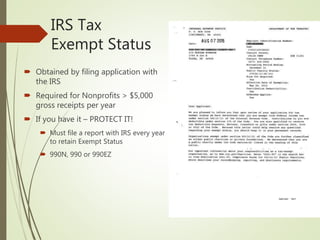
IRS Tax
Exempt Status
 Obtained by filing application with
the IRS
 Required for Nonprofits > $5,000
gross receipts per year
 If you have it – PROTECT IT!
 Must file a report with IRS every year
to retain Exempt Status
 990N, 990 or 990EZ
Bylaws
 Operational guidelines for the organization
 Generally (and wrongly) ignored!
 How old are your Bylaws?
 Should be reviewed every 5 years
 If older than 10 years, may be out of date
 Look for “antiquated” language
 If “very old” – consider complete replacement with new bylaws
Bylaws
 Next Most Important Document to Articles
 Defines the basic structure of the organization
 Things Bylaws should include -
 Number of Board Members on Board of Directors
 Definition of Officers
 Term Limits
 Organization and Membership structure
 Financial requirements
 Committee structure
 Can be complicated, can be lengthy
 Should be reviewed and revised regularly
Bylaws Tell You What to Do
 Bylaws should provide structure
 Bylaws should reflect what your organization actually does.
 If not, either your structure or your bylaws should change
 First – Look at your structure
 Has your organization “departed” from its basic operational
format?
 If so, Why? Is this “drift” or “intentional”? Should you course-
correct?
 Are the Bylaws outdated?
Bylaws Tell You What to Do
 Bylaws should provide structure
 Bylaws should reflect what your organization actually does.
 If not, either your structure or your bylaws should change
 Second – Look at your organization
 Why are you not following your bylaws?
 Is your organization “too informal?”
 Are you risking organization or personal liability?
Bylaws
Why they are important
 Bylaws are for your protection!
 The requirements of the bylaws protect officers and
members from casual conduct of business, or decisions
made on whim
 Term limits provide relief from burnout to Directors, or relief
from tyrants to Members
 Officer definitions provide scope (and limits) to Director
authority
 Voting and Annual Meeting protocols protect Member
rights in governing the organization
Typical Changes to Bylaws
 Number of Directors
 Reduce the size of very large Board of Directors
 12-15 = Maximum size for best efficiency
 Increase the size of a very small Board of Directors
 Unless Membership is small (fewer than 50), small board
concentrates power in two few hands
 Board should never be smaller than 5 Directors
 Watch “absolute numbers” – number of Directors should be a
range (12-15 Directors, not 12 Directors)
Typical Changes to Bylaws
 Functional Committees
 How many Committees are deployed in the Bylaws?
 How many Committees do you actually use?
 Can Committees be combined?
 “Old” Model used diverse Committee Structure – lots of
Committees with specific functions
 “New” Model tends to use fewer Committees, and makes
use of “ad hoc” committees (short-term committees
deployed for a specific task)
Typical Changes to Bylaws
 Required Meetings
 Number of meetings
 Formatted Agenda for meeting
 Date and Time of Annual Meeting
 Bylaws should include flexibility to accomplish goals without
burdening members and directors
 Instead of “Annual Organizational Meeting on January 15,” it can
be, “Annual Organizational Meeting in the month of January”
 Simplification of Language
 Re-stating old, formal language to contemporary style for easier
comprehension
Some things you should not
change (or remove):
 If you don’t have these Articles in your Bylaws – YOU
SHOULD:
 Conflict of interest language
 Indemnification language
 You should not absolve the Directors of responsibility to be
good and ethical stewards of the organization.
 You cannot change the Fiscal Year of the organization
without approval from the IRS (year end date).
 You should not dilute or remove the rights of members.
Bylaws – Operational Tips
 Consider using an Executive Committee or Officers’
Committee to pre-game the member or board meeting
 This committee can discuss agenda items, streamline action
items, develop recommendations, and make sure the meeting
is ready for the members (or Board)
 Can save meeting time by discussing and preparing answers
for expected questions and by providing recommendations for
consideration.
 The use and purpose of an Executive Committee can be
authorized in the Bylaws
Bylaws - Drafting Tips
 Use the active voice (remember grammar lessons)
 “The minutes will be provided by the Secretary prior to each
meeting” (Passive voice)
 “The Secretary will provide the minutes prior to each meeting.”
(Active voice)
 Use everyday language – formal language not required.
 Consider incorporating the use of technology to facilitate
meetings (video conference for officer meetings, e-vote for
minor items that need decisions between meetings) – use of
technology for meetings must be authorized in Bylaws
Troubleshooting
 Checklist for Bylaws Update
 Significant Issues
 Change in Mission – has your organization changed its
mission so that the Bylaws no longer apply?
 Focus on Major Fundraising Event to the point where mission is
lost
 Change in Financial Structure
 Significant organizational growth or decline
 Does change in financial structure change mission? Bylaws should
address
 Activities that endanger Nonprofit Status
 Benefit to Members (Example: Fundraising event where the
proceeds fund an exotic trip for the Board of Directors)
Nonprofit Bylaws
and organizational structure
 Everything you wanted to know about Bylaws
(even if you didn’t know you wanted to know)
 How do Bylaws fit in the Nonprofit organizational structure
(Articles of Organization, Bylaws, Policies, Tax Exempt
Status)
 How often should Bylaws be updated?
 What should be changed – and why?
 Where are trouble area or areas of risk?
For more information:
 www.lawlatte.com
 Sample Bylaws and a copy of this presentation uploaded
 Other information and resources for nonprofit organizations
Thank you for your
attention!
Miriam Robeson, Attorney
Flora, Indiana
www.lawlatte.com

Nonprofit documents (2018 01-18)a

  • 1.
    Nonprofit Documents Keeping Nonprofit ImportantDocuments Up-to-Date and Relevant Purdue Extension – Master Gardener Program Presenter: Miriam Robeson, Attorney January 18, 2018
  • 2.
    The Importance of BeingEarnest Official Documents  Know your Governing Documents  Understand what is in the Documents  Out with the Old – In with the New  Troubleshooting Documents  Why is this important?  Nonprofits responsible to the public and to their constituents.  Nonprofit Board members can be personal responsible for mishandling of the organization and its resources
  • 3.
    Important Documents (Overview)  Articlesof Incorporation  Most Important Governing Document  Bylaws  Should be readily available  Should be reviewed and updated every 5 years  Should “work with” the Board  Policies  “Manual” for day-to-day operation  Easy to change  Tax Exempt Status (from the IRS)  Important for Nonprofits who need formal Exempt Status
  • 4.
    Articles of Incorporation  Mostimportant governing document  Public document on file with the Indiana Secretary of State  Basic structure of the organization  Purpose, Mission  Most difficult to change – not recommended unless significant change in focus and mission  Must be validated every 2 years with Business Entity Report (online report to the IN SOS office)
  • 5.
    IRS Tax Exempt Status Obtained by filing application with the IRS  Required for Nonprofits > $5,000 gross receipts per year  If you have it – PROTECT IT!  Must file a report with IRS every year to retain Exempt Status  990N, 990 or 990EZ
  • 6.
    Bylaws  Operational guidelinesfor the organization  Generally (and wrongly) ignored!  How old are your Bylaws?  Should be reviewed every 5 years  If older than 10 years, may be out of date  Look for “antiquated” language  If “very old” – consider complete replacement with new bylaws
  • 7.
    Bylaws  Next MostImportant Document to Articles  Defines the basic structure of the organization  Things Bylaws should include -  Number of Board Members on Board of Directors  Definition of Officers  Term Limits  Organization and Membership structure  Financial requirements  Committee structure  Can be complicated, can be lengthy  Should be reviewed and revised regularly
  • 8.
    Bylaws Tell YouWhat to Do  Bylaws should provide structure  Bylaws should reflect what your organization actually does.  If not, either your structure or your bylaws should change  First – Look at your structure  Has your organization “departed” from its basic operational format?  If so, Why? Is this “drift” or “intentional”? Should you course- correct?  Are the Bylaws outdated?
  • 9.
    Bylaws Tell YouWhat to Do  Bylaws should provide structure  Bylaws should reflect what your organization actually does.  If not, either your structure or your bylaws should change  Second – Look at your organization  Why are you not following your bylaws?  Is your organization “too informal?”  Are you risking organization or personal liability?
  • 10.
    Bylaws Why they areimportant  Bylaws are for your protection!  The requirements of the bylaws protect officers and members from casual conduct of business, or decisions made on whim  Term limits provide relief from burnout to Directors, or relief from tyrants to Members  Officer definitions provide scope (and limits) to Director authority  Voting and Annual Meeting protocols protect Member rights in governing the organization
  • 11.
    Typical Changes toBylaws  Number of Directors  Reduce the size of very large Board of Directors  12-15 = Maximum size for best efficiency  Increase the size of a very small Board of Directors  Unless Membership is small (fewer than 50), small board concentrates power in two few hands  Board should never be smaller than 5 Directors  Watch “absolute numbers” – number of Directors should be a range (12-15 Directors, not 12 Directors)
  • 12.
    Typical Changes toBylaws  Functional Committees  How many Committees are deployed in the Bylaws?  How many Committees do you actually use?  Can Committees be combined?  “Old” Model used diverse Committee Structure – lots of Committees with specific functions  “New” Model tends to use fewer Committees, and makes use of “ad hoc” committees (short-term committees deployed for a specific task)
  • 13.
    Typical Changes toBylaws  Required Meetings  Number of meetings  Formatted Agenda for meeting  Date and Time of Annual Meeting  Bylaws should include flexibility to accomplish goals without burdening members and directors  Instead of “Annual Organizational Meeting on January 15,” it can be, “Annual Organizational Meeting in the month of January”  Simplification of Language  Re-stating old, formal language to contemporary style for easier comprehension
  • 14.
    Some things youshould not change (or remove):  If you don’t have these Articles in your Bylaws – YOU SHOULD:  Conflict of interest language  Indemnification language  You should not absolve the Directors of responsibility to be good and ethical stewards of the organization.  You cannot change the Fiscal Year of the organization without approval from the IRS (year end date).  You should not dilute or remove the rights of members.
  • 15.
    Bylaws – OperationalTips  Consider using an Executive Committee or Officers’ Committee to pre-game the member or board meeting  This committee can discuss agenda items, streamline action items, develop recommendations, and make sure the meeting is ready for the members (or Board)  Can save meeting time by discussing and preparing answers for expected questions and by providing recommendations for consideration.  The use and purpose of an Executive Committee can be authorized in the Bylaws
  • 16.
    Bylaws - DraftingTips  Use the active voice (remember grammar lessons)  “The minutes will be provided by the Secretary prior to each meeting” (Passive voice)  “The Secretary will provide the minutes prior to each meeting.” (Active voice)  Use everyday language – formal language not required.  Consider incorporating the use of technology to facilitate meetings (video conference for officer meetings, e-vote for minor items that need decisions between meetings) – use of technology for meetings must be authorized in Bylaws
  • 17.
    Troubleshooting  Checklist forBylaws Update  Significant Issues  Change in Mission – has your organization changed its mission so that the Bylaws no longer apply?  Focus on Major Fundraising Event to the point where mission is lost  Change in Financial Structure  Significant organizational growth or decline  Does change in financial structure change mission? Bylaws should address  Activities that endanger Nonprofit Status  Benefit to Members (Example: Fundraising event where the proceeds fund an exotic trip for the Board of Directors)
  • 18.
    Nonprofit Bylaws and organizationalstructure  Everything you wanted to know about Bylaws (even if you didn’t know you wanted to know)  How do Bylaws fit in the Nonprofit organizational structure (Articles of Organization, Bylaws, Policies, Tax Exempt Status)  How often should Bylaws be updated?  What should be changed – and why?  Where are trouble area or areas of risk?
  • 19.
    For more information: www.lawlatte.com  Sample Bylaws and a copy of this presentation uploaded  Other information and resources for nonprofit organizations
  • 20.
    Thank you foryour attention! Miriam Robeson, Attorney Flora, Indiana www.lawlatte.com