





Key Competencies Unlocking the future for our students
Key Changes  (from the draft) * Treaty  of Waitangi – more overt *Values - stronger focus on  sustainablity *Te Reo/NZSL included as  official languages  (English as defacto official) * designing school curriculum  rewritten *explicit statement about  requirements * purpose & scope  added *vision -  connections to the land  added * teaching as inquiry  added to pedagogy
Definition of Terms Key competencies Are generic and needed by everyone across many life contexts to meet important challenges Specific competencies Are only needed in certain contexts. Cannot be used effectively without key competencies and vice versa
Key Competencies Knowledge, skills, attitudes and values cannot be separated Key competencies are interrelated and used together They are developed throughout  life
Key Competencies The ways competencies are manifested will differ in different contexts Proficiency should be seen as the ability to combine and use competencies in increasingly complex contexts
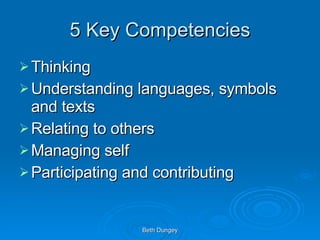
5 Key Competencies Thinking Understanding languages, symbols and texts Relating to others Managing self Participating and contributing
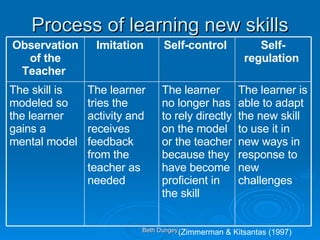
Process of learning new skills (Zimmerman & Kitsantas (1997)  The learner is able to adapt the new skill to use it in new ways in response to new challenges  The learner no longer has to rely directly on the model or the teacher because they have become proficient in the skill  The learner tries the activity and receives feedback from the teacher as needed  The skill is modeled so the learner gains a mental model  Self-regulation   Self-control   Imitation   Observation of the Teacher
Thinking
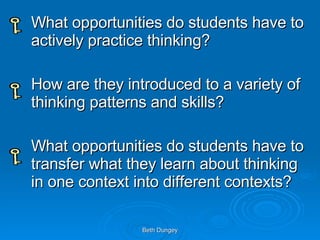
What opportunities do students have to actively practice thinking? How are they introduced to a variety of thinking patterns and skills? What opportunities do students have to transfer what they learn about thinking in one context into different contexts?
How well do teachers use and share a vocabulary of thinking words, to give students the language tools they need to think about their thinking? Do students receive specific feedback on their progress in learning to use these thinking tools and approaches?
Languages, Symbols and Texts
Working with the codes in which knowledge is expressed Systems for representing and communicating information, experiences and ideas Texts of all kinds: written, spoken and visual; informative and imaginative; mathematical, scientific and technological
 
Managing Self
Not just about organisational matters and self discipline Includes managing aspects of physical health Is about awareness of own strengths and  weaknesses Using this self knowledge to approach living and learning tasks strategically
Relating to Others
About interacting effectively with a diverse range of people Includes the ability to listen actively, recognise different points of view, negotiate and share ideas Know when it is appropriate to compete and when to cooperate
Participating and Contributing
Is about learning that is authentic Participating actively in local, national and global communities Balancing rights, roles and responsibilities Responding appropriately as a group member
Key Learning The development of key competencies requires pedagogical  change for teachers  Students (and teachers) need to learn the language of the competencies to have shared meaning and understanding Teachers need to understand the way in which students develop increasing competency over time
Key Learning Key Competencies need to be developed in context and through the curriculum Key Competencies are taught and not caught Teachers need to provide many opportunities for the competencies to be developed in a wide range of contexts both in the classroom and in the wider context of the school
Key Learning about Assessment Co constructing success criteria with students of a competency within a given context attaches greater meaning and understanding.  Students need opportunities to self assess themselves against agreed criteria Stories can be used to describe increasing level of competency in individual students or groups of students.
Key Learning about Assessment Assessment of the Key Competencies is hugely problematic and there is a real danger that schools might resort to some kind of inappropriate ‘tick box’ system Anecdotal evidence is subjective but useful. The interrelated nature of the Key Competencies makes it difficult to assess in isolation
Schools will need to… clarify what the competencies mean for their students show how well the students are currently showing them identify the conditions that will help or hinder development

Beths Powerpoint

  • 1.
    Key Competencies Unlockingthe future for our students
  • 2.
    Key Changes (from the draft) * Treaty of Waitangi – more overt *Values - stronger focus on sustainablity *Te Reo/NZSL included as official languages (English as defacto official) * designing school curriculum rewritten *explicit statement about requirements * purpose & scope added *vision - connections to the land added * teaching as inquiry added to pedagogy
  • 3.
    Definition of TermsKey competencies Are generic and needed by everyone across many life contexts to meet important challenges Specific competencies Are only needed in certain contexts. Cannot be used effectively without key competencies and vice versa
  • 4.
    Key Competencies Knowledge,skills, attitudes and values cannot be separated Key competencies are interrelated and used together They are developed throughout life
  • 5.
    Key Competencies Theways competencies are manifested will differ in different contexts Proficiency should be seen as the ability to combine and use competencies in increasingly complex contexts
  • 6.
    5 Key CompetenciesThinking Understanding languages, symbols and texts Relating to others Managing self Participating and contributing
  • 7.
    Process of learningnew skills (Zimmerman & Kitsantas (1997) The learner is able to adapt the new skill to use it in new ways in response to new challenges The learner no longer has to rely directly on the model or the teacher because they have become proficient in the skill The learner tries the activity and receives feedback from the teacher as needed The skill is modeled so the learner gains a mental model Self-regulation Self-control Imitation Observation of the Teacher
  • 8.
  • 9.
    What opportunities dostudents have to actively practice thinking? How are they introduced to a variety of thinking patterns and skills? What opportunities do students have to transfer what they learn about thinking in one context into different contexts?
  • 10.
    How well doteachers use and share a vocabulary of thinking words, to give students the language tools they need to think about their thinking? Do students receive specific feedback on their progress in learning to use these thinking tools and approaches?
  • 11.
  • 12.
    Working with thecodes in which knowledge is expressed Systems for representing and communicating information, experiences and ideas Texts of all kinds: written, spoken and visual; informative and imaginative; mathematical, scientific and technological
  • 13.
  • 14.
  • 15.
    Not just aboutorganisational matters and self discipline Includes managing aspects of physical health Is about awareness of own strengths and weaknesses Using this self knowledge to approach living and learning tasks strategically
  • 16.
  • 17.
    About interacting effectivelywith a diverse range of people Includes the ability to listen actively, recognise different points of view, negotiate and share ideas Know when it is appropriate to compete and when to cooperate
  • 18.
  • 19.
    Is about learningthat is authentic Participating actively in local, national and global communities Balancing rights, roles and responsibilities Responding appropriately as a group member
  • 20.
    Key Learning Thedevelopment of key competencies requires pedagogical change for teachers Students (and teachers) need to learn the language of the competencies to have shared meaning and understanding Teachers need to understand the way in which students develop increasing competency over time
  • 21.
    Key Learning KeyCompetencies need to be developed in context and through the curriculum Key Competencies are taught and not caught Teachers need to provide many opportunities for the competencies to be developed in a wide range of contexts both in the classroom and in the wider context of the school
  • 22.
    Key Learning aboutAssessment Co constructing success criteria with students of a competency within a given context attaches greater meaning and understanding. Students need opportunities to self assess themselves against agreed criteria Stories can be used to describe increasing level of competency in individual students or groups of students.
  • 23.
    Key Learning aboutAssessment Assessment of the Key Competencies is hugely problematic and there is a real danger that schools might resort to some kind of inappropriate ‘tick box’ system Anecdotal evidence is subjective but useful. The interrelated nature of the Key Competencies makes it difficult to assess in isolation
  • 24.
    Schools will needto… clarify what the competencies mean for their students show how well the students are currently showing them identify the conditions that will help or hinder development