Samadhi Weeraratne
Outline
 Supply Chain Management Defined
 Best Practices of SCM
 Align SC strategy to Corporate strategy
 Establish strong supplier collaborative partnerships
 Technology advancements
 Measuring with Metrics/KPIs
 Lean & Agile Manufacturing
 Importance of SCM best practices
 Summary & Conclusion
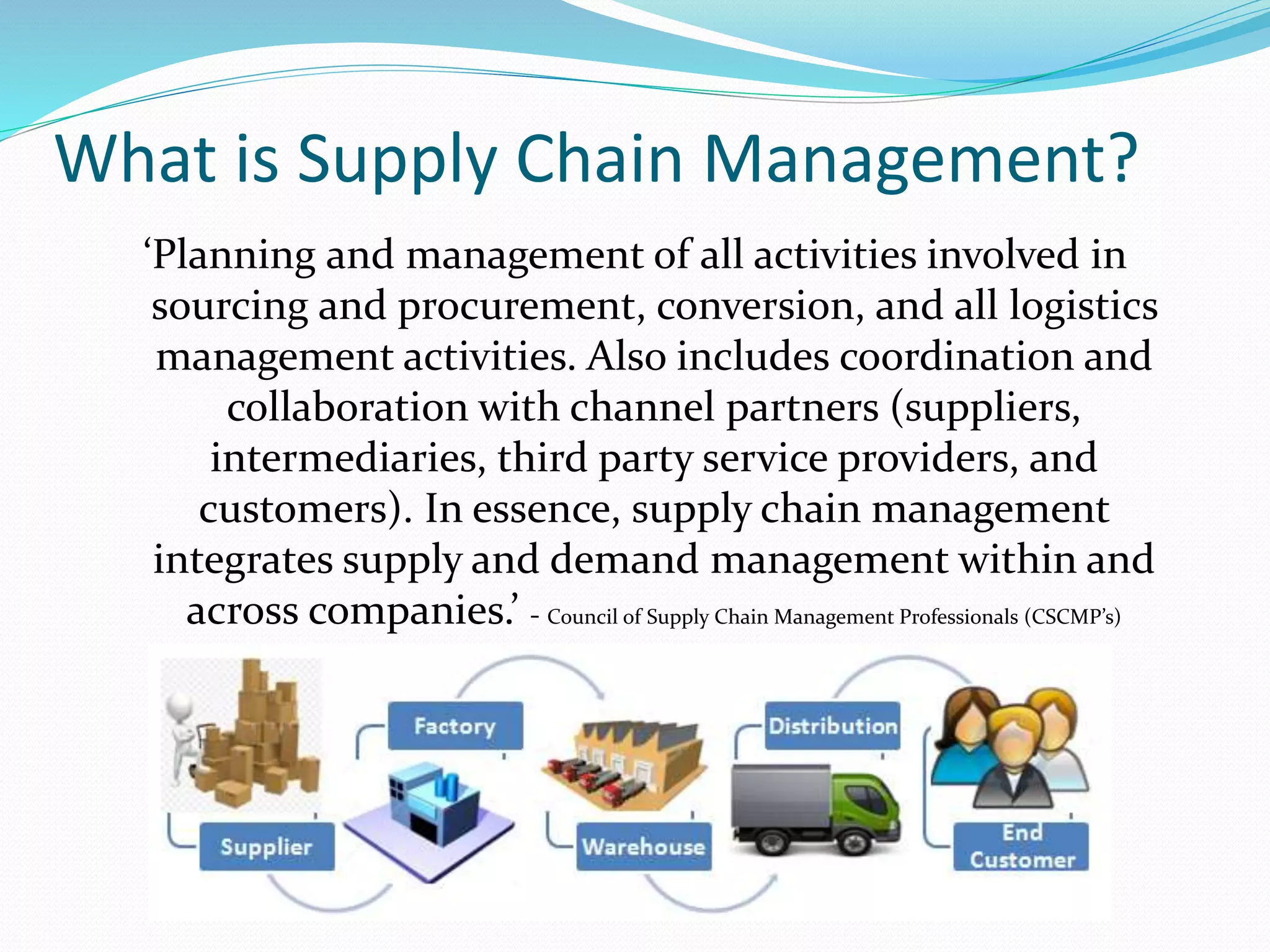
What is Supply Chain Management?
‘Planning and management of all activities involved in
sourcing and procurement, conversion, and all logistics
management activities. Also includes coordination and
collaboration with channel partners (suppliers,
intermediaries, third party service providers, and
customers). In essence, supply chain management
integrates supply and demand management within and
across companies.’ - Council of Supply Chain Management Professionals (CSCMP’s)
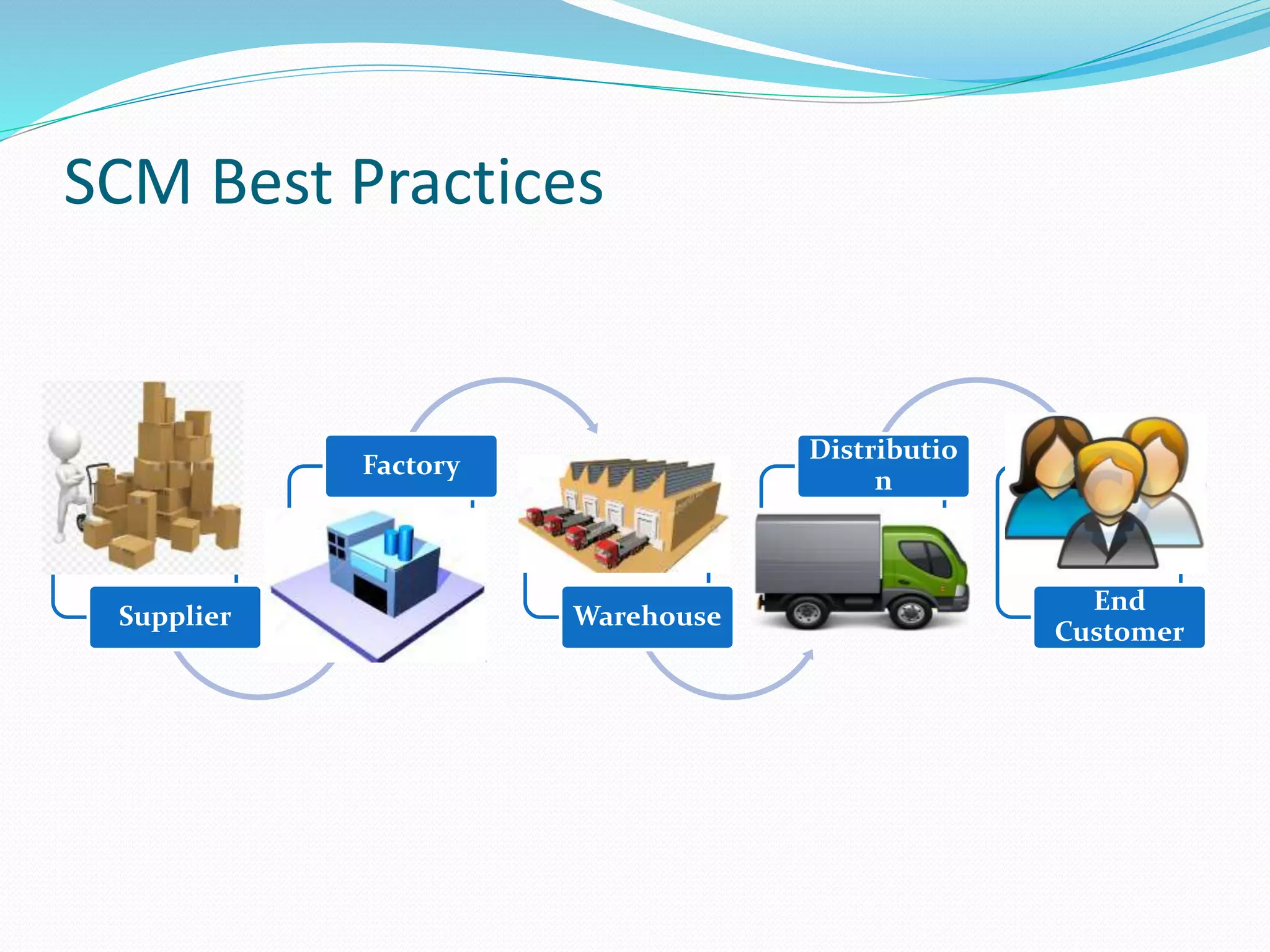
SCM Best Practices
Supplier
Factory
Warehouse
Distributio
n
End
Customer
SCM Best Practices (cont.)
 Align SC strategy to Corporate strategy
 To direct the SCM towards achieving company’s overall
objectives & to remove barriers that exists within the
organization
 Provide a forum for cross-functional communication
 Facilitate SCM with information regarding future strategies
and projects
SCM Best Practices (cont.)
 Establish strong supplier collaborative partnerships
 Reduce number of suppliers
 Supplier involvement in product development and
component design
 Locate suppliers at reachable areas
 Trained suppliers & joint improvement activities
 Information sharing
 Integrates systems
E.G. Toyota
SCM Best Practices (cont.)
 Technology advancements
 Acquire the technology that is best for the identified process
improvements, instead of structuring the workflow around
the acquired technology
E.G.
- Warehouse Management System (WMS)
- Supply Chain Cloud - Cloud Computing is delivering more
visibility throughout the supply chain and enabling
collaboration between all trading partners in the network
SCM Best Practices (cont.)
 Measuring with Metrics/KPIs
 A customized set of KPIs, or industry specific benchmarks,
will measuring metrics, and emphasis where improvements
are needed
E.G.
- Inventory carrying cost, cash‐to‐cash cycle time etc.
- Supply‐Chain Operations Reference (SCOR) – framework
for evaluating and comparing the performance to internal
SCs & to other organizations
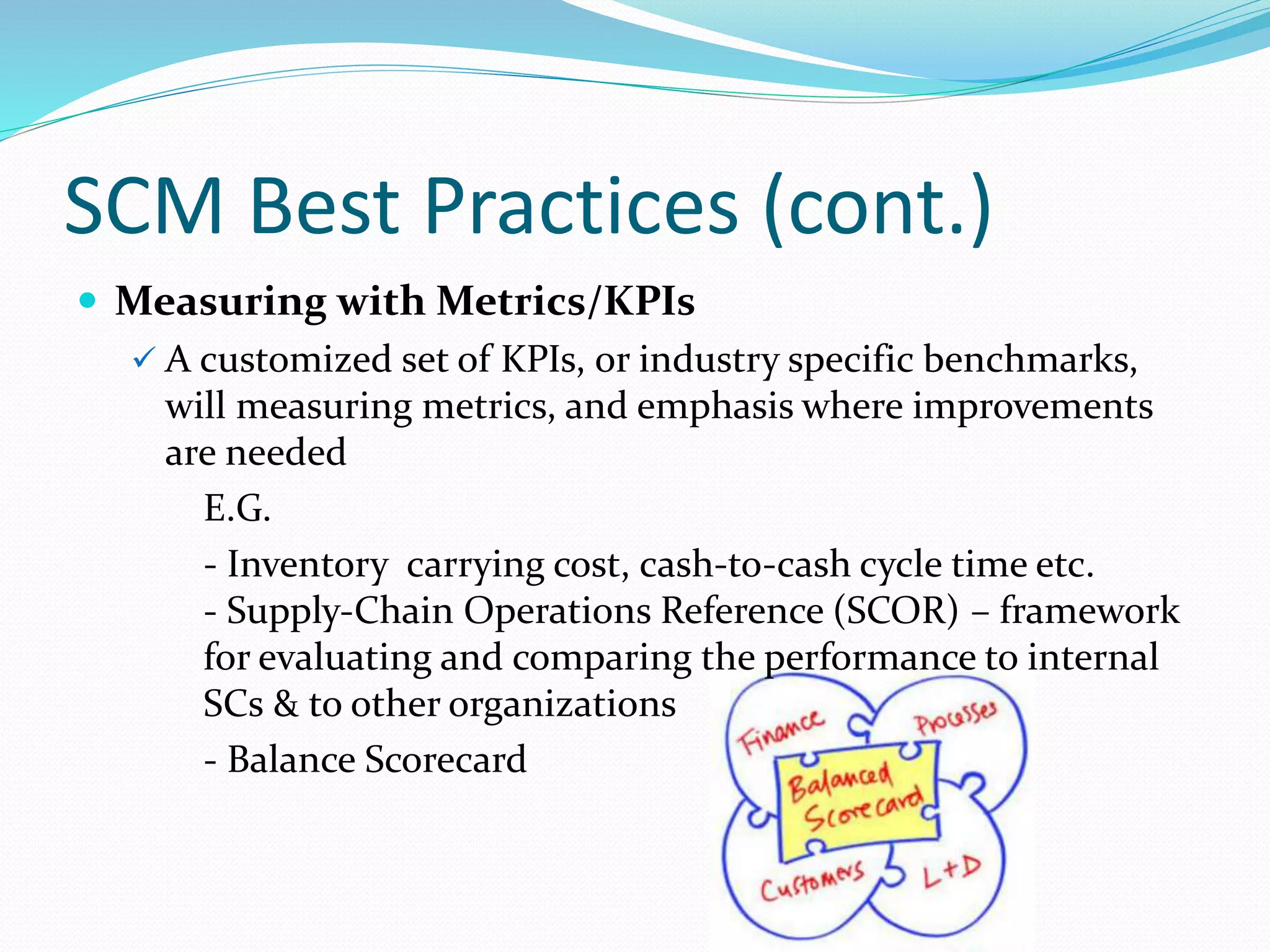
- Balance Scorecard
SCM Best Practices (cont.)
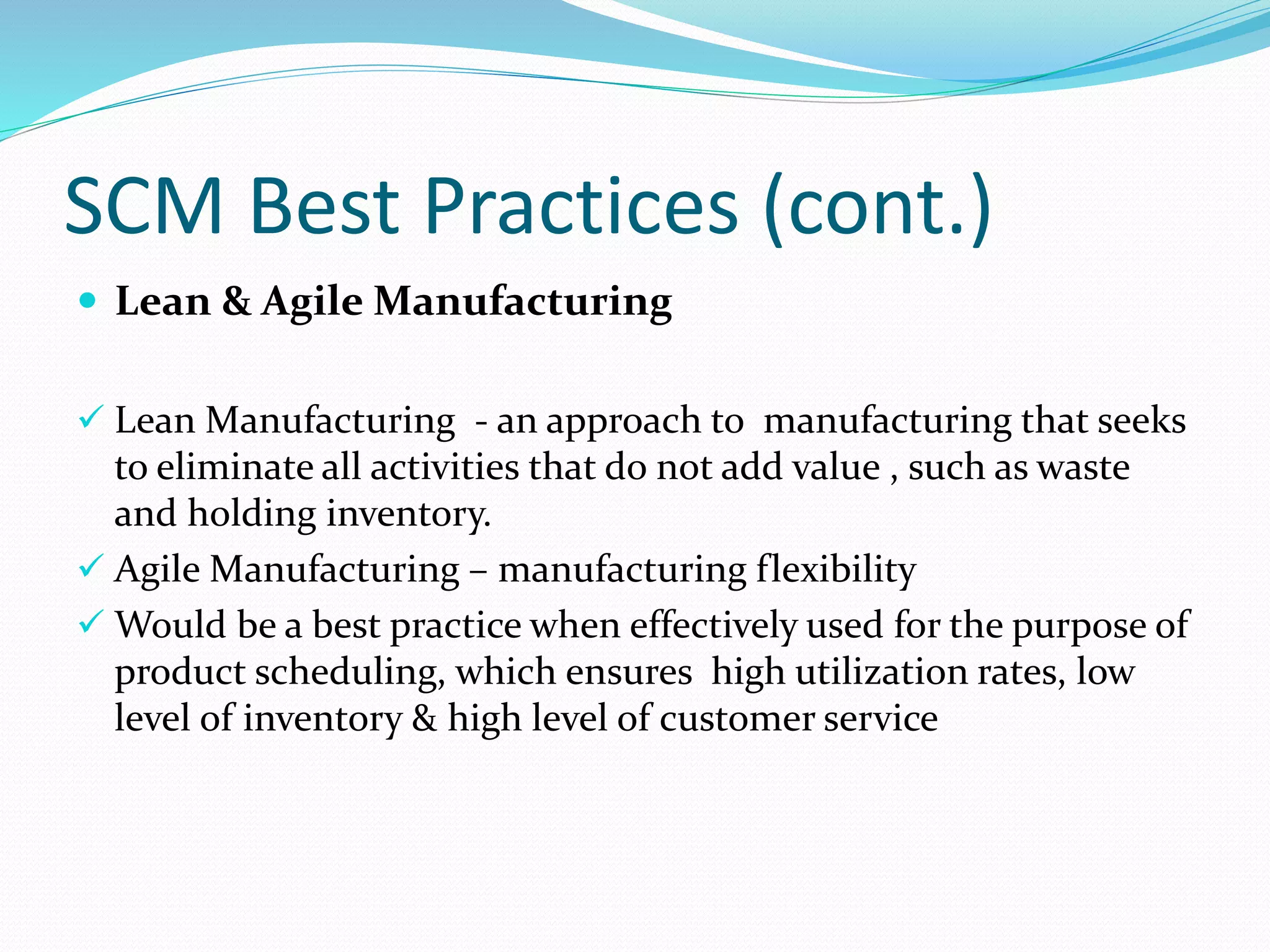
 Lean & Agile Manufacturing
 Lean Manufacturing - an approach to manufacturing that seeks
to eliminate all activities that do not add value , such as waste
and holding inventory.
 Agile Manufacturing – manufacturing flexibility
 Would be a best practice when effectively used for the purpose of
product scheduling, which ensures high utilization rates, low
level of inventory & high level of customer service
SCM Best Practices (cont.)
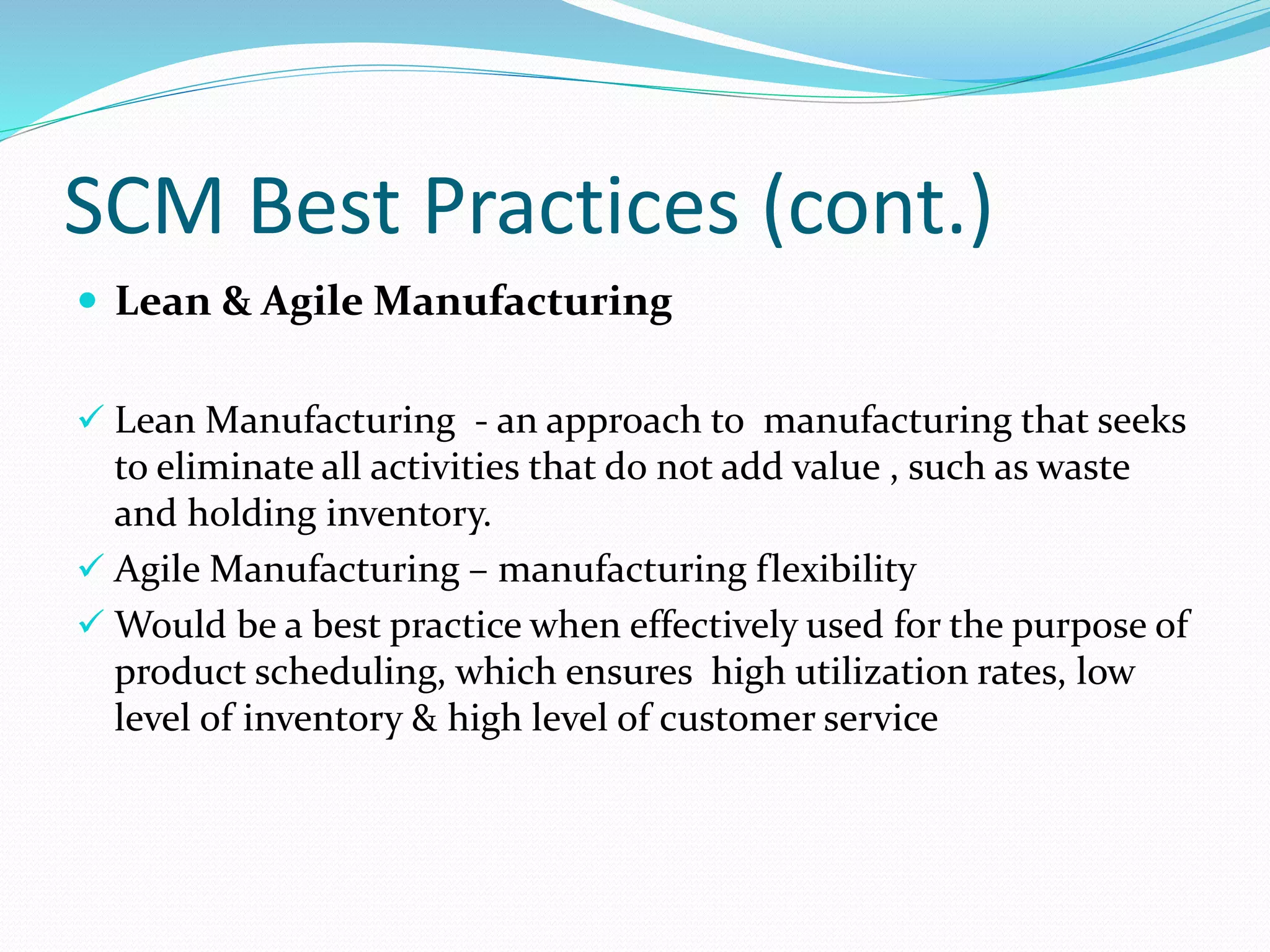
 Lean & Agile Manufacturing
 Lean Manufacturing - an approach to manufacturing that seeks
to eliminate all activities that do not add value , such as waste
and holding inventory.
 Agile Manufacturing – manufacturing flexibility
 Would be a best practice when effectively used for the purpose of
product scheduling, which ensures high utilization rates, low
level of inventory & high level of customer service

Best practices of SCM

  • 1.
  • 2.
    Outline  Supply ChainManagement Defined  Best Practices of SCM  Align SC strategy to Corporate strategy  Establish strong supplier collaborative partnerships  Technology advancements  Measuring with Metrics/KPIs  Lean & Agile Manufacturing  Importance of SCM best practices  Summary & Conclusion
  • 3.
    What is SupplyChain Management? ‘Planning and management of all activities involved in sourcing and procurement, conversion, and all logistics management activities. Also includes coordination and collaboration with channel partners (suppliers, intermediaries, third party service providers, and customers). In essence, supply chain management integrates supply and demand management within and across companies.’ - Council of Supply Chain Management Professionals (CSCMP’s)
  • 4.
  • 5.
    SCM Best Practices(cont.)  Align SC strategy to Corporate strategy  To direct the SCM towards achieving company’s overall objectives & to remove barriers that exists within the organization  Provide a forum for cross-functional communication  Facilitate SCM with information regarding future strategies and projects
  • 6.
    SCM Best Practices(cont.)  Establish strong supplier collaborative partnerships  Reduce number of suppliers  Supplier involvement in product development and component design  Locate suppliers at reachable areas  Trained suppliers & joint improvement activities  Information sharing  Integrates systems E.G. Toyota
  • 7.
    SCM Best Practices(cont.)  Technology advancements  Acquire the technology that is best for the identified process improvements, instead of structuring the workflow around the acquired technology E.G. - Warehouse Management System (WMS) - Supply Chain Cloud - Cloud Computing is delivering more visibility throughout the supply chain and enabling collaboration between all trading partners in the network
  • 8.
    SCM Best Practices(cont.)  Measuring with Metrics/KPIs  A customized set of KPIs, or industry specific benchmarks, will measuring metrics, and emphasis where improvements are needed E.G. - Inventory carrying cost, cash‐to‐cash cycle time etc. - Supply‐Chain Operations Reference (SCOR) – framework for evaluating and comparing the performance to internal SCs & to other organizations - Balance Scorecard
  • 9.
    SCM Best Practices(cont.)  Lean & Agile Manufacturing  Lean Manufacturing - an approach to manufacturing that seeks to eliminate all activities that do not add value , such as waste and holding inventory.  Agile Manufacturing – manufacturing flexibility  Would be a best practice when effectively used for the purpose of product scheduling, which ensures high utilization rates, low level of inventory & high level of customer service
  • 10.
    SCM Best Practices(cont.)  Lean & Agile Manufacturing  Lean Manufacturing - an approach to manufacturing that seeks to eliminate all activities that do not add value , such as waste and holding inventory.  Agile Manufacturing – manufacturing flexibility  Would be a best practice when effectively used for the purpose of product scheduling, which ensures high utilization rates, low level of inventory & high level of customer service