Best Practices for Ensuring
Retirement Plan Fee Reasonableness
        ©2003 – 2013 Multnomah Group, Inc. All Rights Reserved.
Gina Gurgiolo, JD, LL.M
Gina Gurgiolo is a Senior Consultant for the Multnomah Group responsible for
the firm’s ERISA technical and recordkeeping vendor search consulting
services. Gina consults with plan sponsors on plan design, fiduciary
governance, and vendor fees/services.
Prior to joining the Multnomah Group in 2010, Gina managed the product
portfolio for a national retirement services firm and directed the firm’s plan
administration unit serving its largest clients. Prior to that, Gina managed the
retirement plan compliance and regulatory policy functions at another national
retirement services firm.
Gina earned her JD from the University of Pittsburgh and her LL.M in Taxation
with an emphasis in retirement plan and executive compensation law from the
University of Denver. Gina is a member of the Portland Chapter of the Western
Pension & Benefits Council, where she has been a conference speaker.


2                 Best Practices for Ensuring Retirement Plan Fee Reasonableness
Agenda
• Context and Historical Overview
    •   Legislative
    •   Regulatory
    •   Judicial
• Preparing for a DOL Audit
    •   Most frequently requested information
    •   Case study
• Step-by-Step Guide to Fee Reasonableness
    •   Fee reasonableness “to-dos”


3                     Best Practices for Ensuring Retirement Plan Fee Reasonableness
Context & Historical Overview
What is “reasonable”?
•   Intangible   no bright line
•   Agreeable to sound judgment or logic
•   That which is appropriate for a particular situation
•   Not excessive relative to circumstances
Determining reasonableness requires comparison of alternatives and
evaluation of processes used
Under ERISA section 408(b)(2), retirement plan fees must be reasonable in
light of the services being rendered
• But, no specific codified definition of what constitutes fee reasonableness
  per se
    • Impossible to be absolute about reasonableness determinations
    • Follow prudent process that contemplates alternatives
      - Using prudent process to negotiate/compare fees/services promotes improved participant
        outcomes
• Must know and understand applicable fees to determine reasonableness
• Where can plan sponsors find comprehensive fee information?


4                     Best Practices for Ensuring Retirement Plan Fee Reasonableness
Context & Historical Overview
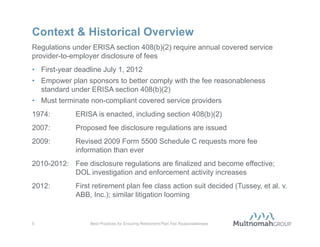
Regulations under ERISA section 408(b)(2) require annual covered service
provider-to-employer disclosure of fees
• First-year deadline July 1, 2012
• Empower plan sponsors to better comply with the fee reasonableness
  standard under ERISA section 408(b)(2)
• Must terminate non-compliant covered service providers
1974:        ERISA is enacted, including section 408(b)(2)
2007:        Proposed fee disclosure regulations are issued
2009:        Revised 2009 Form 5500 Schedule C requests more fee
             information than ever
2010-2012: Fee disclosure regulations are finalized and become effective;
           DOL investigation and enforcement activity increases
2012:        First retirement plan fee class action suit decided (Tussey, et al. v.
             ABB, Inc.); similar litigation looming


5                 Best Practices for Ensuring Retirement Plan Fee Reasonableness
Context & Historical Overview
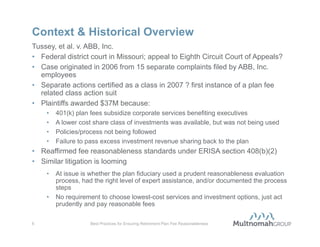
Tussey, et al. v. ABB, Inc.
• Federal district court in Missouri; appeal to Eighth Circuit Court of Appeals?
• Case originated in 2006 from 15 separate complaints filed by ABB, Inc.
  employees
• Separate actions certified as a class in 2007 ? first instance of a plan fee
  related class action suit
• Plaintiffs awarded $37M because:
    •   401(k) plan fees subsidize corporate services benefiting executives
    •   A lower cost share class of investments was available, but was not being used
    •   Policies/process not being followed
    •   Failure to pass excess investment revenue sharing back to the plan
• Reaffirmed fee reasonableness standards under ERISA section 408(b)(2)
• Similar litigation is looming
    •   At issue is whether the plan fiduciary used a prudent reasonableness evaluation
        process, had the right level of expert assistance, and/or documented the process
        steps
    •   No requirement to choose lowest-cost services and investment options, just act
        prudently and pay reasonable fees

6                   Best Practices for Ensuring Retirement Plan Fee Reasonableness
Preparing for a DOL Audit
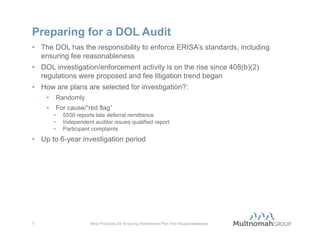
• The DOL has the responsibility to enforce ERISA’s standards, including
  ensuring fee reasonableness
• DOL investigation/enforcement activity is on the rise since 408(b)(2)
  regulations were proposed and fee litigation trend began
• How are plans are selected for investigation?:
    •       Randomly
    •       For cause/“red flag”
        •     5500 reports late deferral remittance
        •     Independent auditor issues qualified report
        •     Participant complaints
• Up to 6-year investigation period


7                        Best Practices for Ensuring Retirement Plan Fee Reasonableness
Preparing for a DOL Audit
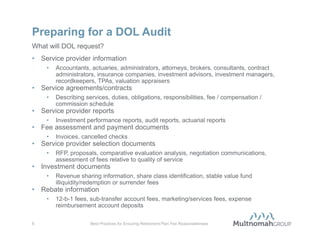
What will DOL request?
• Service provider information
    •   Accountants, actuaries, administrators, attorneys, brokers, consultants, contract
        administrators, insurance companies, investment advisors, investment managers,
        recordkeepers, TPAs, valuation appraisers
• Service agreements/contracts
    •   Describing services, duties, obligations, responsibilities, fee / compensation /
        commission schedule
• Service provider reports
    •   Investment performance reports, audit reports, actuarial reports
• Fee assessment and payment documents
    •   Invoices, cancelled checks
• Service provider selection documents
    •   RFP, proposals, comparative evaluation analysis, negotiation communications,
        assessment of fees relative to quality of service
• Investment documents
    •   Revenue sharing information, share class identification, stable value fund
        illiquidity/redemption or surrender fees
• Rebate information
    •   12-b-1 fees, sub-transfer account fees, marketing/services fees, expense
        reimbursement account deposits

8                    Best Practices for Ensuring Retirement Plan Fee Reasonableness
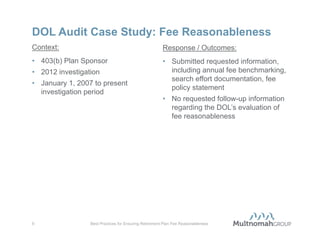
DOL Audit Case Study: Fee Reasonableness
Context:                                               Response / Outcomes:
• 403(b) Plan Sponsor                                  • Submitted requested information,
• 2012 investigation                                     including annual fee benchmarking,
                                                         search effort documentation, fee
• January 1, 2007 to present
                                                         policy statement
  investigation period
                                                       • No requested follow-up information
                                                         regarding the DOL’s evaluation of
                                                         fee reasonableness


9                Best Practices for Ensuring Retirement Plan Fee Reasonableness
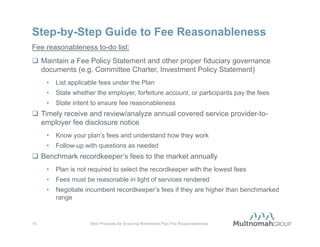
Step-by-Step Guide to Fee Reasonableness
Fee reasonableness to-do list:
 Maintain a Fee Policy Statement and other proper fiduciary governance
  documents (e.g. Committee Charter, Investment Policy Statement)
     •   List applicable fees under the Plan
     •   State whether the employer, forfeiture account, or participants pay the fees
     •   State intent to ensure fee reasonableness
 Timely receive and review/analyze annual covered service provider-to-
  employer fee disclosure notice
     •   Know your plan’s fees and understand how they work
     •   Follow-up with questions as needed
 Benchmark recordkeeper’s fees to the market annually
     •   Plan is not required to select the recordkeeper with the lowest fees
     •   Fees must be reasonable in light of services rendered
     •   Negotiate incumbent recordkeeper’s fees if they are higher than benchmarked
         range


10                   Best Practices for Ensuring Retirement Plan Fee Reasonableness
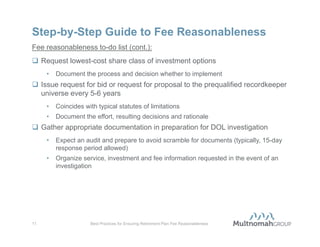
Step-by-Step Guide to Fee Reasonableness
Fee reasonableness to-do list (cont.):
 Request lowest-cost share class of investment options
     •   Document the process and decision whether to implement
 Issue request for bid or request for proposal to the prequalified recordkeeper
  universe every 5-6 years
     •   Coincides with typical statutes of limitations
     •   Document the effort, resulting decisions and rationale
 Gather appropriate documentation in preparation for DOL investigation
     •   Expect an audit and prepare to avoid scramble for documents (typically, 15-day
         response period allowed)
     •   Organize service, investment and fee information requested in the event of an
         investigation


11                   Best Practices for Ensuring Retirement Plan Fee Reasonableness

Best Practices for Ensuring Retirement Plan Fee Reasonableness

  • 1.
    Best Practices forEnsuring Retirement Plan Fee Reasonableness ©2003 – 2013 Multnomah Group, Inc. All Rights Reserved.
  • 2.
    Gina Gurgiolo, JD,LL.M Gina Gurgiolo is a Senior Consultant for the Multnomah Group responsible for the firm’s ERISA technical and recordkeeping vendor search consulting services. Gina consults with plan sponsors on plan design, fiduciary governance, and vendor fees/services. Prior to joining the Multnomah Group in 2010, Gina managed the product portfolio for a national retirement services firm and directed the firm’s plan administration unit serving its largest clients. Prior to that, Gina managed the retirement plan compliance and regulatory policy functions at another national retirement services firm. Gina earned her JD from the University of Pittsburgh and her LL.M in Taxation with an emphasis in retirement plan and executive compensation law from the University of Denver. Gina is a member of the Portland Chapter of the Western Pension & Benefits Council, where she has been a conference speaker. 2 Best Practices for Ensuring Retirement Plan Fee Reasonableness
  • 3.
    Agenda • Context andHistorical Overview • Legislative • Regulatory • Judicial • Preparing for a DOL Audit • Most frequently requested information • Case study • Step-by-Step Guide to Fee Reasonableness • Fee reasonableness “to-dos” 3 Best Practices for Ensuring Retirement Plan Fee Reasonableness
  • 4.
    Context & HistoricalOverview What is “reasonable”? • Intangible no bright line • Agreeable to sound judgment or logic • That which is appropriate for a particular situation • Not excessive relative to circumstances Determining reasonableness requires comparison of alternatives and evaluation of processes used Under ERISA section 408(b)(2), retirement plan fees must be reasonable in light of the services being rendered • But, no specific codified definition of what constitutes fee reasonableness per se • Impossible to be absolute about reasonableness determinations • Follow prudent process that contemplates alternatives - Using prudent process to negotiate/compare fees/services promotes improved participant outcomes • Must know and understand applicable fees to determine reasonableness • Where can plan sponsors find comprehensive fee information? 4 Best Practices for Ensuring Retirement Plan Fee Reasonableness
  • 5.
    Context & HistoricalOverview Regulations under ERISA section 408(b)(2) require annual covered service provider-to-employer disclosure of fees • First-year deadline July 1, 2012 • Empower plan sponsors to better comply with the fee reasonableness standard under ERISA section 408(b)(2) • Must terminate non-compliant covered service providers 1974: ERISA is enacted, including section 408(b)(2) 2007: Proposed fee disclosure regulations are issued 2009: Revised 2009 Form 5500 Schedule C requests more fee information than ever 2010-2012: Fee disclosure regulations are finalized and become effective; DOL investigation and enforcement activity increases 2012: First retirement plan fee class action suit decided (Tussey, et al. v. ABB, Inc.); similar litigation looming 5 Best Practices for Ensuring Retirement Plan Fee Reasonableness
  • 6.
    Context & HistoricalOverview Tussey, et al. v. ABB, Inc. • Federal district court in Missouri; appeal to Eighth Circuit Court of Appeals? • Case originated in 2006 from 15 separate complaints filed by ABB, Inc. employees • Separate actions certified as a class in 2007 ? first instance of a plan fee related class action suit • Plaintiffs awarded $37M because: • 401(k) plan fees subsidize corporate services benefiting executives • A lower cost share class of investments was available, but was not being used • Policies/process not being followed • Failure to pass excess investment revenue sharing back to the plan • Reaffirmed fee reasonableness standards under ERISA section 408(b)(2) • Similar litigation is looming • At issue is whether the plan fiduciary used a prudent reasonableness evaluation process, had the right level of expert assistance, and/or documented the process steps • No requirement to choose lowest-cost services and investment options, just act prudently and pay reasonable fees 6 Best Practices for Ensuring Retirement Plan Fee Reasonableness
  • 7.
    Preparing for aDOL Audit • The DOL has the responsibility to enforce ERISA’s standards, including ensuring fee reasonableness • DOL investigation/enforcement activity is on the rise since 408(b)(2) regulations were proposed and fee litigation trend began • How are plans are selected for investigation?: • Randomly • For cause/“red flag” • 5500 reports late deferral remittance • Independent auditor issues qualified report • Participant complaints • Up to 6-year investigation period 7 Best Practices for Ensuring Retirement Plan Fee Reasonableness
  • 8.
    Preparing for aDOL Audit What will DOL request? • Service provider information • Accountants, actuaries, administrators, attorneys, brokers, consultants, contract administrators, insurance companies, investment advisors, investment managers, recordkeepers, TPAs, valuation appraisers • Service agreements/contracts • Describing services, duties, obligations, responsibilities, fee / compensation / commission schedule • Service provider reports • Investment performance reports, audit reports, actuarial reports • Fee assessment and payment documents • Invoices, cancelled checks • Service provider selection documents • RFP, proposals, comparative evaluation analysis, negotiation communications, assessment of fees relative to quality of service • Investment documents • Revenue sharing information, share class identification, stable value fund illiquidity/redemption or surrender fees • Rebate information • 12-b-1 fees, sub-transfer account fees, marketing/services fees, expense reimbursement account deposits 8 Best Practices for Ensuring Retirement Plan Fee Reasonableness
  • 9.
    DOL Audit CaseStudy: Fee Reasonableness Context: Response / Outcomes: • 403(b) Plan Sponsor • Submitted requested information, • 2012 investigation including annual fee benchmarking, search effort documentation, fee • January 1, 2007 to present policy statement investigation period • No requested follow-up information regarding the DOL’s evaluation of fee reasonableness 9 Best Practices for Ensuring Retirement Plan Fee Reasonableness
  • 10.
    Step-by-Step Guide toFee Reasonableness Fee reasonableness to-do list:  Maintain a Fee Policy Statement and other proper fiduciary governance documents (e.g. Committee Charter, Investment Policy Statement) • List applicable fees under the Plan • State whether the employer, forfeiture account, or participants pay the fees • State intent to ensure fee reasonableness  Timely receive and review/analyze annual covered service provider-to- employer fee disclosure notice • Know your plan’s fees and understand how they work • Follow-up with questions as needed  Benchmark recordkeeper’s fees to the market annually • Plan is not required to select the recordkeeper with the lowest fees • Fees must be reasonable in light of services rendered • Negotiate incumbent recordkeeper’s fees if they are higher than benchmarked range 10 Best Practices for Ensuring Retirement Plan Fee Reasonableness
  • 11.
    Step-by-Step Guide toFee Reasonableness Fee reasonableness to-do list (cont.):  Request lowest-cost share class of investment options • Document the process and decision whether to implement  Issue request for bid or request for proposal to the prequalified recordkeeper universe every 5-6 years • Coincides with typical statutes of limitations • Document the effort, resulting decisions and rationale  Gather appropriate documentation in preparation for DOL investigation • Expect an audit and prepare to avoid scramble for documents (typically, 15-day response period allowed) • Organize service, investment and fee information requested in the event of an investigation 11 Best Practices for Ensuring Retirement Plan Fee Reasonableness