CHAPTER 11: TECHNICAL DESCRIPTION AND
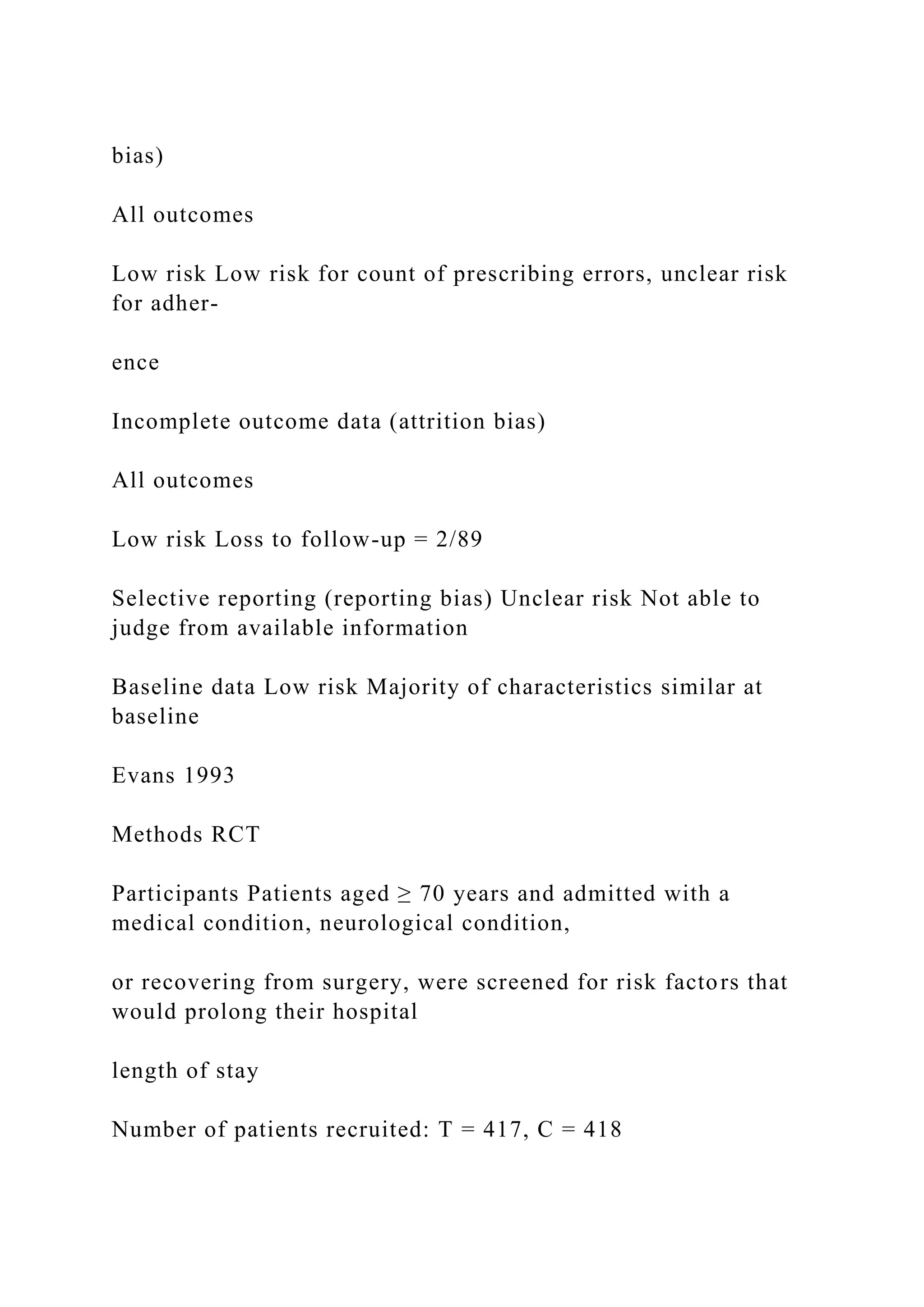
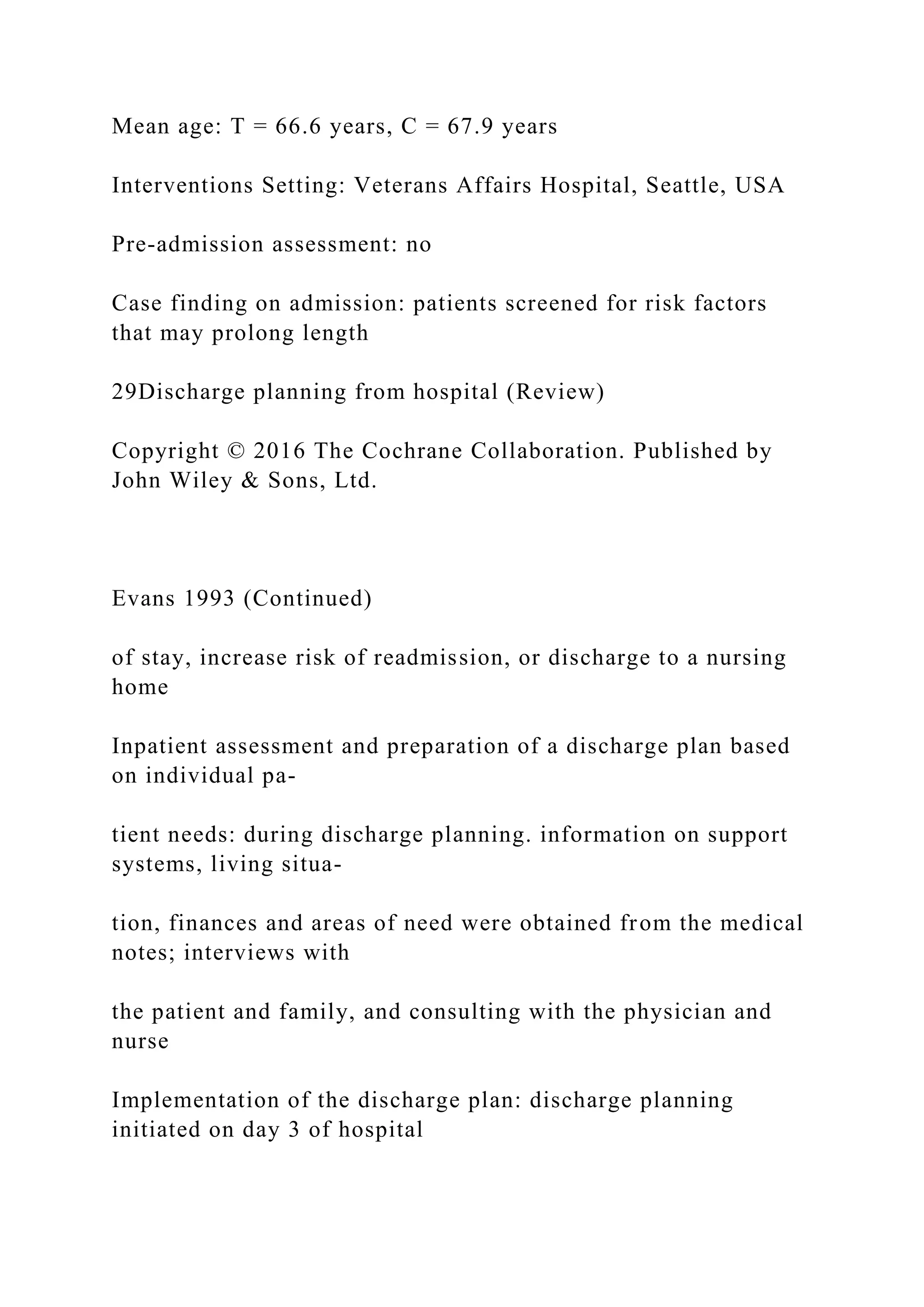
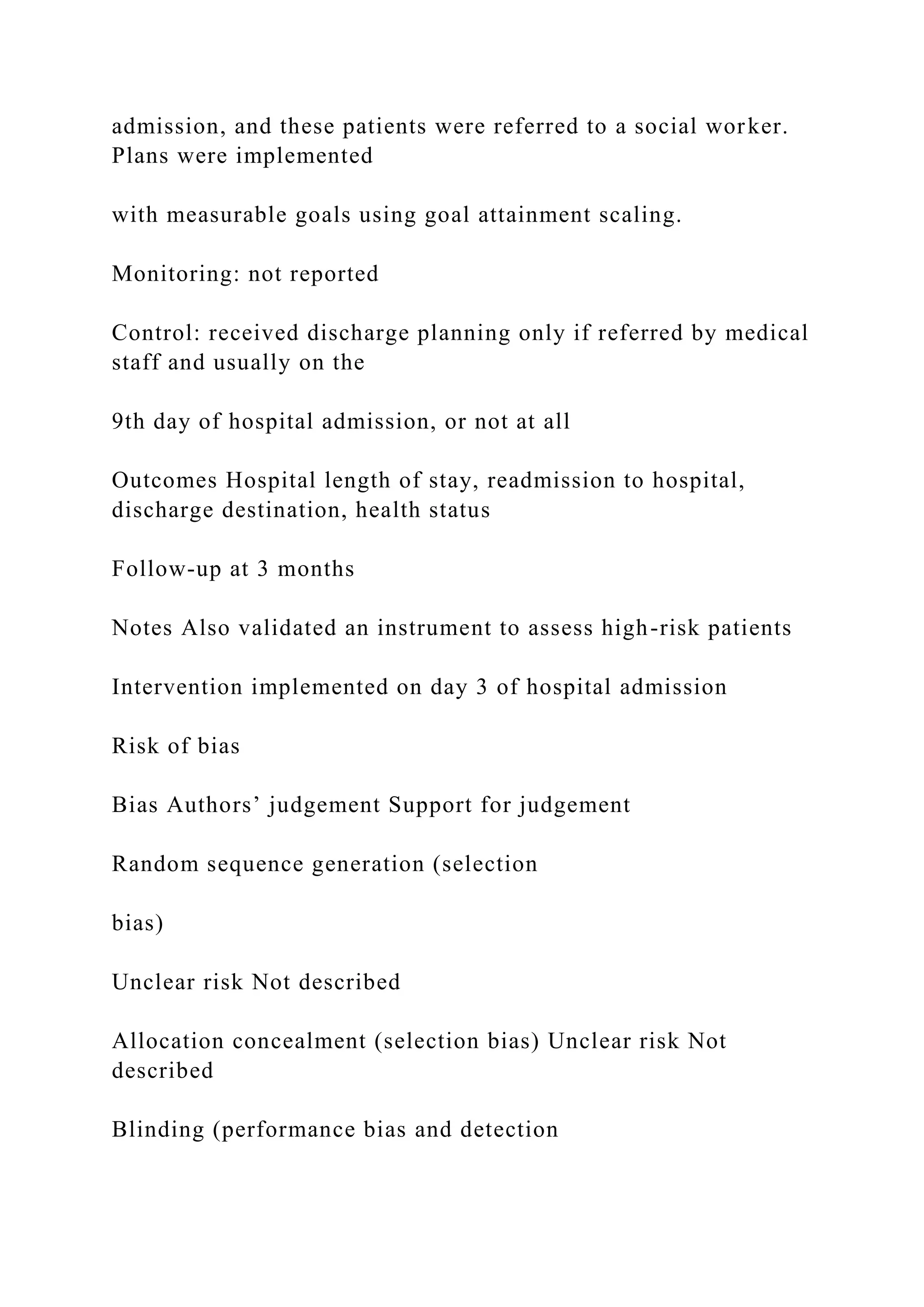
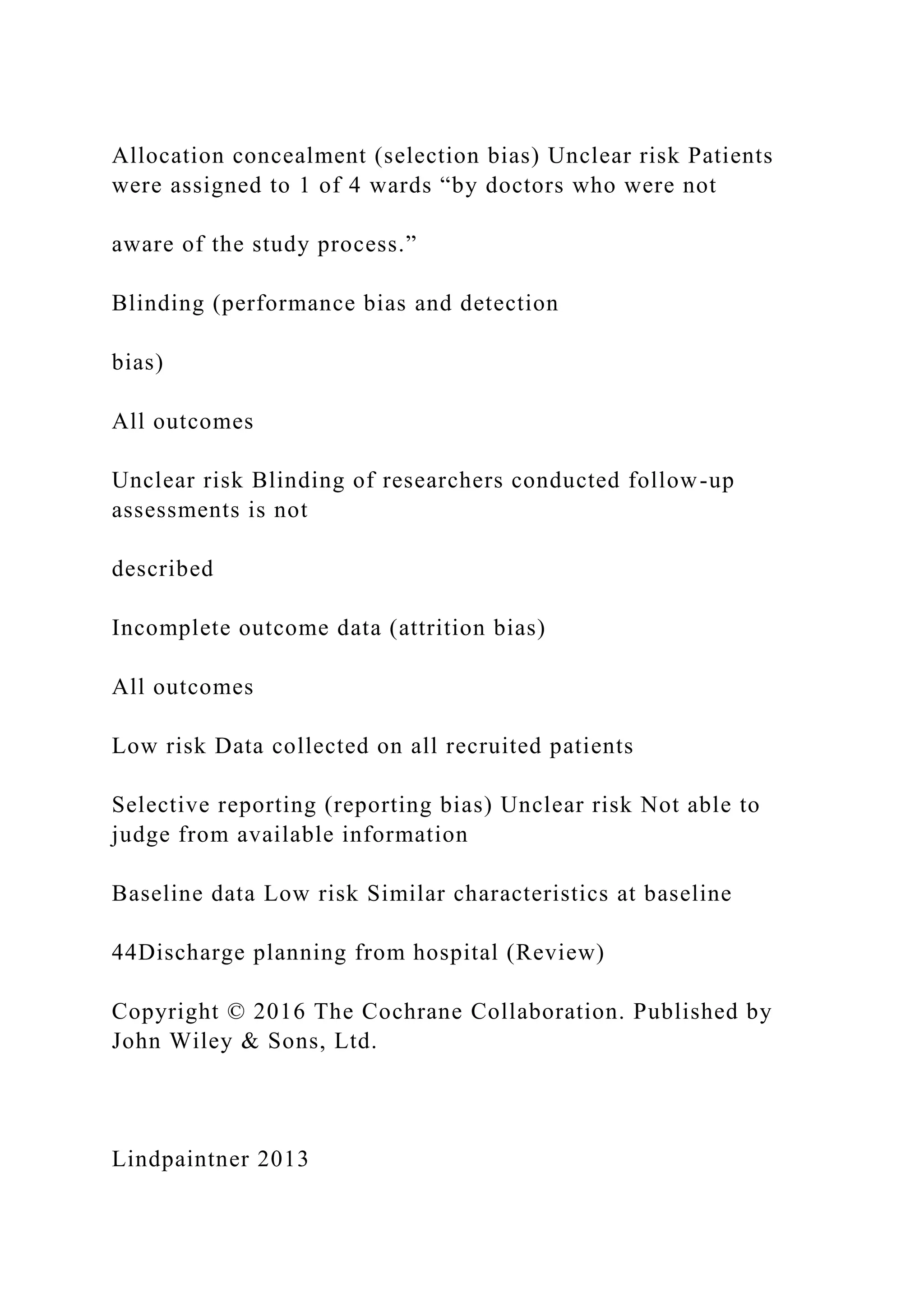
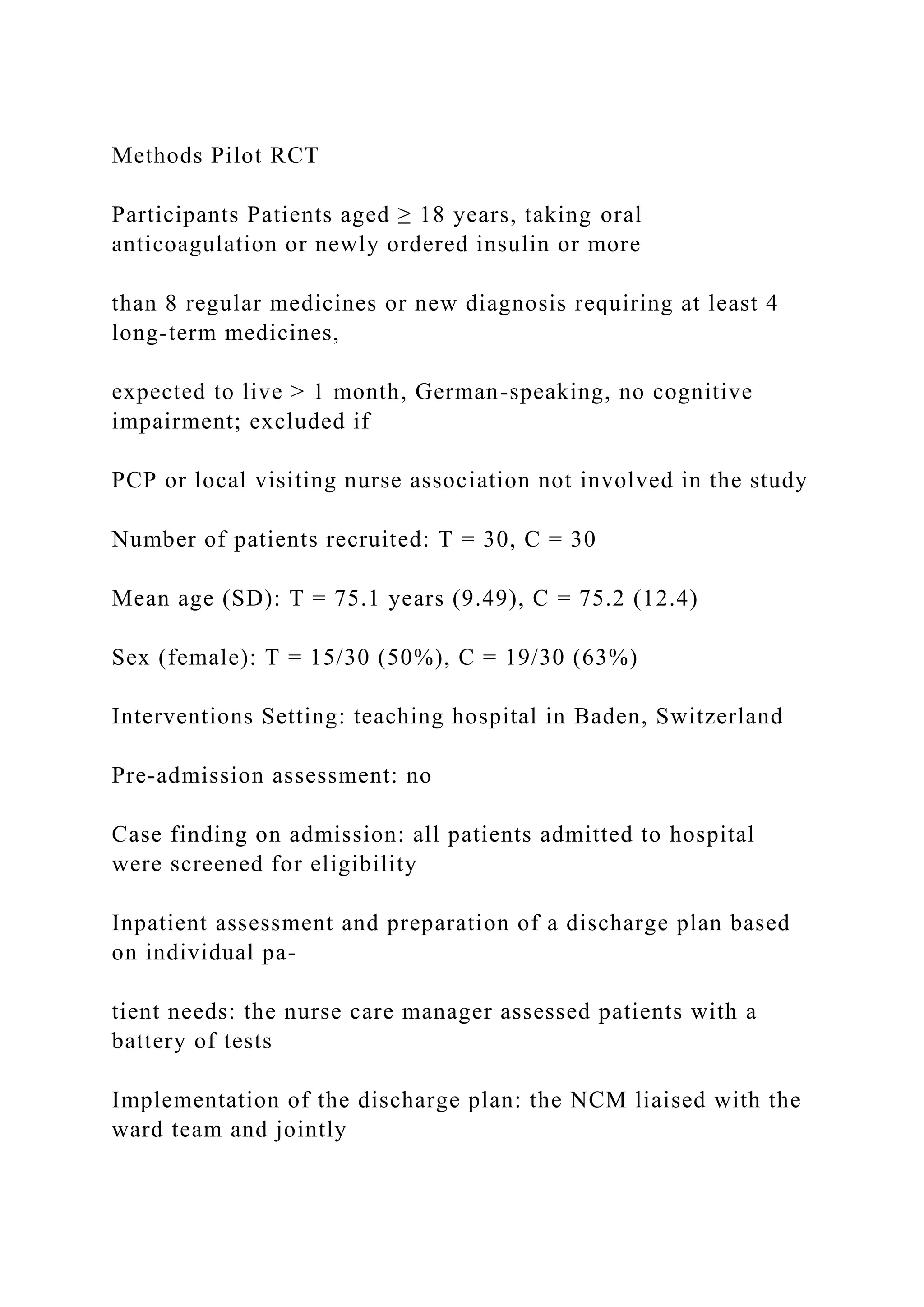
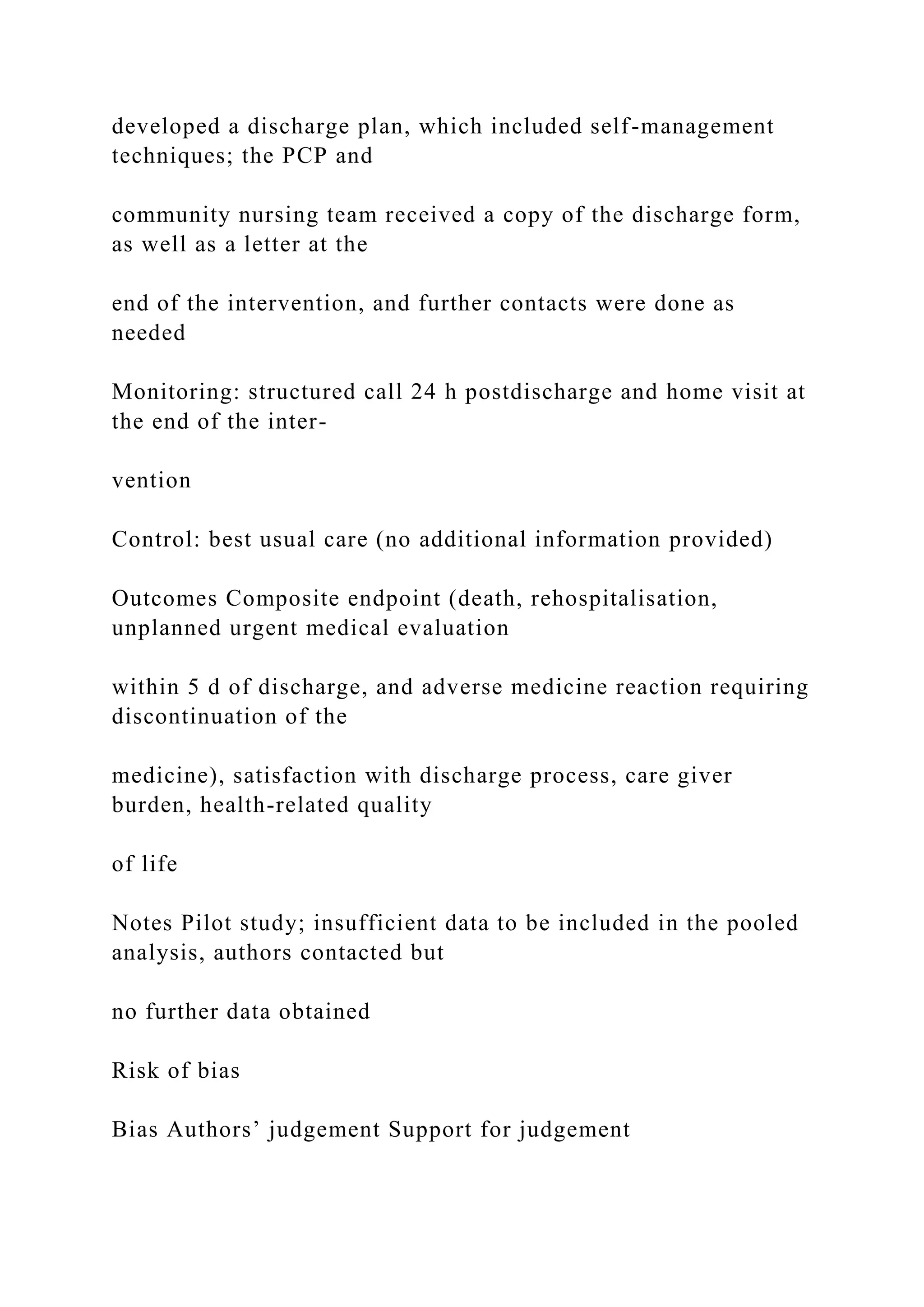
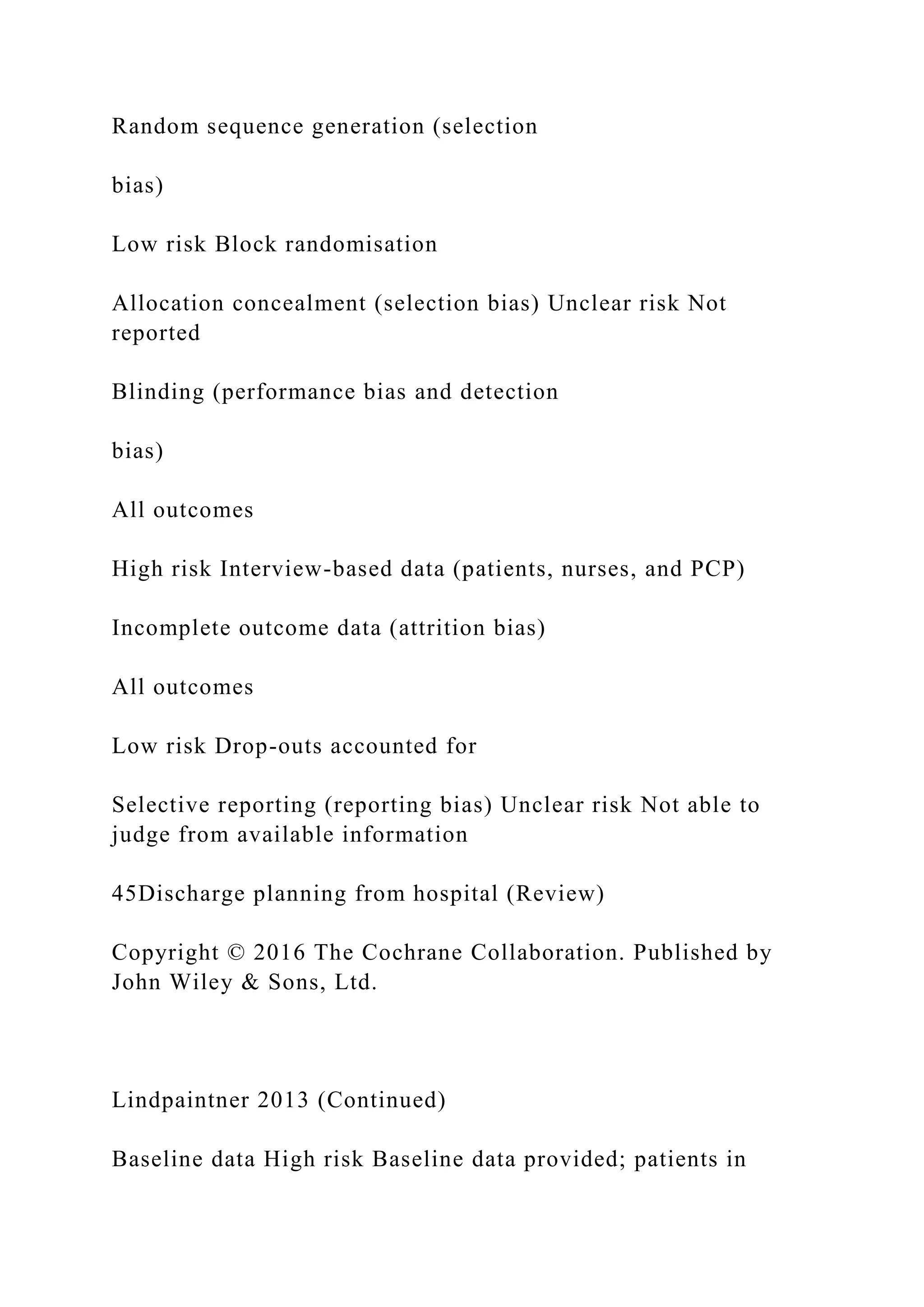
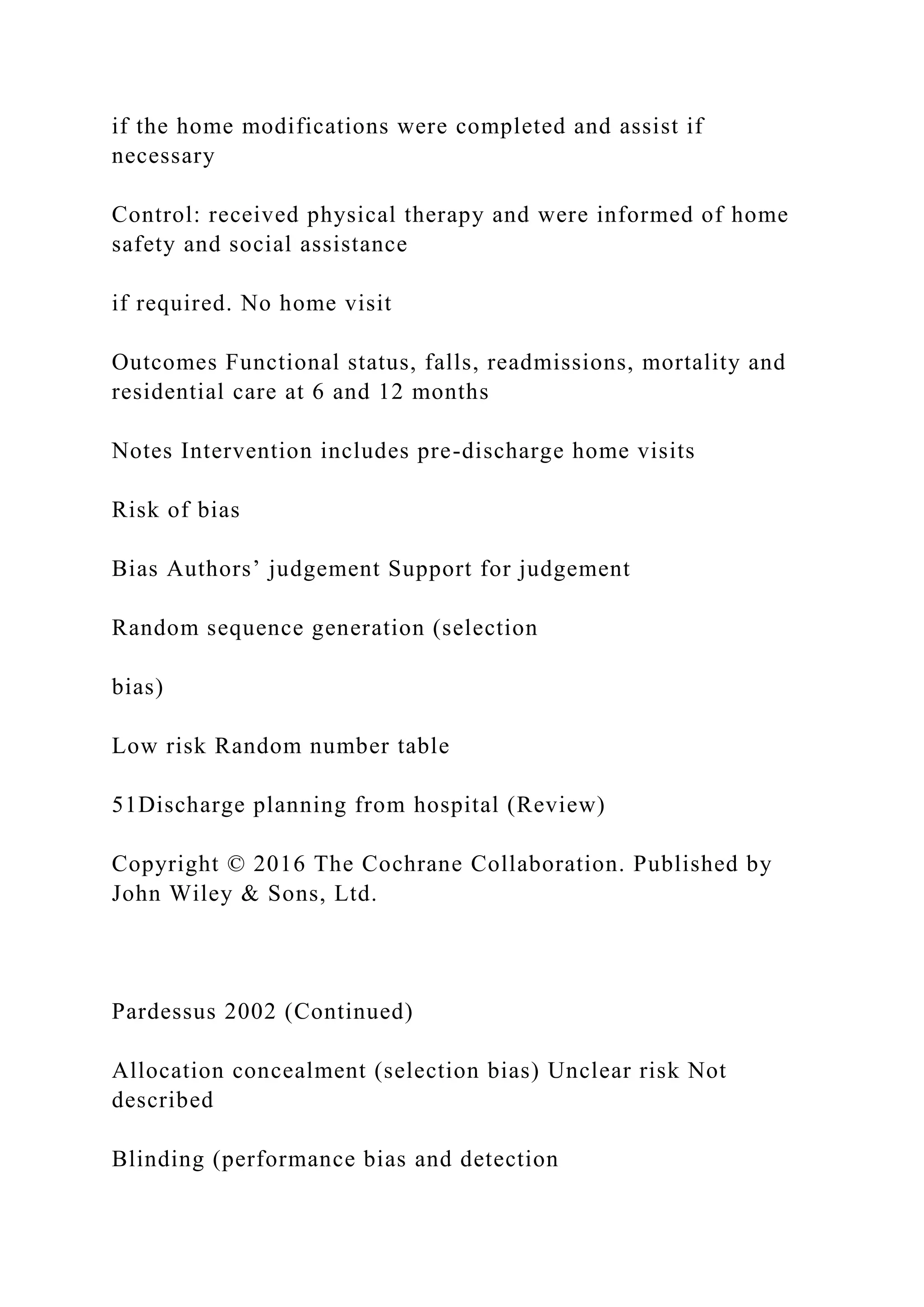
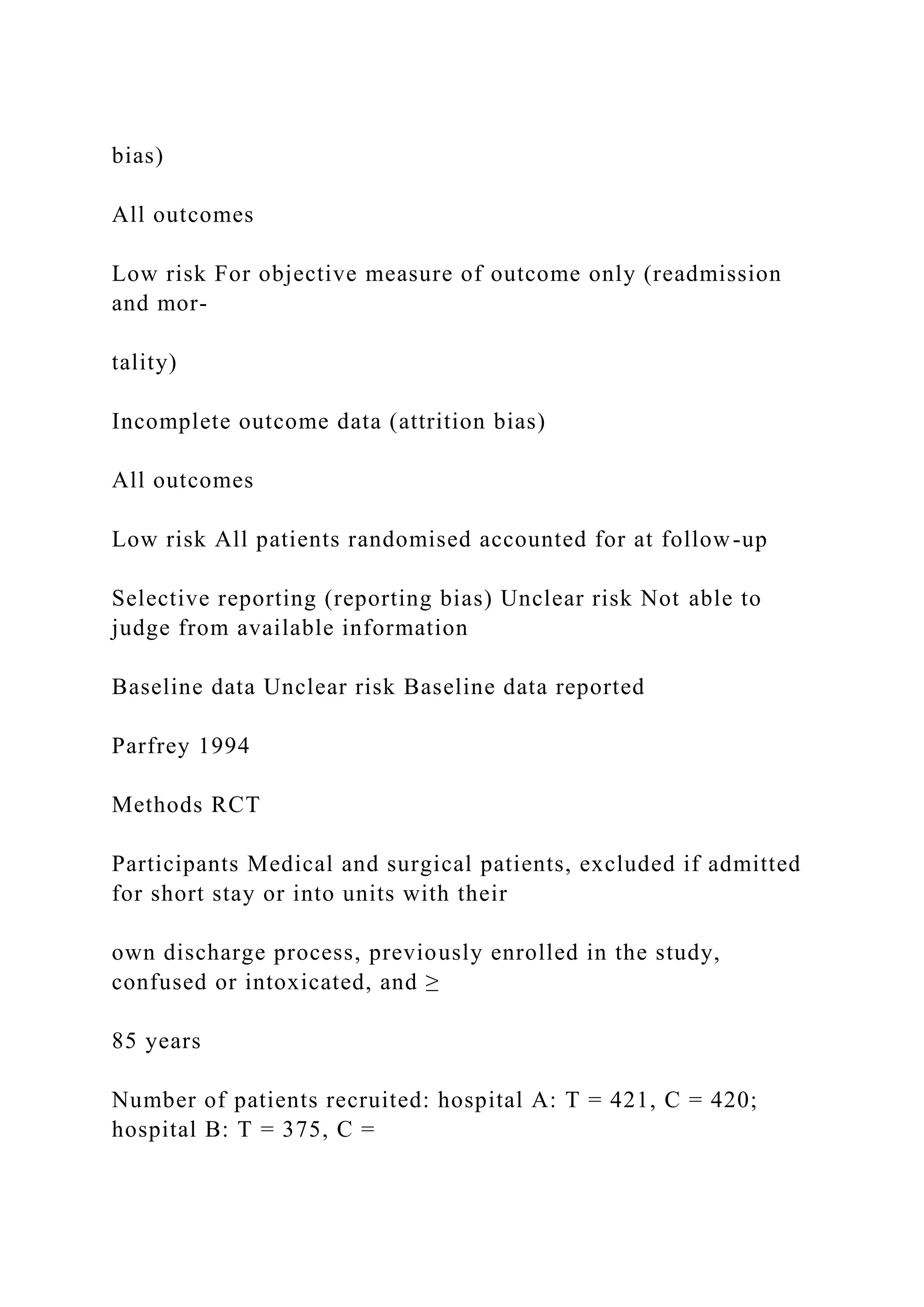
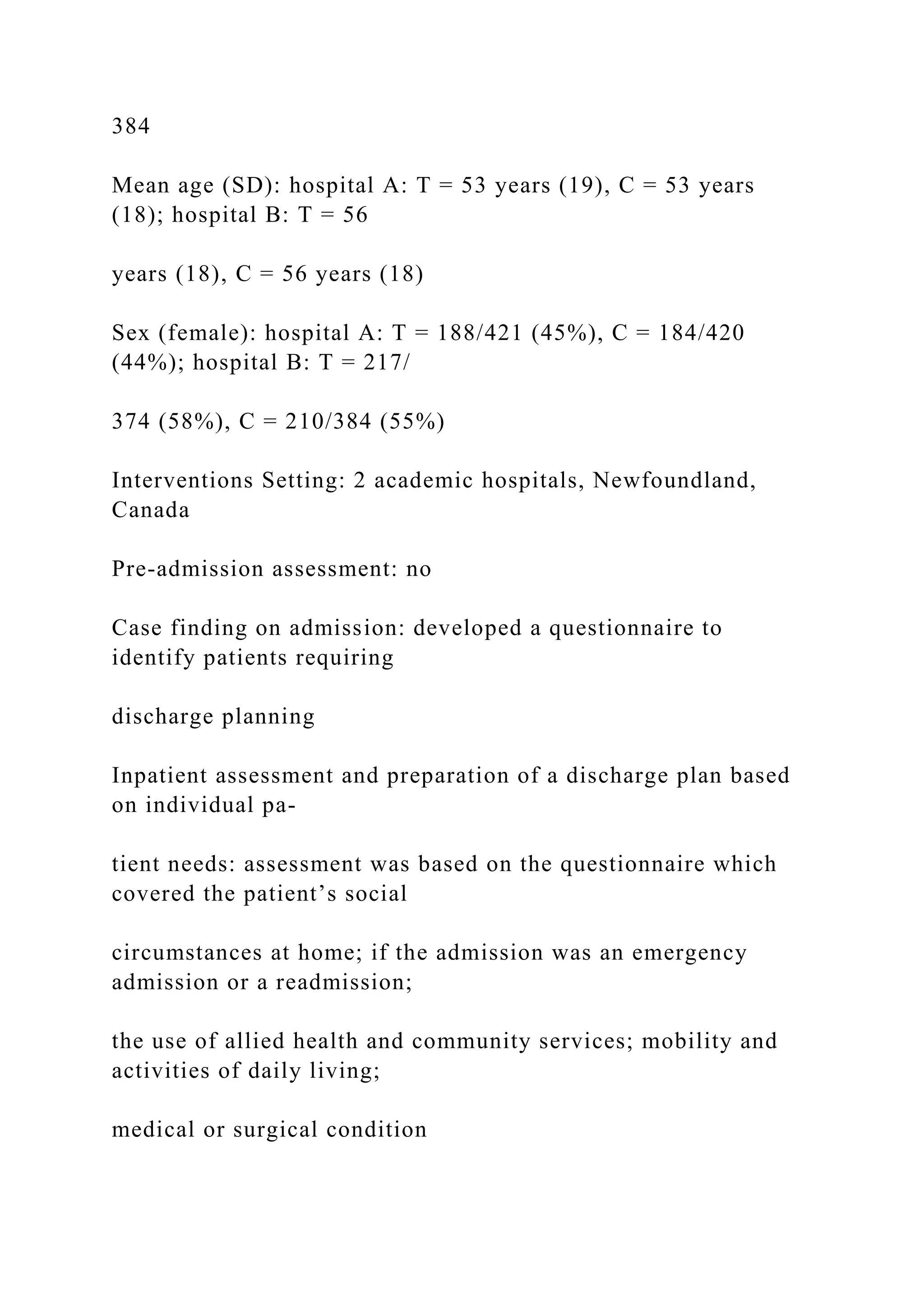
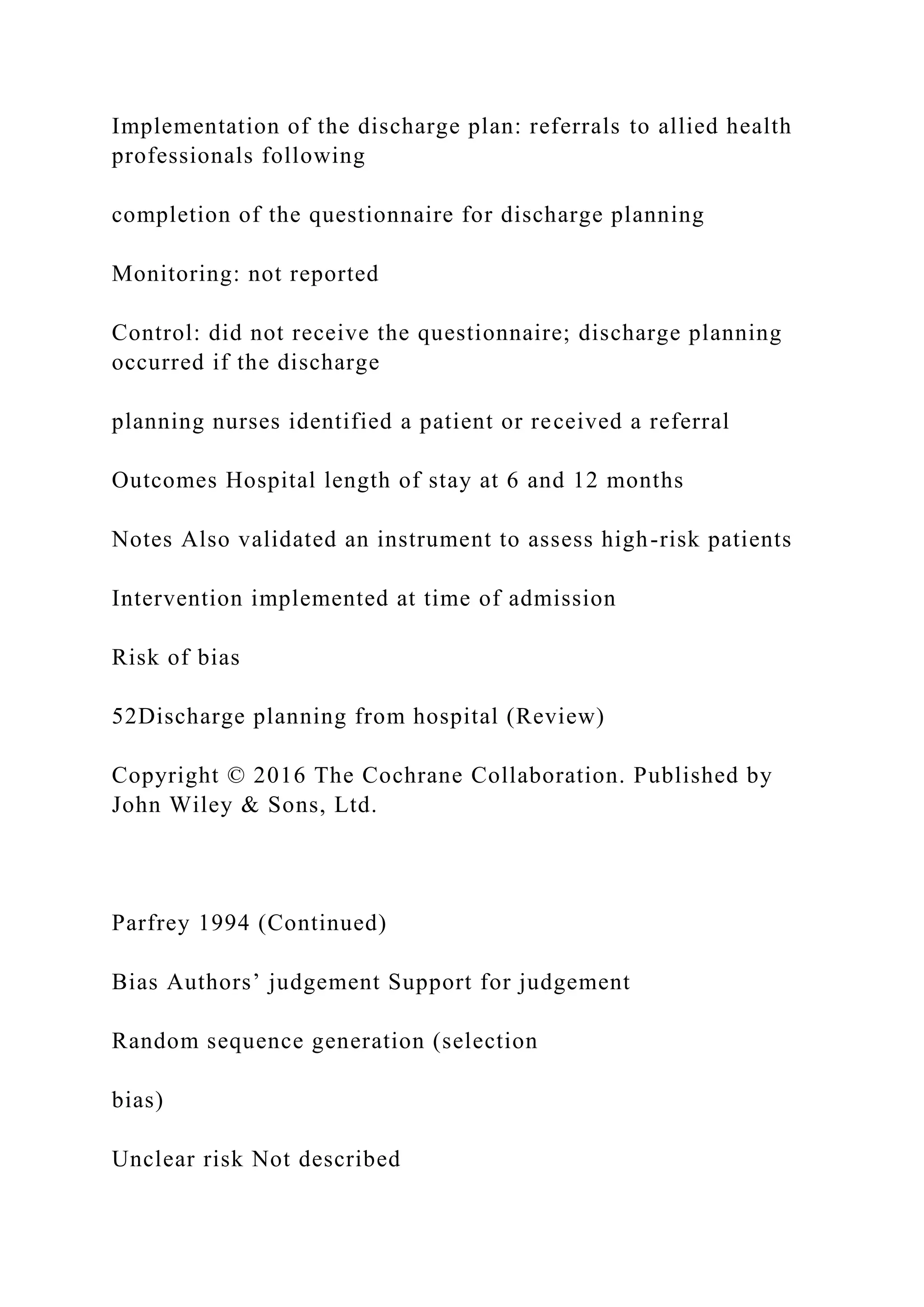
SPECIFICATIONS
Write a professional memo that either:
1. Provides a clear description for a specific technical term from
your field to a general, non-expert audience
OR
2. Argues for the implementation of a specific process or device
in regard to some technical aspect of your field.
Make sure that your memo is properly researched and includes
sources where appropriate.
800 words
http://www.radiolab.org/story/177199-mutant-rights/
Basic Features of Technical Descriptions
Title specific to the subject being described
Introduction with a definition and overall description of the
subject
Introductory moves set a context for the body.
Main moves: Introduction--Definition of Subject--Purpose
Statement--Main Point--Importance of Subject--Overall
Description--List of Major Parts
Body paragraphs that partition the subject into its features,
functions, or stages
Main moves: Definition and Purpose of Part--Minor Part--Minor
Part--Minor Part
Graphics that illustrate the subject and its parts
Conclusion, if needed, that describes the subject in operation
The conclusion shows the subject working or in action.
Make a plan and do research
Define the Rhetorical Situation
Do Background Research: You should know as much as possible
about your subject.
Describe the Context: Particularly, the context of your subject.
Create or Locate Graphics: Collect graphics that illustrate your
subject, or create them yourself.
Partition your subject
Divide your subject into its features, functions, or its stages of a
process:
by features—You might separately describe the subject’s parts
or features.
For example, a description of a computer might describe it part
by part, partitioning it into a monitor, keyboard, external hard
drives, and a central processing unit (CPU).
by functions—You might note how the subject’s different parts
function.
A description of the International Space Station, for example,
might partition it function by function into research, power
generation, infrastructure, habitation, and docking sections.
by stages of its process—You might break down the subject
chronologically by showing how it works.
A description of Hodgkin’s disease, for example, might walk
readers step by step through detection, diagnosis, staging, and
remission stages.
A description of a machine might show how it moves step by
step through its operations.
Logical (or mind) mapping
Pull up https://bubbl.us
1. Put the name of your subject in the middle of your screen or a
sheet of paper.
2. Write down the two to five major parts in the space around it.
3. Circle each major part.
4. Partition each major part into two to five minor parts.
Organize and draft your technical description
Specific and Precise Title: The title of your technical
description should clearly identify the purpose of the document.
Introduction with an Overall Description: Typically, the
introduction will set a framework or context by including some
or all of the following features:
Definition of Subject: A sentence definition of your subject
includes three parts:
the term, the class in which the subject belongs, and the
characteristics that distinguish the subject from the other
members in its class.
The definition of the subject should appear early in the
introduction, preferably in the first sentence.

Purpose Statement: Directly or indirectly state that you are
describing something.
Main Point: Give your readers an overall claim that your
description will support or prove.
Importance of the Subject: For readers who are unfamiliar with
your subject, you might want to include a sentence or paragraph
that stresses its importance.
Overall Description of the Subject: Descriptions sometimes
offer an overall look at the item being described
List of the Major Features, Functions, or Stages: In many
descriptions, the introduction will list the major features,
functions, or stages of the subject.
You can then use this list of features, functions, or stages to
organize the body of your description.
Description by features, functions, or Stages: The body of your
description will concentrate on describing your subject’s
features, functions, or stages.
Address each major part separately, defining it and describing it
in detail. Within your description of each major part, identify
and describe the minor parts.
Description through Senses: Consider each of your five senses
separately, asking yourself,“How does it look?”“How does it
sound?”“How does it smell?”“How does it feel?” and “How
does it taste?”
Similes: describe something by comparing it to something
familiar to the readers (“A is like B”).
Analogies: are like similes, but they work on two parallel levels
(“A is to B as C is to D”).
Metaphors: used to present an image of the subject by equating
two different things (“A is B”).
Conclusion: The conclusion of a technical description should be
short and concise. Conclusions often describe one working
cycle of the object, place, or process.
Style, design and medium
Your style should be simple and straightforward.
Use simple words and limit the amount of jargon.
Focus on the details your readers need to know, and cut the
extras.
Keep sentences short, within breathing length.
Remove any subjective qualifier words like
“very,”“easy,”“hard,”“amazing.”
Use the senses to add color, texture, taste, sound, and smell.
The design should clarify and support the written text.
Use a two-column or three-column format to leave room for
images.
List any minor parts in bulleted lists.
Add a sidebar that draws attention to an important part or
feature.
Use headings to clarify the organization.
Put measurements in a table.
Graphics
Use a title and figure number with each graphic.
Refer to the graphic by number in the written text.
Include captions that explain what the graphic shows.
Label specific features in the graphic.
Place the graphic on the page where it is referenced or soon
afterward.
EXTENDED DEFINITION
An extended definition starts with a sentence definition and
then expands on it in the following ways:
Word history and etymology: Use a dictionary to figure out
where a technical term originated and how its meaning has
evolved
(e.g.,“The word ion, which means ‘going’ in Greek, was coined
by physicist Michael Faraday in 1834.”)
Examples: Include examples of how the term is used in a
specific field
(e.g.,“For example, when hydrogen chloride (HCl) is dissolved
in water, it forms two ions, H+ and Cl−.”)
Negation: Define your subject by explaining what it is not
(e.g.,“An ion is not a subatomic particle.”)
Division into parts: Divide the subject into its major parts and
define each of those parts separately
(e.g.,“An ion has protons, electrons, and neutrons. Protons are
sub-atomic particles with a positive charge found in the
nucleus, while electrons . . .”).
Similarities and differences: Compare your subject to objects or
places that are similar, highlighting their common
characteristics and their differences
(e.g.,“An ion is an atom with a nucleus and electrons, except an
ion does not have an equal number of protons and electrons like
a stable atom.”)
Analogy: Compare your subject to something completely
different but with some similar qualities
(e.g.,“An ion is like an unattached, single person at a dance,
searching for oppositely-charged ions to dance with.”)
Graphics: Use a drawing, picture, diagram, or other kind of
graphic to provide an image of your subject.
Chamberlain College of Nursing NR449 Evidence-
Based PracticeEvidence Matrix Table
Article
Reference
Purpose
Hypothesis
Study Question
Variables
Independent(I)
Dependent(D)
Study Design
Sample
Size and Selection
Data Collection
Methods
Major Findings
1
(sample not a real article)
Smith, Lewis (2013),
What should I eat? A focus for those living with diabetes.
Journal of Nursing Education, 1 (4) 111-112.
How do educational support groups effect dietary modifications
in patients with diabetes?
D-Dietary modifications
I-Education
Qualitative
N- 18
Convenience sample-selected from local support group in
Pittsburgh, PA
Focus Groups
Support and education improved compliance with dietary
modifications.
1
2
3
4
5
NR449 Evidence Matric Table.docx
Revised10/20/14 ns/cs
1
Running head: DISCHARGE PLANNING AND HOW THIS
IMPACTS PATIENT OUTCOME
1
DISCHARGE PLANNING AND HOW THIS IMPACTS
PATIENT OUTCOME
Discharge Planning and How This Impacts Patient’s Outcome
NR449: Evidence-Based Practice
May 2017
Clinical Question
This paper addresses the problem where patients are
discharged only to be readmitted back to the hospital.
Determining how discharge planning can help to reduce the
cases of readmission, which tends to contribute to reducing the
cost the clients incur. Avoidance of hospital readmission is one
of the vital effects that help guarantee patient safety and quality
concerns. Readmission within a short period after a patient has
been discharged is very common and cost effective when it
comes patients who are chronically ill (Graham, et al., 2013).
Statistics that were analyzed between 2013 to 2015 showed that
19.6% of Medicare beneficiaries were readmitted to the hospital
within 30 days after they were discharged. On the other hand,
34% of the patients were readmitted within a 90 days period
(Hansen, et al., 2013). Medical and surgical patients were the
most affected. Furthermore, the medical patients were the ones
with the highest readmission rates, 21.1% compared to 15.6%
surgical patients. Also, a 30-day readmission was observed
among patients with heart failure accounting for 26.9%.
Followed by mental health patients at 24.6%, then patients who
had had vascular surgery at 23.9%. Close to this were patients
with chronic obstructive pulmonary disease at 22.6% and lastly
pneumonia at 20.1% (Hansen, et al., 2013).
The significance of this problem is that proper planning
before discharge will help in reducing the rate of readmission
among clients. A very close review has been done in efforts to
reduce the rates of readmission of clients that were discharged
earlier (Graham, et al., 2013). Recent studies have also, been
done on how to reduce the readmission of hospitalized patients
(Graham, et al., 2013). One is the improvement of patient safety
when the patient is being discharged from the hospital
(Gonçalves‐Bradley, et al., 2016). Also, enhancing a medication
reconciliation (Gonçalves‐Bradley, et al., 2016). Moreover
improving on the handing over of a patient from being an
inpatient to an outpatient (Graham, et al., 2013). Further
publications are also in place highlighting the role that is played
by the ambulatory care that helps in fostering transitions that
are more efficient in providing care to a client.
The PICOT question in support of my group topic is: Can
discharge planning from acute care compared with the lack of
discharge planning reduce readmission and the costs of health
care for clients?
Population-Acute care patients
Intervention-Discharge planning
Comparison-Lack of discharge planning
Outcome-Reduced readmission and costs
Time-1 month after discharge
In this research, the independent variable is discharge planning
while the dependent variable is decreased readmissions and
costs. The population is the hospitalized patients being
discharged from acute care management. The expected outcome
is to reduced readmissions and costs to the patients. The time
variable is approximately one month after discharge because we
expect the acute care patients to have a good prognosis.
The purpose of this paper is to identify evidence-based practice
to help come up with a solution to the high cases of
readmissions of patients that had been admitted previously and
discharged afterward.
Levels of Evidence
The quantitative clinical question focused on how discharge
planning can help in reducing the readmission of a client and
reducing the cost incurred by a client in seeking health care.
The question mainly asked is it a quantitative research question.
For this paper, the type of quantitative research question is
descriptive and causal. In descriptive, it tries to explain the
reason that leads to readmission of patients after having been
discharged from the hospital. On the other hand, the causal
question tends to focus on whether one or more variable. The
more of a variable causes some effect on the outcome. In this
case, poor planning is the likely cause that can lead to increased
cases of readmission and even higher cost incurred by the
client.
Search Strategy
The key terms that I used to search include; discharge
planning and reduce readmission. The database I used is
MEDLINE and Cochrane, and the first word that I searched was
discharge planning. I was able to come up with 4,254 results
from this search. This was followed by the search reduce
readmission, and I was able to get 6,322 results. I combined the
two phrases into discharge planning to contribute to reducing
readmission, and I was able to come up with 231 results. To get
an advanced search, I typed for publications between 2013 to
2016, and I was able to come up with 18 articles, which
included readmission cases with various health conditions
including both medical and surgical cases. When I further went
ahead to search for reduced cost of clients I came up with 3,221
results. However, when I combined the keywords; discharge
planning, reduced readmission and lower cost, I failed to get
any result. This made it hard for me to come up with the articles
that were particular on discharge planning in reducing
readmission and the cost of healthcare for clients. To overcome
this, I decided only to use the keywords, discharge planning and
reduce readmission.
With the findings found from the searches, I was able to
conclude that improvement of patient safety during discharge,
enhancing medical reconciliation, and improved integration of
client from being inpatient to outpatient are the major things
that can help prevent client complications from taking place
(Graham, et al., 2013). The other article focused on educating
the patient on how to take care of themselves better, a follow-up
visit with a healthcare provider and medication compliance.

Health coach and integration of nurses in care participate by
interacting with the client both before and after discharge
(Gonçalves‐Bradley, et al., 2016).
References
Gonçalves‐Bradley, D. C., Lannin, N. A., Clemson, L. M.,
Cameron, I. D., & Shepperd, S. (2016). Discharge planning
from hospital. The Cochrane Library.
Graham, J., Gallagher, R., & Bothe, J. (2013). Nurses' discharge
planning and risk assessment: behaviours, understanding and
barriers. Journal of clinical nursing, 22(15-16), 2338-2346.
Hansen, L. O., Young, R. S., Hinami, K., Leung, A., &
Williams, M. V. (2012). Interventions to reduce 30-day
rehospitalization: a systematic review. Annals of internal
medicine, 155(8), 520-528.
1
4
Running head: APPRASING THE EVIDENCE 1
9
Permission was received by student to share this paper on July
15th, 2015 --NG
Kangaroo Care vs. Infant Warmers in Reducing Mortality in
Low Birth Weight Infants
XXXXXXXXXXXX
Chamberlain College of Nursing
NR 449: Evidence Based Practice
May, 2015
Kangaroo Care vs. Infant Warmers in Reducing Mortality in
Low Birth Weight Infants
Clinical Question
The specific clinical question guiding the search for a
quantitative article is: In low birth weight babies, does
kangaroo mother care improve heart rate, oxygen saturation,
respiration, and temperature?
The specific clinical question guiding the search for a
qualitative article is: In mothers of premature infants in the
NICU, what is the experience of kangaroo holding.
Problem
The problem this paper addresses is whether kangaroo care is an
effective measure in increasing thermoregulation among low
birth weight infants, thus reducing infant mortality. The
significance of this problem is that low birth weight infants are
less likely to achieve thermoregulation on their own and require
specific interventions in regulating their body temperature. The

World Health Organization (WHO) supported a study in Nepal
in which an increased mortality was noted across all grades of
hypothermia, and the risk was twelve times higher among
preterm babies (Bera, et al., 2014). Interventions that may help

reduce infant mortality related to ineffective thermoregulation
include kangaroo care or infant warmers. According to
Nimbalkar, et al. (2014), early skin to skin contact (SSC) can
reduce the incidence of hypothermia in newborns within the
first 48 hours of life and can contribute in the reduction of
neonatal mortality due to hypothermia. The major
pathophysiology of hypothermia in the newborn is the
disturbance of its regulated temperature inside the womb to the
sudden exposure to the colder environment outside the mother’s
womb. At birth, newborns have limited control over regulating
their own body temperature and require assistance through other
means to help keep their body temperature up. The first 24 to 48
hours of life, especially in low birth weight infants, is the most
crucial in preventing hypothermia, thus reducing the possibility
of death.
The purpose of this paper is to interpret the quantitative and
qualitative articles identified to see whether they are or are not
important to our group topic. The paper will compare and
contrast the main components of the matrix table.
Description of Findings
Concepts
The independent variable studied between both quantitative and
qualitative articles is kangaroo care.The quantitative describes
how kangaroo care can impact a low birth weight infant and the
4 physiological parameters: heart rate, oxygen saturation,
respiration, and temperature, which is the dependent variable.
The variable of interest studied in the qualitative article is the
mother’s reactions and/or experiences of kangaroo holing their
preterm infant in the NICU. The concept of this study was for
the mothers to express any behaviors or interactions while
kangaroo holding.
Methods
The methods used between the quantitative and qualitative
articles are studied differently from one another.The study
design used in the quantitative article is a quasi-experimental
with before and after subjects serving as their own control.
Before the mothers participated they were counseled on the
benefits of kangaroo mother care and then volunteer mothers
demonstrated kangaroo mother care (Bera et al., 2014). Once
mothers signed the consent to participate, they were asked to
wear an open front dress with their babies in nothing but a cap.
socks, and nappy. The mothers then placed their infant in a
“frog like” position on their bare chest, with the baby in a
flexed position. Using this method, data were obtained on days
1 with one hour of kangaroo mother care, day 2 with two hours
of kangaroo care, and day 3 with three hours of kangaroo
mother care. This procedure continued for as long as the mother
felt comfortable during kangaroo mother care. Mothers who felt
uncomfortable were allowed another demonstration and ones
that failed after multiple demonstrations were withdrawn
(Johnson, 2007).
The study design collected for the qualitative article was
phenomenology. This method was used to describe the lived
experiences of mothers and how kangaroo holding impacted
their understanding of the advantage and importance it serves to
preterm infants. The mothers were interviewed after their third
sixty minute session of kangaroo holding in the NICU (Johnson,
2007). From then, data was collected from the mother’s
behavior and interactions that were observed unobtrusively and
then analyzed and recorded for the content analysis.
Participants
The participants studied in the quantitative article included low
birth weight babies that were born at the Institute of
Postgraduate Medical Education and Research, Kolkata and its
associated SSKM Hospital, and mothers of these babies (Bera et
al., 2014). The sample included 265 mother-baby pairs that were
selected through purposive sampling over 3 years to collect the
accurate amount of data needed to conduct the research. In
comparison, the qualitative article interviewed eighteen mothers
who kangaroo held their premature infants in the NICU over 5
months (Johnson, 2007). The difference between the
quantitative study and the qualitative study is the quantitative
studies both the mother and the baby and the effect kangaroo
care has on the physiological parameters, whereas the
qualitative article only focuses on the mother’s interactions and
thoughts on kangaroo holding their preterm infants.
Instruments
The instruments used in the quantitative study are the 4
physiological parameters; heart rate, oxygen saturation,
respiration, and temperature. The physiological parameters were
assessed immediately before and after kangaroo mother care
was implemented in 3 consecutive days. When assessing the
babies, axillary temperature was used by a digital thermometer
in degrees Celsius, respirations were observed by chest rise and
fall for one minute, where heart rate and oxygen saturation were
measured through the pulse-oximeter (Bera et al., 2014). In
comparison, the instrument used in the qualitative study was
open-ended, transcribed audiotaped, face to face interviews.
The interviews conducted were transcribed word for word by
the investigator, but to ensure accuracy of each interview the
audiotapes were played a second time while transcriptions were
being read aloud. Once accuracy was assured, “transcriptions
were then coded by descriptive phrases that conveyed the
meaning of each section for the content analysis” (Johnson,
2007, pg. 570). Once this was implemented, the common
meanings of each interview were grouped into the main themes
from the interview content.
Evidence
In the article written by Bera et al., the researcher was able to
assess the low birth weight babies physiological parameters;
heart rate, oxygen saturation, respiration, and temperature.
Table 1 in the quantitative article states the 4 physiological
parameters that were measured and the mean values of before
and after kangaroo mother care was implemented on 3
consecutive days. To give a better understanding, the mean
temperature on day 1 before kangaroo mother care was 36.5+
0.12 and after kangaroo mother care the mean value was 36.9+
0.15. This shows there was a statistical increase in temperature
after the implementing kangaroo mother care. On day 1, the
inferential statistic using temperature on pre and post kangaroo
mother care had a mean value of 0.34+ 0.17, a confidence
interval of 0.320-0.36, and a P value of <0.001, making the
results statistically significant.
In the article written by Johnson, the themes that were
conducted by the analysis of data were maternal-infant benefits
of kangaroo holding, need for support for holding, and the
satisfaction with interactions. From the main themes, sub-
themes were provides to expand on further evidence of the
importance of kangaroo holding by the mothers. Although the
sample size is small and only studies the mothers at a particular
hospital on a particular floor, the experiences the mother had
are still useful for this article. The evidence this article
provides will benefit our group’s topic with supporting details
of the mother’s experience, not just how the baby responded to
this intervention, like the quantitative article explains.
The next step for our group would be to see what articles are
most relevant to our overall group topic and answering our
clinical question. We can depict the information that we need to
help support our topic while identifying pertinent information
and data that should be used. Another step for our group is to
see if the articles we have provide enough evidence to answer
the clinical questions from all the research articles each one of
us found. The two articles I found are relevant to support and
provide a better understanding to our group topic, and can add
much detail on the effects of kangaroo care on preterm or low
birth weight babies.
Conclusion
The purpose statement from the quantitative article supports the
results of this study by assessing the 4 physiological parameters
on low birth weight babies. The data collected from the research
states that the physiological parameters showed improvements
on the three consecutive days kangaroo mother care was
implemented. The study found that there was a rise in
temperature, a small but significant rise in heart rate and a huge
impact on oxygen saturation. Since the study had its limitations
because it was observational, not randomized and some mothers
could not correctly demonstrate kangaroo mother care, it is
stated that they cannot claim that the improvements would work
in any setting. Aside from the limitations, it is concluded that
low birth weight babies who received kangaroo mother care
show a significant increase in all physiological parameters in
this particular setting.
The purpose statement from the qualitative article supports the
results from the interviews that were conducted because it
increased the mothers understanding of the experiences and
advantages of kangaroo holding. The main limitations to the
study conducted are that the sample size was small, and only
relative to the hospital, unit, and location for this specific
research, and that mothers were only interviewed once, with the
thought that their opinions might change over time. With these
limitations, the results did add importance to the way new
mothers interacted and felt towards using kangaroo holding for
their preterm infants. The participants also stated that because
of the experiences they had with kangaroo holding, they
continued the intervention long after the study was conducted.
This is essential in the fact that nurses in the NICU continue to
encourage and educate their new mothers of the benefits
kangaroo holding has on their infants.
References
Bera, A., Ghosh, J., Singh, A. K., Hazra, A., Som, T., &
Munian, D. (2014). Effect of kangaroo mother care on vital
physiological parameters of the low birth weight newborn.
Indian Journal of Community Medicine, 39(4), 245-249.
doi:10.4103/0970-0218.143030
Johnson, A. (2007). The maternal experience of kangaroo
holding. JOGNN: Journal of Obstetric, Gynecologic & Neonatal
Nursing, 36(6), 568-573. doi:10.1111/j.1552-6909.2007.00187.x
Nimbalkar, S., Patel, V., Patel, D., Nimbalkar, A., Sethi, A., &
Phatak, A. (2014). Effect of early skin-to-skin contact following
normal delivery on incidence of hypothermia in neonates more
than 1800 g: Randomized control trial. Journal of Perinatology,
34, 364-368. doi:10.1038/jp.2014.15
Points
Possible
Points Earned
Comments
Problem
20
20
· Group topic identified
· Significance of the problem justified
· Purpose of the paper explicitly given
Description of Findings: Summary
20
20
· Matrix table content was complete
· Matrix table content was accurate
Description of Findings: Description
60
60
· Variables/informants were accurately identified
· Research designs were appropriately designated
· Sampling design and sample were described
· Data collection methods were defined
· Answer to clinical question given
· Steps needed to complete group work articulated
Description of Findings: Conclusion
20
20
· Major findings described with sufficient detail
Format
30
30
· Paper written with professional style using correct grammar
and spelling
· Headings used for each section: Problem, Synthesis of the
Literature, Conclusion
· Rare errors in APA style
· Length of paper appropriate to content
Total
150
Total Points earned = 150
Please Follow the Rubric to write this paper.
· You can use at least 1 additional professional references, but
my articles (references) are priority for this paper because it is
based on my group topic.
· This paper is continuation from the first paper you wrote for
me last week, which I also attached for you to use as a reference
for question 1 and 2 under clinical question (Problem).
· The purpose of analyzing published research assignment is to
interpret the two articles identified as most important to the
group topic.
Paper length: Three pages for body of paper, excluding title,
matrix table, and references page.
Do not use the sample paper as a template to write paper (it’s
used to give you an idea)
Please answer each question on the rubric very carefully.
My Group Topic is: Discharge Planning- from acute care to next
level-Nurses role in discharge planning and how this impacts
patient outcomes
My PICOT Question for my paper is: Can discharge planning
reduce readmission and the costs of health care for clients?
The two articles (references) I will be using for my paper are:
· Graham, J., Gallagher, R., & Bothe, J. (2013). Nurses'
discharge planning and risk assessment: behaviours,
understanding and barriers. Journal of clinical nursing, 22(15-
16), 2338-2346.
· Gonçalves‐Bradley, D. C., Lannin, N. A., Clemson, L. M.,
Cameron, I. D., & Shepperd, S. (2016). Discharge planning
from hospital. The Cochrane Library.
I attached one of the article that I will be using for my paper.
Please include both article within the research paper.
Referring back to the Rubric, you will notice under the
Problem:
**Please note that although most of these questions are the
same as you addressed in paper 1, the purpose of this paper is
different. You can use your work from paper 1 for items 1 and 2
above. Please do not copy and paste from my first paper. You
must paraphrase question 1 and 2 from previous work, including
any suggestions for improvement provided as feedback. Item 3
above should be specific to this paper.
· I also attached a sample paper by another student to give you
an ideal how the professor wants the research paper to be
written. Please follow the Rubric and sample paper carefully.
No Plagiarism.
Description of Findings: Summary (Heading)
· Summarize the basics of each article in a matrix table that
appears in the appendix.
I attached a sample of the matrix table that you can use to copy
and paste to my paper for this section. You are to use the two
articles that’s mention above to fill out the matrix table. If you
are creative you can make your own table on to the paper.
· Must be completed with information from two articles that
address my clinical question.
· Matrix table is submitted as an appendix with the research
paper
Description of Findings: Description (Heading)
· Please follow the rubric and answer each questions carefully
and use sample paper to help guide.
Conclusion Heading
· Bring the information from the body of the paper together.
· Please do not introduce any new material or references to the
conclusion.
NR449 Evidence Based Practice
Required Uniform Assignment: Analyzing Published Research
Purpose
The purpose of this paper is to interpret the two articles
identified as most important to the group topic.
COURSE OUTCOMES
This assignment enables the student to meet the following
course outcomes:
CO 2: Apply research principles to the interpretation of the
content of published research studies. (POs #4
and #8)
CO 4: Evaluate published nursing research for credibility and
clinical significance related to evidence- based
practice. (POs #4 and #8)
DUE DATE
Refer to the course calendar for due date information. The
college’s Late Assignment policy applies to this
activity.
TOTAL POINTS POSSIBLE: 200 POINTS
REQUIREMENTS
The paper will include the following.
1. Clinical question
a. Description of problem
b. Significance of problem
c. Purpose of paper
2. Description of findings
a. Summarize basics in the Matrix Table as found in Assignment
Documents in
e-College.
b. Describe
i. Concepts
ii. Methods used
iii. Participants
iv. Instruments including reliability and
validity
v. Answer to “Purpose” question
vi. Identify next step for group
3. Conclusion of paper
4. Format
a. Correct grammar and spelling
b. Use of headings for each section
Vanessa
Highlight
Vanessa
Highlight
Vanessa
Highlight
Vanessa
Highlight
NR449 Evidence Based Practice
NR449 RUA Analyzing Published Research.docx
Revised 07/25/2016 2
c. Use of APA format (sixth
edition)
d. Page length: three pages
PREPARING THE PAPER
1. Please make sure you do not duplicate articles within your
group.
2. Paper should include a title page and a reference page.
DIRECTIONS AND ASSIGNMENT CRITERIA
Assignment
Criteria
Points % Description
Problem 30
15%
1. Problem is described: What is the focus of your group’s
work?
2. Significance of the problem is described: What health
outcomes result
from your problem? Or what statistics document this is a
problem?
You may find support on websites for government or
professional
organizations.
3. Purpose of your paper: What will your paper do or describe?
“The
purpose of this paper is to . . .”
**Please note that although most of these questions are the
same as
you addressed in paper 1, the purpose of this paper is different.
You
can use your work from paper 1 for items 1 and 2 above,
including
any suggestions for improvement provided as feedback. Item 3
above
should be specific to this paper.
Description of
Findings: Summary
60
30%
Summarize the basics of each article in a matrix table that
appears in the
appendix.
Description of
Findings:
Description
60 30%
Describe in the body of the paper the following.
re the participants or members of the samples?
the reliability and validity?
question? Do the findings of the articles provide evidence
for your answers? If so, how? If not, what is still needed to
be able to answer your question?
can
help guide the group’s work.
Description of
Findings: Conclusion
20 10%
Conclusion: Review major findings in your paper in a summary
paragraph.
Format 30
15%
1. Correct grammar and spelling
2. Use headings for each section: Problem, Synthesis of the
Literature
(Concepts, Methods, Participants, Instruments, Implications for
Future Work), Conclusion.
3. APA format (sixth ed.): Appendices follow references.
4. Paper length: Three pages
Total 200 100%
Vanessa
Highlight
NR449 Evidence Based Practice
NR449 RUA Analyzing Published Research.docx
Revised 07/25/2016 3
GRADING RUBRIC
Assignment
Criteria
Outstanding or Highest
Level of Performance
A (92–100%)
Very Good or High Level of
Performance
B (84–91%)
Competent or Satisfactory
Level of Performance
C (76–83%)
Poor, Failing or
Unsatisfactory Level of
Performance
F (0–75%)
Problem
(30 points)
Includes all elements in a
manner that is clearly
understood.
• Problem description
provides focus of the
group’s work.
• Significance of the
problem is clearly stated
and supported by current
evidence.
• Purpose of paper is clearly
stated.
28-30 points
Missing only one element
OR
One element is not presented
clearly
• Problem description
provides focus of the
group’s work.
• Significance of the problem is
clearly stated and supported
by current evidence.
• Purpose of paper is clearly stated.
26-27 points
Missing two elements
OR
One element is not presented
clearly
• Problem description
provides focus of the
group’s work.
• Significance of the problem is
clearly stated and supported
by current evidence.
• Purpose of paper is clearly stated.
23-25 points
Missing two or more elements
AND/OR
One or more elements are not
presented clearly
• Problem description
provides focus of the
group’s work.
• Significance of the problem is
clearly stated and supported
by current evidence.
• Purpose of paper is clearly stated.
0-22 points
Description of
Findings:
Summary
(60 points)
Summary omits no
more than one required
item from the Evidence
Matrix Table.
55-60 points
Summary omits two or three
required items from the
Evidence Matrix Table.
51-55 points
Summary omits four required
items from the Evidence
Matrix Table.
46-50
points
Summary omits five or more
required items from the
Evidence Matrix Table.
0–45
points
Description
of Findings:
Description
(60 points)
Description includes ALL
elements.
• What concepts
have been studied?
• What methods
have been used?
Description missing no more
than one element.
• What concepts have
been studied?
• What methods have
been used?
Description missing no more
than two elements.
• What concepts have
been studied?
• What methods have
been used?
Description missing three
or more elements.
• What concepts have
been studied?
• What methods have
been used?
NR449 Evidence Based Practice
NR449 RUA Analyzing Published Research.docx
Revised 07/25/2016 4
• Who are the
participants or
members of the
samples?
• What instruments
have been used?
Did the authors
describe the
reliability and
validity?
• How do you answer
your original “the
purpose of this paper”
question? Do the
findings of the articles
provide evidence for
your answers? If so,
how? If not, what is still
needed to be able to
answer your question?
• What is needed for
the next step?
Identify two
questions that can
help guide the
group’s work.
56–60 points
• Who are the participants
or members of the
samples?
• What instruments have
been used? Did the authors
describe the reliability
and validity?
• How do you answer your
original “the purpose of this
paper” question? Do the
findings of the articles
provide evidence for your
answers? If so, how? If not,
what is still needed to be able
to answer your question?
• What is needed for the
next step? Identify two
questions that can help
guide the group’s work.
51–55 points
• Who are the participants
or members of the
samples?
• What instruments have
been used? Did the authors
describe the reliability
and validity?
• How do you answer your
original “the purpose of this
paper” question? Do the
findings of the articles
provide evidence for your
answers? If so, how? If not,
what is still needed to be able
to answer your question?
• What is needed for the
next step? Identify two
questions that can help
guide the group’s work.
46–50 points
• Who are the participants
or members of the
samples?
• What instruments have
been used? Did the authors
describe the reliability
and validity?
• How do you answer your
original “the purpose of this
paper” question? Do the
findings of the articles
provide evidence for your
answers? If so, how? If not,
what is still needed to be able
to answer your question?
• What is needed for the
next step? Identify two
questions that can help
guide the group’s work.
0–45 points
Description of
Findings:
Conclusion
(20 points)
Summary paragraph includes
ALL major findings from
article.
• Independently extracts
complex data from a
variety of quantitative
sources, presents those
data in summary form,
makes appropriate
Summary paragraph omits ONE
major finding from article.
• Independently extracts complex
data from a variety of
quantitative sources, presents
those data in summary form,
makes appropriate
connections and inferences
consistent with the data, and
Summary paragraph omits TWO
major findings from article.
• Independently extracts complex
data from a variety of
quantitative sources, presents
those data in summary form,
makes appropriate
connections and inferences
consistent with the data, and
Summary paragraph omits THREE
or MORE major findings from
article.
• Independently extracts complex
data from a variety of
quantitative sources, presents
those data in summary form,
makes appropriate
connections and inferences
NR449 Evidence Based Practice
NR449 RUA Analyzing Published Research.docx
Revised 07/25/2016 5
connections and
inferences consistent
with the data, and relates
them to a larger context.
• Recognizes points of
view and value
assumptions in
formulating
interpretation of data
collected and
articulates the point of
view in a given
situation.
• Identifies
misrepresentations in the
presentation of
quantitative data and the
logical and empirical
fallacies in inferences
drawn from data.
relates them to a larger
context.
• Recognizes points of view and
value assumptions in
formulating interpretation of
data collected and articulates
the point of view in a given
situation.
• Identifies misrepresentations in
the presentation of
quantitative data and the
logical and empirical fallacies
in inferences drawn from data.
relates them to a larger
context.
• Recognizes points of view and
value assumptions in
formulating interpretation of
data collected and articulates
the point of view in a given
situation.
• Identifies misrepresentations in
the presentation of
quantitative data and the
logical and empirical fallacies
in inferences drawn from data.
consistent with the data, and
relates them to a larger
context.
• Recognizes points of view and
value assumptions in
formulating interpretation of
data collected and articulates
the point of view in a given
situation.
• Identifies misrepresentations in
the presentation of
quantitative data and the
logical and empirical fallacies in
Grammar, Spelling,
Mechanics, and
APA Format
(30 points)
• Length is three full pages.
• Used appropriate APA
format and is free of
errors.
• Includes ALL
headings and
subheadings as
instructed.
• Grammar, spelling, and
mechanics are free of
errors.
28–30 points
• Length is no more than one
quarter page under or
over.
• Used appropriate APA
format, with one type of
error.
• Includes ALL headings
and subheadings as
instructed.
• Grammar, spelling, and
mechanics have one type
of error.
26–27 points
• Length is no more than one
half page under or over.
• Used appropriate APA
format, with two types of
errors.
• Includes ALL headings
and subheadings as
instructed.
• Grammar, spelling, and
mechanics have two types
of errors.
23–25 points
• Length is three quarters of
a page or more under or
over.
• Attempts made to use APA
format; three or more types
of errors are present.
• Includes ALL headings
and subheadings as
instructed.
• Grammar, spelling, and
mechanics have three or
more types of errors.
0–22 points
Total Points Possible = 200 points
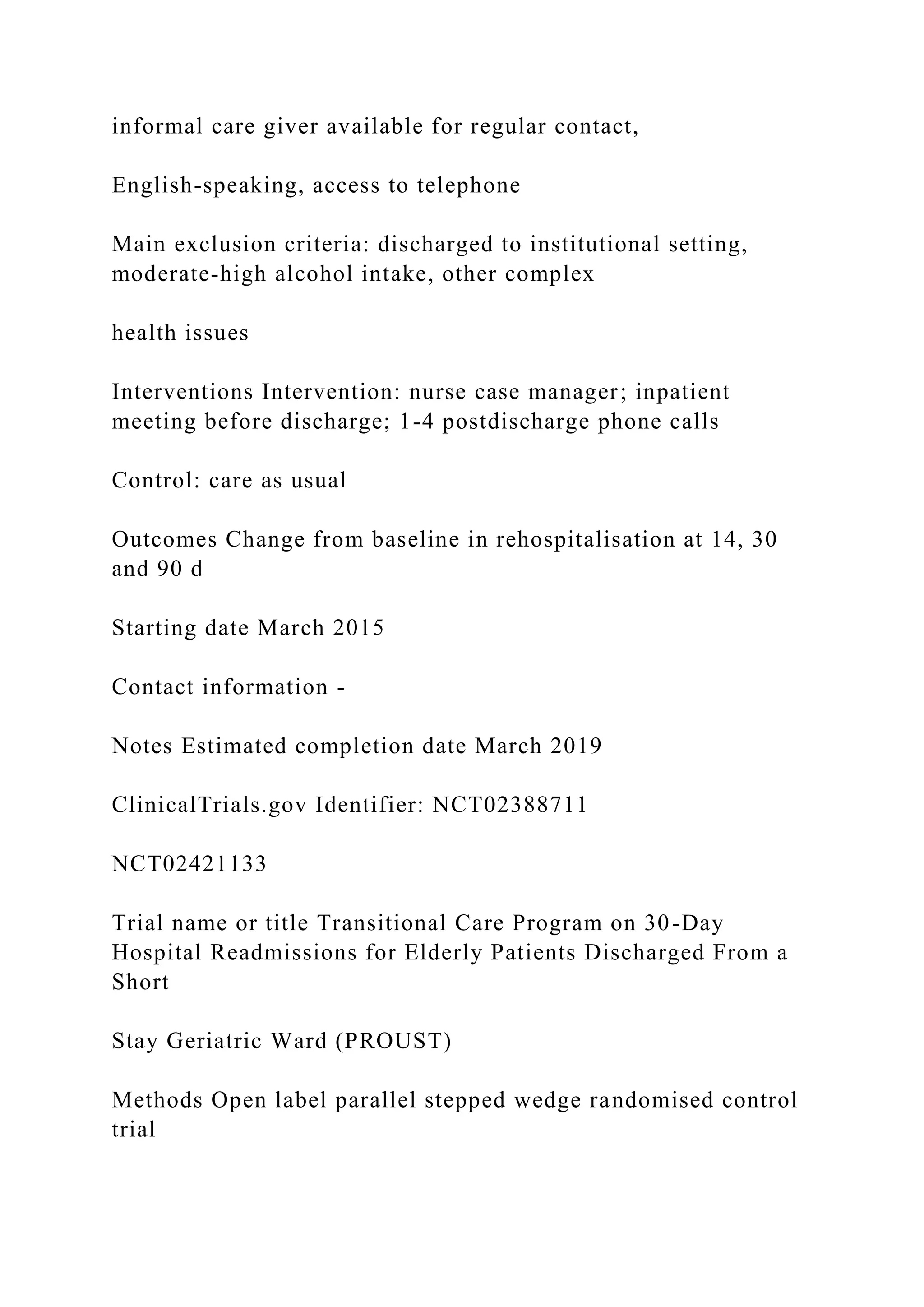
CochraneDatabaseof SystematicReviews
Dischargeplanning from hospital (Review)
Gonçalves-Bradley DC, Lannin NA, Clemson LM,Cameron ID,
Shepperd S
Gonçalves-Bradley DC, Lannin NA, Clemson LM, Cameron
ID,Shepperd S.
Discharge planning from hospital.
CochraneDatabaseof SystematicReviews 2016, Issue1. Art. No.:
CD000313.
DOI: 10.1002/14651858.CD000313.pub5.
www.cochranelibrary.com
Discharge planning fromhospital (Review)
Copyright © 2016The CochraneCollaboration. Published by
John Wiley & Sons,Ltd.
http://www.cochranelibrary.com
T A B L E O F C O N T E N T S
1HEADER . . . . . . . . . . . . . . . . . . . . . . . . . . . . . . . . . . . . . . .
1ABSTRACT . . . . . . . . . . . . . . . . . . . . . . . . . . . . . . . . . . . . .
.
2PLAIN LANGUAGE SUMMARY . . . . . . . . . . . . . . . . . . . . .
. . . . . . . . .
3SUMMARY OF FINDINGS FOR THE MAIN COMPARISON .
. . . . . . . . . . . . . . . . . .
6BACKGROUND . . . . . . . . . . . . . . . . . . . . . . . . . . . . . . . . . .
. .
7OBJECTIVES . . . . . . . . . . . . . . . . . . . . . . . . . . . . . . . . . . . .
.
7METHODS . . . . . . . . . . . . . . . . . . . . . . . . . . . . . . . . . . . . . .
9RESULTS . . . . . . . . . . . . . . . . . . . . . . . . . . . . . . . . . . . . . . .
Figure 1. . . . . . . . . . . . . . . . . . . . . . . . . . . . . . . . . . . . . . 10
Figure 2. . . . . . . . . . . . . . . . . . . . . . . . . . . . . . . . . . . . . . 13
16DISCUSSION . . . . . . . . . . . . . . . . . . . . . . . . . . . . . . . . . . .
. .
18AUTHORS’ CONCLUSIONS . . . . . . . . . . . . . . . . . . . . . . . .
. . . . . . .
18ACKNOWLEDGEMENTS . . . . . . . . . . . . . . . . . . . . . . . . . .
. . . . . .
19REFERENCES . . . . . . . . . . . . . . . . . . . . . . . . . . . . . . . . . .
. . .
25CHARACTERISTICS OF STUDIES . . . . . . . . . . . . . . . . . . .
. . . . . . . . . .
67DATA AND ANALYSES . . . . . . . . . . . . . . . . . . . . . . . . . . .
. . . . . . .
Analysis 1.1. Comparison 1 Effect of discharge planning on
hospital length of stay, Outcome 1 Hospital length of stay -
older patients with a medical condition. . . . . . . . . . . . . . . . . . .
. . . . . . . 71
Analysis 1.2. Comparison 1 Effect of discharge planning on
hospital length of stay, Outcome 2 Sensitivity analysis imputing
missing SD for Kennedy trial. . . . . . . . . . . . . . . . . . . . . . . . . .
. . . 72
Analysis 1.3. Comparison 1 Effect of discharge planning on
hospital length of stay, Outcome 3 Hospital length of stay -
older surgical patients. . . . . . . . . . . . . . . . . . . . . . . . . . . . . . .
. 73
Analysis 1.4. Comparison 1 Effect of discharge planning on
hospital length of stay, Outcome 4 Hospital length of stay -
older medical and surgical patients. . . . . . . . . . . . . . . . . . . . . .
. . . . . 73
Analysis 2.1. Comparison 2 Effect of discharge planning on
unscheduled readmission rates, Outcome 1 Within 3 months
of discharge from hospital. . . . . . . . . . . . . . . . . . . . . . . . . . . .
. . 74
Analysis 4.1. Comparison 4 Effect of discharge planning on
patients’ place of discharge, Outcome 1 Patients discharged
from hospital to home. . . . . . . . . . . . . . . . . . . . . . . . . . . . . . .
79
Analysis 4.4. Comparison 4 Effect of discharge planning on
patients’ place of discharge, Outcome 4 Older patients admitted
to hospital following a fall in residential care at 1 year. . . . . . .
. . . . . . . . . . . . . . 81
Analysis 5.1. Comparison 5 Effect of discharge planning on
mortality, Outcome 1 Mortality at 6 to 9 months. . . 81
Analysis 6.4. Comparison 6 Effect of discharge planning on
patient health outcomes, Outcome 4 Falls at follow-up: patients
admitted to hospital following a fall. . . . . . . . . . . . . . . . . . . . .
. . . . . . 88
Analysis 8.5. Comparison 8 Effect of discharge planning on
hospital care costs, Outcome 5 Hospital outpatient department
attendance. . . . . . . . . . . . . . . . . . . . . . . . . . . . . . . . . . . . 93
Analysis 8.6. Comparison 8 Effect of discharge planning on
hospital care costs, Outcome 6 First visits to the emergency
room. . . . . . . . . . . . . . . . . . . . . . . . . . . . . . . . . . . . . 94
97APPENDICES . . . . . . . . . . . . . . . . . . . . . . . . . . . . . . . . . . .
. .
100FEEDBACK . . . . . . . . . . . . . . . . . . . . . . . . . . . . . . . . . . .
. . .
101WHAT’S NEW . . . . . . . . . . . . . . . . . . . . . . . . . . . . . . . . .
. . . .
101HISTORY . . . . . . . . . . . . . . . . . . . . . . . . . . . . . . . . . . . . .
. .
102CONTRIBUTIONS OF AUTHORS . . . . . . . . . . . . . . . . . . .
. . . . . . . . . .
102DECLARATIONS OF INTEREST . . . . . . . . . . . . . . . . . . .
. . . . . . . . . . .
102SOURCES OF SUPPORT . . . . . . . . . . . . . . . . . . . . . . . . . .
. . . . . . .
102DIFFERENCES BETWEEN PROTOCOL AND REVIEW . . .
. . . . . . . . . . . . . . . . . .
103INDEX TERMS . . . . . . . . . . . . . . . . . . . . . . . . . . . . . . . . .
. . .
iDischarge planning from hospital (Review)
Copyright © 2016 The Cochrane Collaboration. Published by
John Wiley & Sons, Ltd.
[Intervention Review]
Discharge planning from hospital
Daniela C. Gonçalves-Bradley1, Natasha A Lannin2 , Lindy M
Clemson3 , Ian D Cameron4 , Sasha Shepperd1
1Nuffield Department of Population Health, University of
Oxford, Oxford, UK. 2 Occupational Therapy, Alfred Health,
Prahran,
Australia. 3Faculty of Health Sciences, University of Sydney,
Lidcombe, Australia. 4John Walsh Centre for Rehabilitation
Research,
Kolling Institute, Northern Sydney Local Health District, St
Leonards, Australia
Contact address: Sasha Shepperd, Nuffield Department of
Population Health, University of Oxford, Oxford, UK.
[email protected]
Editorial group: Cochrane Effective Practice and Organisation
of Care Group.
Publication status and date: New search for studies and content
updated (no change to conclusions), published in Issue 1, 2016.
Review content assessed as up-to-date: 5 October 2015.
Citation: Gonçalves-Bradley DC, Lannin NA, Clemson LM,
Cameron ID, Shepperd S. Discharge planning from hospital.
Cochrane
Database of Systematic Reviews 2016, Issue 1. Art. No.:
CD000313. DOI: 10.1002/14651858.CD000313.pub5.
Copyright © 2016 The Cochrane Collaboration. Published by
John Wiley & Sons, Ltd.
A B S T R A C T
Background
Discharge planning is a routine feature of health systems in
many countries. The aim of discharge planning is to reduce
hospital length
of stay and unplanned readmission to hospital, and to improve
the co-ordination of services following discharge from
hospital.This is
the third update of the original review.
Objectives
To assess the effectiveness of planning the discharge of
individual patients moving from hospital.
Search methods
We updated the review using the Cochrane Central Register of
Controlled Trials (CENTRAL) (2015, Issue 9), MEDLINE,
EMBASE,
CINAHL, the Social Science Citation Index (last searched in
October 2015), and the US National Institutes of Health trial
register
(ClinicalTrials.gov).
Selection criteria
Randomised controlled trials (RCTs) that compared an
individualised discharge plan with routine discharge care that
was not tailored
to individual participants. Participants were hospital inpatients.
Data collection and analysis
Two authors independently undertook data analysis and quality
assessment using a pre-designed data extraction sheet. We
grouped
studies according to patient groups (elderly medical patients,
patients recovering from surgery, and those with a mix of
conditions)
and by outcome. We performed our statistical analysis
according to the intention-to-treat principle, calculating risk
ratios (RRs) for
dichotomous outcomes and mean differences (MDs) for
continuous data using fixed-effect meta-analysis. When
combining outcome
data was not possible because of differences in the reporting of
outcomes, we summarised the reported data in the text.
1Discharge planning from hospital (Review)
Copyright © 2016 The Cochrane Collaboration. Published by
John Wiley & Sons, Ltd.
mailto:[email protected]
Main results
We included 30 trials (11,964 participants), including six
identified in this update. Twenty-one trials recruited older
participants
with a medical condition, five recruited participants with a mix
of medical and surgical conditions, one recruited participants
from a
psychiatric hospital, one from both a psychiatric hospital and
from a general hospital, and two trials recruited participants
admitted to
hospital following a fall. Hospital length of stay and
readmissions to hospital were reduced for participants admitted
to hospital with
a medical diagnosis and who were allocated to discharge
planning (length of stay MD − 0.73, 95% CI − 1.33 to − 0.12,
12 trials,
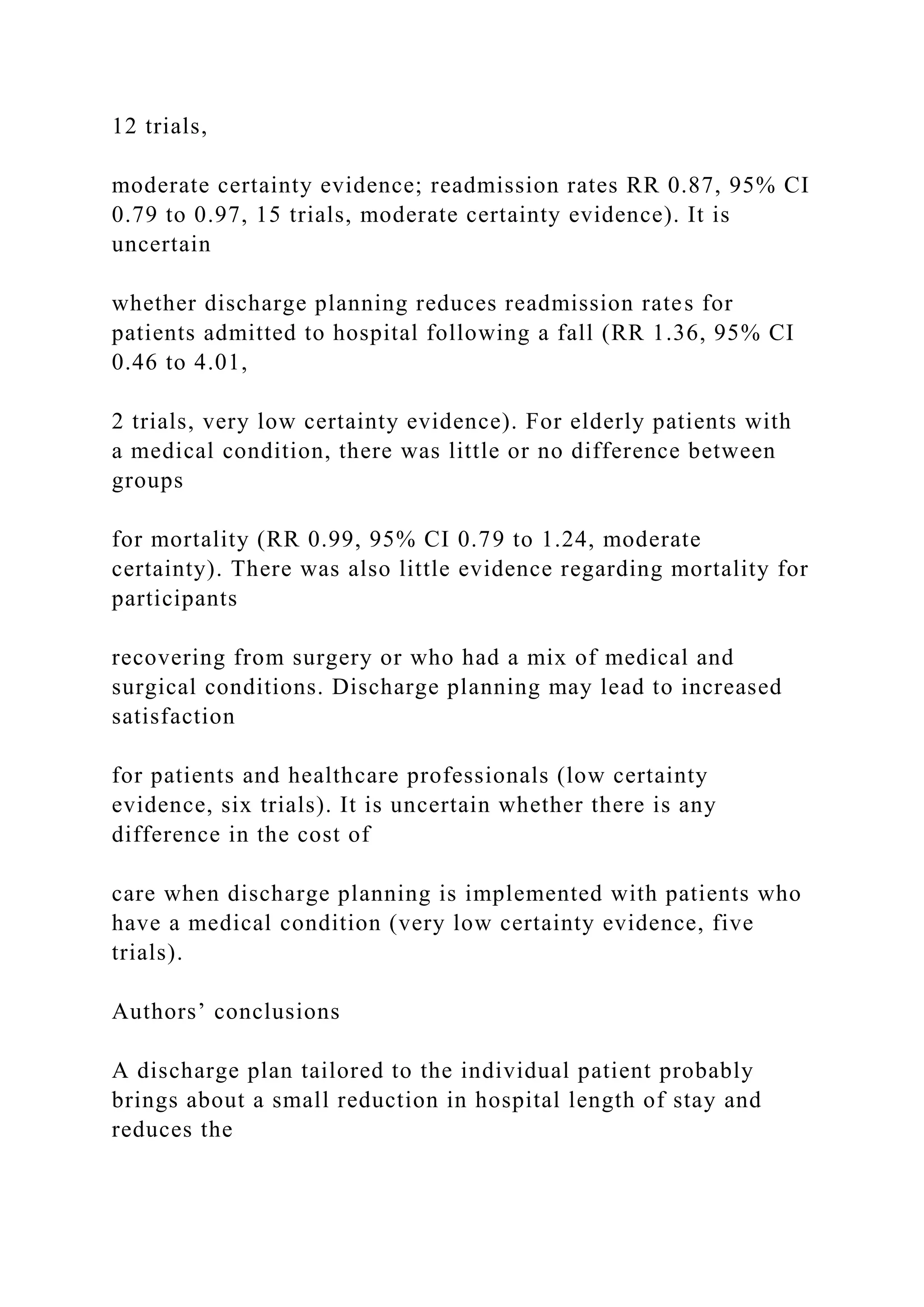
moderate certainty evidence; readmission rates RR 0.87, 95% CI
0.79 to 0.97, 15 trials, moderate certainty evidence). It is
uncertain
whether discharge planning reduces readmission rates for
patients admitted to hospital following a fall (RR 1.36, 95% CI
0.46 to 4.01,
2 trials, very low certainty evidence). For elderly patients with
a medical condition, there was little or no difference between
groups
for mortality (RR 0.99, 95% CI 0.79 to 1.24, moderate
certainty). There was also little evidence regarding mortality for
participants
recovering from surgery or who had a mix of medical and
surgical conditions. Discharge planning may lead to increased
satisfaction
for patients and healthcare professionals (low certainty
evidence, six trials). It is uncertain whether there is any
difference in the cost of
care when discharge planning is implemented with patients who
have a medical condition (very low certainty evidence, five
trials).
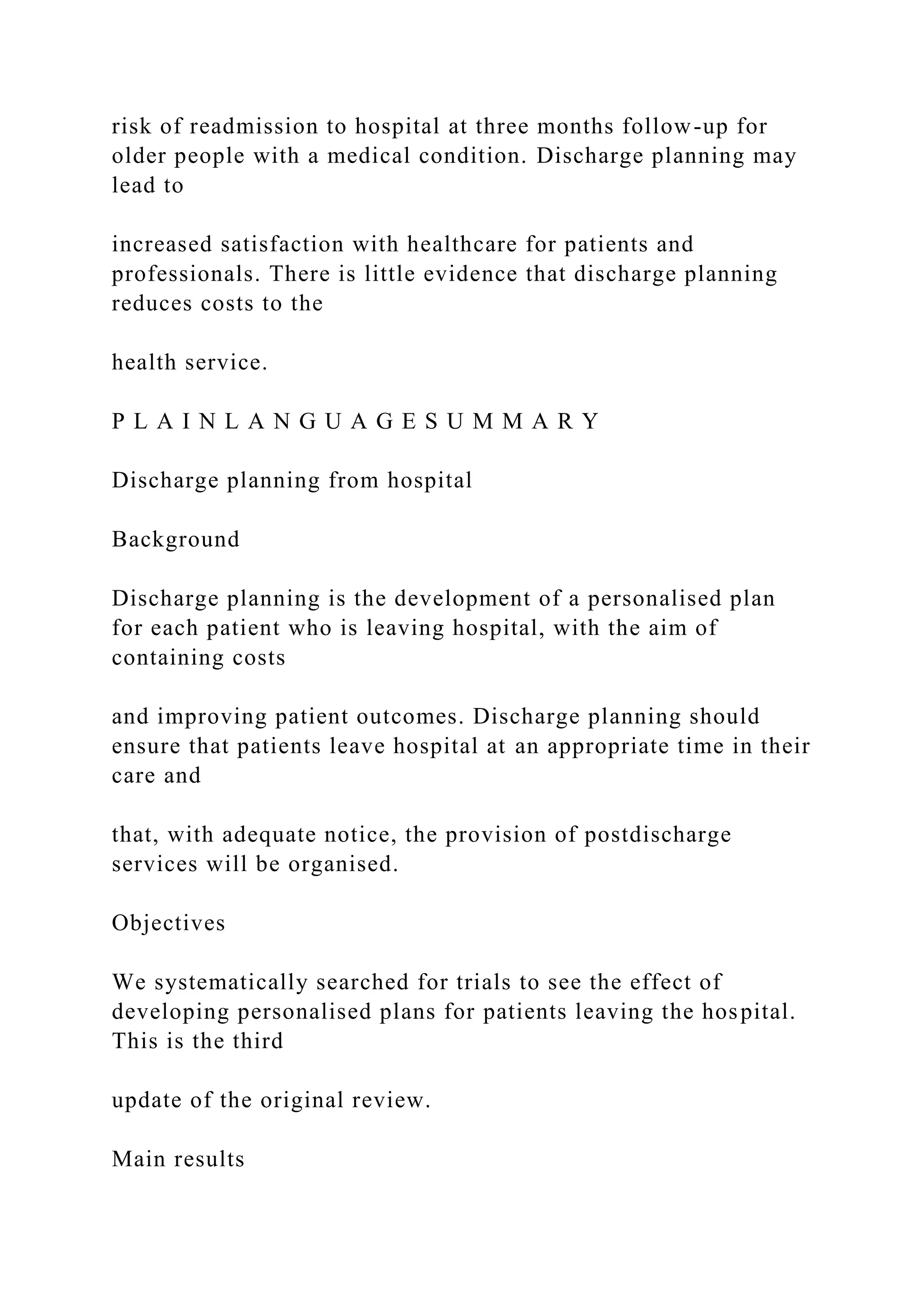
Authors’ conclusions
A discharge plan tailored to the individual patient probably
brings about a small reduction in hospital length of stay and
reduces the
risk of readmission to hospital at three months follow-up for
older people with a medical condition. Discharge planning may
lead to
increased satisfaction with healthcare for patients and
professionals. There is little evidence that discharge planning
reduces costs to the
health service.
P L A I N L A N G U A G E S U M M A R Y
Discharge planning from hospital
Background
Discharge planning is the development of a personalised plan
for each patient who is leaving hospital, with the aim of
containing costs
and improving patient outcomes. Discharge planning should
ensure that patients leave hospital at an appropriate time in their
care and
that, with adequate notice, the provision of postdischarge
services will be organised.
Objectives
We systematically searched for trials to see the effect of
developing personalised plans for patients leaving the hospital.
This is the third
update of the original review.
Main results
We found 30 trials that compared personalised discharge plans
versus standard discharge care. Twenty of those studies
included older
adults.
Authors’ conclusions
This review indicates that a personalised discharge plan
probably brings about a small reduction in hospital length of
stay (mean
difference − 0.73 days) and readmission rates for elderly
patients who were admitted to hospital with a medical
condition, and may
increase patient satisfaction. It may also increase professionals’
satisfaction, though there is little evidence to support this. It is
not clear
if discharge planning reduces costs to the health services.
2Discharge planning from hospital (Review)
Copyright © 2016 The Cochrane Collaboration. Published by
John Wiley & Sons, Ltd.
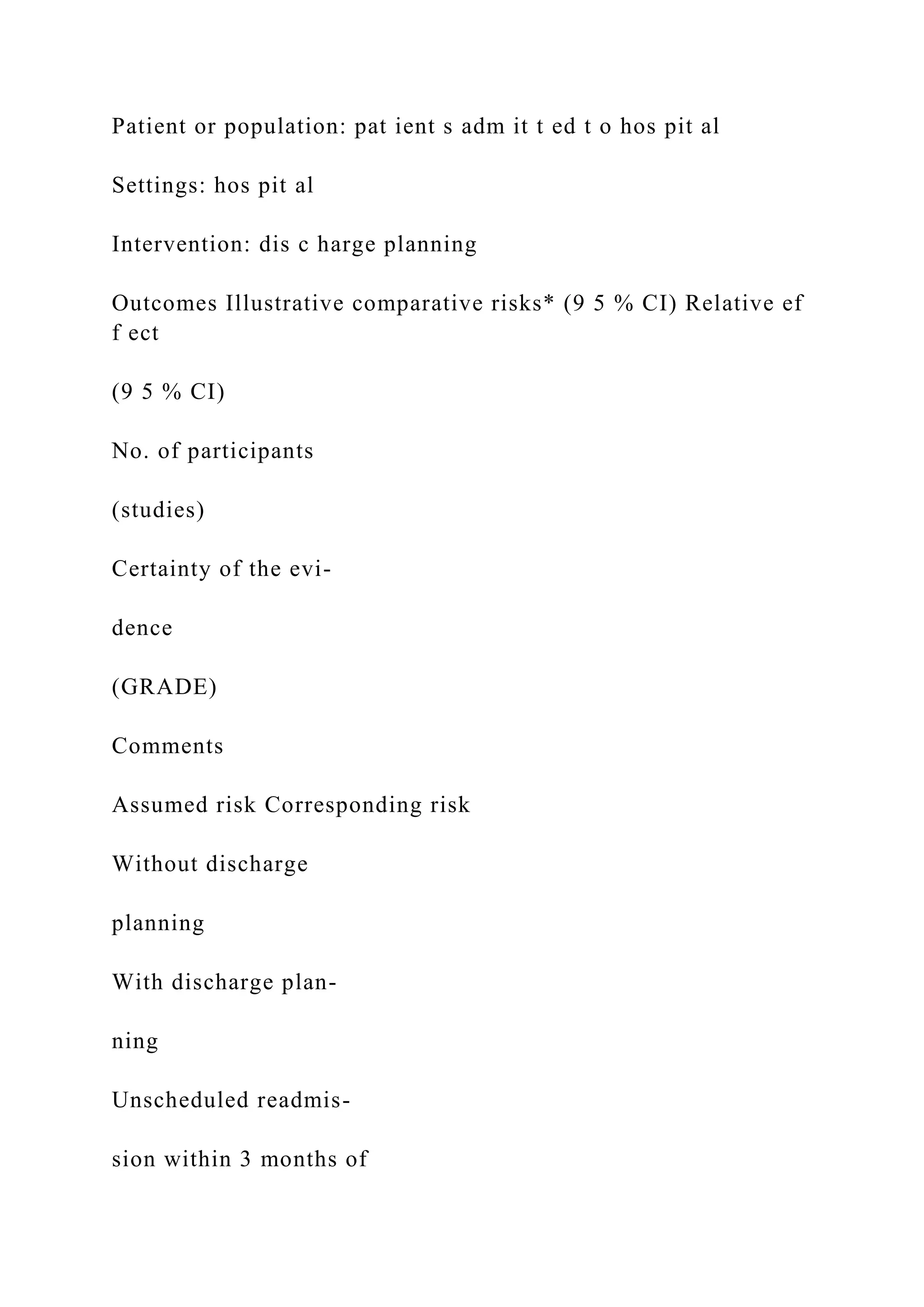
S U M M A R Y O F F I N D I N G S F O R T H E M A I N C O
M P A R I S O N [Explanation]
Ef f ect of discharge planning on patients admitted to hospital
with a medical condition
Patient or population: pat ient s adm it t ed t o hos pit al
Settings: hos pit al
Intervention: dis c harge planning
Outcomes Illustrative comparative risks* (9 5 % CI) Relative ef
f ect
(9 5 % CI)
No. of participants
(studies)
Certainty of the evi-
dence
(GRADE)
Comments
Assumed risk Corresponding risk
Without discharge
planning
With discharge plan-
ning
Unscheduled readmis-
sion within 3 months of
discharge f rom hospi-
tal
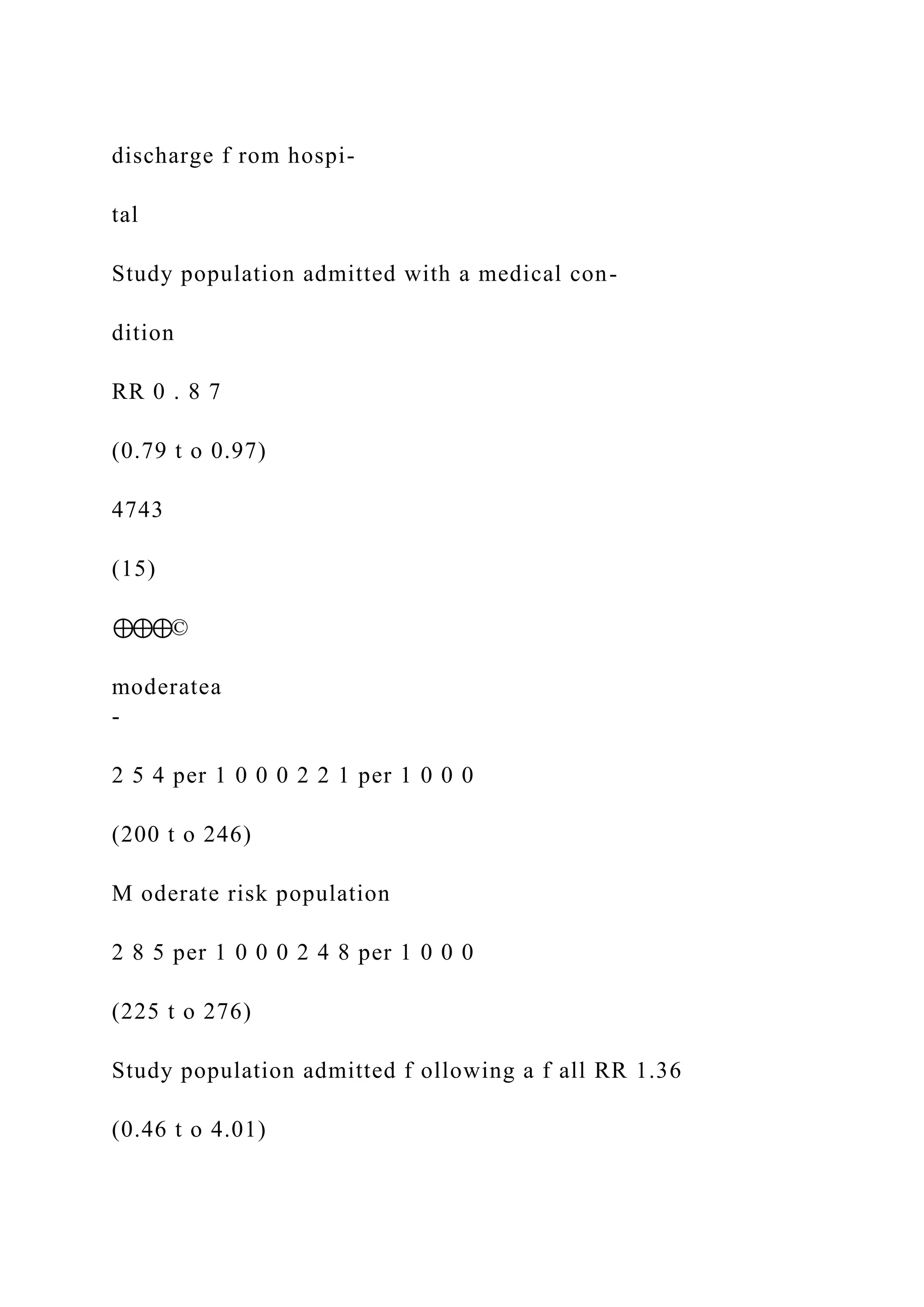
Study population admitted with a medical con-
dition
RR 0 . 8 7
(0.79 t o 0.97)
4743
(15)
⊕⊕⊕©
moderatea
-
2 5 4 per 1 0 0 0 2 2 1 per 1 0 0 0
(200 t o 246)
M oderate risk population
2 8 5 per 1 0 0 0 2 4 8 per 1 0 0 0
(225 t o 276)
Study population admitted f ollowing a f all RR 1.36
(0.46 t o 4.01)
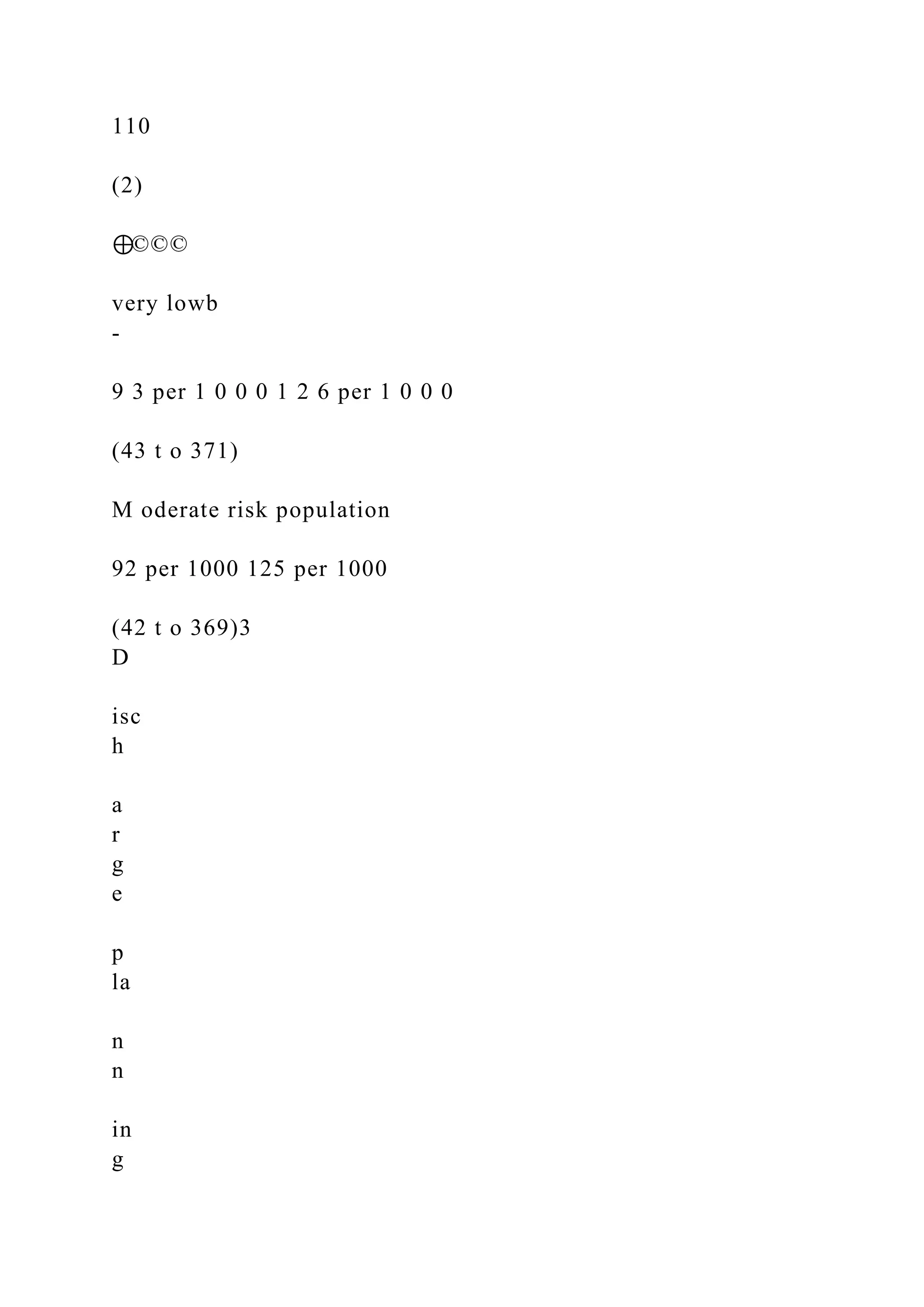
110
(2)
⊕©©©
very lowb
-
9 3 per 1 0 0 0 1 2 6 per 1 0 0 0
(43 t o 371)
M oderate risk population
92 per 1000 125 per 1000
(42 t o 369)3
D
isc
h
a
r
g
e
p
la
n
n
in
g
fro
m
h
o
sp
ita
l
(R
e
v
ie
w
)
C
o
p
y
r
ig
h
t
©
2
0
1
6
T
h
e
C
o
c
h
r
a
n
e
C
o
lla
b
o
r
a
tio
n
.
P
u
b
lish
e
d
b
y
Jo
h
n
W
ile
y
&
S
o
n
s,
L
td
.
http://www.thecochranelibrary.com/view/0/SummaryFindings.ht
ml
Hospital length of stay
Follow -up: 3 t o 6
m ont hs
Study population admitted with a medical con-
dition
- 2193
(12 s t udies )
⊕⊕⊕©
moderated
-
The m ean hos pit al
lengt h of s t ay ranged
ac ros s c ont rol groups
f rom
5 . 2 to 1 2 . 4 daysc
The m ean hos pit al
lengt h of s t ay in t he in-
t ervent ion groups w as
0 . 7 3 lower
(95% CI 1.33 t o 0.12
low er)
Satisf action Dis c harge planning m ay lead t o inc reas ed s at
is -
f ac t ion f or pat ient s and healt hc are prof es s ionals
6 s t udies ⊕⊕©©
low
Pat ient
s at is f ac t ion w as m ea-
s ured in dif f erent w ays ,
and f indings w ere not
c ons is t ent ac ros s s t ud-
ies . Only 6/ 30 s t udies
report ed dat a f or t his
out c om e
Costs A low er readm is s ion rat e f or t hos e rec eiving
dis c harge planning m ay be as s oc iat ed w it h low er
healt h s ervic e c os t s in t he s hort t erm . Dif f erenc es
in us e of prim ary c are varied
5 s t udies ⊕©©©
very low
Findings w ere inc on-
s is t ent . Healt hc are re-
s ourc es t hat w ere as -
s es s ed varied am ong
s t udies , e.g., prim ary
c are vis it s , readm is -
s ion, lengt h of s t ay, lab-
orat ory s ervic es , m edi-
c a-
t ion, diagnos t ic im ag-
ing. The c harges us ed
t o c os t t he healt hc are
res ourc es als o varied
* The bas is f or t he assumed risk (e.g. t he m edian c ont rol
group ris k ac ros s s t udies ) is provided in f oot not es . The
corresponding risk (and it s 95% c onf idenc e int erval) is
bas ed on t he as s um ed ris k in t he c om paris on group and t
he relative ef f ect of t he int ervent ion (and it s 95% CI).
CI: Conf idenc e int erval; RR: Ris k rat io.
4
D
isc
h
a
r
g
e
p
la
n
n
in
g
fro
m
h
o
sp
ita
l
(R
e
v
ie
w
)
C
o
p
y
r
ig
h
t
©
2
0
1
6
T
h
e
C
o
c
h
r
a
n
e
C
o
lla
b
o
r
a
tio
n
.
P
u
b
lish
e
d
b
y
Jo
h
n
W
ile
y
&
S
o
n
s,
L
td
.
GRADE Working Group grades of evidenc e
High:This res earc h provides a very good indic at ion of t he
likely ef f ec t . The likelihood t hat t he ef f ec t w ill be s ubs t
ant ially dif f erent (i.e., large enough t o af f ec t a dec is ion)
is
low .
M oderate: This res earc h provides a good indic at ion of t he
likely ef f ec t . The likelihood t hat t he ef f ec t w ill be s ubs t
ant ially dif f erent is m oderat e.
Low: This res earc h provides s om e indic at ion of t he likely
ef f ec t . How ever, t he likelihood t hat it w ill be s ubs t ant
ially dif f erent is high.
Very low: This res earc h does not provide a reliable indic at
ion of t he likely ef f ec t . The likelihood t hat t he ef f ec t w
ill be s ubs t ant ially dif f erent is very high
a The evidenc e w as dow ngraded t o m oderat e as alloc at ion
c onc ealm ent w as unc lear f or 5 of t he 15 t rials .
bThe evidenc e w as dow ngraded bec aus e of im prec is ion in
t he res ult s due t o 2 s m all t rials .
cThe range exc ludes lengt h of s t ay of 45 days report ed by
Sulc h, as t his w as an out lier.
d The evidenc e w as dow ngraded t o m oderat e as c onc ealm
ent of random alloc at ion w as unc lear f or 6 of t he 11 t rials .
xxxxxxxxxxxxxxxxxxxxxxxxxxxxxxxxxxxxxxxxxxxxxxxxxxxxx
xxxxxxxxxxxxxxxxxxxx
5
D
isc
h
a
r
g
e
p
la
n
n
in
g
fro
m
h
o
sp
ita
l
(R
e
v
ie
w
)
C
o
p
y
r
ig
h
t
©
2
0
1
6
T
h
e
C
o
c
h
r
a
n
e
C
o
lla
b
o
r
a
tio
n
.
P
u
b
lish
e
d
b
y
Jo
h
n
W
ile
y
&
S
o
n
s,
L
td
.
B A C K G R O U N D
Cost containment strategies that aim to limit healthcare-related
costs while still promoting quality are a feature of all healthcare
systems, especially for acute hospital services (Bodenheimer
2005).
Recent trends include specifically targeting those patients who
in-
cur greater healthcare expenditures, decreasing the length of
stay
for inpatient care, reducing the number of long-stay beds,
moving
care into the community, increasing the use of day surgery, pro-
viding increased levels of acute care at home (’hospital at
home’)
and implementing policies such as discharge planning.
There is evidence to suggest that discharge planning (i.e. an in-
dividualised plan for a patient prior to them leaving hospital for
home) combined with additional postdischarge support can re-
duce unplanned readmission to hospital for patients with
conges-
tive heart failure (Phillips 2004). A reduction in readmissions
will
decrease inpatient costs; however, this reduction in costs may
be
offset by an increase in the provision of community services as
a re-
sult of planning. In the United States, unplanned
hospitalisations
accounted for 17% of all Medicare hospital payments in 2004,
and
one quarter of all hospital admissions were 30-day readmissions
(Jencks 2009). Even a small reduction in readmission rates
could
have a substantial financial impact (Burgess 2014).
Description of the condition
It has been estimated that one-fifth of all hospital discharges are
delayed for non-medical reasons (McDonagh 2000). Despite re-
cent advances in electronic records, patient pathways and
technol-
ogy-assisted decision support, the following three factors,
identi-
fied over 30 years ago (Barker 1985), remain causes of delayed
dis-
charge from hospital (Dept of Health 2003): inadequate patient
assessment by health professionals, resulting in problems such
as
poor knowledge of the patient’s social circumstances and poor
or-
ganisation of postdischarge health and social care; the late
book-
ing of transport services to take a patient home, which prevents
timely discharge from hospital; and poor communication
between
the hospital, follow-up care and community service providers.
Or-
ganisational factors, including the number of times a patient is
moved while in hospital and the discharge arrangements, are
more
strongly associated with delayed discharge than patient factors
such
as functional limitations or cognitive function (Challis 2014).
The
transition of patients from hospital to postdischarge healthcare,
residential or the home setting has the potential to disrupt conti-
nuity of care and may increase the risk of an adverse event due
to
an inadequate planning of a patient’s discharge (Kripalani
2007).
Poor communication between the secondary care and the
postdis-
charge setting can result in key clinical information not
reaching
primary care providers, with patients remaining unaware of
infor-
mation that might help them manage their condition and prepare
for discharge from hospital.
Description of the intervention
Discharge planning is the development of an individualised dis-
charge plan for a patient prior to them leaving hospital for
home.
The discharge plan can be a stand-alone intervention or may be
embedded within another intervention, for example, as a compo-
nent of stroke unit care or as part of the comprehensive geriatric
as-
sessment process (Ellis 2011; Langhorne 2002; Rubenstein
1984).
Discharge planning may also extend across healthcare settings
and
include postdischarge support (Parker 2002; Phillips 2004).
How the intervention might work
The aim of discharge planning is to improve the efficiency and
quality of healthcare delivery by reducing delayed discharge
from
hospital, facilitating the transition of patients from a hospital to
a
postdischarge setting, providing patients with information about
their condition and, if required, postdischarge healthcare. Dis-
charge planning may contain costs and improve patient
outcomes.
For example, discharge planning may influence both the
hospital
length of stay and the pattern of care within the community, in-
cluding the follow-up rate and outpatient assessment, by
bridging
the gap between hospital and home (Balaban 2008).
Why it is important to do this review
The emphasis placed on discharge planning varies between
coun-
tries. In the USA, discharge planning is mandatory for hospi-
tals participating in the Medicare and Medicaid programmes.
In the UK, the Department of Health has published guidance
on discharge practice for health and social care (Dept of Health
2010). Clinical guidance issued by professional bodies in the
UK (Future Hospital Comission 2013), the USA (Dept Health
Human Services 2013), Australia (Aus NZ Soc Geriat Med
2008)
and Canada (Health Qual Ontario 2013), all highlight the im-
portance of planning discharge as soon as the patient is
admitted,
involving a multidisciplinary team to provide a thorough assess-
ment, establishing continuous communication with the patient
and the care givers, working towards shared decision-making
and
self-management, and liaising with health and social services in
the
community-particularly primary care. However, procedures may
vary between specialities and healthcare professionals in the
same
hospital (Ubbink 2014). We have conducted a systematic review
of discharge planning to categorise the different types of study
populations and discharge plans being implemented, and to
assess
the effectiveness of organising services in this way. The focus
of
this review is the effectiveness of discharge planning
implemented
in an acute hospital setting. This is the third update of the
original
review.
6Discharge planning from hospital (Review)
Copyright © 2016 The Cochrane Collaboration. Published by
John Wiley & Sons, Ltd.
O B J E C T I V E S
The main objective was to assess the effectiveness of planning
the
discharge of individual patients moving from hospital.
The specific objectives were as follow:
Does discharge planning improve the appropriate use of acute
care
1. Effect of discharge planning on length of stay in hospital
compared to usual care.
2. Effect of discharge planning on unscheduled readmission
rates compared to usual care
3. Effect of discharge planning on other process variables:
patients’ place of discharge.
Does discharge planning improve or (at least) have no adverse
effect on patient outcome?
1. Effect of discharge planning on mortality rate compared to
usual care.
2. Effect of discharge planning on patient health outcomes
compared to usual care.
3. Effect of discharge planning on the incidence of
complications related to the initial admission compared to usual
care.
4. Effect of discharge planning on the satisfaction of patient,
care givers and healthcare professionals compared to usual care.
Does discharge planning reduce overall costs of healthcare?
1. Effect of discharge planning on hospital care costs
compared to usual care.
2. Effect of discharge planning on community care costs
compared to usual care.
3. Effect of discharge planning on overall costs of healthcare
compared to usual care.
4. Effect of discharge planning on the use of medication.
M E T H O D S
Criteria for considering studies for this review
Types of studies
Randomised controlled trials.
Types of participants
All patients in hospital (acute, rehabilitation or community)
irre-
spective of age, gender or condition.
Types of interventions
We defined discharge planning as the development of an
individ-
ualised discharge plan for a patient prior to them leaving hospi-
tal for home or residential care. Where possible, we divided the
process of discharge planning according to the steps identified
by
Marks 1994:
• pre-admission assessment (where possible);
• case finding on admission;
• inpatient assessment and preparation of a discharge plan
based on individual patient needs, for example a
multidisciplinary assessment involving the patient and their
family, and communication between relevant professionals
within the hospital;
• implementation of the discharge plan, which should be
consistent with the assessment and requires documentation of
the discharge process;
• monitoring in the form of an audit to assess if the discharge
plan was implemented.
We excluded studies from the review if they did not include an
as-
sessment or implementation phase in discharge planning; if it
was
not possible to separate the effects of discharge planning from
the
other components of a multifaceted intervention or if discharge
planning appeared to be a minor part of a multifaceted interven-
tion; or if the focus was on the provision of care after discharge
from hospital. We excluded interventions where the focus was
on
the provision of care after discharge from hospital, and those in
which discharge planning was part of a larger package of care
but
the process and components were poorly described.
The control group had to receive standard care with no
individu-
alised discharge plan.
Types of outcome measures
We addressed the effect of discharge planning across several
areas:
the use of acute care, patient outcomes and healthcare costs.
Main outcomes
1. Length of stay in hospital
2. Readmission rate to hospital
Other outcomes
1. Complications related to the initial admission
2. Place of discharge
3. Mortality rate
4. Patient health status, including psychological health
5. Patient satisfaction
6. Care giver and healthcare professional satisfaction
7. Psychological health of care givers
8. Healthcare costs of discharge planning
7Discharge planning from hospital (Review)
Copyright © 2016 The Cochrane Collaboration. Published by
John Wiley & Sons, Ltd.
i) Hospital care costs and use
ii) Primary and community care cost
9. The use of medication for trials evaluating a pharmacy
discharge plan
Search methods for identification of studies
Electronic searches
We searched the following databases: the Cochrane Central
Reg-
ister of Controlled Trials (CENTRAL) (2015, Issue 9), the
Cochrane Effective Practice and Organisation of Care (EPOC)
Group Register (March 2009), MEDLINE via OvidSP (1946 to
October 2015), EMBASE via OvidSP (1974 to October 2015),
CINAHL via EbscoHOST (1980 to October 2015), Social Sci-
ence Citation Index via ISI Web of Knowledge (1975 to October
2015), EconLit (1969 to 1996), SIGLE (grey literature) (1980 to
1996), PsycLIT (1974 to 1996) and PsycINFO (2012 to October
2015). We detail the search strategies for this update in
Appendix
1.
Searching other resources
We checked the reference lists of included studies and related
sys-
tematic reviews using PDQ-Evidence (PDQ-Evidence 2015). We
handsearched the US National Institutes of Health trial register
(ClinicalTrials.gov 2015) and reviewed the reference lists of all
in-
cluded studies. When necessary, we contacted individual
trialists
to clarify issues and to identify unpublished data.
Data collection and analysis
For this update we followed the same methods defined in the
pro-
tocol and used in previous versions of this systematic review.
Risk
of bias of each included study was assessed using the Cochrane
Risk of Bias criteria. We created a summary of findings table
using
the following outcomes: unscheduled hospital readmission,
hospi-
tal length of stay, satisfaction and costs. We used the five
GRADE
considerations (study limitations, consistency of effect,
impreci-
sion, indirectness, and risk of bias) to assess the certainty of the
evidence as it relates to the main outcomes (Guyatt 2008). We
used methods and recommendations described in Section 8.5
and
Chapter 12 of the Cochrane Handbook (Higgins 2011). We jus-
tified all decisions to down- or up-grade the certainty of
evidence
using footnotes to aid readers’ understanding of the review
where
necessary.
Selection of studies
For this update, two authors (of DCGB, IC, NL and LC) read all
the abstracts in the records retrieved by the electronic searches
to
identify publications that appeared to be eligible for this
review.
Two authors (of DCGB, IC, NL and LC) then independently
assessed the full text of all potentially relevant papers in order
to select studies for inclusion. We settled any disagreements by
discussion, or by liaising with SS.
We excluded trials when discharge planning was part of a
broader
package of inpatient care. We made a post hoc decision to
exclude
any studies that did not describe the study design or did not
report
results for the control group. We report details of why we
excluded
studies in the ’Characteristics of excluded studies’ table.
Data extraction and management
For this update, two authors working independently (of DCGB,
IC, NL and LC) extracted data from each article. For the orig-
inal review and two subsequent updates, we used a data extrac-
tion form developed by EPOC, modified and amended for the
purposes of this review. For the current version of the review
we
used an adapted version of the Cochrane good practice
extraction
form (EPOC 2015). We extracted information on study charac-
teristics (first author, year of publication, aim, setting, design,
unit
of allocation, duration, ethical approval, funding sources),
partic-
ipant characteristics (method of recruitment,
inclusion/exclusion
criteria, total number, withdrawals and drop-outs, socio-demo-
graphic indicators, subgroups), intervention (setting, pre-admis-
sion assessment, case finding on admission, inpatient
assessment
and preparation of discharge plan, implementation of discharge
plan, monitoring phase, and comparison), and outcomes.
Assessment of risk of bias in included studies
We assessed the quality of the selected trials using the criteria
pre-
sented in the Cochrane Handbook for Systematic Reviews of
Inter-
ventions (Higgins 2011): random sequence generation,
allocation
concealment, blinding, incomplete outcome data, selective
report-
ing, and baseline data. For this update, two reviewers (of
DCGB,
IC, NL and LC) independently assessed the risk of bias. We re-
solved disagreements by discussing each case with a third
reviewer
(SS).
Unit of analysis issues
All the included studies were parallel RCTs, where participants
were individually allocated to the treatment or control groups.
Dealing with missing data
We contacted investigators for missing data; for this update two
provided unpublished data (Goldman 2014; Lainscak 2013).
8Discharge planning from hospital (Review)
Copyright © 2016 The Cochrane Collaboration. Published by
John Wiley & Sons, Ltd.
Assessment of heterogeneity
We quantified heterogeneity among trials using the I2 statistic
and
Cochrane’s Q test (Cochrane 1954). The I2 statistic quantifies
the
percentage of the total variation across studies that is due to
het-
erogeneity rather than chance (Higgins 2003); smaller
percentages
suggest less observed heterogeneity.
Data synthesis
The primary analysis was a comparison of discharge planning
ver-
sus routine discharge care for each outcome listed in Types of
outcome measures. We calculated risk ratios (RR) for the
dichoto-
mous outcomes mortality, unscheduled readmission and
discharge
destination, with 95% confidence intervals (CI) for all point es-
timates; and combined data using the fixed effects model. Val-
ues under 1 indicated outcomes favouring discharge planning.
We
calculated mean differences (MD) for the hospital length of
stay.
We judged combining data from the included studies inappro-
priate for the other outcomes, including patient health
outcomes,
satisfaction, medication, healthcare costs, and use of other post-
discharge healthcare services (primary care, outpatient, and
emer-
gency room), due to the different methods of measuring and re-
porting these outcomes. We created a ’Summary of findings’
table
for the main outcomes of hospital length of stay and
unscheduled
readmission, and for the secondary outcomes of satisfaction and
cost. We used GRADE worksheets to assess the certainty of the
evidence (GRADEpro GDT 2015).
Subgroup analysis and investigation of heterogeneity
In order to reduce differences between trials, we grouped trial
re-
sults by participants’ condition (patients with a medical
condition,
a surgical condition, or patients recruited to a trial with a mix
of
conditions), as the discharge planning needs for patients
admitted
to hospital for surgery might differ from those for patients
admit-
ted with an acute medical condition or with multiple medical
con-
ditions. We performed post hoc subgroup analyses for
participants
admitted to hospital following a fall and participants admitted
to
a mental health setting, as we found more than one study for
each
subgroup and considered that these participant groups, as well
as
their discharge needs, might differ from both surgical and
medical
patients.
Sensitivity analysis
We performed a post hoc sensitivity analysis by imputing a
missing
standard deviation for one trial (Kennedy 1987).
R E S U L T S
Description of studies
Results of the search
Previous versions of the review identified 4676 records, of
which
we excluded 4526 after screening the title and abstract. The
main
reasons for exclusion were ineligible study design, intervention
or both. Of the 150 full-text records assessed, we excluded 126
and included 24 (Balaban 2008; Bolas 2004; Eggink 2010;
Evans
1993; Harrison 2002; Hendriksen 1990; Jack 2009; Kennedy
1987; Laramee 2003; Legrain 2011; Lin 2009; Moher 1992; Naji
1999; Naughton 1994; Naylor 1994; Nazareth 2001; Pardessus
2002; Parfrey 1994; Preen 2005; Rich 1993a; Rich 1995a; Shaw
2000; Sulch 2000; Weinberger 1996). For this review update,
we
identified 1796 records, of which we excluded 1703 after
screening
the title and abstract. After retrieving the full text of the
remaining
93 studies, we identified six eligible trials (12 publications),
which
we included in this update (Farris 2014; Gillespie 2009;
Goldman
2014; Kripalani 2012; Lainscak 2013; Lindpaintner 2013)
(Figure
1). These 30 trials recruited a total of 11,964 participants. One
of the trials included in the review was translated from Danish
to English (Hendriksen 1990). Follow-up times varied from five
days to 12 months.
9Discharge planning from hospital (Review)
Copyright © 2016 The Cochrane Collaboration. Published by
John Wiley & Sons, Ltd.
Figure 1. PRISMA flow diagram
10Discharge planning from hospital (Review)
Copyright © 2016 The Cochrane Collaboration. Published by
John Wiley & Sons, Ltd.
Included studies
The trials included in the review evaluated broadly similar dis-
charge planning interventions, which included assessment, plan-
ning, implementation and monitoring phases, although seven tri-
als did not describe a monitoring phase (Eggink 2010; Evans
1993;
Moher 1992; Naji 1999; Parfrey 1994; Shaw 2000; Sulch 2000);
see Characteristics of included studies. The intervention was
im-
plemented at varying times during a participant’s stay in
hospital,
from admission to three days prior to discharge. For one trial it
was
not clear when the intervention, which consisted of liaising with
the community healthcare providers about the patient’s specific
needs, was implemented (Lainscak 2013). Another trial
conducted
a needs assessment and implementation of the discharge plan in
two separate encounters, but if discharge occurred the same day
as enrolment, then both phases occurred in one session
(Kripalani
2012). Seven trials evaluated a pharmacy discharge plan imple-
mented by a hospital pharmacy. For six of those trials the
partic-
ipants’ medication was rationalised and prescriptions checked
for
errors by the hospital consultant, GP, community pharmacist or
all of those. These professionals also received a pharmacy
discharge
plan, and participants received information about their
medication
(Bolas 2004; Eggink 2010; Farris 2014; Gillespie 2009;
Nazareth
2001; Shaw 2000). For the seventh trial, the research team con-
tacted the physicians treating the participant, both in the
hospital
and in the community, but only if they had identified
medication-
related problems during the monitoring phase of the
intervention
(Kripalani 2012). In all but two trials a named healthcare
profes-
sional coordinated the discharge plan. Of the 30 included trials,
12 provided a postdischarge phone call, four a visit, and two a
phone call and a visit.
The study population differed between the trials. Twenty-one
tri-
als recruited participants with a medical condition (Balaban
2008;
Bolas 2004; Eggink 2010; Farris 2014; Gillespie 2009; Goldman
2014; Harrison 2002; Jack 2009; Kennedy 1987; Kripalani
2012;
Lainscak 2013; Laramee 2003; Legrain 2011; Moher 1992;
Naughton 1994; Nazareth 2001; Preen 2005; Rich 1993a; Rich
1995a; Sulch 2000; Weinberger 1996), with six of these recruit-
ing participants with heart failure (Eggink 2010; Harrison 2002;
Kripalani 2012; Laramee 2003; Rich 1993a; Rich 1995a). Two
trials recruited older people (> 65 years) admitted to hospital
fol-
lowing a fall (Lin 2009; Pardessus 2002), five recruited partici-
pants with a mix of medical and surgical conditions (Evans
1993;
Farris 2014; Hendriksen 1990; Naylor 1994; Parfrey 1994), and
two recruited participants from an acute psychiatric ward (Naji
1999; Shaw 2000), one of which also recruited participants from
the elderly care ward (Shaw 2000). Two trials used a
questionnaire
designed to identify participants likely to require discharge
plan-
ning (Evans 1993; Parfrey 1994). The majority of trials
included a
patient education component, and two trials included the
partici-
pant’s care giver in the formal assessment process (Lainscak
2013;
Naylor 1994). The average age of participants recruited to 10 of
the trials was > 75 years; in seven trials, between 70 and 75
years,
and in the remaining trials, < 70 years. In two trials, both
recruit-
ing participants from a psychiatric hospital, the participants
were
under 50 years of age.
The description of the type of care the control group received
var-
ied. Two trials did not describe the care that the control group
received (Kennedy 1987; Shaw 2000) and another reported it
only as best usual care (Lindpaintner 2013). Twenty-one trials
described the control group as receiving usual care with some
discharge planning but without a formal link through a coordi-
nator to other departments and services, although other services
were available on request from nursing or medical staff
(Balaban
2008; Eggink 2010; Evans 1993; Gillespie 2009; Goldman 2014;
Harrison 2002; Hendriksen 1990; Jack 2009; Laramee 2003;
Legrain 2011; Lin 2009; Moher 1992; Naji 1999; Naylor 1994;
Naughton 1994; Pardessus 2002; Parfrey 1994; Preen 2005;
Rich
1993a; Rich 1995a; Weinberger 1996). The control groups in
seven trials that evaluated the effectiveness of a pharmacy dis-
charge plan did not have access to a review and discharge plan
by a pharmacist (Bolas 2004; Eggink 2010; Farris 2014;
Gillespie
2009; Kripalani 2012; Nazareth 2001; Shaw 2000). In one trial,
the control group received multidisciplinary care that was not
de-
fined in advance but was determined by the participants’
progress
(Sulch 2000). Two trials considered the potential influence of
lan-
guage fluency (Balaban 2008; Goldman 2014), while two looked
at health literacy (Jack 2009; Kripalani 2012).
Excluded studies
The main reason for excluding trials was due to multifaceted in-
terventions, of which discharge planning was only a minor part.
Some trials reported interventions of postdischarge care,
whereas
for others the control group also received some component of
the
discharge planning intervention. We excluded a small number of
trials that did not include an assessment phase (Characteristics
of
excluded studies).
Risk of bias in included studies
Eighteen trials reported adequate allocation concealment (Farris
2014; Gillespie 2009; Goldman 2014; Harrison 2002; Jack 2009;
Kennedy 1987; Kripalani 2012; Lainscak 2013; Legrain 2011;
Naji 1999; Naughton 1994; Nazareth 2001; Preen 2005; Parfrey
1994; Rich 1995a; Shaw 2000; Sulch 2000; Weinberger 1996).
All but two trials collected data at baseline (Balaban 2008;
Pardessus 2002), and we assessed 21 trials as having a low risk
of bias for measurement of the primary outcomes (readmission
11Discharge planning from hospital (Review)
Copyright © 2016 The Cochrane Collaboration. Published by
John Wiley & Sons, Ltd.
and length of stay), as investigators used routinely collected
data
to measure these outcomes (Balaban 2008; Eggink 2010; Evans
1993; Farris 2014; Gillespie 2009; Goldman 2014; Hendriksen
1990; Jack 2009; Kennedy 1987; Lainscak 2013; Laramee 2003;
Legrain 2011; Moher 1992; Naji 1999; Naughton 1994;
Nazareth
2001; Pardessus 2002; Parfrey 1994; Rich 1993a; Rich 1995a;
Weinberger 1996). We assessed one pilot trial as having a high
risk
of bias for the outcome readmission, which was ascertained by
in-
terview rather than through routine data collection
(Lindpaintner
2013) (Figure 2).
12Discharge planning from hospital (Review)
Copyright © 2016 The Cochrane Collaboration. Published by
John Wiley & Sons, Ltd.
Figure 2. Methodological quality summary: review authors’
judgements about each methodological quality
item for each included study.
13Discharge planning from hospital (Review)
Copyright © 2016 The Cochrane Collaboration. Published by
John Wiley & Sons, Ltd.
Effects of interventions
See: Summary of findings for the main comparison Effect of
discharge planning on readmission and hospital length of stay
Does discharge planning improve the appropriate use
of acute care?
Hospital length of stay
There was a small reduction in hospital length of stay for those
allocated to discharge planning in trials recruiting older people
following a medical admission (mean difference (MD) − 0.73,
95% confidence interval (CI) − 1.33 to − 0.12; 12 trials, mod-
erate certainty evidence, Analysis 1.1; Harrison 2002; Gillespie
2009; Kennedy 1987; Laramee 2003; Lindpaintner 2013; Moher
1992; Naughton 1994; Naylor 1994; Preen 2005; Rich 1993a;
Rich 1995a; Sulch 2000). This reduction increased slightly in
a sensitivity analysis imputing a missing standard deviation for
Kennedy 1987 (MD − 0.98, 95% CI − 1.57 to − 0.38; Analysis
1.2). There was no evidence of statistical heterogeneity. Two
tri-
als recruiting participants recovering from surgery reported a
dif-
ference of − 0.06 day (95% CI − 1.23 to 1.11) (Analysis 1.3;
Lin 2009; Naylor 1994); and two trials recruiting a combination
of participants recovering from surgery and those with a
medical
condition a mean difference of − 0.60 (95% CI − 2.38 to 1.18)
(Analysis 1.4; Evans 1993; Hendriksen 1990). We did not
include
these four trials in the pooled analysis as they recruited partici-
pants from different settings. Parfrey 1994 recruited
participants
from two hospitals and reported a reduction in length of stay for
those receiving discharge planning in one hospital only (median
difference − 0.80 days, P = 0.03).
Readmission rates
For elderly participants with a medical condition, there was a
lower readmission rate in the discharge planning group at three
months of discharge (RR 0.87, 95% CI 0.79 to 0.97; 15 trials,
moderate certainty evidence, Analysis 2.1.1; Balaban 2008;
Farris
2014; Goldman 2014; Harrison 2002; Jack 2009; Kennedy 1987;
Lainscak 2013; Laramee 2003; Legrain 2011; Moher 1992;
Naylor
1994; Nazareth 2001; Rich 1993a; Rich 1995a; Shaw 2000),
with
no evidence of statistical heterogeneity. It is uncertain whether
dis-
charge planning reduces readmission rates for participants
admit-
ted to hospital following a fall (RR 1.36, 95% CI 0.46 to 4.01,
very low certainty evidence, two trials, Analysis 2.1.2).
Evans 1993 recruited a mix of participants, reporting a
reduction
in readmissions for those receiving discharge planning
(difference
− 11%, 95% CI − 17% to − 4%) at four weeks follow-up,
but not at nine months follow-up (difference − 6%, 95% CI
− 12.5% to 0.84%; P = 0.08). One small pilot trial reported
similar readmission rates for both groups at 5 and 30 days but
did not provide enough data to be included in the pooled
analysis
(Lindpaintner 2013; Analysis 2.3). One trial recruiting people
recovering from surgery reported the difference in readmission
rates + 3% (95% CI − 7% to 13%; Analysis 2.4; Naylor 1994),
and a trial recruiting participants admitted to acute psychiatric
wards reported a difference +7% (95% CI − 1% to 17%;
Analysis
2.5; Naji 1999).
Days in hospital due to unscheduled readmission
We are uncertain whether discharge planning has an effect on
days
in hospital due to an unscheduled readmission, for patients with
a
medical condition (Analysis 3.1) or surgical patients (Analysis
3.3).
For participants with a mix of medical and surgical conditions,
Evans 1993 reported that patients receiving discharge planning
spent fewer days in hospital at 9-month follow-up (MD − 2.00;
95% CI − 3.18 to − 0.82), but there was little to no difference
for
the participants recruited by Hendriksen 1990 and Rich 1993a
(Analysis 3.2).
Place of discharge
Seven trials reported the place of discharge. Discharge planning
may not affect the proportion of patients discharged to home
rather than to residential care (RR 1.03, 95% CI 0.93 to 1.14;
Analysis 4.1; Moher 1992; Sulch 2000, low certainty evidence)
or
to a nursing home (Hendriksen 1990; Naughton 1994). One
other
trial reported that there were no differences between treatment
and control groups regarding the likelihood of being discharged
into an institutional setting (Analysis 4.2; Goldman 2014). One
trial reported that all participants allocated to the control group
were discharged home and 83% of participants in the treatment
group were discharged home (difference 17%; 95% CI 2% to
34%; Analysis 4.2; Lindpaintner 2013). These trials were not
in-
cluded in the pooled analysis as they excluded patients with a
high
likelihood of being discharged to an institutional setting. Evans
1993 recruited both medical and surgical patients, reporting that
a
greater proportion of participants allocated to discharge
planning
went home compared with those receiving no formal discharge
planning (difference 6%, 95% CI 0.4% to 12%; Analysis 4.3).
For
patients admitted to hospital after a fall, it is uncertain if
discharge
planning had an effect on place of discharge (OR 0.46, 95% CI
0.15 to 1.40; Analysis 4.4).
Does discharge planning improve or (at least) have no
adverse effect on patient outcome?
14Discharge planning from hospital (Review)
Copyright © 2016 The Cochrane Collaboration. Published by
John Wiley & Sons, Ltd.
Mortality rate
For elderly participants with a medical condition (usually heart
failure), and those admitted to hospital following a fall, it is un-
certain if discharge planning has an effect on mortality at 4- to
6-
month follow-up (RR 1.02, 95% CI 0.83 to 1.27; Analysis 5.1.1;
Goldman 2014; Lainscak 2013; Laramee 2003; Legrain 2011;
Nazareth 2001; Rich 1995a; Sulch 2000) (RR 1.33, 95% CI 0.33
to 5.45; Analysis 5.1.2; Pardessus 2002).
Evans 1993 recruited a mix of surgical and medical patients, re-
porting data for mortality at 9-month follow-up (treatment: 66/
417 (15.8%), control: 67/418 (16%); difference − 0.2%, 95%
CI − 0.04% to 0.5%; Analysis 5.2). Gillespie 2009 recruited
par-
ticipants with a medical condition, reporting the number of par-
ticipants in the treatment and control groups that died during
the
12-month follow-up (treatment: 57/182 (31%), control: 61/186
(33%); difference − 2%, 95% CI − 11% to 8%; Analysis 5.3).
Complication rate
No trials reported on the effect of discharge planning on the
inci-
dence of complications related to the initial admission.
Patient health status
Thirteen trials measured patient-assessed outcomes, including
functional status, mental well-being, perception of health, self-
es-
teem, and affect. Information about the scoring systems for pa-
tient-assessed health outcomes are provided in the notes of
Analysis
6.1, Analysis 6.2 and Analysis 6.3. We are uncertain whether
dis-
charge planning improves patient-assessed health outcomes.
Three
trials did not publish follow-up data (Kennedy 1987; Naylor
1994;
Weinberger 1996), and for five trials there was little to no
differ-
ence in mean scores between groups (Evans 1993; Harrison
2002;
Lainscak 2013; Nazareth 2001; Preen 2005; Analysis 6.1). Rich
1995a recruited participants with heart failure, reporting an im-
provement on the total score for the Chronic Heart Failure
Ques-
tionnaire (MD 22.1 (SD 20.8); P = 0.001; a lower score
indicates
poor quality of life). Sulch 2000 recruited participants recover-
ing from a stroke, reporting an improvement in function
between
weeks 4 and 12 for those allocated to the control group, and
sim-
ilar scores for the remaining mean point estimates on the
Barthel
index. Quality of life, as measured by the EuroQol, showed be-
tween-group differences at 26 weeks, favouring the control
group
(72 points for the control group versus 63 points for the
treatment
group; P < 0.005), but the same point estimates were reported
for
the Rankin score and the Hospital Anxiety and Depression scale
(HADS) (Sulch 2000). Lindpaintner 2013, recruiting
participants
with a mixed medical background, reported that there were no
differences for patient health-related quality of life or care
giver
burden at 5 or 30 days (no data reported, other than describing
no difference).
Lin 2009, recruiting participants recovering from a hip fracture,
measured patient-reported health status with the 36-item Short
Form Health Survey (SF-36); investigators reported
improvements
at 3-month follow-up for the treatment group for the mental
health aspects of social functioning (MD 15.18 (SD 43.67); P =
0.03), vitality (MD 12.59 (SD 36.66); P = 0.004), the physical
aspects of bodily pain (MD 16.58 (SD 48.7); P = 0.009), and
general health perceptions (MD 12.76 (SD 36.31); P = 0.03);
see
Analysis 6.2. Pardessus 2002 recruited participants admitted for
a
fall and reported a reduction of autonomy in daily living
activities
in the control group measured by the Functional Autonomy
Mea-
surement System, whereas the treatment group maintained their
baseline function at 6 months and had a small reduction at 12
months (6-month MD − 8.18 (SD 4.94), P < 0.001; 12-month
MD − 9.73 (SD 5.43), P < 0.001; see Analysis 6.3). Pardessus
2002 reported the number of falls at 12-month follow-up (RR
0.87, 95% CI 0.50 to 1.49; Pardessus 2002; Analysis 6.4). Naji
1999 recruited participants admitted to a psychiatric unit and re-
ported that at 1-month postdischarge those who received
discharge
planning had a higher median score on the HADS depression
scale
(treatment: median: 9.5, IQR: 5.0, 13.3; control: median: 7.0,
IQR: 3.0, 11.0, P = 0.016; Analysis 6.5). There was little to no
difference between groups for anxiety and behavioural
symptoms
(Analysis 6.5).
Satisfaction of patients, care givers and healthcare
professionals
Discharge planning may lead to increased satisfaction for
patients
and healthcare professionals (six trials, low certainty evidence
due
to inconsistent findings and few studies reporting data for this
out-
come). Two trials, recruiting participants with a medical condi-
tion, reported increased patient satisfaction for those allocated
to
discharge planning. In one trial follow-up was at 1 and 6
months,
with the greatest improvement reported for participants’ percep-
tions of continuity of care and non-financial access to medical
care
(no data reported) (Weinberger 1996). In the second trial,
partic-
ipants reported increased satisfaction with hospital care,
hospital
discharge and home recovery (no data reported; Laramee 2003;
Analysis 7.1.1). In two trials evaluating a pharmacy discharge
plan,
Nazareth 2001 reported patient satisfaction to be the same in
both
groups (6-month MD 0.20 (SD 1.19), 95% CI − 0.01 to 0.4),
and Bolas 2004 reported that the pharmacy discharge letter im-
proved the standard of information exchange at discharge, as as-
sessed by primary care practitioners (PCP) and community phar-
macists (57% and 95% agreed, respectively; Analysis 7.1.2). In
Lindpaintner 2013, PCPs and visiting nurses providing care to
participants in the treatment group reported similar 5-day
satisfac-
tion with the discharge process as PCPs and visiting nurses
whose
patients were in the control group (PCP: treatment: median = 1,
interquartile range (IQR) = 1 to 2; control: median = 2, IQR = 1
to 3; nurses: treatment: median = 1, IQR = 1-2; control: 2, IQR
= 1 to 4). The same study reported that at 30-day follow-up,
care
givers for participants in the treatment group were more
satisfied
15Discharge planning from hospital (Review)
Copyright © 2016 The Cochrane Collaboration. Published by
John Wiley & Sons, Ltd.
(treatment: median = 1, IQR = 1 to 2; control: median = 2, IQR
=
1 to 3). In Moher 1992, a subgroup of 40 participants admitted
to
general medical units, mainly for circulatory, respiratory or
diges-
tive problems, completed a satisfaction questionnaire, reporting
increased satisfaction with discharge planning (difference 27%,
P
< 0.001, 95% CI 2% to 52%).
Does discharge planning reduce overall costs of
healthcare?
Healthcare costs
Hospital care costs and use
It is uncertain whether there is any difference in hospital care
cost when discharge planning is implemented with patients with
a medical condition (very low certainty evidence, five trials). A
lower readmission rate for those receiving discharge planning
may
be associated with lower health service costs in the short term,
but
findings were inconsistent. In Naylor 1994, recruiting
participants
with a medical condition, both groups incurred similar costs for
their initial hospital stay. A difference was reported for hospital
charges, which included readmission costs, at two weeks
follow-up
(difference − USD 170,247, 95% CI − USD 253,000 to − USD
87,000, 276 participants, savings per participant not reported)
and
at two to six weeks follow-up (difference − USD 137,508, 95%
CI
− USD 210,000 to − USD 67,000), with participants receiving
discharge planning incurring lower costs (Analysis 8.1).
Naughton
1994 reported lower costs for laboratory services for
participants
receiving discharge planning (MD per participant − GBP 295,
95% CI − GBP 564 to − GBP 26), but not for diagnostic
imaging,
pharmacy, rehabilitation or total costs (Analysis 8.1). In Jack
2009,
the difference between study groups in total cost for the health
service (combining actual hospital utilisation cost and estimated
outpatient cost) for 738 participants was USD 149,995, an
average
of USD 412 per person who received the intervention. In
Gillespie
2009, hospital costs were reported (difference: − USD 400, 95%
CI − USD 4000 to USD 3200; Analysis 8.1). Difference in costs
were not reported in studies recruiting participants with surgical
conditions (Analysis 8.2), admitted to a psychiatric unit
(Analysis
8.3) or to a general medical service (Analysis 8.4).
Naughton 1994 reported that the overall health service costs
were
lower for the treatment group, but with a high level of uncer-
tainty (MD − USD 1949, 95% CI − USD 4204 to USD 306).
Jack 2009 reported a difference between study groups in total
cost
(combining actual hospital utilisation cost and estimated outpa-
tient cost) of USD 149,995 for 738 participants, which
translated
to an average of USD 412 per person who received the interven-
tion; this represents a 33.9% lower observed cost for the
treatment
group. The cost savings balanced against the cost of the
interven-
tion were reported to be EUR 519 per participant in one trial
based in Paris (Legrain 2011), and − USD 460 in a trial based in
the US (Rich 1995a) (RR 0.80, 95% CI 0.61 to 1.07).
One trial reported the number of hospital outpatient visits (RR
1.07, 95% CI 0.74 to 1.56; Nazareth 2001; Analysis 8.5). Two
trials (Farris 2014; Harrison 2002) assessed the effect of
discharge
planning on the number of days from discharge until the first
visit
to the emergency department, reporting little to no difference
for
those receiving discharge planning or usual care (RR 0.80, 95%
CI 0.61 to 1.07; Analysis 8.6).
Primary and community care costs
It is uncertain if discharge planning impacts on primary and
com-
munity care costs. Weinberger 1996 measured the use of
primary
care and reported an increase in the use of primary care by
those
allocated to discharge planning (median time from hospital dis-
charge to first primary care consultation, treatment = seven
days,
control = 13 days; P < 0.001; mean number of visits to general
medical clinic for treatment group was 3.7 days, control group
2.2
days; P < 0.001). Nazareth 2001 reported that the same
proportion
of participants in both groups consulted with their general prac-
titioner at three months (MD 2.7%, 95% CI − 7.4% to 12.7%)
and six months (MD 0.3%, 95% CI − 11.6% to 12.3%). Farris
2014 assessed unscheduled office visits, reporting a difference
of
0% (95% CI − 5% to 5%) at 30-days and 4% (95% CI − 2% to
9%) at 90-days. Goldman 2014 reported an MD of 4%, 95% CI
− 3.7% to 11.5%, at 30 days. See Analysis 9.1.
Medication use
Trials evaluating the effectiveness of a pharmacy discharge plan
measured different outcomes related to medication, including
the
mean number of problems (e.g., difficulty obtaining a prescrip-
tion from the general practitioner) (Analysis 10.1), adherence to
medicines (Analysis 10.2), and knowledge about the prescribed
medication (Analysis 10.3). Nazareth 2001 reported data related
to adherence to medication regimen, knowledge about medicines
and hoarding of medicines (Analysis 10.2, Analysis 10.3,
Analysis
10.4). In Eggink 2010, data on medication errors were reported
following a review of medication by a pharmacist; 68% in the
con-
trol group had at least one discrepancy or medication error com-
pared to 39% in the treatment group (RR 0.57, 95% CI 0.37 to
0.88; Analysis 10.5). Kripalani 2012 assessed clinically
important
medication errors, reporting similar results for both groups at
30
days (RR = 0.92, 95% CI 0.77 to 1.10; Analysis 10.5). Farris
2014
compared medication appropriateness at 30 and 90 days
(Analysis
10.6).
D I S C U S S I O N
16Discharge planning from hospital (Review)
Copyright © 2016 The Cochrane Collaboration. Published by
John Wiley & Sons, Ltd.
Summary of main results
This review assessed the effectiveness of discharge planning in
hos-
pital. Thirty randomised controlled trials met the pre-specified
cri-
teria for inclusion. We were able to pool the data from trials
recruit-
ing older participants with a medical condition and found that
discharge planning probably results in a small reduction in
hospi-
tal length of stay (just under a day; moderate certainty
evidence,12
trials) and unscheduled readmission (approximately three fewer
readmissions per 100 participants; moderate certainty evidence,
15 trials). It is uncertain whether discharge planning reduces
read-
mission rates for patients admitted to hospital following a fall
(very
low certainty evidence, two trials). Discharge planning may
lead
to increased satisfaction for patients and healthcare
professionals
(low certainty evidence, six trials). It is uncertain whether there
is
any difference in the cost of care when discharge planning is
im-
plemented with patients who have a medical condition (very low
certainty evidence, five trials). A lower readmission rate for
those
receiving discharge planning may be associated with lower
health
service costs in the short term, but findings were inconsistent.
Overall completeness and applicability of
evidence
A key issue in interpreting the evidence is the definition of the
in-
tervention and the subsequent understanding of the relative con-
tribution of each element. While authors of all of the trials pro-
vided some description of the intervention, it was not possible
to
assess how some components of the process compared between
trials. For example, Naylor 1994 and Lainscak 2013 formalised
the inclusion of the participants’ care givers into the assessment
process and the discharge plan. Although some of the other
trials
mentioned this aspect, the degree to which this was done was
not
always apparent (Evans 1993; Hendriksen 1990; Kennedy 1987;
Laramee 2003; Naughton 1994). The majority of the trials also
in-
cluded a patient education component within the discharge plan-
ning process. In one trial, which recruited participants admitted
to hospital following a fall, the discharge plan included a pre-
dis-
charge home visit that was specific to this group of patients, by
an
occupational therapist and rehabilitation doctor (Pardessus
2002).
In another trial, hospital and community nurses worked together
on the discharge plan (Harrison 2002). Two of the trials used an
assessment tool to find cases eligible for discharge planning
(Evans
1993; Parfrey 1994). The monitoring of discharge planning also
differed. For example, in one trial this was done primarily by
tele-
phone, while in Weinberger 1996 participants were given
appoint-
ments to attend a primary care clinic. Seven trials evaluated the
effectiveness of a pharmacy discharge plan (Bolas 2004; Eggink
2010; Farris 2014; Gillespie 2009; Kripalani 2012; Nazareth
2001;
Shaw 2000). Of those seven trials, four reported data for
readmis-
sion, with no differences between treatment and control groups
(Farris 2014; Gillespie 2009; Nazareth 2001; Shaw 2000). The
evidence was mixed for the use of medication: three trials
reported
improvements with medication use between groups (Bolas 2004;
Eggink 2010; Shaw 2000), and three trials did not (Farris 2014;
Kripalani 2012; Nazareth 2001). However, the interpretation of
these data is limited by the heterogeneity of the outcomes mea-
sured. An additional problem, common to other trials, was the
difficulty in assessing if contamination between the treatment
and
control groups occurred. Four trials considered equity, assessing
the potentially disadvantageous effect of language and health
lit-
eracy by performing subgroup analyses of participants whose
first
language was not English (Balaban 2008; Goldman 2014) and
who had low health literacy, respectively (Jack 2009; Kripalani
2012). There was mixed evidence for non-English speakers, and
the evidence does not seem to support an increased or decreased
effect of discharge planning for patients with low health
literacy.
The context in which an intervention such as discharge planning
is delivered may also play a role, not only in the way the inter-
vention is delivered but in the way services are configured for
the
control group. Thirteen of the trials included in this review were
based in the USA, five in the UK, three in Canada, two in
France,
one in Australia, one in Sweden, one in Denmark, one in the
Netherlands, one in Taipei, one in Slovenia, and one in Switzer-
land. In each country the orientation of primary care services
dif-
fers, which may affect communication between services.
Different
perceptions of care by professionals of alternative care settings
and
country-specific funding arrangements may also influence
timely
discharge. The point in a patient’s hospital admission when dis-
charge planning was implemented also varied across studies.
Two
trials reported discharge planning commencing from the time a
patient was admitted to hospital (Parfrey 1994; Sulch 2000),
and
another stated that discharge planning was implemented three
days prior to discharge (Weinberger 1996). The timing of
delivery
of an intervention such as discharge planning, which depends on
organising other services, will have some bearing on how
quickly
these services can begin providing care. The patient population
may also impact on outcome. For example, 99 patients recruited
to the trial by Weinberger were experiencing major
complications
from their chronic disease and this, combined with an interven-
tion also designed to increase the intensity of primary care
services,
may explain the observed increase in readmission days for those
receiving the intervention. Similarly, Goldman postulates that
ed-
ucating patients in the treatment group about medication and
side
effects might have made them more likely to visit the
emergency
department (Goldman 2014).
Quality of the evidence
All studies included in this review were randomised controlled
tri-
als, and we considered most of them to have a low risk of bias.
There was consistency among trials recruiting patients with a
med-
ical condition for the main outcomes of readmission and length
of stay, and a moderate level of certainty for these outcomes. A
17Discharge planning from hospital (Review)
Copyright © 2016 The Cochrane Collaboration. Published by
John Wiley & Sons, Ltd.
small number of studies reported data on cost to the health
service
and potential cost savings; the findings from these studies are
less
certain due to different mechanisms for costing and charging
(very
low certainty evidence, five trials). Similarly few studies
assessed
patient satisfaction, and of those that did there is some evidence
of
increased satisfaction in patients experiencing discharge
planning.
However, this evidence base is small and the effects of
discharge
planning on patient satisfaction are uncertain (low certainty evi-
dence, six trials).
Agreements and disagreements with other
studies or reviews
Systematic reviews have been published in related areas, for
exam-
ple, Stuck 1993 and Ellis 2011 evaluated geriatric assessment
that
included discharge planning as part of a broader package of
care,
and Kwan 2004 looked at integrated care pathways for stroke.
This
latter review concluded that this type of care may be associated
with both positive and negative effects on the organisation of
care
and clinical outcomes. Parker 2002 included discharge planning
interventions that were implemented in a hospital setting, com-
prehensive geriatric assessment, discharge support arrangements
and educational interventions, concluding that interventions
pro-
viding an educational component had an effect on reducing
read-
mission rates. The interventions evaluated by the majority of
tri-
als included in this review had an element of patient education.
Leppin 2014 reviewed interventions aimed at reducing early
hos-
pital readmissions (< 30 days) for adults discharged home
versus
any other comparator. Their results indicated that those inter-
ventions that were more complex, promoted patient self-care
and
were conducted less recently were more likely to be effective.
The
authors speculate that an increased standard of care, along with
a
shift on the interventions being tested, might explain their
finding
of more recent interventions being less effective.
A U T H O R S ’ C O N C L U S I O N S
Implications for practice
This review indicates that a structured discharge plan tailored to
the individual probably brings about a small reduction in
hospital
length of stay and unscheduled readmission for elderly patients
with a medical condition. The impact on health outcomes is un-
certain. Even a small reduction in length of stay could free up
capacity for subsequent admissions in a system where there is a
shortage of acute hospital beds and indicates that discharge
plan-
ning does not delay discharge from hospital. This is reassuring,
as interventions comprised of several components may delay
dis-
charge if the components are implemented sequentially.
However,
increasing capacity by reducing length of stay is likely to
increase
costs, as acute hospitals will admit more patients who require
acute
hospital care. It is not clear if costs are reduced or shifted from
secondary to primary care or to patients and care givers as a
result
of discharge planning.
Implications for research
Surprisingly, some of the stated policy aims of discharge
planning,
for instance bridging the gap between hospital and home, were
not reflected in the trials included in this review. An important
element of discharge planning is the effectiveness of
communica-
tion between hospital and community, yet the trials included in
this review did not report on the quality of communication. The
expectation is that discharge planning will ensure that patients
are
discharged from hospital at an appropriate time in their care
and,
with adequate notice, will facilitate the organisation and provi-
sion of other services. A high level of communication between
the
discharge planner and the service providers outside the hospital
setting is clearly important. Future well-conducted studies
should
continue to collect data on readmissions and hospital length of
stay and promote the application of the results by providing de-
tails of the intervention and the context in which it was
delivered.
Investigators should develop safeguards against contamination
of
the control group, for example by appropriately designing
cluster-
randomised trials or documenting the adoption of discharge
plan-
ning by the control group. Conducting research on the impact of
a
delayed discharge on overall bed utilisation and cost-
effectiveness
to the health service, and of increasing capacity by a reduction
in
hospital length of stay would improve the evidence base of
inter-
ventions, such as discharge planning, that are designed to
improve
the efficiency of healthcare services (Hawkes 2015).
A C K N O W L E D G E M E N T S
Diana Harwood for assisting in scanning abstracts retrieved
from
electronic searches for the original review; Andy Oxman for
com-
menting on all versions of this review; Jeremy Grimshaw and
Dar-
ryl Wieland for helpful comments on earlier drafts and Luciana
Ballini, Tomas Pantoja, Craig Ramsey, Darryl Weiland and
Kirsten
Woodend for comments on the previous update; Nia Roberts
for conducting the literature searches; and Julie Parkes, Christo-
pher Phillips, Jacqueline McClaran, Sarah Barras, and Annie
Mc-
Cluskey for contributing to previous versions of this review
(Parkes
2000; Shepperd 2010, Shepperd 2013).
18Discharge planning from hospital (Review)
Copyright © 2016 The Cochrane Collaboration. Published by
John Wiley & Sons, Ltd.
R E F E R E N C E S
References to studies included in this review
Balaban 2008 {published data only}
Balaban RB, Weissman JS, Samuel PA, Woolhandler S.
Redefining and redesigning hospital discharge to enhance
patient care: a randomized controlled study. Journal of
General Internal Medicine 2008;23(8):1228–33.
Bolas 2004 {published data only}
Bolas H, Brookes K, Scott M, McElnay J. Evaluation of
a hospital-based community liaison pharmacy service in
Northern Ireland. Pharmacy World & Science 2004;26(2):
114–20.
Eggink 2010 {published data only}
Eggink RN, Lenderink AW, Widdershoven JWMG, Van
den Bemt PLMA. The effect of a clinical pharmacist
discharge service on medication discrepancies in patients
with heart failure. Pharmacy World & Science 2010;32(6):
759–66.
Evans 1993 {published data only}
Evans RL, Hendricks RD. Evaluating hospital discharge
planning: a randomised controlled trial. Medical Care
1993;31(4):358–70.
Farris 2014 {published data only}
Carter BL, Farris, KB, Abramowitz PW, Weetman DB,
Kaboli PJ, Dawson JD, et al. The Iowa Continuity of Care
Study: background and methods. American Journal of
Health-System Pharmacy 2008;65(17):1631–42.
Farley TM, Shelsky C, Powell S, Farris KB, Carter BL.
Effect of clinical pharmacist intervention on medication
discrepancies following hospital discharge. International
Journal of Clinical Pharmacy 2014;36(2):430–7.
∗ Farris KB, Carter BL, Xu J, Dawson JD, Shelsky C,
Weetman DB, et al. Effect of a care transition intervention
by pharmacists: an RCT. BMC Health Services Research
2014;14:406.
Israel EN, Farley TM, Farris KB, Carter BL. Underutilization
of cardiovascular medications: effect of a continuity-of-
care program. American Journal of Health-System Pharmacy
2013;70(18):1592–1600.
Gillespie 2009 {published data only}
Gillespie U, Alassaad A, Henrohn D, Garmo H,
Hammarlund-Udenaes M, Toss H, et al. A comprehensive
pharmacist intervention to reduce morbidity in patients 80
years or older: a randomized controlled trial. Archives of
Internal Medicine 2009;169(9):849–900.
Goldman 2014 {published and unpublished data}
Goldman. Request of extra data for Support From Hospital
to Home for Elders [personal communication]. Email to D
Gonçalves-Bradley 10 April 2015.
Goldman LE, Sarkar U, Kessell E, Critchfield J,
Schneidermann M, Pierluissi E, et al. Support for hospital
to home for elders: a randomized control trial of an in-
patient discharge intervention among a diverse elderly
population. Journal of General Internal Medicine 2013;
Vol. 28, issue Supplement 1:S189–S190.
∗ Goldman LE, Sarkar U, Kessell E, Guzman D,
Schneidermann M, Pierluissi E, et al. Support from hospital
to home for elders: a randomized trial. Annals of Internal
Medicine 2014;161(7):472–81.
Greysen SR, Hoi-Cheung D, Garcia V, Kessell E, Sarkar
U, Goldman L, et al. “Missing pieces”--functional, social,
and environmental barriers to recovery for vulnerable older
adults transitioning from hospital to home. Journal of the
American Geriatrics Society 2014;62(8):1556–61. [DOI:
10.1111/jgs.12928]
Harrison 2002 {published data only}
Harrison MB, Browne GB, Roberts J, Tugwell P, Gafni A,
Graham I. Quality of life of the effectiveness of two models
of hospital-to-home transition. Medical Care 2002;40(4):
271–82.
Hendriksen 1990 {published data only}
Hendriksen C, Stromgard E, Sorensen K. Current
cooperation concerning admission to and discharge from
geriatric hospitals [Nyt samarbejde om gamle menneskers
syehusindlaeggelse og – udskrivelse]. Nordisk Medicin 1990;
105(2):58–60.
Hendriksen C, Strømgård E, Sørensen KH. Cooperation
concerning admission to and discharge of elderly
people from the hospital. 1. The coordinated
contributions of home care personnel [Samarbejde om
gamle menneskers sygehusindlaeggelse og – udskrivelse.
1. Hjemmesygeplejerskens koordinerende indsats pa
sygehuset]. Ugeskrift For Laeger 1989;151(24):1531–4.
Jack 2009 {published data only}
Jack BW, Chetty VK, Anthony D, Greenwald JL, Sanchez
GM, Johnson AE, et al. A reengineered hospital discharge
program to decrease rehospitalization. Annals of Internal
Medicine 2009;150(3):178–87.
Kennedy 1987 {published data only}
Kennedy L, Neidlinger S, Scroggins K. Effective
comprehensive discharge planning. Gerontologist 1987;27
(5):577–80.
Kripalani 2012 {published data only}
Bell SP, Schnipper JL, Goggins KM, Bian A, Shintani
A, Roumie CL, et al. Effect of a pharmacist counseling
intervention on healthcare utilization after hospital
discharge: a randomized controlled trial. Journal of General
Internal Medicine 2015;30(Supplement 2):S55.
∗ Kripalani S, Roumie CL, Dalal AK, Cawthon C, Businger
A, Eden SK, et al. PILL-CVD (Pharmacist Intervention
for Low Literacy in Cardiovascular Disease) Study Group.
Effect of a pharmacist intervention on clinically important
medication errors after hospital discharge: a randomized
trial. Annals of Internal Medicine 2012;157(1):1–10.
Schnipper JL, Roumie CL, Cawthon C, Businger A, Dalal
AK, Mugalla I, et al. PILL-CVD Study Group. Rationale
and design of the Pharmacist Intervention for Low Literacy
19Discharge planning from hospital (Review)
Copyright © 2016 The Cochrane Collaboration. Published by
John Wiley & Sons, Ltd.
in Cardiovascular Disease (PILL-CVD) study. Circulation:
Cardiovascular Quality and Outcomes 2010;3(2):212–19.
Lainscak 2013 {published and unpublished data}
Farkas J, Kadivec S, Kosnik M, Lainscak M. Effectiveness
of discharge-coordinator intervention in patients with
chronic obstructive pulmonary disease: study protocol of a
randomized controlled clinical trial. Respiratory Medicine
2011;105(Suppl 1):S26–S30.
Lainscak M. Request of extra data for “Discharge
Coordinator intervention” [personal communication].
Email sent to D Gonçalves-Bradley 15 April 2015.
Lainscak M, Kadivec S, Kosnik M, Benedik B, Bratkovic M,
Jakhel T, et al. Discharge coordinator intervention prevents
hospitalisations in patients with COPD: a randomized
controlled trial. European Respiratory Journal 2012;40(S56):
P2895.
∗ Lainscak M, Kadivec S, Kosnik M, Benedik B, Bratkovic
M, Jakhel T, et al. Discharge coordinator intervention
prevents hospitalizations in patients with COPD: a
randomized controlled trial. Journal of the American Medical
Directors Association 2013;14(6):450.e1–6.
Laramee 2003 {published data only}
Laramee AS, Levinsky SK, Sargent J, Ross R, Callas P. Case
management in a heterogeneous congestive heart failure
population. Archives of Internal Medicine 2003;163:809–17.
Legrain 2011 {published data only}
Bonnet-Zamponi D, D’Arailh L, Konrat C, Delpierre S,
Lieberherr D, Lemaire A, et al. Optimzation of Medication
in AGEd study group. Drug-related readmissions to
medical units of older adults discharged from acute geriatric
units: results of the Optimization of Medication in AGEd
multicenter randomized controlled trial. Journal of the
American Geriatrics Society 2013;61(1):113–21.
Legrain S, Tubach F, Bonnet-Zamponi D, Lemaire A,
Aquino J, Paillaud E, et al. A new multimodal geriatric
discharge planning intervention to prevent emergency visits
and rehospitalizations of older adults: the optimization of
medication in AGEd multicentre randomised controlled
trial. Journal of the American Geriatric Society 2011;59(11):
2017–28.
Lin 2009 {published data only}
Lin PC, Wang CH, Chen CS, Liao LP, Kao SF, Wu
HF. To evaluate the effectiveness of a discharge planning
programme for hip fracture patients. Journal of Clinical
Nursing 2009;18(11):1632–9.
Lindpaintner 2013 {published data only}
Lindpaintner LS, Gasser JT, Schramm MS, Cina-Tschumi
B, Müller B, Beer JH. Discharge intervention pilot improves
satisfaction for patients and professionals. European Journal
of Internal Medicine 2013;24(8):756–62.
Moher 1992 {published data only}
Moher D, Weinberg A, Hanlon R, Runnalls K. Effects
of a medical team coordinator on length of hospital stay.
Canadian Medical Association Journal 1992;146(4):511–5.
Naji 1999 {published data only}
Naji SA, Howie FL, Cameron IM, Walker SA, Andrew
J, Eagles JM. Discharging psychiatric in-patients back to
primary care: a pragmatic randomized controlled trial of a
novel discharge protocol. Primary Care Psychiatry 1999;5
(3):109–15.
Naughton 1994 {published data only}
Naughton B, Moran M, Feinglass J, Falconer J. Reducing
hospital costs for the geriatric patient admitted from the
emergency department: a randomised trial. Journal of the
American Geriatrics Society 1994;42(10):1045–9.
Naylor 1994 {published data only}
Naylor M, Brooten D, Jones R, Lavizzo-Mourey R, Mezey
M, Pauly M. Comprehensive discharge planning for the
hospitalized elderly. A randomized clinical trial. Annals of
Internal Medicine 1994;120(12):999–1006.
Nazareth 2001 {published data only}
Nazareth I, Burton A, Shulman S, Smith P, Haines A,
Timberal H. A pharmacy discharge plan for hospitalized
elderly patients - a randomized controlled trial. Age and
Ageing 2001;30(1):33–40.
Pardessus 2002 {published data only}
Pardessus V, Puisieux F, Di Pompeo C, Gaudefroy C,
Thevenon A, Dewailly P. Benefits of home visits for falls and
autonomy in the elderly: a randomized trial study. American
Journal of Physical Medicine & Rehabilitation 2002;81(4):
247–52.
Parfrey 1994 {published data only}
Parfrey PS, Gardner E, Vavasour H, Harnett JD,
McManamon C, McDonald J, et al. The feasibility
and efficacy of early discharge planning initiated by the
admitting department in two acute care hospitals. Clinical
and Investigative Medicine 1994;17(2):88–96.
Preen 2005 {published data only}
Preen DB, Preen DB, Bailey BES, Wright A, Kendall
P, Phillips M, et al. Effects of a multidisciplinary, post
discharge continuance of care intervention on quality of
life, discharge satisfaction, and hospital length of stay:
a randomized controlled trial. International Journal for
Quality in Health Care 2005;17(1):43–51.
Rich 1993a {published data only}
Rich MW, Vinson JM, Sperry JC, Shah AS, Spinner LR,
Chung M, et al. Prevention of readmission in elderly
patients with congestive heart failure: results of a prospective
randomised pilot study. Journal of General Internal Medicine
1993;8(11):585–90.
Rich 1995a {published data only}
Rich MW, Beckham V, Wittenberg C, Leven C, Freedland
KE, Carney RM. A multidisciplinary intervention to
prevent the readmission of elderly patients with congestive
heart failure. New England Journal of Medicine 1995;333
(18):1190–5.
Shaw 2000 {published data only}
Shaw H, Mackie CA, Sharkie I. Evaluation of effect of
pharmacy discharge planning on medication problems
20Discharge planning from hospital (Review)
Copyright © 2016 The Cochrane Collaboration. Published by
John Wiley & Sons, Ltd.
experienced by discharged acute admission mental health
patients. International Journal of Pharmacy Practice 2000;8
(2):144–53.
Sulch 2000 {published data only}
Sulch D, Perez I, Melbourn A, Kalra L. Randomized
controlled trial of integrated (managed) care pathway for
stroke rehabilitation. Stroke 2000;31(8):1929–34.
Weinberger 1996 {published data only}
Weinberger M, Oddone EZ, Henderson WG. Does
increased access to primary care reduce hospital admissions?
Veterans Affairs Cooperative Study Group on Primary
Care and Hospital Readmissions. New England Journal of
Medicine 1996;334(22):1441–7.
References to studies excluded from this review
Applegate 1990 {published data only}
Applegate WB, Miller ST, Graney MJ, Elam JT, Akins
DE. A randomized controlled trial of a geriatric assessment
unit in a community rehabilitation hospital. New England
Journal of Medicine 1990;322(22):1572–8.
Brooten 1987 {published data only}
Brooten D, Kumar S, Brown LP, Butts P, Finkler SA,
Bakewell-Sachs S, et al. A randomized clinical trial of early
hospital discharge and home follow-up of very-low-birth-
weight infants. NLN Publications 1987;21-2194:95–106.
Brooten 1994 {published data only}
Brooten D, Roncoli M, Finkler S, Arnold L, Cohen A,
Mennuti M. A randomized trial of early hospital discharge
and home follow-up of women having cesarean birth.
Obstetrics and Gynecology 1994;84(5):832–8.
Carty 1990 {published data only}
Carty EM, Bradley CF. A randomized, controlled evaluation
of early postpartum hospital discharge. Birth 1990;17(4):
199–204.
Casiro 1993 {published data only}
Casiro OG, McKenzie ME, McFadyen L, Shapiro C,
Seshia MM, MacDonald N, et al. Earlier discharge with
community-based intervention for low birth weight infants:
a randomized trial. Pediatrics 1993;92(1):128–34.
Choong 2000 {published data only}
Choong PFM, Langford AK, Dowsey MM, Santamaria
NM. Clinical pathway for fractured neck of femur: a
prospective controlled study. Medical Journal of Australia
2000;172(9):423–6.
Cossette 2015 {published data only}
Cossette S, Frasure-Smith N, Vadeboncoeur A, McCusker
J, Guertin MC. The impact of an emergency department
nursing intervention on continuity of care, self-care
capacities and psychological symptoms: secondary outcomes
of a randomized controlled trial. International Journal
of Nursing Studies 2015;52(3):666–76. [DOI: 10.1016/
j.ijnurstu.2014.12.007]
Donahue 1994 {published data only}
Donahue D, Brooten D, Roncoli M, Arnold L, Knapp H,
Borucki L, et al. Acute care visits and rehospitalization
in women and infants after cesarean birth. Journal of
Perinatology 1994;14(1):36–40.
Dudas 2001 {published data only}
Dudas V, Bookwalter T, Kerr KM, Pantilat SZ. The impact
of follow-up telephone calls to patients after hospitalization.
American Journal of Medicine 2001;111(9b):26s–30s.
Englander 2014 {published data only}
Englander H, Michaels L, Chan B, Kansagara D. The care
transitions innovation (C-TraIn) for socioeconomically
disadvantaged adults: results of a cluster randomized
controlled trial. Journal of General Internal Medicine 2014;
29(11):460–7.
Epstein 1990 {published data only}
Epstein AM, Hall JA, Fretwell M, Feldstein M, DeCiantis
ML, Tognetti J, et al. Consultative geriatric assessment
for ambulatory patients. A randomized trial in a health
maintenance organization. JAMA 1990;263(4):538–44.
Fretwell 1990 {published data only}
Fretwell MD, Raymond PM, McGarvey ST, Owens N,
Traines M, Silliman RA, et al. The Senior Care Study.
A controlled trial of a consultative/unit-based geriatric
assessment program in acute care. Journal of the American
Geriatrics Society 1990;38(10):1073–81.
Gayton 1987 {published data only}
Gayton D, Wood-Dauphinee S, De Lorimer M, Tousignant
P, Hanley J. Trial of a geriatric consultation team in an
acute care hospital. Journal of the American Geriatrics Society
1987;35(8):726–36.
Germain 1995 {published data only}
Germain M, Knoeffel F, Wieland D, Rubenstein LZ. A
geriatric assessment and intervention team for hospital
inpatients awaiting transfer to a geriatric unit: a randomized
trial. Aging (Milan, Italy) 1995;7(1):55–60.
Gillette 1991 {published data only}
Gillette Y, Hansen NB, Robinson JL, Kirkpatrick K,
Grywalski R. Hospital-based case management for medically
fragile infants: results of a randomized trial. Patient
Education and Counseling 1991;17(1):59–70.
González-Guerrero 2014 {published data only}
González-Guerreroa JL, Alonso-Fernándeza T, García-
Mayolín N, Gusi N, Ribera-Casado JM. Effectiveness of a
follow-up program for elderly heart failure patients after
hospital discharge. A randomized controlled trial. European
Geriatric Medicine 2014;5(4):252–7.
Haggmark 1997 {published data only}
Häggmark C, Nilsson B. Effects of an intervention
programme for improved discharge planning. Nordic
Journal of Nursing Research 1997;17(2):4–8.
Hansen 1992 {published data only}
Hansen FR, Spedtsberg K, Schroll M. Geriatric follow-up
by home visits after discharge from hospital: a randomized
controlled trial. Age and Ageing 1992;21(6):445–50.
Hickey 2000 {published data only}
Hickey ML, Cook FE, Rossi LR, Connor J, Dutkiewicz C,
McCabe Hassan S, et al. Effect of case managers with a
21Discharge planning from hospital (Review)
Copyright © 2016 The Cochrane Collaboration. Published by
John Wiley & Sons, Ltd.
general medical patient population. Journal of Evaluation in
Clinical Practice 2000;6(1):23–9.
Hogan 1990 {published data only}
Hogan DB, Fox RA. A prospective controlled trial of a
geriatric consultation team in an acute-care hospital. Age
and Ageing 1990;19(2):107–13.
Jenkins 1996 {published data only}
Jenkins HM, Blank V, Miller K, Turner J, Stanwick RS. A
randomized single-blind evaluation of a discharge teaching
book for pediatric patients with burns. Journal of Burn Care
& Rehabilitation 1996;17(1):49–61.
Karppi 1995 {published data only}
Karppi P, Tilvis R. Effectiveness of a Finnish geriatric
inpatient assessment. Two-year follow up of a randomized
clinical trial on community-dwelling patients. Scandinavian
Journal of Primary Health Care 1995;13(2):93–8.
Kleinpell 2004 {published data only}
Kleimpell RM. Randomized trial of an intensive care unit-
based early discharge planning intervention for critically ill
elderly patients. American Journal of Critical Care 2004;13
(4):335–45.
Kravitz 1994 {published data only}
Kravitz RL, Reuben DB, Davis JW, Mitchell A, Hemmerling
K, Kington RS, et al. Geriatric home assessment after
hospital discharge. Journal of the American Geriatrics Society
1994;42(12):1229–34.
Landefield 1995 {published data only}
Landefield CS, Palmer RM, Kresevic DM, Fortinsky RH,
Kowal J. A randomized controlled trial of care in a hospital
medical unit especially designed to improve functional
outcomes of acutely ill older patients. New England Journal
of Medicine 1995;332(20):1338–44.
Linden 2014 {published data only}
Linden A, Butterworth S. A comprehensive hospital-based
intervention to reduce readmissions for chronically ill
patients: a randomized controlled trial. American Journal of
Managed Care 2014;20(10):783–92.
Loffler 2014 {published data only}
Löffler C, Drewelow E, Paschka SD, Frankenstein M, Eger
L, Jatsch L, et al. Optimizing polypharmacy among elderly
hospital patients with chronic diseases-study protocol of
the cluster randomized controlled POLITE-RCT trial.
Implementation Science 2014;9:151.
Martin 1994 {published data only}
Martin F, Oyewole A, Moloney A. A randomized controlled
trial of a high support hospital discharge team for elderly
people. Age and Ageing 1994;23(3):228–34.
Marusic 2013 {published data only}
Marusic S, Gojo-Tomic N, Erdeljic V, Bacic-Vrca V, Franic
M, Kirin M, et al. The effect of pharmacotherapeutic
counseling on readmissions and emergency department
visits. International Journal of Clinical Pharmacy 2013;35
(1):37–44.
McGrory 1994 {published data only}
McGrory A, Assmann S. A study investigating primary
nursing, discharge teaching, and patient satisfaction of
ambulatory cataract patients. Insight 1994;19(2):8-13, 29.
McInnes 1999 {published data only}
McInnes E, Mira M, Atkin N, Kennedy P, Cullen J. Can
GP input into discharge planning result in better outcomes
for the frail aged: results from a randomized controlled trial.
Family Practice 1999;16(3):289–93.
Melin 1993 {published data only}
Melin AL, Hakansson S, Bygren LO. The cost-effectiveness
of rehabilitation in the home: a study of Swedish elderly.
American Journal of Public Health 1993;83:356–62.
Melin 1995a {published data only}
Melin AL. A randomized trial of multidisciplinary in-home
care for frail elderly patients awaiting hospital discharge.
Aging 1995;7(3):247–50.
Melin 1995b {published data only}
Melin AL, Wieland D, Harker JO, Bygren LO. Health
outcomes of a post-hospital in-home team care: secondary
analysis of a Swedish trial. Journal of the American Geriatrics
Society 1995;43(3):301–7.
Murray 1995 {published data only}
Murray SK, Garraway WM, Akhtar AJ, Prescott RJ.
Communication between home and hospital in the
management of acute stroke in the elderly: results from a
controlled trial. Health Bulletin 1995;40(5):214–9.
Naylor 1999 {published data only}
Naylor MD, Brooten D, Campbell R, Jacobsen BS, Mezey
MD, Pauly MV, et al. Comprehensive discharge planning
and home follow-up of hospitalized elders: a randomized
controlled trial. JAMA 1999;281(7):613–20.
Naylor 2004 {published data only}
Naylor MD, Brooten DA, Campbell RL, Maislin G,
McCauley KM, Sanford Schwartz J. Transitional care of
older adults hospitalized with heart failure: a randomised
controlled trial. Journal of the American Geriatrics Society
2004;52(5):675–84.
Nickerson 2005 {published data only}
Nickerson A, McKinnon NJ, Roberst N, Saulnier L. Drug
therapy problems, inconsistencies and omissions identified
during a medication reconciliation and seamless care service.
Healthcare Quarterly 2005;8(Spec No):65–72.
Nikolaus 1995 {published data only}
Nikolaus T, Specht-Leible N, Bach M, Wittmann-
Jennewein C, Oster P, Schlierf G. Effectiveness of hospital-
based geriatric evaluation and management and home
intervention team (GEM-HIT): rationale and design of a
5-year randomized trial. Zeitschrift für Gerontologie und
Geriatrie 1995;28(1):47–53.
Reuben 1995 {published data only}
Reuben DB, Borok GM, Wolde-Tsadik G, Ershoff DH,
Fishman LK, Ambrosini VL, et al. A randomized trial
of comprehensive geriatric assessment in the care of
22Discharge planning from hospital (Review)
Copyright © 2016 The Cochrane Collaboration. Published by
John Wiley & Sons, Ltd.
hospitalized patients. New England Journal of Medicine
1995;332(20):1345–50.
Rich 1993b {published data only}
Rich MW, Vinson JM, Sperry JC, Shah AS, Spinner
LR, Chung MK, et al. Prevention of readmission in
elderly patients with congestive heart failure: results of a
prospective, randomized pilot study. Journal of General
Internal Medicine 1993;8(11):585–90.
Rich 1995b {published data only}
Rich MW, Beckham V, Wittenberg C, Leven CL, Freedland
KE, Carney RM. A multidisciplinary intervention to
prevent the readmission of elderly patients with congestive
heart failure. New England Journal of Medicine 1995;333
(18):1190–5.
Rubenstein 1984 {published data only}
Rubenstein LZ, Josephson KR, Wieland GD, English PA,
Sayre JA, Kane RL. Effectiveness of a geriatric evaluation
unit. A randomized clinical trial. New England Journal of
Medicine 1984;311(26):1664–70.
Saleh 2012 {published data only}
Saleh SS, Freire C, Morris-Dickinson G, Shannon T.
An effectiveness and cost-benefit analysis of a hospital-
based discharge transition program for elderly Medicare
recipients. Journal of the American Geriatrics Society 2012;
60(6):1051–6.
Saltz 1988 {published data only}
Saltz CC, McVey LJ, Becker PM, Feussner JR, Cohen
HJ. Impact of a geriatric consultation team on discharge
placement and repeat hospitalization. Gerontologist 1988;28
(3):344–50.
Shah 2013 {published data only}
Shah M, Norwood CA, Farias S, Ibrahim S, Chong PH,
Fogelfeld L. Diabetes transitional care from inpatient to
outpatient setting: pharmacist discharge counseling. Journal
of Pharmacy Practice 2013;26(2):120–4.
Sharif 2014 {published data only}
Sharif F, Moshkelgosha F, Molazem Z, Najafi Kalyani
M, Vossughi M. The effects of discharge plan on stress,
anxiety and depression in patients undergoing percutaneous
transluminal coronary angioplasty: a randomized controlled
trial. International Journal of Community Based Nursing &
Midwifery 2014;2(2):60–8.
Shyu 2010 {published data only}
Shyu YI, Liang J, Wu CC, Su JY, Cheng HS, Chou SW, et
al. Two-year effects of interdisciplinary intervention for
hip fracture in older Taiwanese. Journal of the American
Geriatrics Society 2010;58(6):1081–9.
Siu 1996 {published data only}
Siu AL, Kravitz RL, Keeler E, Hemmerling K, Kington
R, Davis JW, et al. Postdischarge geriatric assessment
of hospitalized frail elderly patients. Archives of Internal
Medicine 1996;156(1):76–81.
Smith 1988 {published data only}
Smith DM, Weinberger M, Katz BP, Moore PS.
Postdischarge care and readmissions. Medical Care 1988;26
(7):699–708.
Thomas 1993 {published data only}
Thomas DR, Brahan R, Haywood BP. Inpatient
community-based geriatric assessment reduces subsequent
mortality. Journal of the American Geriatrics Society 1993;41
(2):101–4.
Townsend 1988 {published data only}
Townsend J, Piper M, Frank AO, Dyer S, North WR,
Meade TW. Reduction in hospital readmission stay of
elderly patients by a community based hospital discharge
scheme: a randomized controlled trial. BMJ 1988;297
(6647):544–7.
Tseng 2012 {published data only}
Tseng MY, Shyu YI, Liang J. Functional recovery of older
hip-fracture patients after interdisciplinary intervention
follows three distinct trajectories. The Gerontologist 2012;52
(6):833–42.
Victor 1988 {published data only}
Victor CR, Vetter NJ. Rearranging the deckchairs on the
Titanic: failure of an augmented home help scheme after
discharge to reduce the length of stay in hospital. Archives of
Gerontology and Geriatrics 1988;7(1):83–91.
Voirol 2004 {published data only}
Voirol P, Kayser SR, Chang CY, Chang QL, Youmans
SL. Impact of pharmacists’ interventions on the pediatric
discharge medication process. Annals of Pharmacotherapy
2004;38(10):1597–602.
Winograd 1993 {published data only}
Winograd CH, Gerety MB, Lai NA. A negative trial
of inpatient geriatric consultation. Lessons learned and
recommendations for future research. Archives of Internal
Medicine 1993;153(17):2017–23.
Yeung 2012 {published data only}
Yeung, SM. The effects of a transitional care programme
using holistic care interventions for Chinese stroke survivors
and their care providers: A randomized controlled trial.
The Effects of a Transitional Care Programme Using Holistic
Care Interventions for Chinese Stroke Survivors and Their
Care Providers: A Randomized Controlled Trial. Hong Kong:
Hong Kong Polytechnic University, 2012.
References to ongoing studies
NCT02112227 {published data only}
NCT02112227. Patient-centered Care Transitions in
Heart Failure (PACT-HF). clinicaltrials.gov/ct2/show/
NCT02112227 (accessed 2 June 2015).
NCT02202096 {published data only}
NCT02202096. A pilot randomized trial of a
comprehensive transitional care program for colorectal
cancer patients. clinicaltrials.gov/ct2/show/NCT02202096
(accessed 2 June 2015).
NCT02295319 {published data only}
NCT02295319. The impact of individual-based discharges
from acute admission units to home. clinicaltrials.gov/ct2/
show/NCT02295319 (accessed 2 June 2015).
23Discharge planning from hospital (Review)
Copyright © 2016 The Cochrane Collaboration. Published by
John Wiley & Sons, Ltd.
NCT02351648 {published data only}
NCT02351648. A randomised control trial of a transitional
care model in Singapore General Hospital. clinicaltrials.gov/
ct2/show/NCT02351648 (accessed 2 June 2015).
NCT02388711 {published data only}
NCT02388711. A trial of the C-TraC intervention
for dementia patients. clinicaltrials.gov/ct2/show/
NCT02388711 (accessed 2 June 2015).
NCT02421133 {published data only}
NCT02421133. Impact of a transitional care program
on 30-day hospital readmissions for elderly patients
discharged from a short stay geriatric ward (PROUST).
clinicaltrials.gov/ct2/show/NCT02421133 (accessed 2 June
2015).
Additional references
Aus NZ Soc Geriat Med 2008
Australia and New Zealand Society for Geriatric Medicine.
Position statement No. 15: Discharge planning. Australia and
New Zealand Society for Geriatric Medicine, 2008.
Barker 1985
Barker WH, Williams TF, Zimmer JG, Van Buren C,
Vincent SJ, Pickrel SG. Geriatric consultation teams in
acute hospitals: impact on back-up of elderly patients.
Journal of the American Geriatrics Society 1985;33(6):422–8.
Bodenheimer 2005
Bodenheimer T, Fernandez A. High and rising health care
costs. Part 4: Can costs be controlled while preserving
quality?. Annals of Internal Medicine 2005;143(1):26–31.
Burgess 2014
Burgess JF, Hockenberry JM. Can all cause readmission
policy improve quality or lower expenditures? A historical
perspective on current initiatives. Health Economics, Policy
and Law 2014;9(2):193–213.
Challis 2014
Challis D, Hughes J, Xie C, Jolley D. An examination of
factors influencing delayed discharge of older people from
hospital. International Journal of Geriatric Psychiatry 2014;
29(2):160–8.
ClinicalTrials.gov 2015
ClinicalTrials.gov. ClinicalTrials.gov. Retrieved from https:/
/clinicaltrials.gov/ (accessed 12/10/15).
Cochrane 1954
Cochran WG. The combination of estimates from different
experiments. Biometrics 1954;10:101–29.
Dept Health Human Services 2013
Department of Health and Human Services. Discharge
Planning. Washington D.C.: Department of Health and
Human Services, Centers for Medicare and Medicaid
Services, 2013.
Dept of Health 2003
Department of Health. Discharge from Hospital: Pathway,
Process and Practice. A Manual of Discharge Practice for
Health and Social Care Commissioners, Managers and
Practitioners. London: Department of Health, 2003.
Dept of Health 2010
Department of Health. Ready to Go? Planning the Discharge
and the Transfer of Patients from Hospital and Intermediate
Care. London: Department of Health, 2010.
Ellis 2011
Ellis G, Whitehead MA, O’Neill D, Langhorne P,
Robinson D. Comprehensive geriatric assessment for
older adults admitted to hospital. Cochrane Database
of Systematic Reviews 2011, Issue 7. [DOI: 10.1002/
14651858.CD006211.pub2]
EPOC 2015
Effective Practice, Organisation of Care (EPOC). Data
extraction and management. EPOC Resources for review
authors. Oslo: Norwegian Knowledge Centre for the Health
Services; 2013. Available at: http://epoc.cochrane.org/
epoc-specific-resources-review-authors.
Future Hospital Comission 2013
Future Hospital Comission. Future hospital: Caring for
medical patients. A report from the Future Hospital Comission
to the Royal College of Physicians. Royal College of Physicians
(ISBN 9781860165184), 2013.
GRADEpro GDT 2015 [Computer program]
McMaster University (developed by Evidence Prime, Inc.).
GRADEpro Guideline Development Tool. Available from
www.gradepro.org: McMaster University (developed by
Evidence Prime, Inc.), 2015.
Guyatt 2008
Guyatt GH, Oxman AD, Vist G, Kunz R, Falck-YtterY,
Alonso-Coello P, Schünemann HJ, for the GRADEWorking
Group. Rating quality of evidence and strength of
recommendations GRADE: An emerging consensus on
rating quality of evidence and strength of recommendations.
BMJ 2008;336:924-926.
Hawkes 2015
Hawkes N. Providing care at home will not save money for
NHS in next five year, Monitor says. BMJ 2015;351:h889.
Health Qual Ontario 2013
Health Quality Ontario. Adopting a Common Approach to
Transitional Care Planning: Helping Health Links Improve
Transitions and Coordination of Care. Health Quality
Ontario, 2013.
Higgins 2003
Higgins JPT, Thompson SG, Deeks JJ, Altman DG.
Measuring inconsistency in meta-analysis. BMJ 2003;327:
557–60.
Higgins 2011
Higgins JPT, Green S (editors). Cochrane Handbook for
Systematic Reviews of Interventions Version 5.1.0 [updated
March 2011]. The Cochrane Collaboration, 2011.
Available from www.cochrane-handbook.org, 2011.
Jencks 2009
Jencks SF, Williams MV, Coleman EA. Rehospitalizations
among patients in the Medicare Fee-for-Service Program.
New England Journal of Medicine 2009;360(14):1418–28.
24Discharge planning from hospital (Review)
Copyright © 2016 The Cochrane Collaboration. Published by
John Wiley & Sons, Ltd.
Kripalani 2007
Kripalani S, LeFevre F, Phillips CO, Williams MV, Basaviah
P, Baker DW. Deficits in communication and information
transfer between hospital-based and primary care physicians:
implications for patient safety and continuity of care. JAMA
2007;297(8):831–41.
Kwan 2004
Kwan J, Sandercock P. In hospital care pathways for stroke.
Cochrane Database of Systematic Reviews 2004, Issue 4.
[DOI: 10.1002/14651858.CD002924.pub2]
Langhorne 2002
Langhorne P, Pollock A with the Stroke Unit Trialists
Collaboration. What are the components of effective stroke
unit care?. Age and Ageing 2002;31(5):365–71.
Leppin 2014
Leppin AL, Gionfriddo MR, Kessler M, Brito JP, Mair FS,
Gallacher K, et al. Preventing 30-day hospital readmissions:
A systematic review and meta-analysis of randomized trials.
JAMA Internal Medicine 2014;174(7):1095–107.
Marks 1994
Marks L. Seamless Care or Patchwork Quilt? Discharging
Patients from Acute Hospital Care. London: Kings Fund,
1994.
McDonagh 2000
McDonagh MS, Smith DH, Goddard M. Measuring
appropriate use of acute beds - a systematic review of
methods and results. Health Policy 2000;53(3):157–84.
Parker 2002
Parker SG, Peet SM, McPherson A, Cannaby AM, Abrams
K, Baker R, et al. A systematic review of discharge
arrangements for older people. Health Technology Assessment
2002;6(4):1–183.
PDQ-Evidence 2015
PDQ-Evidence. PDQ-Evidence. Retrieved from http://
www.pdq-evidence.org/en/ (accessed 14 April 2015).
Phillips 2004
Phillips CO, Wright SM, Kern DE, Singa RM, Shepperd S,
Rubin HR. Comprehensive discharge planning with post
discharge support for older patients with congestive heart
failure: a meta-analysis. JAMA 2004;291(11):358–67.
Stuck 1993
Stuck AE, Sui AL, Wieland GD, Adams J, Rubenstein LS.
Comprehensive geriatric assessment: a meta analysis of
controlled trials. The Lancet 1993;342(8878):1032–6.
Ubbink 2014
Ubbink DT, Tump E, Koenders JA, Kleiterp S, Goslings
JC, Brölmann FE. Which reasons do doctors, nurses, and
patients have for hospital discharge? A mixed-methods
study. PLoS One 2014;9(3):e91333.
References to other published versions of this review
Parkes 2000
Parkes J, Shepperd S. Discharge planning from hospital to
home. Cochrane Database of Systematic Reviews 2000, Issue
4:CD000313. [DOI: 10.1002/14651858.CD000313]
Shepperd 2004
Shepperd S, Parkes J, McClaren J, Phillips C. Discharge
planning from hospital to home. Cochrane Database of
Systematic Reviews 2004, Issue 1:CD000313. [DOI:
10.1002/14651858.CD000313.pub2]
Shepperd 2010
Shepperd S, McClaran J, Phillips CO, Lannin NA, Clemson
LM, McCluskey A, et al. Discharge planning from hospital
to home. Cochrane Database of Systematic Reviews 2010,
Issue 1. [DOI: 10.1002/14651858.CD000313.pub3]
Shepperd 2013
Shepperd S, Lannin NA, Clemson LM, McCluskey A,
Cameron ID, Barras SL. Discharge planning from hospital
to home. Cochrane Database of Systematic Reviews 2013,
Issue 1. [DOI: 10.1002/14651858.CD000313.pub4]
∗ Indicates the major publication for the study
25Discharge planning from hospital (Review)
Copyright © 2016 The Cochrane Collaboration. Published by
John Wiley & Sons, Ltd.
C H A R A C T E R I S T I C S O F S T U D I E S
Characteristics of included studies [ordered by study ID]
Balaban 2008
Methods RCT
Participants A culturally and linguistically diverse group of
patients who were admitted to hospital
as an emergency, and had to have a ’medical home’ defined as
having an established
primary care provider to be discharged to; patients were
excluded if previously enrolled
in the study, discharged to another institution or residing in
long-term care facility
Number of patients recruited: T = 47, C = 49
Number with diabetes: T = 12/47, C = 18/49
Number with heart failure: T = 5/47, C = 5/49
Number with COPD: T = 6/47, C = 6/49
Number with depression: T = 23/47, C = 19/49
Number of patients recruited: T = 47, C = 49
Mean age: T = 58 years, C = 54 years
Sex (female): T = 27/47 (57.4%), C = 30/49 (61%)
Non-English-speaking: T = 19/47 (40%), C = 9/49 (18.4%)
Interventions Setting: a safety net 100 bed community teaching
hospital affiliated with Harvard Med-
ical School, USA
Pre-admission assessment: no
Case finding on admission: not clear
Inpatient assessment and preparation of a discharge plan based
on individual pa-
tient needs: A comprehensive Patient Discharge Form was
provided to patients in one
of 3 languages (English, Spanish and Portuguese). The form
sought to identify commu-
nication problems that occur during the transition of care,
including patients’ lack of
knowledge about their condition and any gaps in outpatient
follow-up care or follow-
up of test results
Implementation of the discharge plan: the Discharge Form was
electronically trans-
ferred to the RN at the patient’s primary care facility, a primary
care RN contacted the
patient and reviewed the Discharge Form and the medication
included in the discharge-
transfer plan
Monitoring phase: by primary care RN who telephoned the
patient to assess their
medical status, review the Patient Discharge Form, assess
patient concerns and confirm
scheduled follow-up appointments. Immediate interventions
were arranged as needed,
and the discharge form and telephone notes were forwarded
electronically to the primary
care provider who reviewed the form
Control: discharged according to existing hospital practice,
which consisted of receiving
discharge instructions handwritten in English. Communication
between the discharge
physician and primary care physician was done on an as-needed
basis
Outcomes Hospital length of stay and readmission rates
Follow-up: at 21 and 31 d
Notes 24/120 patients were excluded after randomisation.
26Discharge planning from hospital (Review)
Copyright © 2016 The Cochrane Collaboration. Published by
John Wiley & Sons, Ltd.
Balaban 2008 (Continued)
Risk of bias
Bias Authors’ judgement Support for judgement
Random sequence generation (selection
bias)
Unclear risk Not described
Allocation concealment (selection bias) Unclear risk Not
described
Blinding (performance bias and detection
bias)
All outcomes
Low risk Main outcome measure was readmission rates
Incomplete outcome data (attrition bias)
All outcomes
Low risk Follow-up data for > 80%
Selective reporting (reporting bias) Unclear risk Not able to
judge from available information
Baseline data High risk Comparison at end of treatment only
Bolas 2004
Methods RCT
Participants Patients recruited within 48 h of an emergency or
unplanned admission to the medical
admissions unit, aged ≥ 55 years and taking 3 regular drugs or
more. Patients were
excluded if transferred to another hospital, admitted or
transferred to a nursing home,
if patient or care giver was unable to communicate with
pharmacist, had mental illness
or alcohol-related admission, or if home visit or follow-up was
declined on admission
Number of patients recruited: T = 119, C = 124
Mean age: T = 73 years, C = 75 years
Sex (female): T = 41/119 (34%), C = 42/124 (34%)
Living alone: T = 27/119, C = 34/124
Interventions Setting: Antrim Hospital, a 426-bed district
general hospital in Northern Ireland
Pre-admission assessment: no
Case finding on admission: not described
Inpatient assessment and preparation of a discharge plan based
on individual pa-
tient needs: use of a comprehensive medication history service,
provision of an inten-
sive clinical pharmacy service including management of
patients’ own drugs brought to
hospital, personalised medicines record and patient counselling
to explain changes at
discharge
Implementation of the discharge plan: discharge letter outlining
complete drug history
on admission and explanation of changes to medication during
hospital and variances to
discharge prescription. This was faxed to GP and community
pharmacist. Personalised
medicine card, discharge counselling, labelling of dispensed
medications under the same
headings for follow-up
Monitoring: medicines helpline
27Discharge planning from hospital (Review)
Copyright © 2016 The Cochrane Collaboration. Published by
John Wiley & Sons, Ltd.
Bolas 2004 (Continued)
Control: standard clinical pharmacy service
Outcomes Patient satisfaction, knowledge of medicines,
hoarding of medicines
Readmissions and length of stay data not reported
Notes -
Risk of bias
Bias Authors’ judgement Support for judgement
Random sequence generation (selection
bias)
Low risk Computer-generated random number
Allocation concealment (selection bias) Unclear risk Allocation
concealment was not described
Blinding (performance bias and detection
bias)
All outcomes
High risk Low risk for readmission data and high risk for
knowledge of
medicines and GP and community pharmacists’ views
Incomplete outcome data (attrition bias)
All outcomes
High risk Follow-up of patients: 67% (162/243)
Low response rate in survey of GPs (55% response rate) and
community pharmacists (56% response rate)
Selective reporting (reporting bias) Unclear risk Not able to
judge from available information
Baseline data Low risk Baseline data reported
Eggink 2010
Methods RCT
Participants Patients aged ≥ 18 years, with heart failure who
were prescribed ≥ 5 medicines at dis-
charge; patients were excluded if living in a nursing home or
unable to provide informed
consent
Number of patients recruited: T = 41, C = 44
Mean age (SD): T = 74 (12), C = 72 (10)
Sex (female): T = 14/41 (41%), C = 11/44 (25%)
Interventions Setting: Department of Cardiology in a teaching
hospital in Tilburg, Netherlands
Pre-admission assessment: no
Case finding on admission: not described
Inpatient assessment and preparation of a discharge plan based
on individual pa-
tient needs: the clinical pharmacist identified potential
prescription errors in the dis-
charge medication, developed a discharge medication list and
discussed with the cardi-
ologist
Implementation of the discharge plan: patients received verbal
and written information
about side effects and changes in their hospital drug therapy
from a clinical pharmacist at
28Discharge planning from hospital (Review)
Copyright © 2016 The Cochrane Collaboration. Published by
John Wiley & Sons, Ltd.
Eggink 2010 (Continued)
discharge. A discharge medication list was faxed to the
community pharmacy and given
as written information to the patient; this contained information
on dose adjustments
and discontinued medications
Monitoring: not described
Control: regular care, verbal and written information about their
drug therapy from a
nurse at hospital discharge, the prescription was made by the
physician and given to the
patient to give to the GP
Outcomes Adherence to medication, prescribing errors (an error
in the process of prescribing) and
discrepancies (a restart of a discontinued medication,
discontinuation of prescribed dis-
charge medication, use of higher or lower dose, more or less
frequent use than prescribed
and incorrect time of taking medication)
Notes -
Risk of bias
Bias Authors’ judgement Support for judgement
Random sequence generation (selection
bias)
Low risk Random number table
Allocation concealment (selection bias) Unclear risk Not
described
Blinding (performance bias and detection
bias)
All outcomes
Low risk Low risk for count of prescribing errors, unclear risk
for adher-
ence
Incomplete outcome data (attrition bias)
All outcomes
Low risk Loss to follow-up = 2/89
Selective reporting (reporting bias) Unclear risk Not able to
judge from available information
Baseline data Low risk Majority of characteristics similar at
baseline
Evans 1993
Methods RCT
Participants Patients aged ≥ 70 years and admitted with a
medical condition, neurological condition,
or recovering from surgery, were screened for risk factors that
would prolong their hospital
length of stay
Number of patients recruited: T = 417, C = 418
Mean age: T = 66.6 years, C = 67.9 years
Interventions Setting: Veterans Affairs Hospital, Seattle, USA
Pre-admission assessment: no
Case finding on admission: patients screened for risk factors
that may prolong length
29Discharge planning from hospital (Review)
Copyright © 2016 The Cochrane Collaboration. Published by
John Wiley & Sons, Ltd.
Evans 1993 (Continued)
of stay, increase risk of readmission, or discharge to a nursing
home
Inpatient assessment and preparation of a discharge plan based
on individual pa-
tient needs: during discharge planning. information on support
systems, living situa-
tion, finances and areas of need were obtained from the medical
notes; interviews with
the patient and family, and consulting with the physician and
nurse
Implementation of the discharge plan: discharge planning
initiated on day 3 of hospital
admission, and these patients were referred to a social worker.
Plans were implemented
with measurable goals using goal attainment scaling.
Monitoring: not reported
Control: received discharge planning only if referred by medical
staff and usually on the
9th day of hospital admission, or not at all
Outcomes Hospital length of stay, readmission to hospital,
discharge destination, health status
Follow-up at 3 months
Notes Also validated an instrument to assess high-risk patients
Intervention implemented on day 3 of hospital admission
Risk of bias
Bias Authors’ judgement Support for judgement
Random sequence generation (selection
bias)
Unclear risk Not described
Allocation concealment (selection bias) Unclear risk Not
described
Blinding (performance bias and detection
bias)
All outcomes
Low risk Yes, for objective measures
Incomplete outcome data (attrition bias)
All outcomes
Low risk All patients randomised accounted for at follow-up
Selective reporting (reporting bias) Unclear risk Not able to
judge from available information
Baseline data Low risk Baseline data reported
Farris 2014
Methods RCT
Participants Patients aged ≥ 18 years, English- or Spanish-
speaking, admitted with diagnosis of
hypertension, hyperlipidaemia, HF, coronary artery disease, MI,
stroke, TIA, asthma,
COPD or receiving oral anticoagulation, with life expectancy of
≥ 6 months and without
cognitive impairment, dementia or severe psychiatric diagnosis
Number of patients recruited: enhanced T = 314, minimum T =
315, C = 316
Mean age (SD): 61.0 (12.2)
30Discharge planning from hospital (Review)
Copyright © 2016 The Cochrane Collaboration. Published by
John Wiley & Sons, Ltd.
Farris 2014 (Continued)
Interventions Setting: Academic health centre, Iowa, US
Pre-admission assessment: no
Case finding on admission: electronic medical records screened
for eligibility, followed
by patient screening
Inpatient assessment and preparation of a discharge plan based
on individual pa-
tient needs: patients in Minimum and Enhanced Intervention
received admission med-
ication reconciliation and pharmacist visits every 2-3 d during
inpatient stay for educa-
tion
Implementation of the discharge plan: patients in Minimum and
Enhanced Interven-
tion received counselling and discharge medication list; PCP
and community pharmacist
of patients in Enhanced Intervention received copy of care plan
(6-24 h postdischarge)
with medication list and patient-specific concerns, among others
Monitoring: patients in Enhanced Intervention received call 3-5
d postdischarge
Control: medication reconciliation at admission as per hospital
policy, nurse discharge
counselling and discharge medication list. The discharge
summary was transcribed and
received in the mail by the PCP several days or weeks after
discharge
Outcomes Medication appropriateness, adverse events,
preventable adverse events, composite vari-
able of combined hospital readmission, emergency department
visit or unscheduled of-
fice visit. Follow-up at 30 and 90 d postdischarge
Notes Fidelity assessment conducted to assess which
intervention components were delivered
Risk of bias
Bias Authors’ judgement Support for judgement
Random sequence generation (selection
bias)
Low risk Statistician-generated blinded randomisation scheme,
sequen-
tially numbered envelopes
Allocation concealment (selection bias) Low risk Unit of
allocation by patient, with sealed opaque envelope
Blinding (performance bias and detection
bias)
All outcomes
Unclear risk Pharmacists unaware of patients allocation to
Minimum Inter-
vention or Enhanced Intervention until discharge; status of RAs
who assessed baseline and follow-up unclear
Incomplete outcome data (attrition bias)
All outcomes
Low risk 9 patients lost to follow-up (3 per group: Enhanced
Intervention
= 311/314; Minimum Intervention = 312/315; Control = 313/
316)
Selective reporting (reporting bias) Unclear risk Some of the
secondary outcomes were analysed in aggregate;
however, they were also reported separately and it was possible
to extract sufficient information
Baseline data Low risk Baseline data reported, similar
characteristics; control group less
likely to forget medication but not related with main outcome
31Discharge planning from hospital (Review)
Copyright © 2016 The Cochrane Collaboration. Published by
John Wiley & Sons, Ltd.
Gillespie 2009
Methods RCT
Participants Patients aged ≥ 80 years, admitted to 2 internal
medicine wards; excluded if admitted
previously to the study wards during the study period or had
scheduled admissions
Number of patients recruited: T = 182, C = 186
Mean age (SD): T = 86.6 (4.2), C = 87.1 (14.1)
Sex (female): T = 105 (57.7%), C = 111 (59.7%)
Interventions Setting: teaching hospital, Upsalla, Sweden
Pre-admission assessment: no
Case finding on admission: no
Inpatient assessment and preparation of a discharge plan based
on individual pa-
tient needs: study pharmacists compiled a comprehensive list of
current medications,
after which they reviewed the drugs. Advice on drug selection,
dosages, and monitoring
needs was given to the patient’s physician, who was responsible
for the final decision.
Patients were educated and monitored throughout the admission
process
Implementation of discharge plan: PCP contacted and given
discharge medications,
which included rationale for changes and monitoring needs for
newly commenced drugs.
All information was approved by ward physicians
Monitoring: follow-up telephone call to patients 2 months after
discharge
Control: standard care without pharmacists’ involvement in the
healthcare team at the
ward level
Outcomes Frequency of hospital visits 12 months after (last
included patient) discharge from hos-
pital; number of readmissions, ED visits, and costs
Notes -
Risk of bias
Bias Authors’ judgement Support for judgement
Random sequence generation (selection
bias)
Low risk Randomisation was performed in blocks of 20 (each
block con-
tained 10 intervention and 10 control allocations)
Allocation concealment (selection bias) Low risk Block
randomisation with a closed-envelope technique. The ran-
domisation process was performed by the clinical trials group at
the Hospital Pharmacy
Blinding (performance bias and detection
bias)
All outcomes
Low risk Objective measures of outcome using routine data.
Incomplete outcome data (attrition bias)
All outcomes
Low risk T: 13 died before discharge and 4 withdrew; C: 14
died and 1
withdrew (< 8%)
Selective reporting (reporting bias) Low risk Main outcome is
the same as reported for the trial registry (
https://clinicaltrials.gov/show/NCT00661310)
32Discharge planning from hospital (Review)
Copyright © 2016 The Cochrane Collaboration. Published by
John Wiley & Sons, Ltd.
https://clinicaltrials.gov/show/NCT00661310
Gillespie 2009 (Continued)
Baseline data Low risk Baseline data reported
Goldman 2014
Methods RCT
Participants Patients aged ≥ 60 years (later lowered to 55 to
improve recruitment), admitted unex-
pectedly to the internal or family medicine, cardiology, or
neurology departments; En-
glish-, Spanish- or Mandarin-speaking, likely to be discharged
home and able to consent
Number of patients recruited: T = 347, C = 352
Mean age (SD): T = 66.5 years (9.0), C = 66.0 years (9.0)
Sex (female): T = 159/347 (46%), C = 145/352 (41%)
Interventions Setting: safety-net hospital, San Francisco, USA
Pre-admission assessment: no
Case finding on admission: electronic medical records screened
for eligibility, followed
by meeting with attending physician
Inpatient assessment and preparation of a discharge plan based
on individual pa-
tient needs: RN provided disease-specific patient education
either in the patient’s pre-
ferred language or via a trained interpreter; motivational
interviewing and coaching for
engagement; written materials provided
Implementation of discharge plan: from admission to discharge,
with outreach visit
by RN within 24 h of discharge; PCP contacted and given
inpatient physicians’ contact
Monitoring: NP called patients 1-3 and 6-10 d after discharge to
assess adherence to
medication, provide further education if required, help solve
barriers to attending follow-
up appointments, among others
Control: bedside RN’s review of the discharge instructions,
received by all patients.
If requested by the medical team, the hospital pharmacy
provided a 10 d medication
supply and a social worker assisted with discharge. The
admitting team was responsible
for liaising with the patients’ PCP
Outcomes ED visits or readmissions (30, 90 and 180 d), non-ED
ambulatory care visits, mortality
(180 d)
Notes Fidelity assessment conducted to measure which
intervention components were delivered
Age criterion was changed halfway from ≥ 60 to ≥ 55 years to
increase the number of
eligible participants
Authors provided supplementary data (readmissions and ED
visits were presented as an
aggregated outcome, access provided to separate outcomes)
Risk of bias
Bias Authors’ judgement Support for judgement
Random sequence generation (selection
bias)
Low risk Statistician-generated randomised tables of treatment
assign-
ment in blocks of 50 for each language
33Discharge planning from hospital (Review)
Copyright © 2016 The Cochrane Collaboration. Published by
John Wiley & Sons, Ltd.
Goldman 2014 (Continued)
Allocation concealment (selection bias) Low risk Pairs of
envelopes containing the treatment assignment and la-
belled with the study identification number
Blinding (performance bias and detection
bias)
All outcomes
Low risk Blinded outcome assessment and objective primary
outcome
Incomplete outcome data (attrition bias)
All outcomes
Low risk Follow-up at 180 d = 90%
All drop-outs accounted for
Selective reporting (reporting bias) Low risk Trial registration
provides same primary outcomes as reported
here
Baseline data Low risk Baseline data reported
Harrison 2002
Methods RCT
Participants Patients admitted with CHF, who lived within the
regional home care radius (60 km),
were expected to be discharged to home nursing care and were
not cognitively impaired
Number of patients recruited: T = 92, C = 100
Mean age (SD): T = 75.5 years (10.4), C = 75.7 years (9.7)
Sex (female): T = 43/92 (47%), C = 44/100 (44%)
Interventions Setting: large urban teaching hospital, Ottawa,
Canada
Pre-admission assessment: no
Case finding on admission: patients’ notes were flagged as a
signal to the primary nurse
to follow a checklist for Transitional Care
Inpatient assessment and preparation of a discharge plan based
on individual pa-
tient needs: comprehensive discharge planning, which included
hospital and commu-
nity nurses working together to smooth transition from hospital
to home (Transitional
Care intervention); a structured evidence based protocol was
used for counselling and
education for heart failure self-management (Partners in Care
for Congestive Heart Fail-
ure). The protocol followed AHCPR guidelines. Home nursing
visits - the same number
as the control group
Implementation of discharge plan: from admission to discharge,
with telephone out-
reach within 24 h of discharge
Monitoring: not reported
Control: received usual care for hospital-to-home transfer,
which involved completion
of a medical history, nursing assessment form and a
multidisciplinary plan. Discharge
planning meetings took place weekly. A regional home care
coordinator consulted with
the hospital team as required. Patients received the same
number of home nurse visits as
the intervention group
Outcomes Health-related quality of life, symptom distress and
functioning. Emergency room visits
and readmissions at 12 weeks
34Discharge planning from hospital (Review)
Copyright © 2016 The Cochrane Collaboration. Published by
John Wiley & Sons, Ltd.
Harrison 2002 (Continued)
Notes -
Risk of bias
Bias Authors’ judgement Support for judgement
Random sequence generation (selection
bias)
Low risk Computer-generated schedule of random numbers
Allocation concealment (selection bias) Low risk Random
allocation by a research co-ordinator
Blinding (performance bias and detection
bias)
All outcomes
High risk High risk for patient assessed outcomes
Low risk for objective measure of readmission
Incomplete outcome data (attrition bias)
All outcomes
Low risk 157/200 (81%) completed the study
Selective reporting (reporting bias) Unclear risk Not able to
judge from available information
Baseline data Low risk Baseline data reported
Hendriksen 1990
Methods RCT
Participants Patients aged ≥ 65 years admitted to 4 wards,
including surgical
Number of patients recruited: T = 135, C = 138
Mean age: T = 76.5 years, C = 76.6 years
Interventions Setting: hospital in suburb of Copenhagen,
Denmark
Pre-admission assessment: no
Case finding on admission: not reported
Inpatient assessment and preparation of a discharge plan based
on individual pa-
tient needs: patients had daily contact with the project nurse
who discussed their illness
with them and discharge arrangements
Implementation of the discharge plan: there was liaison between
hospital and primary
care staff. Project nurse visited patients at home after discharge
and could make one
repeat visit
Monitoring: not reported
Control: described as usual care
Outcomes Hospital length of stay, readmission to hospital,
discharge destination
Notes Details of measures of outcome not provided. Translated
from Danish. Intervention
implemented at time of admission
Risk of bias
35Discharge planning from hospital (Review)
Copyright © 2016 The Cochrane Collaboration. Published by
John Wiley & Sons, Ltd.
Hendriksen 1990 (Continued)
Bias Authors’ judgement Support for judgement
Random sequence generation (selection
bias)
Unclear risk Not described
Allocation concealment (selection bias) Unclear risk Not
described
Blinding (performance bias and detection
bias)
All outcomes
Low risk Yes, for objective outcome measures
Incomplete outcome data (attrition bias)
All outcomes
Unclear risk Not described
Selective reporting (reporting bias) Unclear risk Not able to
judge from available information
Baseline data Low risk Baseline data reported
Jack 2009
Methods RCT
Participants Patients who were emergency admissions to the
medical teaching service and who were
going to be discharged home. Participants had to have a
telephone, comprehend the
study details and consent process in English and have plans to
be discharged to a US
community
Number of participants recruited: T = 373, C = 376
Mean age (SD): T: 50.1 (15.1), C: 49.6 (15.3)
Sex (female): T = 178/373 (48%), C = 200/376 ( 53%)
Interventions Setting: Large urban safety net hospital with an
ethnically diverse patient population;
Boston Medical Centre, Massachusetts, USA
Pre-admission assessment: no
Case finding on admission: the nurse discharge advocate (DA)
completed the (re-
engineered discharge) RED intervention components
Inpatient assessment and preparation of a discharge plan based
on individual pa-
tient needs: with information collected from the hospital team
and the participant, the
DA created the after-hospital care plan (AHCP), which
contained medical provider con-
tact information, dates for appointments and tests, an
appointment calendar, a colour-
coded medication schedule, a list of tests with pending results
at discharge, an illustrated
description of the discharge diagnosis, and information about
what to do if a problem
arises. Information for the AHCP was manually entered into a
Microsoft Word template,
printed, and spiral-bound to produce an individualised, colour
booklet
Implementation of the discharge plan: the DA used scripts from
the training manual
to review the contents of the AHCP with the participant. On the
day of discharge the
AHCP and discharge summary were faxed to the primary care
provider (PCP)
Monitoring phase: clinical pharmacist telephoned the
participants 2-4 d after the index
discharge to reinforce the discharge plan by using a scripted
interview. The pharmacist
36Discharge planning from hospital (Review)
Copyright © 2016 The Cochrane Collaboration. Published by
John Wiley & Sons, Ltd.
Jack 2009 (Continued)
had access to the AHCP and hospital discharge summary and,
over several days, made at
least 3 attempts to reach each participant. The pharmacist asked
participants to bring their
medications to the telephone to review them and address
medication-related problems;
the pharmacist communicated these issues to the PCP or DA
Additional information on the intervention available at
www.bu.edu/fammed/
projectred/index.html
Control: usual care
Outcomes Readmission, patient satisfaction and cost
Notes Readmission data obtained from the authors
Risk of bias
Bias Authors’ judgement Support for judgement
Random sequence generation (selection
bias)
Low risk Index cards in opaque envelopes randomly arranged
Allocation concealment (selection bias) Low risk The authors
state that the research assistants could not selec-
tively choose potential participants for enrolment or predict as-
signment
Blinding (performance bias and detection
bias)
All outcomes
Low risk Research staff doing follow-up telephone calls and
reviewing
hospital records were blinded to study group assignment
Incomplete outcome data (attrition bias)
All outcomes
Low risk Follow-up at 30 d > 80%
Similar proportion in both groups
Selective reporting (reporting bias) Unclear risk Not able to
judge from available information
Baseline data Low risk Baseline data collected at recruitment
Kennedy 1987
Methods RCT
Participants Elderly acute care medical patients
Number of patients recruited: T = 39, C = 41
Mean age: T = 80.1 years, C = 80.5 years
Sex (female): T = 19/39 (49%), C = 23/41 (56%)
Interventions Setting: 500-bed, non-profit acute care teaching
hospital, Texas, USA
Pre-admission assessment: no
Case finding on admission: not reported
Inpatient assessment and preparation of a discharge plan based
on individual pa-
tient needs: discharge planning emphasised communication with
the patient and fam-
37Discharge planning from hospital (Review)
Copyright © 2016 The Cochrane Collaboration. Published by
John Wiley & Sons, Ltd.
http://www.bu.edu/fammed/projectred/index.html
Kennedy 1987 (Continued)
ily. A primary nurse assessed patients’ postdischarge needs. A
comprehensive discharge
planning protocol was developed, which included an assessment
of health status, orienta-
tion level, knowledge and perception of health status, pattern of
resource use, functional
status, skill level, motivation, and demographic data
Implementation of the discharge plan: by the primary nurse and
other members of
the healthcare team. A follow-up visit was made to assess
discharge placement
Monitoring: not reported
Control: care not described
Outcomes Hospital length of stay, re-admission to hospital,
discharge destination, health status
Notes Not clear when intervention implemented
Risk of bias
Bias Authors’ judgement Support for judgement
Random sequence generation (selection
bias)
Low risk Random number schedule described
Allocation concealment (selection bias) Low risk Allocation
provided by the statistics department
Blinding (performance bias and detection
bias)
All outcomes
Low risk For objective measures of outcome
Incomplete outcome data (attrition bias)
All outcomes
Low risk All patients randomised accounted for at follow-up
Selective reporting (reporting bias) Unclear risk Not able to
judge from available information
Baseline data Low risk Baseline data reported
Kripalani 2012
Methods RCT
Participants Patients hospitalised for acute coronary syndrome
or acute decompensated HF, English-
or Spanish-speaking, expected to stay in hospital for more than
3 h, likely to be discharged
home, without dementia, active psychosis, bipolar disorder or
delirium, without hearing
or vision impairment
Number recruited: T = 423, C = 428
Mean age (SD): T = 61 years (14.4), C = 59 years (13.8)
Sex (female): T = 173/423 (41%), C = 179/428 (42%)
Interventions Setting: Tertiary care academic hospitals,
Nashville and Boston, US
Pre-admission assessment: no
Case finding on admission: not reported
38Discharge planning from hospital (Review)
Copyright © 2016 The Cochrane Collaboration. Published by
John Wiley & Sons, Ltd.
Kripalani 2012 (Continued)
Inpatient assessment and preparation of a discharge plan based
on individual pa-
tient needs: at the first meeting, the pharmacist assessed the
patient’s understanding
and needs, communicating with the treating physician if
medication discrepancies were
identified
Implementation of the discharge plan: second meeting occurred
before discharge and
patient was given tailored counselling and low-literacy
adherence aids; if discharge oc-
curred same day as enrolment, then single session was
conducted for assessment and
implementation of discharge plan
Monitoring: call 1-4 d after discharge by unblinded research
assistant; if outstanding
needs identified, pharmacist would perform follow-up call,
liaising with in- and outpa-
tient physician if necessary
Control: physicians and nurses performed medication
reconciliation and provided dis-
charge counselling; medication reconciliation was facilitated by
electronic records. At
one of the sites there were additional features (reminders to
complete a preadmission
medication list and integration with order entry)
Outcomes Number of clinically important medication errors at
30 d (composite measure of pre-
ventable or ameliorable ADEs and potential ADEs due to
medication discrepancies or
non-adherence); preventable or ameliorable ADEs; potential
ADEs due to medication
discrepancies or non-adherence; preventable or ameliorable
ADEs judged to be serious,
life-threatening, or fatal
Notes -
Risk of bias
Bias Authors’ judgement Support for judgement
Random sequence generation (selection
bias)
Low risk Randomisation was stratified by study site and
diagnosis, in
permuted blocks of 2-6 patients, by a computer programme that
maintained allocation concealment
Allocation concealment (selection bias) Low risk One unblinded
research coordinator at each site administered
the randomisation, contacted study pharmacists who then de-
livered the intervention to eligible patients, and participated in
the individualised telephone follow-up
Blinding (performance bias and detection
bias)
All outcomes
Low risk Main outcome determined by 2 independent clinicians
follow-
ing standardised validated methodology
Incomplete outcome data (attrition bias)
All outcomes
Low risk Follow-up at 30 d for > 80%; similar % of drop-outs in
both
groups
Selective reporting (reporting bias) Low risk Slight
discrepancies between protocol and publication, for sec-
ondary outcomes and 1 minor inclusion criterion
Baseline data Low risk Intervention group is slightly older,
groups similar other than
that
39Discharge planning from hospital (Review)
Copyright © 2016 The Cochrane Collaboration. Published by
John Wiley & Sons, Ltd.
Lainscak 2013
Methods RCT
Participants Patients admitted with COPD exacerbation with
reduced pulmonary function, aged ≥
35 years, not at terminal stages of disease
Number recruited: T = 118, C = 135
Mean age (SD): T = 71 years (9), C = 71 years (9)
Sex (female): T = 37/118 (31%), C = 34/135 (25%)
Living alone: T = 29 (25%), C = 27 (20%)
Interventions Setting: specialised pulmonary hospital, Slovenia
Pre-admission assessment: no
Case finding on admission: not reported
Inpatient assessment and preparation of a discharge plan based
on individual pa-
tient needs: the discharge coordinator assessed patient and home
care needs, involving
both the patient and the care giver
Implementation of the discharge plan: the discharge co-
ordinator communicated the
discharge plan to PCP, community nurses, and other providers
of home services, as
required by the patient’s needs
Monitoring: phone call at 48 h postdischarge to assess
adjustment process, followed by
phone calls scheduled as required until a final home visit at 7-
10 d postdischarge
Control: care as usual, which included routine patient education
with written and verbal
information about COPD, supervised inhaler use, respiratory
physiotherapy as indicated,
and disease related communication between medical staff with
patients and their care
givers
Outcomes Number of patients hospitalised due to worsening
COPD, time to COPD hospitalisa-
tion, all-cause mortality, all-cause hospitalisation, days alive
and out of hospital, health-
related quality of life
Notes Steering and end-point committee closed enrolment at
83% of the planned sample due
to re-hospitalisation of patients already assessed for eligibility
and seasonal variation of
COPD
Information about the communication between discharge
coordinators and providers of
home services, including timing and frequency, was not
reported in detail. The authors
provided supplementary unpublished data
Risk of bias
Bias Authors’ judgement Support for judgement
Random sequence generation (selection
bias)
Low risk Software to generate random numbers/allocation
sequence
Allocation concealment (selection bias) Low risk Allocation
independent of researchers and healthcare providers
Blinding (performance bias and detection
bias)
All outcomes
Low risk Objective measure for primary outcome
40Discharge planning from hospital (Review)
Copyright © 2016 The Cochrane Collaboration. Published by
John Wiley & Sons, Ltd.
Lainscak 2013 (Continued)
Incomplete outcome data (attrition bias)
All outcomes
Low risk Follow-up at 180 d for > 80%; similar % of drop-outs
in both
groups
Selective reporting (reporting bias) Low risk One of the
secondary outcomes not reported (healthcare costs)
, all other outcomes reported
Baseline data Low risk Baseline data provided, no differences
between groups
Laramee 2003
Methods RCT
Participants Patients with confirmed congestive heart failure
(CHF), who also had to be at risk for
early readmission as defined by the presence of 1 or more of the
following criteria: history
of CHF, documented knowledge deficits of treatment plan or
disease process, potential
or ongoing lack of adherence to treatment plan, previous CHF
hospital admission, living
alone, and ≥ 4 hospitalisations in the past 5 years
Number recruited: T = 141, C = 146
Mean age (SD): T = 70.6 years (11.4), C = 70.8 years (12.2)
Sex ( female) T = 59/141 (42%), C = 72/146 (50%)
Support at home: T = 127/141 (90%), C = 140/146 (96%)
Interventions Setting: 550-bed academic medical centre, which
serves the largely rural geographic
areas of Vermont and upstate New York, USA
Pre-admission assessment: no
Case finding on admission: no
Inpatient assessment and preparation of a discharge plan based
on individual pa-
tient needs: early discharge planning and co-ordination of care
and individualised and
comprehensive patient and family education
Implementation of the discharge plan: case manager (CM)
assisted in the co-ordination
of care by facilitating the discharge plan and obtaining needed
consultations from social
services, dietary services and physical/occupational therapy.
When indicated, arrange-
ments were made for additional services or support once the
patient had returned home.
The CM also facilitated communication in the hospital among
the patient and family,
attending physician, cardiology team, and other medical care
practitioners through par-
ticipating in daily rounds, documenting patient needs in the
medical record, submitting
progress reports to the PCP, involving the patient and family in
developing the plan
of care, collaborating with the home health agencies and
providing informational and
emotional support to the patient and family
Monitoring: 12 weeks of enhanced telephone follow-up and
surveillance
Control: inpatient treatments included social service evaluation
(25% for usual care
group), dietary consultation (15% usual care), PT/OT (17%
usual care), medication
and CHF education by staff nurses and any other hospital
services. Postdischarge care
was conducted by the patient’s own local physician. The home
care service figures were
44%
Outcomes Readmissions, mortality, hospital bed days, resource
use and patient satisfaction. Follow-
up at 3 months
41Discharge planning from hospital (Review)
Copyright © 2016 The Cochrane Collaboration. Published by
John Wiley & Sons, Ltd.
Laramee 2003 (Continued)
Notes -
Risk of bias
Bias Authors’ judgement Support for judgement
Random sequence generation (selection
bias)
Unclear risk Not described
Allocation concealment (selection bias) Unclear risk Not
described
Blinding (performance bias and detection
bias)
All outcomes
Low risk Objective measure of the primary outcome
readmission, and the
secondary outcome length of stay
Incomplete outcome data (attrition bias)
All outcomes
Low risk Loss to follow-up: 53/287; ≥ 81% retained
T = 122/141; C = 112/146
Selective reporting (reporting bias) Unclear risk Not able to
judge from available information
Baseline data Low risk Baseline data reported
Legrain 2011
Methods RCT
Investigators used the double consent of a Zelen randomised
consent design after assessing
patients for eligibility; informed consent was obtained
following randomisation
Participants Medical patients aged ≥ 70 years; patients were
excluded if expected to be discharged in
less than 5 d, had poor chance of 3-month survival or were
receiving palliative care
Mean age (SD): T = 85.8 years (6.0); C = 86.4 years (6.3)
Sex (female): T = 221/317 (70%); C = 218/348 (63%)
Number of patients randomised using Zelen design: T = 528; C
= 517 (total 1,045) and
of these T = 317 and C = 348 participated in the RCT
Interventions Setting: 5 university-affiliated hospitals and 1
private clinic; Paris, France
Pre-admission assessment: not possible
Case finding on admission: the intervention focused on 3 risk
factors: drug related
problems, under-diagnosis and untreated depression (screened
with the 4-item Geriatric
Depression Scale, and if the DSM-IV criteria were positive) and
protein energy malnu-
trition
Inpatient assessment and preparation of a discharge plan based
on individual pa-
tient needs: the intervention was implemented after admission
to the acute geriatric unit
(AGU) and had 3 components, a comprehensive chronic
medication review according
to geriatric prescribing principles and which involved the
patient and their care giver,
education on self-management of disease and detailed transition
of care communication
with outpatient health professionals and the GP. These were
adapted from disease man-
42Discharge planning from hospital (Review)
Copyright © 2016 The Cochrane Collaboration. Published by
John Wiley & Sons, Ltd.
Legrain 2011 (Continued)
agement programmes for inpatients with multiple chronic
conditions
Implementation of the discharge plan: the intervention was
implemented by a dedi-
cated geriatrician in addition to the care provided by the usual
geriatrician of the AGU.
The dedicated geriatrician provided recommendations to the
AGU geriatrician who
made final decisions. GPs were contacted regarding changes in
treatment
Monitoring: follow-up by a geriatrician.
Control: received standard medical care from the AGU
healthcare team without involve-
ment of the intervention-dedicated geriatrician. AGUs are
hospital units with their own
physical location and structure that are specialised in the care of
elderly people with acute
medical disorders, including acute exacerbations of chronic
diseases. AGUs implement
comprehensive geriatric assessment
Outcomes Emergency hospitalisation, emergency room visit,
mortality, cost
Follow-up time: 6 months from discharge
Notes -
Risk of bias
Bias Authors’ judgement Support for judgement
Random sequence generation (selection
bias)
Low risk Computer-generated ran-
domisation scheme in various sized blocks
stratified according to centre
Allocation concealment (selection bias) Low risk A central
randomisation service in the trial
organisation centre
Blinding (performance bias and detection
bias)
All outcomes
Low risk Objective measure of the primary outcome
of readmission and secondary outcome of
costs using hospital days. Data on readmis-
sion rates were verified by checking admin-
istrative databases
Incomplete outcome data (attrition bias)
All outcomes
Low risk Outcome data reported for all participants
recruited
Selective reporting (reporting bias) Unclear risk Not able to
judge from available informa-
tion
Baseline data Low risk Majority of baseline characteristics
similar
between groups
43Discharge planning from hospital (Review)
Copyright © 2016 The Cochrane Collaboration. Published by
John Wiley & Sons, Ltd.
Lin 2009
Methods RCT
Participants Patients hospitalised with a hip fracture, aged ≥ 65
years, who had a Barthel score of at
least 70 points prior to their hip fracture
Number of patients recruited: T = 26; C = 24
Sex (female): 18/50 (36%)
Mean age (SD): 78.8 years (7.0)
Interventions Setting: 4 orthopaedic wards in a 2800 bed
medical centre in Taipei, Taiwan
Pre-admission assessment: no
Case finding on admission: no
Inpatient assessment and preparation of a discharge plan based
on individual pa-
tient needs: structured assessment of discharge planning needs
within 48h of admission;
systematic individualised nursing instruction based on the
individual’s needs
Implementation of the discharge plan: nurses coordinated
resources and arranged
referral placements. 2 postdischarge home visits were conducted
to provide support and
consultation
Monitoring: nurses monitored services
Control: non-structured discharge planning provided by nurses
who used their profes-
sional judgement
Outcomes Hospital length of stay, readmission, functional
status, quality of life, patient satisfaction
at 2 weeks and 3 months postdischarge
Notes -
Risk of bias
Bias Authors’ judgement Support for judgement
Random sequence generation (selection
bias)
Unclear risk Patients were assigned to 1 of 4 wards: 2 were
designated the
intervention group and 2 the control. The sequence generation
of random assignment was not described
Allocation concealment (selection bias) Unclear risk Patients
were assigned to 1 of 4 wards “by doctors who were not
aware of the study process.”
Blinding (performance bias and detection
bias)
All outcomes
Unclear risk Blinding of researchers conducted follow-up
assessments is not
described
Incomplete outcome data (attrition bias)
All outcomes
Low risk Data collected on all recruited patients
Selective reporting (reporting bias) Unclear risk Not able to
judge from available information
Baseline data Low risk Similar characteristics at baseline
44Discharge planning from hospital (Review)
Copyright © 2016 The Cochrane Collaboration. Published by
John Wiley & Sons, Ltd.
Lindpaintner 2013
Methods Pilot RCT
Participants Patients aged ≥ 18 years, taking oral
anticoagulation or newly ordered insulin or more
than 8 regular medicines or new diagnosis requiring at least 4
long-term medicines,
expected to live > 1 month, German-speaking, no cognitive
impairment; excluded if
PCP or local visiting nurse association not involved in the study
Number of patients recruited: T = 30, C = 30
Mean age (SD): T = 75.1 years (9.49), C = 75.2 (12.4)
Sex (female): T = 15/30 (50%), C = 19/30 (63%)
Interventions Setting: teaching hospital in Baden, Switzerland
Pre-admission assessment: no
Case finding on admission: all patients admitted to hospital
were screened for eligibility
Inpatient assessment and preparation of a discharge plan based
on individual pa-
tient needs: the nurse care manager assessed patients with a
battery of tests
Implementation of the discharge plan: the NCM liaised with the
ward team and jointly
developed a discharge plan, which included self-management
techniques; the PCP and
community nursing team received a copy of the discharge form,
as well as a letter at the
end of the intervention, and further contacts were done as
needed
Monitoring: structured call 24 h postdischarge and home visit at
the end of the inter-
vention
Control: best usual care (no additional information provided)
Outcomes Composite endpoint (death, rehospitalisation,
unplanned urgent medical evaluation
within 5 d of discharge, and adverse medicine reaction requiring
discontinuation of the
medicine), satisfaction with discharge process, care giver
burden, health-related quality
of life
Notes Pilot study; insufficient data to be included in the pooled
analysis, authors contacted but
no further data obtained
Risk of bias
Bias Authors’ judgement Support for judgement
Random sequence generation (selection
bias)
Low risk Block randomisation
Allocation concealment (selection bias) Unclear risk Not
reported
Blinding (performance bias and detection
bias)
All outcomes
High risk Interview-based data (patients, nurses, and PCP)
Incomplete outcome data (attrition bias)
All outcomes
Low risk Drop-outs accounted for
Selective reporting (reporting bias) Unclear risk Not able to
judge from available information
45Discharge planning from hospital (Review)
Copyright © 2016 The Cochrane Collaboration. Published by
John Wiley & Sons, Ltd.
Lindpaintner 2013 (Continued)
Baseline data High risk Baseline data provided; patients in
treatment group had higher
comorbidity (T = 3.2 ± 2.29, C = 2.5 ± 2.45)
Moher 1992
Methods RCT
Participants Patients admitted to a general medical clinic,
excluded if admitted to intensive care unit
or not expected to survive for more than 48 h
Number of patients recruited: T = 136, C = 131
Mean age: T = 66.3 years, C = 64.3 years
Sex (female): T = 73/136 (54%), C = 72/131 (55%)
Interventions Setting: 2 clinical teaching units, Ottawa, Canada
Pre-admission assessment: no
Case finding on admission: no
Inpatient assessment and preparation of a discharge plan based
on individual pa-
tient needs: a nurse employed as a team co-ordinator acted as a
liaison between members
of the medical team and collected patient information
Implementation of the discharge plan: the nurse facilitated
discharge planning
Monitoring: not reported
Control: standard medical care
Outcomes Hospital length of stay, readmission to hospital,
discharge destination, patient satisfaction
Notes Baseline data recorded only on age, sex, diagnosis
Not clear when intervention implemented
Risk of bias
Bias Authors’ judgement Support for judgement
Random sequence generation (selection
bias)
Low risk Computer-generated blocks
Allocation concealment (selection bias) Unclear risk Allocation
procedure not described
Blinding (performance bias and detection
bias)
All outcomes
Low risk Yes for objective measures of outcome
Incomplete outcome data (attrition bias)
All outcomes
Low risk All patients randomised accounted for at follow-up
Selective reporting (reporting bias) Unclear risk Not able to
judge from available information
Baseline data Low risk Baseline data reported
46Discharge planning from hospital (Review)
Copyright © 2016 The Cochrane Collaboration. Published by
John Wiley & Sons, Ltd.
Naji 1999
Methods RCT
Participants Patients admitted to an acute psychiatric ward;
patients were excluded if previously
admitted, too ill, not registered with a GP or had no fixed
address
Number of patients recruited: T = 168, C = 175
Mean age (SD): T = 40 (12), C = 41 (12.8)
Sex (female): T = 83/168 (49%), C = 80/175 (46%)
Interventions Setting: Acute psychiatric wards, Aberdeen,
Scotland
Pre admission assessment: no
Case finding on admission: no
Inpatient assessment and preparation of a discharge plan based
on individual pa-
tient need: not clear
Implementation of the discharge plan: psychiatrist telephoned
GP to discuss patient
and make an appointment for the patient to see the GP within 1
week following discharge.
A copy of the discharge summary was given to the patient to
hand-deliver to the GP. A
copy was also sent by post
Monitoring: no
Control: received standard care, patients advised to make an
appointment to see their
GP and were given a copy of the discharge summary to hand-
deliver to the GP
Outcomes Readmission, mental health status, discharge process,
cost. Follow-up at 1 month for
patient assessed outcomes, 6 months for readmissions
Notes -
Risk of bias
Bias Authors’ judgement Support for judgement
Random sequence generation (selection
bias)
Low risk Independent computer programme
Allocation concealment (selection bias) Low risk Independent
to researchers
Blinding (performance bias and detection
bias)
All outcomes
Low risk Objective measures used for readmission,
consultations and
length of stay. Validated standardised patient assessed outcomes
also measured
Incomplete outcome data (attrition bias)
All outcomes
Unclear risk Less than 80% for patient assessed: 1 month
completion T =
106/168 (63%), C = 111/175 (63%)
Selective reporting (reporting bias) Unclear risk Not able to
judge from available information
Baseline data Low risk Baseline data collected on day of
discharge: baseline completion
T = 132/168 (79%), C = 133/175 (76%)
47Discharge planning from hospital (Review)
Copyright © 2016 The Cochrane Collaboration. Published by
John Wiley & Sons, Ltd.
Naughton 1994
Methods RCT
Participants Patients aged ≥ 70 years admitted from emergency
department who were not receiving
regular care from an attending internist on staff; patients were
excluded if admitted to
intensive care unit or surgical ward
Number of patients recruited: T = 51, C = 60
Mean age (SD): T = 80.1 years (6.6), C = 80.1 years (6.4)
Sex (female): T = 25/51 (49%), C = 38/60 (63%)
Interventions Setting: private, non-profit, academic medical
centre, Chicago, USA
Pre-admission assessment: no
Case finding on admission: not clear
Inpatient assessment and preparation of a discharge plan based
on individual pa-
tient needs: A geriatric evaluation and management team (GEM)
assessed the patients’
mental and physical health status and psychosocial condition to
determine level of reha-
bilitation required and social needs. A geriatrician and social
worker were the core team
members.
Implementation of the discharge plan: team meetings with the
GEM and nurse spe-
cialist and physical therapist took place twice a week to discuss
patients’ medical condi-
tion, living situation, family and social supports, and patient
and family’s understanding
of the patient’s condition. The social worker was responsible
for identifying and co-
ordinating community resources and ensuring the posthospital
treatment place was in
place at the time of discharge and 2 weeks later. The nurse
specialist co-ordinated the
transfer to home healthcare. Patients who did not have a
primary care provider received
outpatient care at the hospital
Monitoring: not reported
Control: received ’usual care’ by medical house staff and an
attending physician. Social
workers and discharge planners were available on request
Outcomes Hospital length of stay, discharge destination, health
service costs
Notes Intervention implemented at time of admission
Risk of bias
Bias Authors’ judgement Support for judgement
Random sequence generation (selection
bias)
Low risk Card indicating assignment to the intervention or
control group
were placed sequentially in opaque sealed envelopes
Allocation concealment (selection bias) Low risk Sealed
envelopes provided by admitting clerk
Blinding (performance bias and detection
bias)
All outcomes
Low risk Yes for objective measures of outcome
Incomplete outcome data (attrition bias)
All outcomes
Low risk 141 patients initially randomised, of these 25 were
ineligible and
5 were transferred to surgical services, leaving 111 to be
analysed
48Discharge planning from hospital (Review)
Copyright © 2016 The Cochrane Collaboration. Published by
John Wiley & Sons, Ltd.
Naughton 1994 (Continued)
Selective reporting (reporting bias) Unclear risk Not able to
judge from available information
Baseline data Low risk Baseline data reported
Naylor 1994
Methods RCT
Participants Patients aged ≥ 70 years, admitted to medical ward
and cardiac surgery, English-speaking,
alert and orientated at admission, and able to use telephone after
discharge
Number of patients recruited: T = 140, C = 136
Mean age (SD): 76 years
Interventions Setting: Hospital of the University of
Pennsylvania, USA
Pre-admission assessment: no
Case finding on admission: not clear
Inpatient assessment and preparation of a discharge plan based
on individual pa-
tient needs: the discharge plan included a comprehensive
assessment of the needs of the
elderly patient and their care giver, an education component for
the patient and family
and interdisciplinary communication regarding discharge status
Implementation of the discharge plan: implemented by geriatric
nurse specialist and
extended from admission to 2 weeks postdischarge with ongoing
evaluation of the ef-
fectiveness of the discharge plan
Monitoring: not reported
Control: received the routine discharge planning available in the
hospital
Outcomes Hospital length of stay, readmission to hospital,
health status, health service costs
Notes Intervention implemented at time of admission
Risk of bias
Bias Authors’ judgement Support for judgement
Random sequence generation (selection
bias)
Unclear risk Not described
Allocation concealment (selection bias) Unclear risk Not
described
Blinding (performance bias and detection
bias)
All outcomes
Low risk Yes, for objective measures
Incomplete outcome data (attrition bias)
All outcomes
Low risk All patients included in the final sample accounted for
Selective reporting (reporting bias) Unclear risk Not able to
judge from available information
49Discharge planning from hospital (Review)
Copyright © 2016 The Cochrane Collaboration. Published by
John Wiley & Sons, Ltd.
Naylor 1994 (Continued)
Baseline data Low risk Baseline data reported
Nazareth 2001
Methods RCT
Participants Patients aged ≥ 75 years, on 4 or more medicines
who were discharged from 3 acute
wards and 1 long-stay ward. Each patient had a mean of 3
chronic medical conditions,
and was on a mean of 6 drugs (SD 2) at discharge
Number of patients recruited: T = 181, C = 181
Mean age (SD): 84 years (5.2)
Sex (female): T = 112/181 (62%), C = 119/181 (66%)
Interventions Setting: Three acute and one long-stay hospital,
London, UK
Pre-admission assessment: no
Case finding on admission: not clear
Inpatient assessment and preparation of a discharge plan based
on individual pa-
tient needs: a hospital pharmacist assessed patients’ medication,
rationalised the drug
treatment, provided information and liaised with care giver and
community profession-
als. An aim was to optimise communication between secondary
and primary care pro-
fessionals
Follow-up visit by community hospital at 7-14 d after discharge
to check medication
and intervene if necessary. Subsequent visits arranged if
appropriate
Implementation of the discharge plan: a copy of the discharge
plan was given to the
patient, care giver, community pharmacist and GP
Monitoring: follow-up in the community by a pharmacist
Control: discharged from hospital following standard
procedures, which included a
letter of discharge to the GP. The pharmacist did not provide a
review of medications or
follow-up in the community
Outcomes Hospital readmission, mortality, quality of life, client
satisfaction, knowledge and adher-
ence to prescribed drugs, consultation with GP
Notes -
Risk of bias
Bias Authors’ judgement Support for judgement
Random sequence generation (selection
bias)
Low risk Computer generated random numbers
Allocation concealment (selection bias) Low risk Allocation by
independent pharmacist at the health authority’s
central community pharmacy office
Blinding (performance bias and detection
bias)
All outcomes
Low risk Blinding of objective outcomes
50Discharge planning from hospital (Review)
Copyright © 2016 The Cochrane Collaboration. Published by
John Wiley & Sons, Ltd.
Nazareth 2001 (Continued)
Incomplete outcome data (attrition bias)
All outcomes
Low risk At each follow-up time the number of deaths and
readmissions
were accounted for. 2 control patients moved away prior to 6-
month follow-up
Selective reporting (reporting bias) Unclear risk Not able to
judge from available information
Baseline data Low risk Baseline data reported
Pardessus 2002
Methods RCT
Participants Patients aged ≥ 65, hospitalised for falling and able
to return home; excluded if cogni-
tively impaired (MM < 24), did not have a phone, lived further
away than 30 km, or if
the falls were secondary to cardiac, neurologic, vascular, or
therapeutic problems
Number recruited: T = 30, C = 30
Age (SD): T = 83.5 years (9.1), C = 82.9 years (6.3)
Sex (female): T = 23/30 (76%), C = 24/30 (80%)
Interventions Setting: acute geriatric department in les Bateliers
Hospital; Lille, France
Pre-admission assessment: no
Case finding on admission: all admitted patients during the trial
period were screened
for inclusion and exclusion criteria. Baseline information
obtained at beginning of hos-
pitalisation
Inpatient assessment and preparation of a discharge plan based
on individual pa-
tient needs: 2 h home visit by occupational therapist and a
physical medicine/rehabili-
tation doctor to evaluate patient abilities in home environment -
ADL, IADL, transfers,
mobility and environmental hazards. Enabled observation of
patient in real conditions
of life. Social supports addressed by social worker
Implementation of the discharge plan: modification of home
hazards and safety advice
in home situation, adaptation of recommendations and
prescriptions, particularly for
physical therapy, speedy evaluation of technical aids and social
supports needed
Monitoring: telephone follow-up was conducted by an
occupational therapist to check
if the home modifications were completed and assist if
necessary
Control: received physical therapy and were informed of home
safety and social assistance
if required. No home visit
Outcomes Functional status, falls, readmissions, mortality and
residential care at 6 and 12 months
Notes Intervention includes pre-discharge home visits
Risk of bias
Bias Authors’ judgement Support for judgement
Random sequence generation (selection
bias)
Low risk Random number table
51Discharge planning from hospital (Review)
Copyright © 2016 The Cochrane Collaboration. Published by
John Wiley & Sons, Ltd.
Pardessus 2002 (Continued)
Allocation concealment (selection bias) Unclear risk Not
described
Blinding (performance bias and detection
bias)
All outcomes
Low risk For objective measure of outcome only (readmission
and mor-
tality)
Incomplete outcome data (attrition bias)
All outcomes
Low risk All patients randomised accounted for at follow-up
Selective reporting (reporting bias) Unclear risk Not able to
judge from available information
Baseline data Unclear risk Baseline data reported
Parfrey 1994
Methods RCT
Participants Medical and surgical patients, excluded if admitted
for short stay or into units with their
own discharge process, previously enrolled in the study,
confused or intoxicated, and ≥
85 years
Number of patients recruited: hospital A: T = 421, C = 420;
hospital B: T = 375, C =
384
Mean age (SD): hospital A: T = 53 years (19), C = 53 years
(18); hospital B: T = 56
years (18), C = 56 years (18)
Sex (female): hospital A: T = 188/421 (45%), C = 184/420
(44%); hospital B: T = 217/
374 (58%), C = 210/384 (55%)
Interventions Setting: 2 academic hospitals, Newfoundland,
Canada
Pre-admission assessment: no
Case finding on admission: developed a questionnaire to
identify patients requiring
discharge planning
Inpatient assessment and preparation of a discharge plan based
on individual pa-
tient needs: assessment was based on the questionnaire which
covered the patient’s social
circumstances at home; if the admission was an emergency
admission or a readmission;
the use of allied health and community services; mobility and
activities of daily living;
medical or surgical condition
Implementation of the discharge plan: referrals to allied health
professionals following
completion of the questionnaire for discharge planning
Monitoring: not reported
Control: did not receive the questionnaire; discharge planning
occurred if the discharge
planning nurses identified a patient or received a referral
Outcomes Hospital length of stay at 6 and 12 months
Notes Also validated an instrument to assess high-risk patients
Intervention implemented at time of admission
Risk of bias
52Discharge planning from hospital (Review)
Copyright © 2016 The Cochrane Collaboration. Published by
John Wiley & Sons, Ltd.
Parfrey 1994 (Continued)
Bias Authors’ judgement Support for judgement
Random sequence generation (selection
bias)
Unclear risk Not described
Allocation concealment (selection bias) Low risk Sealed
envelopes
Blinding (performance bias and detection
bias)
All outcomes
Low risk Yes for objective measures of outcome
Incomplete outcome data (attrition bias)
All outcomes
Low risk All patients randomised accounted for at follow-up
Selective reporting (reporting bias) Unclear risk Not able to
judge from available information
Baseline data Low risk Baseline data reported
Preen 2005
Methods RCT
Participants Patients with chronic obstructive pulmonary
disease, cardiovascular disease, or both;
patients had to be registered with a PCP and have at least two
community care providers
Number of patients recruited: T = 91, C = 98
Mean age (SD): T = 74.8years (6.7), C = 75.4 (7.9) years
Sex: (female): T = 57/91 (62%), C = 58/98 (59%)
Interventions Setting: 2 tertiary hospitals in Western Australia
Pre-admission assessment: no
Case finding on admission: no
Inpatient assessment and preparation of a discharge plan based
on individual pa-
tient needs: Discharge planning was based on the Australian
Enhanced Primary Care
Initiative and tailored to each patient. The discharge plan was
developed 24-48 h prior to
discharge. Problems were identified from hospital notes and
patient/care giver consulta-
tion, goals were developed and agreed upon with the
patient/care giver based on personal
circumstances, and interventions and community service
providers were identified who
met patient needs and who were accessible and agreeable to the
patient
Implementation of the discharge plan: the discharge plan was
faxed to the GP and
consultation with the GP was scheduled within 7 d
postdischarge. Copies faxed to all
service providers identified on the care plan
Monitoring: research nurse followed up if GP did not respond in
24 h and the GP
scheduled a consultation (within 7 d postdischarge) for patient
review
Control: patients were discharged under the hospitals’ existing
processes following stan-
dard practice of Western Australia, where all patients have a
discharge summary com-
pleted, which is copied to their GP
53Discharge planning from hospital (Review)
Copyright © 2016 The Cochrane Collaboration. Published by
John Wiley & Sons, Ltd.
Preen 2005 (Continued)
Outcomes SF-12, patient satisfaction and views of the discharge
process and GP views of the
discharge planning process at 7 d postdischarge
Notes -
Risk of bias
Bias Authors’ judgement Support for judgement
Random sequence generation (selection
bias)
Unclear risk Not described
Allocation concealment (selection bias) Low risk Described as
an “allocation concealment technique”
Blinding (performance bias and detection
bias)
All outcomes
High risk Blinding for objective measures of outcome
Incomplete outcome data (attrition bias)
All outcomes
Low risk 61/189 patients did not return surveys (32% drop-out),
GP 70.
4% response rate at 7 d postdischarge
Selective reporting (reporting bias) Unclear risk Not able to
judge from available information
Baseline data Low risk At discharge from hospital
Rich 1993a
Methods RCT
Participants Patients aged 70 years, with CHF; patients were
excluded if at low risk, resided outside
the catchment area, discharged to a nursing home or long-term
care facility, had other
illnesses likely to result in readmission, denied consent, or
other logistic reasons
Number of patients recruited: T = 63, C = 35
Mean age (SD): T = 80.0 years (6.3), C = 77.3 years (6.1)
Sex (female): T = 38/63 (60%), C = 20/35 (57%)
Ethnicity: number white T = 29/63, C = 20/35
Interventions Setting: Jewish Hospital at Washington University
Medical Centre, USA
Pre-admission assessment: yes
Case finding on admission: screened for CHF and stratified into
readmission risk
categories
Inpatient assessment and preparation of a discharge plan based
on individual pa-
tient needs: patients were visited daily by RN to discuss CHF
using a booklet developed
for the trial and assess and discuss medications, providing a
medication card with timing
and dosing of all drugs; dietary advice was provided by
dietician and study nurse, and
patients were given a low-sodium diet
Implementation of the discharge plan: a social care worker and
member of the home
care team met with patient to facilitate discharge planning and
ease transition. Economic,
54Discharge planning from hospital (Review)
Copyright © 2016 The Cochrane Collaboration. Published by
John Wiley & Sons, Ltd.
Rich 1993a (Continued)
social and transport problems were identified and managed. The
home care nurse visited
the patient at home within 48 h of hospital discharge and then 3
times in the first week
and at regular intervals thereafter; at each visit the teaching
materials, medication, and
diet and activity guidelines were reinforced, and any new
problems were discussed
Monitoring: Study nurse contacted patients by phone, and
patients were encouraged to
call researchers or personal physician with any new problems or
questions
Control: all conventional treatments as requested by the
patient’s attending physician.
These included social service evaluation, dietary and medical
teaching, home care and
all other available hospital services. Control group received
study education materials
and formal assessment of medications. The social service
consultations and home care
referrals were lower (29% versus 34%)
Outcomes Length of stay, readmission to hospital, readmission
days quality of life, cost at 3 months
follow-up
Notes -
Risk of bias
Bias Authors’ judgement Support for judgement
Random sequence generation (selection
bias)
Low risk 2:1 treatment:control allocated
Allocation concealment (selection bias) Unclear risk Not
described
Blinding (performance bias and detection
bias)
All outcomes
Low risk For objective measures of outcome (readmission,
mortality)
Incomplete outcome data (attrition bias)
All outcomes
Low risk All patients randomised accounted for at follow-up
Selective reporting (reporting bias) Unclear risk Not able to
judge from available information
Baseline data Low risk Baseline data reported
Rich 1995a
Methods RCT
Participants Patients aged ≥ 70 years, with confirmed heart
failure and at least 1 of the following risk
factors for early readmission: prior history of heart failure, 4 or
more hospitalisations in
the preceding 5 years, congestive heart failure precipitated by
acute MI or uncontrolled
hypertension. Patients were excluded if resided outside
catchment area, planned discharge
to a long-term care facility, severe dementia or psychiatric
illness, life expectancy of less
than 3 months, refused to participate or other logistic reasons
Number recruited: T = 142, C = 140
Mean age (SD): T = 80.1 years (5,9), C = 78.4 years (6.1)
55Discharge planning from hospital (Review)
Copyright © 2016 The Cochrane Collaboration. Published by
John Wiley & Sons, Ltd.
Rich 1995a (Continued)
Sex (female): T = 96/142 (68%), C = 83/140 (59%)
Ethnicity: non-white 55%
Living alone: T = 58/142 (41%), C = 62/140 (44%)
Interventions Setting: Jewish Hospital at Washington University
Medical Centre, US
Pre-admission assessment: no
Case finding on admission: yes
Inpatient assessment and preparation of a discharge plan based
on individual pa-
tient needs: included using a teaching booklet, individualised
dietary assessment and
instruction by a dietician with reinforcement by the
cardiovascular research nurse, con-
sultation with social services to facilitate discharge planning
and care after discharge,
assessment of medications by geriatric cardiologist, intensive
follow-up after discharge
though the hospital’s home care services, plus individualised
home visits and telephone
contact with the study team
Implementation of the discharge plan: with social services
Monitoring: not clear
Control: received all standard treatment and services ordered by
their primary physicians
Outcomes Mortality, readmission to hospital, quality of life,
cost at 3 months follow-up. Quality of
life and cost data were collected from a subgroup of patients
only: quality of life = 126,
cost = 57
Notes -
Risk of bias
Bias Authors’ judgement Support for judgement
Random sequence generation (selection
bias)
Low risk Computer-generated list of random numbers
Allocation concealment (selection bias) Low risk Neither
patient nor members of the study team were aware of
the treatment assignment until after randomisation
Blinding (performance bias and detection
bias)
All outcomes
Low risk For objective measures of outcome (mortality,
readmissions and
death)
Incomplete outcome data (attrition bias)
All outcomes
Low risk All patients randomised accounted for at follow-up
Selective reporting (reporting bias) Unclear risk Not able to
judge from available information
Baseline data Low risk Baseline data reported
56Discharge planning from hospital (Review)
Copyright © 2016 The Cochrane Collaboration. Published by
John Wiley & Sons, Ltd.
Shaw 2000
Methods RCT
Participants Patients discharged from a psychiatric hospital or
care of the elderly ward;patients were
excluded if they were prescribed medication at discharge,
received a primary diagnosis
of drug or alcohol abuse or dementia, and refused home visits
after discharge
Number of patients recruited: T = 51, C = 46
Mean age (SD): 47 (17)
Sex (female): 61 (63%)
Interventions Setting: psychiatric hospital in South Glasgow,
Scotland
Pre-admission assessment: no
Case finding on admission: no
Inpatient assessment and preparation of a discharge plan based
on individual pa-
tient needs: pre-discharge assessment with a pharmacy checklist
which assessed patient’s
knowledge and identified particular problems, such as
therapeutic drug monitoring,
compliance aid requirements and side effects
Implementation of the discharge plan: a pharmacy discharge
plan was supplied to the
patients’ community pharmacist for the intervention group
Monitoring: not clear
Control: care not described
Outcomes Readmission to hospital, readmission due to non-
compliance, medication problems after
being discharged from hospital
Notes -
Risk of bias
Bias Authors’ judgement Support for judgement
Random sequence generation (selection
bias)
Low risk Table of generated numbers with a randomised
permuted block
size of 6
Allocation concealment (selection bias) Low risk
Randomisation by the project pharmacist
Blinding (performance bias and detection
bias)
All outcomes
High risk Not possible to blind patients
Incomplete outcome data (attrition bias)
All outcomes
Unclear risk > 30% attrition at 12 weeks
Selective reporting (reporting bias) Unclear risk Not able to
judge from available information
Baseline data Low risk Baseline data reported
57Discharge planning from hospital (Review)
Copyright © 2016 The Cochrane Collaboration. Published by
John Wiley & Sons, Ltd.
Sulch 2000
Methods RCT
Participants Patients admitted to the acute stroke unit and
receiving rehabilitation, with persistent
impairment and functional limitations. Patients were excluded if
they had mild deficits
or premorbid physical or cognitive disability
Number recruited: integrated care pathway (ICP) = 76,
multidisciplinary team (MDT)
= 76
Mean age (SD): ICP = 75 (11) years, MDT = 74 (10) years
Interventions Setting: stroke rehabilitation unit at a teaching
hospital in London, UK
Pre-admission assessment: no
Case finding on admission: no
Inpatient assessment and preparation of a discharge plan based
on individual pa-
tient needs: rehabilitation and discharge planning, with regular
review of discharge plan
Implementation of the discharge plan: senior nurse implemented
the ICP. Multidis-
ciplinary training preceded implementation of the ICP. ICP was
piloted for 3 months
prior to recruitment to the trial.
Monitoring: not reported
Control: multidisciplinary model of care in which patients’
progress determined goal
setting, rather than short term goals being determined in
advance. The care received by
the control group was reviewed and a 3-month period of
implementation was undertaken
to exclude bias caused by a placebo effect of undertaking the
trial. Groups received
comparable amounts of physiotherapy and occupational therapy
Outcomes Hospital length of stay, discharge destination,
mortality at 26 weeks, mortality or insti-
tutionalisation, activities of daily living index, anxiety and
depression, quality of life
Notes -
Risk of bias
Bias Authors’ judgement Support for judgement
Random sequence generation (selection
bias)
Low risk Computer-generated list of randomised numbers
Allocation concealment (selection bias) Low risk
Randomisation office allocated patients to intervention or con-
trol
Blinding (performance bias and detection
bias)
All outcomes
Low risk Participants and health professionals aware of
allocation group;
low risk for objective outcomes (readmission, mortality and
length of stay)
Incomplete outcome data (attrition bias)
All outcomes
Low risk All patients randomised accounted for at follow-up
Selective reporting (reporting bias) Unclear risk Not able to
judge from available information
Baseline data Low risk Baseline data reported
58Discharge planning from hospital (Review)
Copyright © 2016 The Cochrane Collaboration. Published by
John Wiley & Sons, Ltd.
Weinberger 1996
Methods RCT
Participants Patients with diabetes mellitus, HF, COPD; patients
were excluded if already receiving
care at a primary care clinic, residing or being discharged to
nursing home, admitted for
surgical procedure or cancer diagnosis, if cognitively impaired
and had no care giver, and
if had no access to a telephone
Number of patients recruited: T = 695, C = 701
Mean age (SD): T = 63.0 years (11.1), C = 62.6 years (10.9)
Sex (female): T = 7/695 (1%), 14/701 (2%)
Interventions Setting: 9 Veterans Affairs hospitals, USA
Pre-admission assessment: no
Case finding on admission: no
Inpatient assessment and preparation of a discharge plan based
on individual pa-
tient needs: 3 d before discharge a primary nurse assessed the
patient’s postdischarge
needs. 2 d before discharge the primary care physician visited
the patient and discussed
patient’s discharge plan with the hospital physician and
reviewed the patient. Primary
nurse made an appointment for the patient to visit the primary
care clinic within 1 week
of discharge
Implementation of the discharge plan: patient provided with
education materials and
given a card with the names and beeper numbers of the primary
care nurse and physician.
Primary care nurse telephoned the patient within 2 working days
after discharge. Primary
care physician and primary nurse reviewed and updated the
treatment plan at the 1st
postdischarge appointment
Monitoring: not reported
Control: did not have access to the primary care nurse and
received no supplementary
education or assessment of needs beyond usual care
Outcomes Readmission to hospital, health status, patient
satisfaction, intensity of primary care
Notes Discharge planning within 3 d of discharge
9 VA hospitals participated in the trial
Risk of bias
Bias Authors’ judgement Support for judgement
Random sequence generation (selection
bias)
Low risk Produced by statistical coordinating centre
Allocation concealment (selection bias) Low risk Allocation
made by telephoning the statistical coordinating cen-
tre
Blinding (performance bias and detection
bias)
All outcomes
Low risk Objective measures of outcome and telephone
interviews
Incomplete outcome data (attrition bias)
All outcomes
Low risk All patients randomised accounted for at follow-up
59Discharge planning from hospital (Review)
Copyright © 2016 The Cochrane Collaboration. Published by
John Wiley & Sons, Ltd.
Weinberger 1996 (Continued)
Selective reporting (reporting bias) Unclear risk Not able to
judge from available information
Baseline data Low risk Baseline data reported
ADE: adverse drug event; ADL: activities of daily living; AGU:
acute geriatric unit; AHCP: after-hospital care plan; AHCPR:
Agency
for Health Care Policy and Research; C: control; CHF:
congestive heart failure; CM: case manager; COPD: chronic
obstructive pul-
monary disease; DA: discharge advocate; DC: discharge
coordinator; DSM: Diagnostic and Statistical Manual of Mental
Disorders;
ED: emergency department; GEM: geriatric evaluation and
management team; GP: general practitioner; HF: heart failure;
IADL:
instrumental activities of daily living; ICP: integrated care
pathway; MDT: Multidisciplinary team; MI: myocardial
infarction;
MM: mini-mental assessment; NCM: nurse care manager; NP:
Nurse practitioner; OT: occupational therapist; PCP: primary
care
provider; PO: Primary outcome; PT: physiotherapist; RA:
research assistant; RCT: randomised controlled trial; RED: re-
engineered
discharge; RN: registered nurse; SD: standard deviation; T:
treatment; TIA: transient Ischaemic attack.
Characteristics of excluded studies [ordered by study ID]
Study Reason for exclusion
Applegate 1990 RCT: discharge planning plus geriatric
assessment unit
Brooten 1987 Discharge planning plus home care package
Brooten 1994 Discharge planning plus home care package plus
counselling
Carty 1990 Early postpartum hospital discharge
Casiro 1993 Intervention: discharge planning plus home care
package
Choong 2000 Intervention: clinical pathway for patients with a
fractured neck of femur, discharge planning is not
described
Cossette 2015 Intervention is focused on decreasing the number
of emergency room visits, not discharge planning
Donahue 1994 Intervention discharge planning plus
postdischarge care package
Dudas 2001 Intervention is focused on telephone follow-up, not
discharge planning. Randomised to groups after
discharge from hospital
Englander 2014 Transitional care intervention; the only element
of discharge planning was primary care-medical home
linkage
Epstein 1990 RCT: consultative geriatric assessment and limited
follow-up
Fretwell 1990 RCT: consultative inpatient multidisciplinary
team care
60Discharge planning from hospital (Review)
Copyright © 2016 The Cochrane Collaboration. Published by
John Wiley & Sons, Ltd.
(Continued)
Gayton 1987 Controlled trial: inpatient geriatric consultation
team
Germain 1995 Geriatric assessment and intervention team
Gillette 1991 Hospital-based case management team for
neonatal intensive care
González-Guerrero 2014 Control group given the same manual
as intervention group at discharge
Haggmark 1997 Study design not clear
Hansen 1992 RCT: follow-up home visits
Hickey 2000 Patients in the intervention group received
discharge planning from a nurse case manager, patients in the
control group received discharge planning on request
Hogan 1990 Controlled trial of geriatric consultation team and
follow-up after discharge
Jenkins 1996 RCT: discharge teaching book
Karppi 1995 Discharge planning plus geriatric assessment unit
Kleinpell 2004 Intervention and control groups received
discharge planning, the intervention group also received a
discharge planning questionnaire
Kravitz 1994 Nested cohort study of postdischarge follow-up
Landefield 1995 Special unit plus rehabilitation
Linden 2014 1. Multidimensional intervention, based on the
transitional care model
2. Control group also received discharge planning
Loffler 2014 Medication review only, not discharge planning
Martin 1994 RCT of discharge planning plus hospital at home
Marusic 2013 Intervention was standardised to all patients; no
individual assessment done
McGrory 1994 Assessed primary nursing and discharge teaching
McInnes 1999 Both groups received discharge planning,
intervention group also received GP input to discharge planning
process
Melin 1993 Postdischarge care
Melin 1995a RCT (secondary analysis); in-home primary care
Melin 1995b Postdischarge care
61Discharge planning from hospital (Review)
Copyright © 2016 The Cochrane Collaboration. Published by
John Wiley & Sons, Ltd.
(Continued)
Murray 1995 Controlled trial; communication between hospital
and home
Naylor 1999 RCT. Discharge planning and home follow-up.
Naylor 2004 Complex package of care; main emphasis was not
on discharge planning
Nickerson 2005 No results reported for the control group
Nikolaus 1995 Pilot study for comprehensive geriatric
assessment
Reuben 1995 RCT of comprehensive geriatric assessment in
HMO setting
Rich 1993b Pilot study of discharge planning plus home care
package
Rich 1995b Discharge planning plus home care package
Rubenstein 1984 Discharge planning plus geriatric assessment
unit
Saleh 2012 Postdischarge care
Saltz 1988 RCT: effect of geriatric consultation team on
discharge placement
Shah 2013 Intervention was standardised to all patients; no
individual assessment done
Sharif 2014 Intervention solely focused on providing education
and information
Shyu 2010 Multifaceted intervention which included a home
care component
Siu 1996 Geriatric assessment started at hospital and continued
at home
Smith 1988 RCT: postdischarge intervention to reduce non-
elective readmission
Thomas 1993 RCT: comprehensive geriatric consultation team
Townsend 1988 Postdischarge care
Tseng 2012 Intervention included a large component of
rehabilitation that was not available to the control group
Victor 1988 Augmented home help scheme
Voirol 2004 Intervention was standardised to all patients; no
individual assessment done
Winograd 1993 RCT: inpatient interdisciplinary geriatric
assessment team
Yeung 2012 Multidimensional intervention, based on the
transitional care model
62Discharge planning from hospital (Review)
Copyright © 2016 The Cochrane Collaboration. Published by
John Wiley & Sons, Ltd.
HMO: health maintenance organisation; RCT: randomised
controlled trial.
Characteristics of ongoing studies [ordered by study ID]
NCT02112227
Trial name or title Patient-centered Care Transitions in Heart
Failure (PACT-HF)
Methods Single blind parallel randomised control trial
Participants Setting: Canada
Inclusion criteria: aged ≥ 16 years and hospitalised with HF
Main exclusion criterion: transferred to another hospital
Interventions Intervention: pre-discharge needs assessment;
self-care education; comprehensive discharge summary; referral
to HF clinic and nurse-led home care
Control: care as usual
Outcomes Main outcomes: all-cause readmission rate at 30d; 6m
composite all-cause death, readmission, or emergency
room visit
Starting date July 2014
Contact information -
Notes Estimated completion date December 2017
ClinicalTrials.gov Identifier: NCT02112227
NCT02202096
Trial name or title Comprehensive Transitional Care Program
for Colorectal Cancer Patients
Methods Parallel randomised control trial (pilot)
Participants Setting: safety-net hospital, USA
Inclusion criteria: aged ≥ 18 years, diagnosis of colorectal
cancer and undergoing surgery for either palliative
cure or palliation
Main exclusion criteria: patients not expected to survive
Interventions Intervention: pre-discharge needs assessment;
medication reconciliation; visit before discharge;
comprehensive
discharge summary; direct communication with primary care
team; co-ordination of follow-up visits; phone
call within 24h of discharge
Control: care as usual
Outcomes Main outcome: readmission and emergency room
visits rate at 30 d
Starting date February 2015
Contact information -
63Discharge planning from hospital (Review)
Copyright © 2016 The Cochrane Collaboration. Published by
John Wiley & Sons, Ltd.
NCT02202096 (Continued)
Notes Estimated completion date February 2016
ClinicalTrials.gov Identifier: NCT02202096
NCT02295319
Trial name or title The Impact of Individual-based Discharges
From Acute Admission Units to Home
Methods Open label parallel randomised control trial
Participants Setting: acute admission unit, Denmark
Inclusion criteria: aged ≥ 18 years, medicine diagnosis,
discharged home, ≥ admission last year, planned
follow-up after discharge (GP, home care, outpatient clinic)
Main exclusion criterion: cognitively impaired, not local
Interventions Intervention: provision of information and
establishment of a discharge plan with the patient; phone
interview
within 48 h of discharge
Control: care as usual
Outcomes Main outcome: readmission rate at 30 d
Starting date November 2014
Contact information -
Notes Estimated completion date December 2015
ClinicalTrials.gov Identifier: NCT02295319
NCT02351648
Trial name or title Randomised Control Trial of a Transitional
Care Model
Methods Single blind parallel randomised control trial
Participants Setting: general hospital, Singapore
Inclusion criteria: aged ≥ 21 years and > 1 admission last 90 d
Main exclusion criteria: not local or discharged to long-term
care facility; not able to provide informed consent;
requires acute treatment or waiting for surgery; primary team
consultant not participating in research
Interventions Intervention: pre-discharge needs assessment;
comprehensive discharge summary; home/phone visit within
48 h of discharge; subsequent contact as needed; research team
available for phone inquiries
Control: care as usual
Outcomes Main outcome: readmission rate at 30 d
Starting date October 2012
Contact information -
64Discharge planning from hospital (Review)
Copyright © 2016 The Cochrane Collaboration. Published by
John Wiley & Sons, Ltd.
NCT02351648 (Continued)
Notes Completed December 2014
ClinicalTrials.gov Identifier: NCT02351648
NCT02388711
Trial name or title Comprehensive Transitional Care Program
for Colorectal Cancer Patients
Methods Single blinded parallel randomised control trial
Participants Setting: US
Inclusion criteria: aged ≥ 65 years, diagnosis of dementia,
informal care giver available for regular contact,
English-speaking, access to telephone
Main exclusion criteria: discharged to institutional setting,
moderate-high alcohol intake, other complex
health issues
Interventions Intervention: nurse case manager; inpatient
meeting before discharge; 1-4 postdischarge phone calls
Control: care as usual
Outcomes Change from baseline in rehospitalisation at 14, 30
and 90 d
Starting date March 2015
Contact information -
Notes Estimated completion date March 2019
ClinicalTrials.gov Identifier: NCT02388711
NCT02421133
Trial name or title Transitional Care Program on 30-Day
Hospital Readmissions for Elderly Patients Discharged From a
Short
Stay Geriatric Ward (PROUST)
Methods Open label parallel stepped wedge randomised control
trial
Participants Setting: acute geriatric service, France
Inclusion criteria: aged ≥ 75 years, admitted for > 48 h,
discharged home, at risk of readmission/ER visit
Main exclusion criteria: hospital at home, not local
Interventions Intervention: pre-discharge needs assessment;
medication reconciliation; comprehensive discharge summary
with medication review; direct communication with primary
care team and scheduling of follow-up appoint-
ment within 30 d of discharge; phone call and home visits for 4
weeks postdischarge
Control: care as usual
Outcomes Main outcome: unscheduled readmission and
emergency room visits rate at 30 d
Starting date May 2015
65Discharge planning from hospital (Review)
Copyright © 2016 The Cochrane Collaboration. Published by
John Wiley & Sons, Ltd.
NCT02421133 (Continued)
Contact information -
Notes Estimated completion date August 2018
ClinicalTrials.gov Identifier: NCT02421133
ER: emergency room; HF: heart failure.
66Discharge planning from hospital (Review)
Copyright © 2016 The Cochrane Collaboration. Published by
John Wiley & Sons, Ltd.
D A T A A N D A N A L Y S E S
Comparison 1. Effect of discharge planning on hospital length
of stay
Outcome or subgroup title
No. of
studies
No. of
participants Statistical method Effect size
1 Hospital length of stay -
older patients with a medical
condition
12 2193 Mean Difference (IV, Fixed, 95% CI) -0.73 [-1.33, -
0.12]
2 Sensitivity analysis imputing
missing SD for Kennedy trial
11 1825 Mean Difference (IV, Fixed, 95% CI) -0.98 [-1.57, -
0.38]
3 Hospital length of stay - older
surgical patients
2 184 Mean Difference (IV, Fixed, 95% CI) -0.06 [-1.23, 1.11]
4 Hospital length of stay - older
medical and surgical patients
2 1108 Mean Difference (IV, Fixed, 95% CI) -0.60 [-2.38, 1.18]
Comparison 2. Effect of discharge planning on unscheduled
readmission rates
Outcome or subgroup title
No. of
studies
No. of
participants Statistical method Effect size
1 Within 3 months of discharge
from hospital
17 4853 Risk Ratio (M-H, Fixed, 95% CI) 0.88 [0.79, 0.97]
1.1 Unscheduled readmission
for those with a medical
condition
15 4743 Risk Ratio (M-H, Fixed, 95% CI) 0.87 [0.79, 0.97]
1.2 Older people admitted to
hospital following a fall
2 110 Risk Ratio (M-H, Fixed, 95% CI) 1.36 [0.46, 4.01]
2 Patients with medical or surgical
condition
Other data No numeric data
3 Patients with a medical condition Other data No numeric data
4 Patients who have had surgery Other data No numeric data
5 Patients with a mental health
diagnosis
Other data No numeric data
67Discharge planning from hospital (Review)
Copyright © 2016 The Cochrane Collaboration. Published by
John Wiley & Sons, Ltd.
Comparison 3. Effect of discharge planning on days in hospital
due to unscheduled readmission
Outcome or subgroup title
No. of
studies
No. of
participants Statistical method Effect size
1 Patients with a medical condition Other data No numeric data
2 Patients with a medical or
surgical condition
Other data No numeric data
3 Patients with a surgical condition Other data No numeric data
Comparison 4. Effect of discharge planning on patients’ place
of discharge
Outcome or subgroup title
No. of
studies
No. of
participants Statistical method Effect size
1 Patients discharged from hospital
to home
2 419 Risk Ratio (M-H, Fixed, 95% CI) 1.03 [0.93, 1.14]
2 Patients with a medical condition Other data No numeric data
3 Patients with a medical or
surgical condition
Other data No numeric data
4 Older patients admitted to
hospital following a fall in
residential care at 1 year
1 60 Odds Ratio (M-H, Fixed, 95% CI) 0.46 [0.15, 1.40]
Comparison 5. Effect of discharge planning on mortality
Outcome or subgroup title
No. of
studies
No. of
participants Statistical method Effect size
1 Mortality at 6 to 9 months 8 2654 Risk Ratio (M-H, Fixed,
95% CI) 1.02 [0.83, 1.27]
1.1 Older people with a
medical condition
7 2594 Risk Ratio (M-H, Fixed, 95% CI) 1.02 [0.82, 1.27]
1.2 Older people admitted to
hospital following a fall
1 60 Risk Ratio (M-H, Fixed, 95% CI) 1.33 [0.33, 5.45]
2 Mortality for trials recruiting
both patients with a medical
condition and those recovering
from surgery
Other data No numeric data
3 Mortality at 12 months Other data No numeric data
68Discharge planning from hospital (Review)
Copyright © 2016 The Cochrane Collaboration. Published by
John Wiley & Sons, Ltd.
Comparison 6. Effect of discharge planning on patient health
outcomes
Outcome or subgroup title
No. of
studies
No. of
participants Statistical method Effect size
1 Patient-reported outcomes:
Patients with a medical
condition
Other data No numeric data
2 Patient-reported outcomes:
Patients with a surgical
condition
Other data No numeric data
3 Patient-reported outcomes:
Patients with a medical or
surgical condition
Other data No numeric data
4 Falls at follow-up: patients
admitted to hospital following
a fall
1 60 Risk Ratio (M-H, Fixed, 95% CI) 0.87 [0.50, 1.49]
5 Patient-reported outcomes:
Patients with a mental health
diagnosis
Other data No numeric data
Comparison 7. Effect of discharge planning on satisfaction with
care process
Outcome or subgroup title
No. of
studies
No. of
participants Statistical method Effect size
1 Satisfaction Other data No numeric data
1.1 Patient and care givers’
satisfaction
Other data No numeric data
1.2 Professional’s satisfaction Other data No numeric data
Comparison 8. Effect of discharge planning on hospital care
costs
Outcome or subgroup title
No. of
studies
No. of
participants Statistical method Effect size
1 Patients with a medical condition Other data No numeric data
2 Patients with a surgical condition Other data No numeric data
3 Patients with a mental health
diagnosis
Other data No numeric data
4 Patients admitted to a general
medical service
Other data No numeric data
5 Hospital outpatient department
attendance
1 288 Risk Ratio (M-H, Fixed, 95% CI) 1.07 [0.74, 1.56]
69Discharge planning from hospital (Review)
Copyright © 2016 The Cochrane Collaboration. Published by
John Wiley & Sons, Ltd.
6 First visits to the emergency
room
2 740 Risk Ratio (M-H, Fixed, 95% CI) 0.80 [0.61, 1.07]
Comparison 9. Effect of discharge planning on primary and
community care costs
Outcome or subgroup title
No. of
studies
No. of
participants Statistical method Effect size
1 Patients with a medical condition Other data No numeric data
Comparison 10. Effect of discharge planning on medication use
Outcome or subgroup title
No. of
studies
No. of
participants Statistical method Effect size
1 Medication problems after being
discharged from hospital
Other data No numeric data
2 Adherence to medicines Other data No numeric data
3 Knowledge about medicines Other data No numeric data
4 Hoarding of medicines Other data No numeric data
5 Prescription errors Other data No numeric data
6 Medication appropriateness Other data No numeric data
70Discharge planning from hospital (Review)
Copyright © 2016 The Cochrane Collaboration. Published by
John Wiley & Sons, Ltd.
Analysis 1.1. Comparison 1 Effect of discharge planning on
hospital length of stay, Outcome 1 Hospital
length of stay - older patients with a medical condition.
Review: Discharge planning from hospital
Comparison: 1 Effect of discharge planning on hospital length
of stay
Outcome: 1 Hospital length of stay - older patients with a
medical condition
Study or subgroup Discharge planning Control
Mean
Difference Weight
Mean
Difference
N Mean(SD) N Mean(SD) IV,Fixed,95% CI IV,Fixed,95% CI
Kennedy 1987 39 7.8 (0) 41 9.7 (0) Not estimable
Moher 1992 136 7.43 (6.33) 131 9.4 (8.97) 10.5 % -1.97 [ -3.84,
-0.10 ]
Naughton 1994 51 5.4 (5.5) 60 7 (7) 6.8 % -1.60 [ -3.93, 0.73 ]
Naylor 1994 72 7.4 (3.8) 66 7.5 (5.2) 15.6 % -0.10 [ -1.63, 1.43
]
Harrison 2002 92 7.59 (8.36) 100 7.67 (7.99) 6.8 % -0.08 [ -
2.40, 2.24 ]
Rich 1993a 63 4.3 (8.8) 35 5.7 (12) 1.8 % -1.40 [ -5.93, 3.13 ]
Rich 1995a 142 3.9 (10) 140 6.2 (11.4) 5.8 % -2.30 [ -4.80, 0.20
]
Preen 2005 91 11.6 (5.7) 98 12.4 (7.4) 10.4 % -0.80 [ -2.68,
1.08 ]
Sulch 2000 76 50 (19) 76 45 (23) 0.8 % 5.00 [ -1.71, 11.71 ]
Laramee 2003 131 5.5 (3.5) 125 6.4 (5.2) 30.8 % -0.90 [ -1.99,
0.19 ]
Lindpaintner 2013 30 12.2 (6.7) 30 12.4 (5.7) 3.7 % -0.20 [ -
3.35, 2.95 ]
Gillespie 2009 182 11.9 (13) 186 10.5 (9.3) 6.9 % 1.40 [ -0.91,
3.71 ]
Total (95% CI) 1105 1088 100.0 % -0.73 [ -1.33, -0.12 ]
Heterogeneity: Chi2 = 11.04, df = 10 (P = 0.35); I2 =9%
Test for overall effect: Z = 2.35 (P = 0.019)
Test for subgroup differences: Not applicable
-10 -5 0 5 10
Favours treatment Favours control
71Discharge planning from hospital (Review)
Copyright © 2016 The Cochrane Collaboration. Published by
John Wiley & Sons, Ltd.
Analysis 1.2. Comparison 1 Effect of discharge planning on
hospital length of stay, Outcome 2 Sensitivity
analysis imputing missing SD for Kennedy trial.
Review: Discharge planning from hospital
Comparison: 1 Effect of discharge planning on hospital length
of stay
Outcome: 2 Sensitivity analysis imputing missing SD for
Kennedy trial
Study or subgroup Discharge planning Control
Mean
Difference Weight
Mean
Difference
N Mean(SD) N Mean(SD) IV,Fixed,95% CI IV,Fixed,95% CI
Harrison 2002 92 7.59 (8.36) 100 7.67 (7.99) 6.7 % -0.08 [ -
2.40, 2.24 ]
Kennedy 1987 39 7.8 (3.8) 41 9.7 (5.2) 9.1 % -1.90 [ -3.89, 0.09
]
Laramee 2003 131 5.5 (3.5) 125 6.4 (5.2) 30.1 % -0.90 [ -1.99,
0.19 ]
Lindpaintner 2013 30 12.2 (6.7) 30 12.4 (5.7) 3.6 % -0.20 [ -
3.35, 2.95 ]
Moher 1992 136 7.43 (6.33) 131 9.4 (8.97) 10.3 % -1.97 [ -3.84,
-0.10 ]
Naughton 1994 51 5.4 (5.5) 60 7 (7) 6.6 % -1.60 [ -3.93, 0.73 ]
Naylor 1994 72 7.4 (3.8) 66 7.5 (5.2) 15.3 % -0.10 [ -1.63, 1.43
]
Preen 2005 91 11.6 (5.7) 98 12.4 (7.4) 10.2 % -0.80 [ -2.68,
1.08 ]
Rich 1993a 63 4.3 (8.8) 35 5.7 (12) 1.7 % -1.40 [ -5.93, 3.13 ]
Rich 1995a 142 3.9 (10) 140 6.2 (11.4) 5.7 % -2.30 [ -4.80, 0.20
]
Sulch 2000 76 50 (19) 76 45 (23) 0.8 % 5.00 [ -1.71, 11.71 ]
Total (95% CI) 923 902 100.0 % -0.98 [ -1.57, -0.38 ]
Heterogeneity: Chi2 = 8.47, df = 10 (P = 0.58); I2 =0.0%
Test for overall effect: Z = 3.20 (P = 0.0014)
Test for subgroup differences: Not applicable
-10 -5 0 5 10
Favours experimental Favours control
72Discharge planning from hospital (Review)
Copyright © 2016 The Cochrane Collaboration. Published by
John Wiley & Sons, Ltd.
Analysis 1.3. Comparison 1 Effect of discharge planning on
hospital length of stay, Outcome 3 Hospital
length of stay - older surgical patients.
Review: Discharge planning from hospital
Comparison: 1 Effect of discharge planning on hospital length
of stay
Outcome: 3 Hospital length of stay - older surgical patients
Study or subgroup Discharge planning Control
Mean
Difference Weight
Mean
Difference
N Mean(SD) N Mean(SD) IV,Fixed,95% CI IV,Fixed,95% CI
Naylor 1994 68 15.8 (9.4) 66 14.8 (8.3) 15.2 % 1.00 [ -2.00,
4.00 ]
Lin 2009 26 6.04 (2.41) 24 6.29 (2.17) 84.8 % -0.25 [ -1.52,
1.02 ]
Total (95% CI) 94 90 100.0 % -0.06 [ -1.23, 1.11 ]
Heterogeneity: Chi2 = 0.57, df = 1 (P = 0.45); I2 =0.0%
Test for overall effect: Z = 0.10 (P = 0.92)
Test for subgroup differences: Not applicable
-10 -5 0 5 10
Favours treatment Favours control
Analysis 1.4. Comparison 1 Effect of discharge planning on
hospital length of stay, Outcome 4 Hospital
length of stay - older medical and surgical patients.
Review: Discharge planning from hospital
Comparison: 1 Effect of discharge planning on hospital length
of stay
Outcome: 4 Hospital length of stay - older medical and surgical
patients
Study or subgroup Discharge planning Control
Mean
Difference Weight
Mean
Difference
N Mean(SD) N Mean(SD) IV,Fixed,95% CI IV,Fixed,95% CI
Hendriksen 1990 135 11 (0) 138 14.3 (0) Not estimable
Evans 1993 417 11.9 (12.7) 418 12.5 (13.5) 100.0 % -0.60 [ -
2.38, 1.18 ]
Total (95% CI) 552 556 100.0 % -0.60 [ -2.38, 1.18 ]
Heterogeneity: not applicable
Test for overall effect: Z = 0.66 (P = 0.51)
Test for subgroup differences: Not applicable
-10 -5 0 5 10
Favours treatment Favours control
73Discharge planning from hospital (Review)
Copyright © 2016 The Cochrane Collaboration. Published by
John Wiley & Sons, Ltd.
Analysis 2.1. Comparison 2 Effect of discharge planning on
unscheduled readmission rates, Outcome 1
Within 3 months of discharge from hospital.
Review: Discharge planning from hospital
Comparison: 2 Effect of discharge planning on unscheduled
readmission rates
Outcome: 1 Within 3 months of discharge from hospital
Study or subgroup Treatment Control Risk Ratio Weight Risk
Ratio
n/N n/N M-H,Fixed,95% CI M-H,Fixed,95% CI
1 Unscheduled readmission for those with a medical condition
Balaban 2008 4/47 4/49 0.6 % 1.04 [ 0.28, 3.93 ]
Farris 2014 49/281 47/294 7.6 % 1.09 [ 0.76, 1.57 ]
Goldman 2014 89/347 77/351 12.6 % 1.17 [ 0.90, 1.53 ]
Harrison 2002 23/80 31/77 5.2 % 0.71 [ 0.46, 1.11 ]
Jack 2009 47/370 59/368 9.8 % 0.79 [ 0.56, 1.13 ]
Kennedy 1987 11/39 14/40 2.3 % 0.81 [ 0.42, 1.55 ]
Lainscak 2013 25/118 43/135 6.6 % 0.67 [ 0.43, 1.02 ]
Laramee 2003 49/131 46/125 7.8 % 1.02 [ 0.74, 1.40 ]
Legrain 2011 64/317 99/348 15.6 % 0.71 [ 0.54, 0.93 ]
Moher 1992 22/136 18/131 3.0 % 1.18 [ 0.66, 2.09 ]
Naylor 1994 11/72 11/70 1.8 % 0.97 [ 0.45, 2.10 ]
Nazareth 2001 64/164 69/176 11.0 % 1.00 [ 0.76, 1.30 ]
Rich 1993a 21/63 16/35 3.4 % 0.73 [ 0.44, 1.20 ]
Rich 1995a 41/142 59/140 9.8 % 0.69 [ 0.50, 0.95 ]
Shaw 2000 5/51 12/46 2.1 % 0.38 [ 0.14, 0.99 ]
Subtotal (95% CI) 2358 2385 99.2 % 0.87 [ 0.79, 0.97 ]
Total events: 525 (Treatment), 605 (Control)
Heterogeneity: Chi2 = 19.52, df = 14 (P = 0.15); I2 =28%
Test for overall effect: Z = 2.65 (P = 0.0080)
2 Older people admitted to hospital following a fall
Lin 2009 2/26 2/24 0.3 % 0.92 [ 0.14, 6.05 ]
Pardessus 2002 5/30 3/30 0.5 % 1.67 [ 0.44, 6.36 ]
0.1 0.2 0.5 1 2 5 10
Favours treatment Favours control
(Continued . . . )
74Discharge planning from hospital (Review)
Copyright © 2016 The Cochrane Collaboration. Published by
John Wiley & Sons, Ltd.
(. . . Continued)
Study or subgroup Treatment Control Risk Ratio Weight Risk
Ratio
n/N n/N M-H,Fixed,95% CI M-H,Fixed,95% CI
Subtotal (95% CI) 56 54 0.8 % 1.36 [ 0.46, 4.01 ]
Total events: 7 (Treatment), 5 (Control)
Heterogeneity: Chi2 = 0.25, df = 1 (P = 0.62); I2 =0.0%
Test for overall effect: Z = 0.56 (P = 0.57)
Total (95% CI) 2414 2439 100.0 % 0.88 [ 0.79, 0.97 ]
Total events: 532 (Treatment), 610 (Control)
Heterogeneity: Chi2 = 20.40, df = 16 (P = 0.20); I2 =22%
Test for overall effect: Z = 2.57 (P = 0.010)
Test for subgroup differences: Chi2 = 0.65, df = 1 (P = 0.42), I2
=0.0%
0.1 0.2 0.5 1 2 5 10
Favours treatment Favours control
Analysis 2.2. Comparison 2 Effect of discharge planning on
unscheduled readmission rates, Outcome 2
Patients with medical or surgical condition.
Patients with medical or surgical condition
Study Readmission rates Notes
Evans 1993 At 4 weeks:
T = 103/417 (24%), C = 147/418 (35%)
Difference − 10.5%; 95% CI − 16.6% to − 4.3%, P <
0.001
At 9 months:
T = 229/417 (55%), C = 254/418 (61%)
Difference − 5.8%; 95% CI −12.5% to 0.84%, P = 0.08
-
Analysis 2.3. Comparison 2 Effect of discharge planning on
unscheduled readmission rates, Outcome 3
Patients with a medical condition.
Patients with a medical condition
Study Readmission rates Notes
Farris 2014 At 30 d:
I = 47/281 (17%), C = 43/294 (15%)
Difference 2%; 95% CI − 0.04% to 0.08%
At 90 d:
ET = 49/281 (17%), C = 47/294 (16%)
Difference 1%; 95% CI − 5% to 8%
-
Gillespie 2009 At 12 months:
I = 106/182 (58.2%), C = 110/186 (59.1%)
-
75Discharge planning from hospital (Review)
Copyright © 2016 The Cochrane Collaboration. Published by
John Wiley & Sons, Ltd.
Patients with a medical condition (Continued)
Difference − 0.9%, 95% CI − 10.9% to 9.1%
Goldman 2014 At 30 d:
I = 50/347 (14%), C = 47/351 (13%)
Difference 1%; 95% CI − 4% to 6%
At 90 d:
I = 89/347 (26%), C = 77/351 (22%)
Difference 3.7%; 95% CI − 2.6% to 10%
Data provided by the trialists
Kennedy 1987 At 1 week:
I = 2/38 (5%), C = 8/40 (20%)
Difference − 15%; 95% CI − 29% to − 0.4%
At 8 weeks:
I = 11/39 (28%), C = 14/40 (35%)
Difference − 7%; 95% CI − 27.2% to 13.6%
-
Lainscak 2013 At 90 d:
COPD− related
I = 14/118 (12%), C = 33/135 (24%)
Difference 12%; 95% CI 3% to 22%
All-cause readmission
T = 25/118 (21%), C = 43/135 (32%)
Difference 11%; 95% CI − 0.3% to 21%
Data provided by the trialists; data also available for
30− and 180− d
Laramee 2003 At 90 d:
T = 49/131 (37%), C = 46/125 (37%), P > 0.99
Readmission days:
T= 6.9 (SD 6.5), C = 9.5 (SD 9.8)
-
Moher 1992 At 2 weeks:
T = 22/136 (16%), C = 18/131 (14%)
Difference 2%; 95% CI − 6% to 11%, P = 0.58
-
Naylor 1994 Within 45-90 d:
T = 11/72 (15%), C = 11/70 (16%)
Difference 1%; 95% CI − 8% to 12%
Authors also report readmission data for 2-6 weeks fol-
low up
Nazareth 2001 At 90 d:
T = 64/164 (39%), C = 69/176 (39.2%)
Difference 0.18; 95% CI − 10.6% to 10.2%
At 180 d:
T = 38/136 (27.9%), C = 43/151 (28.4%)
Difference 0.54; 95% CI − 11 to 9.9%
-
Shaw 2000 At 90 d:
T = 5/51 (10%), C = 12/46 (26%)
OR 3.25; 95% CI 0.94 to 12.76, P = 0.06
Authors also report data for readmission due to non-
compliance with medication
At 3 months:
T = 4/51 (8%), C = 7/46 (15%)
Difference − 7%; 95% CI − 0.2 to 0.05
76Discharge planning from hospital (Review)
Copyright © 2016 The Cochrane Collaboration. Published by
John Wiley & Sons, Ltd.
Patients with a medical condition (Continued)
Weinberger 1996 Number of readmissions per month
T = 0.19 (+ 0.4) (n = 695), C = 0.14 (+ 0.2), P = 0.005
(n = 701)
At 6 months:
T = 49%, C = 44%, P = 0.06
Treatment group readmitted ’sooner’ (P = 0.07)
Non-parametric test used to calculate P values for
monthly readmissions
Analysis 2.4. Comparison 2 Effect of discharge planning on
unscheduled readmission rates, Outcome 4
Patients who have had surgery.
Patients who have had surgery
Study Readmission rates Notes
Naylor 1994 Within 6 to 12 weeks:
T = 7/68 (10%), C = 5/66 (7%)
Difference 3%; 95% CI 7% to 13%
-
Analysis 2.5. Comparison 2 Effect of discharge planning on
unscheduled readmission rates, Outcome 5
Patients with a mental health diagnosis.
Patients with a mental health diagnosis
Study Readmissions Mean time to readmission
Naji 1999 At 6 months:
T = 33/168 (19.6%), C = 48/175 (27%)
Difference 7.4%; 95% CI − 1.1% to 16.7%
Mean time to readmission T = 161 d, C = 153 d
Analysis 3.1. Comparison 3 Effect of discharge planning on
days in hospital due to unscheduled readmission,
Outcome 1 Patients with a medical condition.
Patients with a medical condition
Study Days in hospital Notes
Naylor 1994 Medical readmission days
2 weeks: T = 21 d (n = 72), C = 73 d (n = 70)
Difference − 52 d; 95% CI − 78 to − 26
2 to 6 weeks: T = 16 d (n = 72), C = 49 d (n = 70)
Difference − 33 d; 95% CI − 53 to − 13
6 to 12 weeks: T = 94 d (n = 72), C = 100 d (n = 70)
Difference − 6 d; 95% CI − 83 to 71
Weinberger 1996 Medical readmission days at 6 months follow
up: T =
10.2 (19.8), C = 8.8 (19.7) difference 1.4 d, P = 0.04
-
77Discharge planning from hospital (Review)
Copyright © 2016 The Cochrane Collaboration. Published by
John Wiley & Sons, Ltd.
Analysis 3.2. Comparison 3 Effect of discharge planning on
days in hospital due to unscheduled readmission,
Outcome 2 Patients with a medical or surgical condition.
Patients with a medical or surgical condition
Study Days in hospital Notes
Evans 1993 Readmission days at 9 months:
T = 10.1 ± 8.3, C = 12.1 ± 9.1, P = 0.001; 95% CI −
3.18 to − 0.82
-
Hendriksen 1990 T = 15.5 d per readmission
C = 13.5 d per readmission
P > 0.05
Not possible to calculate exact P
Rich 1993a Days to first readmission
Overall: T = 31.8 (5.1) (n = 63), C = 42.1 (7.3) (n =
35)
Moderate-risk group: T = 35.1 (9.0) (n = 40), C = 28.
6 (7.2) (n = 21)
High-risk group: T = 27.8 (3.5) (n = 23), C = 50.2 (10.
5) (n = 14)
-
Analysis 3.3. Comparison 3 Effect of discharge planning on
days in hospital due to unscheduled readmission,
Outcome 3 Patients with a surgical condition.
Patients with a surgical condition
Study Days in hospital Notes
Naylor 1994 Surgical readmission days
2 weeks: T = 34 d (n = 68), C = 32 d (n = 66)
Difference 2 d; 95% CI − 13 to 17
2 to 6 weeks: T = 63 (n = 68), C = 52 (n = 66)
Difference 11 d; 95% CI − 20 to 52
6 to 12 weeks: T = 52 (n = 68), C = 26 (n = 66)
Difference 26 d; 95% CI − 8 to 60
-
78Discharge planning from hospital (Review)
Copyright © 2016 The Cochrane Collaboration. Published by
John Wiley & Sons, Ltd.
Analysis 4.1. Comparison 4 Effect of discharge planning on
patients’ place of discharge, Outcome 1 Patients
discharged from hospital to home.
Review: Discharge planning from hospital
Comparison: 4 Effect of discharge planning on patients’ place
of discharge
Outcome: 1 Patients discharged from hospital to home
Study or subgroup Intervention Control group Risk Ratio
Weight Risk Ratio
n/N n/N M-H,Fixed,95% CI M-H,Fixed,95% CI
Moher 1992 111/136 104/131 66.2 % 1.03 [ 0.91, 1.16 ]
Sulch 2000 56/76 54/76 33.8 % 1.04 [ 0.85, 1.26 ]
Total (95% CI) 212 207 100.0 % 1.03 [ 0.93, 1.14 ]
Total events: 167 (Intervention), 158 (Control group)
Heterogeneity: Chi2 = 0.01, df = 1 (P = 0.94); I2 =0.0%
Test for overall effect: Z = 0.58 (P = 0.56)
Test for subgroup differences: Not applicable
0.1 0.2 0.5 1 2 5 10
Favours treatment Favours control
Analysis 4.2. Comparison 4 Effect of discharge planning on
patients’ place of discharge, Outcome 2 Patients
with a medical condition.
Patients with a medical condition
Study Place of discharge Notes
Goldman 2014 Discharged to an institutional setting:
T = 19/347 (5.5%), C = 9/352 (2.6%)
Difference 2.9%; 95% CI − 0.04% to 6%
-
Kennedy 1987 At 2 weeks:
87% no change in placement from time of discharge
to 2-week follow-up time (both groups)
At 4 weeks: majority no change (both groups)
No data shown
Legrain 2011 Discharged home or to a nursing home:
T = 183/317
C = 191/348
-
Lindpaintner 2013 Discharged home
T = 25/30 (83%), C = 30/30 (100%)
Difference 17%, 95% CI 2 to 34%
-
Moher 1992 Discharged home:
T = 111/136 (82%), C = 104/131 (79%)
Difference 2.2%; 95% CI − 7.3% to 11.7%
-
79Discharge planning from hospital (Review)
Copyright © 2016 The Cochrane Collaboration. Published by
John Wiley & Sons, Ltd.
Patients with a medical condition (Continued)
Naughton 1994 Discharged to nursing home:
T = 3/51 (5.9%) C = 2/60 (3.3%)
Difference 2.5%; 95% CI − 5.3% to 10.4%
-
Sulch 2000 Discharged home:
T = 56/76 (74%), C = 54/76 (71%)
Discharged to an institution:
T = 10/76 (13%), C = 16/76 (21%)
OR 1.5; 95% CI 0.5 to 2.8
-
Analysis 4.3. Comparison 4 Effect of discharge planning on
patients’ place of discharge, Outcome 3 Patients
with a medical or surgical condition.
Patients with a medical or surgical condition
Study Place of discharge Notes
Evans 1993 Discharged to home:
T = 330/417 (79%), C = 305/418 (73%)
P = 0.04 difference 6%; 95% CI 0.39% to 12%
Home at 9 months:
T = 259/417 (62%), C = 225/418 (54%)
P = 0.01 difference 8.3%; 95% CI 1.6% to 15%
-
Hendriksen 1990 Discharged to nursing home:
T = 0/135 (0%), C = 3/138 (2%)
Difference − 2%; 95% CI − 4.6% to 0.26%
At 6 months: admitted to another institution
T = 3/135 (2%), C = 14/138 (10%)
Difference -8%; 95% CI − 13.5% to − 2.3%
-
80Discharge planning from hospital (Review)
Copyright © 2016 The Cochrane Collaboration. Published by
John Wiley & Sons, Ltd.
Analysis 4.4. Comparison 4 Effect of discharge planning on
patients’ place of discharge, Outcome 4 Older
patients admitted to hospital following a fall in residential care
at 1 year.
Review: Discharge planning from hospital
Comparison: 4 Effect of discharge planning on patients’ place
of discharge
Outcome: 4 Older patients admitted to hospital following a fall
in residential care at 1 year
Study or subgroup Discharge planning Control group Odds
Ratio Weight Odds Ratio
n/N n/N M-H,Fixed,95% CI M-H,Fixed,95% CI
Pardessus 2002 7/30 12/30 100.0 % 0.46 [ 0.15, 1.40 ]
Total (95% CI) 30 30 100.0 % 0.46 [ 0.15, 1.40 ]
Total events: 7 (Discharge planning), 12 (Control group)
Heterogeneity: not applicable
Test for overall effect: Z = 1.37 (P = 0.17)
Test for subgroup differences: Not applicable
0.01 0.1 1 10 100
Favours experimental Favours control
Analysis 5.1. Comparison 5 Effect of discharge planning on
mortality, Outcome 1 Mortality at 6 to 9 months.
Review: Discharge planning from hospital
Comparison: 5 Effect of discharge planning on mortality
Outcome: 1 Mortality at 6 to 9 months
Study or subgroup Treatment Control Risk Ratio Weight Risk
Ratio
n/N n/N M-H,Fixed,95% CI M-H,Fixed,95% CI
1 Older people with a medical condition
Goldman 2014 10/347 6/351 4.3 % 1.69 [ 0.62, 4.59 ]
Lainscak 2013 11/118 13/135 8.7 % 0.97 [ 0.45, 2.08 ]
Laramee 2003 13/131 15/125 11.0 % 0.83 [ 0.41, 1.67 ]
Legrain 2011 56/317 65/348 44.4 % 0.95 [ 0.68, 1.31 ]
Nazareth 2001 22/137 19/151 12.9 % 1.28 [ 0.72, 2.25 ]
Rich 1995a 13/142 17/140 12.3 % 0.75 [ 0.38, 1.49 ]
Sulch 2000 10/76 6/76 4.3 % 1.67 [ 0.64, 4.36 ]
Subtotal (95% CI) 1268 1326 97.9 % 1.02 [ 0.82, 1.27 ]
0.1 0.2 0.5 1 2 5 10
Favours treatment Favours control
(Continued . . . )
81Discharge planning from hospital (Review)
Copyright © 2016 The Cochrane Collaboration. Published by
John Wiley & Sons, Ltd.
(. . . Continued)
Study or subgroup Treatment Control Risk Ratio Weight Risk
Ratio
n/N n/N M-H,Fixed,95% CI M-H,Fixed,95% CI
Total events: 135 (Treatment), 141 (Control)
Heterogeneity: Chi2 = 3.89, df = 6 (P = 0.69); I2 =0.0%
Test for overall effect: Z = 0.16 (P = 0.87)
2 Older people admitted to hospital following a fall
Pardessus 2002 4/30 3/30 2.1 % 1.33 [ 0.33, 5.45 ]
Subtotal (95% CI) 30 30 2.1 % 1.33 [ 0.33, 5.45 ]
Total events: 4 (Treatment), 3 (Control)
Heterogeneity: not applicable
Test for overall effect: Z = 0.40 (P = 0.69)
Total (95% CI) 1298 1356 100.0 % 1.02 [ 0.83, 1.27 ]
Total events: 139 (Treatment), 144 (Control)
Heterogeneity: Chi2 = 4.03, df = 7 (P = 0.78); I2 =0.0%
Test for overall effect: Z = 0.22 (P = 0.82)
Test for subgroup differences: Chi2 = 0.14, df = 1 (P = 0.71), I2
=0.0%
0.1 0.2 0.5 1 2 5 10
Favours treatment Favours control
Analysis 5.2. Comparison 5 Effect of discharge planning on
mortality, Outcome 2 Mortality for trials
recruiting both patients with a medical condition and those
recovering from surgery.
Mortality for trials recruiting both patients with a medical
condition and those recovering from surgery
Study Mortality at 9 months Notes
Evans 1993 T = 66/417 (16%)
C = 67/418 (16%)
-
Analysis 5.3. Comparison 5 Effect of discharge planning on
mortality, Outcome 3 Mortality at 12 months.
Mortality at 12 months
Study Mortality at 12 months Notes
Gillespie 2009 T: 57/182 (31%); C: 61/186 (33%)
Difference − 2%, 95% CI − 11% to 8%
82Discharge planning from hospital (Review)
Copyright © 2016 The Cochrane Collaboration. Published by
John Wiley & Sons, Ltd.
Analysis 6.1. Comparison 6 Effect of discharge planning on
patient health outcomes, Outcome 1 Patient-
reported outcomes: Patients with a medical condition.
Patient-reported outcomes: Patients with a medical condition
Study Patient health outcomes Notes
Harrison 2002 SF-36
Baseline
Physical component
T = 28.63 (SD 9.46) N = 78
C = 28.35 (SD 9.11) N = 78
Mental component
T = 50.49 (SD 12.45) N = 78
C = 49.81 (SD 11.36) N = 78
At 12 weeks
Physical component
T = 32.05 (SD 11.81) N = 77
C = 28.31 (SD 10.0) N = 74
Mental component
T = 53.94 (SD 12.32) N = 78
C = 51.03 (SD 11.51) N = 78
Minnesota Living with Heart Failure Questionnaire
(MLHFQ)
At 12 week follow-up (See table 4) n, %
Worse: T = 6/79 (8), C = 22/76 (29)
Same: T = 7/79 (9), C = 10/76 (13)
Better: T = 65/79 (83), C = 44/76 (58)
SF-36 a higher score indicates better health status
MLHFQ a lower score indicates less disability from
symptoms
Kennedy 1987 Long Term Care Information System (LTCIS)
Health and functional status (also measures services re-
quired)
No data reported
Lainscak 2013 St. George’s Respiratory
Questionnaire (SGRQ)
Change from 7 to 180 d after discharge
T = 1.06 (95% CI 9.50 to 8.43), C = − 0.11 (95% CI
− 11.34 to 8.12)
Complete data available for only approximately half of
the patients
For the SGRQ, higher scores indicate more limitations;
minimal clinically important difference estimated as 4
points
Naylor 1994 Data aggregated for both groups. Mean Enforced
Social
Dependency Scale increased from 19.6 to 26.3 P < 0.
01
No data reported for each group. Decline in functional
status reported for all patients
Functional status. Scale measured:
• Mental status
• Perception of health
• Self-esteem
• Affect
Not possible to calculate exact P value
83Discharge planning from hospital (Review)
Copyright © 2016 The Cochrane Collaboration. Published by
John Wiley & Sons, Ltd.
Patient-reported outcomes: Patients with a medical condition
(Continued)
Nazareth 2001 General well-being questionnaire: 1 = ill health,
5 =
good health
At 3 months:
T = 76, mean 2.4 (SD 0.7)
C = 73, mean 2.4 (SD 0.6)
At 6 months:
T = 62, mean 2.5 (SD 0.6)
C = 61, mean 2.4 (SD 0.7)
Mean difference 0.10; 95% CI − 0.14 to 0.34
-
Preen 2005 SF-12 (N not reported for follow-up)
Mental component score
Predischarge score:
T = 37.4 SD 5.4
C = 39.8 SD 6.1
7 d postdischarge:
T = 42.4 SD 5.6
C = 40.9 SD 5.7
Physical component score
Predischarge score:
T = 27.8 SD 4.8
C = 28.3 SD 4.7
7 d postdischarge:
T = 27.2 SD 4.5
C = 27.2 SD 4.1
-
Rich 1995a Chronic Heart Failure Questionnaire
Treatment N = 67, Control N = 59
Total score
At baseline:
T = 72.1 (15.6), C = 74.4 (16.3)
At 90 d:
T = 94.3 (21.3), C = 85.7 (19.0)
Change score = 22.1 (20.8), P = 0.001
Dyspnoea
At baseline:
T = 9.0 (7.9), C = 8.1 (7.7)
At 90 d:
T = 15.8 (12.8), C = 11.9 (10.0)
Change score 6.8 (7.9)
Fatigue
At baseline:
T = 12.9 (5.3), C = 14.1 (5.6)
At 90 d:
T = 18.3 (6.3), C = 16.8 (5.5)
Change score 5.4 (5.5)
Emotional function
At baseline:
Chronic Heart Failure Questionnaire contains 20 ques-
tions that the patient is asked to rate on a scale 1 to 7
with a low score indicating poor quality of life
84Discharge planning from hospital (Review)
Copyright © 2016 The Cochrane Collaboration. Published by
John Wiley & Sons, Ltd.
Patient-reported outcomes: Patients with a medical condition
(Continued)
T = 31.9 (8.5), C = 33.3 (8.1)
At 90 d:
T = 37.4 (7.8), C = 35.2 (8.4)
Change score 5.6 (7.1)
Environmental mastery
At baseline:
T = 18.3 (5.8), C = 18.9 (4.8)
At 90 d:
T = 22.7 (4.9), C = 21.7 (4.6)
Change score 4.4 (5.3)
Sulch 2000 Barthel activities of daily living
Median scores
At 4 weeks:
T = 13, C = 11
At 12 weeks:
T = 15, C = 17
At 26 weeks:
T = 17, C = 17
Median change from 4 to 12 weeks: P < 0.01
Rankin score
Median score
At 4 weeks:
T = 1, C = 1
At 12 weeks:
T = 3, C = 3
At 26 weeks:
T = 3, C = 3
Hospital anxiety and depression scale
Anxiety
Median scores
At 4 weeks:
T = 5, C = 5
At 12 weeks:
T = 4, C = 4
At 26 weeks
T = 4, C = 4
Depression
Median scores
At 4 weeks:
T = 6, C = 5
At 12 weeks:
T = 5, C = 5
At 26 weeks:
T = 5, C = 5
EuroQol
At 4 weeks:
T = 41, C = 44
Median scores
The Barthel ADL Index covers activities of daily living;
scores range from 0 to 20, with higher scores indicating
better functioning
The Rankin scale assesses activities of daily living in
people who have had a stroke; it contains 7 items with
scores ranging from 0 to 6. Higher scores indicating
more disability
The Hospital Anxiety and Depression Scale is a 14-item
Likert scale (0-3); scores range from 0 to 21 for each
subscale (anxiety and depression), with higher scores
indicating more burden from symptoms
The EuroQol contains 5 items; higher scores indicate
better self-perceived health status
Not possible to calculate exact P value
85Discharge planning from hospital (Review)
Copyright © 2016 The Cochrane Collaboration. Published by
John Wiley & Sons, Ltd.
Patient-reported outcomes: Patients with a medical condition
(Continued)
At 4 weeks:
T = 41, C = 44
P = 0.10
At 12 weeks:
T = 59, C = 65
P = 0.07
At 26 weeks:
T = 63, C = 72
P < 0.005
Weinberger 1996 At 1 month: no significant differences
P = 0.99
At 3 months: no significant differences
P = 0.53
SF-36
No data shown
Analysis 6.2. Comparison 6 Effect of discharge planning on
patient health outcomes, Outcome 2 Patient-
reported outcomes: Patients with a surgical condition.
Patient-reported outcomes: Patients with a surgical condition
Study Patient health outcomes Notes
Lin 2009 OARS Multidimensional Functional Assessment
Questionnaire (Chinese version) at 3 months follow-up
Mean (SD)
T = 16.92 (1.41)
C = 16.83 (1.71)
9 components, each component scored 0 to 2 with a total
score range 0-18
Lin 2009 SF 36 Mean (SD)
Physical aspects
Pre-test T: 74.09 (21.05), C: 68.15 (21.62)
Post-test T: 49.05 (16.27), C: 39.56 (16.76)
Between group difference P = 0.09
Physical functioning
Pre-test T: 74.80 (25.15), C: 73.33 (18.04)
Post-test T: 55.77 (22.56), C: 51.46 (24.82)
Between group difference P = 0.60
Role physical
Pre-test T: 66.34 (47.40), C: 65.63 (44.12)
Post-test T:16.34 (34.60), C: 12.50 (33.78)
Between group difference P = 0.78
Bodily pain
Pre-test T: 88.15 (18.48), C: 77.08 (22.44)
Post-test T: 55.16 (23.20), C: 38.58 (27.68)
Between group difference p=0.009
General health perceptions
Pre-test T: 67.03 (15.31), C: 56.54 (19.96)
Post-test T: 68.46 (16.55), C: 55.70 (22.23)
Between group differences p=0.03
-
86Discharge planning from hospital (Review)
Copyright © 2016 The Cochrane Collaboration. Published by
John Wiley & Sons, Ltd.
Patient-reported outcomes: Patients with a surgical condition
(Continued)
Mental aspects
Pre-test T: 74.49 (16.66), C: 68.24 (15.09)
Post-test T: 50.57 (18.72), C: 43.43 (17.28)
Between group difference P = 0.09
Mental health
Pre-test T: 71.23 (12.18), C: 67.83 (12.28)
Post-test T: 22.30 (10.31), C: 20.00 (11.62)
Between group difference P = 0.27
Role emotion
Pre-test T: 76.92 (40.84), C: 68.05 (41.10)
Post-test T: 52.56 (44.39), C: 54.16 (41.49)
Between group difference P = 0.71
Social functioning
Pre-test T: 80.76 (15.09), C: 77.08 (15.93)
Post test T: 61.01 (24.32), C: 45.83 (20.41)
Between group difference P = 0.03
Vitality
Pre-test T: 69.03 (12.88), C: 60.00 (11.70)
Post-test T: 66.34 (16.94), C: 53.75 (21.93)
Between group difference P = 0.004
Naylor 1994 No differences between groups reported No data
reported
Naylor 1994 - -
Analysis 6.3. Comparison 6 Effect of discharge planning on
patient health outcomes, Outcome 3 Patient-
reported outcomes: Patients with a medical or surgical
condition.
Patient-reported outcomes: Patients with a medical or surgical
condition
Study Patient health outcomes Notes
Evans 1993 At 1 month: mean (SD)
T = 85.3 (21.0) n = 417
C = 86.5 (21.0) n = 418
Difference − 1.2; 95% CI − 4.05 to 1.65
Barthel score
(scale 1 to 100)
Pardessus 2002 Functional Autonomy Measurement System
(SMAF)
At 6 months:
Mean scores T = 29.55 ± 2.64, C = 37.73 ± 2.40
At 12 months:
T = 31.76 ± 3.53, C = 39.25 ± 2.3
Katz ADL
At 6 months:
Mean scores T = 3.79 ± 0.32, C = 3.11 ± 0.27
At 12 months:
Means scores T = 3.84 ± 0.33, C = 2.76 ± 0.29
IADL
The SMAF scale assesses seven fields of activities of daily
living. It has 22 items with scores ranging from 0 (total
independence) to 87 (total dependence)
The Katz ADL scale covers six ADLs, with scores ranging
from 0 (totally dependent) to 6 (totally independent)
87Discharge planning from hospital (Review)
Copyright © 2016 The Cochrane Collaboration. Published by
John Wiley & Sons, Ltd.
Patient-reported outcomes: Patients with a medical or surgical
condition (Continued)
At 6 months:
Mean scores T = 2.41 ± 0.20, C = 2.96 ± 0.18
At 12 months:
T = 2.24 ± 0.19, C = 3.14 ± 0.16
Analysis 6.4. Comparison 6 Effect of discharge planning on
patient health outcomes, Outcome 4 Falls at
follow-up: patients admitted to hospital following a fall.
Review: Discharge planning from hospital
Comparison: 6 Effect of discharge planning on patient health
outcomes
Outcome: 4 Falls at follow-up: patients admitted to hospital
following a fall
Study or subgroup Discharge planning Control Risk Ratio
Weight Risk Ratio
n/N n/N M-H,Fixed,95% CI M-H,Fixed,95% CI
Pardessus 2002 13/30 15/30 100.0 % 0.87 [ 0.50, 1.49 ]
Total (95% CI) 30 30 100.0 % 0.87 [ 0.50, 1.49 ]
Total events: 13 (Discharge planning), 15 (Control)
Heterogeneity: not applicable
Test for overall effect: Z = 0.52 (P = 0.61)
Test for subgroup differences: Not applicable
0.01 0.1 1 10 100
Favours experimental Favours control
Analysis 6.5. Comparison 6 Effect of discharge planning on
patient health outcomes, Outcome 5 Patient-
reported outcomes: Patients with a mental health diagnosis.
Patient-reported outcomes: Patients with a mental health
diagnosis
Study Patient health outcomes Notes
Naji 1999 Hospital Anxiety Depression Scale
At 1 month after discharge, median (IQR)
Anxiety
T = 11.0 (6.0, 15.0), C = 10.0 (5.0, 14.0)
Mann Whitney P = 0.413
Depression
T = 9.5 (5.0, 13.3), C = 7.0 (3.0, 11.0)
Mann Whitney P = 0.016
Behavioural and Symptom Identification Scale
Relation to self/other
-
88Discharge planning from hospital (Review)
Copyright © 2016 The Cochrane Collaboration. Published by
John Wiley & Sons, Ltd.
Patient-reported outcomes: Patients with a mental health
diagnosis (Continued)
T = 1.8 (1.2, 2.8), C = 1.7 (0.4, 2.7)
Mann Whitney P = 0.10
Depression/anxiety
T = 1.7 (0.8, 2.7), C = 1.5 (0.4, 2.4)
Mann Whitney P = 0.46
Daily living/role functioning
T = 2.0 (0.9, 2.8), C = 1.8 (0.8, 2.8)
Mann Whitney P = 0.37
Impulsive/addictive behaviour
T = 0.7 (0.3, 1.6), C = 0.7 (0.1, 1.5)
Mann Whitney P = 0.89
Psychosis
T = 0.5 (0.2, 0.8), C = 0.7 (0.2, 1.0)
Mann Whitney P = 0.31
Total symptom score
T = 1.4 (0.6, 2.1), C = 1.3 (0.5, 2.1)
Mann Whitney P = 0.54
Analysis 7.1. Comparison 7 Effect of discharge planning on
satisfaction with care process, Outcome 1
Satisfaction.
Satisfaction
Study Satisfaction Notes
Patient and care givers’ satisfaction
Laramee 2003 Mean hospital care: T = 4.2 (N = 120), C = 4.0
(N =
100), P = 0.003
Mean hospital discharge: T = 4.3 (N = 120), C = 4.0
(N = 100), P < 0.001
Mean care instructions: T = 4.0 (N = 120), C = 3.4 (N
= 100), P < 0.001
Mean recovering at home: T = 4.4 (N = 120), C = 3.9
(N = 100), P < 0.001
Mean total score: T = 4.2 (N = 120), C = 3.8 (N =
100), P < 0.001
-
Lindpaintner 2013 Satisfaction with discharge process
At 5 d (median and IQR)
Patients: T = 1 (0), C = 1 (1-2)
Carers: T = 1 (0), C = 1 (1-2)
At 30 d
Patients: T = 1 (1-2), C = 1 (1-2)
Carers: T = 1 (1-2), C = 2 (1-3)
4-point Likert-scale, lower scores indicate higher satis-
faction
Moher 1992 Satisfied with medical care:
T = 89%, C = 62%
Difference 27%; 95% CI 2% to 52%, P < 0.001
“Please rate how satisfied you were with the care you
received…”
Subgroup of 40 patients, responses from 18 in the treat-
89Discharge planning from hospital (Review)
Copyright © 2016 The Cochrane Collaboration. Published by
John Wiley & Sons, Ltd.
Satisfaction (Continued)
ment group and 21 in the control group
Nazareth 2001 Client satisfaction questionnaire score (1 =
dissatisfied,
4 = satisfied)
At 3 months:
T = 76, mean 3.3 (SD 0.6)
C = 73, mean 3.3 (SD 0.6)
At 6 months:
T = 62, mean 3.4 (SD 0.6)
C = 61, mean 3.2 (SD 0.6)
Mean difference 0.20; 95% CI − 0.56 to 0.96
Weinberger 1996 At 1 month:
Treatment group more satisfied, P < 0.001
At 6 months:
Treatment group more satisfied, P < 0.001
Authors report differences were greatest for patients’
perceptions of continuity of care and non-financial ac-
cess to medical care
Patient Satisfaction Questionnaire, 11 domains with a
5-point scale
Professional’s satisfaction
Bolas 2004 Standard of information at discharge improved
GPs: 57% agreed
Community pharmacists: 95% agreed
Response rate of 55% (GPs) and 56% (community
pharmacists)
No information provided about the survey
Lindpaintner 2013 Satisfaction with discharge process
At 5 d (median and IQR)
Primary care physician: T = 1 (1-2), C = 2 (1-3)
Visiting nurse: T = 1 (1-2), C = 2 (1-4)
At 30 d (median and IQR)
Primary care physician: T = 2 (1-3), C = 1 (1-2)
Number of respondents ranged between 15 (visiting
nurse) and 30 (PCP)
4-point Likert scale, lower scores indicate higher satis-
faction
Analysis 8.1. Comparison 8 Effect of discharge planning on
hospital care costs, Outcome 1 Patients with a
medical condition.
Patients with a medical condition
Study Costs Notes
Gillespie 2009 Total
T: USD 12000; C: USD 12500
Mean difference: − USD 400 (− USD 4000 to USD
3200)
Visits to ED
T: USD 160; C: USD 260
Mean difference: − USD 100 (− USD 220 to − USD
10)
Readmissions
Costs calculated for 2008
90Discharge planning from hospital (Review)
Copyright © 2016 The Cochrane Collaboration. Published by
John Wiley & Sons, Ltd.
Patients with a medical condition (Continued)
T: USD 12000; C: USD 12300 Mean difference: −
USD 300 (− USD 3900 to USD 3300)
Laramee 2003 Total inpatient and outpatient median costs
T = USD 15,979
C = USD 18,662
P = 0.14
The case manager (CM) kept a log during the first, mid-
dle and last 4 weeks of the recruitment period of how
much time was spent with each patient during the 12-
week study period. Thus,
the average cost of the intervention was calculated based
on an hourly wage (including benefits) of USD 33.93
for the CM. The average intervention cost per patient
was USD 228.52, and the average time spent with each
intervention patient was 6.7 h per 12 weeks
Naughton 1994 - Number:
T = 51, C = 60
Total cost of hospital care including breakdown of costs
for laboratory, diagnostic imaging, pharmacy and reha-
bilitation services
Naylor 1994 Initial stay mean charges (USD):
T = 24,352 ± 15,920 (n = 72)
C = 23,810 ± 18,449 (n = 70)
Difference 542 (CI − 5121 to 6205)
Medical readmission total charges in USD (CIs are in
thousands):
At 2 weeks:
T = 68,754
C = 239,002
Difference = − 170,247 (CI − 253 to − 87)
2-6 weeks:
T = 52,384
C = 189,892
Difference = − 137,508 (CI − 210 to − 67)
6-12 weeks:
T = 471,456
C = 340,496
Difference = 130,960 (CI − 205 to 467)
Charge data were used to calculate the cost of the initial
hospitalisation
Readmission costs were calculated using the mean charge
per day of the index hospitalisations times the actual
number of days of subsequent hospitalisations, as pa-
tients were readmitted to a variety of hospitals with a
wide range of charges
Total charges including readmission charges (first read-
mission only if multiple readmissions)
Rich 1995a Intervention cost
USD 216 per patient
Caregiver cost
T = USD 1164, C = USD 828
Difference USD 336
Other medical care
T = USD 1257, C = USD 1211
Difference USD 46
Readmission costs
T = USD 2178, C = USD 3236
-
91Discharge planning from hospital (Review)
Copyright © 2016 The Cochrane Collaboration. Published by
John Wiley & Sons, Ltd.
Patients with a medical condition (Continued)
Difference − USD 1058
All costs
T = USD 4815, C = USD 5275
Difference − USD 460
Analysis 8.2. Comparison 8 Effect of discharge planning on
hospital care costs, Outcome 2 Patients with a
surgical condition.
Patients with a surgical condition
Study Costs Notes
Naylor 1994 Surgical initial stay mean charges (USD):
T = 105,936 ± 52,356 (n = 68)
C = 98,640 ± 52,331 (n = 66)
Difference 7296 (CI − 5141 to 19,733)
Surgical readmission total charges (USD):
At 2 weeks:
T = 111,316
C = 104,768
Difference = 6548 (CI − 43 to 56)
2-6 weeks:
T = 209,536
C = 170,248
Difference = 39,288 (CI − 66 to 144)
6-12 weeks:
T = 170,248
C = 85,124
Difference = 85,124 (CI − 28 to 198)
Charge data were used to calculate the cost of the initial
hospitalisation
Total charges including readmission charges (first read-
mission only if multiple readmissions)
Readmission costs were calculated using the mean charge
per day of the index hospitalisations times the actual num-
ber of T of subsequent hospitalisations, as patients were
readmitted to a variety of hospitals with a wide range of
charges
Analysis 8.3. Comparison 8 Effect of discharge planning on
hospital care costs, Outcome 3 Patients with a
mental health diagnosis.
Patients with a mental health diagnosis
Study Costs Notes
Naji 1999 T = an additional GBP 1.14 per patient
Intervention can avert 3 outpatient appointments for every
10 patients
Telephone calls: T = 124/168 (86%), C = 19/175 (12%)
92Discharge planning from hospital (Review)
Copyright © 2016 The Cochrane Collaboration. Published by
John Wiley & Sons, Ltd.
Analysis 8.4. Comparison 8 Effect of discharge planning on
hospital care costs, Outcome 4 Patients
admitted to a general medical service.
Patients admitted to a general medical service
Study Costs Notes
Jack 2009 - Follow-up PCP appointments were given an
estimated
cost of USD 55, on the basis of costs from an average
hospital follow-up visit at Boston Medical Center
Legrain 2011 The cost savings balanced against the cost of the
inter-
vention reported to be EUR 519/patient
-
Legrain 2011 Total cost of adverse drug reactions-related
admissions
(180 days follow-up)
T = USD 487/participant
C = USD 1184/participant
P = 0.13
-
Analysis 8.5. Comparison 8 Effect of discharge planning on
hospital care costs, Outcome 5 Hospital
outpatient department attendance.
Review: Discharge planning from hospital
Comparison: 8 Effect of discharge planning on hospital care
costs
Outcome: 5 Hospital outpatient department attendance
Study or subgroup Treatment Control Risk Ratio Weight Risk
Ratio
n/N n/N M-H,Fixed,95% CI M-H,Fixed,95% CI
Nazareth 2001 39/137 40/151 100.0 % 1.07 [ 0.74, 1.56 ]
Total (95% CI) 137 151 100.0 % 1.07 [ 0.74, 1.56 ]
Total events: 39 (Treatment), 40 (Control)
Heterogeneity: not applicable
Test for overall effect: Z = 0.38 (P = 0.71)
Test for subgroup differences: Not applicable
0.1 0.2 0.5 1 2 5 10
Favours treatment Favours control
93Discharge planning from hospital (Review)
Copyright © 2016 The Cochrane Collaboration. Published by
John Wiley & Sons, Ltd.
Analysis 8.6. Comparison 8 Effect of discharge planning on
hospital care costs, Outcome 6 First visits to the
emergency room.
Review: Discharge planning from hospital
Comparison: 8 Effect of discharge planning on hospital care
costs
Outcome: 6 First visits to the emergency room
Study or subgroup Discharge planning Usual care Risk Ratio
Weight Risk Ratio
n/N n/N M-H,Fixed,95% CI M-H,Fixed,95% CI
Farris 2014 41/281 46/294 54.6 % 0.93 [ 0.63, 1.37 ]
Harrison 2002 26/88 35/77 45.4 % 0.65 [ 0.43, 0.97 ]
Total (95% CI) 369 371 100.0 % 0.80 [ 0.61, 1.07 ]
Total events: 67 (Discharge planning), 81 (Usual care)
Heterogeneity: Chi2 = 1.62, df = 1 (P = 0.20); I2 =38%
Test for overall effect: Z = 1.51 (P = 0.13)
Test for subgroup differences: Not applicable
0.01 0.1 1 10 100
Favours experimental Favours control
Analysis 9.1. Comparison 9 Effect of discharge planning on
primary and community care costs, Outcome 1
Patients with a medical condition.
Patients with a medical condition
Study Use of services Notes
Farris 2014 Unscheduled office visits
At 30 d
T = 31/281 (11%), C = 32/294 (11%)
Difference 0%; 95% CI − 5% to 5%
At 90 d
T = 42/281 (15%), C = 33/294 (11%)
Difference 4%; 95% CI − 2 to 9%
Results for Enhanced vs Control intervention (results
for minimal intervention not reported)
Goldman 2014 Primary care visits at 30 d
T = 189/301 (62.8%), C = 186/316 (58.9%)
Difference 4%; 95% CI − 3.7% to 11.5%
-
Laramee 2003 Visiting Nurse postdischarge:
T = 70/141(50%), Control: 64/146 (44%)
-
Nazareth 2001 General practice attendance:
At 3 months:
T = 101/130 (77.7%)
C = 108/144 (75%)
Difference 2.7%; 95% CI − 7.4 to 12.7%
At 6 months:
-
94Discharge planning from hospital (Review)
Copyright © 2016 The Cochrane Collaboration. Published by
John Wiley & Sons, Ltd.
Patients with a medical condition (Continued)
T = 76/107 (71%)
C = 82/116 (70.7%)
Difference 0.3%; 95% CI −11.6 to 12.3%
Weinberger 1996 Median time from hospital discharge to the
first visit:
Treatment 7 d
Control 13 d
P < 0.001
Visit at least one general medicine clinic in 6-month
follow up:
Treatment 646/695 (93%)
Control 540/701 (77%)
Difference 16%; 95% CI 12.3% to 19.6%, P < 0.001
Mean number of visits to general medical clinic:
Treatment 3.7
Control 2.2
P < 0.001
-
Analysis 10.1. Comparison 10 Effect of discharge planning on
medication use, Outcome 1 Medication
problems after being discharged from hospital.
Medication problems after being discharged from hospital
Study Number of problems Notes
Bolas 2004 Intervention group demonstrated a higher rate of
reconcil-
iation of patient’s own drugs with the discharge prescrip-
tion; 90% compared to the 44% in the control group
-
Shaw 2000 Mean number of problems (SD)
At 1 week:
T = 2.0 (1.3), C = 2.5 (1.6)
At 4 weeks:
T = 1.9 (1.5), C = 2.9 (1.8)
At 12 weeks:
T = 1.4 (1.2), C = 2.4 (1.6)
Problems included difficulty obtaining a prescription from
the GP; insufficient knowledge about medication; non-
compliance
Analysis 10.2. Comparison 10 Effect of discharge planning on
medication use, Outcome 2 Adherence to
medicines.
Adherence to medicines
Study Adherence to medicines Notes
Nazareth 2001 At 3 months:
T = 79, mean 0.75 (SD 0.3), C = 72 mean 0.75 (SD 0.
28)
At 6 months:
0 = none
1 = total/highest level
95Discharge planning from hospital (Review)
Copyright © 2016 The Cochrane Collaboration. Published by
John Wiley & Sons, Ltd.
Adherence to medicines (Continued)
T = 60, mean 0.78 (SD 0.30), C = 58 mean 0.78 (SD 0.
30)
Rich 1995a Taking 80% or more of prescribed pills at 30 d after
discharge
T = 117/142 (82.5%), C = 91/140 (64.9%)
-
Analysis 10.3. Comparison 10 Effect of discharge planning on
medication use, Outcome 3 Knowledge about
medicines.
Knowledge about medicines
Study Knowledge Notes
Bolas 2004 Mean error rate in knowledge of drug therapy at 10-
14
d follow up
Drug name T = 15%, C = 43%, P < 0.001
Drug dose T = 14%, C = 39%, P < 0.001
Frequency T = 15%, C = 39%, P < 0.001
(n for each group not reported)
-
Nazareth 2001 At 3 months:
T = 86, mean 0.69 (SD 0.33)
C = 83, mean 0.62 (SD 0.34)
At 6 months:
T = 65, mean 0.69 (SD 0.35)
C = 68, mean 0.68 (SD 0.30)
Mean difference 0.01; 95% CI − 0.12 to 0.13
0 = none
1 = total/highest level
Shaw 2000 At 1 and 12 weeks post-discharge:
Significant improvement in knowledge medication for
both groups (no differences between groups)
-
Analysis 10.4. Comparison 10 Effect of discharge planning on
medication use, Outcome 4 Hoarding of
medicines.
Hoarding of medicines
Study Hoarding Notes
Bolas 2004 90% of people who brought drugs to the hospital
were
returned in the intervention group compared to 50% in
the controls
-
Nazareth 2001 At 3 months:
T = 87, mean 0.006 (SD 0.04)
C = 82 mean 0.005 (SD 0.03)
Mean difference 0.001; 95% CI − 0.01 to 0.012
0 = none
1 = total/highest level
96Discharge planning from hospital (Review)
Copyright © 2016 The Cochrane Collaboration. Published by
John Wiley & Sons, Ltd.
Hoarding of medicines (Continued)
At 6 months
T = 70, mean 0.02 (SD 0.13)
C = 69 mean 0.013 (SD 0.06)
Mean difference 0.007; 95% CI − 0.013 to 0.27
Analysis 10.5. Comparison 10 Effect of discharge planning on
medication use, Outcome 5 Prescription
errors.
Prescription errors
Study
Eggink 2010 Following a review of medication by a pharmacist,
68% in the control group had at least one discrepancy or
medication error compared to 39% in the intervention group
(RR 0.57; 95% CI 0.37 to 0.88). The percent of
medications with a discrepancy or error in the intervention
group was 6.1% in intervention group and 14.6% in
the control group (RR = 0.42; 0.27 to 0.66)
Kripalani 2012 Clinically important medication errors (total
number of events; could be more than one per patient)
At 30 d
T = 370/423, M = 0.87 (SD 1.18)
C = 407/428, M = 0.95 (SD 1.36)
Analysis 10.6. Comparison 10 Effect of discharge planning on
medication use, Outcome 6 Medication
appropriateness.
Medication appropriateness
Study Medication appropriateness Notes
Farris 2014 Discharge
T = 7.1 (SD 7.0), C = 6.1 (SD 6.6)
30 d post-discharge
T = 10.1 (SD 8.9), C = 9.6 (SD 9.5)
P = 0.78
90 d post-discharge
T = 11.6 (SD 10.5), C = 11.1 (11.3)
P = 0.94
As measured by the medication appropriateness index
(MAI); summed MAI per participant
Results for Enhanced v Control intervention (results for
minimal intervention not reported)
97Discharge planning from hospital (Review)
Copyright © 2016 The Cochrane Collaboration. Published by
John Wiley & Sons, Ltd.
A P P E N D I C E S
Appendix 1. Search strategies 2015
CINAHL (EBSCOHost) [1982 - present]
S24 S22 and S23 Limiters - Published Date from: 20121231-
20151005
S23 ( (MH “Experimental Studies+”) OR (MH “Treatment
Outcomes+”) ) OR TI random* OR AB random*
S22 S3 or S21
S21 S11 and S20
S20 S12 or S13 or S14 or S15 or S16 or S17 or S18 or S19
S19 TI ( ((hospital or hospitali?ed or bed) n2 days) ) OR AB (
((hospital or hospitali?ed or bed) n2 days) )
S18 TI length n2 hospital stay OR AB length n2 hospital stay
S17 TI length n2 stay OR AB length n2 stay
S16 TI ( rehospitali?ation* or re-hospitali?ation* or
rehospitali?ed or re-hospitali?ed ) OR AB ( rehospitali?ation*
or re-hospitali?ation*
or rehospitali?ed or re-hospitali?ed )
S15 TI ( readmission or readmitted or re-admission or re-
admitted ) OR AB ( readmission or readmitted or re-admission
or re-admitted
)
S14 (MH “Readmission”)
S13 (MH “Length of Stay”)
S12 (MM “Continuity of Patient Care”)
S11 S4 or S5 or S6 or S7 or S8 or S9 or S10
S10 TI discharge procedure* OR AB discharge procedure*
S9 TI discharge program* OR AB discharge program*
S8 TI discharge service* OR AB discharge service*
S7 TI discharge* n2 plan* OR AB discharge* n2 plan*
S6 TI hospital n2 discharge* OR AB hospital n2 discharge*
S5 TI patient* n2 discharge* OR AB patient* n2 discharge*
S4 (MM “Patient Discharge Education”) OR (MM “Patient
Discharge”) OR (MM “Early Patient Discharge”)
S3 S1 or S2
S2 (MH “Discharge Planning”)
S1 TI (discharge and (plan* or service? or program* or
intervention?))
Cochrane Central Register of Controlled Trials vid Cochrane
Library (Wiley)[Issue 10, 2014]
Date searched: 05 October 2015
#1 (discharge and (plan* or service? or program* or
intervention?)):ti
#2 MeSH descriptor Patient Discharge explode all trees
#3 (patient* near2 discharge):ti,ab,kw
#4 (hospital near2 discharge):ti,ab,kw
#5 (discharge near2 plan*):ti,ab,kw
#6 “discharge service*” OR “discharge program*” OR
“discharge procedure*”:ti,ab,kw
#7 (#2 OR #3 OR #4 OR #5 OR #6)
#8 MeSH descriptor Patient Readmission explode all trees
#9 MeSH descriptor Length of Stay explode all trees
#10 MeSH descriptor Continuity of Patient Care, this term only
#11 (readmission or readmitted or re-admission or re-
admitted):ti,ab,kw
#12 (rehospitali?ation* or re-hospitali?ation* or rehospitali?ed
or re-hospitali?ed):ti,ab,kw
#13 “length of stay”:ti,ab,kw
#14 “length of hospital stay”:ti,ab,kw
#15 ((hospital or hospitali?ed or bed) near2 days):ti,ab,kw
#16 (#8 OR #9 OR #10 OR #11 OR #12 OR #13 OR #14 OR
#15)
#17 (#2 AND #16)
#18 (#1 OR #17), from 2012 to 2015
Embase (OvidSP)[1974 to present]
Date Searched: 05 October 2015
98Discharge planning from hospital (Review)
Copyright © 2016 The Cochrane Collaboration. Published by
John Wiley & Sons, Ltd.
1 (discharge and (plan* or service? or program* or
intervention?)).ti.
2 *Patient Discharge/
3 (patient* adj2 discharge*).ti,ab.
4 (hospital adj2 discharge*).ti,ab.
5 (discharge adj2 plan*).ti,ab.
6 (discharge adj service*).ti,ab.
7 (discharge adj program*).ti,ab.
8 (discharge adj procedure*).ti,ab.
9 2 or 3 or 4 or 5 or 6 or 7 or 8
10 *“Continuity of Patient Care”/
11 *“Length of Stay”/
12 Patient Readmission/
13 (readmission or readmitted or re-admission or re-
admitted).ti,ab.
14 (rehospitali?ation* or re-hospitali?ation* or rehospitali?ed or
re-hospitali?ed).ti,ab. (6918)
15 length of stay.ti,ab.
16 length of hospital stay.ti,ab.
17 ((hospital or hospitali?ed or bed) adj2 days).ti,ab.
18 10 or 11 or 12 or 13 or 14 or 15 or 16 or 17
19 9 and 18
20 1 or 19
21 (random* or factorial* or crossover* or cross over* or cross-
over* or placebo* or (doubl* adj blind*) or (singl* adj blind*)
or assign*
or allocat* or volunteer*).ti,ab. (1404240)
22 crossover-procedure/ or double-blind procedure/ or
randomized controlled trial/ or single-blind procedure/
23 21 or 22
24 nonhuman/
25 23 not 24
26 20 and 25
27 (2012* or 2013* or 2014* or 2015* or 2016*).em,dp,yr.
28 26 and 27
MEDLINE(R) In-Process & Other Non-Indexed Citations and
MEDLINE(R) (OvidSP) [1946 to Present]
Date searched: 05 October November 2015
1 (discharge and (plan* or service? or program* or
intervention?)).ti.
2 *Patient Discharge/
3 (patient* adj2 discharge*).ti,ab.
4 (hospital adj2 discharge*).ti,ab.
5 (discharge adj2 plan*).ti,ab.
6 (discharge adj service?).ti,ab.
7 (discharge adj program*).ti,ab.
8 (discharge adj procedure*).ti,ab.
9 2 or 3 or 4 or 5 or 6 or 7 or 8
10 *“Continuity of Patient Care”/
11 *“Length of Stay”/
12 Patient Readmission/
13 (readmission or readmitted or re-admission or re-
admitted).ti,ab.
14 (rehospitali?ation* or re-hospitali?ation* or rehospitali?ed or
re-hospitali?ed).ti,ab. (4530)
15 length of stay.ti,ab.
16 length of hospital stay.ti,ab.
17 ((hospital or hospitali?ed or bed) adj2 days).ti,ab.
18 10 or 11 or 12 or 13 or 14 or 15 or 16 or 17
19 9 and 18
20 1 or 19
21 randomized controlled trial.pt.
22 controlled clinical trial.pt.
99Discharge planning from hospital (Review)
Copyright © 2016 The Cochrane Collaboration. Published by
John Wiley & Sons, Ltd.
23 randomized.ab.
24 placebo.ab.
25 drug therapy.fs.
26 randomly.ab.
27 trial.ab.
28 groups.ab.
29 21 or 22 or 23 or 24 or 25 or 26 or 27 or 28
30 exp animals/ not humans.sh.
31 29 not 30
32 20 and 31
33 (2012* or 2013* or 2014* or 2015* or 2016*).ed,dp,yr.
34 32 and 33
Social Science Citation Index (Web of Knowledge)
Date searched: 05 October 2015
# 7 #6 AND #5
# 6 TS=(random* or blind* or allocat* or assign* or trial* or
placebo* or crossover* or cross-over*)
# 5 #4 OR #1
# 4 #3 AND #2
# 3 TS=(“hospital discharge” OR “patient discharge”)
# 2 TS=(“length of stay” OR “length of hospital stay”) OR
TS=(“hospital days” OR “bed days” OR “days hospitali?ed”)
OR TS=
(rehospitali?ation* or re-hospitali?ation* or rehospitali?ed or
re-hospitali?ed) OR TS=(readmission or readmitted or re-
admission or re-
admitted)
# 1 TS=(“discharge plan*” OR “discharge care” OR “discharge
service*” OR “discharge program*” OR “discharge
procedure*”)
PsycInfo (OvidSP) [1967 to Present]
Date searched: 05 October 2015
1 (discharge and (plan* or service? or program* or
intervention?)).ti.
2 Discharge Planning/
3 1 or 2
4 *Hospital Discharge/
5 (patient* adj2 discharge*).ti,ab.
6 (hospital adj2 discharge).ti,ab.
7 (discharge adj2 plan*).ti,ab.
8 (discharge adj service*).ti,ab.
9 (discharge adj program*).ti,ab.
10 (discharge adj procedure*).ti,ab.
11 4 or 5 or 6 or 7 or 8 or 9 or 10
12 Psychiatric Hospital Readmission/
13 “Length of Stay”/
14 (readmission or readmitted or re-admission or re-
admitted).ti,ab.
15 (rehospitali?ation* or re-hospitali?ation* or rehospitali?ed or
re-hospitali?ed).ti,ab.
16 length of stay.ti,ab.
17 length of hospital stay.ti,ab.
18 ((hospital or hospitali?ed or bed) adj2 days).ti,ab.
19 12 or 13 or 14 or 15 or 16 or 17 or 18
20 1 or 19
21 3 or 20
22 (placebo* or random*).tw. or exp treatment/
23 22 and 22
24 (2012* or 2013* or 2014* or 2015*).up,dp,yr.
25 23 and 24
100Discharge planning from hospital (Review)
Copyright © 2016 The Cochrane Collaboration. Published by
John Wiley & Sons, Ltd.
F E E D B A C K
Cochrane Highly Sensitive Search Strategy
Summary
The Cochrane Highly Sensitive Search Strategy should BE
REFERENCED ’Dickersin K, Scherer R, Lefebvre C.
Identifying relevant
studies for systematic reviews. BMJ 1994;309:1286-91’ instead
of ’Anonymous. MEDLINE optimally sensitive search strategy
(OSS)
for SilverPlatter. Workshop on Identifying and Registering
Trials. UK Cochrane Centre, 1996’.
Reply
This change has now been made.
Contributors
Mike Clarke
W H A T ’ S N E W
Last assessed as up-to-date: 5 October 2015.
Date Event Description
23 October 2015 New search has been performed This is the
third update of the original review. A new
search was conducted (October 2015) and other con-
tent updated, six new studies were added to the review
23 October 2015 New citation required but conclusions have not
changed
Six new studies were included in this update. The total
number of studies included in the review is now 30
H I S T O R Y
Protocol first published: Issue 3, 1997
Review first published: Issue 4, 2000
Date Event Description
12 December 2012 New search has been performed New search
completed March 2012. Three new stud-
ies.
101Discharge planning from hospital (Review)
Copyright © 2016 The Cochrane Collaboration. Published by
John Wiley & Sons, Ltd.
(Continued)
7 December 2012 New citation required but conclusions have
not
changed
New Search March 2012. Three new studies.
10 November 2009 New citation required and conclusions have
changed Authors found 10 new studies, providing evidence
about the effect of discharge planning
23 September 2003 New search has been performed Search
identified additional trials for inclusion
C O N T R I B U T I O N S O F A U T H O R S
Daniela Gon alves-Bradley (DCGB) scanned the abstracts and
extracted data for this update and took the lead in analysing the
data
and updating the text of the review. Natasha Lannin (NL), Lindy
Clemson (LC) and Ian Cameron (IC) scanned the abstracts and
extracted data. Sasha Shepperd (SS) co-authored the protocol
for the review with Julie Parkes (no longer an author), extracted
and
analysed data for previous versions of this review, and led the
writing of the review.
D E C L A R A T I O N S O F I N T E R E S T
DCGB: none known.
NL: none known.
LC: none known.
IC: none known.
SS: none known.
S O U R C E S O F S U P P O R T
Internal sources
• Anglia and Oxford Regional Research and Development
Programme, UK.
External sources
• NIHR Evidence Synthesis Award to SS and NHS Cochrane
Collaboration Programme Grant Scheme, UK.
• NIHR Evidence Synthesis Award; and an NIHR Cochrane
Programme grant for the last two updates., UK.
102Discharge planning from hospital (Review)
Copyright © 2016 The Cochrane Collaboration. Published by
John Wiley & Sons, Ltd.
D I F F E R E N C E S B E T W E E N P R O T O C O L A N D
R E V I E W
We performed post hoc subgroup analyses for patients admitted
to hospital following a fall and patients admitted to a mental
health
setting. We performed a post hoc sensitivity analysis by
imputing a missing standard deviation for one trial. We made a
post hoc
decision to exclude studies that were considered to be
methodologically weak. We added new analysis to the summary
of findings table
by including results for the patients admitted to hospital
following a fall, patients and healthcare professionals
satisfaction, and costs.
We merged the outcome “Psychological health of patients” with
the outcome “Patient health status”.
I N D E X T E R M S
Medical Subject Headings (MeSH)
∗ Patient Discharge; Aftercare [organization & administration];
Controlled Clinical Trials as Topic; Health Care Costs;
Intention to
Treat Analysis; Length of Stay [statistics & numerical data];
Outcome Assessment (Health Care); Patient Readmission
[statistics &
numerical data]; Randomized Controlled Trials as Topic
MeSH check words
Humans
103Discharge planning from hospital (Review)
Copyright © 2016 The Cochrane Collaboration. Published by
John Wiley & Sons, Ltd.

CHAPTER 11 TECHNICAL DESCRIPTION AND SPECIFICATIONSWrite .docx

  • 1.
    CHAPTER 11: TECHNICALDESCRIPTION AND SPECIFICATIONS Write a professional memo that either: 1. Provides a clear description for a specific technical term from your field to a general, non-expert audience OR 2. Argues for the implementation of a specific process or device in regard to some technical aspect of your field. Make sure that your memo is properly researched and includes sources where appropriate. 800 words http://www.radiolab.org/story/177199-mutant-rights/ Basic Features of Technical Descriptions Title specific to the subject being described Introduction with a definition and overall description of the subject Introductory moves set a context for the body. Main moves: Introduction--Definition of Subject--Purpose Statement--Main Point--Importance of Subject--Overall Description--List of Major Parts Body paragraphs that partition the subject into its features, functions, or stages Main moves: Definition and Purpose of Part--Minor Part--Minor Part--Minor Part Graphics that illustrate the subject and its parts Conclusion, if needed, that describes the subject in operation The conclusion shows the subject working or in action.
  • 2.
    Make a planand do research Define the Rhetorical Situation Do Background Research: You should know as much as possible about your subject. Describe the Context: Particularly, the context of your subject. Create or Locate Graphics: Collect graphics that illustrate your subject, or create them yourself. Partition your subject Divide your subject into its features, functions, or its stages of a process: by features—You might separately describe the subject’s parts or features. For example, a description of a computer might describe it part by part, partitioning it into a monitor, keyboard, external hard drives, and a central processing unit (CPU). by functions—You might note how the subject’s different parts function. A description of the International Space Station, for example, might partition it function by function into research, power generation, infrastructure, habitation, and docking sections. by stages of its process—You might break down the subject chronologically by showing how it works. A description of Hodgkin’s disease, for example, might walk readers step by step through detection, diagnosis, staging, and remission stages. A description of a machine might show how it moves step by step through its operations. Logical (or mind) mapping Pull up https://bubbl.us
  • 3.
    1. Put thename of your subject in the middle of your screen or a sheet of paper. 2. Write down the two to five major parts in the space around it. 3. Circle each major part. 4. Partition each major part into two to five minor parts. Organize and draft your technical description Specific and Precise Title: The title of your technical description should clearly identify the purpose of the document. Introduction with an Overall Description: Typically, the introduction will set a framework or context by including some or all of the following features: Definition of Subject: A sentence definition of your subject includes three parts: the term, the class in which the subject belongs, and the characteristics that distinguish the subject from the other members in its class. The definition of the subject should appear early in the introduction, preferably in the first sentence. Purpose Statement: Directly or indirectly state that you are describing something. Main Point: Give your readers an overall claim that your description will support or prove. Importance of the Subject: For readers who are unfamiliar with your subject, you might want to include a sentence or paragraph that stresses its importance. Overall Description of the Subject: Descriptions sometimes offer an overall look at the item being described List of the Major Features, Functions, or Stages: In many descriptions, the introduction will list the major features, functions, or stages of the subject. You can then use this list of features, functions, or stages to organize the body of your description.
  • 4.
    Description by features,functions, or Stages: The body of your description will concentrate on describing your subject’s features, functions, or stages. Address each major part separately, defining it and describing it in detail. Within your description of each major part, identify and describe the minor parts. Description through Senses: Consider each of your five senses separately, asking yourself,“How does it look?”“How does it sound?”“How does it smell?”“How does it feel?” and “How does it taste?” Similes: describe something by comparing it to something familiar to the readers (“A is like B”). Analogies: are like similes, but they work on two parallel levels (“A is to B as C is to D”). Metaphors: used to present an image of the subject by equating two different things (“A is B”). Conclusion: The conclusion of a technical description should be short and concise. Conclusions often describe one working cycle of the object, place, or process. Style, design and medium Your style should be simple and straightforward. Use simple words and limit the amount of jargon. Focus on the details your readers need to know, and cut the extras. Keep sentences short, within breathing length. Remove any subjective qualifier words like “very,”“easy,”“hard,”“amazing.” Use the senses to add color, texture, taste, sound, and smell. The design should clarify and support the written text. Use a two-column or three-column format to leave room for images. List any minor parts in bulleted lists.
  • 5.
    Add a sidebarthat draws attention to an important part or feature. Use headings to clarify the organization. Put measurements in a table. Graphics Use a title and figure number with each graphic. Refer to the graphic by number in the written text. Include captions that explain what the graphic shows. Label specific features in the graphic. Place the graphic on the page where it is referenced or soon afterward. EXTENDED DEFINITION An extended definition starts with a sentence definition and then expands on it in the following ways: Word history and etymology: Use a dictionary to figure out where a technical term originated and how its meaning has evolved (e.g.,“The word ion, which means ‘going’ in Greek, was coined by physicist Michael Faraday in 1834.”) Examples: Include examples of how the term is used in a specific field (e.g.,“For example, when hydrogen chloride (HCl) is dissolved in water, it forms two ions, H+ and Cl−.”) Negation: Define your subject by explaining what it is not (e.g.,“An ion is not a subatomic particle.”) Division into parts: Divide the subject into its major parts and define each of those parts separately (e.g.,“An ion has protons, electrons, and neutrons. Protons are sub-atomic particles with a positive charge found in the nucleus, while electrons . . .”). Similarities and differences: Compare your subject to objects or places that are similar, highlighting their common
  • 6.
    characteristics and theirdifferences (e.g.,“An ion is an atom with a nucleus and electrons, except an ion does not have an equal number of protons and electrons like a stable atom.”) Analogy: Compare your subject to something completely different but with some similar qualities (e.g.,“An ion is like an unattached, single person at a dance, searching for oppositely-charged ions to dance with.”) Graphics: Use a drawing, picture, diagram, or other kind of graphic to provide an image of your subject. Chamberlain College of Nursing NR449 Evidence- Based PracticeEvidence Matrix Table Article Reference Purpose Hypothesis Study Question Variables Independent(I) Dependent(D) Study Design Sample Size and Selection Data Collection Methods Major Findings 1 (sample not a real article) Smith, Lewis (2013), What should I eat? A focus for those living with diabetes.
  • 7.
    Journal of NursingEducation, 1 (4) 111-112. How do educational support groups effect dietary modifications in patients with diabetes? D-Dietary modifications I-Education Qualitative N- 18 Convenience sample-selected from local support group in Pittsburgh, PA Focus Groups Support and education improved compliance with dietary modifications. 1 2 3
  • 8.
    4 5 NR449 Evidence MatricTable.docx Revised10/20/14 ns/cs 1 Running head: DISCHARGE PLANNING AND HOW THIS IMPACTS PATIENT OUTCOME 1 DISCHARGE PLANNING AND HOW THIS IMPACTS PATIENT OUTCOME Discharge Planning and How This Impacts Patient’s Outcome
  • 9.
    NR449: Evidence-Based Practice May2017 Clinical Question This paper addresses the problem where patients are discharged only to be readmitted back to the hospital. Determining how discharge planning can help to reduce the cases of readmission, which tends to contribute to reducing the cost the clients incur. Avoidance of hospital readmission is one of the vital effects that help guarantee patient safety and quality concerns. Readmission within a short period after a patient has been discharged is very common and cost effective when it comes patients who are chronically ill (Graham, et al., 2013). Statistics that were analyzed between 2013 to 2015 showed that 19.6% of Medicare beneficiaries were readmitted to the hospital within 30 days after they were discharged. On the other hand, 34% of the patients were readmitted within a 90 days period (Hansen, et al., 2013). Medical and surgical patients were the most affected. Furthermore, the medical patients were the ones with the highest readmission rates, 21.1% compared to 15.6% surgical patients. Also, a 30-day readmission was observed among patients with heart failure accounting for 26.9%. Followed by mental health patients at 24.6%, then patients who had had vascular surgery at 23.9%. Close to this were patients with chronic obstructive pulmonary disease at 22.6% and lastly pneumonia at 20.1% (Hansen, et al., 2013). The significance of this problem is that proper planning before discharge will help in reducing the rate of readmission
  • 10.
    among clients. Avery close review has been done in efforts to reduce the rates of readmission of clients that were discharged earlier (Graham, et al., 2013). Recent studies have also, been done on how to reduce the readmission of hospitalized patients (Graham, et al., 2013). One is the improvement of patient safety when the patient is being discharged from the hospital (Gonçalves‐Bradley, et al., 2016). Also, enhancing a medication reconciliation (Gonçalves‐Bradley, et al., 2016). Moreover improving on the handing over of a patient from being an inpatient to an outpatient (Graham, et al., 2013). Further publications are also in place highlighting the role that is played by the ambulatory care that helps in fostering transitions that are more efficient in providing care to a client. The PICOT question in support of my group topic is: Can discharge planning from acute care compared with the lack of discharge planning reduce readmission and the costs of health care for clients? Population-Acute care patients Intervention-Discharge planning Comparison-Lack of discharge planning Outcome-Reduced readmission and costs Time-1 month after discharge In this research, the independent variable is discharge planning while the dependent variable is decreased readmissions and costs. The population is the hospitalized patients being discharged from acute care management. The expected outcome is to reduced readmissions and costs to the patients. The time variable is approximately one month after discharge because we expect the acute care patients to have a good prognosis. The purpose of this paper is to identify evidence-based practice to help come up with a solution to the high cases of readmissions of patients that had been admitted previously and discharged afterward. Levels of Evidence The quantitative clinical question focused on how discharge planning can help in reducing the readmission of a client and
  • 11.
    reducing the costincurred by a client in seeking health care. The question mainly asked is it a quantitative research question. For this paper, the type of quantitative research question is descriptive and causal. In descriptive, it tries to explain the reason that leads to readmission of patients after having been discharged from the hospital. On the other hand, the causal question tends to focus on whether one or more variable. The more of a variable causes some effect on the outcome. In this case, poor planning is the likely cause that can lead to increased cases of readmission and even higher cost incurred by the client. Search Strategy The key terms that I used to search include; discharge planning and reduce readmission. The database I used is MEDLINE and Cochrane, and the first word that I searched was discharge planning. I was able to come up with 4,254 results from this search. This was followed by the search reduce readmission, and I was able to get 6,322 results. I combined the two phrases into discharge planning to contribute to reducing readmission, and I was able to come up with 231 results. To get an advanced search, I typed for publications between 2013 to 2016, and I was able to come up with 18 articles, which included readmission cases with various health conditions including both medical and surgical cases. When I further went ahead to search for reduced cost of clients I came up with 3,221 results. However, when I combined the keywords; discharge planning, reduced readmission and lower cost, I failed to get any result. This made it hard for me to come up with the articles that were particular on discharge planning in reducing readmission and the cost of healthcare for clients. To overcome this, I decided only to use the keywords, discharge planning and reduce readmission. With the findings found from the searches, I was able to conclude that improvement of patient safety during discharge, enhancing medical reconciliation, and improved integration of
  • 12.
    client from beinginpatient to outpatient are the major things that can help prevent client complications from taking place (Graham, et al., 2013). The other article focused on educating the patient on how to take care of themselves better, a follow-up visit with a healthcare provider and medication compliance. Health coach and integration of nurses in care participate by interacting with the client both before and after discharge (Gonçalves‐Bradley, et al., 2016). References Gonçalves‐Bradley, D. C., Lannin, N. A., Clemson, L. M., Cameron, I. D., & Shepperd, S. (2016). Discharge planning from hospital. The Cochrane Library. Graham, J., Gallagher, R., & Bothe, J. (2013). Nurses' discharge planning and risk assessment: behaviours, understanding and barriers. Journal of clinical nursing, 22(15-16), 2338-2346. Hansen, L. O., Young, R. S., Hinami, K., Leung, A., & Williams, M. V. (2012). Interventions to reduce 30-day rehospitalization: a systematic review. Annals of internal medicine, 155(8), 520-528.
  • 13.
    1 4 Running head: APPRASINGTHE EVIDENCE 1 9 Permission was received by student to share this paper on July 15th, 2015 --NG Kangaroo Care vs. Infant Warmers in Reducing Mortality in Low Birth Weight Infants XXXXXXXXXXXX Chamberlain College of Nursing NR 449: Evidence Based Practice May, 2015 Kangaroo Care vs. Infant Warmers in Reducing Mortality in Low Birth Weight Infants Clinical Question The specific clinical question guiding the search for a quantitative article is: In low birth weight babies, does
  • 14.
    kangaroo mother careimprove heart rate, oxygen saturation, respiration, and temperature? The specific clinical question guiding the search for a qualitative article is: In mothers of premature infants in the NICU, what is the experience of kangaroo holding. Problem The problem this paper addresses is whether kangaroo care is an effective measure in increasing thermoregulation among low birth weight infants, thus reducing infant mortality. The significance of this problem is that low birth weight infants are less likely to achieve thermoregulation on their own and require specific interventions in regulating their body temperature. The World Health Organization (WHO) supported a study in Nepal in which an increased mortality was noted across all grades of hypothermia, and the risk was twelve times higher among preterm babies (Bera, et al., 2014). Interventions that may help reduce infant mortality related to ineffective thermoregulation include kangaroo care or infant warmers. According to Nimbalkar, et al. (2014), early skin to skin contact (SSC) can reduce the incidence of hypothermia in newborns within the first 48 hours of life and can contribute in the reduction of neonatal mortality due to hypothermia. The major pathophysiology of hypothermia in the newborn is the disturbance of its regulated temperature inside the womb to the sudden exposure to the colder environment outside the mother’s womb. At birth, newborns have limited control over regulating their own body temperature and require assistance through other means to help keep their body temperature up. The first 24 to 48 hours of life, especially in low birth weight infants, is the most crucial in preventing hypothermia, thus reducing the possibility of death. The purpose of this paper is to interpret the quantitative and qualitative articles identified to see whether they are or are not important to our group topic. The paper will compare and contrast the main components of the matrix table. Description of Findings
  • 15.
    Concepts The independent variablestudied between both quantitative and qualitative articles is kangaroo care.The quantitative describes how kangaroo care can impact a low birth weight infant and the 4 physiological parameters: heart rate, oxygen saturation, respiration, and temperature, which is the dependent variable. The variable of interest studied in the qualitative article is the mother’s reactions and/or experiences of kangaroo holing their preterm infant in the NICU. The concept of this study was for the mothers to express any behaviors or interactions while kangaroo holding. Methods The methods used between the quantitative and qualitative articles are studied differently from one another.The study design used in the quantitative article is a quasi-experimental with before and after subjects serving as their own control. Before the mothers participated they were counseled on the benefits of kangaroo mother care and then volunteer mothers demonstrated kangaroo mother care (Bera et al., 2014). Once mothers signed the consent to participate, they were asked to wear an open front dress with their babies in nothing but a cap. socks, and nappy. The mothers then placed their infant in a “frog like” position on their bare chest, with the baby in a flexed position. Using this method, data were obtained on days 1 with one hour of kangaroo mother care, day 2 with two hours of kangaroo care, and day 3 with three hours of kangaroo mother care. This procedure continued for as long as the mother felt comfortable during kangaroo mother care. Mothers who felt uncomfortable were allowed another demonstration and ones that failed after multiple demonstrations were withdrawn (Johnson, 2007). The study design collected for the qualitative article was phenomenology. This method was used to describe the lived experiences of mothers and how kangaroo holding impacted their understanding of the advantage and importance it serves to preterm infants. The mothers were interviewed after their third
  • 16.
    sixty minute sessionof kangaroo holding in the NICU (Johnson, 2007). From then, data was collected from the mother’s behavior and interactions that were observed unobtrusively and then analyzed and recorded for the content analysis. Participants The participants studied in the quantitative article included low birth weight babies that were born at the Institute of Postgraduate Medical Education and Research, Kolkata and its associated SSKM Hospital, and mothers of these babies (Bera et al., 2014). The sample included 265 mother-baby pairs that were selected through purposive sampling over 3 years to collect the accurate amount of data needed to conduct the research. In comparison, the qualitative article interviewed eighteen mothers who kangaroo held their premature infants in the NICU over 5 months (Johnson, 2007). The difference between the quantitative study and the qualitative study is the quantitative studies both the mother and the baby and the effect kangaroo care has on the physiological parameters, whereas the qualitative article only focuses on the mother’s interactions and thoughts on kangaroo holding their preterm infants. Instruments The instruments used in the quantitative study are the 4 physiological parameters; heart rate, oxygen saturation, respiration, and temperature. The physiological parameters were assessed immediately before and after kangaroo mother care was implemented in 3 consecutive days. When assessing the babies, axillary temperature was used by a digital thermometer in degrees Celsius, respirations were observed by chest rise and fall for one minute, where heart rate and oxygen saturation were measured through the pulse-oximeter (Bera et al., 2014). In comparison, the instrument used in the qualitative study was open-ended, transcribed audiotaped, face to face interviews. The interviews conducted were transcribed word for word by the investigator, but to ensure accuracy of each interview the audiotapes were played a second time while transcriptions were being read aloud. Once accuracy was assured, “transcriptions
  • 17.
    were then codedby descriptive phrases that conveyed the meaning of each section for the content analysis” (Johnson, 2007, pg. 570). Once this was implemented, the common meanings of each interview were grouped into the main themes from the interview content. Evidence In the article written by Bera et al., the researcher was able to assess the low birth weight babies physiological parameters; heart rate, oxygen saturation, respiration, and temperature. Table 1 in the quantitative article states the 4 physiological parameters that were measured and the mean values of before and after kangaroo mother care was implemented on 3 consecutive days. To give a better understanding, the mean temperature on day 1 before kangaroo mother care was 36.5+ 0.12 and after kangaroo mother care the mean value was 36.9+ 0.15. This shows there was a statistical increase in temperature after the implementing kangaroo mother care. On day 1, the inferential statistic using temperature on pre and post kangaroo mother care had a mean value of 0.34+ 0.17, a confidence interval of 0.320-0.36, and a P value of <0.001, making the results statistically significant. In the article written by Johnson, the themes that were conducted by the analysis of data were maternal-infant benefits of kangaroo holding, need for support for holding, and the satisfaction with interactions. From the main themes, sub- themes were provides to expand on further evidence of the importance of kangaroo holding by the mothers. Although the sample size is small and only studies the mothers at a particular hospital on a particular floor, the experiences the mother had are still useful for this article. The evidence this article provides will benefit our group’s topic with supporting details of the mother’s experience, not just how the baby responded to this intervention, like the quantitative article explains. The next step for our group would be to see what articles are most relevant to our overall group topic and answering our clinical question. We can depict the information that we need to
  • 18.
    help support ourtopic while identifying pertinent information and data that should be used. Another step for our group is to see if the articles we have provide enough evidence to answer the clinical questions from all the research articles each one of us found. The two articles I found are relevant to support and provide a better understanding to our group topic, and can add much detail on the effects of kangaroo care on preterm or low birth weight babies. Conclusion The purpose statement from the quantitative article supports the results of this study by assessing the 4 physiological parameters on low birth weight babies. The data collected from the research states that the physiological parameters showed improvements on the three consecutive days kangaroo mother care was implemented. The study found that there was a rise in temperature, a small but significant rise in heart rate and a huge impact on oxygen saturation. Since the study had its limitations because it was observational, not randomized and some mothers could not correctly demonstrate kangaroo mother care, it is stated that they cannot claim that the improvements would work in any setting. Aside from the limitations, it is concluded that low birth weight babies who received kangaroo mother care show a significant increase in all physiological parameters in this particular setting. The purpose statement from the qualitative article supports the results from the interviews that were conducted because it increased the mothers understanding of the experiences and advantages of kangaroo holding. The main limitations to the study conducted are that the sample size was small, and only relative to the hospital, unit, and location for this specific research, and that mothers were only interviewed once, with the thought that their opinions might change over time. With these limitations, the results did add importance to the way new mothers interacted and felt towards using kangaroo holding for
  • 19.
    their preterm infants.The participants also stated that because of the experiences they had with kangaroo holding, they continued the intervention long after the study was conducted. This is essential in the fact that nurses in the NICU continue to encourage and educate their new mothers of the benefits kangaroo holding has on their infants. References Bera, A., Ghosh, J., Singh, A. K., Hazra, A., Som, T., & Munian, D. (2014). Effect of kangaroo mother care on vital physiological parameters of the low birth weight newborn. Indian Journal of Community Medicine, 39(4), 245-249. doi:10.4103/0970-0218.143030 Johnson, A. (2007). The maternal experience of kangaroo holding. JOGNN: Journal of Obstetric, Gynecologic & Neonatal Nursing, 36(6), 568-573. doi:10.1111/j.1552-6909.2007.00187.x Nimbalkar, S., Patel, V., Patel, D., Nimbalkar, A., Sethi, A., & Phatak, A. (2014). Effect of early skin-to-skin contact following normal delivery on incidence of hypothermia in neonates more than 1800 g: Randomized control trial. Journal of Perinatology, 34, 364-368. doi:10.1038/jp.2014.15 Points Possible Points Earned Comments Problem 20 20 · Group topic identified · Significance of the problem justified
  • 20.
    · Purpose ofthe paper explicitly given Description of Findings: Summary 20 20 · Matrix table content was complete · Matrix table content was accurate Description of Findings: Description 60 60 · Variables/informants were accurately identified · Research designs were appropriately designated · Sampling design and sample were described · Data collection methods were defined · Answer to clinical question given · Steps needed to complete group work articulated Description of Findings: Conclusion 20 20 · Major findings described with sufficient detail Format 30 30 · Paper written with professional style using correct grammar and spelling · Headings used for each section: Problem, Synthesis of the Literature, Conclusion · Rare errors in APA style · Length of paper appropriate to content Total 150 Total Points earned = 150 Please Follow the Rubric to write this paper. · You can use at least 1 additional professional references, but
  • 21.
    my articles (references)are priority for this paper because it is based on my group topic. · This paper is continuation from the first paper you wrote for me last week, which I also attached for you to use as a reference for question 1 and 2 under clinical question (Problem). · The purpose of analyzing published research assignment is to interpret the two articles identified as most important to the group topic. Paper length: Three pages for body of paper, excluding title, matrix table, and references page. Do not use the sample paper as a template to write paper (it’s used to give you an idea) Please answer each question on the rubric very carefully. My Group Topic is: Discharge Planning- from acute care to next level-Nurses role in discharge planning and how this impacts patient outcomes My PICOT Question for my paper is: Can discharge planning reduce readmission and the costs of health care for clients? The two articles (references) I will be using for my paper are: · Graham, J., Gallagher, R., & Bothe, J. (2013). Nurses' discharge planning and risk assessment: behaviours, understanding and barriers. Journal of clinical nursing, 22(15- 16), 2338-2346. · Gonçalves‐Bradley, D. C., Lannin, N. A., Clemson, L. M., Cameron, I. D., & Shepperd, S. (2016). Discharge planning from hospital. The Cochrane Library. I attached one of the article that I will be using for my paper. Please include both article within the research paper. Referring back to the Rubric, you will notice under the Problem: **Please note that although most of these questions are the
  • 22.
    same as youaddressed in paper 1, the purpose of this paper is different. You can use your work from paper 1 for items 1 and 2 above. Please do not copy and paste from my first paper. You must paraphrase question 1 and 2 from previous work, including any suggestions for improvement provided as feedback. Item 3 above should be specific to this paper. · I also attached a sample paper by another student to give you an ideal how the professor wants the research paper to be written. Please follow the Rubric and sample paper carefully. No Plagiarism. Description of Findings: Summary (Heading) · Summarize the basics of each article in a matrix table that appears in the appendix. I attached a sample of the matrix table that you can use to copy and paste to my paper for this section. You are to use the two articles that’s mention above to fill out the matrix table. If you are creative you can make your own table on to the paper. · Must be completed with information from two articles that address my clinical question. · Matrix table is submitted as an appendix with the research paper Description of Findings: Description (Heading) · Please follow the rubric and answer each questions carefully and use sample paper to help guide. Conclusion Heading · Bring the information from the body of the paper together.
  • 23.
    · Please donot introduce any new material or references to the conclusion. NR449 Evidence Based Practice Required Uniform Assignment: Analyzing Published Research Purpose The purpose of this paper is to interpret the two articles identified as most important to the group topic. COURSE OUTCOMES This assignment enables the student to meet the following course outcomes: CO 2: Apply research principles to the interpretation of the content of published research studies. (POs #4 and #8) CO 4: Evaluate published nursing research for credibility and clinical significance related to evidence- based practice. (POs #4 and #8) DUE DATE Refer to the course calendar for due date information. The college’s Late Assignment policy applies to this activity.
  • 24.
    TOTAL POINTS POSSIBLE:200 POINTS REQUIREMENTS The paper will include the following. 1. Clinical question a. Description of problem b. Significance of problem c. Purpose of paper 2. Description of findings a. Summarize basics in the Matrix Table as found in Assignment Documents in e-College. b. Describe i. Concepts ii. Methods used iii. Participants iv. Instruments including reliability and validity v. Answer to “Purpose” question vi. Identify next step for group 3. Conclusion of paper 4. Format a. Correct grammar and spelling b. Use of headings for each section Vanessa
  • 25.
    Highlight Vanessa Highlight Vanessa Highlight Vanessa Highlight NR449 Evidence BasedPractice NR449 RUA Analyzing Published Research.docx Revised 07/25/2016 2 c. Use of APA format (sixth edition) d. Page length: three pages PREPARING THE PAPER 1. Please make sure you do not duplicate articles within your group. 2. Paper should include a title page and a reference page. DIRECTIONS AND ASSIGNMENT CRITERIA Assignment Criteria
  • 26.
    Points % Description Problem30 15% 1. Problem is described: What is the focus of your group’s work? 2. Significance of the problem is described: What health outcomes result from your problem? Or what statistics document this is a problem? You may find support on websites for government or professional organizations. 3. Purpose of your paper: What will your paper do or describe? “The purpose of this paper is to . . .” **Please note that although most of these questions are the same as you addressed in paper 1, the purpose of this paper is different. You can use your work from paper 1 for items 1 and 2 above, including any suggestions for improvement provided as feedback. Item 3 above
  • 27.
    should be specificto this paper. Description of Findings: Summary 60 30% Summarize the basics of each article in a matrix table that appears in the appendix. Description of Findings: Description 60 30% Describe in the body of the paper the following. re the participants or members of the samples? the reliability and validity? question? Do the findings of the articles provide evidence for your answers? If so, how? If not, what is still needed to
  • 28.
    be able toanswer your question? can help guide the group’s work. Description of Findings: Conclusion 20 10% Conclusion: Review major findings in your paper in a summary paragraph. Format 30 15% 1. Correct grammar and spelling 2. Use headings for each section: Problem, Synthesis of the Literature (Concepts, Methods, Participants, Instruments, Implications for Future Work), Conclusion. 3. APA format (sixth ed.): Appendices follow references. 4. Paper length: Three pages Total 200 100% Vanessa Highlight
  • 29.
    NR449 Evidence BasedPractice NR449 RUA Analyzing Published Research.docx Revised 07/25/2016 3 GRADING RUBRIC Assignment Criteria Outstanding or Highest Level of Performance A (92–100%) Very Good or High Level of Performance B (84–91%) Competent or Satisfactory Level of Performance C (76–83%) Poor, Failing or Unsatisfactory Level of Performance F (0–75%)
  • 30.
    Problem (30 points) Includes allelements in a manner that is clearly understood. • Problem description provides focus of the group’s work. • Significance of the problem is clearly stated and supported by current evidence. • Purpose of paper is clearly stated. 28-30 points Missing only one element OR One element is not presented clearly • Problem description provides focus of the group’s work.
  • 31.
    • Significance ofthe problem is clearly stated and supported by current evidence. • Purpose of paper is clearly stated. 26-27 points Missing two elements OR One element is not presented clearly • Problem description provides focus of the group’s work. • Significance of the problem is clearly stated and supported by current evidence. • Purpose of paper is clearly stated. 23-25 points Missing two or more elements AND/OR One or more elements are not presented clearly
  • 32.
    • Problem description providesfocus of the group’s work. • Significance of the problem is clearly stated and supported by current evidence. • Purpose of paper is clearly stated. 0-22 points Description of Findings: Summary (60 points) Summary omits no more than one required item from the Evidence Matrix Table. 55-60 points Summary omits two or three required items from the Evidence Matrix Table. 51-55 points
  • 33.
    Summary omits fourrequired items from the Evidence Matrix Table. 46-50 points Summary omits five or more required items from the Evidence Matrix Table. 0–45 points Description of Findings: Description (60 points) Description includes ALL elements. • What concepts have been studied? • What methods
  • 34.
    have been used? Descriptionmissing no more than one element. • What concepts have been studied? • What methods have been used? Description missing no more than two elements. • What concepts have been studied? • What methods have been used? Description missing three or more elements. • What concepts have been studied? • What methods have been used?
  • 35.
    NR449 Evidence BasedPractice NR449 RUA Analyzing Published Research.docx Revised 07/25/2016 4 • Who are the participants or members of the samples? • What instruments have been used? Did the authors describe the reliability and validity? • How do you answer your original “the purpose of this paper” question? Do the findings of the articles provide evidence for your answers? If so, how? If not, what is still needed to be able to answer your question? • What is needed for the next step? Identify two questions that can help guide the group’s work.
  • 36.
    56–60 points • Whoare the participants or members of the samples? • What instruments have been used? Did the authors describe the reliability and validity? • How do you answer your original “the purpose of this paper” question? Do the findings of the articles provide evidence for your answers? If so, how? If not, what is still needed to be able to answer your question? • What is needed for the next step? Identify two questions that can help guide the group’s work. 51–55 points • Who are the participants or members of the samples? • What instruments have
  • 37.
    been used? Didthe authors describe the reliability and validity? • How do you answer your original “the purpose of this paper” question? Do the findings of the articles provide evidence for your answers? If so, how? If not, what is still needed to be able to answer your question? • What is needed for the next step? Identify two questions that can help guide the group’s work. 46–50 points • Who are the participants or members of the samples? • What instruments have been used? Did the authors describe the reliability and validity? • How do you answer your original “the purpose of this paper” question? Do the findings of the articles provide evidence for your answers? If so, how? If not,
  • 38.
    what is stillneeded to be able to answer your question? • What is needed for the next step? Identify two questions that can help guide the group’s work. 0–45 points Description of Findings: Conclusion (20 points) Summary paragraph includes ALL major findings from article. • Independently extracts complex data from a variety of quantitative sources, presents those data in summary form, makes appropriate Summary paragraph omits ONE major finding from article.
  • 39.
    • Independently extractscomplex data from a variety of quantitative sources, presents those data in summary form, makes appropriate connections and inferences consistent with the data, and Summary paragraph omits TWO major findings from article. • Independently extracts complex data from a variety of quantitative sources, presents those data in summary form, makes appropriate connections and inferences consistent with the data, and Summary paragraph omits THREE or MORE major findings from article. • Independently extracts complex data from a variety of quantitative sources, presents those data in summary form, makes appropriate connections and inferences
  • 40.
    NR449 Evidence BasedPractice NR449 RUA Analyzing Published Research.docx Revised 07/25/2016 5 connections and inferences consistent with the data, and relates them to a larger context. • Recognizes points of view and value assumptions in formulating interpretation of data collected and articulates the point of view in a given situation. • Identifies misrepresentations in the presentation of quantitative data and the logical and empirical fallacies in inferences drawn from data. relates them to a larger context. • Recognizes points of view and value assumptions in
  • 41.
    formulating interpretation of datacollected and articulates the point of view in a given situation. • Identifies misrepresentations in the presentation of quantitative data and the logical and empirical fallacies in inferences drawn from data. relates them to a larger context. • Recognizes points of view and value assumptions in formulating interpretation of data collected and articulates the point of view in a given situation. • Identifies misrepresentations in the presentation of quantitative data and the logical and empirical fallacies in inferences drawn from data. consistent with the data, and relates them to a larger context. • Recognizes points of view and value assumptions in formulating interpretation of data collected and articulates the point of view in a given
  • 42.
    situation. • Identifies misrepresentationsin the presentation of quantitative data and the logical and empirical fallacies in Grammar, Spelling, Mechanics, and APA Format (30 points) • Length is three full pages. • Used appropriate APA format and is free of errors. • Includes ALL headings and subheadings as instructed. • Grammar, spelling, and mechanics are free of errors. 28–30 points
  • 43.
    • Length isno more than one quarter page under or over. • Used appropriate APA format, with one type of error. • Includes ALL headings and subheadings as instructed. • Grammar, spelling, and mechanics have one type of error. 26–27 points • Length is no more than one half page under or over. • Used appropriate APA format, with two types of errors. • Includes ALL headings and subheadings as instructed. • Grammar, spelling, and mechanics have two types
  • 44.
    of errors. 23–25 points •Length is three quarters of a page or more under or over. • Attempts made to use APA format; three or more types of errors are present. • Includes ALL headings and subheadings as instructed. • Grammar, spelling, and mechanics have three or more types of errors. 0–22 points Total Points Possible = 200 points CochraneDatabaseof SystematicReviews Dischargeplanning from hospital (Review) Gonçalves-Bradley DC, Lannin NA, Clemson LM,Cameron ID, Shepperd S
  • 45.
    Gonçalves-Bradley DC, LanninNA, Clemson LM, Cameron ID,Shepperd S. Discharge planning from hospital. CochraneDatabaseof SystematicReviews 2016, Issue1. Art. No.: CD000313. DOI: 10.1002/14651858.CD000313.pub5. www.cochranelibrary.com Discharge planning fromhospital (Review) Copyright © 2016The CochraneCollaboration. Published by John Wiley & Sons,Ltd. http://www.cochranelibrary.com T A B L E O F C O N T E N T S 1HEADER . . . . . . . . . . . . . . . . . . . . . . . . . . . . . . . . . . . . . . . 1ABSTRACT . . . . . . . . . . . . . . . . . . . . . . . . . . . . . . . . . . . . . . 2PLAIN LANGUAGE SUMMARY . . . . . . . . . . . . . . . . . . . . . . . . . . . . . . 3SUMMARY OF FINDINGS FOR THE MAIN COMPARISON . . . . . . . . . . . . . . . . . . . 6BACKGROUND . . . . . . . . . . . . . . . . . . . . . . . . . . . . . . . . . . . .
  • 46.
    7OBJECTIVES . .. . . . . . . . . . . . . . . . . . . . . . . . . . . . . . . . . . . 7METHODS . . . . . . . . . . . . . . . . . . . . . . . . . . . . . . . . . . . . . . 9RESULTS . . . . . . . . . . . . . . . . . . . . . . . . . . . . . . . . . . . . . . . Figure 1. . . . . . . . . . . . . . . . . . . . . . . . . . . . . . . . . . . . . . 10 Figure 2. . . . . . . . . . . . . . . . . . . . . . . . . . . . . . . . . . . . . . 13 16DISCUSSION . . . . . . . . . . . . . . . . . . . . . . . . . . . . . . . . . . . . . 18AUTHORS’ CONCLUSIONS . . . . . . . . . . . . . . . . . . . . . . . . . . . . . . . 18ACKNOWLEDGEMENTS . . . . . . . . . . . . . . . . . . . . . . . . . . . . . . . . 19REFERENCES . . . . . . . . . . . . . . . . . . . . . . . . . . . . . . . . . . . . . 25CHARACTERISTICS OF STUDIES . . . . . . . . . . . . . . . . . . . . . . . . . . . . . 67DATA AND ANALYSES . . . . . . . . . . . . . . . . . . . . . . . . . . . . . . . . . . Analysis 1.1. Comparison 1 Effect of discharge planning on hospital length of stay, Outcome 1 Hospital length of stay - older patients with a medical condition. . . . . . . . . . . . . . . . . . . . . . . . . . 71
  • 47.
    Analysis 1.2. Comparison1 Effect of discharge planning on hospital length of stay, Outcome 2 Sensitivity analysis imputing missing SD for Kennedy trial. . . . . . . . . . . . . . . . . . . . . . . . . . . . . 72 Analysis 1.3. Comparison 1 Effect of discharge planning on hospital length of stay, Outcome 3 Hospital length of stay - older surgical patients. . . . . . . . . . . . . . . . . . . . . . . . . . . . . . . . 73 Analysis 1.4. Comparison 1 Effect of discharge planning on hospital length of stay, Outcome 4 Hospital length of stay - older medical and surgical patients. . . . . . . . . . . . . . . . . . . . . . . . . . . 73 Analysis 2.1. Comparison 2 Effect of discharge planning on unscheduled readmission rates, Outcome 1 Within 3 months of discharge from hospital. . . . . . . . . . . . . . . . . . . . . . . . . . . . . . 74 Analysis 4.1. Comparison 4 Effect of discharge planning on patients’ place of discharge, Outcome 1 Patients discharged from hospital to home. . . . . . . . . . . . . . . . . . . . . . . . . . . . . . . 79 Analysis 4.4. Comparison 4 Effect of discharge planning on patients’ place of discharge, Outcome 4 Older patients admitted to hospital following a fall in residential care at 1 year. . . . . . . . . . . . . . . . . . . . . 81
  • 48.
    Analysis 5.1. Comparison5 Effect of discharge planning on mortality, Outcome 1 Mortality at 6 to 9 months. . . 81 Analysis 6.4. Comparison 6 Effect of discharge planning on patient health outcomes, Outcome 4 Falls at follow-up: patients admitted to hospital following a fall. . . . . . . . . . . . . . . . . . . . . . . . . . . 88 Analysis 8.5. Comparison 8 Effect of discharge planning on hospital care costs, Outcome 5 Hospital outpatient department attendance. . . . . . . . . . . . . . . . . . . . . . . . . . . . . . . . . . . . 93 Analysis 8.6. Comparison 8 Effect of discharge planning on hospital care costs, Outcome 6 First visits to the emergency room. . . . . . . . . . . . . . . . . . . . . . . . . . . . . . . . . . . . . 94 97APPENDICES . . . . . . . . . . . . . . . . . . . . . . . . . . . . . . . . . . . . . 100FEEDBACK . . . . . . . . . . . . . . . . . . . . . . . . . . . . . . . . . . . . . . 101WHAT’S NEW . . . . . . . . . . . . . . . . . . . . . . . . . . . . . . . . . . . . . 101HISTORY . . . . . . . . . . . . . . . . . . . . . . . . . . . . . . . . . . . . . . . 102CONTRIBUTIONS OF AUTHORS . . . . . . . . . . . . . . . . . . . . . . . . . . . . . 102DECLARATIONS OF INTEREST . . . . . . . . . . . . . . . . . . . . . . . . . . . . . .
  • 49.
    102SOURCES OF SUPPORT. . . . . . . . . . . . . . . . . . . . . . . . . . . . . . . . . 102DIFFERENCES BETWEEN PROTOCOL AND REVIEW . . . . . . . . . . . . . . . . . . . . . 103INDEX TERMS . . . . . . . . . . . . . . . . . . . . . . . . . . . . . . . . . . . . iDischarge planning from hospital (Review) Copyright © 2016 The Cochrane Collaboration. Published by John Wiley & Sons, Ltd. [Intervention Review] Discharge planning from hospital Daniela C. Gonçalves-Bradley1, Natasha A Lannin2 , Lindy M Clemson3 , Ian D Cameron4 , Sasha Shepperd1 1Nuffield Department of Population Health, University of Oxford, Oxford, UK. 2 Occupational Therapy, Alfred Health, Prahran, Australia. 3Faculty of Health Sciences, University of Sydney, Lidcombe, Australia. 4John Walsh Centre for Rehabilitation Research, Kolling Institute, Northern Sydney Local Health District, St Leonards, Australia Contact address: Sasha Shepperd, Nuffield Department of
  • 50.
    Population Health, Universityof Oxford, Oxford, UK. [email protected] Editorial group: Cochrane Effective Practice and Organisation of Care Group. Publication status and date: New search for studies and content updated (no change to conclusions), published in Issue 1, 2016. Review content assessed as up-to-date: 5 October 2015. Citation: Gonçalves-Bradley DC, Lannin NA, Clemson LM, Cameron ID, Shepperd S. Discharge planning from hospital. Cochrane Database of Systematic Reviews 2016, Issue 1. Art. No.: CD000313. DOI: 10.1002/14651858.CD000313.pub5. Copyright © 2016 The Cochrane Collaboration. Published by John Wiley & Sons, Ltd. A B S T R A C T Background Discharge planning is a routine feature of health systems in many countries. The aim of discharge planning is to reduce hospital length of stay and unplanned readmission to hospital, and to improve the co-ordination of services following discharge from hospital.This is the third update of the original review. Objectives
  • 51.
    To assess theeffectiveness of planning the discharge of individual patients moving from hospital. Search methods We updated the review using the Cochrane Central Register of Controlled Trials (CENTRAL) (2015, Issue 9), MEDLINE, EMBASE, CINAHL, the Social Science Citation Index (last searched in October 2015), and the US National Institutes of Health trial register (ClinicalTrials.gov). Selection criteria Randomised controlled trials (RCTs) that compared an individualised discharge plan with routine discharge care that was not tailored to individual participants. Participants were hospital inpatients. Data collection and analysis Two authors independently undertook data analysis and quality assessment using a pre-designed data extraction sheet. We grouped studies according to patient groups (elderly medical patients, patients recovering from surgery, and those with a mix of conditions) and by outcome. We performed our statistical analysis according to the intention-to-treat principle, calculating risk ratios (RRs) for
  • 52.
    dichotomous outcomes andmean differences (MDs) for continuous data using fixed-effect meta-analysis. When combining outcome data was not possible because of differences in the reporting of outcomes, we summarised the reported data in the text. 1Discharge planning from hospital (Review) Copyright © 2016 The Cochrane Collaboration. Published by John Wiley & Sons, Ltd. mailto:[email protected] Main results We included 30 trials (11,964 participants), including six identified in this update. Twenty-one trials recruited older participants with a medical condition, five recruited participants with a mix of medical and surgical conditions, one recruited participants from a psychiatric hospital, one from both a psychiatric hospital and from a general hospital, and two trials recruited participants admitted to hospital following a fall. Hospital length of stay and readmissions to hospital were reduced for participants admitted to hospital with a medical diagnosis and who were allocated to discharge planning (length of stay MD − 0.73, 95% CI − 1.33 to − 0.12,
  • 53.
    12 trials, moderate certaintyevidence; readmission rates RR 0.87, 95% CI 0.79 to 0.97, 15 trials, moderate certainty evidence). It is uncertain whether discharge planning reduces readmission rates for patients admitted to hospital following a fall (RR 1.36, 95% CI 0.46 to 4.01, 2 trials, very low certainty evidence). For elderly patients with a medical condition, there was little or no difference between groups for mortality (RR 0.99, 95% CI 0.79 to 1.24, moderate certainty). There was also little evidence regarding mortality for participants recovering from surgery or who had a mix of medical and surgical conditions. Discharge planning may lead to increased satisfaction for patients and healthcare professionals (low certainty evidence, six trials). It is uncertain whether there is any difference in the cost of care when discharge planning is implemented with patients who have a medical condition (very low certainty evidence, five trials). Authors’ conclusions A discharge plan tailored to the individual patient probably brings about a small reduction in hospital length of stay and reduces the
  • 54.
    risk of readmissionto hospital at three months follow-up for older people with a medical condition. Discharge planning may lead to increased satisfaction with healthcare for patients and professionals. There is little evidence that discharge planning reduces costs to the health service. P L A I N L A N G U A G E S U M M A R Y Discharge planning from hospital Background Discharge planning is the development of a personalised plan for each patient who is leaving hospital, with the aim of containing costs and improving patient outcomes. Discharge planning should ensure that patients leave hospital at an appropriate time in their care and that, with adequate notice, the provision of postdischarge services will be organised. Objectives We systematically searched for trials to see the effect of developing personalised plans for patients leaving the hospital. This is the third update of the original review. Main results
  • 55.
    We found 30trials that compared personalised discharge plans versus standard discharge care. Twenty of those studies included older adults. Authors’ conclusions This review indicates that a personalised discharge plan probably brings about a small reduction in hospital length of stay (mean difference − 0.73 days) and readmission rates for elderly patients who were admitted to hospital with a medical condition, and may increase patient satisfaction. It may also increase professionals’ satisfaction, though there is little evidence to support this. It is not clear if discharge planning reduces costs to the health services. 2Discharge planning from hospital (Review) Copyright © 2016 The Cochrane Collaboration. Published by John Wiley & Sons, Ltd. S U M M A R Y O F F I N D I N G S F O R T H E M A I N C O M P A R I S O N [Explanation] Ef f ect of discharge planning on patients admitted to hospital with a medical condition
  • 56.
    Patient or population:pat ient s adm it t ed t o hos pit al Settings: hos pit al Intervention: dis c harge planning Outcomes Illustrative comparative risks* (9 5 % CI) Relative ef f ect (9 5 % CI) No. of participants (studies) Certainty of the evi- dence (GRADE) Comments Assumed risk Corresponding risk Without discharge planning With discharge plan- ning Unscheduled readmis- sion within 3 months of
  • 57.
    discharge f romhospi- tal Study population admitted with a medical con- dition RR 0 . 8 7 (0.79 t o 0.97) 4743 (15) ⊕⊕⊕© moderatea - 2 5 4 per 1 0 0 0 2 2 1 per 1 0 0 0 (200 t o 246) M oderate risk population 2 8 5 per 1 0 0 0 2 4 8 per 1 0 0 0 (225 t o 276) Study population admitted f ollowing a f all RR 1.36 (0.46 t o 4.01)
  • 58.
    110 (2) ⊕©©© very lowb - 9 3per 1 0 0 0 1 2 6 per 1 0 0 0 (43 t o 371) M oderate risk population 92 per 1000 125 per 1000 (42 t o 369)3 D isc h a r g e p la n n in g
  • 59.
  • 60.
  • 61.
  • 62.
    Study population admittedwith a medical con- dition - 2193 (12 s t udies ) ⊕⊕⊕© moderated - The m ean hos pit al lengt h of s t ay ranged ac ros s c ont rol groups f rom 5 . 2 to 1 2 . 4 daysc The m ean hos pit al lengt h of s t ay in t he in- t ervent ion groups w as 0 . 7 3 lower (95% CI 1.33 t o 0.12 low er)
  • 63.
    Satisf action Disc harge planning m ay lead t o inc reas ed s at is - f ac t ion f or pat ient s and healt hc are prof es s ionals 6 s t udies ⊕⊕©© low Pat ient s at is f ac t ion w as m ea- s ured in dif f erent w ays , and f indings w ere not c ons is t ent ac ros s s t ud- ies . Only 6/ 30 s t udies report ed dat a f or t his out c om e Costs A low er readm is s ion rat e f or t hos e rec eiving dis c harge planning m ay be as s oc iat ed w it h low er healt h s ervic e c os t s in t he s hort t erm . Dif f erenc es in us e of prim ary c are varied 5 s t udies ⊕©©© very low
  • 64.
    Findings w ereinc on- s is t ent . Healt hc are re- s ourc es t hat w ere as - s es s ed varied am ong s t udies , e.g., prim ary c are vis it s , readm is - s ion, lengt h of s t ay, lab- orat ory s ervic es , m edi- c a- t ion, diagnos t ic im ag- ing. The c harges us ed t o c os t t he healt hc are res ourc es als o varied * The bas is f or t he assumed risk (e.g. t he m edian c ont rol group ris k ac ros s s t udies ) is provided in f oot not es . The corresponding risk (and it s 95% c onf idenc e int erval) is bas ed on t he as s um ed ris k in t he c om paris on group and t he relative ef f ect of t he int ervent ion (and it s 95% CI). CI: Conf idenc e int erval; RR: Ris k rat io.
  • 65.
  • 66.
  • 67.
  • 68.
    o n s, L td . GRADE Working Groupgrades of evidenc e High:This res earc h provides a very good indic at ion of t he likely ef f ec t . The likelihood t hat t he ef f ec t w ill be s ubs t ant ially dif f erent (i.e., large enough t o af f ec t a dec is ion) is low . M oderate: This res earc h provides a good indic at ion of t he likely ef f ec t . The likelihood t hat t he ef f ec t w ill be s ubs t ant ially dif f erent is m oderat e. Low: This res earc h provides s om e indic at ion of t he likely ef f ec t . How ever, t he likelihood t hat it w ill be s ubs t ant ially dif f erent is high. Very low: This res earc h does not provide a reliable indic at ion of t he likely ef f ec t . The likelihood t hat t he ef f ec t w ill be s ubs t ant ially dif f erent is very high a The evidenc e w as dow ngraded t o m oderat e as alloc at ion c onc ealm ent w as unc lear f or 5 of t he 15 t rials . bThe evidenc e w as dow ngraded bec aus e of im prec is ion in
  • 69.
    t he result s due t o 2 s m all t rials . cThe range exc ludes lengt h of s t ay of 45 days report ed by Sulc h, as t his w as an out lier. d The evidenc e w as dow ngraded t o m oderat e as c onc ealm ent of random alloc at ion w as unc lear f or 6 of t he 11 t rials . xxxxxxxxxxxxxxxxxxxxxxxxxxxxxxxxxxxxxxxxxxxxxxxxxxxxx xxxxxxxxxxxxxxxxxxxxxxxxxxxxxxxxxxxxxxxxxxxxxxxxxxxxx xxxxxxxxxxxxxxxxxxxxxxxxxxxxxxxxxxxxxxxxxxxxxxxxxxxxx xxxxxxxxxxxxxxxxxxxx 5 D isc h a r g e p la n n in g fro m h o
  • 70.
  • 71.
  • 72.
    Jo h n W ile y & S o n s, L td . B A CK G R O U N D Cost containment strategies that aim to limit healthcare-related costs while still promoting quality are a feature of all healthcare systems, especially for acute hospital services (Bodenheimer 2005). Recent trends include specifically targeting those patients who in- cur greater healthcare expenditures, decreasing the length of
  • 73.
    stay for inpatient care,reducing the number of long-stay beds, moving care into the community, increasing the use of day surgery, pro- viding increased levels of acute care at home (’hospital at home’) and implementing policies such as discharge planning. There is evidence to suggest that discharge planning (i.e. an in- dividualised plan for a patient prior to them leaving hospital for home) combined with additional postdischarge support can re- duce unplanned readmission to hospital for patients with conges- tive heart failure (Phillips 2004). A reduction in readmissions will decrease inpatient costs; however, this reduction in costs may be offset by an increase in the provision of community services as a re- sult of planning. In the United States, unplanned hospitalisations accounted for 17% of all Medicare hospital payments in 2004, and
  • 74.
    one quarter ofall hospital admissions were 30-day readmissions (Jencks 2009). Even a small reduction in readmission rates could have a substantial financial impact (Burgess 2014). Description of the condition It has been estimated that one-fifth of all hospital discharges are delayed for non-medical reasons (McDonagh 2000). Despite re- cent advances in electronic records, patient pathways and technol- ogy-assisted decision support, the following three factors, identi- fied over 30 years ago (Barker 1985), remain causes of delayed dis- charge from hospital (Dept of Health 2003): inadequate patient assessment by health professionals, resulting in problems such as poor knowledge of the patient’s social circumstances and poor or- ganisation of postdischarge health and social care; the late book- ing of transport services to take a patient home, which prevents timely discharge from hospital; and poor communication
  • 75.
    between the hospital, follow-upcare and community service providers. Or- ganisational factors, including the number of times a patient is moved while in hospital and the discharge arrangements, are more strongly associated with delayed discharge than patient factors such as functional limitations or cognitive function (Challis 2014). The transition of patients from hospital to postdischarge healthcare, residential or the home setting has the potential to disrupt conti- nuity of care and may increase the risk of an adverse event due to an inadequate planning of a patient’s discharge (Kripalani 2007). Poor communication between the secondary care and the postdis- charge setting can result in key clinical information not reaching primary care providers, with patients remaining unaware of infor- mation that might help them manage their condition and prepare
  • 76.
    for discharge fromhospital. Description of the intervention Discharge planning is the development of an individualised dis- charge plan for a patient prior to them leaving hospital for home. The discharge plan can be a stand-alone intervention or may be embedded within another intervention, for example, as a compo- nent of stroke unit care or as part of the comprehensive geriatric as- sessment process (Ellis 2011; Langhorne 2002; Rubenstein 1984). Discharge planning may also extend across healthcare settings and include postdischarge support (Parker 2002; Phillips 2004). How the intervention might work The aim of discharge planning is to improve the efficiency and quality of healthcare delivery by reducing delayed discharge from hospital, facilitating the transition of patients from a hospital to a postdischarge setting, providing patients with information about
  • 77.
    their condition and,if required, postdischarge healthcare. Dis- charge planning may contain costs and improve patient outcomes. For example, discharge planning may influence both the hospital length of stay and the pattern of care within the community, in- cluding the follow-up rate and outpatient assessment, by bridging the gap between hospital and home (Balaban 2008). Why it is important to do this review The emphasis placed on discharge planning varies between coun- tries. In the USA, discharge planning is mandatory for hospi- tals participating in the Medicare and Medicaid programmes. In the UK, the Department of Health has published guidance on discharge practice for health and social care (Dept of Health 2010). Clinical guidance issued by professional bodies in the UK (Future Hospital Comission 2013), the USA (Dept Health Human Services 2013), Australia (Aus NZ Soc Geriat Med 2008)
  • 78.
    and Canada (HealthQual Ontario 2013), all highlight the im- portance of planning discharge as soon as the patient is admitted, involving a multidisciplinary team to provide a thorough assess- ment, establishing continuous communication with the patient and the care givers, working towards shared decision-making and self-management, and liaising with health and social services in the community-particularly primary care. However, procedures may vary between specialities and healthcare professionals in the same hospital (Ubbink 2014). We have conducted a systematic review of discharge planning to categorise the different types of study populations and discharge plans being implemented, and to assess the effectiveness of organising services in this way. The focus of this review is the effectiveness of discharge planning implemented in an acute hospital setting. This is the third update of the original
  • 79.
    review. 6Discharge planning fromhospital (Review) Copyright © 2016 The Cochrane Collaboration. Published by John Wiley & Sons, Ltd. O B J E C T I V E S The main objective was to assess the effectiveness of planning the discharge of individual patients moving from hospital. The specific objectives were as follow: Does discharge planning improve the appropriate use of acute care 1. Effect of discharge planning on length of stay in hospital compared to usual care. 2. Effect of discharge planning on unscheduled readmission rates compared to usual care 3. Effect of discharge planning on other process variables: patients’ place of discharge. Does discharge planning improve or (at least) have no adverse
  • 80.
    effect on patientoutcome? 1. Effect of discharge planning on mortality rate compared to usual care. 2. Effect of discharge planning on patient health outcomes compared to usual care. 3. Effect of discharge planning on the incidence of complications related to the initial admission compared to usual care. 4. Effect of discharge planning on the satisfaction of patient, care givers and healthcare professionals compared to usual care. Does discharge planning reduce overall costs of healthcare? 1. Effect of discharge planning on hospital care costs compared to usual care. 2. Effect of discharge planning on community care costs compared to usual care. 3. Effect of discharge planning on overall costs of healthcare compared to usual care. 4. Effect of discharge planning on the use of medication.
  • 81.
    M E TH O D S Criteria for considering studies for this review Types of studies Randomised controlled trials. Types of participants All patients in hospital (acute, rehabilitation or community) irre- spective of age, gender or condition. Types of interventions We defined discharge planning as the development of an individ- ualised discharge plan for a patient prior to them leaving hospi- tal for home or residential care. Where possible, we divided the process of discharge planning according to the steps identified by Marks 1994: • pre-admission assessment (where possible); • case finding on admission; • inpatient assessment and preparation of a discharge plan based on individual patient needs, for example a
  • 82.
    multidisciplinary assessment involvingthe patient and their family, and communication between relevant professionals within the hospital; • implementation of the discharge plan, which should be consistent with the assessment and requires documentation of the discharge process; • monitoring in the form of an audit to assess if the discharge plan was implemented. We excluded studies from the review if they did not include an as- sessment or implementation phase in discharge planning; if it was not possible to separate the effects of discharge planning from the other components of a multifaceted intervention or if discharge planning appeared to be a minor part of a multifaceted interven- tion; or if the focus was on the provision of care after discharge from hospital. We excluded interventions where the focus was on the provision of care after discharge from hospital, and those in
  • 83.
    which discharge planningwas part of a larger package of care but the process and components were poorly described. The control group had to receive standard care with no individu- alised discharge plan. Types of outcome measures We addressed the effect of discharge planning across several areas: the use of acute care, patient outcomes and healthcare costs. Main outcomes 1. Length of stay in hospital 2. Readmission rate to hospital Other outcomes 1. Complications related to the initial admission 2. Place of discharge 3. Mortality rate 4. Patient health status, including psychological health 5. Patient satisfaction
  • 84.
    6. Care giverand healthcare professional satisfaction 7. Psychological health of care givers 8. Healthcare costs of discharge planning 7Discharge planning from hospital (Review) Copyright © 2016 The Cochrane Collaboration. Published by John Wiley & Sons, Ltd. i) Hospital care costs and use ii) Primary and community care cost 9. The use of medication for trials evaluating a pharmacy discharge plan Search methods for identification of studies Electronic searches We searched the following databases: the Cochrane Central Reg- ister of Controlled Trials (CENTRAL) (2015, Issue 9), the Cochrane Effective Practice and Organisation of Care (EPOC) Group Register (March 2009), MEDLINE via OvidSP (1946 to October 2015), EMBASE via OvidSP (1974 to October 2015),
  • 85.
    CINAHL via EbscoHOST(1980 to October 2015), Social Sci- ence Citation Index via ISI Web of Knowledge (1975 to October 2015), EconLit (1969 to 1996), SIGLE (grey literature) (1980 to 1996), PsycLIT (1974 to 1996) and PsycINFO (2012 to October 2015). We detail the search strategies for this update in Appendix 1. Searching other resources We checked the reference lists of included studies and related sys- tematic reviews using PDQ-Evidence (PDQ-Evidence 2015). We handsearched the US National Institutes of Health trial register (ClinicalTrials.gov 2015) and reviewed the reference lists of all in- cluded studies. When necessary, we contacted individual trialists to clarify issues and to identify unpublished data. Data collection and analysis For this update we followed the same methods defined in the pro- tocol and used in previous versions of this systematic review.
  • 86.
    Risk of bias ofeach included study was assessed using the Cochrane Risk of Bias criteria. We created a summary of findings table using the following outcomes: unscheduled hospital readmission, hospi- tal length of stay, satisfaction and costs. We used the five GRADE considerations (study limitations, consistency of effect, impreci- sion, indirectness, and risk of bias) to assess the certainty of the evidence as it relates to the main outcomes (Guyatt 2008). We used methods and recommendations described in Section 8.5 and Chapter 12 of the Cochrane Handbook (Higgins 2011). We jus- tified all decisions to down- or up-grade the certainty of evidence using footnotes to aid readers’ understanding of the review where necessary. Selection of studies For this update, two authors (of DCGB, IC, NL and LC) read all
  • 87.
    the abstracts inthe records retrieved by the electronic searches to identify publications that appeared to be eligible for this review. Two authors (of DCGB, IC, NL and LC) then independently assessed the full text of all potentially relevant papers in order to select studies for inclusion. We settled any disagreements by discussion, or by liaising with SS. We excluded trials when discharge planning was part of a broader package of inpatient care. We made a post hoc decision to exclude any studies that did not describe the study design or did not report results for the control group. We report details of why we excluded studies in the ’Characteristics of excluded studies’ table. Data extraction and management For this update, two authors working independently (of DCGB, IC, NL and LC) extracted data from each article. For the orig- inal review and two subsequent updates, we used a data extrac-
  • 88.
    tion form developedby EPOC, modified and amended for the purposes of this review. For the current version of the review we used an adapted version of the Cochrane good practice extraction form (EPOC 2015). We extracted information on study charac- teristics (first author, year of publication, aim, setting, design, unit of allocation, duration, ethical approval, funding sources), partic- ipant characteristics (method of recruitment, inclusion/exclusion criteria, total number, withdrawals and drop-outs, socio-demo- graphic indicators, subgroups), intervention (setting, pre-admis- sion assessment, case finding on admission, inpatient assessment and preparation of discharge plan, implementation of discharge plan, monitoring phase, and comparison), and outcomes. Assessment of risk of bias in included studies We assessed the quality of the selected trials using the criteria pre-
  • 89.
    sented in theCochrane Handbook for Systematic Reviews of Inter- ventions (Higgins 2011): random sequence generation, allocation concealment, blinding, incomplete outcome data, selective report- ing, and baseline data. For this update, two reviewers (of DCGB, IC, NL and LC) independently assessed the risk of bias. We re- solved disagreements by discussing each case with a third reviewer (SS). Unit of analysis issues All the included studies were parallel RCTs, where participants were individually allocated to the treatment or control groups. Dealing with missing data We contacted investigators for missing data; for this update two provided unpublished data (Goldman 2014; Lainscak 2013). 8Discharge planning from hospital (Review) Copyright © 2016 The Cochrane Collaboration. Published by John Wiley & Sons, Ltd.
  • 90.
    Assessment of heterogeneity Wequantified heterogeneity among trials using the I2 statistic and Cochrane’s Q test (Cochrane 1954). The I2 statistic quantifies the percentage of the total variation across studies that is due to het- erogeneity rather than chance (Higgins 2003); smaller percentages suggest less observed heterogeneity. Data synthesis The primary analysis was a comparison of discharge planning ver- sus routine discharge care for each outcome listed in Types of outcome measures. We calculated risk ratios (RR) for the dichoto- mous outcomes mortality, unscheduled readmission and discharge destination, with 95% confidence intervals (CI) for all point es- timates; and combined data using the fixed effects model. Val- ues under 1 indicated outcomes favouring discharge planning. We
  • 91.
    calculated mean differences(MD) for the hospital length of stay. We judged combining data from the included studies inappro- priate for the other outcomes, including patient health outcomes, satisfaction, medication, healthcare costs, and use of other post- discharge healthcare services (primary care, outpatient, and emer- gency room), due to the different methods of measuring and re- porting these outcomes. We created a ’Summary of findings’ table for the main outcomes of hospital length of stay and unscheduled readmission, and for the secondary outcomes of satisfaction and cost. We used GRADE worksheets to assess the certainty of the evidence (GRADEpro GDT 2015). Subgroup analysis and investigation of heterogeneity In order to reduce differences between trials, we grouped trial re- sults by participants’ condition (patients with a medical condition, a surgical condition, or patients recruited to a trial with a mix
  • 92.
    of conditions), as thedischarge planning needs for patients admitted to hospital for surgery might differ from those for patients admit- ted with an acute medical condition or with multiple medical con- ditions. We performed post hoc subgroup analyses for participants admitted to hospital following a fall and participants admitted to a mental health setting, as we found more than one study for each subgroup and considered that these participant groups, as well as their discharge needs, might differ from both surgical and medical patients. Sensitivity analysis We performed a post hoc sensitivity analysis by imputing a missing standard deviation for one trial (Kennedy 1987). R E S U L T S
  • 93.
    Description of studies Resultsof the search Previous versions of the review identified 4676 records, of which we excluded 4526 after screening the title and abstract. The main reasons for exclusion were ineligible study design, intervention or both. Of the 150 full-text records assessed, we excluded 126 and included 24 (Balaban 2008; Bolas 2004; Eggink 2010; Evans 1993; Harrison 2002; Hendriksen 1990; Jack 2009; Kennedy 1987; Laramee 2003; Legrain 2011; Lin 2009; Moher 1992; Naji 1999; Naughton 1994; Naylor 1994; Nazareth 2001; Pardessus 2002; Parfrey 1994; Preen 2005; Rich 1993a; Rich 1995a; Shaw 2000; Sulch 2000; Weinberger 1996). For this review update, we identified 1796 records, of which we excluded 1703 after screening the title and abstract. After retrieving the full text of the remaining 93 studies, we identified six eligible trials (12 publications),
  • 94.
    which we included inthis update (Farris 2014; Gillespie 2009; Goldman 2014; Kripalani 2012; Lainscak 2013; Lindpaintner 2013) (Figure 1). These 30 trials recruited a total of 11,964 participants. One of the trials included in the review was translated from Danish to English (Hendriksen 1990). Follow-up times varied from five days to 12 months. 9Discharge planning from hospital (Review) Copyright © 2016 The Cochrane Collaboration. Published by John Wiley & Sons, Ltd. Figure 1. PRISMA flow diagram 10Discharge planning from hospital (Review) Copyright © 2016 The Cochrane Collaboration. Published by John Wiley & Sons, Ltd. Included studies The trials included in the review evaluated broadly similar dis-
  • 95.
    charge planning interventions,which included assessment, plan- ning, implementation and monitoring phases, although seven tri- als did not describe a monitoring phase (Eggink 2010; Evans 1993; Moher 1992; Naji 1999; Parfrey 1994; Shaw 2000; Sulch 2000); see Characteristics of included studies. The intervention was im- plemented at varying times during a participant’s stay in hospital, from admission to three days prior to discharge. For one trial it was not clear when the intervention, which consisted of liaising with the community healthcare providers about the patient’s specific needs, was implemented (Lainscak 2013). Another trial conducted a needs assessment and implementation of the discharge plan in two separate encounters, but if discharge occurred the same day as enrolment, then both phases occurred in one session (Kripalani 2012). Seven trials evaluated a pharmacy discharge plan imple- mented by a hospital pharmacy. For six of those trials the partic-
  • 96.
    ipants’ medication wasrationalised and prescriptions checked for errors by the hospital consultant, GP, community pharmacist or all of those. These professionals also received a pharmacy discharge plan, and participants received information about their medication (Bolas 2004; Eggink 2010; Farris 2014; Gillespie 2009; Nazareth 2001; Shaw 2000). For the seventh trial, the research team con- tacted the physicians treating the participant, both in the hospital and in the community, but only if they had identified medication- related problems during the monitoring phase of the intervention (Kripalani 2012). In all but two trials a named healthcare profes- sional coordinated the discharge plan. Of the 30 included trials, 12 provided a postdischarge phone call, four a visit, and two a phone call and a visit. The study population differed between the trials. Twenty-one
  • 97.
    tri- als recruited participantswith a medical condition (Balaban 2008; Bolas 2004; Eggink 2010; Farris 2014; Gillespie 2009; Goldman 2014; Harrison 2002; Jack 2009; Kennedy 1987; Kripalani 2012; Lainscak 2013; Laramee 2003; Legrain 2011; Moher 1992; Naughton 1994; Nazareth 2001; Preen 2005; Rich 1993a; Rich 1995a; Sulch 2000; Weinberger 1996), with six of these recruit- ing participants with heart failure (Eggink 2010; Harrison 2002; Kripalani 2012; Laramee 2003; Rich 1993a; Rich 1995a). Two trials recruited older people (> 65 years) admitted to hospital fol- lowing a fall (Lin 2009; Pardessus 2002), five recruited partici- pants with a mix of medical and surgical conditions (Evans 1993; Farris 2014; Hendriksen 1990; Naylor 1994; Parfrey 1994), and two recruited participants from an acute psychiatric ward (Naji 1999; Shaw 2000), one of which also recruited participants from the elderly care ward (Shaw 2000). Two trials used a questionnaire
  • 98.
    designed to identifyparticipants likely to require discharge plan- ning (Evans 1993; Parfrey 1994). The majority of trials included a patient education component, and two trials included the partici- pant’s care giver in the formal assessment process (Lainscak 2013; Naylor 1994). The average age of participants recruited to 10 of the trials was > 75 years; in seven trials, between 70 and 75 years, and in the remaining trials, < 70 years. In two trials, both recruit- ing participants from a psychiatric hospital, the participants were under 50 years of age. The description of the type of care the control group received var- ied. Two trials did not describe the care that the control group received (Kennedy 1987; Shaw 2000) and another reported it only as best usual care (Lindpaintner 2013). Twenty-one trials described the control group as receiving usual care with some
  • 99.
    discharge planning butwithout a formal link through a coordi- nator to other departments and services, although other services were available on request from nursing or medical staff (Balaban 2008; Eggink 2010; Evans 1993; Gillespie 2009; Goldman 2014; Harrison 2002; Hendriksen 1990; Jack 2009; Laramee 2003; Legrain 2011; Lin 2009; Moher 1992; Naji 1999; Naylor 1994; Naughton 1994; Pardessus 2002; Parfrey 1994; Preen 2005; Rich 1993a; Rich 1995a; Weinberger 1996). The control groups in seven trials that evaluated the effectiveness of a pharmacy dis- charge plan did not have access to a review and discharge plan by a pharmacist (Bolas 2004; Eggink 2010; Farris 2014; Gillespie 2009; Kripalani 2012; Nazareth 2001; Shaw 2000). In one trial, the control group received multidisciplinary care that was not de- fined in advance but was determined by the participants’ progress (Sulch 2000). Two trials considered the potential influence of lan-
  • 100.
    guage fluency (Balaban2008; Goldman 2014), while two looked at health literacy (Jack 2009; Kripalani 2012). Excluded studies The main reason for excluding trials was due to multifaceted in- terventions, of which discharge planning was only a minor part. Some trials reported interventions of postdischarge care, whereas for others the control group also received some component of the discharge planning intervention. We excluded a small number of trials that did not include an assessment phase (Characteristics of excluded studies). Risk of bias in included studies Eighteen trials reported adequate allocation concealment (Farris 2014; Gillespie 2009; Goldman 2014; Harrison 2002; Jack 2009; Kennedy 1987; Kripalani 2012; Lainscak 2013; Legrain 2011; Naji 1999; Naughton 1994; Nazareth 2001; Preen 2005; Parfrey 1994; Rich 1995a; Shaw 2000; Sulch 2000; Weinberger 1996).
  • 101.
    All but twotrials collected data at baseline (Balaban 2008; Pardessus 2002), and we assessed 21 trials as having a low risk of bias for measurement of the primary outcomes (readmission 11Discharge planning from hospital (Review) Copyright © 2016 The Cochrane Collaboration. Published by John Wiley & Sons, Ltd. and length of stay), as investigators used routinely collected data to measure these outcomes (Balaban 2008; Eggink 2010; Evans 1993; Farris 2014; Gillespie 2009; Goldman 2014; Hendriksen 1990; Jack 2009; Kennedy 1987; Lainscak 2013; Laramee 2003; Legrain 2011; Moher 1992; Naji 1999; Naughton 1994; Nazareth 2001; Pardessus 2002; Parfrey 1994; Rich 1993a; Rich 1995a; Weinberger 1996). We assessed one pilot trial as having a high risk of bias for the outcome readmission, which was ascertained by in- terview rather than through routine data collection (Lindpaintner
  • 102.
    2013) (Figure 2). 12Dischargeplanning from hospital (Review) Copyright © 2016 The Cochrane Collaboration. Published by John Wiley & Sons, Ltd. Figure 2. Methodological quality summary: review authors’ judgements about each methodological quality item for each included study. 13Discharge planning from hospital (Review) Copyright © 2016 The Cochrane Collaboration. Published by John Wiley & Sons, Ltd. Effects of interventions See: Summary of findings for the main comparison Effect of discharge planning on readmission and hospital length of stay Does discharge planning improve the appropriate use of acute care? Hospital length of stay There was a small reduction in hospital length of stay for those allocated to discharge planning in trials recruiting older people
  • 103.
    following a medicaladmission (mean difference (MD) − 0.73, 95% confidence interval (CI) − 1.33 to − 0.12; 12 trials, mod- erate certainty evidence, Analysis 1.1; Harrison 2002; Gillespie 2009; Kennedy 1987; Laramee 2003; Lindpaintner 2013; Moher 1992; Naughton 1994; Naylor 1994; Preen 2005; Rich 1993a; Rich 1995a; Sulch 2000). This reduction increased slightly in a sensitivity analysis imputing a missing standard deviation for Kennedy 1987 (MD − 0.98, 95% CI − 1.57 to − 0.38; Analysis 1.2). There was no evidence of statistical heterogeneity. Two tri- als recruiting participants recovering from surgery reported a dif- ference of − 0.06 day (95% CI − 1.23 to 1.11) (Analysis 1.3; Lin 2009; Naylor 1994); and two trials recruiting a combination of participants recovering from surgery and those with a medical condition a mean difference of − 0.60 (95% CI − 2.38 to 1.18) (Analysis 1.4; Evans 1993; Hendriksen 1990). We did not include these four trials in the pooled analysis as they recruited partici-
  • 104.
    pants from differentsettings. Parfrey 1994 recruited participants from two hospitals and reported a reduction in length of stay for those receiving discharge planning in one hospital only (median difference − 0.80 days, P = 0.03). Readmission rates For elderly participants with a medical condition, there was a lower readmission rate in the discharge planning group at three months of discharge (RR 0.87, 95% CI 0.79 to 0.97; 15 trials, moderate certainty evidence, Analysis 2.1.1; Balaban 2008; Farris 2014; Goldman 2014; Harrison 2002; Jack 2009; Kennedy 1987; Lainscak 2013; Laramee 2003; Legrain 2011; Moher 1992; Naylor 1994; Nazareth 2001; Rich 1993a; Rich 1995a; Shaw 2000), with no evidence of statistical heterogeneity. It is uncertain whether dis- charge planning reduces readmission rates for participants admit- ted to hospital following a fall (RR 1.36, 95% CI 0.46 to 4.01,
  • 105.
    very low certaintyevidence, two trials, Analysis 2.1.2). Evans 1993 recruited a mix of participants, reporting a reduction in readmissions for those receiving discharge planning (difference − 11%, 95% CI − 17% to − 4%) at four weeks follow-up, but not at nine months follow-up (difference − 6%, 95% CI − 12.5% to 0.84%; P = 0.08). One small pilot trial reported similar readmission rates for both groups at 5 and 30 days but did not provide enough data to be included in the pooled analysis (Lindpaintner 2013; Analysis 2.3). One trial recruiting people recovering from surgery reported the difference in readmission rates + 3% (95% CI − 7% to 13%; Analysis 2.4; Naylor 1994), and a trial recruiting participants admitted to acute psychiatric wards reported a difference +7% (95% CI − 1% to 17%; Analysis 2.5; Naji 1999). Days in hospital due to unscheduled readmission We are uncertain whether discharge planning has an effect on
  • 106.
    days in hospital dueto an unscheduled readmission, for patients with a medical condition (Analysis 3.1) or surgical patients (Analysis 3.3). For participants with a mix of medical and surgical conditions, Evans 1993 reported that patients receiving discharge planning spent fewer days in hospital at 9-month follow-up (MD − 2.00; 95% CI − 3.18 to − 0.82), but there was little to no difference for the participants recruited by Hendriksen 1990 and Rich 1993a (Analysis 3.2). Place of discharge Seven trials reported the place of discharge. Discharge planning may not affect the proportion of patients discharged to home rather than to residential care (RR 1.03, 95% CI 0.93 to 1.14; Analysis 4.1; Moher 1992; Sulch 2000, low certainty evidence) or to a nursing home (Hendriksen 1990; Naughton 1994). One other trial reported that there were no differences between treatment
  • 107.
    and control groupsregarding the likelihood of being discharged into an institutional setting (Analysis 4.2; Goldman 2014). One trial reported that all participants allocated to the control group were discharged home and 83% of participants in the treatment group were discharged home (difference 17%; 95% CI 2% to 34%; Analysis 4.2; Lindpaintner 2013). These trials were not in- cluded in the pooled analysis as they excluded patients with a high likelihood of being discharged to an institutional setting. Evans 1993 recruited both medical and surgical patients, reporting that a greater proportion of participants allocated to discharge planning went home compared with those receiving no formal discharge planning (difference 6%, 95% CI 0.4% to 12%; Analysis 4.3). For patients admitted to hospital after a fall, it is uncertain if discharge planning had an effect on place of discharge (OR 0.46, 95% CI 0.15 to 1.40; Analysis 4.4).
  • 108.
    Does discharge planningimprove or (at least) have no adverse effect on patient outcome? 14Discharge planning from hospital (Review) Copyright © 2016 The Cochrane Collaboration. Published by John Wiley & Sons, Ltd. Mortality rate For elderly participants with a medical condition (usually heart failure), and those admitted to hospital following a fall, it is un- certain if discharge planning has an effect on mortality at 4- to 6- month follow-up (RR 1.02, 95% CI 0.83 to 1.27; Analysis 5.1.1; Goldman 2014; Lainscak 2013; Laramee 2003; Legrain 2011; Nazareth 2001; Rich 1995a; Sulch 2000) (RR 1.33, 95% CI 0.33 to 5.45; Analysis 5.1.2; Pardessus 2002). Evans 1993 recruited a mix of surgical and medical patients, re- porting data for mortality at 9-month follow-up (treatment: 66/ 417 (15.8%), control: 67/418 (16%); difference − 0.2%, 95% CI − 0.04% to 0.5%; Analysis 5.2). Gillespie 2009 recruited
  • 109.
    par- ticipants with amedical condition, reporting the number of par- ticipants in the treatment and control groups that died during the 12-month follow-up (treatment: 57/182 (31%), control: 61/186 (33%); difference − 2%, 95% CI − 11% to 8%; Analysis 5.3). Complication rate No trials reported on the effect of discharge planning on the inci- dence of complications related to the initial admission. Patient health status Thirteen trials measured patient-assessed outcomes, including functional status, mental well-being, perception of health, self- es- teem, and affect. Information about the scoring systems for pa- tient-assessed health outcomes are provided in the notes of Analysis 6.1, Analysis 6.2 and Analysis 6.3. We are uncertain whether dis- charge planning improves patient-assessed health outcomes. Three
  • 110.
    trials did notpublish follow-up data (Kennedy 1987; Naylor 1994; Weinberger 1996), and for five trials there was little to no differ- ence in mean scores between groups (Evans 1993; Harrison 2002; Lainscak 2013; Nazareth 2001; Preen 2005; Analysis 6.1). Rich 1995a recruited participants with heart failure, reporting an im- provement on the total score for the Chronic Heart Failure Ques- tionnaire (MD 22.1 (SD 20.8); P = 0.001; a lower score indicates poor quality of life). Sulch 2000 recruited participants recover- ing from a stroke, reporting an improvement in function between weeks 4 and 12 for those allocated to the control group, and sim- ilar scores for the remaining mean point estimates on the Barthel index. Quality of life, as measured by the EuroQol, showed be- tween-group differences at 26 weeks, favouring the control group (72 points for the control group versus 63 points for the
  • 111.
    treatment group; P <0.005), but the same point estimates were reported for the Rankin score and the Hospital Anxiety and Depression scale (HADS) (Sulch 2000). Lindpaintner 2013, recruiting participants with a mixed medical background, reported that there were no differences for patient health-related quality of life or care giver burden at 5 or 30 days (no data reported, other than describing no difference). Lin 2009, recruiting participants recovering from a hip fracture, measured patient-reported health status with the 36-item Short Form Health Survey (SF-36); investigators reported improvements at 3-month follow-up for the treatment group for the mental health aspects of social functioning (MD 15.18 (SD 43.67); P = 0.03), vitality (MD 12.59 (SD 36.66); P = 0.004), the physical aspects of bodily pain (MD 16.58 (SD 48.7); P = 0.009), and general health perceptions (MD 12.76 (SD 36.31); P = 0.03); see
  • 112.
    Analysis 6.2. Pardessus2002 recruited participants admitted for a fall and reported a reduction of autonomy in daily living activities in the control group measured by the Functional Autonomy Mea- surement System, whereas the treatment group maintained their baseline function at 6 months and had a small reduction at 12 months (6-month MD − 8.18 (SD 4.94), P < 0.001; 12-month MD − 9.73 (SD 5.43), P < 0.001; see Analysis 6.3). Pardessus 2002 reported the number of falls at 12-month follow-up (RR 0.87, 95% CI 0.50 to 1.49; Pardessus 2002; Analysis 6.4). Naji 1999 recruited participants admitted to a psychiatric unit and re- ported that at 1-month postdischarge those who received discharge planning had a higher median score on the HADS depression scale (treatment: median: 9.5, IQR: 5.0, 13.3; control: median: 7.0, IQR: 3.0, 11.0, P = 0.016; Analysis 6.5). There was little to no difference between groups for anxiety and behavioural symptoms
  • 113.
    (Analysis 6.5). Satisfaction ofpatients, care givers and healthcare professionals Discharge planning may lead to increased satisfaction for patients and healthcare professionals (six trials, low certainty evidence due to inconsistent findings and few studies reporting data for this out- come). Two trials, recruiting participants with a medical condi- tion, reported increased patient satisfaction for those allocated to discharge planning. In one trial follow-up was at 1 and 6 months, with the greatest improvement reported for participants’ percep- tions of continuity of care and non-financial access to medical care (no data reported) (Weinberger 1996). In the second trial, partic- ipants reported increased satisfaction with hospital care, hospital discharge and home recovery (no data reported; Laramee 2003;
  • 114.
    Analysis 7.1.1). Intwo trials evaluating a pharmacy discharge plan, Nazareth 2001 reported patient satisfaction to be the same in both groups (6-month MD 0.20 (SD 1.19), 95% CI − 0.01 to 0.4), and Bolas 2004 reported that the pharmacy discharge letter im- proved the standard of information exchange at discharge, as as- sessed by primary care practitioners (PCP) and community phar- macists (57% and 95% agreed, respectively; Analysis 7.1.2). In Lindpaintner 2013, PCPs and visiting nurses providing care to participants in the treatment group reported similar 5-day satisfac- tion with the discharge process as PCPs and visiting nurses whose patients were in the control group (PCP: treatment: median = 1, interquartile range (IQR) = 1 to 2; control: median = 2, IQR = 1 to 3; nurses: treatment: median = 1, IQR = 1-2; control: 2, IQR = 1 to 4). The same study reported that at 30-day follow-up, care givers for participants in the treatment group were more satisfied
  • 115.
    15Discharge planning fromhospital (Review) Copyright © 2016 The Cochrane Collaboration. Published by John Wiley & Sons, Ltd. (treatment: median = 1, IQR = 1 to 2; control: median = 2, IQR = 1 to 3). In Moher 1992, a subgroup of 40 participants admitted to general medical units, mainly for circulatory, respiratory or diges- tive problems, completed a satisfaction questionnaire, reporting increased satisfaction with discharge planning (difference 27%, P < 0.001, 95% CI 2% to 52%). Does discharge planning reduce overall costs of healthcare? Healthcare costs Hospital care costs and use It is uncertain whether there is any difference in hospital care cost when discharge planning is implemented with patients with a medical condition (very low certainty evidence, five trials). A
  • 116.
    lower readmission ratefor those receiving discharge planning may be associated with lower health service costs in the short term, but findings were inconsistent. In Naylor 1994, recruiting participants with a medical condition, both groups incurred similar costs for their initial hospital stay. A difference was reported for hospital charges, which included readmission costs, at two weeks follow-up (difference − USD 170,247, 95% CI − USD 253,000 to − USD 87,000, 276 participants, savings per participant not reported) and at two to six weeks follow-up (difference − USD 137,508, 95% CI − USD 210,000 to − USD 67,000), with participants receiving discharge planning incurring lower costs (Analysis 8.1). Naughton 1994 reported lower costs for laboratory services for participants receiving discharge planning (MD per participant − GBP 295, 95% CI − GBP 564 to − GBP 26), but not for diagnostic
  • 117.
    imaging, pharmacy, rehabilitation ortotal costs (Analysis 8.1). In Jack 2009, the difference between study groups in total cost for the health service (combining actual hospital utilisation cost and estimated outpatient cost) for 738 participants was USD 149,995, an average of USD 412 per person who received the intervention. In Gillespie 2009, hospital costs were reported (difference: − USD 400, 95% CI − USD 4000 to USD 3200; Analysis 8.1). Difference in costs were not reported in studies recruiting participants with surgical conditions (Analysis 8.2), admitted to a psychiatric unit (Analysis 8.3) or to a general medical service (Analysis 8.4). Naughton 1994 reported that the overall health service costs were lower for the treatment group, but with a high level of uncer- tainty (MD − USD 1949, 95% CI − USD 4204 to USD 306). Jack 2009 reported a difference between study groups in total cost
  • 118.
    (combining actual hospitalutilisation cost and estimated outpa- tient cost) of USD 149,995 for 738 participants, which translated to an average of USD 412 per person who received the interven- tion; this represents a 33.9% lower observed cost for the treatment group. The cost savings balanced against the cost of the interven- tion were reported to be EUR 519 per participant in one trial based in Paris (Legrain 2011), and − USD 460 in a trial based in the US (Rich 1995a) (RR 0.80, 95% CI 0.61 to 1.07). One trial reported the number of hospital outpatient visits (RR 1.07, 95% CI 0.74 to 1.56; Nazareth 2001; Analysis 8.5). Two trials (Farris 2014; Harrison 2002) assessed the effect of discharge planning on the number of days from discharge until the first visit to the emergency department, reporting little to no difference for those receiving discharge planning or usual care (RR 0.80, 95% CI 0.61 to 1.07; Analysis 8.6).
  • 119.
    Primary and communitycare costs It is uncertain if discharge planning impacts on primary and com- munity care costs. Weinberger 1996 measured the use of primary care and reported an increase in the use of primary care by those allocated to discharge planning (median time from hospital dis- charge to first primary care consultation, treatment = seven days, control = 13 days; P < 0.001; mean number of visits to general medical clinic for treatment group was 3.7 days, control group 2.2 days; P < 0.001). Nazareth 2001 reported that the same proportion of participants in both groups consulted with their general prac- titioner at three months (MD 2.7%, 95% CI − 7.4% to 12.7%) and six months (MD 0.3%, 95% CI − 11.6% to 12.3%). Farris 2014 assessed unscheduled office visits, reporting a difference of 0% (95% CI − 5% to 5%) at 30-days and 4% (95% CI − 2% to 9%) at 90-days. Goldman 2014 reported an MD of 4%, 95% CI
  • 120.
    − 3.7% to11.5%, at 30 days. See Analysis 9.1. Medication use Trials evaluating the effectiveness of a pharmacy discharge plan measured different outcomes related to medication, including the mean number of problems (e.g., difficulty obtaining a prescrip- tion from the general practitioner) (Analysis 10.1), adherence to medicines (Analysis 10.2), and knowledge about the prescribed medication (Analysis 10.3). Nazareth 2001 reported data related to adherence to medication regimen, knowledge about medicines and hoarding of medicines (Analysis 10.2, Analysis 10.3, Analysis 10.4). In Eggink 2010, data on medication errors were reported following a review of medication by a pharmacist; 68% in the con- trol group had at least one discrepancy or medication error com- pared to 39% in the treatment group (RR 0.57, 95% CI 0.37 to 0.88; Analysis 10.5). Kripalani 2012 assessed clinically important medication errors, reporting similar results for both groups at
  • 121.
    30 days (RR =0.92, 95% CI 0.77 to 1.10; Analysis 10.5). Farris 2014 compared medication appropriateness at 30 and 90 days (Analysis 10.6). D I S C U S S I O N 16Discharge planning from hospital (Review) Copyright © 2016 The Cochrane Collaboration. Published by John Wiley & Sons, Ltd. Summary of main results This review assessed the effectiveness of discharge planning in hos- pital. Thirty randomised controlled trials met the pre-specified cri- teria for inclusion. We were able to pool the data from trials recruit- ing older participants with a medical condition and found that discharge planning probably results in a small reduction in hospi- tal length of stay (just under a day; moderate certainty
  • 122.
    evidence,12 trials) and unscheduledreadmission (approximately three fewer readmissions per 100 participants; moderate certainty evidence, 15 trials). It is uncertain whether discharge planning reduces read- mission rates for patients admitted to hospital following a fall (very low certainty evidence, two trials). Discharge planning may lead to increased satisfaction for patients and healthcare professionals (low certainty evidence, six trials). It is uncertain whether there is any difference in the cost of care when discharge planning is im- plemented with patients who have a medical condition (very low certainty evidence, five trials). A lower readmission rate for those receiving discharge planning may be associated with lower health service costs in the short term, but findings were inconsistent. Overall completeness and applicability of evidence
  • 123.
    A key issuein interpreting the evidence is the definition of the in- tervention and the subsequent understanding of the relative con- tribution of each element. While authors of all of the trials pro- vided some description of the intervention, it was not possible to assess how some components of the process compared between trials. For example, Naylor 1994 and Lainscak 2013 formalised the inclusion of the participants’ care givers into the assessment process and the discharge plan. Although some of the other trials mentioned this aspect, the degree to which this was done was not always apparent (Evans 1993; Hendriksen 1990; Kennedy 1987; Laramee 2003; Naughton 1994). The majority of the trials also in- cluded a patient education component within the discharge plan- ning process. In one trial, which recruited participants admitted to hospital following a fall, the discharge plan included a pre- dis- charge home visit that was specific to this group of patients, by
  • 124.
    an occupational therapist andrehabilitation doctor (Pardessus 2002). In another trial, hospital and community nurses worked together on the discharge plan (Harrison 2002). Two of the trials used an assessment tool to find cases eligible for discharge planning (Evans 1993; Parfrey 1994). The monitoring of discharge planning also differed. For example, in one trial this was done primarily by tele- phone, while in Weinberger 1996 participants were given appoint- ments to attend a primary care clinic. Seven trials evaluated the effectiveness of a pharmacy discharge plan (Bolas 2004; Eggink 2010; Farris 2014; Gillespie 2009; Kripalani 2012; Nazareth 2001; Shaw 2000). Of those seven trials, four reported data for readmis- sion, with no differences between treatment and control groups (Farris 2014; Gillespie 2009; Nazareth 2001; Shaw 2000). The evidence was mixed for the use of medication: three trials reported
  • 125.
    improvements with medicationuse between groups (Bolas 2004; Eggink 2010; Shaw 2000), and three trials did not (Farris 2014; Kripalani 2012; Nazareth 2001). However, the interpretation of these data is limited by the heterogeneity of the outcomes mea- sured. An additional problem, common to other trials, was the difficulty in assessing if contamination between the treatment and control groups occurred. Four trials considered equity, assessing the potentially disadvantageous effect of language and health lit- eracy by performing subgroup analyses of participants whose first language was not English (Balaban 2008; Goldman 2014) and who had low health literacy, respectively (Jack 2009; Kripalani 2012). There was mixed evidence for non-English speakers, and the evidence does not seem to support an increased or decreased effect of discharge planning for patients with low health literacy. The context in which an intervention such as discharge planning is delivered may also play a role, not only in the way the inter-
  • 126.
    vention is deliveredbut in the way services are configured for the control group. Thirteen of the trials included in this review were based in the USA, five in the UK, three in Canada, two in France, one in Australia, one in Sweden, one in Denmark, one in the Netherlands, one in Taipei, one in Slovenia, and one in Switzer- land. In each country the orientation of primary care services dif- fers, which may affect communication between services. Different perceptions of care by professionals of alternative care settings and country-specific funding arrangements may also influence timely discharge. The point in a patient’s hospital admission when dis- charge planning was implemented also varied across studies. Two trials reported discharge planning commencing from the time a patient was admitted to hospital (Parfrey 1994; Sulch 2000), and another stated that discharge planning was implemented three
  • 127.
    days prior todischarge (Weinberger 1996). The timing of delivery of an intervention such as discharge planning, which depends on organising other services, will have some bearing on how quickly these services can begin providing care. The patient population may also impact on outcome. For example, 99 patients recruited to the trial by Weinberger were experiencing major complications from their chronic disease and this, combined with an interven- tion also designed to increase the intensity of primary care services, may explain the observed increase in readmission days for those receiving the intervention. Similarly, Goldman postulates that ed- ucating patients in the treatment group about medication and side effects might have made them more likely to visit the emergency department (Goldman 2014). Quality of the evidence
  • 128.
    All studies includedin this review were randomised controlled tri- als, and we considered most of them to have a low risk of bias. There was consistency among trials recruiting patients with a med- ical condition for the main outcomes of readmission and length of stay, and a moderate level of certainty for these outcomes. A 17Discharge planning from hospital (Review) Copyright © 2016 The Cochrane Collaboration. Published by John Wiley & Sons, Ltd. small number of studies reported data on cost to the health service and potential cost savings; the findings from these studies are less certain due to different mechanisms for costing and charging (very low certainty evidence, five trials). Similarly few studies assessed patient satisfaction, and of those that did there is some evidence of increased satisfaction in patients experiencing discharge planning.
  • 129.
    However, this evidencebase is small and the effects of discharge planning on patient satisfaction are uncertain (low certainty evi- dence, six trials). Agreements and disagreements with other studies or reviews Systematic reviews have been published in related areas, for exam- ple, Stuck 1993 and Ellis 2011 evaluated geriatric assessment that included discharge planning as part of a broader package of care, and Kwan 2004 looked at integrated care pathways for stroke. This latter review concluded that this type of care may be associated with both positive and negative effects on the organisation of care and clinical outcomes. Parker 2002 included discharge planning interventions that were implemented in a hospital setting, com- prehensive geriatric assessment, discharge support arrangements and educational interventions, concluding that interventions pro-
  • 130.
    viding an educationalcomponent had an effect on reducing read- mission rates. The interventions evaluated by the majority of tri- als included in this review had an element of patient education. Leppin 2014 reviewed interventions aimed at reducing early hos- pital readmissions (< 30 days) for adults discharged home versus any other comparator. Their results indicated that those inter- ventions that were more complex, promoted patient self-care and were conducted less recently were more likely to be effective. The authors speculate that an increased standard of care, along with a shift on the interventions being tested, might explain their finding of more recent interventions being less effective. A U T H O R S ’ C O N C L U S I O N S Implications for practice This review indicates that a structured discharge plan tailored to
  • 131.
    the individual probablybrings about a small reduction in hospital length of stay and unscheduled readmission for elderly patients with a medical condition. The impact on health outcomes is un- certain. Even a small reduction in length of stay could free up capacity for subsequent admissions in a system where there is a shortage of acute hospital beds and indicates that discharge plan- ning does not delay discharge from hospital. This is reassuring, as interventions comprised of several components may delay dis- charge if the components are implemented sequentially. However, increasing capacity by reducing length of stay is likely to increase costs, as acute hospitals will admit more patients who require acute hospital care. It is not clear if costs are reduced or shifted from secondary to primary care or to patients and care givers as a result of discharge planning.
  • 132.
    Implications for research Surprisingly,some of the stated policy aims of discharge planning, for instance bridging the gap between hospital and home, were not reflected in the trials included in this review. An important element of discharge planning is the effectiveness of communica- tion between hospital and community, yet the trials included in this review did not report on the quality of communication. The expectation is that discharge planning will ensure that patients are discharged from hospital at an appropriate time in their care and, with adequate notice, will facilitate the organisation and provi- sion of other services. A high level of communication between the discharge planner and the service providers outside the hospital setting is clearly important. Future well-conducted studies should continue to collect data on readmissions and hospital length of stay and promote the application of the results by providing de-
  • 133.
    tails of theintervention and the context in which it was delivered. Investigators should develop safeguards against contamination of the control group, for example by appropriately designing cluster- randomised trials or documenting the adoption of discharge plan- ning by the control group. Conducting research on the impact of a delayed discharge on overall bed utilisation and cost- effectiveness to the health service, and of increasing capacity by a reduction in hospital length of stay would improve the evidence base of inter- ventions, such as discharge planning, that are designed to improve the efficiency of healthcare services (Hawkes 2015). A C K N O W L E D G E M E N T S Diana Harwood for assisting in scanning abstracts retrieved from electronic searches for the original review; Andy Oxman for com-
  • 134.
    menting on allversions of this review; Jeremy Grimshaw and Dar- ryl Wieland for helpful comments on earlier drafts and Luciana Ballini, Tomas Pantoja, Craig Ramsey, Darryl Weiland and Kirsten Woodend for comments on the previous update; Nia Roberts for conducting the literature searches; and Julie Parkes, Christo- pher Phillips, Jacqueline McClaran, Sarah Barras, and Annie Mc- Cluskey for contributing to previous versions of this review (Parkes 2000; Shepperd 2010, Shepperd 2013). 18Discharge planning from hospital (Review) Copyright © 2016 The Cochrane Collaboration. Published by John Wiley & Sons, Ltd. R E F E R E N C E S References to studies included in this review Balaban 2008 {published data only} Balaban RB, Weissman JS, Samuel PA, Woolhandler S.
  • 135.
    Redefining and redesigninghospital discharge to enhance patient care: a randomized controlled study. Journal of General Internal Medicine 2008;23(8):1228–33. Bolas 2004 {published data only} Bolas H, Brookes K, Scott M, McElnay J. Evaluation of a hospital-based community liaison pharmacy service in Northern Ireland. Pharmacy World & Science 2004;26(2): 114–20. Eggink 2010 {published data only} Eggink RN, Lenderink AW, Widdershoven JWMG, Van den Bemt PLMA. The effect of a clinical pharmacist discharge service on medication discrepancies in patients with heart failure. Pharmacy World & Science 2010;32(6): 759–66. Evans 1993 {published data only} Evans RL, Hendricks RD. Evaluating hospital discharge planning: a randomised controlled trial. Medical Care 1993;31(4):358–70.
  • 136.
    Farris 2014 {publisheddata only} Carter BL, Farris, KB, Abramowitz PW, Weetman DB, Kaboli PJ, Dawson JD, et al. The Iowa Continuity of Care Study: background and methods. American Journal of Health-System Pharmacy 2008;65(17):1631–42. Farley TM, Shelsky C, Powell S, Farris KB, Carter BL. Effect of clinical pharmacist intervention on medication discrepancies following hospital discharge. International Journal of Clinical Pharmacy 2014;36(2):430–7. ∗ Farris KB, Carter BL, Xu J, Dawson JD, Shelsky C, Weetman DB, et al. Effect of a care transition intervention by pharmacists: an RCT. BMC Health Services Research 2014;14:406. Israel EN, Farley TM, Farris KB, Carter BL. Underutilization of cardiovascular medications: effect of a continuity-of- care program. American Journal of Health-System Pharmacy 2013;70(18):1592–1600. Gillespie 2009 {published data only} Gillespie U, Alassaad A, Henrohn D, Garmo H,
  • 137.
    Hammarlund-Udenaes M, TossH, et al. A comprehensive pharmacist intervention to reduce morbidity in patients 80 years or older: a randomized controlled trial. Archives of Internal Medicine 2009;169(9):849–900. Goldman 2014 {published and unpublished data} Goldman. Request of extra data for Support From Hospital to Home for Elders [personal communication]. Email to D Gonçalves-Bradley 10 April 2015. Goldman LE, Sarkar U, Kessell E, Critchfield J, Schneidermann M, Pierluissi E, et al. Support for hospital to home for elders: a randomized control trial of an in- patient discharge intervention among a diverse elderly population. Journal of General Internal Medicine 2013; Vol. 28, issue Supplement 1:S189–S190. ∗ Goldman LE, Sarkar U, Kessell E, Guzman D, Schneidermann M, Pierluissi E, et al. Support from hospital to home for elders: a randomized trial. Annals of Internal Medicine 2014;161(7):472–81.
  • 138.
    Greysen SR, Hoi-CheungD, Garcia V, Kessell E, Sarkar U, Goldman L, et al. “Missing pieces”--functional, social, and environmental barriers to recovery for vulnerable older adults transitioning from hospital to home. Journal of the American Geriatrics Society 2014;62(8):1556–61. [DOI: 10.1111/jgs.12928] Harrison 2002 {published data only} Harrison MB, Browne GB, Roberts J, Tugwell P, Gafni A, Graham I. Quality of life of the effectiveness of two models of hospital-to-home transition. Medical Care 2002;40(4): 271–82. Hendriksen 1990 {published data only} Hendriksen C, Stromgard E, Sorensen K. Current cooperation concerning admission to and discharge from geriatric hospitals [Nyt samarbejde om gamle menneskers syehusindlaeggelse og – udskrivelse]. Nordisk Medicin 1990; 105(2):58–60. Hendriksen C, Strømgård E, Sørensen KH. Cooperation
  • 139.
    concerning admission toand discharge of elderly people from the hospital. 1. The coordinated contributions of home care personnel [Samarbejde om gamle menneskers sygehusindlaeggelse og – udskrivelse. 1. Hjemmesygeplejerskens koordinerende indsats pa sygehuset]. Ugeskrift For Laeger 1989;151(24):1531–4. Jack 2009 {published data only} Jack BW, Chetty VK, Anthony D, Greenwald JL, Sanchez GM, Johnson AE, et al. A reengineered hospital discharge program to decrease rehospitalization. Annals of Internal Medicine 2009;150(3):178–87. Kennedy 1987 {published data only} Kennedy L, Neidlinger S, Scroggins K. Effective comprehensive discharge planning. Gerontologist 1987;27 (5):577–80. Kripalani 2012 {published data only} Bell SP, Schnipper JL, Goggins KM, Bian A, Shintani A, Roumie CL, et al. Effect of a pharmacist counseling
  • 140.
    intervention on healthcareutilization after hospital discharge: a randomized controlled trial. Journal of General Internal Medicine 2015;30(Supplement 2):S55. ∗ Kripalani S, Roumie CL, Dalal AK, Cawthon C, Businger A, Eden SK, et al. PILL-CVD (Pharmacist Intervention for Low Literacy in Cardiovascular Disease) Study Group. Effect of a pharmacist intervention on clinically important medication errors after hospital discharge: a randomized trial. Annals of Internal Medicine 2012;157(1):1–10. Schnipper JL, Roumie CL, Cawthon C, Businger A, Dalal AK, Mugalla I, et al. PILL-CVD Study Group. Rationale and design of the Pharmacist Intervention for Low Literacy 19Discharge planning from hospital (Review) Copyright © 2016 The Cochrane Collaboration. Published by John Wiley & Sons, Ltd. in Cardiovascular Disease (PILL-CVD) study. Circulation: Cardiovascular Quality and Outcomes 2010;3(2):212–19. Lainscak 2013 {published and unpublished data}
  • 141.
    Farkas J, KadivecS, Kosnik M, Lainscak M. Effectiveness of discharge-coordinator intervention in patients with chronic obstructive pulmonary disease: study protocol of a randomized controlled clinical trial. Respiratory Medicine 2011;105(Suppl 1):S26–S30. Lainscak M. Request of extra data for “Discharge Coordinator intervention” [personal communication]. Email sent to D Gonçalves-Bradley 15 April 2015. Lainscak M, Kadivec S, Kosnik M, Benedik B, Bratkovic M, Jakhel T, et al. Discharge coordinator intervention prevents hospitalisations in patients with COPD: a randomized controlled trial. European Respiratory Journal 2012;40(S56): P2895. ∗ Lainscak M, Kadivec S, Kosnik M, Benedik B, Bratkovic M, Jakhel T, et al. Discharge coordinator intervention prevents hospitalizations in patients with COPD: a randomized controlled trial. Journal of the American Medical Directors Association 2013;14(6):450.e1–6. Laramee 2003 {published data only}
  • 142.
    Laramee AS, LevinskySK, Sargent J, Ross R, Callas P. Case management in a heterogeneous congestive heart failure population. Archives of Internal Medicine 2003;163:809–17. Legrain 2011 {published data only} Bonnet-Zamponi D, D’Arailh L, Konrat C, Delpierre S, Lieberherr D, Lemaire A, et al. Optimzation of Medication in AGEd study group. Drug-related readmissions to medical units of older adults discharged from acute geriatric units: results of the Optimization of Medication in AGEd multicenter randomized controlled trial. Journal of the American Geriatrics Society 2013;61(1):113–21. Legrain S, Tubach F, Bonnet-Zamponi D, Lemaire A, Aquino J, Paillaud E, et al. A new multimodal geriatric discharge planning intervention to prevent emergency visits and rehospitalizations of older adults: the optimization of medication in AGEd multicentre randomised controlled trial. Journal of the American Geriatric Society 2011;59(11): 2017–28.
  • 143.
    Lin 2009 {publisheddata only} Lin PC, Wang CH, Chen CS, Liao LP, Kao SF, Wu HF. To evaluate the effectiveness of a discharge planning programme for hip fracture patients. Journal of Clinical Nursing 2009;18(11):1632–9. Lindpaintner 2013 {published data only} Lindpaintner LS, Gasser JT, Schramm MS, Cina-Tschumi B, Müller B, Beer JH. Discharge intervention pilot improves satisfaction for patients and professionals. European Journal of Internal Medicine 2013;24(8):756–62. Moher 1992 {published data only} Moher D, Weinberg A, Hanlon R, Runnalls K. Effects of a medical team coordinator on length of hospital stay. Canadian Medical Association Journal 1992;146(4):511–5. Naji 1999 {published data only} Naji SA, Howie FL, Cameron IM, Walker SA, Andrew J, Eagles JM. Discharging psychiatric in-patients back to primary care: a pragmatic randomized controlled trial of a
  • 144.
    novel discharge protocol.Primary Care Psychiatry 1999;5 (3):109–15. Naughton 1994 {published data only} Naughton B, Moran M, Feinglass J, Falconer J. Reducing hospital costs for the geriatric patient admitted from the emergency department: a randomised trial. Journal of the American Geriatrics Society 1994;42(10):1045–9. Naylor 1994 {published data only} Naylor M, Brooten D, Jones R, Lavizzo-Mourey R, Mezey M, Pauly M. Comprehensive discharge planning for the hospitalized elderly. A randomized clinical trial. Annals of Internal Medicine 1994;120(12):999–1006. Nazareth 2001 {published data only} Nazareth I, Burton A, Shulman S, Smith P, Haines A, Timberal H. A pharmacy discharge plan for hospitalized elderly patients - a randomized controlled trial. Age and Ageing 2001;30(1):33–40. Pardessus 2002 {published data only}
  • 145.
    Pardessus V, PuisieuxF, Di Pompeo C, Gaudefroy C, Thevenon A, Dewailly P. Benefits of home visits for falls and autonomy in the elderly: a randomized trial study. American Journal of Physical Medicine & Rehabilitation 2002;81(4): 247–52. Parfrey 1994 {published data only} Parfrey PS, Gardner E, Vavasour H, Harnett JD, McManamon C, McDonald J, et al. The feasibility and efficacy of early discharge planning initiated by the admitting department in two acute care hospitals. Clinical and Investigative Medicine 1994;17(2):88–96. Preen 2005 {published data only} Preen DB, Preen DB, Bailey BES, Wright A, Kendall P, Phillips M, et al. Effects of a multidisciplinary, post discharge continuance of care intervention on quality of life, discharge satisfaction, and hospital length of stay: a randomized controlled trial. International Journal for Quality in Health Care 2005;17(1):43–51.
  • 146.
    Rich 1993a {publisheddata only} Rich MW, Vinson JM, Sperry JC, Shah AS, Spinner LR, Chung M, et al. Prevention of readmission in elderly patients with congestive heart failure: results of a prospective randomised pilot study. Journal of General Internal Medicine 1993;8(11):585–90. Rich 1995a {published data only} Rich MW, Beckham V, Wittenberg C, Leven C, Freedland KE, Carney RM. A multidisciplinary intervention to prevent the readmission of elderly patients with congestive heart failure. New England Journal of Medicine 1995;333 (18):1190–5. Shaw 2000 {published data only} Shaw H, Mackie CA, Sharkie I. Evaluation of effect of pharmacy discharge planning on medication problems 20Discharge planning from hospital (Review) Copyright © 2016 The Cochrane Collaboration. Published by John Wiley & Sons, Ltd.
  • 147.
    experienced by dischargedacute admission mental health patients. International Journal of Pharmacy Practice 2000;8 (2):144–53. Sulch 2000 {published data only} Sulch D, Perez I, Melbourn A, Kalra L. Randomized controlled trial of integrated (managed) care pathway for stroke rehabilitation. Stroke 2000;31(8):1929–34. Weinberger 1996 {published data only} Weinberger M, Oddone EZ, Henderson WG. Does increased access to primary care reduce hospital admissions? Veterans Affairs Cooperative Study Group on Primary Care and Hospital Readmissions. New England Journal of Medicine 1996;334(22):1441–7. References to studies excluded from this review Applegate 1990 {published data only} Applegate WB, Miller ST, Graney MJ, Elam JT, Akins DE. A randomized controlled trial of a geriatric assessment
  • 148.
    unit in acommunity rehabilitation hospital. New England Journal of Medicine 1990;322(22):1572–8. Brooten 1987 {published data only} Brooten D, Kumar S, Brown LP, Butts P, Finkler SA, Bakewell-Sachs S, et al. A randomized clinical trial of early hospital discharge and home follow-up of very-low-birth- weight infants. NLN Publications 1987;21-2194:95–106. Brooten 1994 {published data only} Brooten D, Roncoli M, Finkler S, Arnold L, Cohen A, Mennuti M. A randomized trial of early hospital discharge and home follow-up of women having cesarean birth. Obstetrics and Gynecology 1994;84(5):832–8. Carty 1990 {published data only} Carty EM, Bradley CF. A randomized, controlled evaluation of early postpartum hospital discharge. Birth 1990;17(4): 199–204. Casiro 1993 {published data only} Casiro OG, McKenzie ME, McFadyen L, Shapiro C,
  • 149.
    Seshia MM, MacDonaldN, et al. Earlier discharge with community-based intervention for low birth weight infants: a randomized trial. Pediatrics 1993;92(1):128–34. Choong 2000 {published data only} Choong PFM, Langford AK, Dowsey MM, Santamaria NM. Clinical pathway for fractured neck of femur: a prospective controlled study. Medical Journal of Australia 2000;172(9):423–6. Cossette 2015 {published data only} Cossette S, Frasure-Smith N, Vadeboncoeur A, McCusker J, Guertin MC. The impact of an emergency department nursing intervention on continuity of care, self-care capacities and psychological symptoms: secondary outcomes of a randomized controlled trial. International Journal of Nursing Studies 2015;52(3):666–76. [DOI: 10.1016/ j.ijnurstu.2014.12.007] Donahue 1994 {published data only} Donahue D, Brooten D, Roncoli M, Arnold L, Knapp H,
  • 150.
    Borucki L, etal. Acute care visits and rehospitalization in women and infants after cesarean birth. Journal of Perinatology 1994;14(1):36–40. Dudas 2001 {published data only} Dudas V, Bookwalter T, Kerr KM, Pantilat SZ. The impact of follow-up telephone calls to patients after hospitalization. American Journal of Medicine 2001;111(9b):26s–30s. Englander 2014 {published data only} Englander H, Michaels L, Chan B, Kansagara D. The care transitions innovation (C-TraIn) for socioeconomically disadvantaged adults: results of a cluster randomized controlled trial. Journal of General Internal Medicine 2014; 29(11):460–7. Epstein 1990 {published data only} Epstein AM, Hall JA, Fretwell M, Feldstein M, DeCiantis ML, Tognetti J, et al. Consultative geriatric assessment for ambulatory patients. A randomized trial in a health maintenance organization. JAMA 1990;263(4):538–44.
  • 151.
    Fretwell 1990 {publisheddata only} Fretwell MD, Raymond PM, McGarvey ST, Owens N, Traines M, Silliman RA, et al. The Senior Care Study. A controlled trial of a consultative/unit-based geriatric assessment program in acute care. Journal of the American Geriatrics Society 1990;38(10):1073–81. Gayton 1987 {published data only} Gayton D, Wood-Dauphinee S, De Lorimer M, Tousignant P, Hanley J. Trial of a geriatric consultation team in an acute care hospital. Journal of the American Geriatrics Society 1987;35(8):726–36. Germain 1995 {published data only} Germain M, Knoeffel F, Wieland D, Rubenstein LZ. A geriatric assessment and intervention team for hospital inpatients awaiting transfer to a geriatric unit: a randomized trial. Aging (Milan, Italy) 1995;7(1):55–60. Gillette 1991 {published data only} Gillette Y, Hansen NB, Robinson JL, Kirkpatrick K,
  • 152.
    Grywalski R. Hospital-basedcase management for medically fragile infants: results of a randomized trial. Patient Education and Counseling 1991;17(1):59–70. González-Guerrero 2014 {published data only} González-Guerreroa JL, Alonso-Fernándeza T, García- Mayolín N, Gusi N, Ribera-Casado JM. Effectiveness of a follow-up program for elderly heart failure patients after hospital discharge. A randomized controlled trial. European Geriatric Medicine 2014;5(4):252–7. Haggmark 1997 {published data only} Häggmark C, Nilsson B. Effects of an intervention programme for improved discharge planning. Nordic Journal of Nursing Research 1997;17(2):4–8. Hansen 1992 {published data only} Hansen FR, Spedtsberg K, Schroll M. Geriatric follow-up by home visits after discharge from hospital: a randomized controlled trial. Age and Ageing 1992;21(6):445–50. Hickey 2000 {published data only}
  • 153.
    Hickey ML, CookFE, Rossi LR, Connor J, Dutkiewicz C, McCabe Hassan S, et al. Effect of case managers with a 21Discharge planning from hospital (Review) Copyright © 2016 The Cochrane Collaboration. Published by John Wiley & Sons, Ltd. general medical patient population. Journal of Evaluation in Clinical Practice 2000;6(1):23–9. Hogan 1990 {published data only} Hogan DB, Fox RA. A prospective controlled trial of a geriatric consultation team in an acute-care hospital. Age and Ageing 1990;19(2):107–13. Jenkins 1996 {published data only} Jenkins HM, Blank V, Miller K, Turner J, Stanwick RS. A randomized single-blind evaluation of a discharge teaching book for pediatric patients with burns. Journal of Burn Care & Rehabilitation 1996;17(1):49–61. Karppi 1995 {published data only} Karppi P, Tilvis R. Effectiveness of a Finnish geriatric
  • 154.
    inpatient assessment. Two-yearfollow up of a randomized clinical trial on community-dwelling patients. Scandinavian Journal of Primary Health Care 1995;13(2):93–8. Kleinpell 2004 {published data only} Kleimpell RM. Randomized trial of an intensive care unit- based early discharge planning intervention for critically ill elderly patients. American Journal of Critical Care 2004;13 (4):335–45. Kravitz 1994 {published data only} Kravitz RL, Reuben DB, Davis JW, Mitchell A, Hemmerling K, Kington RS, et al. Geriatric home assessment after hospital discharge. Journal of the American Geriatrics Society 1994;42(12):1229–34. Landefield 1995 {published data only} Landefield CS, Palmer RM, Kresevic DM, Fortinsky RH, Kowal J. A randomized controlled trial of care in a hospital medical unit especially designed to improve functional outcomes of acutely ill older patients. New England Journal
  • 155.
    of Medicine 1995;332(20):1338–44. Linden2014 {published data only} Linden A, Butterworth S. A comprehensive hospital-based intervention to reduce readmissions for chronically ill patients: a randomized controlled trial. American Journal of Managed Care 2014;20(10):783–92. Loffler 2014 {published data only} Löffler C, Drewelow E, Paschka SD, Frankenstein M, Eger L, Jatsch L, et al. Optimizing polypharmacy among elderly hospital patients with chronic diseases-study protocol of the cluster randomized controlled POLITE-RCT trial. Implementation Science 2014;9:151. Martin 1994 {published data only} Martin F, Oyewole A, Moloney A. A randomized controlled trial of a high support hospital discharge team for elderly people. Age and Ageing 1994;23(3):228–34. Marusic 2013 {published data only} Marusic S, Gojo-Tomic N, Erdeljic V, Bacic-Vrca V, Franic
  • 156.
    M, Kirin M,et al. The effect of pharmacotherapeutic counseling on readmissions and emergency department visits. International Journal of Clinical Pharmacy 2013;35 (1):37–44. McGrory 1994 {published data only} McGrory A, Assmann S. A study investigating primary nursing, discharge teaching, and patient satisfaction of ambulatory cataract patients. Insight 1994;19(2):8-13, 29. McInnes 1999 {published data only} McInnes E, Mira M, Atkin N, Kennedy P, Cullen J. Can GP input into discharge planning result in better outcomes for the frail aged: results from a randomized controlled trial. Family Practice 1999;16(3):289–93. Melin 1993 {published data only} Melin AL, Hakansson S, Bygren LO. The cost-effectiveness of rehabilitation in the home: a study of Swedish elderly. American Journal of Public Health 1993;83:356–62. Melin 1995a {published data only}
  • 157.
    Melin AL. Arandomized trial of multidisciplinary in-home care for frail elderly patients awaiting hospital discharge. Aging 1995;7(3):247–50. Melin 1995b {published data only} Melin AL, Wieland D, Harker JO, Bygren LO. Health outcomes of a post-hospital in-home team care: secondary analysis of a Swedish trial. Journal of the American Geriatrics Society 1995;43(3):301–7. Murray 1995 {published data only} Murray SK, Garraway WM, Akhtar AJ, Prescott RJ. Communication between home and hospital in the management of acute stroke in the elderly: results from a controlled trial. Health Bulletin 1995;40(5):214–9. Naylor 1999 {published data only} Naylor MD, Brooten D, Campbell R, Jacobsen BS, Mezey MD, Pauly MV, et al. Comprehensive discharge planning and home follow-up of hospitalized elders: a randomized controlled trial. JAMA 1999;281(7):613–20.
  • 158.
    Naylor 2004 {publisheddata only} Naylor MD, Brooten DA, Campbell RL, Maislin G, McCauley KM, Sanford Schwartz J. Transitional care of older adults hospitalized with heart failure: a randomised controlled trial. Journal of the American Geriatrics Society 2004;52(5):675–84. Nickerson 2005 {published data only} Nickerson A, McKinnon NJ, Roberst N, Saulnier L. Drug therapy problems, inconsistencies and omissions identified during a medication reconciliation and seamless care service. Healthcare Quarterly 2005;8(Spec No):65–72. Nikolaus 1995 {published data only} Nikolaus T, Specht-Leible N, Bach M, Wittmann- Jennewein C, Oster P, Schlierf G. Effectiveness of hospital- based geriatric evaluation and management and home intervention team (GEM-HIT): rationale and design of a 5-year randomized trial. Zeitschrift für Gerontologie und Geriatrie 1995;28(1):47–53.
  • 159.
    Reuben 1995 {publisheddata only} Reuben DB, Borok GM, Wolde-Tsadik G, Ershoff DH, Fishman LK, Ambrosini VL, et al. A randomized trial of comprehensive geriatric assessment in the care of 22Discharge planning from hospital (Review) Copyright © 2016 The Cochrane Collaboration. Published by John Wiley & Sons, Ltd. hospitalized patients. New England Journal of Medicine 1995;332(20):1345–50. Rich 1993b {published data only} Rich MW, Vinson JM, Sperry JC, Shah AS, Spinner LR, Chung MK, et al. Prevention of readmission in elderly patients with congestive heart failure: results of a prospective, randomized pilot study. Journal of General Internal Medicine 1993;8(11):585–90. Rich 1995b {published data only} Rich MW, Beckham V, Wittenberg C, Leven CL, Freedland
  • 160.
    KE, Carney RM.A multidisciplinary intervention to prevent the readmission of elderly patients with congestive heart failure. New England Journal of Medicine 1995;333 (18):1190–5. Rubenstein 1984 {published data only} Rubenstein LZ, Josephson KR, Wieland GD, English PA, Sayre JA, Kane RL. Effectiveness of a geriatric evaluation unit. A randomized clinical trial. New England Journal of Medicine 1984;311(26):1664–70. Saleh 2012 {published data only} Saleh SS, Freire C, Morris-Dickinson G, Shannon T. An effectiveness and cost-benefit analysis of a hospital- based discharge transition program for elderly Medicare recipients. Journal of the American Geriatrics Society 2012; 60(6):1051–6. Saltz 1988 {published data only} Saltz CC, McVey LJ, Becker PM, Feussner JR, Cohen HJ. Impact of a geriatric consultation team on discharge
  • 161.
    placement and repeathospitalization. Gerontologist 1988;28 (3):344–50. Shah 2013 {published data only} Shah M, Norwood CA, Farias S, Ibrahim S, Chong PH, Fogelfeld L. Diabetes transitional care from inpatient to outpatient setting: pharmacist discharge counseling. Journal of Pharmacy Practice 2013;26(2):120–4. Sharif 2014 {published data only} Sharif F, Moshkelgosha F, Molazem Z, Najafi Kalyani M, Vossughi M. The effects of discharge plan on stress, anxiety and depression in patients undergoing percutaneous transluminal coronary angioplasty: a randomized controlled trial. International Journal of Community Based Nursing & Midwifery 2014;2(2):60–8. Shyu 2010 {published data only} Shyu YI, Liang J, Wu CC, Su JY, Cheng HS, Chou SW, et al. Two-year effects of interdisciplinary intervention for hip fracture in older Taiwanese. Journal of the American
  • 162.
    Geriatrics Society 2010;58(6):1081–9. Siu1996 {published data only} Siu AL, Kravitz RL, Keeler E, Hemmerling K, Kington R, Davis JW, et al. Postdischarge geriatric assessment of hospitalized frail elderly patients. Archives of Internal Medicine 1996;156(1):76–81. Smith 1988 {published data only} Smith DM, Weinberger M, Katz BP, Moore PS. Postdischarge care and readmissions. Medical Care 1988;26 (7):699–708. Thomas 1993 {published data only} Thomas DR, Brahan R, Haywood BP. Inpatient community-based geriatric assessment reduces subsequent mortality. Journal of the American Geriatrics Society 1993;41 (2):101–4. Townsend 1988 {published data only} Townsend J, Piper M, Frank AO, Dyer S, North WR, Meade TW. Reduction in hospital readmission stay of
  • 163.
    elderly patients bya community based hospital discharge scheme: a randomized controlled trial. BMJ 1988;297 (6647):544–7. Tseng 2012 {published data only} Tseng MY, Shyu YI, Liang J. Functional recovery of older hip-fracture patients after interdisciplinary intervention follows three distinct trajectories. The Gerontologist 2012;52 (6):833–42. Victor 1988 {published data only} Victor CR, Vetter NJ. Rearranging the deckchairs on the Titanic: failure of an augmented home help scheme after discharge to reduce the length of stay in hospital. Archives of Gerontology and Geriatrics 1988;7(1):83–91. Voirol 2004 {published data only} Voirol P, Kayser SR, Chang CY, Chang QL, Youmans SL. Impact of pharmacists’ interventions on the pediatric discharge medication process. Annals of Pharmacotherapy 2004;38(10):1597–602.
  • 164.
    Winograd 1993 {publisheddata only} Winograd CH, Gerety MB, Lai NA. A negative trial of inpatient geriatric consultation. Lessons learned and recommendations for future research. Archives of Internal Medicine 1993;153(17):2017–23. Yeung 2012 {published data only} Yeung, SM. The effects of a transitional care programme using holistic care interventions for Chinese stroke survivors and their care providers: A randomized controlled trial. The Effects of a Transitional Care Programme Using Holistic Care Interventions for Chinese Stroke Survivors and Their Care Providers: A Randomized Controlled Trial. Hong Kong: Hong Kong Polytechnic University, 2012. References to ongoing studies NCT02112227 {published data only} NCT02112227. Patient-centered Care Transitions in Heart Failure (PACT-HF). clinicaltrials.gov/ct2/show/ NCT02112227 (accessed 2 June 2015).
  • 165.
    NCT02202096 {published dataonly} NCT02202096. A pilot randomized trial of a comprehensive transitional care program for colorectal cancer patients. clinicaltrials.gov/ct2/show/NCT02202096 (accessed 2 June 2015). NCT02295319 {published data only} NCT02295319. The impact of individual-based discharges from acute admission units to home. clinicaltrials.gov/ct2/ show/NCT02295319 (accessed 2 June 2015). 23Discharge planning from hospital (Review) Copyright © 2016 The Cochrane Collaboration. Published by John Wiley & Sons, Ltd. NCT02351648 {published data only} NCT02351648. A randomised control trial of a transitional care model in Singapore General Hospital. clinicaltrials.gov/ ct2/show/NCT02351648 (accessed 2 June 2015). NCT02388711 {published data only} NCT02388711. A trial of the C-TraC intervention
  • 166.
    for dementia patients.clinicaltrials.gov/ct2/show/ NCT02388711 (accessed 2 June 2015). NCT02421133 {published data only} NCT02421133. Impact of a transitional care program on 30-day hospital readmissions for elderly patients discharged from a short stay geriatric ward (PROUST). clinicaltrials.gov/ct2/show/NCT02421133 (accessed 2 June 2015). Additional references Aus NZ Soc Geriat Med 2008 Australia and New Zealand Society for Geriatric Medicine. Position statement No. 15: Discharge planning. Australia and New Zealand Society for Geriatric Medicine, 2008. Barker 1985 Barker WH, Williams TF, Zimmer JG, Van Buren C, Vincent SJ, Pickrel SG. Geriatric consultation teams in acute hospitals: impact on back-up of elderly patients. Journal of the American Geriatrics Society 1985;33(6):422–8.
  • 167.
    Bodenheimer 2005 Bodenheimer T,Fernandez A. High and rising health care costs. Part 4: Can costs be controlled while preserving quality?. Annals of Internal Medicine 2005;143(1):26–31. Burgess 2014 Burgess JF, Hockenberry JM. Can all cause readmission policy improve quality or lower expenditures? A historical perspective on current initiatives. Health Economics, Policy and Law 2014;9(2):193–213. Challis 2014 Challis D, Hughes J, Xie C, Jolley D. An examination of factors influencing delayed discharge of older people from hospital. International Journal of Geriatric Psychiatry 2014; 29(2):160–8. ClinicalTrials.gov 2015 ClinicalTrials.gov. ClinicalTrials.gov. Retrieved from https:/ /clinicaltrials.gov/ (accessed 12/10/15). Cochrane 1954
  • 168.
    Cochran WG. Thecombination of estimates from different experiments. Biometrics 1954;10:101–29. Dept Health Human Services 2013 Department of Health and Human Services. Discharge Planning. Washington D.C.: Department of Health and Human Services, Centers for Medicare and Medicaid Services, 2013. Dept of Health 2003 Department of Health. Discharge from Hospital: Pathway, Process and Practice. A Manual of Discharge Practice for Health and Social Care Commissioners, Managers and Practitioners. London: Department of Health, 2003. Dept of Health 2010 Department of Health. Ready to Go? Planning the Discharge and the Transfer of Patients from Hospital and Intermediate Care. London: Department of Health, 2010. Ellis 2011 Ellis G, Whitehead MA, O’Neill D, Langhorne P,
  • 169.
    Robinson D. Comprehensivegeriatric assessment for older adults admitted to hospital. Cochrane Database of Systematic Reviews 2011, Issue 7. [DOI: 10.1002/ 14651858.CD006211.pub2] EPOC 2015 Effective Practice, Organisation of Care (EPOC). Data extraction and management. EPOC Resources for review authors. Oslo: Norwegian Knowledge Centre for the Health Services; 2013. Available at: http://epoc.cochrane.org/ epoc-specific-resources-review-authors. Future Hospital Comission 2013 Future Hospital Comission. Future hospital: Caring for medical patients. A report from the Future Hospital Comission to the Royal College of Physicians. Royal College of Physicians (ISBN 9781860165184), 2013. GRADEpro GDT 2015 [Computer program] McMaster University (developed by Evidence Prime, Inc.). GRADEpro Guideline Development Tool. Available from
  • 170.
    www.gradepro.org: McMaster University(developed by Evidence Prime, Inc.), 2015. Guyatt 2008 Guyatt GH, Oxman AD, Vist G, Kunz R, Falck-YtterY, Alonso-Coello P, Schünemann HJ, for the GRADEWorking Group. Rating quality of evidence and strength of recommendations GRADE: An emerging consensus on rating quality of evidence and strength of recommendations. BMJ 2008;336:924-926. Hawkes 2015 Hawkes N. Providing care at home will not save money for NHS in next five year, Monitor says. BMJ 2015;351:h889. Health Qual Ontario 2013 Health Quality Ontario. Adopting a Common Approach to Transitional Care Planning: Helping Health Links Improve Transitions and Coordination of Care. Health Quality Ontario, 2013. Higgins 2003
  • 171.
    Higgins JPT, ThompsonSG, Deeks JJ, Altman DG. Measuring inconsistency in meta-analysis. BMJ 2003;327: 557–60. Higgins 2011 Higgins JPT, Green S (editors). Cochrane Handbook for Systematic Reviews of Interventions Version 5.1.0 [updated March 2011]. The Cochrane Collaboration, 2011. Available from www.cochrane-handbook.org, 2011. Jencks 2009 Jencks SF, Williams MV, Coleman EA. Rehospitalizations among patients in the Medicare Fee-for-Service Program. New England Journal of Medicine 2009;360(14):1418–28. 24Discharge planning from hospital (Review) Copyright © 2016 The Cochrane Collaboration. Published by John Wiley & Sons, Ltd. Kripalani 2007 Kripalani S, LeFevre F, Phillips CO, Williams MV, Basaviah
  • 172.
    P, Baker DW.Deficits in communication and information transfer between hospital-based and primary care physicians: implications for patient safety and continuity of care. JAMA 2007;297(8):831–41. Kwan 2004 Kwan J, Sandercock P. In hospital care pathways for stroke. Cochrane Database of Systematic Reviews 2004, Issue 4. [DOI: 10.1002/14651858.CD002924.pub2] Langhorne 2002 Langhorne P, Pollock A with the Stroke Unit Trialists Collaboration. What are the components of effective stroke unit care?. Age and Ageing 2002;31(5):365–71. Leppin 2014 Leppin AL, Gionfriddo MR, Kessler M, Brito JP, Mair FS, Gallacher K, et al. Preventing 30-day hospital readmissions: A systematic review and meta-analysis of randomized trials. JAMA Internal Medicine 2014;174(7):1095–107. Marks 1994
  • 173.
    Marks L. SeamlessCare or Patchwork Quilt? Discharging Patients from Acute Hospital Care. London: Kings Fund, 1994. McDonagh 2000 McDonagh MS, Smith DH, Goddard M. Measuring appropriate use of acute beds - a systematic review of methods and results. Health Policy 2000;53(3):157–84. Parker 2002 Parker SG, Peet SM, McPherson A, Cannaby AM, Abrams K, Baker R, et al. A systematic review of discharge arrangements for older people. Health Technology Assessment 2002;6(4):1–183. PDQ-Evidence 2015 PDQ-Evidence. PDQ-Evidence. Retrieved from http:// www.pdq-evidence.org/en/ (accessed 14 April 2015). Phillips 2004 Phillips CO, Wright SM, Kern DE, Singa RM, Shepperd S, Rubin HR. Comprehensive discharge planning with post
  • 174.
    discharge support forolder patients with congestive heart failure: a meta-analysis. JAMA 2004;291(11):358–67. Stuck 1993 Stuck AE, Sui AL, Wieland GD, Adams J, Rubenstein LS. Comprehensive geriatric assessment: a meta analysis of controlled trials. The Lancet 1993;342(8878):1032–6. Ubbink 2014 Ubbink DT, Tump E, Koenders JA, Kleiterp S, Goslings JC, Brölmann FE. Which reasons do doctors, nurses, and patients have for hospital discharge? A mixed-methods study. PLoS One 2014;9(3):e91333. References to other published versions of this review Parkes 2000 Parkes J, Shepperd S. Discharge planning from hospital to home. Cochrane Database of Systematic Reviews 2000, Issue 4:CD000313. [DOI: 10.1002/14651858.CD000313] Shepperd 2004 Shepperd S, Parkes J, McClaren J, Phillips C. Discharge
  • 175.
    planning from hospitalto home. Cochrane Database of Systematic Reviews 2004, Issue 1:CD000313. [DOI: 10.1002/14651858.CD000313.pub2] Shepperd 2010 Shepperd S, McClaran J, Phillips CO, Lannin NA, Clemson LM, McCluskey A, et al. Discharge planning from hospital to home. Cochrane Database of Systematic Reviews 2010, Issue 1. [DOI: 10.1002/14651858.CD000313.pub3] Shepperd 2013 Shepperd S, Lannin NA, Clemson LM, McCluskey A, Cameron ID, Barras SL. Discharge planning from hospital to home. Cochrane Database of Systematic Reviews 2013, Issue 1. [DOI: 10.1002/14651858.CD000313.pub4] ∗ Indicates the major publication for the study 25Discharge planning from hospital (Review) Copyright © 2016 The Cochrane Collaboration. Published by John Wiley & Sons, Ltd. C H A R A C T E R I S T I C S O F S T U D I E S
  • 176.
    Characteristics of includedstudies [ordered by study ID] Balaban 2008 Methods RCT Participants A culturally and linguistically diverse group of patients who were admitted to hospital as an emergency, and had to have a ’medical home’ defined as having an established primary care provider to be discharged to; patients were excluded if previously enrolled in the study, discharged to another institution or residing in long-term care facility Number of patients recruited: T = 47, C = 49 Number with diabetes: T = 12/47, C = 18/49 Number with heart failure: T = 5/47, C = 5/49 Number with COPD: T = 6/47, C = 6/49 Number with depression: T = 23/47, C = 19/49 Number of patients recruited: T = 47, C = 49 Mean age: T = 58 years, C = 54 years Sex (female): T = 27/47 (57.4%), C = 30/49 (61%) Non-English-speaking: T = 19/47 (40%), C = 9/49 (18.4%)
  • 177.
    Interventions Setting: asafety net 100 bed community teaching hospital affiliated with Harvard Med- ical School, USA Pre-admission assessment: no Case finding on admission: not clear Inpatient assessment and preparation of a discharge plan based on individual pa- tient needs: A comprehensive Patient Discharge Form was provided to patients in one of 3 languages (English, Spanish and Portuguese). The form sought to identify commu- nication problems that occur during the transition of care, including patients’ lack of knowledge about their condition and any gaps in outpatient follow-up care or follow- up of test results Implementation of the discharge plan: the Discharge Form was electronically trans- ferred to the RN at the patient’s primary care facility, a primary care RN contacted the patient and reviewed the Discharge Form and the medication included in the discharge- transfer plan
  • 178.
    Monitoring phase: byprimary care RN who telephoned the patient to assess their medical status, review the Patient Discharge Form, assess patient concerns and confirm scheduled follow-up appointments. Immediate interventions were arranged as needed, and the discharge form and telephone notes were forwarded electronically to the primary care provider who reviewed the form Control: discharged according to existing hospital practice, which consisted of receiving discharge instructions handwritten in English. Communication between the discharge physician and primary care physician was done on an as-needed basis Outcomes Hospital length of stay and readmission rates Follow-up: at 21 and 31 d Notes 24/120 patients were excluded after randomisation. 26Discharge planning from hospital (Review) Copyright © 2016 The Cochrane Collaboration. Published by John Wiley & Sons, Ltd.
  • 179.
    Balaban 2008 (Continued) Riskof bias Bias Authors’ judgement Support for judgement Random sequence generation (selection bias) Unclear risk Not described Allocation concealment (selection bias) Unclear risk Not described Blinding (performance bias and detection bias) All outcomes Low risk Main outcome measure was readmission rates Incomplete outcome data (attrition bias) All outcomes Low risk Follow-up data for > 80% Selective reporting (reporting bias) Unclear risk Not able to judge from available information Baseline data High risk Comparison at end of treatment only Bolas 2004
  • 180.
    Methods RCT Participants Patientsrecruited within 48 h of an emergency or unplanned admission to the medical admissions unit, aged ≥ 55 years and taking 3 regular drugs or more. Patients were excluded if transferred to another hospital, admitted or transferred to a nursing home, if patient or care giver was unable to communicate with pharmacist, had mental illness or alcohol-related admission, or if home visit or follow-up was declined on admission Number of patients recruited: T = 119, C = 124 Mean age: T = 73 years, C = 75 years Sex (female): T = 41/119 (34%), C = 42/124 (34%) Living alone: T = 27/119, C = 34/124 Interventions Setting: Antrim Hospital, a 426-bed district general hospital in Northern Ireland Pre-admission assessment: no Case finding on admission: not described Inpatient assessment and preparation of a discharge plan based on individual pa-
  • 181.
    tient needs: useof a comprehensive medication history service, provision of an inten- sive clinical pharmacy service including management of patients’ own drugs brought to hospital, personalised medicines record and patient counselling to explain changes at discharge Implementation of the discharge plan: discharge letter outlining complete drug history on admission and explanation of changes to medication during hospital and variances to discharge prescription. This was faxed to GP and community pharmacist. Personalised medicine card, discharge counselling, labelling of dispensed medications under the same headings for follow-up Monitoring: medicines helpline 27Discharge planning from hospital (Review) Copyright © 2016 The Cochrane Collaboration. Published by John Wiley & Sons, Ltd. Bolas 2004 (Continued)
  • 182.
    Control: standard clinicalpharmacy service Outcomes Patient satisfaction, knowledge of medicines, hoarding of medicines Readmissions and length of stay data not reported Notes - Risk of bias Bias Authors’ judgement Support for judgement Random sequence generation (selection bias) Low risk Computer-generated random number Allocation concealment (selection bias) Unclear risk Allocation concealment was not described Blinding (performance bias and detection bias) All outcomes High risk Low risk for readmission data and high risk for knowledge of medicines and GP and community pharmacists’ views Incomplete outcome data (attrition bias) All outcomes
  • 183.
    High risk Follow-upof patients: 67% (162/243) Low response rate in survey of GPs (55% response rate) and community pharmacists (56% response rate) Selective reporting (reporting bias) Unclear risk Not able to judge from available information Baseline data Low risk Baseline data reported Eggink 2010 Methods RCT Participants Patients aged ≥ 18 years, with heart failure who were prescribed ≥ 5 medicines at dis- charge; patients were excluded if living in a nursing home or unable to provide informed consent Number of patients recruited: T = 41, C = 44 Mean age (SD): T = 74 (12), C = 72 (10) Sex (female): T = 14/41 (41%), C = 11/44 (25%) Interventions Setting: Department of Cardiology in a teaching hospital in Tilburg, Netherlands Pre-admission assessment: no Case finding on admission: not described
  • 184.
    Inpatient assessment andpreparation of a discharge plan based on individual pa- tient needs: the clinical pharmacist identified potential prescription errors in the dis- charge medication, developed a discharge medication list and discussed with the cardi- ologist Implementation of the discharge plan: patients received verbal and written information about side effects and changes in their hospital drug therapy from a clinical pharmacist at 28Discharge planning from hospital (Review) Copyright © 2016 The Cochrane Collaboration. Published by John Wiley & Sons, Ltd. Eggink 2010 (Continued) discharge. A discharge medication list was faxed to the community pharmacy and given as written information to the patient; this contained information on dose adjustments and discontinued medications Monitoring: not described
  • 185.
    Control: regular care,verbal and written information about their drug therapy from a nurse at hospital discharge, the prescription was made by the physician and given to the patient to give to the GP Outcomes Adherence to medication, prescribing errors (an error in the process of prescribing) and discrepancies (a restart of a discontinued medication, discontinuation of prescribed dis- charge medication, use of higher or lower dose, more or less frequent use than prescribed and incorrect time of taking medication) Notes - Risk of bias Bias Authors’ judgement Support for judgement Random sequence generation (selection bias) Low risk Random number table Allocation concealment (selection bias) Unclear risk Not described Blinding (performance bias and detection
  • 186.
    bias) All outcomes Low riskLow risk for count of prescribing errors, unclear risk for adher- ence Incomplete outcome data (attrition bias) All outcomes Low risk Loss to follow-up = 2/89 Selective reporting (reporting bias) Unclear risk Not able to judge from available information Baseline data Low risk Majority of characteristics similar at baseline Evans 1993 Methods RCT Participants Patients aged ≥ 70 years and admitted with a medical condition, neurological condition, or recovering from surgery, were screened for risk factors that would prolong their hospital length of stay Number of patients recruited: T = 417, C = 418
  • 187.
    Mean age: T= 66.6 years, C = 67.9 years Interventions Setting: Veterans Affairs Hospital, Seattle, USA Pre-admission assessment: no Case finding on admission: patients screened for risk factors that may prolong length 29Discharge planning from hospital (Review) Copyright © 2016 The Cochrane Collaboration. Published by John Wiley & Sons, Ltd. Evans 1993 (Continued) of stay, increase risk of readmission, or discharge to a nursing home Inpatient assessment and preparation of a discharge plan based on individual pa- tient needs: during discharge planning. information on support systems, living situa- tion, finances and areas of need were obtained from the medical notes; interviews with the patient and family, and consulting with the physician and nurse Implementation of the discharge plan: discharge planning initiated on day 3 of hospital
  • 188.
    admission, and thesepatients were referred to a social worker. Plans were implemented with measurable goals using goal attainment scaling. Monitoring: not reported Control: received discharge planning only if referred by medical staff and usually on the 9th day of hospital admission, or not at all Outcomes Hospital length of stay, readmission to hospital, discharge destination, health status Follow-up at 3 months Notes Also validated an instrument to assess high-risk patients Intervention implemented on day 3 of hospital admission Risk of bias Bias Authors’ judgement Support for judgement Random sequence generation (selection bias) Unclear risk Not described Allocation concealment (selection bias) Unclear risk Not described Blinding (performance bias and detection
  • 189.
    bias) All outcomes Low riskYes, for objective measures Incomplete outcome data (attrition bias) All outcomes Low risk All patients randomised accounted for at follow-up Selective reporting (reporting bias) Unclear risk Not able to judge from available information Baseline data Low risk Baseline data reported Farris 2014 Methods RCT Participants Patients aged ≥ 18 years, English- or Spanish- speaking, admitted with diagnosis of hypertension, hyperlipidaemia, HF, coronary artery disease, MI, stroke, TIA, asthma, COPD or receiving oral anticoagulation, with life expectancy of ≥ 6 months and without cognitive impairment, dementia or severe psychiatric diagnosis Number of patients recruited: enhanced T = 314, minimum T = 315, C = 316 Mean age (SD): 61.0 (12.2)
  • 190.
    30Discharge planning fromhospital (Review) Copyright © 2016 The Cochrane Collaboration. Published by John Wiley & Sons, Ltd. Farris 2014 (Continued) Interventions Setting: Academic health centre, Iowa, US Pre-admission assessment: no Case finding on admission: electronic medical records screened for eligibility, followed by patient screening Inpatient assessment and preparation of a discharge plan based on individual pa- tient needs: patients in Minimum and Enhanced Intervention received admission med- ication reconciliation and pharmacist visits every 2-3 d during inpatient stay for educa- tion Implementation of the discharge plan: patients in Minimum and Enhanced Interven- tion received counselling and discharge medication list; PCP and community pharmacist
  • 191.
    of patients inEnhanced Intervention received copy of care plan (6-24 h postdischarge) with medication list and patient-specific concerns, among others Monitoring: patients in Enhanced Intervention received call 3-5 d postdischarge Control: medication reconciliation at admission as per hospital policy, nurse discharge counselling and discharge medication list. The discharge summary was transcribed and received in the mail by the PCP several days or weeks after discharge Outcomes Medication appropriateness, adverse events, preventable adverse events, composite vari- able of combined hospital readmission, emergency department visit or unscheduled of- fice visit. Follow-up at 30 and 90 d postdischarge Notes Fidelity assessment conducted to assess which intervention components were delivered Risk of bias Bias Authors’ judgement Support for judgement Random sequence generation (selection bias)
  • 192.
    Low risk Statistician-generatedblinded randomisation scheme, sequen- tially numbered envelopes Allocation concealment (selection bias) Low risk Unit of allocation by patient, with sealed opaque envelope Blinding (performance bias and detection bias) All outcomes Unclear risk Pharmacists unaware of patients allocation to Minimum Inter- vention or Enhanced Intervention until discharge; status of RAs who assessed baseline and follow-up unclear Incomplete outcome data (attrition bias) All outcomes Low risk 9 patients lost to follow-up (3 per group: Enhanced Intervention = 311/314; Minimum Intervention = 312/315; Control = 313/ 316) Selective reporting (reporting bias) Unclear risk Some of the secondary outcomes were analysed in aggregate; however, they were also reported separately and it was possible
  • 193.
    to extract sufficientinformation Baseline data Low risk Baseline data reported, similar characteristics; control group less likely to forget medication but not related with main outcome 31Discharge planning from hospital (Review) Copyright © 2016 The Cochrane Collaboration. Published by John Wiley & Sons, Ltd. Gillespie 2009 Methods RCT Participants Patients aged ≥ 80 years, admitted to 2 internal medicine wards; excluded if admitted previously to the study wards during the study period or had scheduled admissions Number of patients recruited: T = 182, C = 186 Mean age (SD): T = 86.6 (4.2), C = 87.1 (14.1) Sex (female): T = 105 (57.7%), C = 111 (59.7%) Interventions Setting: teaching hospital, Upsalla, Sweden Pre-admission assessment: no Case finding on admission: no
  • 194.
    Inpatient assessment andpreparation of a discharge plan based on individual pa- tient needs: study pharmacists compiled a comprehensive list of current medications, after which they reviewed the drugs. Advice on drug selection, dosages, and monitoring needs was given to the patient’s physician, who was responsible for the final decision. Patients were educated and monitored throughout the admission process Implementation of discharge plan: PCP contacted and given discharge medications, which included rationale for changes and monitoring needs for newly commenced drugs. All information was approved by ward physicians Monitoring: follow-up telephone call to patients 2 months after discharge Control: standard care without pharmacists’ involvement in the healthcare team at the ward level Outcomes Frequency of hospital visits 12 months after (last included patient) discharge from hos- pital; number of readmissions, ED visits, and costs
  • 195.
    Notes - Risk ofbias Bias Authors’ judgement Support for judgement Random sequence generation (selection bias) Low risk Randomisation was performed in blocks of 20 (each block con- tained 10 intervention and 10 control allocations) Allocation concealment (selection bias) Low risk Block randomisation with a closed-envelope technique. The ran- domisation process was performed by the clinical trials group at the Hospital Pharmacy Blinding (performance bias and detection bias) All outcomes Low risk Objective measures of outcome using routine data. Incomplete outcome data (attrition bias) All outcomes Low risk T: 13 died before discharge and 4 withdrew; C: 14
  • 196.
    died and 1 withdrew(< 8%) Selective reporting (reporting bias) Low risk Main outcome is the same as reported for the trial registry ( https://clinicaltrials.gov/show/NCT00661310) 32Discharge planning from hospital (Review) Copyright © 2016 The Cochrane Collaboration. Published by John Wiley & Sons, Ltd. https://clinicaltrials.gov/show/NCT00661310 https://clinicaltrials.gov/show/NCT00661310 https://clinicaltrials.gov/show/NCT00661310 https://clinicaltrials.gov/show/NCT00661310 https://clinicaltrials.gov/show/NCT00661310 Gillespie 2009 (Continued) Baseline data Low risk Baseline data reported Goldman 2014 Methods RCT Participants Patients aged ≥ 60 years (later lowered to 55 to improve recruitment), admitted unex- pectedly to the internal or family medicine, cardiology, or neurology departments; En- glish-, Spanish- or Mandarin-speaking, likely to be discharged
  • 197.
    home and ableto consent Number of patients recruited: T = 347, C = 352 Mean age (SD): T = 66.5 years (9.0), C = 66.0 years (9.0) Sex (female): T = 159/347 (46%), C = 145/352 (41%) Interventions Setting: safety-net hospital, San Francisco, USA Pre-admission assessment: no Case finding on admission: electronic medical records screened for eligibility, followed by meeting with attending physician Inpatient assessment and preparation of a discharge plan based on individual pa- tient needs: RN provided disease-specific patient education either in the patient’s pre- ferred language or via a trained interpreter; motivational interviewing and coaching for engagement; written materials provided Implementation of discharge plan: from admission to discharge, with outreach visit by RN within 24 h of discharge; PCP contacted and given inpatient physicians’ contact Monitoring: NP called patients 1-3 and 6-10 d after discharge to assess adherence to
  • 198.
    medication, provide furthereducation if required, help solve barriers to attending follow- up appointments, among others Control: bedside RN’s review of the discharge instructions, received by all patients. If requested by the medical team, the hospital pharmacy provided a 10 d medication supply and a social worker assisted with discharge. The admitting team was responsible for liaising with the patients’ PCP Outcomes ED visits or readmissions (30, 90 and 180 d), non-ED ambulatory care visits, mortality (180 d) Notes Fidelity assessment conducted to measure which intervention components were delivered Age criterion was changed halfway from ≥ 60 to ≥ 55 years to increase the number of eligible participants Authors provided supplementary data (readmissions and ED visits were presented as an aggregated outcome, access provided to separate outcomes) Risk of bias
  • 199.
    Bias Authors’ judgementSupport for judgement Random sequence generation (selection bias) Low risk Statistician-generated randomised tables of treatment assign- ment in blocks of 50 for each language 33Discharge planning from hospital (Review) Copyright © 2016 The Cochrane Collaboration. Published by John Wiley & Sons, Ltd. Goldman 2014 (Continued) Allocation concealment (selection bias) Low risk Pairs of envelopes containing the treatment assignment and la- belled with the study identification number Blinding (performance bias and detection bias) All outcomes Low risk Blinded outcome assessment and objective primary outcome Incomplete outcome data (attrition bias)
  • 200.
    All outcomes Low riskFollow-up at 180 d = 90% All drop-outs accounted for Selective reporting (reporting bias) Low risk Trial registration provides same primary outcomes as reported here Baseline data Low risk Baseline data reported Harrison 2002 Methods RCT Participants Patients admitted with CHF, who lived within the regional home care radius (60 km), were expected to be discharged to home nursing care and were not cognitively impaired Number of patients recruited: T = 92, C = 100 Mean age (SD): T = 75.5 years (10.4), C = 75.7 years (9.7) Sex (female): T = 43/92 (47%), C = 44/100 (44%) Interventions Setting: large urban teaching hospital, Ottawa, Canada Pre-admission assessment: no Case finding on admission: patients’ notes were flagged as a
  • 201.
    signal to theprimary nurse to follow a checklist for Transitional Care Inpatient assessment and preparation of a discharge plan based on individual pa- tient needs: comprehensive discharge planning, which included hospital and commu- nity nurses working together to smooth transition from hospital to home (Transitional Care intervention); a structured evidence based protocol was used for counselling and education for heart failure self-management (Partners in Care for Congestive Heart Fail- ure). The protocol followed AHCPR guidelines. Home nursing visits - the same number as the control group Implementation of discharge plan: from admission to discharge, with telephone out- reach within 24 h of discharge Monitoring: not reported Control: received usual care for hospital-to-home transfer, which involved completion of a medical history, nursing assessment form and a multidisciplinary plan. Discharge
  • 202.
    planning meetings tookplace weekly. A regional home care coordinator consulted with the hospital team as required. Patients received the same number of home nurse visits as the intervention group Outcomes Health-related quality of life, symptom distress and functioning. Emergency room visits and readmissions at 12 weeks 34Discharge planning from hospital (Review) Copyright © 2016 The Cochrane Collaboration. Published by John Wiley & Sons, Ltd. Harrison 2002 (Continued) Notes - Risk of bias Bias Authors’ judgement Support for judgement Random sequence generation (selection bias) Low risk Computer-generated schedule of random numbers Allocation concealment (selection bias) Low risk Random
  • 203.
    allocation by aresearch co-ordinator Blinding (performance bias and detection bias) All outcomes High risk High risk for patient assessed outcomes Low risk for objective measure of readmission Incomplete outcome data (attrition bias) All outcomes Low risk 157/200 (81%) completed the study Selective reporting (reporting bias) Unclear risk Not able to judge from available information Baseline data Low risk Baseline data reported Hendriksen 1990 Methods RCT Participants Patients aged ≥ 65 years admitted to 4 wards, including surgical Number of patients recruited: T = 135, C = 138 Mean age: T = 76.5 years, C = 76.6 years Interventions Setting: hospital in suburb of Copenhagen, Denmark
  • 204.
    Pre-admission assessment: no Casefinding on admission: not reported Inpatient assessment and preparation of a discharge plan based on individual pa- tient needs: patients had daily contact with the project nurse who discussed their illness with them and discharge arrangements Implementation of the discharge plan: there was liaison between hospital and primary care staff. Project nurse visited patients at home after discharge and could make one repeat visit Monitoring: not reported Control: described as usual care Outcomes Hospital length of stay, readmission to hospital, discharge destination Notes Details of measures of outcome not provided. Translated from Danish. Intervention implemented at time of admission Risk of bias 35Discharge planning from hospital (Review)
  • 205.
    Copyright © 2016The Cochrane Collaboration. Published by John Wiley & Sons, Ltd. Hendriksen 1990 (Continued) Bias Authors’ judgement Support for judgement Random sequence generation (selection bias) Unclear risk Not described Allocation concealment (selection bias) Unclear risk Not described Blinding (performance bias and detection bias) All outcomes Low risk Yes, for objective outcome measures Incomplete outcome data (attrition bias) All outcomes Unclear risk Not described Selective reporting (reporting bias) Unclear risk Not able to judge from available information
  • 206.
    Baseline data Lowrisk Baseline data reported Jack 2009 Methods RCT Participants Patients who were emergency admissions to the medical teaching service and who were going to be discharged home. Participants had to have a telephone, comprehend the study details and consent process in English and have plans to be discharged to a US community Number of participants recruited: T = 373, C = 376 Mean age (SD): T: 50.1 (15.1), C: 49.6 (15.3) Sex (female): T = 178/373 (48%), C = 200/376 ( 53%) Interventions Setting: Large urban safety net hospital with an ethnically diverse patient population; Boston Medical Centre, Massachusetts, USA Pre-admission assessment: no Case finding on admission: the nurse discharge advocate (DA) completed the (re- engineered discharge) RED intervention components Inpatient assessment and preparation of a discharge plan based
  • 207.
    on individual pa- tientneeds: with information collected from the hospital team and the participant, the DA created the after-hospital care plan (AHCP), which contained medical provider con- tact information, dates for appointments and tests, an appointment calendar, a colour- coded medication schedule, a list of tests with pending results at discharge, an illustrated description of the discharge diagnosis, and information about what to do if a problem arises. Information for the AHCP was manually entered into a Microsoft Word template, printed, and spiral-bound to produce an individualised, colour booklet Implementation of the discharge plan: the DA used scripts from the training manual to review the contents of the AHCP with the participant. On the day of discharge the AHCP and discharge summary were faxed to the primary care provider (PCP) Monitoring phase: clinical pharmacist telephoned the participants 2-4 d after the index discharge to reinforce the discharge plan by using a scripted
  • 208.
    interview. The pharmacist 36Dischargeplanning from hospital (Review) Copyright © 2016 The Cochrane Collaboration. Published by John Wiley & Sons, Ltd. Jack 2009 (Continued) had access to the AHCP and hospital discharge summary and, over several days, made at least 3 attempts to reach each participant. The pharmacist asked participants to bring their medications to the telephone to review them and address medication-related problems; the pharmacist communicated these issues to the PCP or DA Additional information on the intervention available at www.bu.edu/fammed/ projectred/index.html Control: usual care Outcomes Readmission, patient satisfaction and cost Notes Readmission data obtained from the authors Risk of bias Bias Authors’ judgement Support for judgement
  • 209.
    Random sequence generation(selection bias) Low risk Index cards in opaque envelopes randomly arranged Allocation concealment (selection bias) Low risk The authors state that the research assistants could not selec- tively choose potential participants for enrolment or predict as- signment Blinding (performance bias and detection bias) All outcomes Low risk Research staff doing follow-up telephone calls and reviewing hospital records were blinded to study group assignment Incomplete outcome data (attrition bias) All outcomes Low risk Follow-up at 30 d > 80% Similar proportion in both groups Selective reporting (reporting bias) Unclear risk Not able to judge from available information
  • 210.
    Baseline data Lowrisk Baseline data collected at recruitment Kennedy 1987 Methods RCT Participants Elderly acute care medical patients Number of patients recruited: T = 39, C = 41 Mean age: T = 80.1 years, C = 80.5 years Sex (female): T = 19/39 (49%), C = 23/41 (56%) Interventions Setting: 500-bed, non-profit acute care teaching hospital, Texas, USA Pre-admission assessment: no Case finding on admission: not reported Inpatient assessment and preparation of a discharge plan based on individual pa- tient needs: discharge planning emphasised communication with the patient and fam- 37Discharge planning from hospital (Review) Copyright © 2016 The Cochrane Collaboration. Published by John Wiley & Sons, Ltd. http://www.bu.edu/fammed/projectred/index.html http://www.bu.edu/fammed/projectred/index.html http://www.bu.edu/fammed/projectred/index.html http://www.bu.edu/fammed/projectred/index.html
  • 211.
    Kennedy 1987 (Continued) ily.A primary nurse assessed patients’ postdischarge needs. A comprehensive discharge planning protocol was developed, which included an assessment of health status, orienta- tion level, knowledge and perception of health status, pattern of resource use, functional status, skill level, motivation, and demographic data Implementation of the discharge plan: by the primary nurse and other members of the healthcare team. A follow-up visit was made to assess discharge placement Monitoring: not reported Control: care not described Outcomes Hospital length of stay, re-admission to hospital, discharge destination, health status Notes Not clear when intervention implemented Risk of bias Bias Authors’ judgement Support for judgement Random sequence generation (selection
  • 212.
    bias) Low risk Randomnumber schedule described Allocation concealment (selection bias) Low risk Allocation provided by the statistics department Blinding (performance bias and detection bias) All outcomes Low risk For objective measures of outcome Incomplete outcome data (attrition bias) All outcomes Low risk All patients randomised accounted for at follow-up Selective reporting (reporting bias) Unclear risk Not able to judge from available information Baseline data Low risk Baseline data reported Kripalani 2012 Methods RCT Participants Patients hospitalised for acute coronary syndrome or acute decompensated HF, English- or Spanish-speaking, expected to stay in hospital for more than 3 h, likely to be discharged
  • 213.
    home, without dementia,active psychosis, bipolar disorder or delirium, without hearing or vision impairment Number recruited: T = 423, C = 428 Mean age (SD): T = 61 years (14.4), C = 59 years (13.8) Sex (female): T = 173/423 (41%), C = 179/428 (42%) Interventions Setting: Tertiary care academic hospitals, Nashville and Boston, US Pre-admission assessment: no Case finding on admission: not reported 38Discharge planning from hospital (Review) Copyright © 2016 The Cochrane Collaboration. Published by John Wiley & Sons, Ltd. Kripalani 2012 (Continued) Inpatient assessment and preparation of a discharge plan based on individual pa- tient needs: at the first meeting, the pharmacist assessed the patient’s understanding and needs, communicating with the treating physician if medication discrepancies were
  • 214.
    identified Implementation of thedischarge plan: second meeting occurred before discharge and patient was given tailored counselling and low-literacy adherence aids; if discharge oc- curred same day as enrolment, then single session was conducted for assessment and implementation of discharge plan Monitoring: call 1-4 d after discharge by unblinded research assistant; if outstanding needs identified, pharmacist would perform follow-up call, liaising with in- and outpa- tient physician if necessary Control: physicians and nurses performed medication reconciliation and provided dis- charge counselling; medication reconciliation was facilitated by electronic records. At one of the sites there were additional features (reminders to complete a preadmission medication list and integration with order entry) Outcomes Number of clinically important medication errors at 30 d (composite measure of pre- ventable or ameliorable ADEs and potential ADEs due to
  • 215.
    medication discrepancies or non-adherence);preventable or ameliorable ADEs; potential ADEs due to medication discrepancies or non-adherence; preventable or ameliorable ADEs judged to be serious, life-threatening, or fatal Notes - Risk of bias Bias Authors’ judgement Support for judgement Random sequence generation (selection bias) Low risk Randomisation was stratified by study site and diagnosis, in permuted blocks of 2-6 patients, by a computer programme that maintained allocation concealment Allocation concealment (selection bias) Low risk One unblinded research coordinator at each site administered the randomisation, contacted study pharmacists who then de- livered the intervention to eligible patients, and participated in the individualised telephone follow-up
  • 216.
    Blinding (performance biasand detection bias) All outcomes Low risk Main outcome determined by 2 independent clinicians follow- ing standardised validated methodology Incomplete outcome data (attrition bias) All outcomes Low risk Follow-up at 30 d for > 80%; similar % of drop-outs in both groups Selective reporting (reporting bias) Low risk Slight discrepancies between protocol and publication, for sec- ondary outcomes and 1 minor inclusion criterion Baseline data Low risk Intervention group is slightly older, groups similar other than that 39Discharge planning from hospital (Review) Copyright © 2016 The Cochrane Collaboration. Published by John Wiley & Sons, Ltd.
  • 217.
    Lainscak 2013 Methods RCT ParticipantsPatients admitted with COPD exacerbation with reduced pulmonary function, aged ≥ 35 years, not at terminal stages of disease Number recruited: T = 118, C = 135 Mean age (SD): T = 71 years (9), C = 71 years (9) Sex (female): T = 37/118 (31%), C = 34/135 (25%) Living alone: T = 29 (25%), C = 27 (20%) Interventions Setting: specialised pulmonary hospital, Slovenia Pre-admission assessment: no Case finding on admission: not reported Inpatient assessment and preparation of a discharge plan based on individual pa- tient needs: the discharge coordinator assessed patient and home care needs, involving both the patient and the care giver Implementation of the discharge plan: the discharge co- ordinator communicated the discharge plan to PCP, community nurses, and other providers
  • 218.
    of home services,as required by the patient’s needs Monitoring: phone call at 48 h postdischarge to assess adjustment process, followed by phone calls scheduled as required until a final home visit at 7- 10 d postdischarge Control: care as usual, which included routine patient education with written and verbal information about COPD, supervised inhaler use, respiratory physiotherapy as indicated, and disease related communication between medical staff with patients and their care givers Outcomes Number of patients hospitalised due to worsening COPD, time to COPD hospitalisa- tion, all-cause mortality, all-cause hospitalisation, days alive and out of hospital, health- related quality of life Notes Steering and end-point committee closed enrolment at 83% of the planned sample due to re-hospitalisation of patients already assessed for eligibility and seasonal variation of COPD
  • 219.
    Information about thecommunication between discharge coordinators and providers of home services, including timing and frequency, was not reported in detail. The authors provided supplementary unpublished data Risk of bias Bias Authors’ judgement Support for judgement Random sequence generation (selection bias) Low risk Software to generate random numbers/allocation sequence Allocation concealment (selection bias) Low risk Allocation independent of researchers and healthcare providers Blinding (performance bias and detection bias) All outcomes Low risk Objective measure for primary outcome 40Discharge planning from hospital (Review) Copyright © 2016 The Cochrane Collaboration. Published by John Wiley & Sons, Ltd.
  • 220.
    Lainscak 2013 (Continued) Incompleteoutcome data (attrition bias) All outcomes Low risk Follow-up at 180 d for > 80%; similar % of drop-outs in both groups Selective reporting (reporting bias) Low risk One of the secondary outcomes not reported (healthcare costs) , all other outcomes reported Baseline data Low risk Baseline data provided, no differences between groups Laramee 2003 Methods RCT Participants Patients with confirmed congestive heart failure (CHF), who also had to be at risk for early readmission as defined by the presence of 1 or more of the following criteria: history of CHF, documented knowledge deficits of treatment plan or disease process, potential or ongoing lack of adherence to treatment plan, previous CHF hospital admission, living
  • 221.
    alone, and ≥4 hospitalisations in the past 5 years Number recruited: T = 141, C = 146 Mean age (SD): T = 70.6 years (11.4), C = 70.8 years (12.2) Sex ( female) T = 59/141 (42%), C = 72/146 (50%) Support at home: T = 127/141 (90%), C = 140/146 (96%) Interventions Setting: 550-bed academic medical centre, which serves the largely rural geographic areas of Vermont and upstate New York, USA Pre-admission assessment: no Case finding on admission: no Inpatient assessment and preparation of a discharge plan based on individual pa- tient needs: early discharge planning and co-ordination of care and individualised and comprehensive patient and family education Implementation of the discharge plan: case manager (CM) assisted in the co-ordination of care by facilitating the discharge plan and obtaining needed consultations from social services, dietary services and physical/occupational therapy. When indicated, arrange-
  • 222.
    ments were madefor additional services or support once the patient had returned home. The CM also facilitated communication in the hospital among the patient and family, attending physician, cardiology team, and other medical care practitioners through par- ticipating in daily rounds, documenting patient needs in the medical record, submitting progress reports to the PCP, involving the patient and family in developing the plan of care, collaborating with the home health agencies and providing informational and emotional support to the patient and family Monitoring: 12 weeks of enhanced telephone follow-up and surveillance Control: inpatient treatments included social service evaluation (25% for usual care group), dietary consultation (15% usual care), PT/OT (17% usual care), medication and CHF education by staff nurses and any other hospital services. Postdischarge care was conducted by the patient’s own local physician. The home care service figures were
  • 223.
    44% Outcomes Readmissions, mortality,hospital bed days, resource use and patient satisfaction. Follow- up at 3 months 41Discharge planning from hospital (Review) Copyright © 2016 The Cochrane Collaboration. Published by John Wiley & Sons, Ltd. Laramee 2003 (Continued) Notes - Risk of bias Bias Authors’ judgement Support for judgement Random sequence generation (selection bias) Unclear risk Not described Allocation concealment (selection bias) Unclear risk Not described Blinding (performance bias and detection bias) All outcomes
  • 224.
    Low risk Objectivemeasure of the primary outcome readmission, and the secondary outcome length of stay Incomplete outcome data (attrition bias) All outcomes Low risk Loss to follow-up: 53/287; ≥ 81% retained T = 122/141; C = 112/146 Selective reporting (reporting bias) Unclear risk Not able to judge from available information Baseline data Low risk Baseline data reported Legrain 2011 Methods RCT Investigators used the double consent of a Zelen randomised consent design after assessing patients for eligibility; informed consent was obtained following randomisation Participants Medical patients aged ≥ 70 years; patients were excluded if expected to be discharged in less than 5 d, had poor chance of 3-month survival or were receiving palliative care Mean age (SD): T = 85.8 years (6.0); C = 86.4 years (6.3)
  • 225.
    Sex (female): T= 221/317 (70%); C = 218/348 (63%) Number of patients randomised using Zelen design: T = 528; C = 517 (total 1,045) and of these T = 317 and C = 348 participated in the RCT Interventions Setting: 5 university-affiliated hospitals and 1 private clinic; Paris, France Pre-admission assessment: not possible Case finding on admission: the intervention focused on 3 risk factors: drug related problems, under-diagnosis and untreated depression (screened with the 4-item Geriatric Depression Scale, and if the DSM-IV criteria were positive) and protein energy malnu- trition Inpatient assessment and preparation of a discharge plan based on individual pa- tient needs: the intervention was implemented after admission to the acute geriatric unit (AGU) and had 3 components, a comprehensive chronic medication review according to geriatric prescribing principles and which involved the patient and their care giver,
  • 226.
    education on self-managementof disease and detailed transition of care communication with outpatient health professionals and the GP. These were adapted from disease man- 42Discharge planning from hospital (Review) Copyright © 2016 The Cochrane Collaboration. Published by John Wiley & Sons, Ltd. Legrain 2011 (Continued) agement programmes for inpatients with multiple chronic conditions Implementation of the discharge plan: the intervention was implemented by a dedi- cated geriatrician in addition to the care provided by the usual geriatrician of the AGU. The dedicated geriatrician provided recommendations to the AGU geriatrician who made final decisions. GPs were contacted regarding changes in treatment Monitoring: follow-up by a geriatrician. Control: received standard medical care from the AGU healthcare team without involve- ment of the intervention-dedicated geriatrician. AGUs are
  • 227.
    hospital units withtheir own physical location and structure that are specialised in the care of elderly people with acute medical disorders, including acute exacerbations of chronic diseases. AGUs implement comprehensive geriatric assessment Outcomes Emergency hospitalisation, emergency room visit, mortality, cost Follow-up time: 6 months from discharge Notes - Risk of bias Bias Authors’ judgement Support for judgement Random sequence generation (selection bias) Low risk Computer-generated ran- domisation scheme in various sized blocks stratified according to centre Allocation concealment (selection bias) Low risk A central randomisation service in the trial organisation centre
  • 228.
    Blinding (performance biasand detection bias) All outcomes Low risk Objective measure of the primary outcome of readmission and secondary outcome of costs using hospital days. Data on readmis- sion rates were verified by checking admin- istrative databases Incomplete outcome data (attrition bias) All outcomes Low risk Outcome data reported for all participants recruited Selective reporting (reporting bias) Unclear risk Not able to judge from available informa- tion Baseline data Low risk Majority of baseline characteristics similar between groups 43Discharge planning from hospital (Review)
  • 229.
    Copyright © 2016The Cochrane Collaboration. Published by John Wiley & Sons, Ltd. Lin 2009 Methods RCT Participants Patients hospitalised with a hip fracture, aged ≥ 65 years, who had a Barthel score of at least 70 points prior to their hip fracture Number of patients recruited: T = 26; C = 24 Sex (female): 18/50 (36%) Mean age (SD): 78.8 years (7.0) Interventions Setting: 4 orthopaedic wards in a 2800 bed medical centre in Taipei, Taiwan Pre-admission assessment: no Case finding on admission: no Inpatient assessment and preparation of a discharge plan based on individual pa- tient needs: structured assessment of discharge planning needs within 48h of admission; systematic individualised nursing instruction based on the individual’s needs
  • 230.
    Implementation of thedischarge plan: nurses coordinated resources and arranged referral placements. 2 postdischarge home visits were conducted to provide support and consultation Monitoring: nurses monitored services Control: non-structured discharge planning provided by nurses who used their profes- sional judgement Outcomes Hospital length of stay, readmission, functional status, quality of life, patient satisfaction at 2 weeks and 3 months postdischarge Notes - Risk of bias Bias Authors’ judgement Support for judgement Random sequence generation (selection bias) Unclear risk Patients were assigned to 1 of 4 wards: 2 were designated the intervention group and 2 the control. The sequence generation of random assignment was not described
  • 231.
    Allocation concealment (selectionbias) Unclear risk Patients were assigned to 1 of 4 wards “by doctors who were not aware of the study process.” Blinding (performance bias and detection bias) All outcomes Unclear risk Blinding of researchers conducted follow-up assessments is not described Incomplete outcome data (attrition bias) All outcomes Low risk Data collected on all recruited patients Selective reporting (reporting bias) Unclear risk Not able to judge from available information Baseline data Low risk Similar characteristics at baseline 44Discharge planning from hospital (Review) Copyright © 2016 The Cochrane Collaboration. Published by John Wiley & Sons, Ltd. Lindpaintner 2013
  • 232.
    Methods Pilot RCT ParticipantsPatients aged ≥ 18 years, taking oral anticoagulation or newly ordered insulin or more than 8 regular medicines or new diagnosis requiring at least 4 long-term medicines, expected to live > 1 month, German-speaking, no cognitive impairment; excluded if PCP or local visiting nurse association not involved in the study Number of patients recruited: T = 30, C = 30 Mean age (SD): T = 75.1 years (9.49), C = 75.2 (12.4) Sex (female): T = 15/30 (50%), C = 19/30 (63%) Interventions Setting: teaching hospital in Baden, Switzerland Pre-admission assessment: no Case finding on admission: all patients admitted to hospital were screened for eligibility Inpatient assessment and preparation of a discharge plan based on individual pa- tient needs: the nurse care manager assessed patients with a battery of tests Implementation of the discharge plan: the NCM liaised with the ward team and jointly
  • 233.
    developed a dischargeplan, which included self-management techniques; the PCP and community nursing team received a copy of the discharge form, as well as a letter at the end of the intervention, and further contacts were done as needed Monitoring: structured call 24 h postdischarge and home visit at the end of the inter- vention Control: best usual care (no additional information provided) Outcomes Composite endpoint (death, rehospitalisation, unplanned urgent medical evaluation within 5 d of discharge, and adverse medicine reaction requiring discontinuation of the medicine), satisfaction with discharge process, care giver burden, health-related quality of life Notes Pilot study; insufficient data to be included in the pooled analysis, authors contacted but no further data obtained Risk of bias Bias Authors’ judgement Support for judgement
  • 234.
    Random sequence generation(selection bias) Low risk Block randomisation Allocation concealment (selection bias) Unclear risk Not reported Blinding (performance bias and detection bias) All outcomes High risk Interview-based data (patients, nurses, and PCP) Incomplete outcome data (attrition bias) All outcomes Low risk Drop-outs accounted for Selective reporting (reporting bias) Unclear risk Not able to judge from available information 45Discharge planning from hospital (Review) Copyright © 2016 The Cochrane Collaboration. Published by John Wiley & Sons, Ltd. Lindpaintner 2013 (Continued) Baseline data High risk Baseline data provided; patients in
  • 235.
    treatment group hadhigher comorbidity (T = 3.2 ± 2.29, C = 2.5 ± 2.45) Moher 1992 Methods RCT Participants Patients admitted to a general medical clinic, excluded if admitted to intensive care unit or not expected to survive for more than 48 h Number of patients recruited: T = 136, C = 131 Mean age: T = 66.3 years, C = 64.3 years Sex (female): T = 73/136 (54%), C = 72/131 (55%) Interventions Setting: 2 clinical teaching units, Ottawa, Canada Pre-admission assessment: no Case finding on admission: no Inpatient assessment and preparation of a discharge plan based on individual pa- tient needs: a nurse employed as a team co-ordinator acted as a liaison between members of the medical team and collected patient information Implementation of the discharge plan: the nurse facilitated discharge planning
  • 236.
    Monitoring: not reported Control:standard medical care Outcomes Hospital length of stay, readmission to hospital, discharge destination, patient satisfaction Notes Baseline data recorded only on age, sex, diagnosis Not clear when intervention implemented Risk of bias Bias Authors’ judgement Support for judgement Random sequence generation (selection bias) Low risk Computer-generated blocks Allocation concealment (selection bias) Unclear risk Allocation procedure not described Blinding (performance bias and detection bias) All outcomes Low risk Yes for objective measures of outcome Incomplete outcome data (attrition bias) All outcomes
  • 237.
    Low risk Allpatients randomised accounted for at follow-up Selective reporting (reporting bias) Unclear risk Not able to judge from available information Baseline data Low risk Baseline data reported 46Discharge planning from hospital (Review) Copyright © 2016 The Cochrane Collaboration. Published by John Wiley & Sons, Ltd. Naji 1999 Methods RCT Participants Patients admitted to an acute psychiatric ward; patients were excluded if previously admitted, too ill, not registered with a GP or had no fixed address Number of patients recruited: T = 168, C = 175 Mean age (SD): T = 40 (12), C = 41 (12.8) Sex (female): T = 83/168 (49%), C = 80/175 (46%) Interventions Setting: Acute psychiatric wards, Aberdeen, Scotland Pre admission assessment: no Case finding on admission: no
  • 238.
    Inpatient assessment andpreparation of a discharge plan based on individual pa- tient need: not clear Implementation of the discharge plan: psychiatrist telephoned GP to discuss patient and make an appointment for the patient to see the GP within 1 week following discharge. A copy of the discharge summary was given to the patient to hand-deliver to the GP. A copy was also sent by post Monitoring: no Control: received standard care, patients advised to make an appointment to see their GP and were given a copy of the discharge summary to hand- deliver to the GP Outcomes Readmission, mental health status, discharge process, cost. Follow-up at 1 month for patient assessed outcomes, 6 months for readmissions Notes - Risk of bias Bias Authors’ judgement Support for judgement
  • 239.
    Random sequence generation(selection bias) Low risk Independent computer programme Allocation concealment (selection bias) Low risk Independent to researchers Blinding (performance bias and detection bias) All outcomes Low risk Objective measures used for readmission, consultations and length of stay. Validated standardised patient assessed outcomes also measured Incomplete outcome data (attrition bias) All outcomes Unclear risk Less than 80% for patient assessed: 1 month completion T = 106/168 (63%), C = 111/175 (63%) Selective reporting (reporting bias) Unclear risk Not able to judge from available information Baseline data Low risk Baseline data collected on day of discharge: baseline completion
  • 240.
    T = 132/168(79%), C = 133/175 (76%) 47Discharge planning from hospital (Review) Copyright © 2016 The Cochrane Collaboration. Published by John Wiley & Sons, Ltd. Naughton 1994 Methods RCT Participants Patients aged ≥ 70 years admitted from emergency department who were not receiving regular care from an attending internist on staff; patients were excluded if admitted to intensive care unit or surgical ward Number of patients recruited: T = 51, C = 60 Mean age (SD): T = 80.1 years (6.6), C = 80.1 years (6.4) Sex (female): T = 25/51 (49%), C = 38/60 (63%) Interventions Setting: private, non-profit, academic medical centre, Chicago, USA Pre-admission assessment: no Case finding on admission: not clear Inpatient assessment and preparation of a discharge plan based
  • 241.
    on individual pa- tientneeds: A geriatric evaluation and management team (GEM) assessed the patients’ mental and physical health status and psychosocial condition to determine level of reha- bilitation required and social needs. A geriatrician and social worker were the core team members. Implementation of the discharge plan: team meetings with the GEM and nurse spe- cialist and physical therapist took place twice a week to discuss patients’ medical condi- tion, living situation, family and social supports, and patient and family’s understanding of the patient’s condition. The social worker was responsible for identifying and co- ordinating community resources and ensuring the posthospital treatment place was in place at the time of discharge and 2 weeks later. The nurse specialist co-ordinated the transfer to home healthcare. Patients who did not have a primary care provider received outpatient care at the hospital
  • 242.
    Monitoring: not reported Control:received ’usual care’ by medical house staff and an attending physician. Social workers and discharge planners were available on request Outcomes Hospital length of stay, discharge destination, health service costs Notes Intervention implemented at time of admission Risk of bias Bias Authors’ judgement Support for judgement Random sequence generation (selection bias) Low risk Card indicating assignment to the intervention or control group were placed sequentially in opaque sealed envelopes Allocation concealment (selection bias) Low risk Sealed envelopes provided by admitting clerk Blinding (performance bias and detection bias) All outcomes Low risk Yes for objective measures of outcome
  • 243.
    Incomplete outcome data(attrition bias) All outcomes Low risk 141 patients initially randomised, of these 25 were ineligible and 5 were transferred to surgical services, leaving 111 to be analysed 48Discharge planning from hospital (Review) Copyright © 2016 The Cochrane Collaboration. Published by John Wiley & Sons, Ltd. Naughton 1994 (Continued) Selective reporting (reporting bias) Unclear risk Not able to judge from available information Baseline data Low risk Baseline data reported Naylor 1994 Methods RCT Participants Patients aged ≥ 70 years, admitted to medical ward and cardiac surgery, English-speaking, alert and orientated at admission, and able to use telephone after discharge Number of patients recruited: T = 140, C = 136
  • 244.
    Mean age (SD):76 years Interventions Setting: Hospital of the University of Pennsylvania, USA Pre-admission assessment: no Case finding on admission: not clear Inpatient assessment and preparation of a discharge plan based on individual pa- tient needs: the discharge plan included a comprehensive assessment of the needs of the elderly patient and their care giver, an education component for the patient and family and interdisciplinary communication regarding discharge status Implementation of the discharge plan: implemented by geriatric nurse specialist and extended from admission to 2 weeks postdischarge with ongoing evaluation of the ef- fectiveness of the discharge plan Monitoring: not reported Control: received the routine discharge planning available in the hospital Outcomes Hospital length of stay, readmission to hospital, health status, health service costs
  • 245.
    Notes Intervention implementedat time of admission Risk of bias Bias Authors’ judgement Support for judgement Random sequence generation (selection bias) Unclear risk Not described Allocation concealment (selection bias) Unclear risk Not described Blinding (performance bias and detection bias) All outcomes Low risk Yes, for objective measures Incomplete outcome data (attrition bias) All outcomes Low risk All patients included in the final sample accounted for Selective reporting (reporting bias) Unclear risk Not able to judge from available information 49Discharge planning from hospital (Review) Copyright © 2016 The Cochrane Collaboration. Published by John Wiley & Sons, Ltd.
  • 246.
    Naylor 1994 (Continued) Baselinedata Low risk Baseline data reported Nazareth 2001 Methods RCT Participants Patients aged ≥ 75 years, on 4 or more medicines who were discharged from 3 acute wards and 1 long-stay ward. Each patient had a mean of 3 chronic medical conditions, and was on a mean of 6 drugs (SD 2) at discharge Number of patients recruited: T = 181, C = 181 Mean age (SD): 84 years (5.2) Sex (female): T = 112/181 (62%), C = 119/181 (66%) Interventions Setting: Three acute and one long-stay hospital, London, UK Pre-admission assessment: no Case finding on admission: not clear Inpatient assessment and preparation of a discharge plan based on individual pa- tient needs: a hospital pharmacist assessed patients’ medication,
  • 247.
    rationalised the drug treatment,provided information and liaised with care giver and community profession- als. An aim was to optimise communication between secondary and primary care pro- fessionals Follow-up visit by community hospital at 7-14 d after discharge to check medication and intervene if necessary. Subsequent visits arranged if appropriate Implementation of the discharge plan: a copy of the discharge plan was given to the patient, care giver, community pharmacist and GP Monitoring: follow-up in the community by a pharmacist Control: discharged from hospital following standard procedures, which included a letter of discharge to the GP. The pharmacist did not provide a review of medications or follow-up in the community Outcomes Hospital readmission, mortality, quality of life, client satisfaction, knowledge and adher- ence to prescribed drugs, consultation with GP
  • 248.
    Notes - Risk ofbias Bias Authors’ judgement Support for judgement Random sequence generation (selection bias) Low risk Computer generated random numbers Allocation concealment (selection bias) Low risk Allocation by independent pharmacist at the health authority’s central community pharmacy office Blinding (performance bias and detection bias) All outcomes Low risk Blinding of objective outcomes 50Discharge planning from hospital (Review) Copyright © 2016 The Cochrane Collaboration. Published by John Wiley & Sons, Ltd. Nazareth 2001 (Continued) Incomplete outcome data (attrition bias)
  • 249.
    All outcomes Low riskAt each follow-up time the number of deaths and readmissions were accounted for. 2 control patients moved away prior to 6- month follow-up Selective reporting (reporting bias) Unclear risk Not able to judge from available information Baseline data Low risk Baseline data reported Pardessus 2002 Methods RCT Participants Patients aged ≥ 65, hospitalised for falling and able to return home; excluded if cogni- tively impaired (MM < 24), did not have a phone, lived further away than 30 km, or if the falls were secondary to cardiac, neurologic, vascular, or therapeutic problems Number recruited: T = 30, C = 30 Age (SD): T = 83.5 years (9.1), C = 82.9 years (6.3) Sex (female): T = 23/30 (76%), C = 24/30 (80%) Interventions Setting: acute geriatric department in les Bateliers Hospital; Lille, France
  • 250.
    Pre-admission assessment: no Casefinding on admission: all admitted patients during the trial period were screened for inclusion and exclusion criteria. Baseline information obtained at beginning of hos- pitalisation Inpatient assessment and preparation of a discharge plan based on individual pa- tient needs: 2 h home visit by occupational therapist and a physical medicine/rehabili- tation doctor to evaluate patient abilities in home environment - ADL, IADL, transfers, mobility and environmental hazards. Enabled observation of patient in real conditions of life. Social supports addressed by social worker Implementation of the discharge plan: modification of home hazards and safety advice in home situation, adaptation of recommendations and prescriptions, particularly for physical therapy, speedy evaluation of technical aids and social supports needed Monitoring: telephone follow-up was conducted by an occupational therapist to check
  • 251.
    if the homemodifications were completed and assist if necessary Control: received physical therapy and were informed of home safety and social assistance if required. No home visit Outcomes Functional status, falls, readmissions, mortality and residential care at 6 and 12 months Notes Intervention includes pre-discharge home visits Risk of bias Bias Authors’ judgement Support for judgement Random sequence generation (selection bias) Low risk Random number table 51Discharge planning from hospital (Review) Copyright © 2016 The Cochrane Collaboration. Published by John Wiley & Sons, Ltd. Pardessus 2002 (Continued) Allocation concealment (selection bias) Unclear risk Not described Blinding (performance bias and detection
  • 252.
    bias) All outcomes Low riskFor objective measure of outcome only (readmission and mor- tality) Incomplete outcome data (attrition bias) All outcomes Low risk All patients randomised accounted for at follow-up Selective reporting (reporting bias) Unclear risk Not able to judge from available information Baseline data Unclear risk Baseline data reported Parfrey 1994 Methods RCT Participants Medical and surgical patients, excluded if admitted for short stay or into units with their own discharge process, previously enrolled in the study, confused or intoxicated, and ≥ 85 years Number of patients recruited: hospital A: T = 421, C = 420; hospital B: T = 375, C =
  • 253.
    384 Mean age (SD):hospital A: T = 53 years (19), C = 53 years (18); hospital B: T = 56 years (18), C = 56 years (18) Sex (female): hospital A: T = 188/421 (45%), C = 184/420 (44%); hospital B: T = 217/ 374 (58%), C = 210/384 (55%) Interventions Setting: 2 academic hospitals, Newfoundland, Canada Pre-admission assessment: no Case finding on admission: developed a questionnaire to identify patients requiring discharge planning Inpatient assessment and preparation of a discharge plan based on individual pa- tient needs: assessment was based on the questionnaire which covered the patient’s social circumstances at home; if the admission was an emergency admission or a readmission; the use of allied health and community services; mobility and activities of daily living; medical or surgical condition
  • 254.
    Implementation of thedischarge plan: referrals to allied health professionals following completion of the questionnaire for discharge planning Monitoring: not reported Control: did not receive the questionnaire; discharge planning occurred if the discharge planning nurses identified a patient or received a referral Outcomes Hospital length of stay at 6 and 12 months Notes Also validated an instrument to assess high-risk patients Intervention implemented at time of admission Risk of bias 52Discharge planning from hospital (Review) Copyright © 2016 The Cochrane Collaboration. Published by John Wiley & Sons, Ltd. Parfrey 1994 (Continued) Bias Authors’ judgement Support for judgement Random sequence generation (selection bias) Unclear risk Not described
  • 255.
    Allocation concealment (selectionbias) Low risk Sealed envelopes Blinding (performance bias and detection bias) All outcomes Low risk Yes for objective measures of outcome Incomplete outcome data (attrition bias) All outcomes Low risk All patients randomised accounted for at follow-up Selective reporting (reporting bias) Unclear risk Not able to judge from available information Baseline data Low risk Baseline data reported Preen 2005 Methods RCT Participants Patients with chronic obstructive pulmonary disease, cardiovascular disease, or both; patients had to be registered with a PCP and have at least two community care providers Number of patients recruited: T = 91, C = 98 Mean age (SD): T = 74.8years (6.7), C = 75.4 (7.9) years
  • 256.
    Sex: (female): T= 57/91 (62%), C = 58/98 (59%) Interventions Setting: 2 tertiary hospitals in Western Australia Pre-admission assessment: no Case finding on admission: no Inpatient assessment and preparation of a discharge plan based on individual pa- tient needs: Discharge planning was based on the Australian Enhanced Primary Care Initiative and tailored to each patient. The discharge plan was developed 24-48 h prior to discharge. Problems were identified from hospital notes and patient/care giver consulta- tion, goals were developed and agreed upon with the patient/care giver based on personal circumstances, and interventions and community service providers were identified who met patient needs and who were accessible and agreeable to the patient Implementation of the discharge plan: the discharge plan was faxed to the GP and consultation with the GP was scheduled within 7 d postdischarge. Copies faxed to all
  • 257.
    service providers identifiedon the care plan Monitoring: research nurse followed up if GP did not respond in 24 h and the GP scheduled a consultation (within 7 d postdischarge) for patient review Control: patients were discharged under the hospitals’ existing processes following stan- dard practice of Western Australia, where all patients have a discharge summary com- pleted, which is copied to their GP 53Discharge planning from hospital (Review) Copyright © 2016 The Cochrane Collaboration. Published by John Wiley & Sons, Ltd. Preen 2005 (Continued) Outcomes SF-12, patient satisfaction and views of the discharge process and GP views of the discharge planning process at 7 d postdischarge Notes - Risk of bias Bias Authors’ judgement Support for judgement
  • 258.
    Random sequence generation(selection bias) Unclear risk Not described Allocation concealment (selection bias) Low risk Described as an “allocation concealment technique” Blinding (performance bias and detection bias) All outcomes High risk Blinding for objective measures of outcome Incomplete outcome data (attrition bias) All outcomes Low risk 61/189 patients did not return surveys (32% drop-out), GP 70. 4% response rate at 7 d postdischarge Selective reporting (reporting bias) Unclear risk Not able to judge from available information Baseline data Low risk At discharge from hospital Rich 1993a Methods RCT Participants Patients aged 70 years, with CHF; patients were
  • 259.
    excluded if atlow risk, resided outside the catchment area, discharged to a nursing home or long-term care facility, had other illnesses likely to result in readmission, denied consent, or other logistic reasons Number of patients recruited: T = 63, C = 35 Mean age (SD): T = 80.0 years (6.3), C = 77.3 years (6.1) Sex (female): T = 38/63 (60%), C = 20/35 (57%) Ethnicity: number white T = 29/63, C = 20/35 Interventions Setting: Jewish Hospital at Washington University Medical Centre, USA Pre-admission assessment: yes Case finding on admission: screened for CHF and stratified into readmission risk categories Inpatient assessment and preparation of a discharge plan based on individual pa- tient needs: patients were visited daily by RN to discuss CHF using a booklet developed for the trial and assess and discuss medications, providing a medication card with timing and dosing of all drugs; dietary advice was provided by
  • 260.
    dietician and studynurse, and patients were given a low-sodium diet Implementation of the discharge plan: a social care worker and member of the home care team met with patient to facilitate discharge planning and ease transition. Economic, 54Discharge planning from hospital (Review) Copyright © 2016 The Cochrane Collaboration. Published by John Wiley & Sons, Ltd. Rich 1993a (Continued) social and transport problems were identified and managed. The home care nurse visited the patient at home within 48 h of hospital discharge and then 3 times in the first week and at regular intervals thereafter; at each visit the teaching materials, medication, and diet and activity guidelines were reinforced, and any new problems were discussed Monitoring: Study nurse contacted patients by phone, and patients were encouraged to call researchers or personal physician with any new problems or questions
  • 261.
    Control: all conventionaltreatments as requested by the patient’s attending physician. These included social service evaluation, dietary and medical teaching, home care and all other available hospital services. Control group received study education materials and formal assessment of medications. The social service consultations and home care referrals were lower (29% versus 34%) Outcomes Length of stay, readmission to hospital, readmission days quality of life, cost at 3 months follow-up Notes - Risk of bias Bias Authors’ judgement Support for judgement Random sequence generation (selection bias) Low risk 2:1 treatment:control allocated Allocation concealment (selection bias) Unclear risk Not described Blinding (performance bias and detection
  • 262.
    bias) All outcomes Low riskFor objective measures of outcome (readmission, mortality) Incomplete outcome data (attrition bias) All outcomes Low risk All patients randomised accounted for at follow-up Selective reporting (reporting bias) Unclear risk Not able to judge from available information Baseline data Low risk Baseline data reported Rich 1995a Methods RCT Participants Patients aged ≥ 70 years, with confirmed heart failure and at least 1 of the following risk factors for early readmission: prior history of heart failure, 4 or more hospitalisations in the preceding 5 years, congestive heart failure precipitated by acute MI or uncontrolled hypertension. Patients were excluded if resided outside catchment area, planned discharge to a long-term care facility, severe dementia or psychiatric
  • 263.
    illness, life expectancyof less than 3 months, refused to participate or other logistic reasons Number recruited: T = 142, C = 140 Mean age (SD): T = 80.1 years (5,9), C = 78.4 years (6.1) 55Discharge planning from hospital (Review) Copyright © 2016 The Cochrane Collaboration. Published by John Wiley & Sons, Ltd. Rich 1995a (Continued) Sex (female): T = 96/142 (68%), C = 83/140 (59%) Ethnicity: non-white 55% Living alone: T = 58/142 (41%), C = 62/140 (44%) Interventions Setting: Jewish Hospital at Washington University Medical Centre, US Pre-admission assessment: no Case finding on admission: yes Inpatient assessment and preparation of a discharge plan based on individual pa- tient needs: included using a teaching booklet, individualised dietary assessment and
  • 264.
    instruction by adietician with reinforcement by the cardiovascular research nurse, con- sultation with social services to facilitate discharge planning and care after discharge, assessment of medications by geriatric cardiologist, intensive follow-up after discharge though the hospital’s home care services, plus individualised home visits and telephone contact with the study team Implementation of the discharge plan: with social services Monitoring: not clear Control: received all standard treatment and services ordered by their primary physicians Outcomes Mortality, readmission to hospital, quality of life, cost at 3 months follow-up. Quality of life and cost data were collected from a subgroup of patients only: quality of life = 126, cost = 57 Notes - Risk of bias Bias Authors’ judgement Support for judgement Random sequence generation (selection
  • 265.
    bias) Low risk Computer-generatedlist of random numbers Allocation concealment (selection bias) Low risk Neither patient nor members of the study team were aware of the treatment assignment until after randomisation Blinding (performance bias and detection bias) All outcomes Low risk For objective measures of outcome (mortality, readmissions and death) Incomplete outcome data (attrition bias) All outcomes Low risk All patients randomised accounted for at follow-up Selective reporting (reporting bias) Unclear risk Not able to judge from available information Baseline data Low risk Baseline data reported 56Discharge planning from hospital (Review) Copyright © 2016 The Cochrane Collaboration. Published by John Wiley & Sons, Ltd.
  • 266.
    Shaw 2000 Methods RCT ParticipantsPatients discharged from a psychiatric hospital or care of the elderly ward;patients were excluded if they were prescribed medication at discharge, received a primary diagnosis of drug or alcohol abuse or dementia, and refused home visits after discharge Number of patients recruited: T = 51, C = 46 Mean age (SD): 47 (17) Sex (female): 61 (63%) Interventions Setting: psychiatric hospital in South Glasgow, Scotland Pre-admission assessment: no Case finding on admission: no Inpatient assessment and preparation of a discharge plan based on individual pa- tient needs: pre-discharge assessment with a pharmacy checklist which assessed patient’s knowledge and identified particular problems, such as
  • 267.
    therapeutic drug monitoring, complianceaid requirements and side effects Implementation of the discharge plan: a pharmacy discharge plan was supplied to the patients’ community pharmacist for the intervention group Monitoring: not clear Control: care not described Outcomes Readmission to hospital, readmission due to non- compliance, medication problems after being discharged from hospital Notes - Risk of bias Bias Authors’ judgement Support for judgement Random sequence generation (selection bias) Low risk Table of generated numbers with a randomised permuted block size of 6 Allocation concealment (selection bias) Low risk Randomisation by the project pharmacist
  • 268.
    Blinding (performance biasand detection bias) All outcomes High risk Not possible to blind patients Incomplete outcome data (attrition bias) All outcomes Unclear risk > 30% attrition at 12 weeks Selective reporting (reporting bias) Unclear risk Not able to judge from available information Baseline data Low risk Baseline data reported 57Discharge planning from hospital (Review) Copyright © 2016 The Cochrane Collaboration. Published by John Wiley & Sons, Ltd. Sulch 2000 Methods RCT Participants Patients admitted to the acute stroke unit and receiving rehabilitation, with persistent impairment and functional limitations. Patients were excluded if they had mild deficits
  • 269.
    or premorbid physicalor cognitive disability Number recruited: integrated care pathway (ICP) = 76, multidisciplinary team (MDT) = 76 Mean age (SD): ICP = 75 (11) years, MDT = 74 (10) years Interventions Setting: stroke rehabilitation unit at a teaching hospital in London, UK Pre-admission assessment: no Case finding on admission: no Inpatient assessment and preparation of a discharge plan based on individual pa- tient needs: rehabilitation and discharge planning, with regular review of discharge plan Implementation of the discharge plan: senior nurse implemented the ICP. Multidis- ciplinary training preceded implementation of the ICP. ICP was piloted for 3 months prior to recruitment to the trial. Monitoring: not reported Control: multidisciplinary model of care in which patients’ progress determined goal setting, rather than short term goals being determined in
  • 270.
    advance. The carereceived by the control group was reviewed and a 3-month period of implementation was undertaken to exclude bias caused by a placebo effect of undertaking the trial. Groups received comparable amounts of physiotherapy and occupational therapy Outcomes Hospital length of stay, discharge destination, mortality at 26 weeks, mortality or insti- tutionalisation, activities of daily living index, anxiety and depression, quality of life Notes - Risk of bias Bias Authors’ judgement Support for judgement Random sequence generation (selection bias) Low risk Computer-generated list of randomised numbers Allocation concealment (selection bias) Low risk Randomisation office allocated patients to intervention or con- trol Blinding (performance bias and detection bias)
  • 271.
    All outcomes Low riskParticipants and health professionals aware of allocation group; low risk for objective outcomes (readmission, mortality and length of stay) Incomplete outcome data (attrition bias) All outcomes Low risk All patients randomised accounted for at follow-up Selective reporting (reporting bias) Unclear risk Not able to judge from available information Baseline data Low risk Baseline data reported 58Discharge planning from hospital (Review) Copyright © 2016 The Cochrane Collaboration. Published by John Wiley & Sons, Ltd. Weinberger 1996 Methods RCT Participants Patients with diabetes mellitus, HF, COPD; patients were excluded if already receiving care at a primary care clinic, residing or being discharged to
  • 272.
    nursing home, admittedfor surgical procedure or cancer diagnosis, if cognitively impaired and had no care giver, and if had no access to a telephone Number of patients recruited: T = 695, C = 701 Mean age (SD): T = 63.0 years (11.1), C = 62.6 years (10.9) Sex (female): T = 7/695 (1%), 14/701 (2%) Interventions Setting: 9 Veterans Affairs hospitals, USA Pre-admission assessment: no Case finding on admission: no Inpatient assessment and preparation of a discharge plan based on individual pa- tient needs: 3 d before discharge a primary nurse assessed the patient’s postdischarge needs. 2 d before discharge the primary care physician visited the patient and discussed patient’s discharge plan with the hospital physician and reviewed the patient. Primary nurse made an appointment for the patient to visit the primary care clinic within 1 week of discharge
  • 273.
    Implementation of thedischarge plan: patient provided with education materials and given a card with the names and beeper numbers of the primary care nurse and physician. Primary care nurse telephoned the patient within 2 working days after discharge. Primary care physician and primary nurse reviewed and updated the treatment plan at the 1st postdischarge appointment Monitoring: not reported Control: did not have access to the primary care nurse and received no supplementary education or assessment of needs beyond usual care Outcomes Readmission to hospital, health status, patient satisfaction, intensity of primary care Notes Discharge planning within 3 d of discharge 9 VA hospitals participated in the trial Risk of bias Bias Authors’ judgement Support for judgement Random sequence generation (selection bias)
  • 274.
    Low risk Producedby statistical coordinating centre Allocation concealment (selection bias) Low risk Allocation made by telephoning the statistical coordinating cen- tre Blinding (performance bias and detection bias) All outcomes Low risk Objective measures of outcome and telephone interviews Incomplete outcome data (attrition bias) All outcomes Low risk All patients randomised accounted for at follow-up 59Discharge planning from hospital (Review) Copyright © 2016 The Cochrane Collaboration. Published by John Wiley & Sons, Ltd. Weinberger 1996 (Continued) Selective reporting (reporting bias) Unclear risk Not able to judge from available information Baseline data Low risk Baseline data reported
  • 275.
    ADE: adverse drugevent; ADL: activities of daily living; AGU: acute geriatric unit; AHCP: after-hospital care plan; AHCPR: Agency for Health Care Policy and Research; C: control; CHF: congestive heart failure; CM: case manager; COPD: chronic obstructive pul- monary disease; DA: discharge advocate; DC: discharge coordinator; DSM: Diagnostic and Statistical Manual of Mental Disorders; ED: emergency department; GEM: geriatric evaluation and management team; GP: general practitioner; HF: heart failure; IADL: instrumental activities of daily living; ICP: integrated care pathway; MDT: Multidisciplinary team; MI: myocardial infarction; MM: mini-mental assessment; NCM: nurse care manager; NP: Nurse practitioner; OT: occupational therapist; PCP: primary care provider; PO: Primary outcome; PT: physiotherapist; RA: research assistant; RCT: randomised controlled trial; RED: re- engineered discharge; RN: registered nurse; SD: standard deviation; T: treatment; TIA: transient Ischaemic attack. Characteristics of excluded studies [ordered by study ID] Study Reason for exclusion Applegate 1990 RCT: discharge planning plus geriatric
  • 276.
    assessment unit Brooten 1987Discharge planning plus home care package Brooten 1994 Discharge planning plus home care package plus counselling Carty 1990 Early postpartum hospital discharge Casiro 1993 Intervention: discharge planning plus home care package Choong 2000 Intervention: clinical pathway for patients with a fractured neck of femur, discharge planning is not described Cossette 2015 Intervention is focused on decreasing the number of emergency room visits, not discharge planning Donahue 1994 Intervention discharge planning plus postdischarge care package Dudas 2001 Intervention is focused on telephone follow-up, not discharge planning. Randomised to groups after discharge from hospital Englander 2014 Transitional care intervention; the only element of discharge planning was primary care-medical home linkage Epstein 1990 RCT: consultative geriatric assessment and limited follow-up
  • 277.
    Fretwell 1990 RCT:consultative inpatient multidisciplinary team care 60Discharge planning from hospital (Review) Copyright © 2016 The Cochrane Collaboration. Published by John Wiley & Sons, Ltd. (Continued) Gayton 1987 Controlled trial: inpatient geriatric consultation team Germain 1995 Geriatric assessment and intervention team Gillette 1991 Hospital-based case management team for neonatal intensive care González-Guerrero 2014 Control group given the same manual as intervention group at discharge Haggmark 1997 Study design not clear Hansen 1992 RCT: follow-up home visits Hickey 2000 Patients in the intervention group received discharge planning from a nurse case manager, patients in the control group received discharge planning on request Hogan 1990 Controlled trial of geriatric consultation team and follow-up after discharge Jenkins 1996 RCT: discharge teaching book
  • 278.
    Karppi 1995 Dischargeplanning plus geriatric assessment unit Kleinpell 2004 Intervention and control groups received discharge planning, the intervention group also received a discharge planning questionnaire Kravitz 1994 Nested cohort study of postdischarge follow-up Landefield 1995 Special unit plus rehabilitation Linden 2014 1. Multidimensional intervention, based on the transitional care model 2. Control group also received discharge planning Loffler 2014 Medication review only, not discharge planning Martin 1994 RCT of discharge planning plus hospital at home Marusic 2013 Intervention was standardised to all patients; no individual assessment done McGrory 1994 Assessed primary nursing and discharge teaching McInnes 1999 Both groups received discharge planning, intervention group also received GP input to discharge planning process Melin 1993 Postdischarge care Melin 1995a RCT (secondary analysis); in-home primary care Melin 1995b Postdischarge care
  • 279.
    61Discharge planning fromhospital (Review) Copyright © 2016 The Cochrane Collaboration. Published by John Wiley & Sons, Ltd. (Continued) Murray 1995 Controlled trial; communication between hospital and home Naylor 1999 RCT. Discharge planning and home follow-up. Naylor 2004 Complex package of care; main emphasis was not on discharge planning Nickerson 2005 No results reported for the control group Nikolaus 1995 Pilot study for comprehensive geriatric assessment Reuben 1995 RCT of comprehensive geriatric assessment in HMO setting Rich 1993b Pilot study of discharge planning plus home care package Rich 1995b Discharge planning plus home care package Rubenstein 1984 Discharge planning plus geriatric assessment unit Saleh 2012 Postdischarge care
  • 280.
    Saltz 1988 RCT:effect of geriatric consultation team on discharge placement Shah 2013 Intervention was standardised to all patients; no individual assessment done Sharif 2014 Intervention solely focused on providing education and information Shyu 2010 Multifaceted intervention which included a home care component Siu 1996 Geriatric assessment started at hospital and continued at home Smith 1988 RCT: postdischarge intervention to reduce non- elective readmission Thomas 1993 RCT: comprehensive geriatric consultation team Townsend 1988 Postdischarge care Tseng 2012 Intervention included a large component of rehabilitation that was not available to the control group Victor 1988 Augmented home help scheme Voirol 2004 Intervention was standardised to all patients; no individual assessment done Winograd 1993 RCT: inpatient interdisciplinary geriatric assessment team Yeung 2012 Multidimensional intervention, based on the transitional care model
  • 281.
    62Discharge planning fromhospital (Review) Copyright © 2016 The Cochrane Collaboration. Published by John Wiley & Sons, Ltd. HMO: health maintenance organisation; RCT: randomised controlled trial. Characteristics of ongoing studies [ordered by study ID] NCT02112227 Trial name or title Patient-centered Care Transitions in Heart Failure (PACT-HF) Methods Single blind parallel randomised control trial Participants Setting: Canada Inclusion criteria: aged ≥ 16 years and hospitalised with HF Main exclusion criterion: transferred to another hospital Interventions Intervention: pre-discharge needs assessment; self-care education; comprehensive discharge summary; referral to HF clinic and nurse-led home care Control: care as usual Outcomes Main outcomes: all-cause readmission rate at 30d; 6m composite all-cause death, readmission, or emergency room visit
  • 282.
    Starting date July2014 Contact information - Notes Estimated completion date December 2017 ClinicalTrials.gov Identifier: NCT02112227 NCT02202096 Trial name or title Comprehensive Transitional Care Program for Colorectal Cancer Patients Methods Parallel randomised control trial (pilot) Participants Setting: safety-net hospital, USA Inclusion criteria: aged ≥ 18 years, diagnosis of colorectal cancer and undergoing surgery for either palliative cure or palliation Main exclusion criteria: patients not expected to survive Interventions Intervention: pre-discharge needs assessment; medication reconciliation; visit before discharge; comprehensive discharge summary; direct communication with primary care team; co-ordination of follow-up visits; phone call within 24h of discharge Control: care as usual
  • 283.
    Outcomes Main outcome:readmission and emergency room visits rate at 30 d Starting date February 2015 Contact information - 63Discharge planning from hospital (Review) Copyright © 2016 The Cochrane Collaboration. Published by John Wiley & Sons, Ltd. NCT02202096 (Continued) Notes Estimated completion date February 2016 ClinicalTrials.gov Identifier: NCT02202096 NCT02295319 Trial name or title The Impact of Individual-based Discharges From Acute Admission Units to Home Methods Open label parallel randomised control trial Participants Setting: acute admission unit, Denmark Inclusion criteria: aged ≥ 18 years, medicine diagnosis, discharged home, ≥ admission last year, planned follow-up after discharge (GP, home care, outpatient clinic) Main exclusion criterion: cognitively impaired, not local
  • 284.
    Interventions Intervention: provisionof information and establishment of a discharge plan with the patient; phone interview within 48 h of discharge Control: care as usual Outcomes Main outcome: readmission rate at 30 d Starting date November 2014 Contact information - Notes Estimated completion date December 2015 ClinicalTrials.gov Identifier: NCT02295319 NCT02351648 Trial name or title Randomised Control Trial of a Transitional Care Model Methods Single blind parallel randomised control trial Participants Setting: general hospital, Singapore Inclusion criteria: aged ≥ 21 years and > 1 admission last 90 d Main exclusion criteria: not local or discharged to long-term care facility; not able to provide informed consent; requires acute treatment or waiting for surgery; primary team consultant not participating in research Interventions Intervention: pre-discharge needs assessment;
  • 285.
    comprehensive discharge summary;home/phone visit within 48 h of discharge; subsequent contact as needed; research team available for phone inquiries Control: care as usual Outcomes Main outcome: readmission rate at 30 d Starting date October 2012 Contact information - 64Discharge planning from hospital (Review) Copyright © 2016 The Cochrane Collaboration. Published by John Wiley & Sons, Ltd. NCT02351648 (Continued) Notes Completed December 2014 ClinicalTrials.gov Identifier: NCT02351648 NCT02388711 Trial name or title Comprehensive Transitional Care Program for Colorectal Cancer Patients Methods Single blinded parallel randomised control trial Participants Setting: US Inclusion criteria: aged ≥ 65 years, diagnosis of dementia,
  • 286.
    informal care giveravailable for regular contact, English-speaking, access to telephone Main exclusion criteria: discharged to institutional setting, moderate-high alcohol intake, other complex health issues Interventions Intervention: nurse case manager; inpatient meeting before discharge; 1-4 postdischarge phone calls Control: care as usual Outcomes Change from baseline in rehospitalisation at 14, 30 and 90 d Starting date March 2015 Contact information - Notes Estimated completion date March 2019 ClinicalTrials.gov Identifier: NCT02388711 NCT02421133 Trial name or title Transitional Care Program on 30-Day Hospital Readmissions for Elderly Patients Discharged From a Short Stay Geriatric Ward (PROUST) Methods Open label parallel stepped wedge randomised control trial
  • 287.
    Participants Setting: acutegeriatric service, France Inclusion criteria: aged ≥ 75 years, admitted for > 48 h, discharged home, at risk of readmission/ER visit Main exclusion criteria: hospital at home, not local Interventions Intervention: pre-discharge needs assessment; medication reconciliation; comprehensive discharge summary with medication review; direct communication with primary care team and scheduling of follow-up appoint- ment within 30 d of discharge; phone call and home visits for 4 weeks postdischarge Control: care as usual Outcomes Main outcome: unscheduled readmission and emergency room visits rate at 30 d Starting date May 2015 65Discharge planning from hospital (Review) Copyright © 2016 The Cochrane Collaboration. Published by John Wiley & Sons, Ltd. NCT02421133 (Continued) Contact information - Notes Estimated completion date August 2018
  • 288.
    ClinicalTrials.gov Identifier: NCT02421133 ER:emergency room; HF: heart failure. 66Discharge planning from hospital (Review) Copyright © 2016 The Cochrane Collaboration. Published by John Wiley & Sons, Ltd. D A T A A N D A N A L Y S E S Comparison 1. Effect of discharge planning on hospital length of stay Outcome or subgroup title No. of studies No. of participants Statistical method Effect size 1 Hospital length of stay - older patients with a medical condition 12 2193 Mean Difference (IV, Fixed, 95% CI) -0.73 [-1.33, - 0.12] 2 Sensitivity analysis imputing
  • 289.
    missing SD forKennedy trial 11 1825 Mean Difference (IV, Fixed, 95% CI) -0.98 [-1.57, - 0.38] 3 Hospital length of stay - older surgical patients 2 184 Mean Difference (IV, Fixed, 95% CI) -0.06 [-1.23, 1.11] 4 Hospital length of stay - older medical and surgical patients 2 1108 Mean Difference (IV, Fixed, 95% CI) -0.60 [-2.38, 1.18] Comparison 2. Effect of discharge planning on unscheduled readmission rates Outcome or subgroup title No. of studies No. of participants Statistical method Effect size 1 Within 3 months of discharge from hospital 17 4853 Risk Ratio (M-H, Fixed, 95% CI) 0.88 [0.79, 0.97] 1.1 Unscheduled readmission
  • 290.
    for those witha medical condition 15 4743 Risk Ratio (M-H, Fixed, 95% CI) 0.87 [0.79, 0.97] 1.2 Older people admitted to hospital following a fall 2 110 Risk Ratio (M-H, Fixed, 95% CI) 1.36 [0.46, 4.01] 2 Patients with medical or surgical condition Other data No numeric data 3 Patients with a medical condition Other data No numeric data 4 Patients who have had surgery Other data No numeric data 5 Patients with a mental health diagnosis Other data No numeric data 67Discharge planning from hospital (Review) Copyright © 2016 The Cochrane Collaboration. Published by John Wiley & Sons, Ltd.
  • 291.
    Comparison 3. Effectof discharge planning on days in hospital due to unscheduled readmission Outcome or subgroup title No. of studies No. of participants Statistical method Effect size 1 Patients with a medical condition Other data No numeric data 2 Patients with a medical or surgical condition Other data No numeric data 3 Patients with a surgical condition Other data No numeric data Comparison 4. Effect of discharge planning on patients’ place of discharge Outcome or subgroup title No. of studies No. of participants Statistical method Effect size 1 Patients discharged from hospital
  • 292.
    to home 2 419Risk Ratio (M-H, Fixed, 95% CI) 1.03 [0.93, 1.14] 2 Patients with a medical condition Other data No numeric data 3 Patients with a medical or surgical condition Other data No numeric data 4 Older patients admitted to hospital following a fall in residential care at 1 year 1 60 Odds Ratio (M-H, Fixed, 95% CI) 0.46 [0.15, 1.40] Comparison 5. Effect of discharge planning on mortality Outcome or subgroup title No. of studies No. of participants Statistical method Effect size 1 Mortality at 6 to 9 months 8 2654 Risk Ratio (M-H, Fixed, 95% CI) 1.02 [0.83, 1.27] 1.1 Older people with a
  • 293.
    medical condition 7 2594Risk Ratio (M-H, Fixed, 95% CI) 1.02 [0.82, 1.27] 1.2 Older people admitted to hospital following a fall 1 60 Risk Ratio (M-H, Fixed, 95% CI) 1.33 [0.33, 5.45] 2 Mortality for trials recruiting both patients with a medical condition and those recovering from surgery Other data No numeric data 3 Mortality at 12 months Other data No numeric data 68Discharge planning from hospital (Review) Copyright © 2016 The Cochrane Collaboration. Published by John Wiley & Sons, Ltd. Comparison 6. Effect of discharge planning on patient health outcomes Outcome or subgroup title No. of studies
  • 294.
    No. of participants Statisticalmethod Effect size 1 Patient-reported outcomes: Patients with a medical condition Other data No numeric data 2 Patient-reported outcomes: Patients with a surgical condition Other data No numeric data 3 Patient-reported outcomes: Patients with a medical or surgical condition Other data No numeric data 4 Falls at follow-up: patients admitted to hospital following a fall 1 60 Risk Ratio (M-H, Fixed, 95% CI) 0.87 [0.50, 1.49]
  • 295.
    5 Patient-reported outcomes: Patientswith a mental health diagnosis Other data No numeric data Comparison 7. Effect of discharge planning on satisfaction with care process Outcome or subgroup title No. of studies No. of participants Statistical method Effect size 1 Satisfaction Other data No numeric data 1.1 Patient and care givers’ satisfaction Other data No numeric data 1.2 Professional’s satisfaction Other data No numeric data Comparison 8. Effect of discharge planning on hospital care costs Outcome or subgroup title No. of
  • 296.
    studies No. of participants Statisticalmethod Effect size 1 Patients with a medical condition Other data No numeric data 2 Patients with a surgical condition Other data No numeric data 3 Patients with a mental health diagnosis Other data No numeric data 4 Patients admitted to a general medical service Other data No numeric data 5 Hospital outpatient department attendance 1 288 Risk Ratio (M-H, Fixed, 95% CI) 1.07 [0.74, 1.56] 69Discharge planning from hospital (Review) Copyright © 2016 The Cochrane Collaboration. Published by John Wiley & Sons, Ltd.
  • 297.
    6 First visitsto the emergency room 2 740 Risk Ratio (M-H, Fixed, 95% CI) 0.80 [0.61, 1.07] Comparison 9. Effect of discharge planning on primary and community care costs Outcome or subgroup title No. of studies No. of participants Statistical method Effect size 1 Patients with a medical condition Other data No numeric data Comparison 10. Effect of discharge planning on medication use Outcome or subgroup title No. of studies No. of participants Statistical method Effect size 1 Medication problems after being discharged from hospital Other data No numeric data
  • 298.
    2 Adherence tomedicines Other data No numeric data 3 Knowledge about medicines Other data No numeric data 4 Hoarding of medicines Other data No numeric data 5 Prescription errors Other data No numeric data 6 Medication appropriateness Other data No numeric data 70Discharge planning from hospital (Review) Copyright © 2016 The Cochrane Collaboration. Published by John Wiley & Sons, Ltd. Analysis 1.1. Comparison 1 Effect of discharge planning on hospital length of stay, Outcome 1 Hospital length of stay - older patients with a medical condition. Review: Discharge planning from hospital Comparison: 1 Effect of discharge planning on hospital length of stay Outcome: 1 Hospital length of stay - older patients with a medical condition Study or subgroup Discharge planning Control Mean Difference Weight Mean
  • 299.
    Difference N Mean(SD) NMean(SD) IV,Fixed,95% CI IV,Fixed,95% CI Kennedy 1987 39 7.8 (0) 41 9.7 (0) Not estimable Moher 1992 136 7.43 (6.33) 131 9.4 (8.97) 10.5 % -1.97 [ -3.84, -0.10 ] Naughton 1994 51 5.4 (5.5) 60 7 (7) 6.8 % -1.60 [ -3.93, 0.73 ] Naylor 1994 72 7.4 (3.8) 66 7.5 (5.2) 15.6 % -0.10 [ -1.63, 1.43 ] Harrison 2002 92 7.59 (8.36) 100 7.67 (7.99) 6.8 % -0.08 [ - 2.40, 2.24 ] Rich 1993a 63 4.3 (8.8) 35 5.7 (12) 1.8 % -1.40 [ -5.93, 3.13 ] Rich 1995a 142 3.9 (10) 140 6.2 (11.4) 5.8 % -2.30 [ -4.80, 0.20 ] Preen 2005 91 11.6 (5.7) 98 12.4 (7.4) 10.4 % -0.80 [ -2.68, 1.08 ] Sulch 2000 76 50 (19) 76 45 (23) 0.8 % 5.00 [ -1.71, 11.71 ] Laramee 2003 131 5.5 (3.5) 125 6.4 (5.2) 30.8 % -0.90 [ -1.99, 0.19 ] Lindpaintner 2013 30 12.2 (6.7) 30 12.4 (5.7) 3.7 % -0.20 [ - 3.35, 2.95 ] Gillespie 2009 182 11.9 (13) 186 10.5 (9.3) 6.9 % 1.40 [ -0.91, 3.71 ]
  • 300.
    Total (95% CI)1105 1088 100.0 % -0.73 [ -1.33, -0.12 ] Heterogeneity: Chi2 = 11.04, df = 10 (P = 0.35); I2 =9% Test for overall effect: Z = 2.35 (P = 0.019) Test for subgroup differences: Not applicable -10 -5 0 5 10 Favours treatment Favours control 71Discharge planning from hospital (Review) Copyright © 2016 The Cochrane Collaboration. Published by John Wiley & Sons, Ltd. Analysis 1.2. Comparison 1 Effect of discharge planning on hospital length of stay, Outcome 2 Sensitivity analysis imputing missing SD for Kennedy trial. Review: Discharge planning from hospital Comparison: 1 Effect of discharge planning on hospital length of stay Outcome: 2 Sensitivity analysis imputing missing SD for Kennedy trial Study or subgroup Discharge planning Control Mean
  • 301.
    Difference Weight Mean Difference N Mean(SD)N Mean(SD) IV,Fixed,95% CI IV,Fixed,95% CI Harrison 2002 92 7.59 (8.36) 100 7.67 (7.99) 6.7 % -0.08 [ - 2.40, 2.24 ] Kennedy 1987 39 7.8 (3.8) 41 9.7 (5.2) 9.1 % -1.90 [ -3.89, 0.09 ] Laramee 2003 131 5.5 (3.5) 125 6.4 (5.2) 30.1 % -0.90 [ -1.99, 0.19 ] Lindpaintner 2013 30 12.2 (6.7) 30 12.4 (5.7) 3.6 % -0.20 [ - 3.35, 2.95 ] Moher 1992 136 7.43 (6.33) 131 9.4 (8.97) 10.3 % -1.97 [ -3.84, -0.10 ] Naughton 1994 51 5.4 (5.5) 60 7 (7) 6.6 % -1.60 [ -3.93, 0.73 ] Naylor 1994 72 7.4 (3.8) 66 7.5 (5.2) 15.3 % -0.10 [ -1.63, 1.43 ] Preen 2005 91 11.6 (5.7) 98 12.4 (7.4) 10.2 % -0.80 [ -2.68, 1.08 ] Rich 1993a 63 4.3 (8.8) 35 5.7 (12) 1.7 % -1.40 [ -5.93, 3.13 ] Rich 1995a 142 3.9 (10) 140 6.2 (11.4) 5.7 % -2.30 [ -4.80, 0.20 ] Sulch 2000 76 50 (19) 76 45 (23) 0.8 % 5.00 [ -1.71, 11.71 ]
  • 302.
    Total (95% CI)923 902 100.0 % -0.98 [ -1.57, -0.38 ] Heterogeneity: Chi2 = 8.47, df = 10 (P = 0.58); I2 =0.0% Test for overall effect: Z = 3.20 (P = 0.0014) Test for subgroup differences: Not applicable -10 -5 0 5 10 Favours experimental Favours control 72Discharge planning from hospital (Review) Copyright © 2016 The Cochrane Collaboration. Published by John Wiley & Sons, Ltd. Analysis 1.3. Comparison 1 Effect of discharge planning on hospital length of stay, Outcome 3 Hospital length of stay - older surgical patients. Review: Discharge planning from hospital Comparison: 1 Effect of discharge planning on hospital length of stay Outcome: 3 Hospital length of stay - older surgical patients Study or subgroup Discharge planning Control Mean Difference Weight
  • 303.
    Mean Difference N Mean(SD) NMean(SD) IV,Fixed,95% CI IV,Fixed,95% CI Naylor 1994 68 15.8 (9.4) 66 14.8 (8.3) 15.2 % 1.00 [ -2.00, 4.00 ] Lin 2009 26 6.04 (2.41) 24 6.29 (2.17) 84.8 % -0.25 [ -1.52, 1.02 ] Total (95% CI) 94 90 100.0 % -0.06 [ -1.23, 1.11 ] Heterogeneity: Chi2 = 0.57, df = 1 (P = 0.45); I2 =0.0% Test for overall effect: Z = 0.10 (P = 0.92) Test for subgroup differences: Not applicable -10 -5 0 5 10 Favours treatment Favours control Analysis 1.4. Comparison 1 Effect of discharge planning on hospital length of stay, Outcome 4 Hospital length of stay - older medical and surgical patients. Review: Discharge planning from hospital Comparison: 1 Effect of discharge planning on hospital length of stay Outcome: 4 Hospital length of stay - older medical and surgical patients
  • 304.
    Study or subgroupDischarge planning Control Mean Difference Weight Mean Difference N Mean(SD) N Mean(SD) IV,Fixed,95% CI IV,Fixed,95% CI Hendriksen 1990 135 11 (0) 138 14.3 (0) Not estimable Evans 1993 417 11.9 (12.7) 418 12.5 (13.5) 100.0 % -0.60 [ - 2.38, 1.18 ] Total (95% CI) 552 556 100.0 % -0.60 [ -2.38, 1.18 ] Heterogeneity: not applicable Test for overall effect: Z = 0.66 (P = 0.51) Test for subgroup differences: Not applicable -10 -5 0 5 10 Favours treatment Favours control 73Discharge planning from hospital (Review) Copyright © 2016 The Cochrane Collaboration. Published by John Wiley & Sons, Ltd. Analysis 2.1. Comparison 2 Effect of discharge planning on
  • 305.
    unscheduled readmission rates,Outcome 1 Within 3 months of discharge from hospital. Review: Discharge planning from hospital Comparison: 2 Effect of discharge planning on unscheduled readmission rates Outcome: 1 Within 3 months of discharge from hospital Study or subgroup Treatment Control Risk Ratio Weight Risk Ratio n/N n/N M-H,Fixed,95% CI M-H,Fixed,95% CI 1 Unscheduled readmission for those with a medical condition Balaban 2008 4/47 4/49 0.6 % 1.04 [ 0.28, 3.93 ] Farris 2014 49/281 47/294 7.6 % 1.09 [ 0.76, 1.57 ] Goldman 2014 89/347 77/351 12.6 % 1.17 [ 0.90, 1.53 ] Harrison 2002 23/80 31/77 5.2 % 0.71 [ 0.46, 1.11 ] Jack 2009 47/370 59/368 9.8 % 0.79 [ 0.56, 1.13 ] Kennedy 1987 11/39 14/40 2.3 % 0.81 [ 0.42, 1.55 ] Lainscak 2013 25/118 43/135 6.6 % 0.67 [ 0.43, 1.02 ] Laramee 2003 49/131 46/125 7.8 % 1.02 [ 0.74, 1.40 ] Legrain 2011 64/317 99/348 15.6 % 0.71 [ 0.54, 0.93 ]
  • 306.
    Moher 1992 22/13618/131 3.0 % 1.18 [ 0.66, 2.09 ] Naylor 1994 11/72 11/70 1.8 % 0.97 [ 0.45, 2.10 ] Nazareth 2001 64/164 69/176 11.0 % 1.00 [ 0.76, 1.30 ] Rich 1993a 21/63 16/35 3.4 % 0.73 [ 0.44, 1.20 ] Rich 1995a 41/142 59/140 9.8 % 0.69 [ 0.50, 0.95 ] Shaw 2000 5/51 12/46 2.1 % 0.38 [ 0.14, 0.99 ] Subtotal (95% CI) 2358 2385 99.2 % 0.87 [ 0.79, 0.97 ] Total events: 525 (Treatment), 605 (Control) Heterogeneity: Chi2 = 19.52, df = 14 (P = 0.15); I2 =28% Test for overall effect: Z = 2.65 (P = 0.0080) 2 Older people admitted to hospital following a fall Lin 2009 2/26 2/24 0.3 % 0.92 [ 0.14, 6.05 ] Pardessus 2002 5/30 3/30 0.5 % 1.67 [ 0.44, 6.36 ] 0.1 0.2 0.5 1 2 5 10 Favours treatment Favours control (Continued . . . ) 74Discharge planning from hospital (Review) Copyright © 2016 The Cochrane Collaboration. Published by John Wiley & Sons, Ltd.
  • 307.
    (. . .Continued) Study or subgroup Treatment Control Risk Ratio Weight Risk Ratio n/N n/N M-H,Fixed,95% CI M-H,Fixed,95% CI Subtotal (95% CI) 56 54 0.8 % 1.36 [ 0.46, 4.01 ] Total events: 7 (Treatment), 5 (Control) Heterogeneity: Chi2 = 0.25, df = 1 (P = 0.62); I2 =0.0% Test for overall effect: Z = 0.56 (P = 0.57) Total (95% CI) 2414 2439 100.0 % 0.88 [ 0.79, 0.97 ] Total events: 532 (Treatment), 610 (Control) Heterogeneity: Chi2 = 20.40, df = 16 (P = 0.20); I2 =22% Test for overall effect: Z = 2.57 (P = 0.010) Test for subgroup differences: Chi2 = 0.65, df = 1 (P = 0.42), I2 =0.0% 0.1 0.2 0.5 1 2 5 10 Favours treatment Favours control Analysis 2.2. Comparison 2 Effect of discharge planning on unscheduled readmission rates, Outcome 2 Patients with medical or surgical condition.
  • 308.
    Patients with medicalor surgical condition Study Readmission rates Notes Evans 1993 At 4 weeks: T = 103/417 (24%), C = 147/418 (35%) Difference − 10.5%; 95% CI − 16.6% to − 4.3%, P < 0.001 At 9 months: T = 229/417 (55%), C = 254/418 (61%) Difference − 5.8%; 95% CI −12.5% to 0.84%, P = 0.08 - Analysis 2.3. Comparison 2 Effect of discharge planning on unscheduled readmission rates, Outcome 3 Patients with a medical condition. Patients with a medical condition Study Readmission rates Notes Farris 2014 At 30 d: I = 47/281 (17%), C = 43/294 (15%) Difference 2%; 95% CI − 0.04% to 0.08%
  • 309.
    At 90 d: ET= 49/281 (17%), C = 47/294 (16%) Difference 1%; 95% CI − 5% to 8% - Gillespie 2009 At 12 months: I = 106/182 (58.2%), C = 110/186 (59.1%) - 75Discharge planning from hospital (Review) Copyright © 2016 The Cochrane Collaboration. Published by John Wiley & Sons, Ltd. Patients with a medical condition (Continued) Difference − 0.9%, 95% CI − 10.9% to 9.1% Goldman 2014 At 30 d: I = 50/347 (14%), C = 47/351 (13%) Difference 1%; 95% CI − 4% to 6% At 90 d: I = 89/347 (26%), C = 77/351 (22%) Difference 3.7%; 95% CI − 2.6% to 10%
  • 310.
    Data provided bythe trialists Kennedy 1987 At 1 week: I = 2/38 (5%), C = 8/40 (20%) Difference − 15%; 95% CI − 29% to − 0.4% At 8 weeks: I = 11/39 (28%), C = 14/40 (35%) Difference − 7%; 95% CI − 27.2% to 13.6% - Lainscak 2013 At 90 d: COPD− related I = 14/118 (12%), C = 33/135 (24%) Difference 12%; 95% CI 3% to 22% All-cause readmission T = 25/118 (21%), C = 43/135 (32%) Difference 11%; 95% CI − 0.3% to 21% Data provided by the trialists; data also available for 30− and 180− d Laramee 2003 At 90 d:
  • 311.
    T = 49/131(37%), C = 46/125 (37%), P > 0.99 Readmission days: T= 6.9 (SD 6.5), C = 9.5 (SD 9.8) - Moher 1992 At 2 weeks: T = 22/136 (16%), C = 18/131 (14%) Difference 2%; 95% CI − 6% to 11%, P = 0.58 - Naylor 1994 Within 45-90 d: T = 11/72 (15%), C = 11/70 (16%) Difference 1%; 95% CI − 8% to 12% Authors also report readmission data for 2-6 weeks fol- low up Nazareth 2001 At 90 d: T = 64/164 (39%), C = 69/176 (39.2%) Difference 0.18; 95% CI − 10.6% to 10.2% At 180 d: T = 38/136 (27.9%), C = 43/151 (28.4%)
  • 312.
    Difference 0.54; 95%CI − 11 to 9.9% - Shaw 2000 At 90 d: T = 5/51 (10%), C = 12/46 (26%) OR 3.25; 95% CI 0.94 to 12.76, P = 0.06 Authors also report data for readmission due to non- compliance with medication At 3 months: T = 4/51 (8%), C = 7/46 (15%) Difference − 7%; 95% CI − 0.2 to 0.05 76Discharge planning from hospital (Review) Copyright © 2016 The Cochrane Collaboration. Published by John Wiley & Sons, Ltd. Patients with a medical condition (Continued) Weinberger 1996 Number of readmissions per month T = 0.19 (+ 0.4) (n = 695), C = 0.14 (+ 0.2), P = 0.005 (n = 701)
  • 313.
    At 6 months: T= 49%, C = 44%, P = 0.06 Treatment group readmitted ’sooner’ (P = 0.07) Non-parametric test used to calculate P values for monthly readmissions Analysis 2.4. Comparison 2 Effect of discharge planning on unscheduled readmission rates, Outcome 4 Patients who have had surgery. Patients who have had surgery Study Readmission rates Notes Naylor 1994 Within 6 to 12 weeks: T = 7/68 (10%), C = 5/66 (7%) Difference 3%; 95% CI 7% to 13% - Analysis 2.5. Comparison 2 Effect of discharge planning on unscheduled readmission rates, Outcome 5 Patients with a mental health diagnosis. Patients with a mental health diagnosis Study Readmissions Mean time to readmission
  • 314.
    Naji 1999 At6 months: T = 33/168 (19.6%), C = 48/175 (27%) Difference 7.4%; 95% CI − 1.1% to 16.7% Mean time to readmission T = 161 d, C = 153 d Analysis 3.1. Comparison 3 Effect of discharge planning on days in hospital due to unscheduled readmission, Outcome 1 Patients with a medical condition. Patients with a medical condition Study Days in hospital Notes Naylor 1994 Medical readmission days 2 weeks: T = 21 d (n = 72), C = 73 d (n = 70) Difference − 52 d; 95% CI − 78 to − 26 2 to 6 weeks: T = 16 d (n = 72), C = 49 d (n = 70) Difference − 33 d; 95% CI − 53 to − 13 6 to 12 weeks: T = 94 d (n = 72), C = 100 d (n = 70) Difference − 6 d; 95% CI − 83 to 71 Weinberger 1996 Medical readmission days at 6 months follow up: T = 10.2 (19.8), C = 8.8 (19.7) difference 1.4 d, P = 0.04
  • 315.
    - 77Discharge planning fromhospital (Review) Copyright © 2016 The Cochrane Collaboration. Published by John Wiley & Sons, Ltd. Analysis 3.2. Comparison 3 Effect of discharge planning on days in hospital due to unscheduled readmission, Outcome 2 Patients with a medical or surgical condition. Patients with a medical or surgical condition Study Days in hospital Notes Evans 1993 Readmission days at 9 months: T = 10.1 ± 8.3, C = 12.1 ± 9.1, P = 0.001; 95% CI − 3.18 to − 0.82 - Hendriksen 1990 T = 15.5 d per readmission C = 13.5 d per readmission P > 0.05 Not possible to calculate exact P Rich 1993a Days to first readmission
  • 316.
    Overall: T =31.8 (5.1) (n = 63), C = 42.1 (7.3) (n = 35) Moderate-risk group: T = 35.1 (9.0) (n = 40), C = 28. 6 (7.2) (n = 21) High-risk group: T = 27.8 (3.5) (n = 23), C = 50.2 (10. 5) (n = 14) - Analysis 3.3. Comparison 3 Effect of discharge planning on days in hospital due to unscheduled readmission, Outcome 3 Patients with a surgical condition. Patients with a surgical condition Study Days in hospital Notes Naylor 1994 Surgical readmission days 2 weeks: T = 34 d (n = 68), C = 32 d (n = 66) Difference 2 d; 95% CI − 13 to 17 2 to 6 weeks: T = 63 (n = 68), C = 52 (n = 66) Difference 11 d; 95% CI − 20 to 52 6 to 12 weeks: T = 52 (n = 68), C = 26 (n = 66) Difference 26 d; 95% CI − 8 to 60
  • 317.
    - 78Discharge planning fromhospital (Review) Copyright © 2016 The Cochrane Collaboration. Published by John Wiley & Sons, Ltd. Analysis 4.1. Comparison 4 Effect of discharge planning on patients’ place of discharge, Outcome 1 Patients discharged from hospital to home. Review: Discharge planning from hospital Comparison: 4 Effect of discharge planning on patients’ place of discharge Outcome: 1 Patients discharged from hospital to home Study or subgroup Intervention Control group Risk Ratio Weight Risk Ratio n/N n/N M-H,Fixed,95% CI M-H,Fixed,95% CI Moher 1992 111/136 104/131 66.2 % 1.03 [ 0.91, 1.16 ] Sulch 2000 56/76 54/76 33.8 % 1.04 [ 0.85, 1.26 ] Total (95% CI) 212 207 100.0 % 1.03 [ 0.93, 1.14 ] Total events: 167 (Intervention), 158 (Control group) Heterogeneity: Chi2 = 0.01, df = 1 (P = 0.94); I2 =0.0%
  • 318.
    Test for overalleffect: Z = 0.58 (P = 0.56) Test for subgroup differences: Not applicable 0.1 0.2 0.5 1 2 5 10 Favours treatment Favours control Analysis 4.2. Comparison 4 Effect of discharge planning on patients’ place of discharge, Outcome 2 Patients with a medical condition. Patients with a medical condition Study Place of discharge Notes Goldman 2014 Discharged to an institutional setting: T = 19/347 (5.5%), C = 9/352 (2.6%) Difference 2.9%; 95% CI − 0.04% to 6% - Kennedy 1987 At 2 weeks: 87% no change in placement from time of discharge to 2-week follow-up time (both groups) At 4 weeks: majority no change (both groups) No data shown
  • 319.
    Legrain 2011 Dischargedhome or to a nursing home: T = 183/317 C = 191/348 - Lindpaintner 2013 Discharged home T = 25/30 (83%), C = 30/30 (100%) Difference 17%, 95% CI 2 to 34% - Moher 1992 Discharged home: T = 111/136 (82%), C = 104/131 (79%) Difference 2.2%; 95% CI − 7.3% to 11.7% - 79Discharge planning from hospital (Review) Copyright © 2016 The Cochrane Collaboration. Published by John Wiley & Sons, Ltd. Patients with a medical condition (Continued) Naughton 1994 Discharged to nursing home: T = 3/51 (5.9%) C = 2/60 (3.3%)
  • 320.
    Difference 2.5%; 95%CI − 5.3% to 10.4% - Sulch 2000 Discharged home: T = 56/76 (74%), C = 54/76 (71%) Discharged to an institution: T = 10/76 (13%), C = 16/76 (21%) OR 1.5; 95% CI 0.5 to 2.8 - Analysis 4.3. Comparison 4 Effect of discharge planning on patients’ place of discharge, Outcome 3 Patients with a medical or surgical condition. Patients with a medical or surgical condition Study Place of discharge Notes Evans 1993 Discharged to home: T = 330/417 (79%), C = 305/418 (73%) P = 0.04 difference 6%; 95% CI 0.39% to 12% Home at 9 months: T = 259/417 (62%), C = 225/418 (54%)
  • 321.
    P = 0.01difference 8.3%; 95% CI 1.6% to 15% - Hendriksen 1990 Discharged to nursing home: T = 0/135 (0%), C = 3/138 (2%) Difference − 2%; 95% CI − 4.6% to 0.26% At 6 months: admitted to another institution T = 3/135 (2%), C = 14/138 (10%) Difference -8%; 95% CI − 13.5% to − 2.3% - 80Discharge planning from hospital (Review) Copyright © 2016 The Cochrane Collaboration. Published by John Wiley & Sons, Ltd. Analysis 4.4. Comparison 4 Effect of discharge planning on patients’ place of discharge, Outcome 4 Older patients admitted to hospital following a fall in residential care at 1 year. Review: Discharge planning from hospital Comparison: 4 Effect of discharge planning on patients’ place of discharge
  • 322.
    Outcome: 4 Olderpatients admitted to hospital following a fall in residential care at 1 year Study or subgroup Discharge planning Control group Odds Ratio Weight Odds Ratio n/N n/N M-H,Fixed,95% CI M-H,Fixed,95% CI Pardessus 2002 7/30 12/30 100.0 % 0.46 [ 0.15, 1.40 ] Total (95% CI) 30 30 100.0 % 0.46 [ 0.15, 1.40 ] Total events: 7 (Discharge planning), 12 (Control group) Heterogeneity: not applicable Test for overall effect: Z = 1.37 (P = 0.17) Test for subgroup differences: Not applicable 0.01 0.1 1 10 100 Favours experimental Favours control Analysis 5.1. Comparison 5 Effect of discharge planning on mortality, Outcome 1 Mortality at 6 to 9 months. Review: Discharge planning from hospital Comparison: 5 Effect of discharge planning on mortality Outcome: 1 Mortality at 6 to 9 months Study or subgroup Treatment Control Risk Ratio Weight Risk Ratio
  • 323.
    n/N n/N M-H,Fixed,95%CI M-H,Fixed,95% CI 1 Older people with a medical condition Goldman 2014 10/347 6/351 4.3 % 1.69 [ 0.62, 4.59 ] Lainscak 2013 11/118 13/135 8.7 % 0.97 [ 0.45, 2.08 ] Laramee 2003 13/131 15/125 11.0 % 0.83 [ 0.41, 1.67 ] Legrain 2011 56/317 65/348 44.4 % 0.95 [ 0.68, 1.31 ] Nazareth 2001 22/137 19/151 12.9 % 1.28 [ 0.72, 2.25 ] Rich 1995a 13/142 17/140 12.3 % 0.75 [ 0.38, 1.49 ] Sulch 2000 10/76 6/76 4.3 % 1.67 [ 0.64, 4.36 ] Subtotal (95% CI) 1268 1326 97.9 % 1.02 [ 0.82, 1.27 ] 0.1 0.2 0.5 1 2 5 10 Favours treatment Favours control (Continued . . . ) 81Discharge planning from hospital (Review) Copyright © 2016 The Cochrane Collaboration. Published by John Wiley & Sons, Ltd. (. . . Continued) Study or subgroup Treatment Control Risk Ratio Weight Risk Ratio
  • 324.
    n/N n/N M-H,Fixed,95%CI M-H,Fixed,95% CI Total events: 135 (Treatment), 141 (Control) Heterogeneity: Chi2 = 3.89, df = 6 (P = 0.69); I2 =0.0% Test for overall effect: Z = 0.16 (P = 0.87) 2 Older people admitted to hospital following a fall Pardessus 2002 4/30 3/30 2.1 % 1.33 [ 0.33, 5.45 ] Subtotal (95% CI) 30 30 2.1 % 1.33 [ 0.33, 5.45 ] Total events: 4 (Treatment), 3 (Control) Heterogeneity: not applicable Test for overall effect: Z = 0.40 (P = 0.69) Total (95% CI) 1298 1356 100.0 % 1.02 [ 0.83, 1.27 ] Total events: 139 (Treatment), 144 (Control) Heterogeneity: Chi2 = 4.03, df = 7 (P = 0.78); I2 =0.0% Test for overall effect: Z = 0.22 (P = 0.82) Test for subgroup differences: Chi2 = 0.14, df = 1 (P = 0.71), I2 =0.0% 0.1 0.2 0.5 1 2 5 10 Favours treatment Favours control
  • 325.
    Analysis 5.2. Comparison5 Effect of discharge planning on mortality, Outcome 2 Mortality for trials recruiting both patients with a medical condition and those recovering from surgery. Mortality for trials recruiting both patients with a medical condition and those recovering from surgery Study Mortality at 9 months Notes Evans 1993 T = 66/417 (16%) C = 67/418 (16%) - Analysis 5.3. Comparison 5 Effect of discharge planning on mortality, Outcome 3 Mortality at 12 months. Mortality at 12 months Study Mortality at 12 months Notes Gillespie 2009 T: 57/182 (31%); C: 61/186 (33%) Difference − 2%, 95% CI − 11% to 8% 82Discharge planning from hospital (Review) Copyright © 2016 The Cochrane Collaboration. Published by John Wiley & Sons, Ltd. Analysis 6.1. Comparison 6 Effect of discharge planning on
  • 326.
    patient health outcomes,Outcome 1 Patient- reported outcomes: Patients with a medical condition. Patient-reported outcomes: Patients with a medical condition Study Patient health outcomes Notes Harrison 2002 SF-36 Baseline Physical component T = 28.63 (SD 9.46) N = 78 C = 28.35 (SD 9.11) N = 78 Mental component T = 50.49 (SD 12.45) N = 78 C = 49.81 (SD 11.36) N = 78 At 12 weeks Physical component T = 32.05 (SD 11.81) N = 77 C = 28.31 (SD 10.0) N = 74 Mental component T = 53.94 (SD 12.32) N = 78
  • 327.
    C = 51.03(SD 11.51) N = 78 Minnesota Living with Heart Failure Questionnaire (MLHFQ) At 12 week follow-up (See table 4) n, % Worse: T = 6/79 (8), C = 22/76 (29) Same: T = 7/79 (9), C = 10/76 (13) Better: T = 65/79 (83), C = 44/76 (58) SF-36 a higher score indicates better health status MLHFQ a lower score indicates less disability from symptoms Kennedy 1987 Long Term Care Information System (LTCIS) Health and functional status (also measures services re- quired) No data reported Lainscak 2013 St. George’s Respiratory Questionnaire (SGRQ) Change from 7 to 180 d after discharge T = 1.06 (95% CI 9.50 to 8.43), C = − 0.11 (95% CI
  • 328.
    − 11.34 to8.12) Complete data available for only approximately half of the patients For the SGRQ, higher scores indicate more limitations; minimal clinically important difference estimated as 4 points Naylor 1994 Data aggregated for both groups. Mean Enforced Social Dependency Scale increased from 19.6 to 26.3 P < 0. 01 No data reported for each group. Decline in functional status reported for all patients Functional status. Scale measured: • Mental status • Perception of health • Self-esteem • Affect Not possible to calculate exact P value 83Discharge planning from hospital (Review)
  • 329.
    Copyright © 2016The Cochrane Collaboration. Published by John Wiley & Sons, Ltd. Patient-reported outcomes: Patients with a medical condition (Continued) Nazareth 2001 General well-being questionnaire: 1 = ill health, 5 = good health At 3 months: T = 76, mean 2.4 (SD 0.7) C = 73, mean 2.4 (SD 0.6) At 6 months: T = 62, mean 2.5 (SD 0.6) C = 61, mean 2.4 (SD 0.7) Mean difference 0.10; 95% CI − 0.14 to 0.34 - Preen 2005 SF-12 (N not reported for follow-up) Mental component score Predischarge score:
  • 330.
    T = 37.4SD 5.4 C = 39.8 SD 6.1 7 d postdischarge: T = 42.4 SD 5.6 C = 40.9 SD 5.7 Physical component score Predischarge score: T = 27.8 SD 4.8 C = 28.3 SD 4.7 7 d postdischarge: T = 27.2 SD 4.5 C = 27.2 SD 4.1 - Rich 1995a Chronic Heart Failure Questionnaire Treatment N = 67, Control N = 59 Total score At baseline: T = 72.1 (15.6), C = 74.4 (16.3)
  • 331.
    At 90 d: T= 94.3 (21.3), C = 85.7 (19.0) Change score = 22.1 (20.8), P = 0.001 Dyspnoea At baseline: T = 9.0 (7.9), C = 8.1 (7.7) At 90 d: T = 15.8 (12.8), C = 11.9 (10.0) Change score 6.8 (7.9) Fatigue At baseline: T = 12.9 (5.3), C = 14.1 (5.6) At 90 d: T = 18.3 (6.3), C = 16.8 (5.5) Change score 5.4 (5.5) Emotional function At baseline: Chronic Heart Failure Questionnaire contains 20 ques-
  • 332.
    tions that thepatient is asked to rate on a scale 1 to 7 with a low score indicating poor quality of life 84Discharge planning from hospital (Review) Copyright © 2016 The Cochrane Collaboration. Published by John Wiley & Sons, Ltd. Patient-reported outcomes: Patients with a medical condition (Continued) T = 31.9 (8.5), C = 33.3 (8.1) At 90 d: T = 37.4 (7.8), C = 35.2 (8.4) Change score 5.6 (7.1) Environmental mastery At baseline: T = 18.3 (5.8), C = 18.9 (4.8) At 90 d: T = 22.7 (4.9), C = 21.7 (4.6) Change score 4.4 (5.3) Sulch 2000 Barthel activities of daily living
  • 333.
    Median scores At 4weeks: T = 13, C = 11 At 12 weeks: T = 15, C = 17 At 26 weeks: T = 17, C = 17 Median change from 4 to 12 weeks: P < 0.01 Rankin score Median score At 4 weeks: T = 1, C = 1 At 12 weeks: T = 3, C = 3 At 26 weeks: T = 3, C = 3 Hospital anxiety and depression scale Anxiety
  • 334.
    Median scores At 4weeks: T = 5, C = 5 At 12 weeks: T = 4, C = 4 At 26 weeks T = 4, C = 4 Depression Median scores At 4 weeks: T = 6, C = 5 At 12 weeks: T = 5, C = 5 At 26 weeks: T = 5, C = 5 EuroQol At 4 weeks: T = 41, C = 44
  • 335.
    Median scores The BarthelADL Index covers activities of daily living; scores range from 0 to 20, with higher scores indicating better functioning The Rankin scale assesses activities of daily living in people who have had a stroke; it contains 7 items with scores ranging from 0 to 6. Higher scores indicating more disability The Hospital Anxiety and Depression Scale is a 14-item Likert scale (0-3); scores range from 0 to 21 for each subscale (anxiety and depression), with higher scores indicating more burden from symptoms The EuroQol contains 5 items; higher scores indicate better self-perceived health status Not possible to calculate exact P value 85Discharge planning from hospital (Review) Copyright © 2016 The Cochrane Collaboration. Published by John Wiley & Sons, Ltd.
  • 336.
    Patient-reported outcomes: Patientswith a medical condition (Continued) At 4 weeks: T = 41, C = 44 P = 0.10 At 12 weeks: T = 59, C = 65 P = 0.07 At 26 weeks: T = 63, C = 72 P < 0.005 Weinberger 1996 At 1 month: no significant differences P = 0.99 At 3 months: no significant differences P = 0.53 SF-36 No data shown Analysis 6.2. Comparison 6 Effect of discharge planning on patient health outcomes, Outcome 2 Patient-
  • 337.
    reported outcomes: Patientswith a surgical condition. Patient-reported outcomes: Patients with a surgical condition Study Patient health outcomes Notes Lin 2009 OARS Multidimensional Functional Assessment Questionnaire (Chinese version) at 3 months follow-up Mean (SD) T = 16.92 (1.41) C = 16.83 (1.71) 9 components, each component scored 0 to 2 with a total score range 0-18 Lin 2009 SF 36 Mean (SD) Physical aspects Pre-test T: 74.09 (21.05), C: 68.15 (21.62) Post-test T: 49.05 (16.27), C: 39.56 (16.76) Between group difference P = 0.09 Physical functioning Pre-test T: 74.80 (25.15), C: 73.33 (18.04) Post-test T: 55.77 (22.56), C: 51.46 (24.82) Between group difference P = 0.60
  • 338.
    Role physical Pre-test T:66.34 (47.40), C: 65.63 (44.12) Post-test T:16.34 (34.60), C: 12.50 (33.78) Between group difference P = 0.78 Bodily pain Pre-test T: 88.15 (18.48), C: 77.08 (22.44) Post-test T: 55.16 (23.20), C: 38.58 (27.68) Between group difference p=0.009 General health perceptions Pre-test T: 67.03 (15.31), C: 56.54 (19.96) Post-test T: 68.46 (16.55), C: 55.70 (22.23) Between group differences p=0.03 - 86Discharge planning from hospital (Review) Copyright © 2016 The Cochrane Collaboration. Published by John Wiley & Sons, Ltd. Patient-reported outcomes: Patients with a surgical condition (Continued) Mental aspects Pre-test T: 74.49 (16.66), C: 68.24 (15.09)
  • 339.
    Post-test T: 50.57(18.72), C: 43.43 (17.28) Between group difference P = 0.09 Mental health Pre-test T: 71.23 (12.18), C: 67.83 (12.28) Post-test T: 22.30 (10.31), C: 20.00 (11.62) Between group difference P = 0.27 Role emotion Pre-test T: 76.92 (40.84), C: 68.05 (41.10) Post-test T: 52.56 (44.39), C: 54.16 (41.49) Between group difference P = 0.71 Social functioning Pre-test T: 80.76 (15.09), C: 77.08 (15.93) Post test T: 61.01 (24.32), C: 45.83 (20.41) Between group difference P = 0.03 Vitality Pre-test T: 69.03 (12.88), C: 60.00 (11.70) Post-test T: 66.34 (16.94), C: 53.75 (21.93) Between group difference P = 0.004 Naylor 1994 No differences between groups reported No data reported
  • 340.
    Naylor 1994 -- Analysis 6.3. Comparison 6 Effect of discharge planning on patient health outcomes, Outcome 3 Patient- reported outcomes: Patients with a medical or surgical condition. Patient-reported outcomes: Patients with a medical or surgical condition Study Patient health outcomes Notes Evans 1993 At 1 month: mean (SD) T = 85.3 (21.0) n = 417 C = 86.5 (21.0) n = 418 Difference − 1.2; 95% CI − 4.05 to 1.65 Barthel score (scale 1 to 100) Pardessus 2002 Functional Autonomy Measurement System (SMAF) At 6 months: Mean scores T = 29.55 ± 2.64, C = 37.73 ± 2.40 At 12 months: T = 31.76 ± 3.53, C = 39.25 ± 2.3
  • 341.
    Katz ADL At 6months: Mean scores T = 3.79 ± 0.32, C = 3.11 ± 0.27 At 12 months: Means scores T = 3.84 ± 0.33, C = 2.76 ± 0.29 IADL The SMAF scale assesses seven fields of activities of daily living. It has 22 items with scores ranging from 0 (total independence) to 87 (total dependence) The Katz ADL scale covers six ADLs, with scores ranging from 0 (totally dependent) to 6 (totally independent) 87Discharge planning from hospital (Review) Copyright © 2016 The Cochrane Collaboration. Published by John Wiley & Sons, Ltd. Patient-reported outcomes: Patients with a medical or surgical condition (Continued) At 6 months: Mean scores T = 2.41 ± 0.20, C = 2.96 ± 0.18
  • 342.
    At 12 months: T= 2.24 ± 0.19, C = 3.14 ± 0.16 Analysis 6.4. Comparison 6 Effect of discharge planning on patient health outcomes, Outcome 4 Falls at follow-up: patients admitted to hospital following a fall. Review: Discharge planning from hospital Comparison: 6 Effect of discharge planning on patient health outcomes Outcome: 4 Falls at follow-up: patients admitted to hospital following a fall Study or subgroup Discharge planning Control Risk Ratio Weight Risk Ratio n/N n/N M-H,Fixed,95% CI M-H,Fixed,95% CI Pardessus 2002 13/30 15/30 100.0 % 0.87 [ 0.50, 1.49 ] Total (95% CI) 30 30 100.0 % 0.87 [ 0.50, 1.49 ] Total events: 13 (Discharge planning), 15 (Control) Heterogeneity: not applicable Test for overall effect: Z = 0.52 (P = 0.61) Test for subgroup differences: Not applicable 0.01 0.1 1 10 100
  • 343.
    Favours experimental Favourscontrol Analysis 6.5. Comparison 6 Effect of discharge planning on patient health outcomes, Outcome 5 Patient- reported outcomes: Patients with a mental health diagnosis. Patient-reported outcomes: Patients with a mental health diagnosis Study Patient health outcomes Notes Naji 1999 Hospital Anxiety Depression Scale At 1 month after discharge, median (IQR) Anxiety T = 11.0 (6.0, 15.0), C = 10.0 (5.0, 14.0) Mann Whitney P = 0.413 Depression T = 9.5 (5.0, 13.3), C = 7.0 (3.0, 11.0) Mann Whitney P = 0.016 Behavioural and Symptom Identification Scale Relation to self/other - 88Discharge planning from hospital (Review)
  • 344.
    Copyright © 2016The Cochrane Collaboration. Published by John Wiley & Sons, Ltd. Patient-reported outcomes: Patients with a mental health diagnosis (Continued) T = 1.8 (1.2, 2.8), C = 1.7 (0.4, 2.7) Mann Whitney P = 0.10 Depression/anxiety T = 1.7 (0.8, 2.7), C = 1.5 (0.4, 2.4) Mann Whitney P = 0.46 Daily living/role functioning T = 2.0 (0.9, 2.8), C = 1.8 (0.8, 2.8) Mann Whitney P = 0.37 Impulsive/addictive behaviour T = 0.7 (0.3, 1.6), C = 0.7 (0.1, 1.5) Mann Whitney P = 0.89 Psychosis T = 0.5 (0.2, 0.8), C = 0.7 (0.2, 1.0) Mann Whitney P = 0.31
  • 345.
    Total symptom score T= 1.4 (0.6, 2.1), C = 1.3 (0.5, 2.1) Mann Whitney P = 0.54 Analysis 7.1. Comparison 7 Effect of discharge planning on satisfaction with care process, Outcome 1 Satisfaction. Satisfaction Study Satisfaction Notes Patient and care givers’ satisfaction Laramee 2003 Mean hospital care: T = 4.2 (N = 120), C = 4.0 (N = 100), P = 0.003 Mean hospital discharge: T = 4.3 (N = 120), C = 4.0 (N = 100), P < 0.001 Mean care instructions: T = 4.0 (N = 120), C = 3.4 (N = 100), P < 0.001 Mean recovering at home: T = 4.4 (N = 120), C = 3.9 (N = 100), P < 0.001 Mean total score: T = 4.2 (N = 120), C = 3.8 (N =
  • 346.
    100), P <0.001 - Lindpaintner 2013 Satisfaction with discharge process At 5 d (median and IQR) Patients: T = 1 (0), C = 1 (1-2) Carers: T = 1 (0), C = 1 (1-2) At 30 d Patients: T = 1 (1-2), C = 1 (1-2) Carers: T = 1 (1-2), C = 2 (1-3) 4-point Likert-scale, lower scores indicate higher satis- faction Moher 1992 Satisfied with medical care: T = 89%, C = 62% Difference 27%; 95% CI 2% to 52%, P < 0.001 “Please rate how satisfied you were with the care you received…” Subgroup of 40 patients, responses from 18 in the treat- 89Discharge planning from hospital (Review)
  • 347.
    Copyright © 2016The Cochrane Collaboration. Published by John Wiley & Sons, Ltd. Satisfaction (Continued) ment group and 21 in the control group Nazareth 2001 Client satisfaction questionnaire score (1 = dissatisfied, 4 = satisfied) At 3 months: T = 76, mean 3.3 (SD 0.6) C = 73, mean 3.3 (SD 0.6) At 6 months: T = 62, mean 3.4 (SD 0.6) C = 61, mean 3.2 (SD 0.6) Mean difference 0.20; 95% CI − 0.56 to 0.96 Weinberger 1996 At 1 month: Treatment group more satisfied, P < 0.001 At 6 months: Treatment group more satisfied, P < 0.001
  • 348.
    Authors report differenceswere greatest for patients’ perceptions of continuity of care and non-financial ac- cess to medical care Patient Satisfaction Questionnaire, 11 domains with a 5-point scale Professional’s satisfaction Bolas 2004 Standard of information at discharge improved GPs: 57% agreed Community pharmacists: 95% agreed Response rate of 55% (GPs) and 56% (community pharmacists) No information provided about the survey Lindpaintner 2013 Satisfaction with discharge process At 5 d (median and IQR) Primary care physician: T = 1 (1-2), C = 2 (1-3) Visiting nurse: T = 1 (1-2), C = 2 (1-4) At 30 d (median and IQR) Primary care physician: T = 2 (1-3), C = 1 (1-2)
  • 349.
    Number of respondentsranged between 15 (visiting nurse) and 30 (PCP) 4-point Likert scale, lower scores indicate higher satis- faction Analysis 8.1. Comparison 8 Effect of discharge planning on hospital care costs, Outcome 1 Patients with a medical condition. Patients with a medical condition Study Costs Notes Gillespie 2009 Total T: USD 12000; C: USD 12500 Mean difference: − USD 400 (− USD 4000 to USD 3200) Visits to ED T: USD 160; C: USD 260 Mean difference: − USD 100 (− USD 220 to − USD 10) Readmissions Costs calculated for 2008 90Discharge planning from hospital (Review)
  • 350.
    Copyright © 2016The Cochrane Collaboration. Published by John Wiley & Sons, Ltd. Patients with a medical condition (Continued) T: USD 12000; C: USD 12300 Mean difference: − USD 300 (− USD 3900 to USD 3300) Laramee 2003 Total inpatient and outpatient median costs T = USD 15,979 C = USD 18,662 P = 0.14 The case manager (CM) kept a log during the first, mid- dle and last 4 weeks of the recruitment period of how much time was spent with each patient during the 12- week study period. Thus, the average cost of the intervention was calculated based on an hourly wage (including benefits) of USD 33.93 for the CM. The average intervention cost per patient was USD 228.52, and the average time spent with each intervention patient was 6.7 h per 12 weeks
  • 351.
    Naughton 1994 -Number: T = 51, C = 60 Total cost of hospital care including breakdown of costs for laboratory, diagnostic imaging, pharmacy and reha- bilitation services Naylor 1994 Initial stay mean charges (USD): T = 24,352 ± 15,920 (n = 72) C = 23,810 ± 18,449 (n = 70) Difference 542 (CI − 5121 to 6205) Medical readmission total charges in USD (CIs are in thousands): At 2 weeks: T = 68,754 C = 239,002 Difference = − 170,247 (CI − 253 to − 87) 2-6 weeks: T = 52,384 C = 189,892 Difference = − 137,508 (CI − 210 to − 67)
  • 352.
    6-12 weeks: T =471,456 C = 340,496 Difference = 130,960 (CI − 205 to 467) Charge data were used to calculate the cost of the initial hospitalisation Readmission costs were calculated using the mean charge per day of the index hospitalisations times the actual number of days of subsequent hospitalisations, as pa- tients were readmitted to a variety of hospitals with a wide range of charges Total charges including readmission charges (first read- mission only if multiple readmissions) Rich 1995a Intervention cost USD 216 per patient Caregiver cost T = USD 1164, C = USD 828 Difference USD 336 Other medical care
  • 353.
    T = USD1257, C = USD 1211 Difference USD 46 Readmission costs T = USD 2178, C = USD 3236 - 91Discharge planning from hospital (Review) Copyright © 2016 The Cochrane Collaboration. Published by John Wiley & Sons, Ltd. Patients with a medical condition (Continued) Difference − USD 1058 All costs T = USD 4815, C = USD 5275 Difference − USD 460 Analysis 8.2. Comparison 8 Effect of discharge planning on hospital care costs, Outcome 2 Patients with a surgical condition. Patients with a surgical condition Study Costs Notes Naylor 1994 Surgical initial stay mean charges (USD):
  • 354.
    T = 105,936± 52,356 (n = 68) C = 98,640 ± 52,331 (n = 66) Difference 7296 (CI − 5141 to 19,733) Surgical readmission total charges (USD): At 2 weeks: T = 111,316 C = 104,768 Difference = 6548 (CI − 43 to 56) 2-6 weeks: T = 209,536 C = 170,248 Difference = 39,288 (CI − 66 to 144) 6-12 weeks: T = 170,248 C = 85,124 Difference = 85,124 (CI − 28 to 198) Charge data were used to calculate the cost of the initial hospitalisation
  • 355.
    Total charges includingreadmission charges (first read- mission only if multiple readmissions) Readmission costs were calculated using the mean charge per day of the index hospitalisations times the actual num- ber of T of subsequent hospitalisations, as patients were readmitted to a variety of hospitals with a wide range of charges Analysis 8.3. Comparison 8 Effect of discharge planning on hospital care costs, Outcome 3 Patients with a mental health diagnosis. Patients with a mental health diagnosis Study Costs Notes Naji 1999 T = an additional GBP 1.14 per patient Intervention can avert 3 outpatient appointments for every 10 patients Telephone calls: T = 124/168 (86%), C = 19/175 (12%) 92Discharge planning from hospital (Review) Copyright © 2016 The Cochrane Collaboration. Published by John Wiley & Sons, Ltd.
  • 356.
    Analysis 8.4. Comparison8 Effect of discharge planning on hospital care costs, Outcome 4 Patients admitted to a general medical service. Patients admitted to a general medical service Study Costs Notes Jack 2009 - Follow-up PCP appointments were given an estimated cost of USD 55, on the basis of costs from an average hospital follow-up visit at Boston Medical Center Legrain 2011 The cost savings balanced against the cost of the inter- vention reported to be EUR 519/patient - Legrain 2011 Total cost of adverse drug reactions-related admissions (180 days follow-up) T = USD 487/participant C = USD 1184/participant P = 0.13
  • 357.
    - Analysis 8.5. Comparison8 Effect of discharge planning on hospital care costs, Outcome 5 Hospital outpatient department attendance. Review: Discharge planning from hospital Comparison: 8 Effect of discharge planning on hospital care costs Outcome: 5 Hospital outpatient department attendance Study or subgroup Treatment Control Risk Ratio Weight Risk Ratio n/N n/N M-H,Fixed,95% CI M-H,Fixed,95% CI Nazareth 2001 39/137 40/151 100.0 % 1.07 [ 0.74, 1.56 ] Total (95% CI) 137 151 100.0 % 1.07 [ 0.74, 1.56 ] Total events: 39 (Treatment), 40 (Control) Heterogeneity: not applicable Test for overall effect: Z = 0.38 (P = 0.71) Test for subgroup differences: Not applicable 0.1 0.2 0.5 1 2 5 10 Favours treatment Favours control 93Discharge planning from hospital (Review)
  • 358.
    Copyright © 2016The Cochrane Collaboration. Published by John Wiley & Sons, Ltd. Analysis 8.6. Comparison 8 Effect of discharge planning on hospital care costs, Outcome 6 First visits to the emergency room. Review: Discharge planning from hospital Comparison: 8 Effect of discharge planning on hospital care costs Outcome: 6 First visits to the emergency room Study or subgroup Discharge planning Usual care Risk Ratio Weight Risk Ratio n/N n/N M-H,Fixed,95% CI M-H,Fixed,95% CI Farris 2014 41/281 46/294 54.6 % 0.93 [ 0.63, 1.37 ] Harrison 2002 26/88 35/77 45.4 % 0.65 [ 0.43, 0.97 ] Total (95% CI) 369 371 100.0 % 0.80 [ 0.61, 1.07 ] Total events: 67 (Discharge planning), 81 (Usual care) Heterogeneity: Chi2 = 1.62, df = 1 (P = 0.20); I2 =38% Test for overall effect: Z = 1.51 (P = 0.13) Test for subgroup differences: Not applicable
  • 359.
    0.01 0.1 110 100 Favours experimental Favours control Analysis 9.1. Comparison 9 Effect of discharge planning on primary and community care costs, Outcome 1 Patients with a medical condition. Patients with a medical condition Study Use of services Notes Farris 2014 Unscheduled office visits At 30 d T = 31/281 (11%), C = 32/294 (11%) Difference 0%; 95% CI − 5% to 5% At 90 d T = 42/281 (15%), C = 33/294 (11%) Difference 4%; 95% CI − 2 to 9% Results for Enhanced vs Control intervention (results for minimal intervention not reported) Goldman 2014 Primary care visits at 30 d T = 189/301 (62.8%), C = 186/316 (58.9%)
  • 360.
    Difference 4%; 95%CI − 3.7% to 11.5% - Laramee 2003 Visiting Nurse postdischarge: T = 70/141(50%), Control: 64/146 (44%) - Nazareth 2001 General practice attendance: At 3 months: T = 101/130 (77.7%) C = 108/144 (75%) Difference 2.7%; 95% CI − 7.4 to 12.7% At 6 months: - 94Discharge planning from hospital (Review) Copyright © 2016 The Cochrane Collaboration. Published by John Wiley & Sons, Ltd. Patients with a medical condition (Continued) T = 76/107 (71%) C = 82/116 (70.7%)
  • 361.
    Difference 0.3%; 95%CI −11.6 to 12.3% Weinberger 1996 Median time from hospital discharge to the first visit: Treatment 7 d Control 13 d P < 0.001 Visit at least one general medicine clinic in 6-month follow up: Treatment 646/695 (93%) Control 540/701 (77%) Difference 16%; 95% CI 12.3% to 19.6%, P < 0.001 Mean number of visits to general medical clinic: Treatment 3.7 Control 2.2 P < 0.001 - Analysis 10.1. Comparison 10 Effect of discharge planning on medication use, Outcome 1 Medication problems after being discharged from hospital.
  • 362.
    Medication problems afterbeing discharged from hospital Study Number of problems Notes Bolas 2004 Intervention group demonstrated a higher rate of reconcil- iation of patient’s own drugs with the discharge prescrip- tion; 90% compared to the 44% in the control group - Shaw 2000 Mean number of problems (SD) At 1 week: T = 2.0 (1.3), C = 2.5 (1.6) At 4 weeks: T = 1.9 (1.5), C = 2.9 (1.8) At 12 weeks: T = 1.4 (1.2), C = 2.4 (1.6) Problems included difficulty obtaining a prescription from the GP; insufficient knowledge about medication; non- compliance Analysis 10.2. Comparison 10 Effect of discharge planning on medication use, Outcome 2 Adherence to
  • 363.
    medicines. Adherence to medicines StudyAdherence to medicines Notes Nazareth 2001 At 3 months: T = 79, mean 0.75 (SD 0.3), C = 72 mean 0.75 (SD 0. 28) At 6 months: 0 = none 1 = total/highest level 95Discharge planning from hospital (Review) Copyright © 2016 The Cochrane Collaboration. Published by John Wiley & Sons, Ltd. Adherence to medicines (Continued) T = 60, mean 0.78 (SD 0.30), C = 58 mean 0.78 (SD 0. 30) Rich 1995a Taking 80% or more of prescribed pills at 30 d after discharge
  • 364.
    T = 117/142(82.5%), C = 91/140 (64.9%) - Analysis 10.3. Comparison 10 Effect of discharge planning on medication use, Outcome 3 Knowledge about medicines. Knowledge about medicines Study Knowledge Notes Bolas 2004 Mean error rate in knowledge of drug therapy at 10- 14 d follow up Drug name T = 15%, C = 43%, P < 0.001 Drug dose T = 14%, C = 39%, P < 0.001 Frequency T = 15%, C = 39%, P < 0.001 (n for each group not reported) - Nazareth 2001 At 3 months: T = 86, mean 0.69 (SD 0.33) C = 83, mean 0.62 (SD 0.34) At 6 months:
  • 365.
    T = 65,mean 0.69 (SD 0.35) C = 68, mean 0.68 (SD 0.30) Mean difference 0.01; 95% CI − 0.12 to 0.13 0 = none 1 = total/highest level Shaw 2000 At 1 and 12 weeks post-discharge: Significant improvement in knowledge medication for both groups (no differences between groups) - Analysis 10.4. Comparison 10 Effect of discharge planning on medication use, Outcome 4 Hoarding of medicines. Hoarding of medicines Study Hoarding Notes Bolas 2004 90% of people who brought drugs to the hospital were returned in the intervention group compared to 50% in the controls -
  • 366.
    Nazareth 2001 At3 months: T = 87, mean 0.006 (SD 0.04) C = 82 mean 0.005 (SD 0.03) Mean difference 0.001; 95% CI − 0.01 to 0.012 0 = none 1 = total/highest level 96Discharge planning from hospital (Review) Copyright © 2016 The Cochrane Collaboration. Published by John Wiley & Sons, Ltd. Hoarding of medicines (Continued) At 6 months T = 70, mean 0.02 (SD 0.13) C = 69 mean 0.013 (SD 0.06) Mean difference 0.007; 95% CI − 0.013 to 0.27 Analysis 10.5. Comparison 10 Effect of discharge planning on medication use, Outcome 5 Prescription errors. Prescription errors
  • 367.
    Study Eggink 2010 Followinga review of medication by a pharmacist, 68% in the control group had at least one discrepancy or medication error compared to 39% in the intervention group (RR 0.57; 95% CI 0.37 to 0.88). The percent of medications with a discrepancy or error in the intervention group was 6.1% in intervention group and 14.6% in the control group (RR = 0.42; 0.27 to 0.66) Kripalani 2012 Clinically important medication errors (total number of events; could be more than one per patient) At 30 d T = 370/423, M = 0.87 (SD 1.18) C = 407/428, M = 0.95 (SD 1.36) Analysis 10.6. Comparison 10 Effect of discharge planning on medication use, Outcome 6 Medication appropriateness. Medication appropriateness Study Medication appropriateness Notes Farris 2014 Discharge T = 7.1 (SD 7.0), C = 6.1 (SD 6.6) 30 d post-discharge
  • 368.
    T = 10.1(SD 8.9), C = 9.6 (SD 9.5) P = 0.78 90 d post-discharge T = 11.6 (SD 10.5), C = 11.1 (11.3) P = 0.94 As measured by the medication appropriateness index (MAI); summed MAI per participant Results for Enhanced v Control intervention (results for minimal intervention not reported) 97Discharge planning from hospital (Review) Copyright © 2016 The Cochrane Collaboration. Published by John Wiley & Sons, Ltd. A P P E N D I C E S Appendix 1. Search strategies 2015 CINAHL (EBSCOHost) [1982 - present] S24 S22 and S23 Limiters - Published Date from: 20121231- 20151005 S23 ( (MH “Experimental Studies+”) OR (MH “Treatment
  • 369.
    Outcomes+”) ) ORTI random* OR AB random* S22 S3 or S21 S21 S11 and S20 S20 S12 or S13 or S14 or S15 or S16 or S17 or S18 or S19 S19 TI ( ((hospital or hospitali?ed or bed) n2 days) ) OR AB ( ((hospital or hospitali?ed or bed) n2 days) ) S18 TI length n2 hospital stay OR AB length n2 hospital stay S17 TI length n2 stay OR AB length n2 stay S16 TI ( rehospitali?ation* or re-hospitali?ation* or rehospitali?ed or re-hospitali?ed ) OR AB ( rehospitali?ation* or re-hospitali?ation* or rehospitali?ed or re-hospitali?ed ) S15 TI ( readmission or readmitted or re-admission or re- admitted ) OR AB ( readmission or readmitted or re-admission or re-admitted ) S14 (MH “Readmission”) S13 (MH “Length of Stay”) S12 (MM “Continuity of Patient Care”) S11 S4 or S5 or S6 or S7 or S8 or S9 or S10 S10 TI discharge procedure* OR AB discharge procedure*
  • 370.
    S9 TI dischargeprogram* OR AB discharge program* S8 TI discharge service* OR AB discharge service* S7 TI discharge* n2 plan* OR AB discharge* n2 plan* S6 TI hospital n2 discharge* OR AB hospital n2 discharge* S5 TI patient* n2 discharge* OR AB patient* n2 discharge* S4 (MM “Patient Discharge Education”) OR (MM “Patient Discharge”) OR (MM “Early Patient Discharge”) S3 S1 or S2 S2 (MH “Discharge Planning”) S1 TI (discharge and (plan* or service? or program* or intervention?)) Cochrane Central Register of Controlled Trials vid Cochrane Library (Wiley)[Issue 10, 2014] Date searched: 05 October 2015 #1 (discharge and (plan* or service? or program* or intervention?)):ti #2 MeSH descriptor Patient Discharge explode all trees #3 (patient* near2 discharge):ti,ab,kw #4 (hospital near2 discharge):ti,ab,kw #5 (discharge near2 plan*):ti,ab,kw
  • 371.
    #6 “discharge service*”OR “discharge program*” OR “discharge procedure*”:ti,ab,kw #7 (#2 OR #3 OR #4 OR #5 OR #6) #8 MeSH descriptor Patient Readmission explode all trees #9 MeSH descriptor Length of Stay explode all trees #10 MeSH descriptor Continuity of Patient Care, this term only #11 (readmission or readmitted or re-admission or re- admitted):ti,ab,kw #12 (rehospitali?ation* or re-hospitali?ation* or rehospitali?ed or re-hospitali?ed):ti,ab,kw #13 “length of stay”:ti,ab,kw #14 “length of hospital stay”:ti,ab,kw #15 ((hospital or hospitali?ed or bed) near2 days):ti,ab,kw #16 (#8 OR #9 OR #10 OR #11 OR #12 OR #13 OR #14 OR #15) #17 (#2 AND #16) #18 (#1 OR #17), from 2012 to 2015 Embase (OvidSP)[1974 to present] Date Searched: 05 October 2015 98Discharge planning from hospital (Review)
  • 372.
    Copyright © 2016The Cochrane Collaboration. Published by John Wiley & Sons, Ltd. 1 (discharge and (plan* or service? or program* or intervention?)).ti. 2 *Patient Discharge/ 3 (patient* adj2 discharge*).ti,ab. 4 (hospital adj2 discharge*).ti,ab. 5 (discharge adj2 plan*).ti,ab. 6 (discharge adj service*).ti,ab. 7 (discharge adj program*).ti,ab. 8 (discharge adj procedure*).ti,ab. 9 2 or 3 or 4 or 5 or 6 or 7 or 8 10 *“Continuity of Patient Care”/ 11 *“Length of Stay”/ 12 Patient Readmission/ 13 (readmission or readmitted or re-admission or re- admitted).ti,ab. 14 (rehospitali?ation* or re-hospitali?ation* or rehospitali?ed or re-hospitali?ed).ti,ab. (6918)
  • 373.
    15 length ofstay.ti,ab. 16 length of hospital stay.ti,ab. 17 ((hospital or hospitali?ed or bed) adj2 days).ti,ab. 18 10 or 11 or 12 or 13 or 14 or 15 or 16 or 17 19 9 and 18 20 1 or 19 21 (random* or factorial* or crossover* or cross over* or cross- over* or placebo* or (doubl* adj blind*) or (singl* adj blind*) or assign* or allocat* or volunteer*).ti,ab. (1404240) 22 crossover-procedure/ or double-blind procedure/ or randomized controlled trial/ or single-blind procedure/ 23 21 or 22 24 nonhuman/ 25 23 not 24 26 20 and 25 27 (2012* or 2013* or 2014* or 2015* or 2016*).em,dp,yr. 28 26 and 27 MEDLINE(R) In-Process & Other Non-Indexed Citations and MEDLINE(R) (OvidSP) [1946 to Present]
  • 374.
    Date searched: 05October November 2015 1 (discharge and (plan* or service? or program* or intervention?)).ti. 2 *Patient Discharge/ 3 (patient* adj2 discharge*).ti,ab. 4 (hospital adj2 discharge*).ti,ab. 5 (discharge adj2 plan*).ti,ab. 6 (discharge adj service?).ti,ab. 7 (discharge adj program*).ti,ab. 8 (discharge adj procedure*).ti,ab. 9 2 or 3 or 4 or 5 or 6 or 7 or 8 10 *“Continuity of Patient Care”/ 11 *“Length of Stay”/ 12 Patient Readmission/ 13 (readmission or readmitted or re-admission or re- admitted).ti,ab. 14 (rehospitali?ation* or re-hospitali?ation* or rehospitali?ed or re-hospitali?ed).ti,ab. (4530) 15 length of stay.ti,ab.
  • 375.
    16 length ofhospital stay.ti,ab. 17 ((hospital or hospitali?ed or bed) adj2 days).ti,ab. 18 10 or 11 or 12 or 13 or 14 or 15 or 16 or 17 19 9 and 18 20 1 or 19 21 randomized controlled trial.pt. 22 controlled clinical trial.pt. 99Discharge planning from hospital (Review) Copyright © 2016 The Cochrane Collaboration. Published by John Wiley & Sons, Ltd. 23 randomized.ab. 24 placebo.ab. 25 drug therapy.fs. 26 randomly.ab. 27 trial.ab. 28 groups.ab. 29 21 or 22 or 23 or 24 or 25 or 26 or 27 or 28 30 exp animals/ not humans.sh.
  • 376.
    31 29 not30 32 20 and 31 33 (2012* or 2013* or 2014* or 2015* or 2016*).ed,dp,yr. 34 32 and 33 Social Science Citation Index (Web of Knowledge) Date searched: 05 October 2015 # 7 #6 AND #5 # 6 TS=(random* or blind* or allocat* or assign* or trial* or placebo* or crossover* or cross-over*) # 5 #4 OR #1 # 4 #3 AND #2 # 3 TS=(“hospital discharge” OR “patient discharge”) # 2 TS=(“length of stay” OR “length of hospital stay”) OR TS=(“hospital days” OR “bed days” OR “days hospitali?ed”) OR TS= (rehospitali?ation* or re-hospitali?ation* or rehospitali?ed or re-hospitali?ed) OR TS=(readmission or readmitted or re- admission or re- admitted) # 1 TS=(“discharge plan*” OR “discharge care” OR “discharge service*” OR “discharge program*” OR “discharge
  • 377.
    procedure*”) PsycInfo (OvidSP) [1967to Present] Date searched: 05 October 2015 1 (discharge and (plan* or service? or program* or intervention?)).ti. 2 Discharge Planning/ 3 1 or 2 4 *Hospital Discharge/ 5 (patient* adj2 discharge*).ti,ab. 6 (hospital adj2 discharge).ti,ab. 7 (discharge adj2 plan*).ti,ab. 8 (discharge adj service*).ti,ab. 9 (discharge adj program*).ti,ab. 10 (discharge adj procedure*).ti,ab. 11 4 or 5 or 6 or 7 or 8 or 9 or 10 12 Psychiatric Hospital Readmission/ 13 “Length of Stay”/ 14 (readmission or readmitted or re-admission or re- admitted).ti,ab.
  • 378.
    15 (rehospitali?ation* orre-hospitali?ation* or rehospitali?ed or re-hospitali?ed).ti,ab. 16 length of stay.ti,ab. 17 length of hospital stay.ti,ab. 18 ((hospital or hospitali?ed or bed) adj2 days).ti,ab. 19 12 or 13 or 14 or 15 or 16 or 17 or 18 20 1 or 19 21 3 or 20 22 (placebo* or random*).tw. or exp treatment/ 23 22 and 22 24 (2012* or 2013* or 2014* or 2015*).up,dp,yr. 25 23 and 24 100Discharge planning from hospital (Review) Copyright © 2016 The Cochrane Collaboration. Published by John Wiley & Sons, Ltd. F E E D B A C K Cochrane Highly Sensitive Search Strategy Summary
  • 379.
    The Cochrane HighlySensitive Search Strategy should BE REFERENCED ’Dickersin K, Scherer R, Lefebvre C. Identifying relevant studies for systematic reviews. BMJ 1994;309:1286-91’ instead of ’Anonymous. MEDLINE optimally sensitive search strategy (OSS) for SilverPlatter. Workshop on Identifying and Registering Trials. UK Cochrane Centre, 1996’. Reply This change has now been made. Contributors Mike Clarke W H A T ’ S N E W Last assessed as up-to-date: 5 October 2015. Date Event Description 23 October 2015 New search has been performed This is the third update of the original review. A new search was conducted (October 2015) and other con- tent updated, six new studies were added to the review 23 October 2015 New citation required but conclusions have not changed
  • 380.
    Six new studieswere included in this update. The total number of studies included in the review is now 30 H I S T O R Y Protocol first published: Issue 3, 1997 Review first published: Issue 4, 2000 Date Event Description 12 December 2012 New search has been performed New search completed March 2012. Three new stud- ies. 101Discharge planning from hospital (Review) Copyright © 2016 The Cochrane Collaboration. Published by John Wiley & Sons, Ltd. (Continued) 7 December 2012 New citation required but conclusions have not changed New Search March 2012. Three new studies. 10 November 2009 New citation required and conclusions have changed Authors found 10 new studies, providing evidence
  • 381.
    about the effectof discharge planning 23 September 2003 New search has been performed Search identified additional trials for inclusion C O N T R I B U T I O N S O F A U T H O R S Daniela Gon alves-Bradley (DCGB) scanned the abstracts and extracted data for this update and took the lead in analysing the data and updating the text of the review. Natasha Lannin (NL), Lindy Clemson (LC) and Ian Cameron (IC) scanned the abstracts and extracted data. Sasha Shepperd (SS) co-authored the protocol for the review with Julie Parkes (no longer an author), extracted and analysed data for previous versions of this review, and led the writing of the review. D E C L A R A T I O N S O F I N T E R E S T DCGB: none known. NL: none known. LC: none known. IC: none known. SS: none known. S O U R C E S O F S U P P O R T Internal sources
  • 382.
    • Anglia andOxford Regional Research and Development Programme, UK. External sources • NIHR Evidence Synthesis Award to SS and NHS Cochrane Collaboration Programme Grant Scheme, UK. • NIHR Evidence Synthesis Award; and an NIHR Cochrane Programme grant for the last two updates., UK. 102Discharge planning from hospital (Review) Copyright © 2016 The Cochrane Collaboration. Published by John Wiley & Sons, Ltd. D I F F E R E N C E S B E T W E E N P R O T O C O L A N D R E V I E W We performed post hoc subgroup analyses for patients admitted to hospital following a fall and patients admitted to a mental health setting. We performed a post hoc sensitivity analysis by imputing a missing standard deviation for one trial. We made a post hoc decision to exclude studies that were considered to be methodologically weak. We added new analysis to the summary of findings table by including results for the patients admitted to hospital following a fall, patients and healthcare professionals
  • 383.
    satisfaction, and costs. Wemerged the outcome “Psychological health of patients” with the outcome “Patient health status”. I N D E X T E R M S Medical Subject Headings (MeSH) ∗ Patient Discharge; Aftercare [organization & administration]; Controlled Clinical Trials as Topic; Health Care Costs; Intention to Treat Analysis; Length of Stay [statistics & numerical data]; Outcome Assessment (Health Care); Patient Readmission [statistics & numerical data]; Randomized Controlled Trials as Topic MeSH check words Humans 103Discharge planning from hospital (Review) Copyright © 2016 The Cochrane Collaboration. Published by John Wiley & Sons, Ltd.