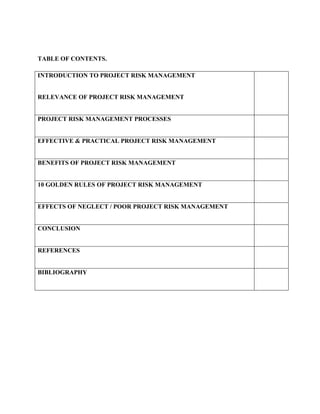
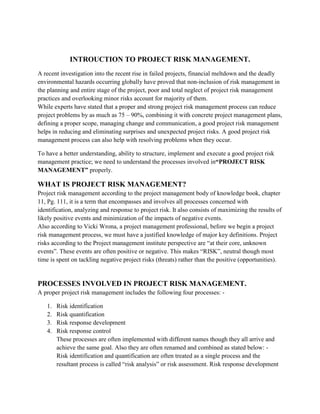
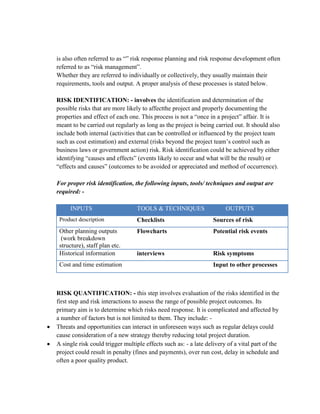
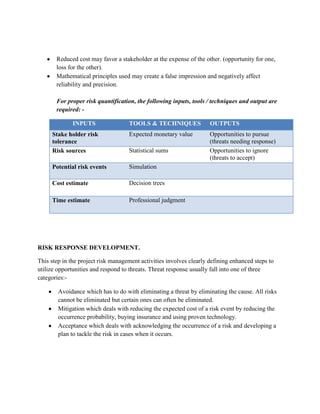
TABLE OF CONTENTS.<br />INTRODUCTION TO PROJECT RISK MANAGEMENTRELEVANCE OF PROJECT RISK MANAGEMENTPROJECT RISK MANAGEMENT PROCESSESEFFECTIVE & PRACTICAL PROJECT RISK MANAGEMENTBENEFITS OF PROJECT RISK MANAGEMENT10 GOLDEN RULES OF PROJECT RISK MANAGEMENTEFFECTS OF NEGLECT / POOR PROJECT RISK MANAGEMENTCONCLUSIONREFERENCESBIBLIOGRAPHY<br /> <br />INTROUCTION TO PROJECT RISK MANAGEMENT.<br />A recent investigation into the recent rise in failed projects, financial meltdown and the deadly environmental hazards occurring globally have proved that non-inclusion of risk management in the planning and entire stage of the project, poor and total neglect of project risk management practices and overlooking minor risks account for majority of them.While experts have stated that a proper and strong project risk management process can reduce project problems by as much as 75 – 90%, combining it with concrete project management plans, defining a proper scope, managing change and communication, a good project risk management helps in reducing and eliminating surprises and unexpected project risks. A good project risk management process can also help with resolving problems when they occur.<br />To have a better understanding, ability to structure, implement and execute a good project risk management practice; we need to understand the processes involved in “PROJECT RISK MANAGEMENT” properly. <br />WHAT IS PROJECT RISK MANAGEMENT?Project risk management according to the project management body of knowledge book, chapter 11, Pg. 111, it is a term that encompasses and involves all processes concerned with identification, analyzing and response to project risk. It also consists of maximizing the results of likely positive events and minimization of the impacts of negative events.Also according to Vicki Wrona, a project management professional, before we begin a project risk management process, we must have a justified knowledge of major key definitions. Project risks according to the Project management institute perspective are “at their core, unknown events”. These events are often positive or negative. This makes “RISK”, neutral though most time is spent on tackling negative project risks (threats) rather than the positive (opportunities).<br />PROCESSES INVOLVED IN PROJECT RISK MANAGEMENT.A proper project risk management includes the following four processes: -<br />Risk identification
Risk quantification
Risk response development
Risk response control
These processes are often implemented with different names though they all arrive and achieve the same goal. Also they are often renamed and combined as stated below: -Risk identification and quantification are often treated as a single process and the resultant process is called “risk analysis” or risk assessment. Risk response development is also often referred to as “” risk response planning and risk response development often referred to as “risk management”.
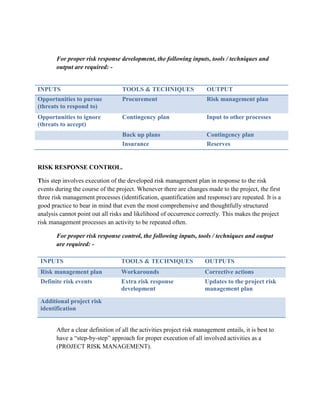
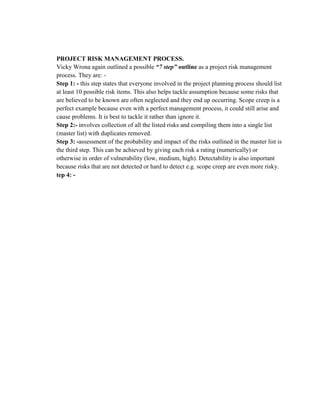
Whether they are referred to individually or collectively, they usually maintain their requirements, tools and output. A proper analysis of these processes is stated below.

Bertrand's Individual Essay

  • 1.
    TABLE OF CONTENTS.<br />INTRODUCTION TO PROJECT RISK MANAGEMENTRELEVANCE OF PROJECT RISK MANAGEMENTPROJECT RISK MANAGEMENT PROCESSESEFFECTIVE & PRACTICAL PROJECT RISK MANAGEMENTBENEFITS OF PROJECT RISK MANAGEMENT10 GOLDEN RULES OF PROJECT RISK MANAGEMENTEFFECTS OF NEGLECT / POOR PROJECT RISK MANAGEMENTCONCLUSIONREFERENCESBIBLIOGRAPHY<br /> <br />INTROUCTION TO PROJECT RISK MANAGEMENT.<br />A recent investigation into the recent rise in failed projects, financial meltdown and the deadly environmental hazards occurring globally have proved that non-inclusion of risk management in the planning and entire stage of the project, poor and total neglect of project risk management practices and overlooking minor risks account for majority of them.While experts have stated that a proper and strong project risk management process can reduce project problems by as much as 75 – 90%, combining it with concrete project management plans, defining a proper scope, managing change and communication, a good project risk management helps in reducing and eliminating surprises and unexpected project risks. A good project risk management process can also help with resolving problems when they occur.<br />To have a better understanding, ability to structure, implement and execute a good project risk management practice; we need to understand the processes involved in “PROJECT RISK MANAGEMENT” properly. <br />WHAT IS PROJECT RISK MANAGEMENT?Project risk management according to the project management body of knowledge book, chapter 11, Pg. 111, it is a term that encompasses and involves all processes concerned with identification, analyzing and response to project risk. It also consists of maximizing the results of likely positive events and minimization of the impacts of negative events.Also according to Vicki Wrona, a project management professional, before we begin a project risk management process, we must have a justified knowledge of major key definitions. Project risks according to the Project management institute perspective are “at their core, unknown events”. These events are often positive or negative. This makes “RISK”, neutral though most time is spent on tackling negative project risks (threats) rather than the positive (opportunities).<br />PROCESSES INVOLVED IN PROJECT RISK MANAGEMENT.A proper project risk management includes the following four processes: -<br />Risk identification
  • 2.
  • 3.
  • 4.
  • 5.
    These processes areoften implemented with different names though they all arrive and achieve the same goal. Also they are often renamed and combined as stated below: -Risk identification and quantification are often treated as a single process and the resultant process is called “risk analysis” or risk assessment. Risk response development is also often referred to as “” risk response planning and risk response development often referred to as “risk management”.
  • 6.
    Whether they arereferred to individually or collectively, they usually maintain their requirements, tools and output. A proper analysis of these processes is stated below.