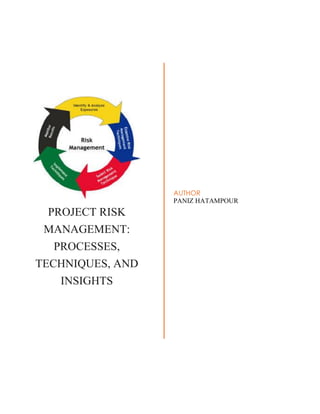
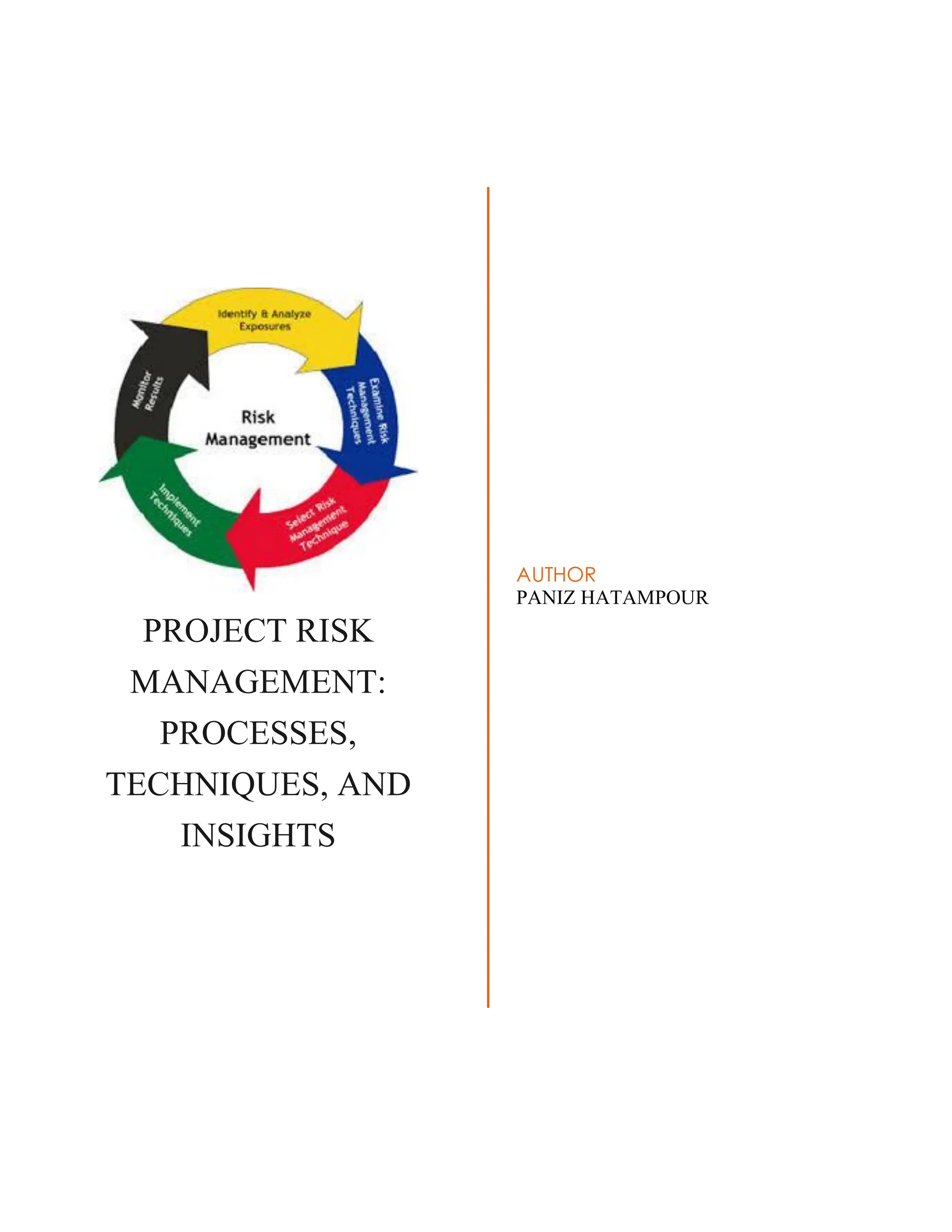
PROJECT RISK
MANAGEMENT:
PROCESSES,
TECHNIQUES, AND
INSIGHTS
AUTHOR
PANIZ HATAMPOUR
Introduction
Project risk management is a crucial aspect of project management that involves
identifying, assessing, and mitigating risks that could potentially affect the success
of a project. Effective risk management can lead to improved project outcomes,
reduced costs, and enhanced stakeholder satisfaction. This article explores the
processes involved in project risk management, various techniques employed, and
insights gained from industry practices.
Processes of Project Risk Management
The Project Management Institute (PMI) outlines a structured approach to risk
management in its PMBOK Guide, which includes the following key processes:
1. Risk Identification: This is the first step where potential risks are identified
through brainstorming sessions, expert interviews, and historical data analysis.
Tools such as SWOT analysis (Strengths, Weaknesses, Opportunities, Threats) and
checklists can be beneficial in this phase (PMI, 2021).
2. Risk Assessment: Once risks are identified, they need to be assessed in terms of
their likelihood and impact. Qualitative and quantitative risk analysis techniques
can be employed. Qualitative analysis prioritizes risks based on their severity,
while quantitative analysis uses numerical methods to estimate the potential impact
on project objectives (Chapman Ward, 2011).
3. Risk Response Planning: After assessing risks, the next step is to develop
strategies to address them. This may involve avoiding the risk, transferring it,
mitigating its impact, or accepting it if the risk is deemed acceptable. Each
response should align with the project's overall objectives (Kerzner, 2017).
4. Risk Monitoring and Control: This ongoing process involves tracking
identified risks, monitoring residual risks, and identifying new risks throughout the
project lifecycle. Regular reviews and updates to the risk management plan are
essential for effective control (PMI, 2021).
Techniques for Risk Management
Several techniques can be employed at various stages of the risk management
process:
1. Brainstorming: A collaborative approach where team members generate ideas
about potential risks.
2. Delphi Technique: A structured method that gathers expert opinions through
rounds of questionnaires to reach a consensus on risks.
3. Monte Carlo Simulation: A quantitative technique that uses statistical models to
predict the impact of risks on project outcomes by simulating different scenarios
(Vose, 2008).
4. Risk Matrix: A visual tool that helps in prioritizing risks based on their
likelihood and impact. It allows project managers to focus on high-priority risks
that require immediate attention.
5. Root Cause Analysis: This technique helps identify the underlying causes of
risks to develop more effective mitigation strategies.
Insights from Industry Practices
1. Cultural Factors: Organizations with a strong risk management culture tend to
have better project outcomes. Encouraging open communication and fostering a
proactive attitude towards risk can significantly enhance risk management efforts
(Hillson Murray-Webster, 2017).
2. Integration with Project Planning: Successful projects integrate risk
management into their overall planning processes rather than treating it as a
separate function. This ensures that risk considerations are embedded in decision-
making throughout the project lifecycle (Kerzner, 2017).
3. Continuous Improvement: Learning from past projects is vital for improving
risk management practices. Conducting post-project reviews can help identify
lessons learned and refine risk management processes for future projects (PMI,
2021).
Emerging Trends in Project Risk Management
As the field of project management continues to evolve, several emerging trends
are shaping the landscape of risk management. Understanding these trends can
enhance the effectiveness of risk management practices and prepare organizations
for future challenges.
1. Integration of Artificial Intelligence (AI)
Artificial intelligence is increasingly being used in project risk management to
automate risk identification and assessment processes. Machine learning
algorithms can analyze historical data and identify patterns that human analysts
may overlook. This allows for more accurate predictions and a proactive approach
to managing risks.
2. Agile Risk Management
With the rise of agile methodologies, there is a shift towards more dynamic and
iterative approaches to risk management. Agile teams continuously assess risks
throughout the project lifecycle, allowing for quick adjustments in response to
changing circumstances. This flexibility is particularly valuable in fast-paced
environments.
3. Big Data Analytics
The use of big data analytics in risk management enables organizations to leverage
vast amounts of data to inform their decision-making processes. By analyzing large
datasets, teams can uncover insights about potential risks and make data-driven
decisions that enhance project outcomes.
4. Cybersecurity Risks
As projects become more digital and interconnected, cybersecurity risks have
emerged as a critical concern. Organizations must prioritize the identification and
management of cyber threats, ensuring that risk management strategies encompass
both traditional project risks and digital vulnerabilities.
5. Stakeholder Engagement
Engaging stakeholders in the risk management process is becoming increasingly
important. By involving stakeholders in identifying and assessing risks,
organizations can gain diverse perspectives and foster a culture of shared
responsibility. This collaborative approach enhances transparency and improves
overall risk management effectiveness.
6. Sustainability and Social Responsibility
There is a growing emphasis on sustainability and social responsibility in project
management. Organizations are now considering environmental, social, and
governance (ESG) factors as part of their risk assessment processes. This holistic
approach not only mitigates risks but also aligns projects with broader societal
goals.
Best Practices for Effective Project Risk Management
To navigate the complexities of project risk management, organizations can adopt
several best practices that enhance their ability to identify, assess, and mitigate
risks. Implementing these strategies can lead to more successful project outcomes
and improved organizational resilience.
1. Establish a Risk Management Framework
Creating a structured risk management framework is essential for consistent and
systematic risk handling. This framework should outline processes for risk
identification, assessment, response planning, and monitoring. By establishing
clear guidelines, organizations can ensure that all team members understand their
roles in managing risks.
2. Conduct Regular Risk Assessments
Risk assessments should not be a one-time event but an ongoing process
throughout the project lifecycle. Regularly revisiting and updating risk assessments
allows teams to adapt to new information and changing circumstances. Utilizing
tools such as SWOT analysis (Strengths, Weaknesses, Opportunities, Threats) can
facilitate comprehensive evaluations.
3. Foster a Risk-Aware Culture
Encouraging a culture of openness regarding risk can significantly improve risk
management efforts. Team members should feel empowered to report potential
risks without fear of repercussions. Regular training sessions and workshops can
help build awareness and equip employees with the skills needed to identify and
manage risks effectively.
4. Utilize Risk Management Tools and Software
Investing in risk management tools and software can streamline the process of
identifying, tracking, and mitigating risks. These tools often provide features such
as dashboards for monitoring risk status, automated alerts for emerging risks, and
reporting capabilities that enhance communication among stakeholders.
5. Engage Stakeholders Early and Often
Involving stakeholders in the risk management process from the outset can
provide valuable insights and foster buy-in for risk mitigation strategies.
Conducting stakeholder workshops or surveys can help gather diverse perspectives
on potential risks and create a shared understanding of risk priorities.
6. Develop Contingency Plans
Having contingency plans in place for identified risks is crucial for effective risk
management. These plans should outline specific actions to take if a risk
materializes, ensuring that the project team can respond quickly and minimize
disruptions. Regularly reviewing and updating these plans based on new
information is essential.
7. Monitor and Review Risks Continuously
Establishing a process for continuous monitoring of risks allows teams to stay
vigilant and responsive to changes. Regularly scheduled reviews can help identify
new risks and assess the effectiveness of existing mitigation strategies. This
proactive approach ensures that risks are managed throughout the project lifecycle.
8. Learn from Past Projects
Conducting post-project reviews to analyze what went well and what didn’t in
terms of risk management can provide valuable lessons for future projects.
Documenting these insights helps organizations refine their risk management
practices over time and build a knowledge base that informs future decision-
making.
Conclusion
Effective project risk management is essential for achieving project success. By
following structured processes, employing appropriate techniques, and learning
from industry insights, organizations can better navigate uncertainties and enhance
their project outcomes. As the complexity of projects continues to grow,
prioritizing risk management will be key to sustaining competitive advantage in
today’s dynamic environment. The landscape of project risk management is
continually evolving, influenced by technological advancements and changing
organizational priorities. By staying informed about emerging trends and
incorporating them into their practices, organizations can enhance their ability to
manage risks effectively and achieve successful project outcomes. Effective project
risk management is crucial for navigating uncertainties and achieving project
success. By adopting best practices such as establishing a structured framework,
fostering a risk-aware culture, and utilizing modern tools, organizations can
enhance their ability to identify, assess, and mitigate risks. As projects become
increasingly complex, the importance of robust risk management strategies will
only continue to grow.
References
• Chapman, C., Ward, S. (2011). *Project Risk Management: Processes,
Techniques and Insights*. 2nd ed. New York: Wiley.
• Hillson, D., Murray-Webster, R. (2017). *Understanding and Managing Risk
Attitude*. 2nd ed. New York: Routledge.
• Kerzner, H. (2017). *Project Management: A Systems Approach to Planning,
Scheduling, and Controlling*. 12th ed. New York: Wiley.
• PMI (2021). *A Guide to the Project Management Body of Knowledge
(PMBOK® Guide)*. 7th ed. Newtown Square, PA: Project Management Institute.
• Vose, D. (2008). *Risk Analysis: A Quantitative Guide*. 2nd ed. Hoboken, NJ:
Wiley.

risk management;Project Risk Management: Processes, Techniques, and Insights

  • 1.
  • 2.
    Introduction Project risk managementis a crucial aspect of project management that involves identifying, assessing, and mitigating risks that could potentially affect the success of a project. Effective risk management can lead to improved project outcomes, reduced costs, and enhanced stakeholder satisfaction. This article explores the processes involved in project risk management, various techniques employed, and insights gained from industry practices. Processes of Project Risk Management The Project Management Institute (PMI) outlines a structured approach to risk management in its PMBOK Guide, which includes the following key processes: 1. Risk Identification: This is the first step where potential risks are identified through brainstorming sessions, expert interviews, and historical data analysis. Tools such as SWOT analysis (Strengths, Weaknesses, Opportunities, Threats) and checklists can be beneficial in this phase (PMI, 2021). 2. Risk Assessment: Once risks are identified, they need to be assessed in terms of their likelihood and impact. Qualitative and quantitative risk analysis techniques can be employed. Qualitative analysis prioritizes risks based on their severity, while quantitative analysis uses numerical methods to estimate the potential impact on project objectives (Chapman Ward, 2011). 3. Risk Response Planning: After assessing risks, the next step is to develop strategies to address them. This may involve avoiding the risk, transferring it, mitigating its impact, or accepting it if the risk is deemed acceptable. Each response should align with the project's overall objectives (Kerzner, 2017). 4. Risk Monitoring and Control: This ongoing process involves tracking identified risks, monitoring residual risks, and identifying new risks throughout the
  • 3.
    project lifecycle. Regularreviews and updates to the risk management plan are essential for effective control (PMI, 2021). Techniques for Risk Management Several techniques can be employed at various stages of the risk management process: 1. Brainstorming: A collaborative approach where team members generate ideas about potential risks. 2. Delphi Technique: A structured method that gathers expert opinions through rounds of questionnaires to reach a consensus on risks. 3. Monte Carlo Simulation: A quantitative technique that uses statistical models to predict the impact of risks on project outcomes by simulating different scenarios (Vose, 2008). 4. Risk Matrix: A visual tool that helps in prioritizing risks based on their likelihood and impact. It allows project managers to focus on high-priority risks that require immediate attention. 5. Root Cause Analysis: This technique helps identify the underlying causes of risks to develop more effective mitigation strategies.
  • 4.
    Insights from IndustryPractices 1. Cultural Factors: Organizations with a strong risk management culture tend to have better project outcomes. Encouraging open communication and fostering a proactive attitude towards risk can significantly enhance risk management efforts (Hillson Murray-Webster, 2017). 2. Integration with Project Planning: Successful projects integrate risk management into their overall planning processes rather than treating it as a separate function. This ensures that risk considerations are embedded in decision- making throughout the project lifecycle (Kerzner, 2017). 3. Continuous Improvement: Learning from past projects is vital for improving risk management practices. Conducting post-project reviews can help identify lessons learned and refine risk management processes for future projects (PMI, 2021). Emerging Trends in Project Risk Management As the field of project management continues to evolve, several emerging trends are shaping the landscape of risk management. Understanding these trends can enhance the effectiveness of risk management practices and prepare organizations for future challenges. 1. Integration of Artificial Intelligence (AI) Artificial intelligence is increasingly being used in project risk management to automate risk identification and assessment processes. Machine learning algorithms can analyze historical data and identify patterns that human analysts may overlook. This allows for more accurate predictions and a proactive approach to managing risks.
  • 5.
    2. Agile RiskManagement With the rise of agile methodologies, there is a shift towards more dynamic and iterative approaches to risk management. Agile teams continuously assess risks throughout the project lifecycle, allowing for quick adjustments in response to changing circumstances. This flexibility is particularly valuable in fast-paced environments. 3. Big Data Analytics The use of big data analytics in risk management enables organizations to leverage vast amounts of data to inform their decision-making processes. By analyzing large datasets, teams can uncover insights about potential risks and make data-driven decisions that enhance project outcomes. 4. Cybersecurity Risks As projects become more digital and interconnected, cybersecurity risks have emerged as a critical concern. Organizations must prioritize the identification and management of cyber threats, ensuring that risk management strategies encompass both traditional project risks and digital vulnerabilities. 5. Stakeholder Engagement Engaging stakeholders in the risk management process is becoming increasingly important. By involving stakeholders in identifying and assessing risks, organizations can gain diverse perspectives and foster a culture of shared responsibility. This collaborative approach enhances transparency and improves overall risk management effectiveness. 6. Sustainability and Social Responsibility There is a growing emphasis on sustainability and social responsibility in project management. Organizations are now considering environmental, social, and governance (ESG) factors as part of their risk assessment processes. This holistic approach not only mitigates risks but also aligns projects with broader societal goals.
  • 6.
    Best Practices forEffective Project Risk Management To navigate the complexities of project risk management, organizations can adopt several best practices that enhance their ability to identify, assess, and mitigate risks. Implementing these strategies can lead to more successful project outcomes and improved organizational resilience. 1. Establish a Risk Management Framework Creating a structured risk management framework is essential for consistent and systematic risk handling. This framework should outline processes for risk identification, assessment, response planning, and monitoring. By establishing clear guidelines, organizations can ensure that all team members understand their roles in managing risks. 2. Conduct Regular Risk Assessments Risk assessments should not be a one-time event but an ongoing process throughout the project lifecycle. Regularly revisiting and updating risk assessments allows teams to adapt to new information and changing circumstances. Utilizing tools such as SWOT analysis (Strengths, Weaknesses, Opportunities, Threats) can facilitate comprehensive evaluations. 3. Foster a Risk-Aware Culture Encouraging a culture of openness regarding risk can significantly improve risk management efforts. Team members should feel empowered to report potential risks without fear of repercussions. Regular training sessions and workshops can help build awareness and equip employees with the skills needed to identify and manage risks effectively.
  • 7.
    4. Utilize RiskManagement Tools and Software Investing in risk management tools and software can streamline the process of identifying, tracking, and mitigating risks. These tools often provide features such as dashboards for monitoring risk status, automated alerts for emerging risks, and reporting capabilities that enhance communication among stakeholders. 5. Engage Stakeholders Early and Often Involving stakeholders in the risk management process from the outset can provide valuable insights and foster buy-in for risk mitigation strategies. Conducting stakeholder workshops or surveys can help gather diverse perspectives on potential risks and create a shared understanding of risk priorities. 6. Develop Contingency Plans Having contingency plans in place for identified risks is crucial for effective risk management. These plans should outline specific actions to take if a risk materializes, ensuring that the project team can respond quickly and minimize disruptions. Regularly reviewing and updating these plans based on new information is essential. 7. Monitor and Review Risks Continuously Establishing a process for continuous monitoring of risks allows teams to stay vigilant and responsive to changes. Regularly scheduled reviews can help identify new risks and assess the effectiveness of existing mitigation strategies. This proactive approach ensures that risks are managed throughout the project lifecycle. 8. Learn from Past Projects Conducting post-project reviews to analyze what went well and what didn’t in terms of risk management can provide valuable lessons for future projects. Documenting these insights helps organizations refine their risk management practices over time and build a knowledge base that informs future decision- making. Conclusion
  • 8.
    Effective project riskmanagement is essential for achieving project success. By following structured processes, employing appropriate techniques, and learning from industry insights, organizations can better navigate uncertainties and enhance their project outcomes. As the complexity of projects continues to grow, prioritizing risk management will be key to sustaining competitive advantage in today’s dynamic environment. The landscape of project risk management is continually evolving, influenced by technological advancements and changing organizational priorities. By staying informed about emerging trends and incorporating them into their practices, organizations can enhance their ability to manage risks effectively and achieve successful project outcomes. Effective project risk management is crucial for navigating uncertainties and achieving project success. By adopting best practices such as establishing a structured framework, fostering a risk-aware culture, and utilizing modern tools, organizations can enhance their ability to identify, assess, and mitigate risks. As projects become increasingly complex, the importance of robust risk management strategies will only continue to grow. References • Chapman, C., Ward, S. (2011). *Project Risk Management: Processes, Techniques and Insights*. 2nd ed. New York: Wiley. • Hillson, D., Murray-Webster, R. (2017). *Understanding and Managing Risk Attitude*. 2nd ed. New York: Routledge. • Kerzner, H. (2017). *Project Management: A Systems Approach to Planning, Scheduling, and Controlling*. 12th ed. New York: Wiley. • PMI (2021). *A Guide to the Project Management Body of Knowledge (PMBOK® Guide)*. 7th ed. Newtown Square, PA: Project Management Institute.
  • 9.
    • Vose, D.(2008). *Risk Analysis: A Quantitative Guide*. 2nd ed. Hoboken, NJ: Wiley.