Benchmark Study Guide
Important Dates 1607 1776 1787 1803 1861-1865
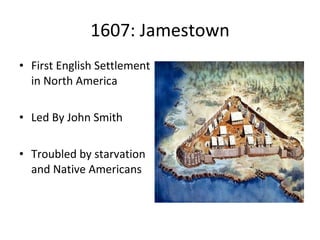
1607: Jamestown First English Settlement in North America Led By John Smith Troubled by starvation and Native Americans
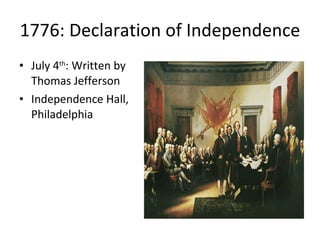
1776: Declaration of Independence July 4 th : Written by Thomas Jefferson Independence Hall, Philadelphia
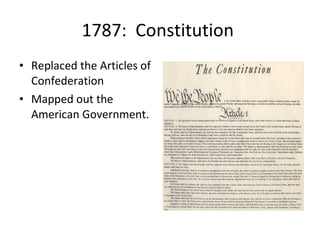
1787:  Constitution  Replaced the Articles of Confederation Mapped out the American Government.
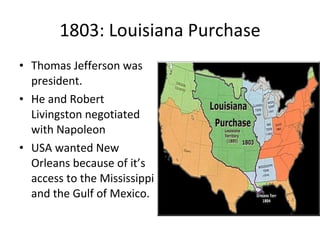
1803: Louisiana Purchase Thomas Jefferson was president. He and Robert Livingston negotiated with Napoleon USA wanted New Orleans because of it’s access to the Mississippi and the Gulf of Mexico.
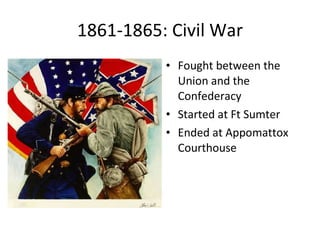
1861-1865: Civil War Fought between the Union and the Confederacy Started at Ft Sumter Ended at Appomattox Courthouse
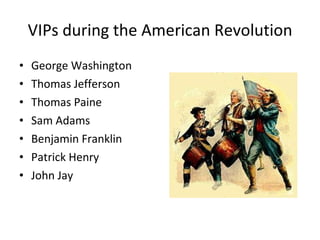
VIPs during the American Revolution George Washington Thomas Jefferson Thomas Paine Sam Adams Benjamin Franklin Patrick Henry John Jay
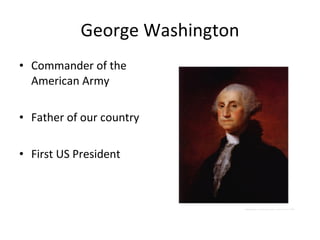
George Washington Commander of the American Army Father of our country First US President
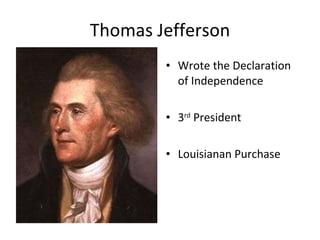
Thomas Jefferson Wrote the Declaration of Independence 3 rd  President  Louisianan Purchase
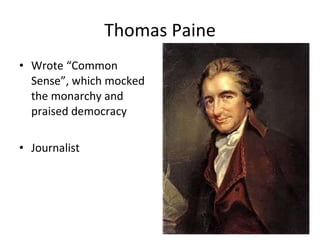
Thomas Paine Wrote “Common Sense”, which mocked the monarchy and praised democracy Journalist
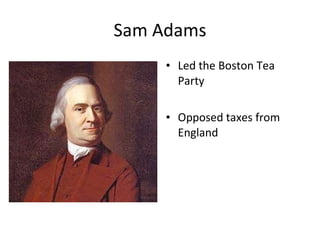
Sam Adams Led the Boston Tea Party Opposed taxes from England
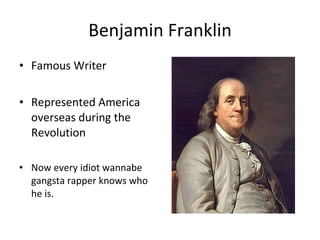
Benjamin Franklin Famous Writer Represented America overseas during the Revolution Now every idiot wannabe gangsta rapper knows who he is.
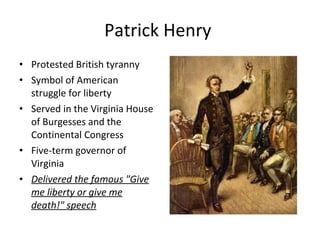
Patrick Henry  Protested British tyranny Symbol of American struggle for liberty Served in the Virginia House of Burgesses and the Continental Congress Five-term governor of Virginia Delivered the famous "Give me liberty or give me death!" speech
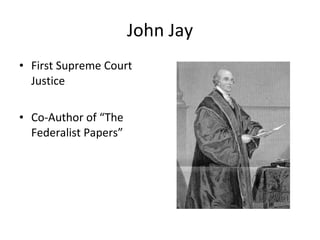
John Jay First Supreme Court Justice Co-Author of “The Federalist Papers”
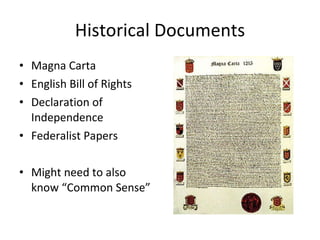
Historical Documents Magna Carta English Bill of Rights Declaration of Independence Federalist Papers Might need to also know “Common Sense”
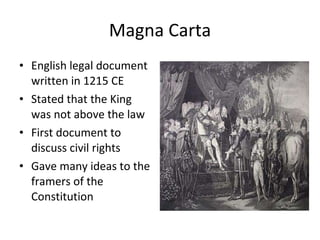
Magna Carta English legal document written in 1215 CE Stated that the King was not above the law First document to discuss civil rights Gave many ideas to the framers of the Constitution
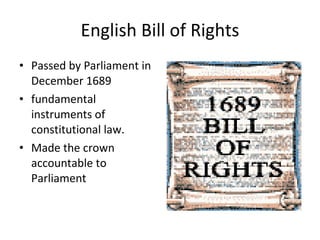
English Bill of Rights Passed by Parliament in December 1689 fundamental instruments of constitutional law. Made the crown accountable to Parliament
Declaration of Independence Jefferson summarized this philosophy in "self-evident truths" and set forth a list of grievances against the King in order to justify before the world the breaking of ties between the colonies and the mother country Jefferson expressed the convictions in the minds and hearts of the American people
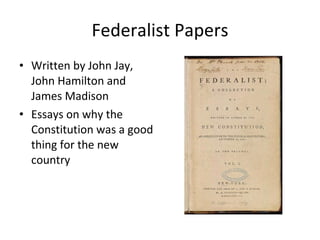
Federalist Papers Written by John Jay,  John Hamilton and James Madison Essays on why the Constitution was a good thing for the new country
SRPLICF???
See Rocky Pop Lock In  Class Foo
Seven Principles of the Constitution See Rocky Pop Lock In Class Foo Separation of Powers Republicanism Popular Sovereignty Limited Government Individual Rights Checks and Balances Federalism
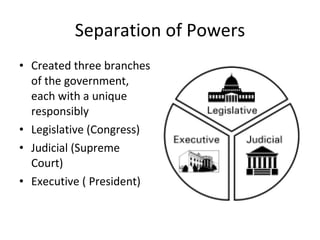
Separation of Powers Created three branches of the government, each with a unique responsibly Legislative (Congress) Judicial (Supreme Court) Executive ( President)
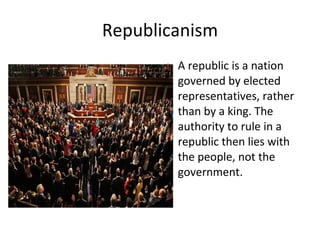
Republicanism A republic is a nation governed by elected representatives, rather than by a king. The authority to rule in a republic then lies with the people, not the government.
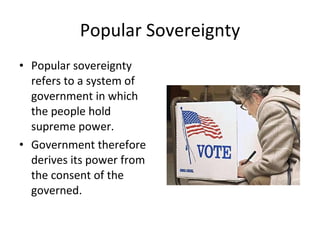
Popular Sovereignty Popular sovereignty refers to a system of government in which the people hold supreme power.  Government therefore derives its power from the consent of the governed.
Limited Government The desire for limited government came about out of a desire to ensure that no other entity would be too powerful and tyrannical in nature. No branch has all powers
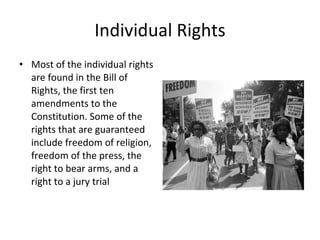
Individual Rights Most of the individual rights are found in the Bill of Rights, the first ten amendments to the Constitution. Some of the rights that are guaranteed include freedom of religion, freedom of the press, the right to bear arms, and a right to a jury trial
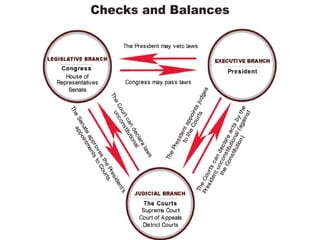
Checks and Balances The Constitution created an extended way of making sure that no one branch of the federal government would become too powerful. It provided each branch of government with ways to check or limit the other branches. Examples of these checks and balances include the President vetoing legislation, the Judicial Branch declaring a law unconstitutional, and the Legislative Branch impeach and remove a President.
 
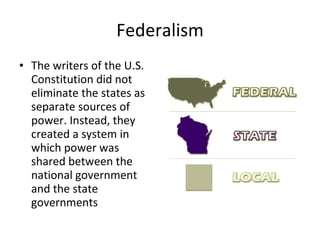
Federalism The writers of the U.S. Constitution did not eliminate the states as separate sources of power. Instead, they created a system in which power was shared between the national government and the state governments
19 th  Century Amendments 13th amendment - abolished slavery  14th amendment - granted citizenship to African Americans  15th amendment - gave African American males the right to vote (suffrage)
Nullification Crisis The Nullification Crisis was when South Carolina refused to pay the tariffs that president Andrew Jackson had set up.  Opposed by his own VP, John C Calhoun
States Rights Issues Secession was based on the idea of state rights (or "states rights," a variant that came into use after the Civil War). This exalted the powers of the individual states as opposed to those of the Federal government. It generally rested on the theory of state sovereignty-- that in the United States  the ultimate source of political authority lay in the separate states .
The Second Industrial Revolution Before the Industrial revolution, society was one based largely on agriculture. A majority of people lived and survived on single-family subsistence farms. Most farming was done by hand. New tools and improved production allowed crops to be produced easier and more efficient. The production of goods changed from home or small-scale production to factories where machines were run by steam power and later electricity. Small towns and cities changed from farming communities which were largely rural to large over-crowded, industrial centers which were characterized by overcrowded tenement housing, poor sanitation, high crime, and poor working conditions for the people who worked in factories.
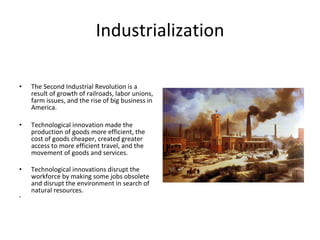
Industrialization The Second Industrial Revolution is a result of growth of railroads, labor unions, farm issues, and the rise of big business in America.  Technological innovation made the production of goods more efficient, the cost of goods cheaper, created greater access to more efficient travel, and the movement of goods and services.  Technological innovations disrupt the workforce by making some jobs obsolete and disrupt the environment in search of natural resources.
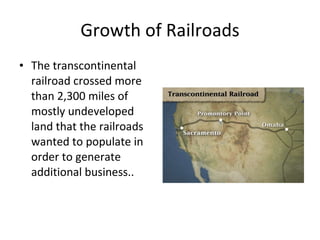
Growth of Railroads The transcontinental railroad crossed more than 2,300 miles of mostly undeveloped land that the railroads wanted to populate in order to generate additional business..
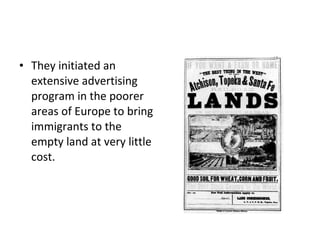
They initiated an extensive advertising program in the poorer areas of Europe to bring immigrants to the empty land at very little cost.
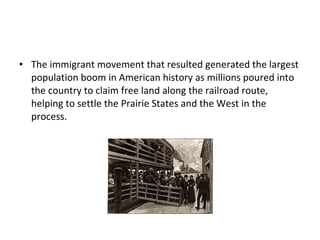
The immigrant movement that resulted generated the largest population boom in American history as millions poured into the country to claim free land along the railroad route, helping to settle the Prairie States and the West in the process.
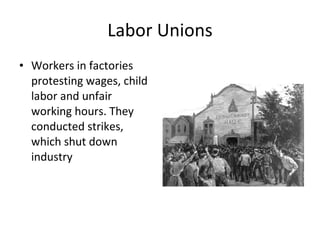
Labor Unions Workers in factories protesting wages, child labor and unfair working hours. They conducted strikes, which shut down industry

Benchmark study guide

  • 1.
  • 2.
    Important Dates 16071776 1787 1803 1861-1865
  • 3.
    1607: Jamestown FirstEnglish Settlement in North America Led By John Smith Troubled by starvation and Native Americans
  • 4.
    1776: Declaration ofIndependence July 4 th : Written by Thomas Jefferson Independence Hall, Philadelphia
  • 5.
    1787: Constitution Replaced the Articles of Confederation Mapped out the American Government.
  • 6.
    1803: Louisiana PurchaseThomas Jefferson was president. He and Robert Livingston negotiated with Napoleon USA wanted New Orleans because of it’s access to the Mississippi and the Gulf of Mexico.
  • 7.
    1861-1865: Civil WarFought between the Union and the Confederacy Started at Ft Sumter Ended at Appomattox Courthouse
  • 8.
    VIPs during theAmerican Revolution George Washington Thomas Jefferson Thomas Paine Sam Adams Benjamin Franklin Patrick Henry John Jay
  • 9.
    George Washington Commanderof the American Army Father of our country First US President
  • 10.
    Thomas Jefferson Wrotethe Declaration of Independence 3 rd President Louisianan Purchase
  • 11.
    Thomas Paine Wrote“Common Sense”, which mocked the monarchy and praised democracy Journalist
  • 12.
    Sam Adams Ledthe Boston Tea Party Opposed taxes from England
  • 13.
    Benjamin Franklin FamousWriter Represented America overseas during the Revolution Now every idiot wannabe gangsta rapper knows who he is.
  • 14.
    Patrick Henry Protested British tyranny Symbol of American struggle for liberty Served in the Virginia House of Burgesses and the Continental Congress Five-term governor of Virginia Delivered the famous "Give me liberty or give me death!" speech
  • 15.
    John Jay FirstSupreme Court Justice Co-Author of “The Federalist Papers”
  • 16.
    Historical Documents MagnaCarta English Bill of Rights Declaration of Independence Federalist Papers Might need to also know “Common Sense”
  • 17.
    Magna Carta Englishlegal document written in 1215 CE Stated that the King was not above the law First document to discuss civil rights Gave many ideas to the framers of the Constitution
  • 18.
    English Bill ofRights Passed by Parliament in December 1689 fundamental instruments of constitutional law. Made the crown accountable to Parliament
  • 19.
    Declaration of IndependenceJefferson summarized this philosophy in "self-evident truths" and set forth a list of grievances against the King in order to justify before the world the breaking of ties between the colonies and the mother country Jefferson expressed the convictions in the minds and hearts of the American people
  • 20.
    Federalist Papers Writtenby John Jay, John Hamilton and James Madison Essays on why the Constitution was a good thing for the new country
  • 21.
  • 22.
    See Rocky PopLock In Class Foo
  • 23.
    Seven Principles ofthe Constitution See Rocky Pop Lock In Class Foo Separation of Powers Republicanism Popular Sovereignty Limited Government Individual Rights Checks and Balances Federalism
  • 24.
    Separation of PowersCreated three branches of the government, each with a unique responsibly Legislative (Congress) Judicial (Supreme Court) Executive ( President)
  • 25.
    Republicanism A republicis a nation governed by elected representatives, rather than by a king. The authority to rule in a republic then lies with the people, not the government.
  • 26.
    Popular Sovereignty Popularsovereignty refers to a system of government in which the people hold supreme power. Government therefore derives its power from the consent of the governed.
  • 27.
    Limited Government Thedesire for limited government came about out of a desire to ensure that no other entity would be too powerful and tyrannical in nature. No branch has all powers
  • 28.
    Individual Rights Mostof the individual rights are found in the Bill of Rights, the first ten amendments to the Constitution. Some of the rights that are guaranteed include freedom of religion, freedom of the press, the right to bear arms, and a right to a jury trial
  • 29.
    Checks and BalancesThe Constitution created an extended way of making sure that no one branch of the federal government would become too powerful. It provided each branch of government with ways to check or limit the other branches. Examples of these checks and balances include the President vetoing legislation, the Judicial Branch declaring a law unconstitutional, and the Legislative Branch impeach and remove a President.
  • 30.
  • 31.
    Federalism The writersof the U.S. Constitution did not eliminate the states as separate sources of power. Instead, they created a system in which power was shared between the national government and the state governments
  • 32.
    19 th Century Amendments 13th amendment - abolished slavery 14th amendment - granted citizenship to African Americans 15th amendment - gave African American males the right to vote (suffrage)
  • 33.
    Nullification Crisis TheNullification Crisis was when South Carolina refused to pay the tariffs that president Andrew Jackson had set up. Opposed by his own VP, John C Calhoun
  • 34.
    States Rights IssuesSecession was based on the idea of state rights (or "states rights," a variant that came into use after the Civil War). This exalted the powers of the individual states as opposed to those of the Federal government. It generally rested on the theory of state sovereignty-- that in the United States the ultimate source of political authority lay in the separate states .
  • 35.
    The Second IndustrialRevolution Before the Industrial revolution, society was one based largely on agriculture. A majority of people lived and survived on single-family subsistence farms. Most farming was done by hand. New tools and improved production allowed crops to be produced easier and more efficient. The production of goods changed from home or small-scale production to factories where machines were run by steam power and later electricity. Small towns and cities changed from farming communities which were largely rural to large over-crowded, industrial centers which were characterized by overcrowded tenement housing, poor sanitation, high crime, and poor working conditions for the people who worked in factories.
  • 36.
    Industrialization The SecondIndustrial Revolution is a result of growth of railroads, labor unions, farm issues, and the rise of big business in America. Technological innovation made the production of goods more efficient, the cost of goods cheaper, created greater access to more efficient travel, and the movement of goods and services. Technological innovations disrupt the workforce by making some jobs obsolete and disrupt the environment in search of natural resources.
  • 37.
    Growth of RailroadsThe transcontinental railroad crossed more than 2,300 miles of mostly undeveloped land that the railroads wanted to populate in order to generate additional business..
  • 38.
    They initiated anextensive advertising program in the poorer areas of Europe to bring immigrants to the empty land at very little cost.
  • 39.
    The immigrant movementthat resulted generated the largest population boom in American history as millions poured into the country to claim free land along the railroad route, helping to settle the Prairie States and the West in the process.
  • 40.
    Labor Unions Workersin factories protesting wages, child labor and unfair working hours. They conducted strikes, which shut down industry