Belfast ConfettiBelfast Confetti
Learning Objective
To learn how to identify key features of a poem and
use these to inform interpretations.
AO1 (select and evaluate textual detail to
illustrate and support interpretations)
AO2 (explain how language, structure and
form contribute to writers’ presentation of
ideas and themes)
Bitesize Resources
http://www.bbc.co.uk/schools
/gcsebitesize/english_literat
ure/poetryconflict/
Belfast Confetti
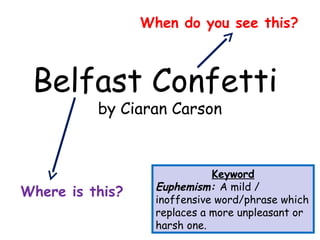
by Ciaran Carson
Where is this?
When do you see this?
Keyword
Euphemism: A mild /
inoffensive word/phrase which
replaces a more unpleasant or
harsh one.
Belfast Confetti
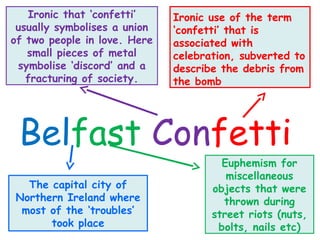
The capital city of
Northern Ireland where
most of the ‘troubles’
took place
Ironic use of the term
‘confetti’ that is
associated with
celebration, subverted to
describe the debris from
the bomb
Euphemism for
miscellaneous
objects that were
thrown during
street riots (nuts,
bolts, nails etc)
Ironic that ‘confetti’
usually symbolises a union
of two people in love. Here
small pieces of metal
symbolise ‘discord’ and a
fracturing of society.
Listen
• http://www.bbc.co.uk/schools/gcsebitesize
/english_literature/poetryconflict/belfastcon
fettiact.shtml
The Poet
Poet Ciaran Carson was born in Belfast, Northern Ireland, in
1948. He suggests two influences on his poetry: his bilingual
upbringing, and an unusual alertness to language. He shows
language being used to enforce, to spy, and - broken into its
almost meaningless constituent parts - to commit physical
violence, when the bomb in 'Belfast Confetti' is loaded with
not only ironmongery but "a fount of broken type."
Violence, or its effects, often makes an appearance in
Carson's poetry, whether this is found in historical warfare or
the more recent conflicts of Northern Ireland. Indeed,
Carson's use of the street names of Belfast that allude to
these battles - "Balaclava, Raglan, Inkerman, Odessa Street" -
underlines the violence of the Troubles.
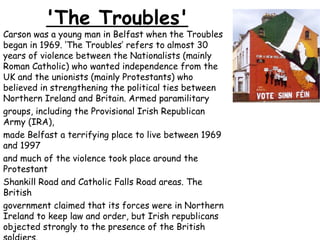
'The Troubles'
Carson was a young man in Belfast when the Troubles
began in 1969. ‘The Troubles’ refers to almost 30
years of violence between the Nationalists (mainly
Roman Catholic) who wanted independence from the
UK and the unionists (mainly Protestants) who
believed in strengthening the political ties between
Northern Ireland and Britain. Armed paramilitary
groups, including the Provisional Irish Republican
Army (IRA),
made Belfast a terrifying place to live between 1969
and 1997
and much of the violence took place around the
Protestant
Shankill Road and Catholic Falls Road areas. The
British
government claimed that its forces were in Northern
Ireland to keep law and order, but Irish republicans
objected strongly to the presence of the British
Investigate and Annotate
Identify the poet’s use of the features below and
consider the intended/potential effect on the
reader:
1.Punctuation
2.Structure
3.Form
4.Techniques
5.Meaning
6.What is the poem’s form, structure and meaning?
Meaning
The poem is written in the first person, giving a dramatic
description of what it felt like to be caught up in the violent
riots in Belfast in the 1970s. In the aftermath of an IRA
bomb, there is chaos and the ‘riot squad’ moves in. In his
confusion and terror the poet cannot find his way through the
maze of Belfast streets that he usually knows so well. He’s
stopped and interrogated by British soldiers, but is unable to
communicate with them to answer their questions. Nothing
makes sense to him anymore.
Use of lists
conveys a
sense of panic
Suddenly as the riot squad moved in it was raining exclamation
marks,
Nuts, bolts, nails, car-keys. A fount of broken type. And
the explosion
Itself - an asterisk on the map. This hyphenated line, a burst
This links to ‘next to of
course’ as both poems show
unusual variation of form,
language and use of
punctuation.
Thrown into the
middle of the
action, reflecting
the persona’s
experience.
Punctuation
metaphors to
visualise the
sense of alarm
to the reader
The whole poem is an
extended metaphor
for the way that
violent conflict
destroys language.
Continual references
to punctuation.
Trying to escape
but cannot.
Suggests confusion,
shock and disbelief.
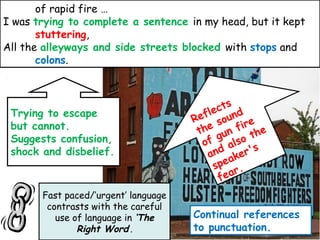
of rapid fire …
I was trying to complete a sentence in my head, but it kept
stuttering,
All the alleyways and side streets blocked with stops and
colons.
Fast paced/’urgent’ language
contrasts with the careful
use of language in ‘The
Right Word’.
Reflects
the sound
of gun fire
and also the
speaker's
fear.
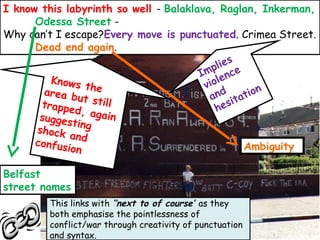
I know this labyrinth so well - Balaklava, Raglan, Inkerman,
Odessa Street -
Why can’t I escape?Every move is punctuated. Crimea Street.
Dead end again.
Knows thearea but stilltrapped, againsuggestingshock andconfusion
Implies
violence
and
hesitation
This links with ‘’next to of course’ as they
both emphasise the pointlessness of
conflict/war through creativity of punctuation
and syntax.
Belfast
street names
Ambiguity
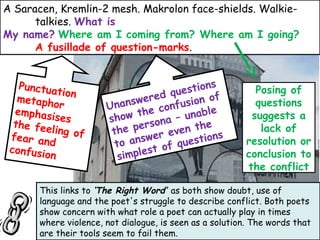
Unanswered questions
show the confusion of
the persona – unable
to answer even the
simplest of questions
Punctuationmetaphor
emphasisesthe feeling offear and
confusion
A Saracen, Kremlin-2 mesh. Makrolon face-shields. Walkie-
talkies. What is
My name? Where am I coming from? Where am I going?
A fusillade of question-marks.
This links to ‘The Right Word’ as both show doubt, use of
language and the poet's struggle to describe conflict. Both poets
show concern with what role a poet can actually play in times
where violence, not dialogue, is seen as a solution. The words that
are their tools seem to fail them.
Posing of
questions
suggests a
lack of
resolution or
conclusion to
the conflict
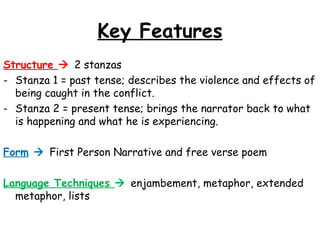
Key Features
Structure  2 stanzas
- Stanza 1 = past tense; describes the violence and effects of
being caught in the conflict.
- Stanza 2 = present tense; brings the narrator back to what
is happening and what he is experiencing.
Form  First Person Narrative and free verse poem
Language Techniques  enjambement, metaphor, extended
metaphor, lists
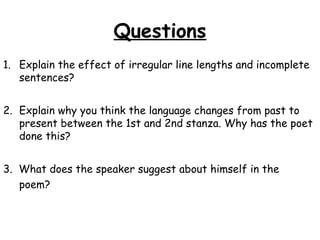
Questions
1. Explain the effect of irregular line lengths and incomplete
sentences?
2. Explain why you think the language changes from past to
present between the 1st and 2nd stanza. Why has the poet
done this?
3. What does the speaker suggest about himself in the
poem?
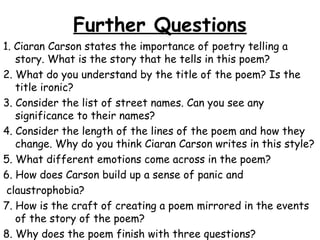
Further Questions
1. Ciaran Carson states the importance of poetry telling a
story. What is the story that he tells in this poem?
2. What do you understand by the title of the poem? Is the
title ironic?
3. Consider the list of street names. Can you see any
significance to their names?
4. Consider the length of the lines of the poem and how they
change. Why do you think Ciaran Carson writes in this style?
5. What different emotions come across in the poem?
6. How does Carson build up a sense of panic and
claustrophobia?
7. How is the craft of creating a poem mirrored in the events
of the story of the poem?
8. Why does the poem finish with three questions?

Belfast confetti annotation

  • 1.
    Belfast ConfettiBelfast Confetti LearningObjective To learn how to identify key features of a poem and use these to inform interpretations. AO1 (select and evaluate textual detail to illustrate and support interpretations) AO2 (explain how language, structure and form contribute to writers’ presentation of ideas and themes) Bitesize Resources http://www.bbc.co.uk/schools /gcsebitesize/english_literat ure/poetryconflict/
  • 2.
    Belfast Confetti by CiaranCarson Where is this? When do you see this? Keyword Euphemism: A mild / inoffensive word/phrase which replaces a more unpleasant or harsh one.
  • 3.
    Belfast Confetti The capitalcity of Northern Ireland where most of the ‘troubles’ took place Ironic use of the term ‘confetti’ that is associated with celebration, subverted to describe the debris from the bomb Euphemism for miscellaneous objects that were thrown during street riots (nuts, bolts, nails etc) Ironic that ‘confetti’ usually symbolises a union of two people in love. Here small pieces of metal symbolise ‘discord’ and a fracturing of society.
  • 4.
  • 5.
    The Poet Poet CiaranCarson was born in Belfast, Northern Ireland, in 1948. He suggests two influences on his poetry: his bilingual upbringing, and an unusual alertness to language. He shows language being used to enforce, to spy, and - broken into its almost meaningless constituent parts - to commit physical violence, when the bomb in 'Belfast Confetti' is loaded with not only ironmongery but "a fount of broken type." Violence, or its effects, often makes an appearance in Carson's poetry, whether this is found in historical warfare or the more recent conflicts of Northern Ireland. Indeed, Carson's use of the street names of Belfast that allude to these battles - "Balaclava, Raglan, Inkerman, Odessa Street" - underlines the violence of the Troubles.
  • 6.
    'The Troubles' Carson wasa young man in Belfast when the Troubles began in 1969. ‘The Troubles’ refers to almost 30 years of violence between the Nationalists (mainly Roman Catholic) who wanted independence from the UK and the unionists (mainly Protestants) who believed in strengthening the political ties between Northern Ireland and Britain. Armed paramilitary groups, including the Provisional Irish Republican Army (IRA), made Belfast a terrifying place to live between 1969 and 1997 and much of the violence took place around the Protestant Shankill Road and Catholic Falls Road areas. The British government claimed that its forces were in Northern Ireland to keep law and order, but Irish republicans objected strongly to the presence of the British
  • 7.
    Investigate and Annotate Identifythe poet’s use of the features below and consider the intended/potential effect on the reader: 1.Punctuation 2.Structure 3.Form 4.Techniques 5.Meaning 6.What is the poem’s form, structure and meaning?
  • 8.
    Meaning The poem iswritten in the first person, giving a dramatic description of what it felt like to be caught up in the violent riots in Belfast in the 1970s. In the aftermath of an IRA bomb, there is chaos and the ‘riot squad’ moves in. In his confusion and terror the poet cannot find his way through the maze of Belfast streets that he usually knows so well. He’s stopped and interrogated by British soldiers, but is unable to communicate with them to answer their questions. Nothing makes sense to him anymore.
  • 9.
    Use of lists conveysa sense of panic Suddenly as the riot squad moved in it was raining exclamation marks, Nuts, bolts, nails, car-keys. A fount of broken type. And the explosion Itself - an asterisk on the map. This hyphenated line, a burst This links to ‘next to of course’ as both poems show unusual variation of form, language and use of punctuation. Thrown into the middle of the action, reflecting the persona’s experience. Punctuation metaphors to visualise the sense of alarm to the reader The whole poem is an extended metaphor for the way that violent conflict destroys language.
  • 10.
    Continual references to punctuation. Tryingto escape but cannot. Suggests confusion, shock and disbelief. of rapid fire … I was trying to complete a sentence in my head, but it kept stuttering, All the alleyways and side streets blocked with stops and colons. Fast paced/’urgent’ language contrasts with the careful use of language in ‘The Right Word’. Reflects the sound of gun fire and also the speaker's fear.
  • 11.
    I know thislabyrinth so well - Balaklava, Raglan, Inkerman, Odessa Street - Why can’t I escape?Every move is punctuated. Crimea Street. Dead end again. Knows thearea but stilltrapped, againsuggestingshock andconfusion Implies violence and hesitation This links with ‘’next to of course’ as they both emphasise the pointlessness of conflict/war through creativity of punctuation and syntax. Belfast street names Ambiguity
  • 12.
    Unanswered questions show theconfusion of the persona – unable to answer even the simplest of questions Punctuationmetaphor emphasisesthe feeling offear and confusion A Saracen, Kremlin-2 mesh. Makrolon face-shields. Walkie- talkies. What is My name? Where am I coming from? Where am I going? A fusillade of question-marks. This links to ‘The Right Word’ as both show doubt, use of language and the poet's struggle to describe conflict. Both poets show concern with what role a poet can actually play in times where violence, not dialogue, is seen as a solution. The words that are their tools seem to fail them. Posing of questions suggests a lack of resolution or conclusion to the conflict
  • 13.
    Key Features Structure 2 stanzas - Stanza 1 = past tense; describes the violence and effects of being caught in the conflict. - Stanza 2 = present tense; brings the narrator back to what is happening and what he is experiencing. Form  First Person Narrative and free verse poem Language Techniques  enjambement, metaphor, extended metaphor, lists
  • 14.
    Questions 1. Explain theeffect of irregular line lengths and incomplete sentences? 2. Explain why you think the language changes from past to present between the 1st and 2nd stanza. Why has the poet done this? 3. What does the speaker suggest about himself in the poem?
  • 15.
    Further Questions 1. CiaranCarson states the importance of poetry telling a story. What is the story that he tells in this poem? 2. What do you understand by the title of the poem? Is the title ironic? 3. Consider the list of street names. Can you see any significance to their names? 4. Consider the length of the lines of the poem and how they change. Why do you think Ciaran Carson writes in this style? 5. What different emotions come across in the poem? 6. How does Carson build up a sense of panic and claustrophobia? 7. How is the craft of creating a poem mirrored in the events of the story of the poem? 8. Why does the poem finish with three questions?