LOVE SONNETS
  British & World Literature
  Unit 2, Session 1
  October 4, 2012


     Working to provide an exemplary individualized
and engaging educational experience for all students.
•Note I suggest you listen to the
 recording of the session for full
 details
Warm-up

• Francesco Petrarch and the Italian Sonnet

• Sonnet Quiz Flashcards

• Braingle: Sonnets Quiz
Common Core Georgia Performance Standards
• ELACC9-10RL2: Determine a theme or central idea of text and
  analyze in detail its development over the course of the
  text, including how it emerges and is shaped and refined by
  specific details; provide an objective summary of the text.
• ELACC11-12RL5: Analyze how an author’s choices concerning how
  to structure specific parts of a text (e.g., the choice of where to
  begin or end a story, the choice to provide a comedic or tragic
  resolution) contribute to its overall structure and meaning as well
  as its aesthetic impact.
• ELACC11-12SL1: Initiate and participate effectively in a range of
  collaborative discussions(one-on-one, in groups, and teacher-led)
  with diverse partners on grades 11-12 topics, texts, and
  issues, building on others’ ideas and expressing their own clearly
  and persuasively.
Keywords to know
                         Octave
Couplet                  Personification
Diction                  Quatrain
Epic                     Renaissance
                         Rhyme
Figurative language
                         Rhyme scheme
Humanism                 Rhythm
Imagery                  Sestet
Metaphor                 Simile
                         Speaker
Meter
                         Style
Narrative poem           tone
•couplet : two consecutive lines of poetry
•diction : the choice of words used by a
 speaker or writer
•epic : a long narrative poem that celebrates
 the deeds of a heroic figure
•figurative language : language that uses figures
 of speech such as metaphor, simile, and
 personification for poetic effect rather than for
 precise, factual meaning; for example, "Her eyes
 are like stars" is figurative language, in contrast
 to the literal use of "stars" in "The stars are
 shining tonight"
 humanism :a movement during the Renaissance that
  emphasized secular ideas and concerns, based on
  classical studies
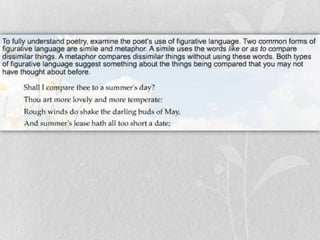
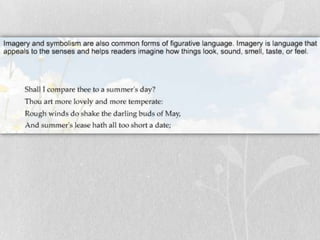
 imagery : language that creates a mental picture by
  appealing to the senses, that makes readers
  see, hear, smell, taste, or feel things in their imagination;
  for example, "the coal-black night," "the stinging cold,"
  "the rapping and tapping of rain on the roof"
 metaphor : a figure of speech that suggests or states a
  comparison between two unlike things, without using
  such words as like or as; for example, "The cat s eyes
  were emeralds shining in the night."
 meter : the arrangement of words in poetry based on
  rhythm, accents, and the number of syllables in a line
 narrative poem : a poem that tells a story
 octave : a stanza of eight lines in a poem
 personification : giving human qualities to a
  thing or abstraction; for example, "The kettle
  sang on the hearth," or "After the
  victory, freedom held its head high in the
  nation."
 quatrain : a stanza of four lines in a poem
 Renaissance : a general time period stretching
  from roughly the fourteenth century to as late
  as the seventeenth century when the arts and
  intellectual activity flourished in Europe
 rhyme : words with similar ending sounds such as
  hit/bit, yellow/fellow, bark/park, and so on; when
  words at the end of a line of poetry or verse sound the
  same, the lines are said to rhyme

 rhyme scheme : the pattern of rhymes made by the
  final words or sounds in the lines of a poem, typically
  designated by a different letter of the alphabet to
  represent each rhyme
     Roses are red      a
     Violets are blue b
     Sugar is sweet c
     So are you b
 rhythm : a regular pattern of sound and beats within
  a poem
 sestet : a stanza of six lines in a poem
 simile : a figure of speech that compares two
  things, usually using the words like or as; for
  example, "like a thief in the night," "quiet as a
  mouse"
 speaker : the imaginary person who speaks the
  words of a poem, not necessarily the poet
 style : the words the writer chooses and the way the
  writer arranges the words into sentences
 tone : the attitude of the writer toward the topic or
Poet vs. Speaker   • As with the study of any
                     poem, you make a distinction
                     between the poet and the
                     speaker when reading and
                     analyzing sonnets.
                   • The poet is the writer of the
                     work; Petrarch and
                     Shakespeare are the poets
                   • The speaker is the narrator
                     of the poem. That is, just as a
                     prose author may write a
                     novel told from the point of
                     view of a fictional
                     narrator, poets may write
                     verse from the point of view
                     of a fictional speaker.
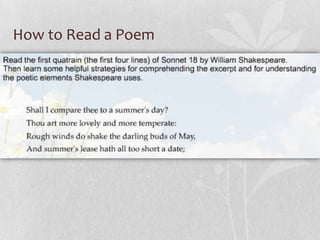
How to Read a Poem
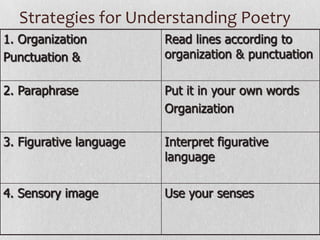
Strategies for Understanding Poetry
1. Organization          Read lines according to
Punctuation &            organization & punctuation

2. Paraphrase            Put it in your own words
                         Organization

3. Figurative language   Interpret figurative
                         language

4. Sensory image         Use your senses
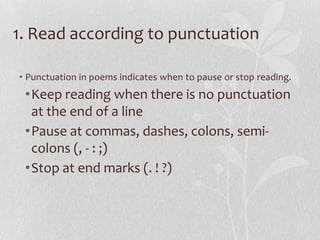
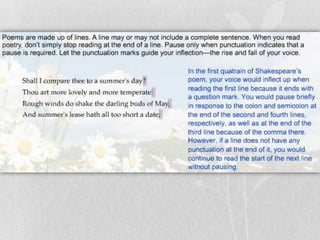
1. Read according to punctuation

• Punctuation in poems indicates when to pause or stop reading.
 •Keep reading when there is no punctuation
  at the end of a line
 •Pause at commas, dashes, colons, semi-
  colons (, - : ;)
 •Stop at end marks (. ! ?)
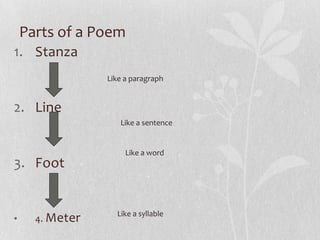
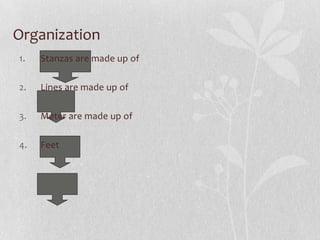
Parts of a Poem
1. Stanza
                 Like a paragraph


2. Line
                    Like a sentence


                      Like a word
3. Foot


                   Like a syllable
•     4. Meter
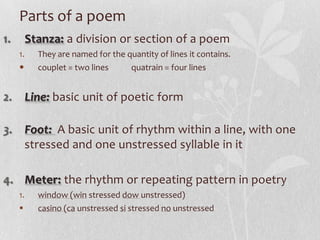
Parts of a poem
1.    Stanza: a division or section of a poem
     1.   They are named for the quantity of lines it contains.
         couplet = two lines     quatrain = four lines


2.    Line: basic unit of poetic form

3. Foot: A basic unit of rhythm within a line, with one
   stressed and one unstressed syllable in it

4. Meter: the rhythm or repeating pattern in poetry
     1.   window (win stressed dow unstressed)
         casino (ca unstressed si stressed no unstressed
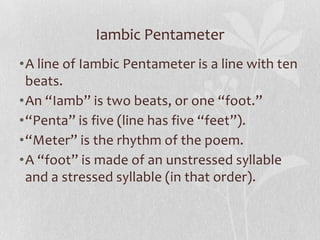
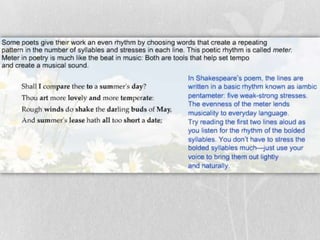
Iambic Pentameter
•A line of Iambic Pentameter is a line with ten
 beats.
•An “Iamb” is two beats, or one “foot.”
•“Penta” is five (line has five “feet”).
•“Meter” is the rhythm of the poem.
•A “foot” is made of an unstressed syllable
 and a stressed syllable (in that order).
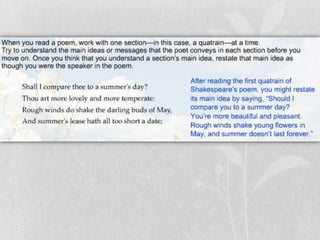
2. Paraphrase

•Putting the poem in your own words to
 make sure you understand it.
3. Interpret figurative language

• Figurative language is language that is not intended to be taken
 word  for   word. It sets up comparisons that help readers see
 things in new ways or form a vivid mental picture of something

• She is as happy as a clam
• It’s raining cats and dogs
• It is a million miles away
4. Use your senses

•Being descriptive by using your senses
 (sight, hearing, smell, touch, or taste)
 to help paint a picture
Sensory Image


•Appeals to our 5 senses
 •Sweet, sour, bitter
 •Icy, sweltering
 •Humongous, tiny
 •Booming
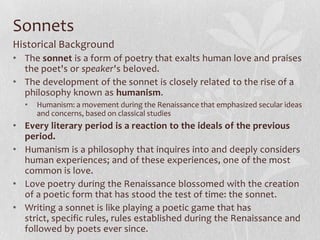
WHAT IS A SONNET?

Understanding the
forms, meter, rhyme, and other aspects of
the sonnet .
Sonnets
Historical Background
• The sonnet is a form of poetry that exalts human love and praises
  the poet's or speaker's beloved.
• The development of the sonnet is closely related to the rise of a
  philosophy known as humanism.
  •   Humanism: a movement during the Renaissance that emphasized secular ideas
      and concerns, based on classical studies
• Every literary period is a reaction to the ideals of the previous
  period.
• Humanism is a philosophy that inquires into and deeply considers
  human experiences; and of these experiences, one of the most
  common is love.
• Love poetry during the Renaissance blossomed with the creation
  of a poetic form that has stood the test of time: the sonnet.
• Writing a sonnet is like playing a poetic game that has
  strict, specific rules, rules established during the Renaissance and
  followed by poets ever since.
The Sonnet
• A sonnet is a fourteen-line poem in iambic pentameter with a
  carefully patterned rhyme scheme. Other strict, short poetic
  forms occur in English poetry (the sestina, the villanelle, and the
  haiku, for example), but none has been used so successfully by
  so many different poets.
Petrarchan Sonnets
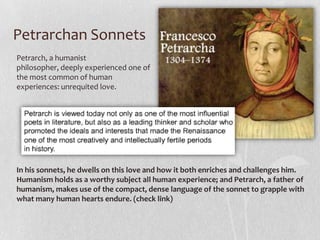
Petrarch, a humanist
philosopher, deeply experienced one of
the most common of human
experiences: unrequited love.


In his sonnets, he dwells on this love and how it both enriches and challenges him.
Humanism holds as a worthy subject all human experience; and Petrarch, a father of
humanism, makes use of the compact, dense language of the sonnet to grapple with
what many human hearts endure. (check link)
Shakespearean Sonnets
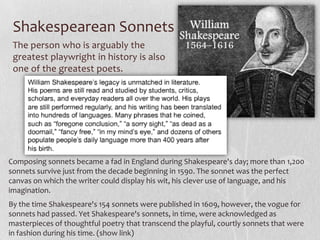
 The person who is arguably the
 greatest playwright in history is also
 one of the greatest poets.


Composing sonnets became a fad in England during Shakespeare's day; more than 1,200
sonnets survive just from the decade beginning in 1590. The sonnet was the perfect
canvas on which the writer could display his wit, his clever use of language, and his
imagination.
By the time Shakespeare's 154 sonnets were published in 1609, however, the vogue for
sonnets had passed. Yet Shakespeare's sonnets, in time, were acknowledged as
masterpieces of thoughtful poetry that transcend the playful, courtly sonnets that were
in fashion during his time. (show link)
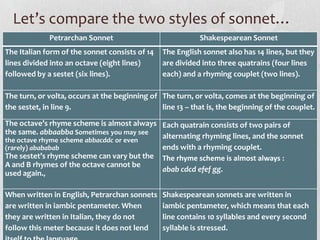
Let’s compare the two styles of sonnet…
             Petrarchan Sonnet                             Shakespearean Sonnet
The Italian form of the sonnet consists of 14   The English sonnet also has 14 lines, but they
lines divided into an octave (eight lines)      are divided into three quatrains (four lines
followed by a sestet (six lines).               each) and a rhyming couplet (two lines).

The turn, or volta, occurs at the beginning of The turn, or volta, comes at the beginning of
the sestet, in line 9.                         line 13 – that is, the beginning of the couplet.

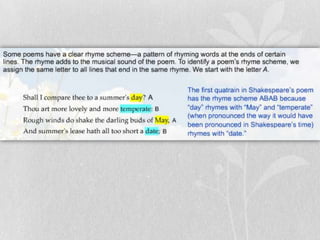
The octave’s rhyme scheme is almost always Each quatrain consists of two pairs of
the same. abbaabba Sometimes you may see
the octave rhyme scheme abbacddc or even
                                           alternating rhyming lines, and the sonnet
(rarely) abababab                          ends with a rhyming couplet.
The sestet’s rhyme scheme can vary but the The rhyme scheme is almost always :
A and B rhymes of the octave cannot be
used again.,                               abab cdcd efef gg.


When written in English, Petrarchan sonnets     Shakespearean sonnets are written in
are written in iambic pentameter. When          iambic pentameter, which means that each
they are written in Italian, they do not        line contains 10 syllables and every second
follow this meter because it does not lend      syllable is stressed.
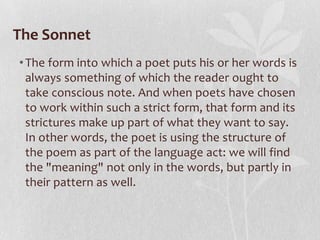
The Sonnet
• The form into which a poet puts his or her words is
  always something of which the reader ought to
  take conscious note. And when poets have chosen
  to work within such a strict form, that form and its
  strictures make up part of what they want to say.
  In other words, the poet is using the structure of
  the poem as part of the language act: we will find
  the "meaning" not only in the words, but partly in
  their pattern as well.
The Sonnet
•The sonnet can be thematically divided into
 two sections:
•The first presents the theme, raises an issue
 or doubt,
•The second part answers the
 question, resolves the problem, or drives
 home the poem's point.
•The turn, or change, in the poem helps move
 forward the emotional action of the poem
 quickly.
The Sonnet
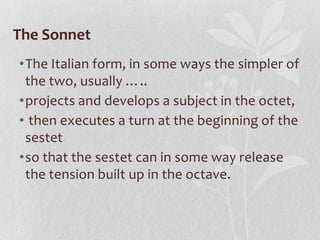
•The Italian form, in some ways the simpler of
 the two, usually …..
•projects and develops a subject in the octet,
• then executes a turn at the beginning of the
 sestet
•so that the sestet can in some way release
 the tension built up in the octave.
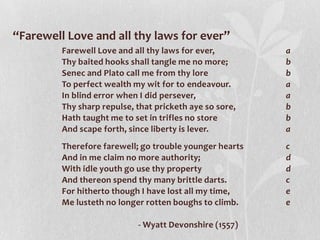
“Farewell Love and all thy laws for ever”
         Farewell Love and all thy laws for ever,        a
         Thy baited hooks shall tangle me no more;       b
         Senec and Plato call me from thy lore           b
         To perfect wealth my wit for to endeavour.      a
         In blind error when I did persever,             a
         Thy sharp repulse, that pricketh aye so sore,   b
         Hath taught me to set in trifles no store       b
         And scape forth, since liberty is lever.        a
         Therefore farewell; go trouble younger hearts   c
         And in me claim no more authority;              d
         With idle youth go use thy property             d
         And thereon spend thy many brittle darts.       c
         For hitherto though I have lost all my time,    e
         Me lusteth no longer rotten boughs to climb.    e

                            - Wyatt Devonshire (1557)
The Sonnet
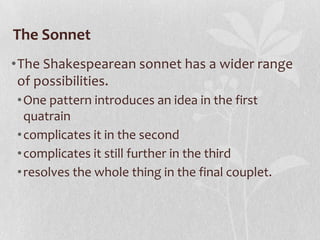
•The Shakespearean sonnet has a wider range
 of possibilities.
• One pattern introduces an idea in the first
  quatrain
• complicates it in the second
• complicates it still further in the third
• resolves the whole thing in the final couplet.
“Sonnet 138” or “When My Love Swears that
She is Made of Truth”
When my love swears that she is made of truth a  {First quatrain; note the puns and
I do believe her, though I know she lies, b      the intellectual games: [I know she
That she might think me some untutor'd youth, a  lies, so I believe her so that she will
Unlearned in the world's false subtleties. b     believe me to be young and
                                                 untutored]}
Thus vainly thinking that she thinks me young, c {Second quatrain: [Well of course I
Although she knows my days are past the best, d know that she doesn't really think I'm
Simply I credit her false speaking tongue: c
                                                 young, but I have to pretend to
                                                 believe her so that she will pretend
On both sides thus is simple truth suppress'd. d that I'm young]}
                                                 {Third quatrain: [so why don't we
But wherefore says she not she is unjust? e      both fess up? because love depends
And wherefore say not I that I am old? f         upon trust and upon youth]}
O, love's best habit is in seeming trust, e
                                                 {Final couplet, and resolution:
And age in love loves not to have years told: f
                                                 [we lie to ourselves and to each
Therefore I lie with her and she with me, g      other, so that we may flatter
And in our faults by lies we flatter'd be. g     ourselves that we are young, honest,
                      - William Shakespeare      and in love]. Note especially the
                                                 puns.
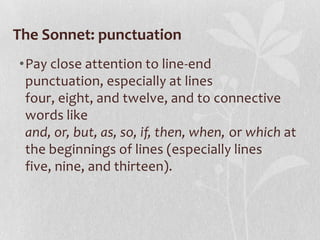
The Sonnet: punctuation
•Pay close attention to line-end
 punctuation, especially at lines
 four, eight, and twelve, and to connective
 words like
 and, or, but, as, so, if, then, when, or which at
 the beginnings of lines (especially lines
 five, nine, and thirteen).
Review: Sonnet Form
•Has 14 lines.
•Must be written in iambic pentameter
•Must follow a specific rhyme
 scheme, depending on the type of sonnet.
•Can be about any subject, though they are
 often about love or nature.
•Introduces a problem or question in the
 beginning, and a resolution is offered after
 the turn.
Review
•The Italian, or Petrarchan sonnet:
 • Fourteen lines
 • Iambic pentameter
 • Consists of an octet (eight lines) of two envelope
   quatrains
  •Usually abba abba,
  •Sometimes abba cddc,
  •Or rarely abab abab;
  •The turn occurs at the end of the octet and
   is developed and closed in the sestet.
 • And a sestet (six lines)
  •Which may rhyme xyzxyz
  •Or xyxyxy
Review
• The English or Shakespearean sonnet:
  •Fourteen lines
  •Iambic pentameter
  •Consists of three Sicilian quatrains (four
   lines)
  •And a heroic couplet (two lines)
  •Rhymes: abab cdcd efef gg
  •The turn comes at or near line 13
What type of sonnet is
            “What the Sonnet Is”?

•We are going analyze a sonnet to determine
 what “type” of sonnet it is…..
•Ask yourself the following questions

•What are the groupings of the lines (how
 many lines are in each group)?
•What is the rhyme scheme?
•Where is the turn?
•Based on your answers, what kind of sonnet
 is it?
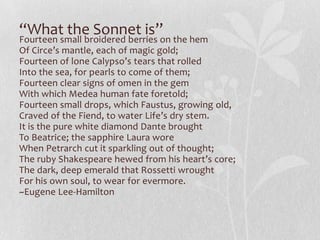
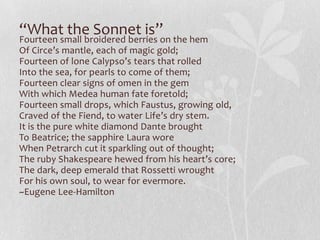
“What the Sonnet is”
Fourteen small broidered berries on the hem
Of Circe’s mantle, each of magic gold;
Fourteen of lone Calypso’s tears that rolled
Into the sea, for pearls to come of them;
Fourteen clear signs of omen in the gem
With which Medea human fate foretold;
Fourteen small drops, which Faustus, growing old,
Craved of the Fiend, to water Life’s dry stem.
It is the pure white diamond Dante brought
To Beatrice; the sapphire Laura wore
When Petrarch cut it sparkling out of thought;
The ruby Shakespeare hewed from his heart’s core;
The dark, deep emerald that Rossetti wrought
For his own soul, to wear for evermore.
~Eugene Lee-Hamilton
•What are the groupings of the
 lines (how many lines are in each
 group)?
“What the Sonnet is”
Fourteen small broidered berries on the hem
Of Circe’s mantle, each of magic gold;
Fourteen of lone Calypso’s tears that rolled
Into the sea, for pearls to come of them;
Fourteen clear signs of omen in the gem
With which Medea human fate foretold;
Fourteen small drops, which Faustus, growing old,
Craved of the Fiend, to water Life’s dry stem.
It is the pure white diamond Dante brought
To Beatrice; the sapphire Laura wore
When Petrarch cut it sparkling out of thought;
The ruby Shakespeare hewed from his heart’s core;
The dark, deep emerald that Rossetti wrought
For his own soul, to wear for evermore.
~Eugene Lee-Hamilton
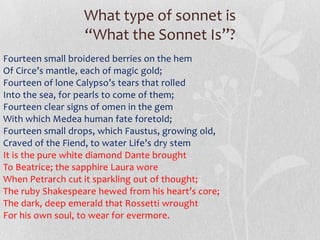
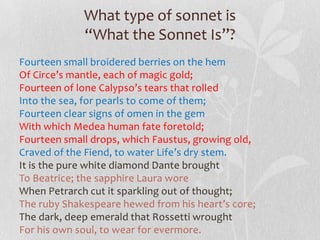
What type of sonnet is
                  “What the Sonnet Is”?
Fourteen small broidered berries on the hem
Of Circe’s mantle, each of magic gold;
Fourteen of lone Calypso’s tears that rolled
Into the sea, for pearls to come of them;
Fourteen clear signs of omen in the gem
With which Medea human fate foretold;
Fourteen small drops, which Faustus, growing old,
Craved of the Fiend, to water Life’s dry stem.
It is the pure white diamond Dante brought
To Beatrice; the sapphire Laura wore
When Petrarch cut it sparkling out of thought;
The ruby Shakespeare hewed from his heart’s core;
The dark, deep emerald that Rossetti wrought
For his own soul, to wear for evermore.
•What is the rhyme
 scheme?
“What the Sonnet is”
Fourteen small broidered berries on the hem
Of Circe’s mantle, each of magic gold;
Fourteen of lone Calypso’s tears that rolled
Into the sea, for pearls to come of them;
Fourteen clear signs of omen in the gem
With which Medea human fate foretold;
Fourteen small drops, which Faustus, growing old,
Craved of the Fiend, to water Life’s dry stem.
It is the pure white diamond Dante brought
To Beatrice; the sapphire Laura wore
When Petrarch cut it sparkling out of thought;
The ruby Shakespeare hewed from his heart’s core;
The dark, deep emerald that Rossetti wrought
For his own soul, to wear for evermore.
~Eugene Lee-Hamilton
What type of sonnet is
             “What the Sonnet Is”?
Fourteen small broidered berries on the hem
Of Circe’s mantle, each of magic gold;
Fourteen of lone Calypso’s tears that rolled
Into the sea, for pearls to come of them;
Fourteen clear signs of omen in the gem
With which Medea human fate foretold;
Fourteen small drops, which Faustus, growing old,
Craved of the Fiend, to water Life’s dry stem.
It is the pure white diamond Dante brought
To Beatrice; the sapphire Laura wore
When Petrarch cut it sparkling out of thought;
The ruby Shakespeare hewed from his heart’s core;
The dark, deep emerald that Rossetti wrought
For his own soul, to wear for evermore.
•Where is the turn?
“What the Sonnet is”
Fourteen small broidered berries on the hem
Of Circe’s mantle, each of magic gold;
Fourteen of lone Calypso’s tears that rolled
Into the sea, for pearls to come of them;
Fourteen clear signs of omen in the gem
With which Medea human fate foretold;
Fourteen small drops, which Faustus, growing old,
Craved of the Fiend, to water Life’s dry stem.
It is the pure white diamond Dante brought
To Beatrice; the sapphire Laura wore
When Petrarch cut it sparkling out of thought;
The ruby Shakespeare hewed from his heart’s core;
The dark, deep emerald that Rossetti wrought
For his own soul, to wear for evermore.
~Eugene Lee-Hamilton
What type of sonnet is
             “What the Sonnet Is”?
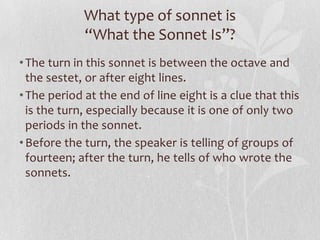
• The turn in this sonnet is between the octave and
  the sestet, or after eight lines.
• The period at the end of line eight is a clue that this
  is the turn, especially because it is one of only two
  periods in the sonnet.
• Before the turn, the speaker is telling of groups of
  fourteen; after the turn, he tells of who wrote the
  sonnets.
What type of sonnet is
“What the Sonnet Is”?
What type of sonnet is
    “What the Sonnet Is”?


“What the Sonnet Is” is an
Italian/Petrarchan Sonnet!
Organization
1.   Stanzas are made up of

2.   Lines are made up of

3.   Meter are made up of

4.   Feet

Love sonnets week 1 ss lms

  • 1.
    LOVE SONNETS British & World Literature Unit 2, Session 1 October 4, 2012 Working to provide an exemplary individualized and engaging educational experience for all students.
  • 2.
    •Note I suggestyou listen to the recording of the session for full details
  • 3.
    Warm-up • Francesco Petrarchand the Italian Sonnet • Sonnet Quiz Flashcards • Braingle: Sonnets Quiz
  • 4.
    Common Core GeorgiaPerformance Standards • ELACC9-10RL2: Determine a theme or central idea of text and analyze in detail its development over the course of the text, including how it emerges and is shaped and refined by specific details; provide an objective summary of the text. • ELACC11-12RL5: Analyze how an author’s choices concerning how to structure specific parts of a text (e.g., the choice of where to begin or end a story, the choice to provide a comedic or tragic resolution) contribute to its overall structure and meaning as well as its aesthetic impact. • ELACC11-12SL1: Initiate and participate effectively in a range of collaborative discussions(one-on-one, in groups, and teacher-led) with diverse partners on grades 11-12 topics, texts, and issues, building on others’ ideas and expressing their own clearly and persuasively.
  • 5.
    Keywords to know  Octave Couplet  Personification Diction  Quatrain Epic  Renaissance  Rhyme Figurative language  Rhyme scheme Humanism  Rhythm Imagery  Sestet Metaphor  Simile  Speaker Meter  Style Narrative poem  tone
  • 6.
    •couplet : twoconsecutive lines of poetry •diction : the choice of words used by a speaker or writer •epic : a long narrative poem that celebrates the deeds of a heroic figure •figurative language : language that uses figures of speech such as metaphor, simile, and personification for poetic effect rather than for precise, factual meaning; for example, "Her eyes are like stars" is figurative language, in contrast to the literal use of "stars" in "The stars are shining tonight"
  • 7.
     humanism :amovement during the Renaissance that emphasized secular ideas and concerns, based on classical studies  imagery : language that creates a mental picture by appealing to the senses, that makes readers see, hear, smell, taste, or feel things in their imagination; for example, "the coal-black night," "the stinging cold," "the rapping and tapping of rain on the roof"  metaphor : a figure of speech that suggests or states a comparison between two unlike things, without using such words as like or as; for example, "The cat s eyes were emeralds shining in the night."  meter : the arrangement of words in poetry based on rhythm, accents, and the number of syllables in a line
  • 8.
     narrative poem: a poem that tells a story  octave : a stanza of eight lines in a poem  personification : giving human qualities to a thing or abstraction; for example, "The kettle sang on the hearth," or "After the victory, freedom held its head high in the nation."  quatrain : a stanza of four lines in a poem  Renaissance : a general time period stretching from roughly the fourteenth century to as late as the seventeenth century when the arts and intellectual activity flourished in Europe
  • 9.
     rhyme :words with similar ending sounds such as hit/bit, yellow/fellow, bark/park, and so on; when words at the end of a line of poetry or verse sound the same, the lines are said to rhyme  rhyme scheme : the pattern of rhymes made by the final words or sounds in the lines of a poem, typically designated by a different letter of the alphabet to represent each rhyme  Roses are red a  Violets are blue b  Sugar is sweet c  So are you b
  • 10.
     rhythm :a regular pattern of sound and beats within a poem  sestet : a stanza of six lines in a poem  simile : a figure of speech that compares two things, usually using the words like or as; for example, "like a thief in the night," "quiet as a mouse"  speaker : the imaginary person who speaks the words of a poem, not necessarily the poet  style : the words the writer chooses and the way the writer arranges the words into sentences  tone : the attitude of the writer toward the topic or
  • 11.
    Poet vs. Speaker • As with the study of any poem, you make a distinction between the poet and the speaker when reading and analyzing sonnets. • The poet is the writer of the work; Petrarch and Shakespeare are the poets • The speaker is the narrator of the poem. That is, just as a prose author may write a novel told from the point of view of a fictional narrator, poets may write verse from the point of view of a fictional speaker.
  • 12.
  • 13.
    Strategies for UnderstandingPoetry 1. Organization Read lines according to Punctuation & organization & punctuation 2. Paraphrase Put it in your own words Organization 3. Figurative language Interpret figurative language 4. Sensory image Use your senses
  • 14.
    1. Read accordingto punctuation • Punctuation in poems indicates when to pause or stop reading. •Keep reading when there is no punctuation at the end of a line •Pause at commas, dashes, colons, semi- colons (, - : ;) •Stop at end marks (. ! ?)
  • 16.
    Parts of aPoem 1. Stanza Like a paragraph 2. Line Like a sentence Like a word 3. Foot Like a syllable • 4. Meter
  • 17.
    Parts of apoem 1. Stanza: a division or section of a poem 1. They are named for the quantity of lines it contains.  couplet = two lines quatrain = four lines 2. Line: basic unit of poetic form 3. Foot: A basic unit of rhythm within a line, with one stressed and one unstressed syllable in it 4. Meter: the rhythm or repeating pattern in poetry 1. window (win stressed dow unstressed)  casino (ca unstressed si stressed no unstressed
  • 18.
    Iambic Pentameter •A lineof Iambic Pentameter is a line with ten beats. •An “Iamb” is two beats, or one “foot.” •“Penta” is five (line has five “feet”). •“Meter” is the rhythm of the poem. •A “foot” is made of an unstressed syllable and a stressed syllable (in that order).
  • 21.
    2. Paraphrase •Putting thepoem in your own words to make sure you understand it.
  • 23.
    3. Interpret figurativelanguage • Figurative language is language that is not intended to be taken word for word. It sets up comparisons that help readers see things in new ways or form a vivid mental picture of something • She is as happy as a clam • It’s raining cats and dogs • It is a million miles away
  • 25.
    4. Use yoursenses •Being descriptive by using your senses (sight, hearing, smell, touch, or taste) to help paint a picture
  • 26.
    Sensory Image •Appeals toour 5 senses •Sweet, sour, bitter •Icy, sweltering •Humongous, tiny •Booming
  • 29.
    WHAT IS ASONNET? Understanding the forms, meter, rhyme, and other aspects of the sonnet .
  • 30.
    Sonnets Historical Background • Thesonnet is a form of poetry that exalts human love and praises the poet's or speaker's beloved. • The development of the sonnet is closely related to the rise of a philosophy known as humanism. • Humanism: a movement during the Renaissance that emphasized secular ideas and concerns, based on classical studies • Every literary period is a reaction to the ideals of the previous period. • Humanism is a philosophy that inquires into and deeply considers human experiences; and of these experiences, one of the most common is love. • Love poetry during the Renaissance blossomed with the creation of a poetic form that has stood the test of time: the sonnet. • Writing a sonnet is like playing a poetic game that has strict, specific rules, rules established during the Renaissance and followed by poets ever since.
  • 31.
    The Sonnet • Asonnet is a fourteen-line poem in iambic pentameter with a carefully patterned rhyme scheme. Other strict, short poetic forms occur in English poetry (the sestina, the villanelle, and the haiku, for example), but none has been used so successfully by so many different poets.
  • 32.
    Petrarchan Sonnets Petrarch, ahumanist philosopher, deeply experienced one of the most common of human experiences: unrequited love. In his sonnets, he dwells on this love and how it both enriches and challenges him. Humanism holds as a worthy subject all human experience; and Petrarch, a father of humanism, makes use of the compact, dense language of the sonnet to grapple with what many human hearts endure. (check link)
  • 33.
    Shakespearean Sonnets Theperson who is arguably the greatest playwright in history is also one of the greatest poets. Composing sonnets became a fad in England during Shakespeare's day; more than 1,200 sonnets survive just from the decade beginning in 1590. The sonnet was the perfect canvas on which the writer could display his wit, his clever use of language, and his imagination. By the time Shakespeare's 154 sonnets were published in 1609, however, the vogue for sonnets had passed. Yet Shakespeare's sonnets, in time, were acknowledged as masterpieces of thoughtful poetry that transcend the playful, courtly sonnets that were in fashion during his time. (show link)
  • 34.
    Let’s compare thetwo styles of sonnet… Petrarchan Sonnet Shakespearean Sonnet The Italian form of the sonnet consists of 14 The English sonnet also has 14 lines, but they lines divided into an octave (eight lines) are divided into three quatrains (four lines followed by a sestet (six lines). each) and a rhyming couplet (two lines). The turn, or volta, occurs at the beginning of The turn, or volta, comes at the beginning of the sestet, in line 9. line 13 – that is, the beginning of the couplet. The octave’s rhyme scheme is almost always Each quatrain consists of two pairs of the same. abbaabba Sometimes you may see the octave rhyme scheme abbacddc or even alternating rhyming lines, and the sonnet (rarely) abababab ends with a rhyming couplet. The sestet’s rhyme scheme can vary but the The rhyme scheme is almost always : A and B rhymes of the octave cannot be used again., abab cdcd efef gg. When written in English, Petrarchan sonnets Shakespearean sonnets are written in are written in iambic pentameter. When iambic pentameter, which means that each they are written in Italian, they do not line contains 10 syllables and every second follow this meter because it does not lend syllable is stressed.
  • 35.
    The Sonnet • Theform into which a poet puts his or her words is always something of which the reader ought to take conscious note. And when poets have chosen to work within such a strict form, that form and its strictures make up part of what they want to say. In other words, the poet is using the structure of the poem as part of the language act: we will find the "meaning" not only in the words, but partly in their pattern as well.
  • 36.
    The Sonnet •The sonnetcan be thematically divided into two sections: •The first presents the theme, raises an issue or doubt, •The second part answers the question, resolves the problem, or drives home the poem's point. •The turn, or change, in the poem helps move forward the emotional action of the poem quickly.
  • 37.
    The Sonnet •The Italianform, in some ways the simpler of the two, usually ….. •projects and develops a subject in the octet, • then executes a turn at the beginning of the sestet •so that the sestet can in some way release the tension built up in the octave.
  • 38.
    “Farewell Love andall thy laws for ever” Farewell Love and all thy laws for ever, a Thy baited hooks shall tangle me no more; b Senec and Plato call me from thy lore b To perfect wealth my wit for to endeavour. a In blind error when I did persever, a Thy sharp repulse, that pricketh aye so sore, b Hath taught me to set in trifles no store b And scape forth, since liberty is lever. a Therefore farewell; go trouble younger hearts c And in me claim no more authority; d With idle youth go use thy property d And thereon spend thy many brittle darts. c For hitherto though I have lost all my time, e Me lusteth no longer rotten boughs to climb. e - Wyatt Devonshire (1557)
  • 39.
    The Sonnet •The Shakespeareansonnet has a wider range of possibilities. • One pattern introduces an idea in the first quatrain • complicates it in the second • complicates it still further in the third • resolves the whole thing in the final couplet.
  • 40.
    “Sonnet 138” or“When My Love Swears that She is Made of Truth” When my love swears that she is made of truth a {First quatrain; note the puns and I do believe her, though I know she lies, b the intellectual games: [I know she That she might think me some untutor'd youth, a lies, so I believe her so that she will Unlearned in the world's false subtleties. b believe me to be young and untutored]} Thus vainly thinking that she thinks me young, c {Second quatrain: [Well of course I Although she knows my days are past the best, d know that she doesn't really think I'm Simply I credit her false speaking tongue: c young, but I have to pretend to believe her so that she will pretend On both sides thus is simple truth suppress'd. d that I'm young]} {Third quatrain: [so why don't we But wherefore says she not she is unjust? e both fess up? because love depends And wherefore say not I that I am old? f upon trust and upon youth]} O, love's best habit is in seeming trust, e {Final couplet, and resolution: And age in love loves not to have years told: f [we lie to ourselves and to each Therefore I lie with her and she with me, g other, so that we may flatter And in our faults by lies we flatter'd be. g ourselves that we are young, honest, - William Shakespeare and in love]. Note especially the puns.
  • 41.
    The Sonnet: punctuation •Payclose attention to line-end punctuation, especially at lines four, eight, and twelve, and to connective words like and, or, but, as, so, if, then, when, or which at the beginnings of lines (especially lines five, nine, and thirteen).
  • 42.
    Review: Sonnet Form •Has14 lines. •Must be written in iambic pentameter •Must follow a specific rhyme scheme, depending on the type of sonnet. •Can be about any subject, though they are often about love or nature. •Introduces a problem or question in the beginning, and a resolution is offered after the turn.
  • 43.
    Review •The Italian, orPetrarchan sonnet: • Fourteen lines • Iambic pentameter • Consists of an octet (eight lines) of two envelope quatrains •Usually abba abba, •Sometimes abba cddc, •Or rarely abab abab; •The turn occurs at the end of the octet and is developed and closed in the sestet. • And a sestet (six lines) •Which may rhyme xyzxyz •Or xyxyxy
  • 44.
    Review • The Englishor Shakespearean sonnet: •Fourteen lines •Iambic pentameter •Consists of three Sicilian quatrains (four lines) •And a heroic couplet (two lines) •Rhymes: abab cdcd efef gg •The turn comes at or near line 13
  • 45.
    What type ofsonnet is “What the Sonnet Is”? •We are going analyze a sonnet to determine what “type” of sonnet it is….. •Ask yourself the following questions •What are the groupings of the lines (how many lines are in each group)? •What is the rhyme scheme? •Where is the turn? •Based on your answers, what kind of sonnet is it?
  • 46.
    “What the Sonnetis” Fourteen small broidered berries on the hem Of Circe’s mantle, each of magic gold; Fourteen of lone Calypso’s tears that rolled Into the sea, for pearls to come of them; Fourteen clear signs of omen in the gem With which Medea human fate foretold; Fourteen small drops, which Faustus, growing old, Craved of the Fiend, to water Life’s dry stem. It is the pure white diamond Dante brought To Beatrice; the sapphire Laura wore When Petrarch cut it sparkling out of thought; The ruby Shakespeare hewed from his heart’s core; The dark, deep emerald that Rossetti wrought For his own soul, to wear for evermore. ~Eugene Lee-Hamilton
  • 47.
    •What are thegroupings of the lines (how many lines are in each group)?
  • 48.
    “What the Sonnetis” Fourteen small broidered berries on the hem Of Circe’s mantle, each of magic gold; Fourteen of lone Calypso’s tears that rolled Into the sea, for pearls to come of them; Fourteen clear signs of omen in the gem With which Medea human fate foretold; Fourteen small drops, which Faustus, growing old, Craved of the Fiend, to water Life’s dry stem. It is the pure white diamond Dante brought To Beatrice; the sapphire Laura wore When Petrarch cut it sparkling out of thought; The ruby Shakespeare hewed from his heart’s core; The dark, deep emerald that Rossetti wrought For his own soul, to wear for evermore. ~Eugene Lee-Hamilton
  • 49.
    What type ofsonnet is “What the Sonnet Is”? Fourteen small broidered berries on the hem Of Circe’s mantle, each of magic gold; Fourteen of lone Calypso’s tears that rolled Into the sea, for pearls to come of them; Fourteen clear signs of omen in the gem With which Medea human fate foretold; Fourteen small drops, which Faustus, growing old, Craved of the Fiend, to water Life’s dry stem. It is the pure white diamond Dante brought To Beatrice; the sapphire Laura wore When Petrarch cut it sparkling out of thought; The ruby Shakespeare hewed from his heart’s core; The dark, deep emerald that Rossetti wrought For his own soul, to wear for evermore.
  • 50.
    •What is therhyme scheme?
  • 51.
    “What the Sonnetis” Fourteen small broidered berries on the hem Of Circe’s mantle, each of magic gold; Fourteen of lone Calypso’s tears that rolled Into the sea, for pearls to come of them; Fourteen clear signs of omen in the gem With which Medea human fate foretold; Fourteen small drops, which Faustus, growing old, Craved of the Fiend, to water Life’s dry stem. It is the pure white diamond Dante brought To Beatrice; the sapphire Laura wore When Petrarch cut it sparkling out of thought; The ruby Shakespeare hewed from his heart’s core; The dark, deep emerald that Rossetti wrought For his own soul, to wear for evermore. ~Eugene Lee-Hamilton
  • 52.
    What type ofsonnet is “What the Sonnet Is”? Fourteen small broidered berries on the hem Of Circe’s mantle, each of magic gold; Fourteen of lone Calypso’s tears that rolled Into the sea, for pearls to come of them; Fourteen clear signs of omen in the gem With which Medea human fate foretold; Fourteen small drops, which Faustus, growing old, Craved of the Fiend, to water Life’s dry stem. It is the pure white diamond Dante brought To Beatrice; the sapphire Laura wore When Petrarch cut it sparkling out of thought; The ruby Shakespeare hewed from his heart’s core; The dark, deep emerald that Rossetti wrought For his own soul, to wear for evermore.
  • 53.
  • 54.
    “What the Sonnetis” Fourteen small broidered berries on the hem Of Circe’s mantle, each of magic gold; Fourteen of lone Calypso’s tears that rolled Into the sea, for pearls to come of them; Fourteen clear signs of omen in the gem With which Medea human fate foretold; Fourteen small drops, which Faustus, growing old, Craved of the Fiend, to water Life’s dry stem. It is the pure white diamond Dante brought To Beatrice; the sapphire Laura wore When Petrarch cut it sparkling out of thought; The ruby Shakespeare hewed from his heart’s core; The dark, deep emerald that Rossetti wrought For his own soul, to wear for evermore. ~Eugene Lee-Hamilton
  • 55.
    What type ofsonnet is “What the Sonnet Is”? • The turn in this sonnet is between the octave and the sestet, or after eight lines. • The period at the end of line eight is a clue that this is the turn, especially because it is one of only two periods in the sonnet. • Before the turn, the speaker is telling of groups of fourteen; after the turn, he tells of who wrote the sonnets.
  • 56.
    What type ofsonnet is “What the Sonnet Is”?
  • 57.
    What type ofsonnet is “What the Sonnet Is”? “What the Sonnet Is” is an Italian/Petrarchan Sonnet!
  • 58.
    Organization 1. Stanzas are made up of 2. Lines are made up of 3. Meter are made up of 4. Feet

Editor's Notes

  • #4 Francesco and the Italian Sonnet http://www.quia.com/quiz/754590.htmlQuizlethttp://quizlet.com/2133422/sonnet-quiz-flash-cards/Brainglehttp://www.braingle.com/trivia/22695/sonnets.html
  • #33 http://www.youtube.com/watch?v=cRgcUlZZmxohttp://viewpure.com/cRgcUlZZmxo
  • #34 http://www.youtube.com/watch?v=ZK86GOGNsschttp://viewpure.com/ZK86GOGNssc
  • #41 Ababcdcdefefgg
  • #48 Lines are in an octave (eight lines) and a sestet (six lines).
  • #51 Rhyme scheme is abbaabbacdcdcd.
  • #54 The turn in this sonnet is between the octave and the sestet, or after eight lines.The period at the end of line eight is a clue that this is the turn, especially because it is one of only two periods in the sonnet.Before the turn, the speaker is telling of groups of fourteen; after the turn, he tells of who wrote the sonnets