Belfast Confetti
Ciaran Carson
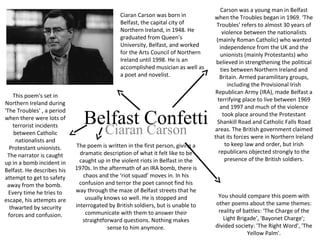
Ciaran Carson was born in
Belfast, the capital city of
Northern Ireland, in 1948. He
graduated from Queen’s
University, Belfast, and worked
for the Arts Council of Northern
Ireland until 1998. He is an
accomplished musician as well as
a poet and novelist.
Carson was a young man in Belfast
when the Troubles began in 1969. ‘The
Troubles’ refers to almost 30 years of
violence between the nationalists
(mainly Roman Catholic) who wanted
independence from the UK and the
unionists (mainly Protestants) who
believed in strengthening the political
ties between Northern Ireland and
Britain. Armed paramilitary groups,
including the Provisional Irish
Republican Army (IRA), made Belfast a
terrifying place to live between 1969
and 1997 and much of the violence
took place around the Protestant
Shankill Road and Catholic Falls Road
areas. The British government claimed
that its forces were in Northern Ireland
to keep law and order, but Irish
republicans objected strongly to the
presence of the British soldiers.
This poem's set in
Northern Ireland during
'The Troubles' , a period
when there were lots of
terrorist incidents
between Catholic
nationalists and
Protestant unionists.
The narrator is caught
up in a bomb incident in
Belfast. He describes his
attempt to get to safety
away from the bomb.
Every time he tries to
escape, his attempts are
thwarted by security
forces and confusion.
The poem is written in the first person, giving a
dramatic description of what it felt like to be
caught up in the violent riots in Belfast in the
1970s. In the aftermath of an IRA bomb, there is
chaos and the ‘riot squad’ moves in. In his
confusion and terror the poet cannot find his
way through the maze of Belfast streets that he
usually knows so well. He is stopped and
interrogated by British soldiers, but is unable to
communicate with them to answer their
straightforward questions. Nothing makes
sense to him anymore.
You should compare this poem with
other poems about the same themes:
reality of battles: 'The Charge of the
Light Brigade', 'Bayonet Charge';
divided society: 'The Right Word', 'The
Yellow Palm'.
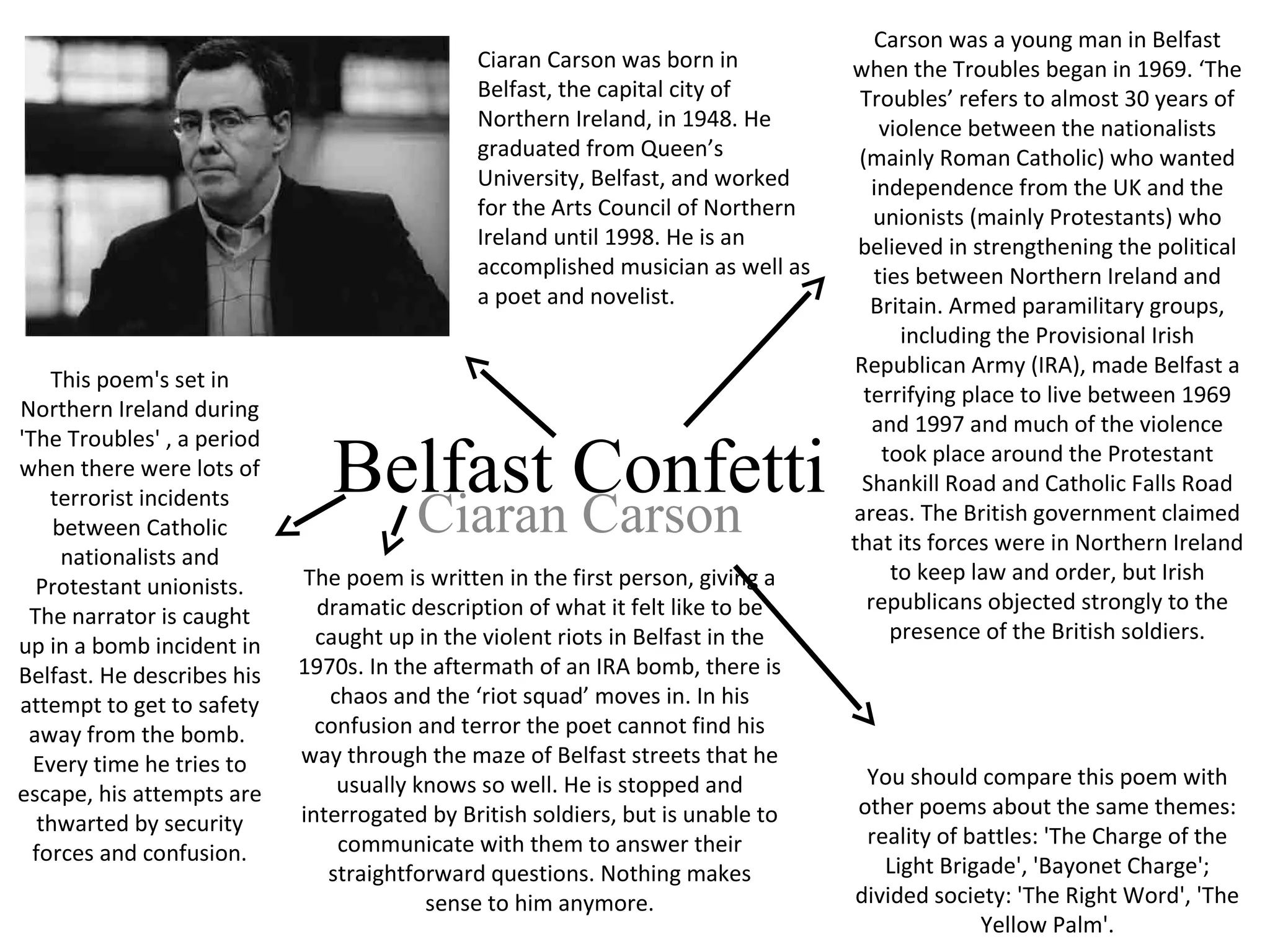
Belfast Confetti
 
Suddenly as the riot squad moved in it was raining exclamation
marks,
Nuts, bolts, nails, car-keys. A fount of broken type. And
the explosion
Itself – an asterisk on the map. This hyphenated line, a burst
of rapid fire …
I was trying to complete a sentence in my head, but it kept
stuttering,
All the alleyways and side streets blocked with stops and
colons.
 
I know this labyrinth so well – Balaklava, Raglan, Inkerman,
Odessa Street –
Why can’t I escape? Every move is punctuated. Crimea Street.
Dead end again.
A Saracen, Kremlin-2 mesh. Makrolon face-shields. Walkie-
talkies. What is
My name? Where am I coming from? Where am I going?
A fusillade of question-marks.
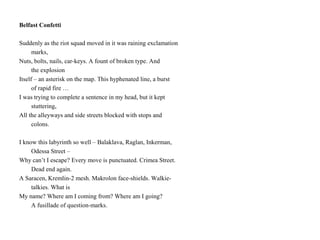
Suddenly as the riot squad moved in it was raining exclamation
marks,
Nuts, bolts, nails, car-keys. A fount of broken type. And
the explosion
Itself – an asterisk on the map. This hyphenated line, a burst
of rapid fire …
I was trying to complete a sentence in my head, but it kept
stuttering,
All the alleyways and side streets blocked with stops and
colons.
‘Belfast confetti’ is a euphemism for miscellaneous objects that were thrown during street riots: ‘nuts, bolts, nails,
car keys’, even tin cans. Sometimes they were added to IRA bombs to cause more injury. It is ironic that nuts and
bolts, which usually hold things together, should be used in conflict to hurt and alienate others. Also confetti (small
pieces of coloured paper) is usually thrown over a new bride and groom to celebrate a happy union but here small
pieces of metal are hurled to break up relationships and create discord.
Punctuation is the way we make sense of
language. It tells us when to pause, stop
and start again. Too little punctuation
causes confusion and too much results in
short chaotic, panicky sentences. The
speaker in the poem is caught up in a
violent bout of street fighting and cannot
‘complete a sentence in his head’. Carson
skilfully weaves most types of punctuation
mark into the poem.
Just as he feels out of
control, so the
sentences are erratic.
His language stops and
starts, whether because
of ‘a burst of rapid
fire…’ or because he
repeatedly loses his way
and has to turn back:
‘Dead end again.’
Regular use of
enjambment
effectively throws
emphasis on single
words like ‘explosion’
(l. 4) and ‘stuttering’
(l. 8) and the natural
break
at the end of line 16,
where he seems to
break mid question,
stresses his confused
state when inhuman
masked figures
impede his progress.
Carson contrasts the
short jerky sentences
with lists, which
give a feeling of
panic.
Carson plays visual tricks:
‘● Fount’ is another word for ‘fountain’ which
suggests that words are being cut short as the
‘confetti’ sprays through the air. There is no
time for talking, for reasoning.
‘● An asterisk’ on the map (*) looks as though
there has been an explosion on paper.
‘● A burst of rapid fire’ is followed by … (an
ellipsis), a punctuation mark when there has
been something missed out or there’s more
to follow.
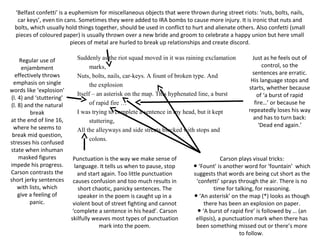
I know this labyrinth so well – Balaklava, Raglan, Inkerman,
Odessa Street –
Why can’t I escape? Every move is punctuated. Crimea Street.
Dead end again.
A Saracen, Kremlin-2 mesh. Makrolon face-shields. Walkie-
talkies. What is
My name? Where am I coming from? Where am I going?
A fusillade of question-marks.
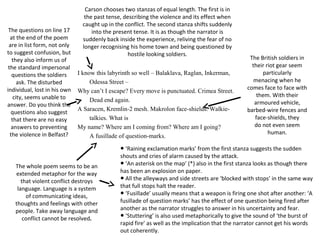
Carson chooses two stanzas of equal length. The first is in
the past tense, describing the violence and its effect when
caught up in the conflict. The second stanza shifts suddenly
into the present tense. It is as though the narrator is
suddenly back inside the experience, reliving the fear of no
longer recognising his home town and being questioned by
hostile looking soldiers.
The British soldiers in
their riot gear seem
particularly
menacing when he
comes face to face with
them. With their
armoured vehicle,
barbed-wire fences and
face-shields, they
do not even seem
human.
The questions on line 17
at the end of the poem
are in list form, not only
to suggest confusion, but
they also inform us of
the standard impersonal
questions the soldiers
ask. The disturbed
individual, lost in his own
city, seems unable to
answer. Do you think the
questions also suggest
that there are no easy
answers to preventing
the violence in Belfast?
The whole poem seems to be an
extended metaphor for the way
that violent conflict destroys
language. Language is a system
of communicating ideas,
thoughts and feelings with other
people. Take away language and
conflict cannot be resolved.
‘● Raining exclamation marks’ from the first stanza suggests the sudden
shouts and cries of alarm caused by the attack.
‘● An asterisk on the map’ (*) also in the first stanza looks as though there
has been an explosion on paper.
● All the alleyways and side streets are ‘blocked with stops’ in the same way
that full stops halt the reader.
‘● Fusillade’ usually means that a weapon is firing one shot after another: ‘A
fusillade of question marks’ has the effect of one question being fired after
another as the narrator struggles to answer in his uncertainty and fear.
‘● Stuttering’ is also used metaphorically to give the sound of ‘the burst of
rapid fire’ as well as the implication that the narrator cannot get his words
out coherently.

Belfast Confetti by Ciaran Carson

  • 1.
    Belfast Confetti Ciaran Carson CiaranCarson was born in Belfast, the capital city of Northern Ireland, in 1948. He graduated from Queen’s University, Belfast, and worked for the Arts Council of Northern Ireland until 1998. He is an accomplished musician as well as a poet and novelist. Carson was a young man in Belfast when the Troubles began in 1969. ‘The Troubles’ refers to almost 30 years of violence between the nationalists (mainly Roman Catholic) who wanted independence from the UK and the unionists (mainly Protestants) who believed in strengthening the political ties between Northern Ireland and Britain. Armed paramilitary groups, including the Provisional Irish Republican Army (IRA), made Belfast a terrifying place to live between 1969 and 1997 and much of the violence took place around the Protestant Shankill Road and Catholic Falls Road areas. The British government claimed that its forces were in Northern Ireland to keep law and order, but Irish republicans objected strongly to the presence of the British soldiers. This poem's set in Northern Ireland during 'The Troubles' , a period when there were lots of terrorist incidents between Catholic nationalists and Protestant unionists. The narrator is caught up in a bomb incident in Belfast. He describes his attempt to get to safety away from the bomb. Every time he tries to escape, his attempts are thwarted by security forces and confusion. The poem is written in the first person, giving a dramatic description of what it felt like to be caught up in the violent riots in Belfast in the 1970s. In the aftermath of an IRA bomb, there is chaos and the ‘riot squad’ moves in. In his confusion and terror the poet cannot find his way through the maze of Belfast streets that he usually knows so well. He is stopped and interrogated by British soldiers, but is unable to communicate with them to answer their straightforward questions. Nothing makes sense to him anymore. You should compare this poem with other poems about the same themes: reality of battles: 'The Charge of the Light Brigade', 'Bayonet Charge'; divided society: 'The Right Word', 'The Yellow Palm'.
  • 2.
    Belfast Confetti   Suddenly as the riot squad moved in it was raining exclamation marks, Nuts, bolts, nails, car-keys. A fount of broken type. And the explosion Itself – an asterisk on the map. This hyphenated line, a burst of rapid fire … I was trying to complete a sentence in my head, but it kept stuttering, All the alleyways and side streets blocked with stops and colons.   I know this labyrinth so well – Balaklava, Raglan, Inkerman, Odessa Street – Why can’t I escape? Every move is punctuated. Crimea Street. Dead end again. A Saracen, Kremlin-2 mesh. Makrolon face-shields. Walkie- talkies. What is My name? Where am I coming from? Where am I going? A fusillade of question-marks.
  • 3.
    Suddenly as theriot squad moved in it was raining exclamation marks, Nuts, bolts, nails, car-keys. A fount of broken type. And the explosion Itself – an asterisk on the map. This hyphenated line, a burst of rapid fire … I was trying to complete a sentence in my head, but it kept stuttering, All the alleyways and side streets blocked with stops and colons. ‘Belfast confetti’ is a euphemism for miscellaneous objects that were thrown during street riots: ‘nuts, bolts, nails, car keys’, even tin cans. Sometimes they were added to IRA bombs to cause more injury. It is ironic that nuts and bolts, which usually hold things together, should be used in conflict to hurt and alienate others. Also confetti (small pieces of coloured paper) is usually thrown over a new bride and groom to celebrate a happy union but here small pieces of metal are hurled to break up relationships and create discord. Punctuation is the way we make sense of language. It tells us when to pause, stop and start again. Too little punctuation causes confusion and too much results in short chaotic, panicky sentences. The speaker in the poem is caught up in a violent bout of street fighting and cannot ‘complete a sentence in his head’. Carson skilfully weaves most types of punctuation mark into the poem. Just as he feels out of control, so the sentences are erratic. His language stops and starts, whether because of ‘a burst of rapid fire…’ or because he repeatedly loses his way and has to turn back: ‘Dead end again.’ Regular use of enjambment effectively throws emphasis on single words like ‘explosion’ (l. 4) and ‘stuttering’ (l. 8) and the natural break at the end of line 16, where he seems to break mid question, stresses his confused state when inhuman masked figures impede his progress. Carson contrasts the short jerky sentences with lists, which give a feeling of panic. Carson plays visual tricks: ‘● Fount’ is another word for ‘fountain’ which suggests that words are being cut short as the ‘confetti’ sprays through the air. There is no time for talking, for reasoning. ‘● An asterisk’ on the map (*) looks as though there has been an explosion on paper. ‘● A burst of rapid fire’ is followed by … (an ellipsis), a punctuation mark when there has been something missed out or there’s more to follow.
  • 4.
    I know thislabyrinth so well – Balaklava, Raglan, Inkerman, Odessa Street – Why can’t I escape? Every move is punctuated. Crimea Street. Dead end again. A Saracen, Kremlin-2 mesh. Makrolon face-shields. Walkie- talkies. What is My name? Where am I coming from? Where am I going? A fusillade of question-marks. Carson chooses two stanzas of equal length. The first is in the past tense, describing the violence and its effect when caught up in the conflict. The second stanza shifts suddenly into the present tense. It is as though the narrator is suddenly back inside the experience, reliving the fear of no longer recognising his home town and being questioned by hostile looking soldiers. The British soldiers in their riot gear seem particularly menacing when he comes face to face with them. With their armoured vehicle, barbed-wire fences and face-shields, they do not even seem human. The questions on line 17 at the end of the poem are in list form, not only to suggest confusion, but they also inform us of the standard impersonal questions the soldiers ask. The disturbed individual, lost in his own city, seems unable to answer. Do you think the questions also suggest that there are no easy answers to preventing the violence in Belfast? The whole poem seems to be an extended metaphor for the way that violent conflict destroys language. Language is a system of communicating ideas, thoughts and feelings with other people. Take away language and conflict cannot be resolved. ‘● Raining exclamation marks’ from the first stanza suggests the sudden shouts and cries of alarm caused by the attack. ‘● An asterisk on the map’ (*) also in the first stanza looks as though there has been an explosion on paper. ● All the alleyways and side streets are ‘blocked with stops’ in the same way that full stops halt the reader. ‘● Fusillade’ usually means that a weapon is firing one shot after another: ‘A fusillade of question marks’ has the effect of one question being fired after another as the narrator struggles to answer in his uncertainty and fear. ‘● Stuttering’ is also used metaphorically to give the sound of ‘the burst of rapid fire’ as well as the implication that the narrator cannot get his words out coherently.