AUGMENTED REALITY (AR)
5 applications in the travel sector:
- Where to find what: AR City
Location-Based Applications are useful for travelers all over the world because through
tracking GPS positions you can navigate around in new cityscapes. These Applications use
device features f.e. GPS or digital compass to pinpoint users’ locations and help them find
nearest hotels and tourist spots or even more. Almost 90% of smartphone users leave their
geolocation feature switched on so it is easy for the Applications to show them the right way.
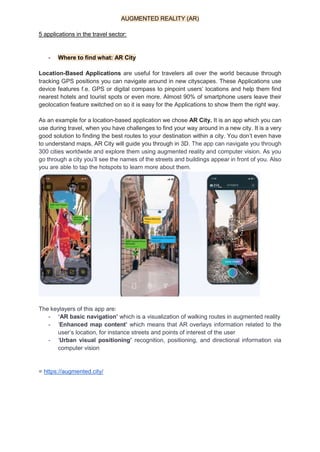
As an example for a location-based application we chose AR City. It is an app which you can
use during travel, when you have challenges to find your way around in a new city. It is a very
good solution to finding the best routes to your destination within a city. You don’t even have
to understand maps, AR City will guide you through in 3D. The app can navigate you through
300 cities worldwide and explore them using augmented reality and computer vision. As you
go through a city you’ll see the names of the streets and buildings appear in front of you. Also
you are able to tap the hotspots to learn more about them.
The keylayers of this app are:
- ‘AR basic navigation’ which is a visualization of walking routes in augmented reality
- ‘Enhanced map content’ which means that AR overlays information related to the
user’s location, for instance streets and points of interest of the user
- ‘Urban visual positioning’ recognition, positioning, and directional information via
computer vision
= https://augmented.city/
- Info regarding e.g. buildings (historical background)
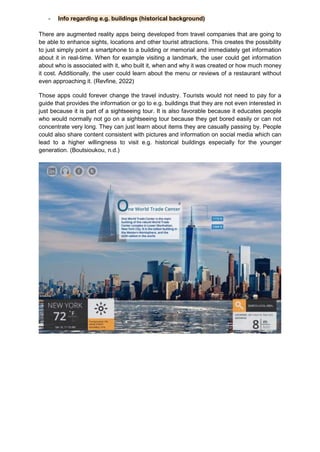
There are augmented reality apps being developed from travel companies that are going to
be able to enhance sights, locations and other tourist attractions. This creates the possibility
to just simply point a smartphone to a building or memorial and immediately get information
about it in real-time. When for example visiting a landmark, the user could get information
about who is associated with it, who built it, when and why it was created or how much money
it cost. Additionally, the user could learn about the menu or reviews of a restaurant without
even approaching it. (Revfine, 2022)
Those apps could forever change the travel industry. Tourists would not need to pay for a
guide that provides the information or go to e.g. buildings that they are not even interested in
just because it is part of a sightseeing tour. It is also favorable because it educates people
who would normally not go on a sightseeing tour because they get bored easily or can not
concentrate very long. They can just learn about items they are casually passing by. People
could also share content consistent with pictures and information on social media which can
lead to a higher willingness to visit e.g. historical buildings especially for the younger
generation. (Boutsioukou, n.d.)
- timetravel
Augmented Reality is a great way of showing tourists certain locations with a little twist to
them: By augmenting the buildings and surroundings a little bit it gives off the feeling of time
traveling, which is an interesting and playful way to learn about the past.
One of the most famous examples for a touristic time travel experience is the Yuanmingyuan
in Beijing. Unfortunately, the imperial garden, constructed in the late 18th and early 19th
centuries, was destroyed in 1860 during the second Opium War due to armed conflict and
looting. For a long time China had to rely on drawings and paintings to see what the
breathtaking gardens once looked like. Not anymore: The Beijing Institute of Technology
invented an AR program which allows visitors to view the gardens through a coin operated
viewing platform. (Saenz, 2009)
Here a video to show what is possible with AR: https://youtu.be/N-9tF4dJISs
Marketing intern Jennie Eliasson from the new start-up “Zaubar” from Berlin, Germany shares
how AR time travel can revolutionize tourism: “And we aim to do nothing less than to
revolutionize the tourism and education industry with AR and AI technology. Our founders
Stefan and Anne-Sophie have entrepreneurial and journalistic backgrounds and they were
thinking of new ways to tell stories for younger and more engaged audiences. We started with
transforming historical photos into 3D experiences – right at the place of interest – to imitate
the feeling of time travel. So our core business is immersive tours, and then we started creating
the world’s first AR content management system which now turned into a whole software as
a service thought. Yet we are still keen on telling the most wonderful stories – and we are
curious about wild and exciting projects.” (Adzo, 2021)
Nowadays, more and more people and enterprises are discovering AR and the benefits it
brings. It will become a bigger part of everyday life and we should take advantage of it. (Vars
& ArchäoNow, n.d.) Whether showing the users media in real time, modifying or creating
houses and surroundings or allowing AR tour guides to lead the tourists and sharing specific
content with them are all innovative, playful and fun, but at the same time educational
experiences. (Adzo, 2021)
- Food culture: BuUuk
One main point when traveling to a new country is to experience their culture. People love to
try out local delicacies and experience the culture of new places. Therefore the AR travel app
‘BuUuk’ is a must-have for travelers.
BuUuk is a restaurant recommendation app that uses AR technology to locate the nearest
restaurants around you. You just have to point your camera in a direction. You can also look
up if there are any exclusive deals or specials available in the listed restaurants. Also you see
the reviews and how many stars the restaurant/cafe has.
Furthermore, BuUuk displays reviews from previous visitors to recommend the best
restaurants to dine. It also directly shows you the directions to your chosen place. Moreover it
has an active forum where you can discuss your favorite dishes and food places with other
travelers and app users.
= https://buuuk.com/
But there are a lot of other things with which restaurants can work when talking about AR. For
instance, an AR menu. AR menus allow diners to see every detail of a dish, including the
texture of products used, portion sizes, and additional information such as ingredients
(Ferrandez, 2021). The first restaurant in the UK who roll out an AR menu was the Mexican
restaurant group Wahaca.
- AR in the hotel industry
Augmented reality is also used in hotels in order to make the experience more interactive for
the visitors. They have easy access to more information through their phone cameras. When
for example holding the mobile phone towards the restaurant, the opening hours appear and
there is the option to make a reservation for the next meal. Furthermore, some hotels show
the details of the drinks in their bar through AR, offer online check-ins, digital keys, etc. Another
way to make the stay more fun is to give the guests the possibility to customize their hotel
rooms. (Harrison, 2020)
Augmented Hotel Environment is also an interesting topic. Holiday Inn for example, created a
tool that shows the visitors famous celebrities in the hotel through their smartphone. In Disney
resorts in Orlando, you can lock and unlock your door with Augmented Reality. To be able to
do so, you simply have to download the application “My Disney Experience”. (Potter, 2020)
But this app has many different uses, from providing information to entertaining. Another
example is that guests can see photos others took at the Cinderella Castle and upload their
own ones as well. (YouTube, 2020)
Here you can find the link to the application and some more information about it:
https://www.disneyworld.eu/plan/my-disney-experience/
References
- Saenz, A. (2009, November 19). Augmented Reality Does Time Travel Tourism.
Singularityhub. Retrieved November 28 from:
https://singularityhub.com/2009/11/19/augmented-reality-does-time-travel-tourism/
- Cubix. (2020, January 29). How to Create a Location Based App | Geolocation
application ideas. Retrieved November 28, 2022, from https://www.cubix.co/blog/how-
to-create-location-based-apps+
- Marie, O. (2020, August 13). Top 10 AR Travel Apps You Should Try in 2020.
ThinkMobiles. Retrieved November 28, 2022, from https://thinkmobiles.com/posts/75/
- Harrison, J. (2020, March 6). Augmented Reality in Hotels. Hotel Technology
Consulting Services. Retrieved November 28, 2022, from
https://hoteltcs.com/augmented-reality-in-hotels/
- Potter, K. (n.d.). How Augmented Reality Technology is Shaping the Hotel Industry.
Hotel Technology News. Retrieved November 28, 2022, from
https://hoteltechnologynews.com/2019/03/how-augmented-reality-technology-is-
shaping-the-hotel-industry/
- Home. (n.d.). YouTube. Retrieved November 28, 2022, from
https://www.disneyworld.eu/attractions/magic-kingdom/mural-of-
memories/?int_cmp=INS-intWDWtoWDW-MuralMem
- Ferrandez, C. (2021, July 29). Augmented reality restaurant experiences: 5 examples.
Poplar Studio. Retrieved November 28, 2022, from
https://poplar.studio/blog/augmented-reality-restaurant-experiences-5-examples/
- Vars & ArchäoNow. (n.d.). Augmented Reality (AR) Tour in Wien "Die Vergangenheit
ist jetzt" VARS. VARS | AR. Retrieved November 28, 2022, from
https://www.vars.at/augmented-reality-tour/
- Revfine. (2022, March 10). How Augmented Reality (AR) is Revolutionising the Travel
Industry. Revfine.com. Retrieved November 28, 2022, from
https://www.revfine.com/augmented-reality-travel-industry/
- Boutsioukou, K. (n.d.). Travel and Tourism with Augmented Reality. Zumoko AR/VR
Company. Retrieved November 28, 2022, from https://www.zumoko.com/travel-and-
tourism-with-augmented-reality/
- Adzo, K. (2021, March 5). Zaubar: Making Time-Travel a Reality! Startup Info.
Retrieved November 28, 2022, from https://startup.info/fabian-mrongowius-zaubar/

Beispeil_ (1).docx

  • 1.
    AUGMENTED REALITY (AR) 5applications in the travel sector: - Where to find what: AR City Location-Based Applications are useful for travelers all over the world because through tracking GPS positions you can navigate around in new cityscapes. These Applications use device features f.e. GPS or digital compass to pinpoint users’ locations and help them find nearest hotels and tourist spots or even more. Almost 90% of smartphone users leave their geolocation feature switched on so it is easy for the Applications to show them the right way. As an example for a location-based application we chose AR City. It is an app which you can use during travel, when you have challenges to find your way around in a new city. It is a very good solution to finding the best routes to your destination within a city. You don’t even have to understand maps, AR City will guide you through in 3D. The app can navigate you through 300 cities worldwide and explore them using augmented reality and computer vision. As you go through a city you’ll see the names of the streets and buildings appear in front of you. Also you are able to tap the hotspots to learn more about them. The keylayers of this app are: - ‘AR basic navigation’ which is a visualization of walking routes in augmented reality - ‘Enhanced map content’ which means that AR overlays information related to the user’s location, for instance streets and points of interest of the user - ‘Urban visual positioning’ recognition, positioning, and directional information via computer vision = https://augmented.city/
  • 2.
    - Info regardinge.g. buildings (historical background) There are augmented reality apps being developed from travel companies that are going to be able to enhance sights, locations and other tourist attractions. This creates the possibility to just simply point a smartphone to a building or memorial and immediately get information about it in real-time. When for example visiting a landmark, the user could get information about who is associated with it, who built it, when and why it was created or how much money it cost. Additionally, the user could learn about the menu or reviews of a restaurant without even approaching it. (Revfine, 2022) Those apps could forever change the travel industry. Tourists would not need to pay for a guide that provides the information or go to e.g. buildings that they are not even interested in just because it is part of a sightseeing tour. It is also favorable because it educates people who would normally not go on a sightseeing tour because they get bored easily or can not concentrate very long. They can just learn about items they are casually passing by. People could also share content consistent with pictures and information on social media which can lead to a higher willingness to visit e.g. historical buildings especially for the younger generation. (Boutsioukou, n.d.)
  • 3.
    - timetravel Augmented Realityis a great way of showing tourists certain locations with a little twist to them: By augmenting the buildings and surroundings a little bit it gives off the feeling of time traveling, which is an interesting and playful way to learn about the past. One of the most famous examples for a touristic time travel experience is the Yuanmingyuan in Beijing. Unfortunately, the imperial garden, constructed in the late 18th and early 19th centuries, was destroyed in 1860 during the second Opium War due to armed conflict and looting. For a long time China had to rely on drawings and paintings to see what the breathtaking gardens once looked like. Not anymore: The Beijing Institute of Technology invented an AR program which allows visitors to view the gardens through a coin operated viewing platform. (Saenz, 2009) Here a video to show what is possible with AR: https://youtu.be/N-9tF4dJISs Marketing intern Jennie Eliasson from the new start-up “Zaubar” from Berlin, Germany shares how AR time travel can revolutionize tourism: “And we aim to do nothing less than to revolutionize the tourism and education industry with AR and AI technology. Our founders Stefan and Anne-Sophie have entrepreneurial and journalistic backgrounds and they were thinking of new ways to tell stories for younger and more engaged audiences. We started with transforming historical photos into 3D experiences – right at the place of interest – to imitate the feeling of time travel. So our core business is immersive tours, and then we started creating the world’s first AR content management system which now turned into a whole software as a service thought. Yet we are still keen on telling the most wonderful stories – and we are curious about wild and exciting projects.” (Adzo, 2021) Nowadays, more and more people and enterprises are discovering AR and the benefits it brings. It will become a bigger part of everyday life and we should take advantage of it. (Vars & ArchäoNow, n.d.) Whether showing the users media in real time, modifying or creating houses and surroundings or allowing AR tour guides to lead the tourists and sharing specific content with them are all innovative, playful and fun, but at the same time educational experiences. (Adzo, 2021)
  • 4.
    - Food culture:BuUuk One main point when traveling to a new country is to experience their culture. People love to try out local delicacies and experience the culture of new places. Therefore the AR travel app ‘BuUuk’ is a must-have for travelers. BuUuk is a restaurant recommendation app that uses AR technology to locate the nearest restaurants around you. You just have to point your camera in a direction. You can also look up if there are any exclusive deals or specials available in the listed restaurants. Also you see the reviews and how many stars the restaurant/cafe has. Furthermore, BuUuk displays reviews from previous visitors to recommend the best restaurants to dine. It also directly shows you the directions to your chosen place. Moreover it has an active forum where you can discuss your favorite dishes and food places with other travelers and app users. = https://buuuk.com/ But there are a lot of other things with which restaurants can work when talking about AR. For instance, an AR menu. AR menus allow diners to see every detail of a dish, including the texture of products used, portion sizes, and additional information such as ingredients (Ferrandez, 2021). The first restaurant in the UK who roll out an AR menu was the Mexican restaurant group Wahaca.
  • 5.
    - AR inthe hotel industry Augmented reality is also used in hotels in order to make the experience more interactive for the visitors. They have easy access to more information through their phone cameras. When for example holding the mobile phone towards the restaurant, the opening hours appear and there is the option to make a reservation for the next meal. Furthermore, some hotels show the details of the drinks in their bar through AR, offer online check-ins, digital keys, etc. Another way to make the stay more fun is to give the guests the possibility to customize their hotel rooms. (Harrison, 2020) Augmented Hotel Environment is also an interesting topic. Holiday Inn for example, created a tool that shows the visitors famous celebrities in the hotel through their smartphone. In Disney resorts in Orlando, you can lock and unlock your door with Augmented Reality. To be able to do so, you simply have to download the application “My Disney Experience”. (Potter, 2020) But this app has many different uses, from providing information to entertaining. Another example is that guests can see photos others took at the Cinderella Castle and upload their own ones as well. (YouTube, 2020) Here you can find the link to the application and some more information about it: https://www.disneyworld.eu/plan/my-disney-experience/
  • 6.
    References - Saenz, A.(2009, November 19). Augmented Reality Does Time Travel Tourism. Singularityhub. Retrieved November 28 from: https://singularityhub.com/2009/11/19/augmented-reality-does-time-travel-tourism/ - Cubix. (2020, January 29). How to Create a Location Based App | Geolocation application ideas. Retrieved November 28, 2022, from https://www.cubix.co/blog/how- to-create-location-based-apps+ - Marie, O. (2020, August 13). Top 10 AR Travel Apps You Should Try in 2020. ThinkMobiles. Retrieved November 28, 2022, from https://thinkmobiles.com/posts/75/ - Harrison, J. (2020, March 6). Augmented Reality in Hotels. Hotel Technology Consulting Services. Retrieved November 28, 2022, from https://hoteltcs.com/augmented-reality-in-hotels/ - Potter, K. (n.d.). How Augmented Reality Technology is Shaping the Hotel Industry. Hotel Technology News. Retrieved November 28, 2022, from https://hoteltechnologynews.com/2019/03/how-augmented-reality-technology-is- shaping-the-hotel-industry/ - Home. (n.d.). YouTube. Retrieved November 28, 2022, from https://www.disneyworld.eu/attractions/magic-kingdom/mural-of- memories/?int_cmp=INS-intWDWtoWDW-MuralMem - Ferrandez, C. (2021, July 29). Augmented reality restaurant experiences: 5 examples. Poplar Studio. Retrieved November 28, 2022, from https://poplar.studio/blog/augmented-reality-restaurant-experiences-5-examples/ - Vars & ArchäoNow. (n.d.). Augmented Reality (AR) Tour in Wien "Die Vergangenheit ist jetzt" VARS. VARS | AR. Retrieved November 28, 2022, from https://www.vars.at/augmented-reality-tour/ - Revfine. (2022, March 10). How Augmented Reality (AR) is Revolutionising the Travel Industry. Revfine.com. Retrieved November 28, 2022, from https://www.revfine.com/augmented-reality-travel-industry/ - Boutsioukou, K. (n.d.). Travel and Tourism with Augmented Reality. Zumoko AR/VR Company. Retrieved November 28, 2022, from https://www.zumoko.com/travel-and- tourism-with-augmented-reality/ - Adzo, K. (2021, March 5). Zaubar: Making Time-Travel a Reality! Startup Info. Retrieved November 28, 2022, from https://startup.info/fabian-mrongowius-zaubar/