International Research Journal of Engineering and Technology (IRJET) e-ISSN: 2395-0056
Volume: 10 Issue: 03 | Mar 2023 www.irjet.net p-ISSN: 2395-0072
© 2023, IRJET | Impact Factor value: 8.226 | ISO 9001:2008 Certified Journal | Page 1177
Implementing Portable Tourist Captain
Jyotsna A Nanajkar1, Niketan Gulekar2, Suyash Bibave3, Krishna Gadhave4, Ronald Anthony5
Department of Information Technology, Zeal College of Engineering and Research, Pune-41, Maharashtra, India
---------------------------------------------------------------------***---------------------------------------------------------------------
Abstract - Tourism is travel for pleasure and for business
as well. The tourism industry has become the largest and
fastest growing industry in the world. These days, more and
more people travel on vacation for the purpose of
recreation, accommodation, and entertainment. The main
goal of this project is to help tourists understand all of the
information about specific tourist spots and glorious places.
This will enable them to make full use of their visit without
omitting critical information. There are lots of apps out
there to guide tourists towards the places they should visit.
They're paper-based and mobile-based, but they lack
interactive features. Considering the limitations of existing
applications, this system application provides a portable
tour guide mobile application replacing the old tour guide
booklet. The application was produced based on the Android
platform with augmented reality technology, and delivered
as a mobile application.
Key Words: Tourism; Technology; Mobile; Guide;
Landmark;
1. Introduction
According to The World Tourism Organization,
approximately 448 million tourists were visiting various
places for entertainment and recreational purposes. This
number is only increasing after COVID has reduced. Every
year, there are more and more tourists coming from
different regions of the world. For these 448 million
tourists, there are only 400 Thousand tourist guides
currently registered who are working at various tourist
sites. They are the main and only source of knowledge
about the place in most cases. Because of this, not every
tourist has easy access to the information. The costs
associated with the guides are also high in some cases. The
tourists are English speaking in most places, however, for
tourists coming from different language speaking regions,
there is a language barrier. The second solution a lot of
tourist places have is paper-based navigation and guide
systems. These are simple banners and info graphics
which are used to convey the information. Despite being
available in most places, they are often outdated or
inaccurate. The language barrier problem is also faced by
such systems. The maintenance and installation of such
systems in all of the tourist sites will be very cost
intensive.
Because of all these issues, a lot of tourists coming to visit
a site often remain unaware about the history and
importance of the place they are visiting. This includes the
historical as well as cultural value. For places like temples
and ancient landmarks, knowing the history is very crucial
to truly understand the value of the monument.
With the growing use of smartphones and advances in
smartphone cameras, along with the improvements in the
Machine Learning models, an interactive solution can be
quite helpful. [5.2.1] will not only make the information
freely available at fingertips, but it will also act as a way to
promote tourism across various regions by suggesting
places of similar value and history. The interactivity of [5]
will keep the tourist engaged while reducing the need of
traditional guide systems.
1.1 Problem Statement
This Mobile Application “VIRTUAL TOURIST GUIDE”, aims
to help the tourist to know more about the place to be
visited.
Paper based tour guide system presents static photo
copied images with limited information, so they have
limitations of intelligent representation and precise
navigation and it is a traditional one. With a mobile
application, we aim to solve the problem by allowing the
user to identify and access information about tourist
places just by capturing an image.
1.2 Need
➢ Increasing number of tourists coming from various
parts of the world who speak different languages
➢ Lack of interactive system for providing information
about tourist places
➢ Loss of history & importance of landmarks because of
unawareness regarding the place
➢ Issues and limitations of traditional, paper-based
guiding systems
International Research Journal of Engineering and Technology (IRJET) e-ISSN: 2395-0056
Volume: 10 Issue: 03 | Mar 2023 www.irjet.net p-ISSN: 2395-0072
© 2023, IRJET | Impact Factor value: 8.226 | ISO 9001:2008 Certified Journal | Page 1178
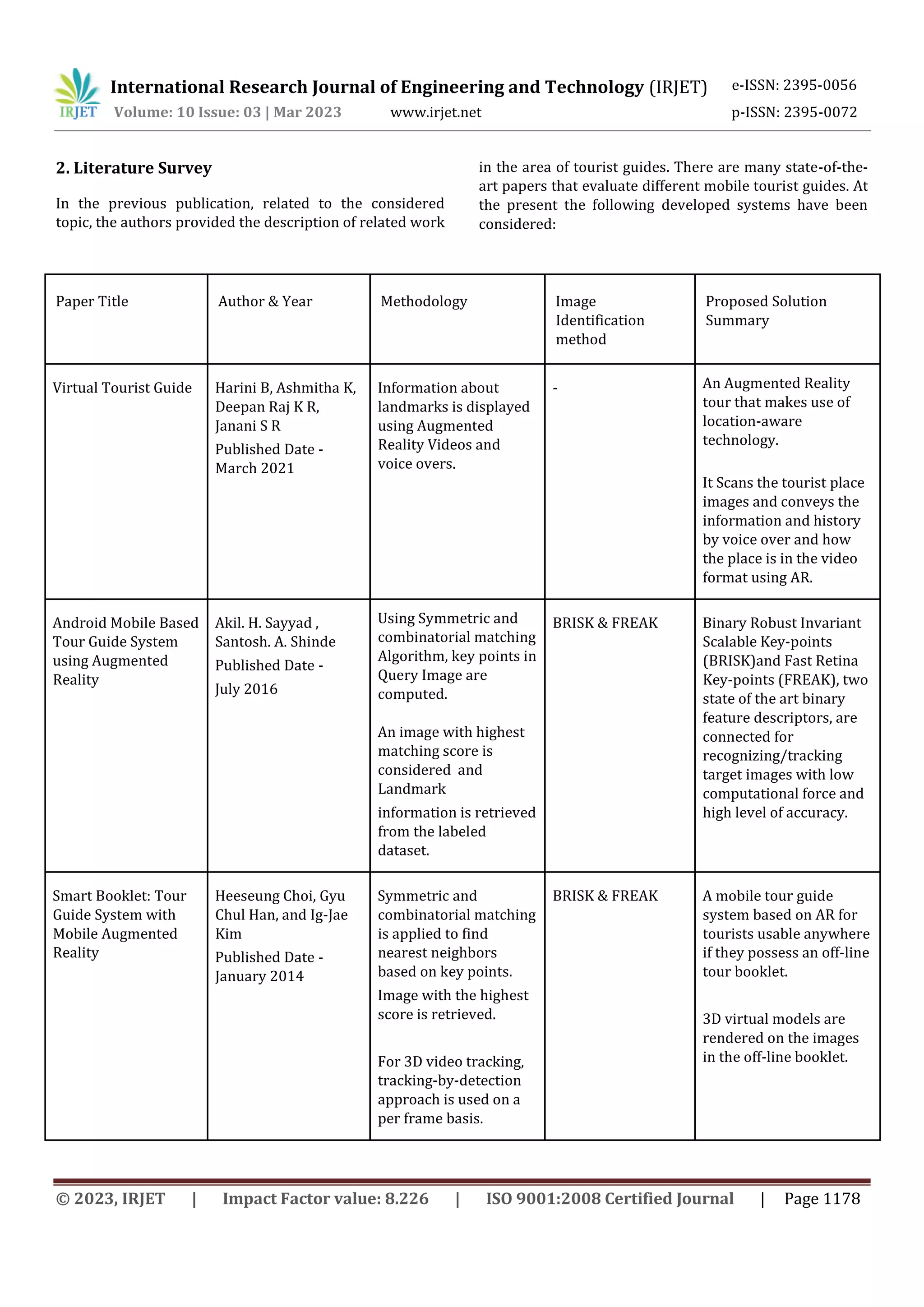
2. Literature Survey
In the previous publication, related to the considered
topic, the authors provided the description of related work
in the area of tourist guides. There are many state-of-the-
art papers that evaluate different mobile tourist guides. At
the present the following developed systems have been
considered:
Paper Title Author & Year Methodology Image
Identification
method
Proposed Solution
Summary
Virtual Tourist Guide Harini B, Ashmitha K,
Deepan Raj K R,
Janani S R
Published Date -
March 2021
Information about
landmarks is displayed
using Augmented
Reality Videos and
voice overs.
- An Augmented Reality
tour that makes use of
location-aware
technology.
It Scans the tourist place
images and conveys the
information and history
by voice over and how
the place is in the video
format using AR.
Android Mobile Based
Tour Guide System
using Augmented
Reality
Akil. H. Sayyad ,
Santosh. A. Shinde
Published Date -
July 2016
Using Symmetric and
combinatorial matching
Algorithm, key points in
Query Image are
computed.
An image with highest
matching score is
considered and
Landmark
information is retrieved
from the labeled
dataset.
BRISK & FREAK Binary Robust Invariant
Scalable Key-points
(BRISK)and Fast Retina
Key-points (FREAK), two
state of the art binary
feature descriptors, are
connected for
recognizing/tracking
target images with low
computational force and
high level of accuracy.
Smart Booklet: Tour
Guide System with
Mobile Augmented
Reality
Heeseung Choi, Gyu
Chul Han, and Ig-Jae
Kim
Published Date -
January 2014
Symmetric and
combinatorial matching
is applied to find
nearest neighbors
based on key points.
Image with the highest
score is retrieved.
For 3D video tracking,
tracking-by-detection
approach is used on a
per frame basis.
BRISK & FREAK A mobile tour guide
system based on AR for
tourists usable anywhere
if they possess an off-line
tour booklet.
3D virtual models are
rendered on the images
in the off-line booklet.
International Research Journal of Engineering and Technology (IRJET) e-ISSN: 2395-0056
Volume: 10 Issue: 03 | Mar 2023 www.irjet.net p-ISSN: 2395-0072
© 2023, IRJET | Impact Factor value: 8.226 | ISO 9001:2008 Certified Journal | Page 1179
A Mobile Application
based on Global
Positioning System
and Object
Recognition Towards
a DIgital Tourist
Guide
Wadii Boulila, Anmar
Abuhamdah, Maha
Driss, Slim Kammoun,
Slim Kammoun
Published Date - April
2014
The image is processed
in on device DL model
provided by Firebase
Vision. The result will
be an array that
contains place names
and confidence of each
place.
Firebase ML kit
SDK,
GPS - Haversine
Formula
An application that
provides 3 ways of
identifying and retrieving
landmarks: Image based,
GPS Location Based and
Manual search for
retrieving list of
monuments for pilgrims.
3. Features of the project
➢ User-friendly android application.
➢ Multiple modules are combined into one application.
➢ Portable, as it will be available in android phones.
➢ Provides reusability and scalability.
➢ Multiple language support
➢ Lightweight, works on all smartphones
➢ Search feature for finding landmarks of choice
➢ Landmark Information can be downloaded for later use,
in case of no network connectivity
➢ Crowdsourced feedback for reporting false or incorrect
information about a landmark
4. Methodology
The application uses technologies like Machine
Learning(ML) and Image Processing algorithm to get the
place details like name and location .
-Google’s Places [13] and Vision APIs [12] are used to
further identify the place based on geo-coordinates and
provide appropriate details.
-Based on the location[13], a list of related tourist places
around the vicinity will be shown to the user.
-A blog-like system for allowing the users to add/edit new
tourist places not identified by the system, as well as share
their opinions regarding the same will also be
implemented.
A middleware cache will also be implemented. Landmark
information retrieved from Google Vision API will be
stored in a server database. Subsequent requests from
nearby coordinates can be answered with this information
without having to call Google Vision API. This will further
reduce the response times as well as the costs required for
operation.
Fig 4.1: Flow chart
International Research Journal of Engineering and Technology (IRJET) e-ISSN: 2395-0056
Volume: 10 Issue: 03 | Mar 2023 www.irjet.net p-ISSN: 2395-0072
© 2023, IRJET | Impact Factor value: 8.226 | ISO 9001:2008 Certified Journal | Page 1180
5. System Implementation
5.1 System Architecture
There are currently 4.78 billion mobile phone users
worldwide, of which 3.5 billion use smartphones. Users
can now easily purchase a smartphone with a built-in
digital camera and internet connectivity for a low price.
Based on this, the suggested approach will enable end
users to utilize their phones as equipment to identify
landmarks and get information about them. The consumer
can photograph a tourist place, in order to discover
relevant information. These images will be processed and
verified by the server after being included in a request.
After that, the end-user will receive the results along with
a list of nearby places that might be of interest to the user.
An overall architecture of this solution is shown in figure
below.
Fig 5.1: System Architecture Diagram
5.2 Modules
5.2.1 Mobile Application:
The mobile application will be the user facing part of the
system. It will include a screen for the user to capture an
image of a landmark. After clicking a picture, it will be sent
to the server. The mobile application will also make use of
GPS location to further provide a list of tourist attractions
around the user’s location. The user can then browse
through the list and get any information about them.
Navigational functionality will also be a part of the system
so that user’s can identify the distance and potential roads,
routes to the destination place.
React Native, which is a framework for developing cross
platform mobile applications, is used on the client side
application. The framework is robust despite being easy to
develop in. It is based on the React.js framework for the
Web. Using React Native, we can code once and develop an
application for both iOS and Android operating systems.
5.2.2 Server
The server will handle all the complex processing and data
storage required for the system. Requests from the mobile
application will be first handled by the server. These
requests will include images of the landmark along with
GPS Coordinates. The server will forward the data to
Google Vision API & Google Places API. The results will be
stored in a database for faster access in consecutive
requests. Reviews and suggestions about landmark
information will also be stored in the database through the
server.
The server will be connected to the mobile application
over a REST API. The technologies used for development
will consist of Javascript, Express.js, Node.js.
5.2.3 Identification
The Google Vision API takes an Image as an input and can
identify objects[12] in it based on provided criteria.
Landmarks and monuments can be identified using that,
which will be returned to the server, which will store them
first in the database. It will also retrieve any reviews for
the tourist place and then in turn send the information
back to the client application.
The results from popular tourist places will be cached to
send the data faster to the users without having to run the
Google Vision identification pipeline again. For eg. For
multiple user requests that are coming from very specific
GPS coordinates around a small region, we can safely
assume they all are at a single tourist location. Thus we
can identify the tourist place for the first request and
cache it in our database. For any consecutive requests
coming from that region, we can send the cached data very
quickly.
5.2.4 Suggestions:
The Google Places API provides features like Geocoding,
Reverse[10] location search, Search related functionality.
It will provide the ability to search any tourist place and
return its GPS Location, along with the navigational data.
This data will be parsed by the mobile application and
displayed appropriately. The Google Places API also allows
retrieving a list of items based on a given filter around a
specific coordinate. We will provide the user's location as
the origin and retrieve a list of tourist places around it.
Using the Reverse Geocoding functionality, more accurate
identification of a landmark can be done. We can use the
International Research Journal of Engineering and Technology (IRJET) e-ISSN: 2395-0056
Volume: 10 Issue: 03 | Mar 2023 www.irjet.net p-ISSN: 2395-0072
© 2023, IRJET | Impact Factor value: 8.226 | ISO 9001:2008 Certified Journal | Page 1181
user’s current location to pinpoint the exact place along
with using the Landmark identification from the image.
This will provide more accurate identification to the user.
6. Results
Fig 6.1: Landmark capture screen
The above is a representation of the landmark capturing
screen in the application. Once the user captures an image,
the image along with the user’s GPS coordinates will be
sent to the server for landmark identification. After the
identification process is completed, the user will get a
response with the details. This response will be displayed
on a separate screen which will include details like
Landmark name, information such as monuments, historic
data, Fees and other charges related to the landmark. The
location of the landmark will also be available to the user
along with a button to get directions for navigation.
Lastly, the user will have a list of related landmarks or
tourist attractions that are nearby the user's current
location. The user can scroll through these and plan their
trip accordingly.
7. Conclusion
The major issue with traditional tourist-based guide
systems is that they present static photo-copied images
with limited information, so they have limitations in
intelligent representation and precise navigation.
Secondly, the information that is present is available in the
regional language of that particular area which can not be
understood by the tourists visiting the landmark, and most
of the time the in-person guide is also not available at
every landmark to guide and inform about the place to the
visiting tourists.
This Mobile Application “VIRTUAL TOURIST GUIDE”,
overcomes these challenges by allowing the user to
identify and access information about tourist places in the
language they understand, just by capturing an image.
With this app, one gets to know the history of a place, the
intricacies involved in the art or monument, and provide
any additional information and opinions about it. Also, the
app provides a list of tourist places in the vicinity of the
user's current location. Henceforth enhancing the overall
traveling experience of the tourist.
REFERENCES
[1] Harini B, Ashmitha K, Deepan Raj K R, Janani S R
“VIRTUAL TOURIST GUIDE", International Research
Journal of Engineering and Technology (IRJET), March
2021
[2] Akil. H. Sayyad , Santosh. A. Shinde “Android Mobile
Based Tour Guide System using Augmented Reality”,
International Journal of Science and Research (IJSR), July
2016
[3] Heeseung Choi, Gyu Chul Han, and Ig-Jae Kim, “Smart
Booklet: Tour Guide System with Mobile Augmented
Reality”, Imaging Media Research Center, Korea Institute
of Science and Technology, Seoul, Korea, IEEE
International Conference on Consumer Electronics ·
January 2014
[4] M.U.E.Wijesuriya, S.U.Mendis, B.E.S.Bandara,
K.P.Mahawattage, N.Walgampaya , D. De Silva,
“INTERACTIVE MOBILE BASED TOUR GUIDE", IEEE,
January 2013
International Research Journal of Engineering and Technology (IRJET) e-ISSN: 2395-0056
Volume: 10 Issue: 03 | Mar 2023 www.irjet.net p-ISSN: 2395-0072
© 2023, IRJET | Impact Factor value: 8.226 | ISO 9001:2008 Certified Journal | Page 1182
[5] Eman Ahmed Ali Mohamed, Dr. Safaa Hussein, “A
Proposed Mobile Application for the Tourism Sector in
Egypt”, December 2018
[6] Alexander Smirnov, Alexey Kashevnik, Andrew
Ponomarev, Nikolay Shilov, Maksim Shchekotov, Nikolay
Teslya “Smart Space-Based Intelligent Mobile Tourist
Guide: Service-Based Implementation”, 15th Conference of
FRUCT Association, April 2014
[7] Wadii Boulila, Anmar Abuhamdah, Maha Driss, Slim
Kammoun, Slim Kammoun “GuideMe: A Mobile
Application based on Global Positioning System and Object
Recognition Towards a Smart Tourist Guide”, 2021
International Congress of Advanced Technology and
Engineering (ICOTEN)
[8] Keshav Soni, Aman Agrawal, Jahanvi Solanki, Arsh Jain,
Krati Mahajan, Prof. Akshita Mishra “VIRTUAL TRAVEL
GUIDE”, International Research Journal of Modernization
in Engineering Technology and Science 2021
[9] “VR For Tourism: The Future Of The Travel Industry.”
Immersion VR, 19 Nov. 2019 immersionvr.co.uk/about-
360vr/vr-for-tourism/#:~:text=VR in tourism is currently,
industry in the near future.
[10] Rob S. February, and Tomas July 15. “How Virtual
Reality (VR) Is Transforming the Travel Industry.”
Revfine.com, 22 Dec. 2020, www.revfine.com/virtual-
reality-travel-industry/
[11] Google Geocoding API documentation
https://developers.google.com/maps/documentation/geo
coding/requests-reverse-geocoding
[12] Google Vision API documentation
https://cloud.google.com/vision/docs/detecting-
landmarks
[13] Google Places API Documentation for identifying
places based on user’s coordinates
https://developers.google.com/maps/documentation/pla
ces/web-service/overview

Implementing Portable Tourist Captain

  • 1.
    International Research Journalof Engineering and Technology (IRJET) e-ISSN: 2395-0056 Volume: 10 Issue: 03 | Mar 2023 www.irjet.net p-ISSN: 2395-0072 © 2023, IRJET | Impact Factor value: 8.226 | ISO 9001:2008 Certified Journal | Page 1177 Implementing Portable Tourist Captain Jyotsna A Nanajkar1, Niketan Gulekar2, Suyash Bibave3, Krishna Gadhave4, Ronald Anthony5 Department of Information Technology, Zeal College of Engineering and Research, Pune-41, Maharashtra, India ---------------------------------------------------------------------***--------------------------------------------------------------------- Abstract - Tourism is travel for pleasure and for business as well. The tourism industry has become the largest and fastest growing industry in the world. These days, more and more people travel on vacation for the purpose of recreation, accommodation, and entertainment. The main goal of this project is to help tourists understand all of the information about specific tourist spots and glorious places. This will enable them to make full use of their visit without omitting critical information. There are lots of apps out there to guide tourists towards the places they should visit. They're paper-based and mobile-based, but they lack interactive features. Considering the limitations of existing applications, this system application provides a portable tour guide mobile application replacing the old tour guide booklet. The application was produced based on the Android platform with augmented reality technology, and delivered as a mobile application. Key Words: Tourism; Technology; Mobile; Guide; Landmark; 1. Introduction According to The World Tourism Organization, approximately 448 million tourists were visiting various places for entertainment and recreational purposes. This number is only increasing after COVID has reduced. Every year, there are more and more tourists coming from different regions of the world. For these 448 million tourists, there are only 400 Thousand tourist guides currently registered who are working at various tourist sites. They are the main and only source of knowledge about the place in most cases. Because of this, not every tourist has easy access to the information. The costs associated with the guides are also high in some cases. The tourists are English speaking in most places, however, for tourists coming from different language speaking regions, there is a language barrier. The second solution a lot of tourist places have is paper-based navigation and guide systems. These are simple banners and info graphics which are used to convey the information. Despite being available in most places, they are often outdated or inaccurate. The language barrier problem is also faced by such systems. The maintenance and installation of such systems in all of the tourist sites will be very cost intensive. Because of all these issues, a lot of tourists coming to visit a site often remain unaware about the history and importance of the place they are visiting. This includes the historical as well as cultural value. For places like temples and ancient landmarks, knowing the history is very crucial to truly understand the value of the monument. With the growing use of smartphones and advances in smartphone cameras, along with the improvements in the Machine Learning models, an interactive solution can be quite helpful. [5.2.1] will not only make the information freely available at fingertips, but it will also act as a way to promote tourism across various regions by suggesting places of similar value and history. The interactivity of [5] will keep the tourist engaged while reducing the need of traditional guide systems. 1.1 Problem Statement This Mobile Application “VIRTUAL TOURIST GUIDE”, aims to help the tourist to know more about the place to be visited. Paper based tour guide system presents static photo copied images with limited information, so they have limitations of intelligent representation and precise navigation and it is a traditional one. With a mobile application, we aim to solve the problem by allowing the user to identify and access information about tourist places just by capturing an image. 1.2 Need ➢ Increasing number of tourists coming from various parts of the world who speak different languages ➢ Lack of interactive system for providing information about tourist places ➢ Loss of history & importance of landmarks because of unawareness regarding the place ➢ Issues and limitations of traditional, paper-based guiding systems
  • 2.
    International Research Journalof Engineering and Technology (IRJET) e-ISSN: 2395-0056 Volume: 10 Issue: 03 | Mar 2023 www.irjet.net p-ISSN: 2395-0072 © 2023, IRJET | Impact Factor value: 8.226 | ISO 9001:2008 Certified Journal | Page 1178 2. Literature Survey In the previous publication, related to the considered topic, the authors provided the description of related work in the area of tourist guides. There are many state-of-the- art papers that evaluate different mobile tourist guides. At the present the following developed systems have been considered: Paper Title Author & Year Methodology Image Identification method Proposed Solution Summary Virtual Tourist Guide Harini B, Ashmitha K, Deepan Raj K R, Janani S R Published Date - March 2021 Information about landmarks is displayed using Augmented Reality Videos and voice overs. - An Augmented Reality tour that makes use of location-aware technology. It Scans the tourist place images and conveys the information and history by voice over and how the place is in the video format using AR. Android Mobile Based Tour Guide System using Augmented Reality Akil. H. Sayyad , Santosh. A. Shinde Published Date - July 2016 Using Symmetric and combinatorial matching Algorithm, key points in Query Image are computed. An image with highest matching score is considered and Landmark information is retrieved from the labeled dataset. BRISK & FREAK Binary Robust Invariant Scalable Key-points (BRISK)and Fast Retina Key-points (FREAK), two state of the art binary feature descriptors, are connected for recognizing/tracking target images with low computational force and high level of accuracy. Smart Booklet: Tour Guide System with Mobile Augmented Reality Heeseung Choi, Gyu Chul Han, and Ig-Jae Kim Published Date - January 2014 Symmetric and combinatorial matching is applied to find nearest neighbors based on key points. Image with the highest score is retrieved. For 3D video tracking, tracking-by-detection approach is used on a per frame basis. BRISK & FREAK A mobile tour guide system based on AR for tourists usable anywhere if they possess an off-line tour booklet. 3D virtual models are rendered on the images in the off-line booklet.
  • 3.
    International Research Journalof Engineering and Technology (IRJET) e-ISSN: 2395-0056 Volume: 10 Issue: 03 | Mar 2023 www.irjet.net p-ISSN: 2395-0072 © 2023, IRJET | Impact Factor value: 8.226 | ISO 9001:2008 Certified Journal | Page 1179 A Mobile Application based on Global Positioning System and Object Recognition Towards a DIgital Tourist Guide Wadii Boulila, Anmar Abuhamdah, Maha Driss, Slim Kammoun, Slim Kammoun Published Date - April 2014 The image is processed in on device DL model provided by Firebase Vision. The result will be an array that contains place names and confidence of each place. Firebase ML kit SDK, GPS - Haversine Formula An application that provides 3 ways of identifying and retrieving landmarks: Image based, GPS Location Based and Manual search for retrieving list of monuments for pilgrims. 3. Features of the project ➢ User-friendly android application. ➢ Multiple modules are combined into one application. ➢ Portable, as it will be available in android phones. ➢ Provides reusability and scalability. ➢ Multiple language support ➢ Lightweight, works on all smartphones ➢ Search feature for finding landmarks of choice ➢ Landmark Information can be downloaded for later use, in case of no network connectivity ➢ Crowdsourced feedback for reporting false or incorrect information about a landmark 4. Methodology The application uses technologies like Machine Learning(ML) and Image Processing algorithm to get the place details like name and location . -Google’s Places [13] and Vision APIs [12] are used to further identify the place based on geo-coordinates and provide appropriate details. -Based on the location[13], a list of related tourist places around the vicinity will be shown to the user. -A blog-like system for allowing the users to add/edit new tourist places not identified by the system, as well as share their opinions regarding the same will also be implemented. A middleware cache will also be implemented. Landmark information retrieved from Google Vision API will be stored in a server database. Subsequent requests from nearby coordinates can be answered with this information without having to call Google Vision API. This will further reduce the response times as well as the costs required for operation. Fig 4.1: Flow chart
  • 4.
    International Research Journalof Engineering and Technology (IRJET) e-ISSN: 2395-0056 Volume: 10 Issue: 03 | Mar 2023 www.irjet.net p-ISSN: 2395-0072 © 2023, IRJET | Impact Factor value: 8.226 | ISO 9001:2008 Certified Journal | Page 1180 5. System Implementation 5.1 System Architecture There are currently 4.78 billion mobile phone users worldwide, of which 3.5 billion use smartphones. Users can now easily purchase a smartphone with a built-in digital camera and internet connectivity for a low price. Based on this, the suggested approach will enable end users to utilize their phones as equipment to identify landmarks and get information about them. The consumer can photograph a tourist place, in order to discover relevant information. These images will be processed and verified by the server after being included in a request. After that, the end-user will receive the results along with a list of nearby places that might be of interest to the user. An overall architecture of this solution is shown in figure below. Fig 5.1: System Architecture Diagram 5.2 Modules 5.2.1 Mobile Application: The mobile application will be the user facing part of the system. It will include a screen for the user to capture an image of a landmark. After clicking a picture, it will be sent to the server. The mobile application will also make use of GPS location to further provide a list of tourist attractions around the user’s location. The user can then browse through the list and get any information about them. Navigational functionality will also be a part of the system so that user’s can identify the distance and potential roads, routes to the destination place. React Native, which is a framework for developing cross platform mobile applications, is used on the client side application. The framework is robust despite being easy to develop in. It is based on the React.js framework for the Web. Using React Native, we can code once and develop an application for both iOS and Android operating systems. 5.2.2 Server The server will handle all the complex processing and data storage required for the system. Requests from the mobile application will be first handled by the server. These requests will include images of the landmark along with GPS Coordinates. The server will forward the data to Google Vision API & Google Places API. The results will be stored in a database for faster access in consecutive requests. Reviews and suggestions about landmark information will also be stored in the database through the server. The server will be connected to the mobile application over a REST API. The technologies used for development will consist of Javascript, Express.js, Node.js. 5.2.3 Identification The Google Vision API takes an Image as an input and can identify objects[12] in it based on provided criteria. Landmarks and monuments can be identified using that, which will be returned to the server, which will store them first in the database. It will also retrieve any reviews for the tourist place and then in turn send the information back to the client application. The results from popular tourist places will be cached to send the data faster to the users without having to run the Google Vision identification pipeline again. For eg. For multiple user requests that are coming from very specific GPS coordinates around a small region, we can safely assume they all are at a single tourist location. Thus we can identify the tourist place for the first request and cache it in our database. For any consecutive requests coming from that region, we can send the cached data very quickly. 5.2.4 Suggestions: The Google Places API provides features like Geocoding, Reverse[10] location search, Search related functionality. It will provide the ability to search any tourist place and return its GPS Location, along with the navigational data. This data will be parsed by the mobile application and displayed appropriately. The Google Places API also allows retrieving a list of items based on a given filter around a specific coordinate. We will provide the user's location as the origin and retrieve a list of tourist places around it. Using the Reverse Geocoding functionality, more accurate identification of a landmark can be done. We can use the
  • 5.
    International Research Journalof Engineering and Technology (IRJET) e-ISSN: 2395-0056 Volume: 10 Issue: 03 | Mar 2023 www.irjet.net p-ISSN: 2395-0072 © 2023, IRJET | Impact Factor value: 8.226 | ISO 9001:2008 Certified Journal | Page 1181 user’s current location to pinpoint the exact place along with using the Landmark identification from the image. This will provide more accurate identification to the user. 6. Results Fig 6.1: Landmark capture screen The above is a representation of the landmark capturing screen in the application. Once the user captures an image, the image along with the user’s GPS coordinates will be sent to the server for landmark identification. After the identification process is completed, the user will get a response with the details. This response will be displayed on a separate screen which will include details like Landmark name, information such as monuments, historic data, Fees and other charges related to the landmark. The location of the landmark will also be available to the user along with a button to get directions for navigation. Lastly, the user will have a list of related landmarks or tourist attractions that are nearby the user's current location. The user can scroll through these and plan their trip accordingly. 7. Conclusion The major issue with traditional tourist-based guide systems is that they present static photo-copied images with limited information, so they have limitations in intelligent representation and precise navigation. Secondly, the information that is present is available in the regional language of that particular area which can not be understood by the tourists visiting the landmark, and most of the time the in-person guide is also not available at every landmark to guide and inform about the place to the visiting tourists. This Mobile Application “VIRTUAL TOURIST GUIDE”, overcomes these challenges by allowing the user to identify and access information about tourist places in the language they understand, just by capturing an image. With this app, one gets to know the history of a place, the intricacies involved in the art or monument, and provide any additional information and opinions about it. Also, the app provides a list of tourist places in the vicinity of the user's current location. Henceforth enhancing the overall traveling experience of the tourist. REFERENCES [1] Harini B, Ashmitha K, Deepan Raj K R, Janani S R “VIRTUAL TOURIST GUIDE", International Research Journal of Engineering and Technology (IRJET), March 2021 [2] Akil. H. Sayyad , Santosh. A. Shinde “Android Mobile Based Tour Guide System using Augmented Reality”, International Journal of Science and Research (IJSR), July 2016 [3] Heeseung Choi, Gyu Chul Han, and Ig-Jae Kim, “Smart Booklet: Tour Guide System with Mobile Augmented Reality”, Imaging Media Research Center, Korea Institute of Science and Technology, Seoul, Korea, IEEE International Conference on Consumer Electronics · January 2014 [4] M.U.E.Wijesuriya, S.U.Mendis, B.E.S.Bandara, K.P.Mahawattage, N.Walgampaya , D. De Silva, “INTERACTIVE MOBILE BASED TOUR GUIDE", IEEE, January 2013
  • 6.
    International Research Journalof Engineering and Technology (IRJET) e-ISSN: 2395-0056 Volume: 10 Issue: 03 | Mar 2023 www.irjet.net p-ISSN: 2395-0072 © 2023, IRJET | Impact Factor value: 8.226 | ISO 9001:2008 Certified Journal | Page 1182 [5] Eman Ahmed Ali Mohamed, Dr. Safaa Hussein, “A Proposed Mobile Application for the Tourism Sector in Egypt”, December 2018 [6] Alexander Smirnov, Alexey Kashevnik, Andrew Ponomarev, Nikolay Shilov, Maksim Shchekotov, Nikolay Teslya “Smart Space-Based Intelligent Mobile Tourist Guide: Service-Based Implementation”, 15th Conference of FRUCT Association, April 2014 [7] Wadii Boulila, Anmar Abuhamdah, Maha Driss, Slim Kammoun, Slim Kammoun “GuideMe: A Mobile Application based on Global Positioning System and Object Recognition Towards a Smart Tourist Guide”, 2021 International Congress of Advanced Technology and Engineering (ICOTEN) [8] Keshav Soni, Aman Agrawal, Jahanvi Solanki, Arsh Jain, Krati Mahajan, Prof. Akshita Mishra “VIRTUAL TRAVEL GUIDE”, International Research Journal of Modernization in Engineering Technology and Science 2021 [9] “VR For Tourism: The Future Of The Travel Industry.” Immersion VR, 19 Nov. 2019 immersionvr.co.uk/about- 360vr/vr-for-tourism/#:~:text=VR in tourism is currently, industry in the near future. [10] Rob S. February, and Tomas July 15. “How Virtual Reality (VR) Is Transforming the Travel Industry.” Revfine.com, 22 Dec. 2020, www.revfine.com/virtual- reality-travel-industry/ [11] Google Geocoding API documentation https://developers.google.com/maps/documentation/geo coding/requests-reverse-geocoding [12] Google Vision API documentation https://cloud.google.com/vision/docs/detecting- landmarks [13] Google Places API Documentation for identifying places based on user’s coordinates https://developers.google.com/maps/documentation/pla ces/web-service/overview