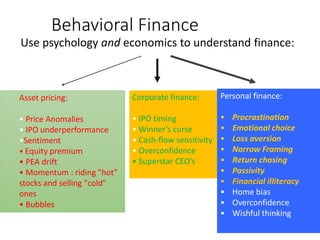
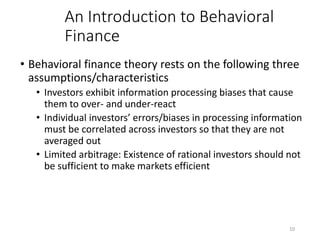
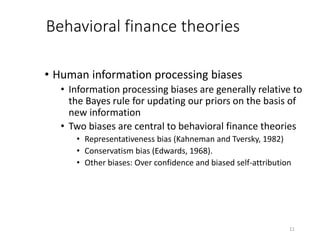
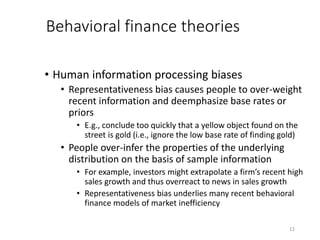
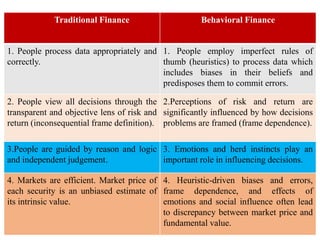
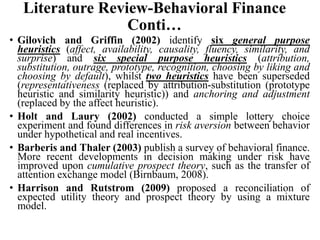
The document discusses the key concepts of behavioral finance. It notes that behavioral finance developed as a response to evidence that financial markets often exhibit irrational behavior inconsistent with efficient market hypotheses. Behavioral finance incorporates insights from psychology about cognitive biases and emotional factors that influence investor decision-making. Some of the major biases discussed include representativeness bias, conservatism bias, overconfidence, and biased self-attribution. The document also discusses how limited arbitrage allows mispricing to persist despite the presence of rational investors.